What is Economics?
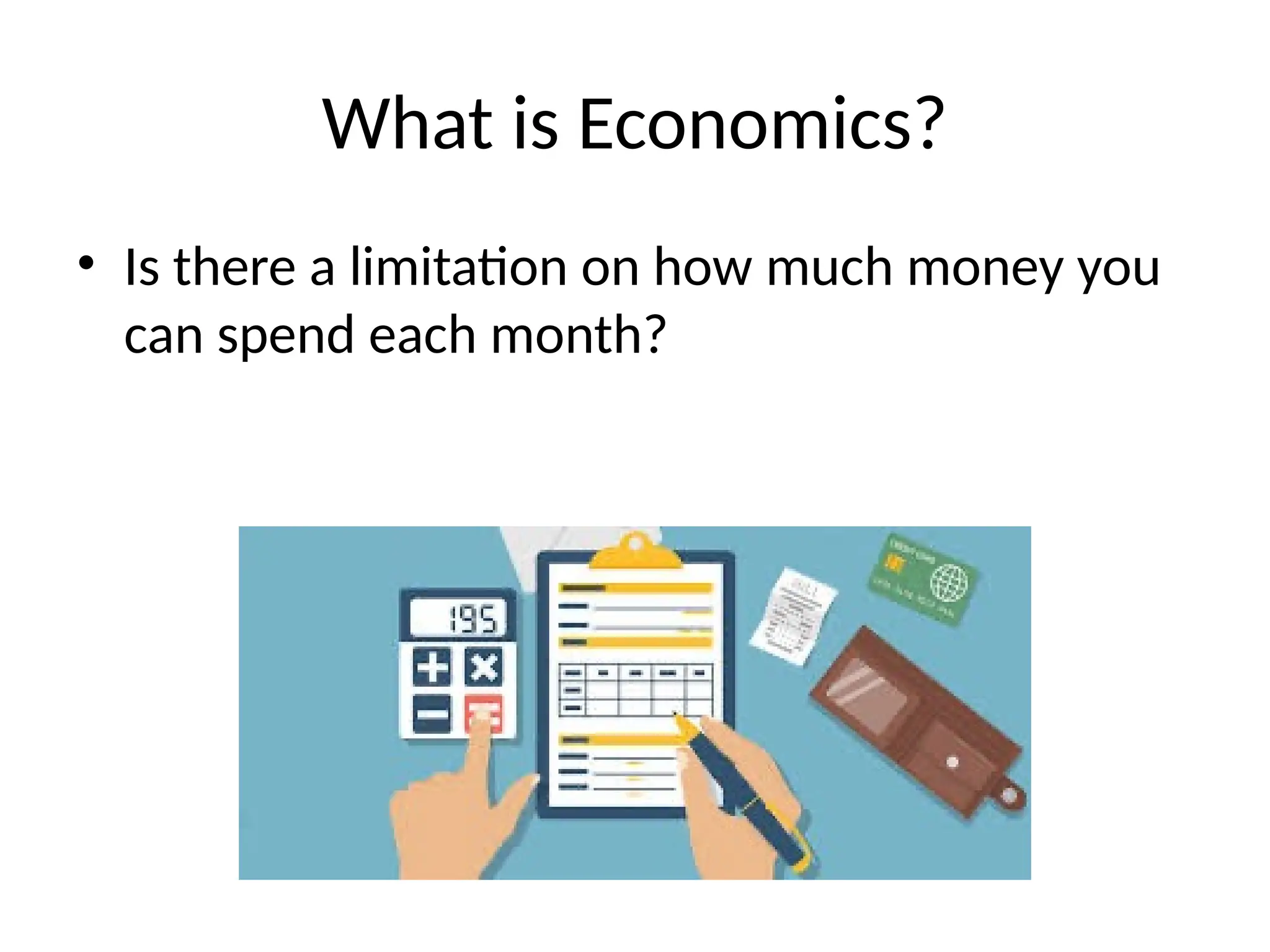
•Is there a limitation on how much money you
can spend each month?
3.
What is Economics?
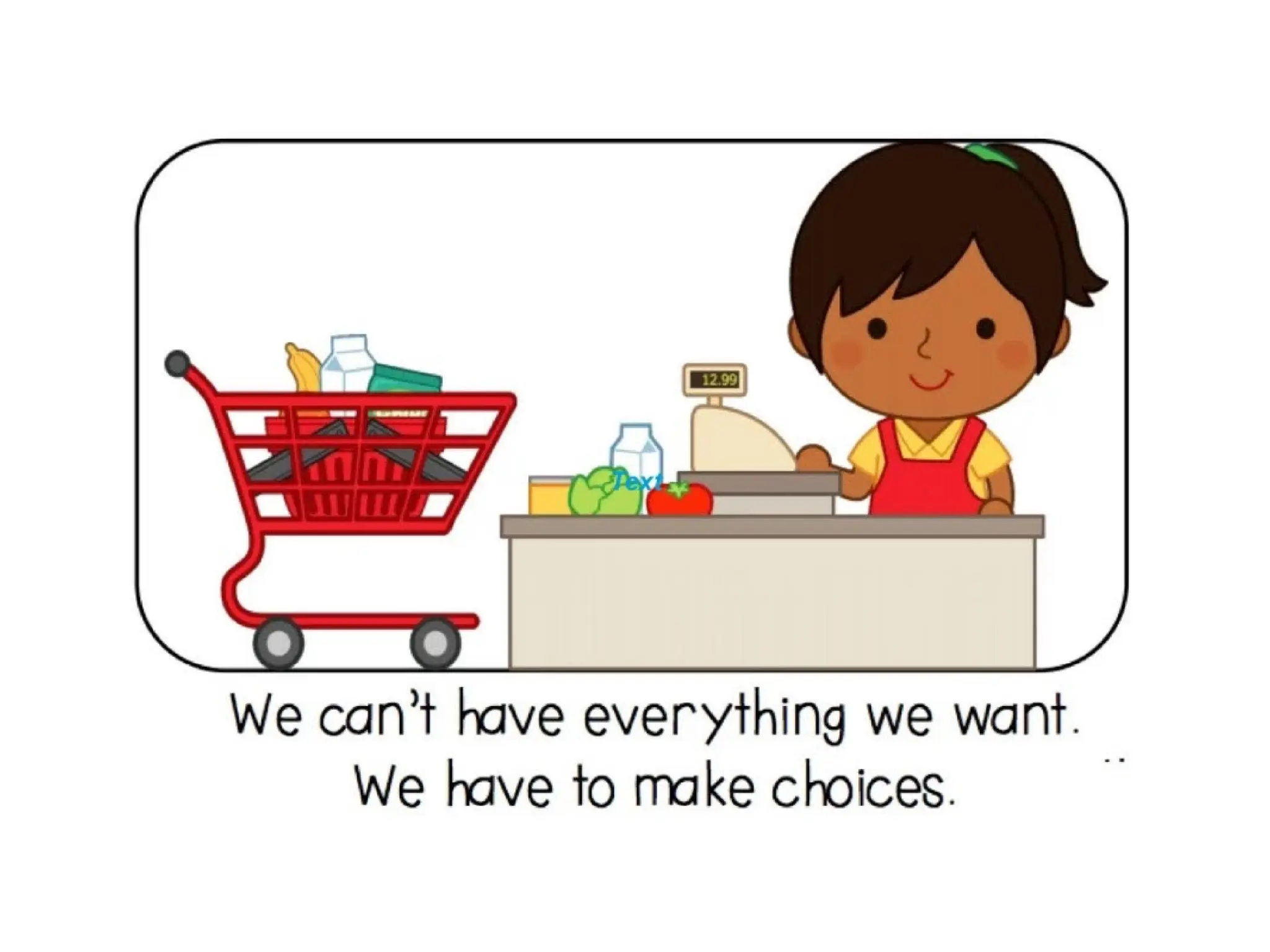
•Your limited budget is one example of limited
resources (scarce resources).
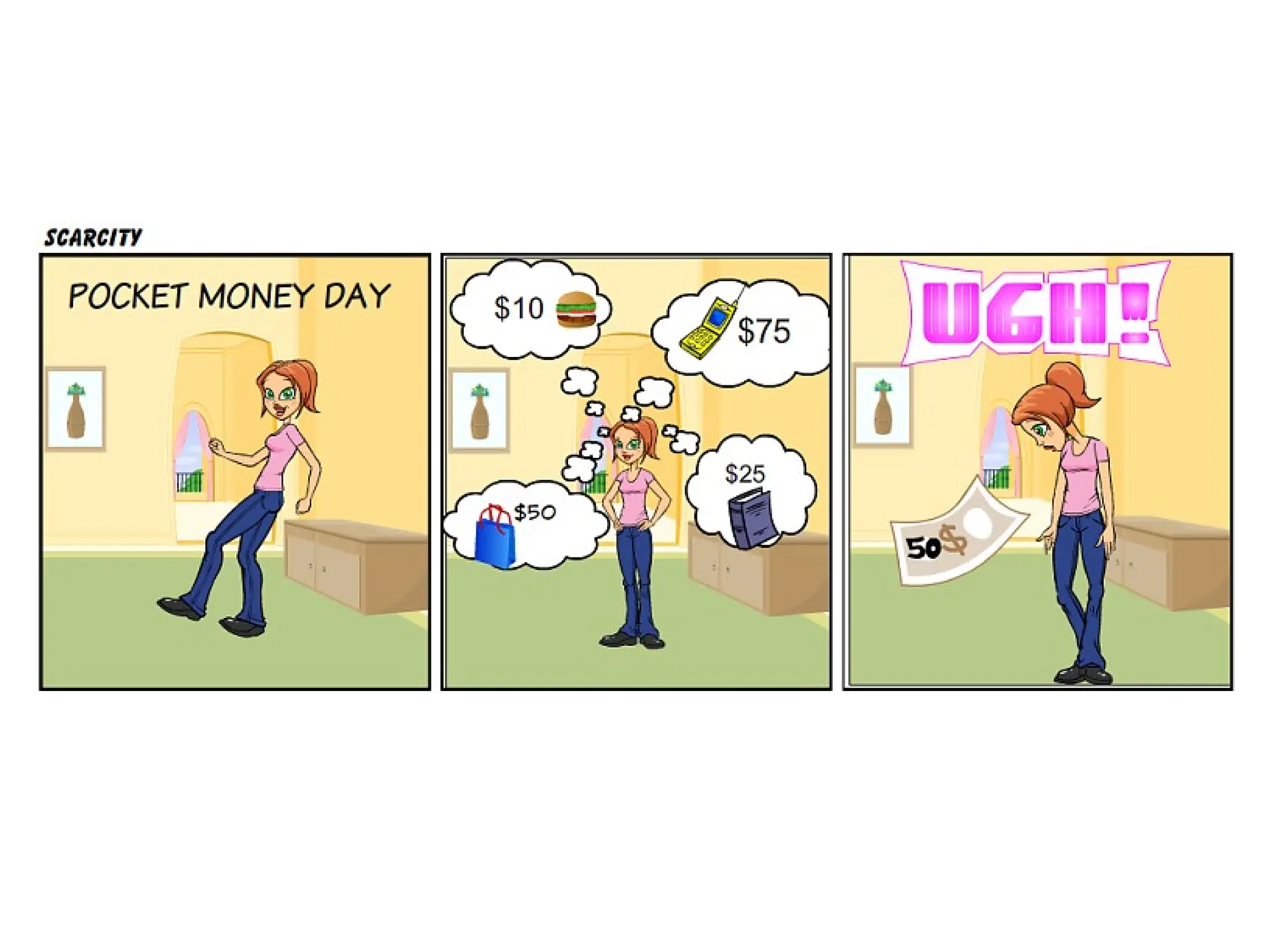
• Scarcity: A situation in which unlimited wants
exceed the limited resources available to fulfill
those wants
5.
What is Economics?
•When you decide how to spend your budget, you
are a decision maker (economic agent).
Economic agents: decision makers.
• In economics, agents are
– self interest
– rational
• using all available information to achieve your goals.
• Rational consumers and firms weigh the benefits and costs of
each action and try to make the best decision possible.
6.
What is Economics?
•Textbook: Economics is the study of
1. how agents choose to allocate scarce resources,
and
2. how those choices affects society.
• Your understanding?
8.
What is Macroeconomics?
Economicsconcludes:
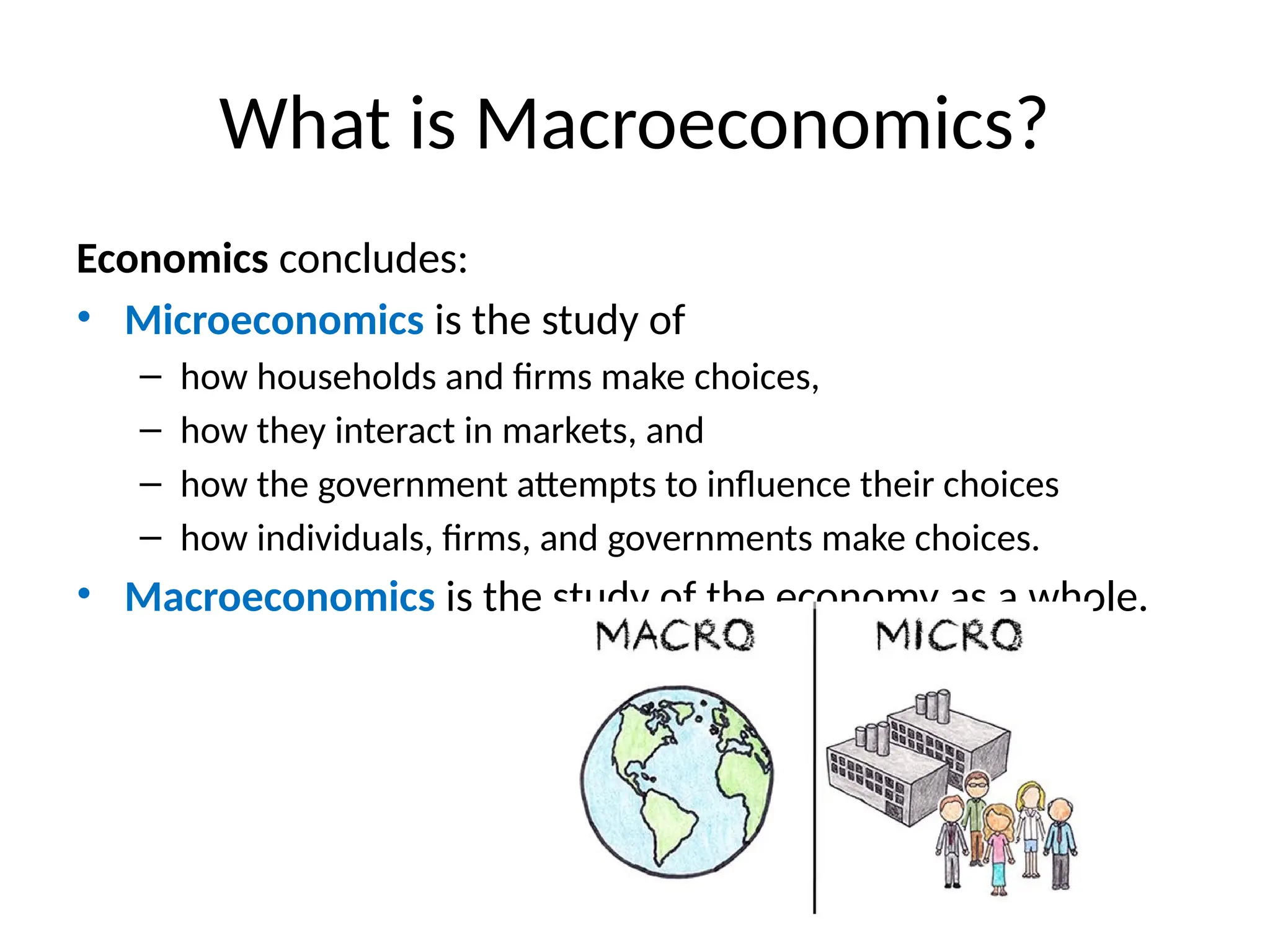
• Microeconomics is the study of
– how households and firms make choices,
– how they interact in markets, and
– how the government attempts to influence their choices
– how individuals, firms, and governments make choices.
• Macroeconomics is the study of the economy as a whole.
9.
What is Macroeconomics?
Macroconcerns Micro concerns
GDP How much should I spend my money as a household?
How much should I produce as a firm?
Price level How to price my product as a firm?
Unemployment rates How many hours should I work each day as a worker?
How many workers should I hire as a firm?
10.
The Economic Wayof Thinking
• Optimization: choosing the best feasible
option with given constraints (information,
knowledge, budget, experience, training, etc).
• Equilibrium: a situation in which everyone is
simultaneously optimizing, so nobody would
benefit personally by changing his or her own
behavior, given the choices of others.
– Next: one example of equilibrium
11.
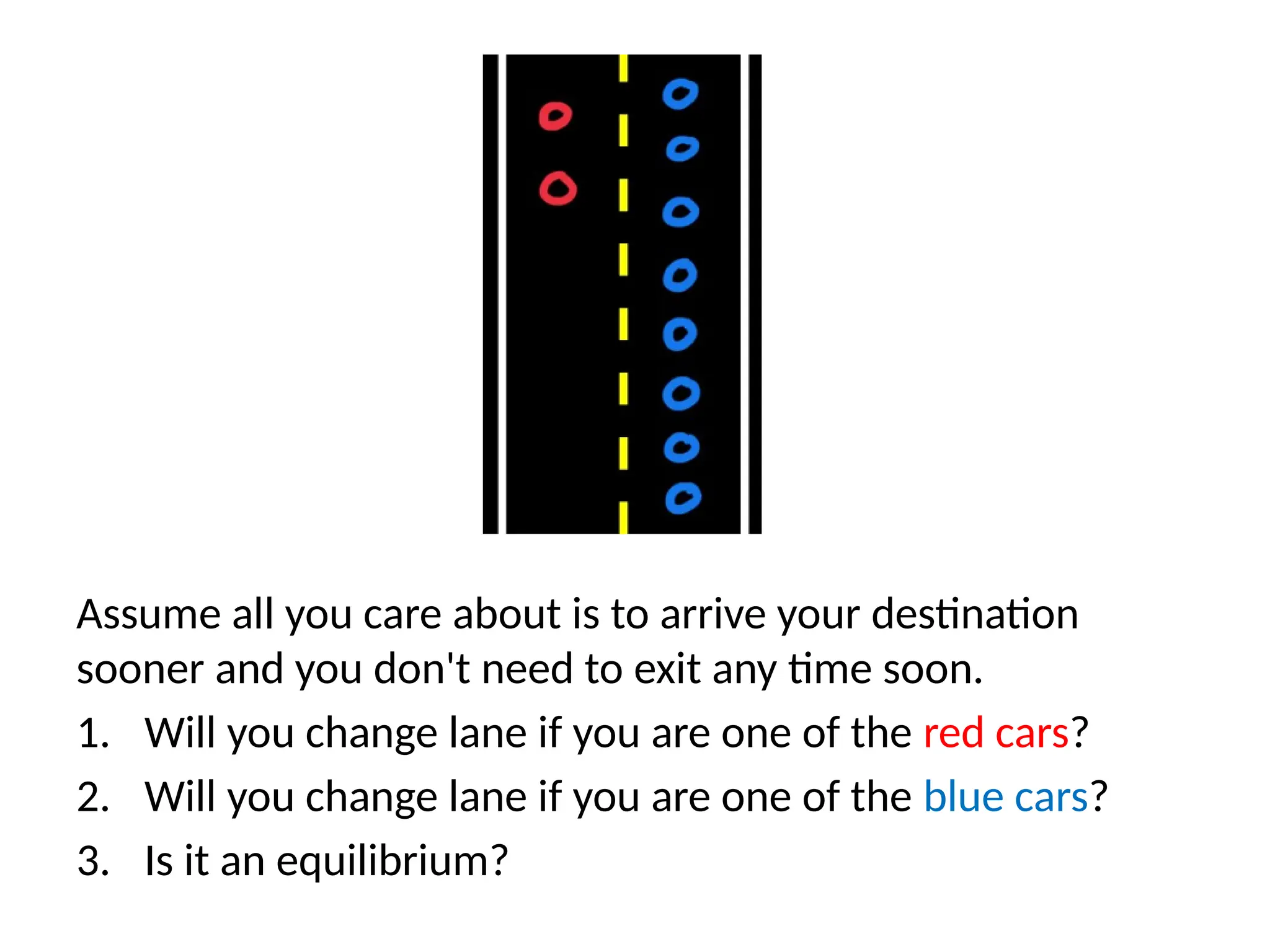
Assume all youcare about is to arrive your destination
sooner and you don't need to exit any time soon.
1. Will you change lane if you are one of the red cars?
2. Will you change lane if you are one of the blue cars?
3. Is it an equilibrium?
12.
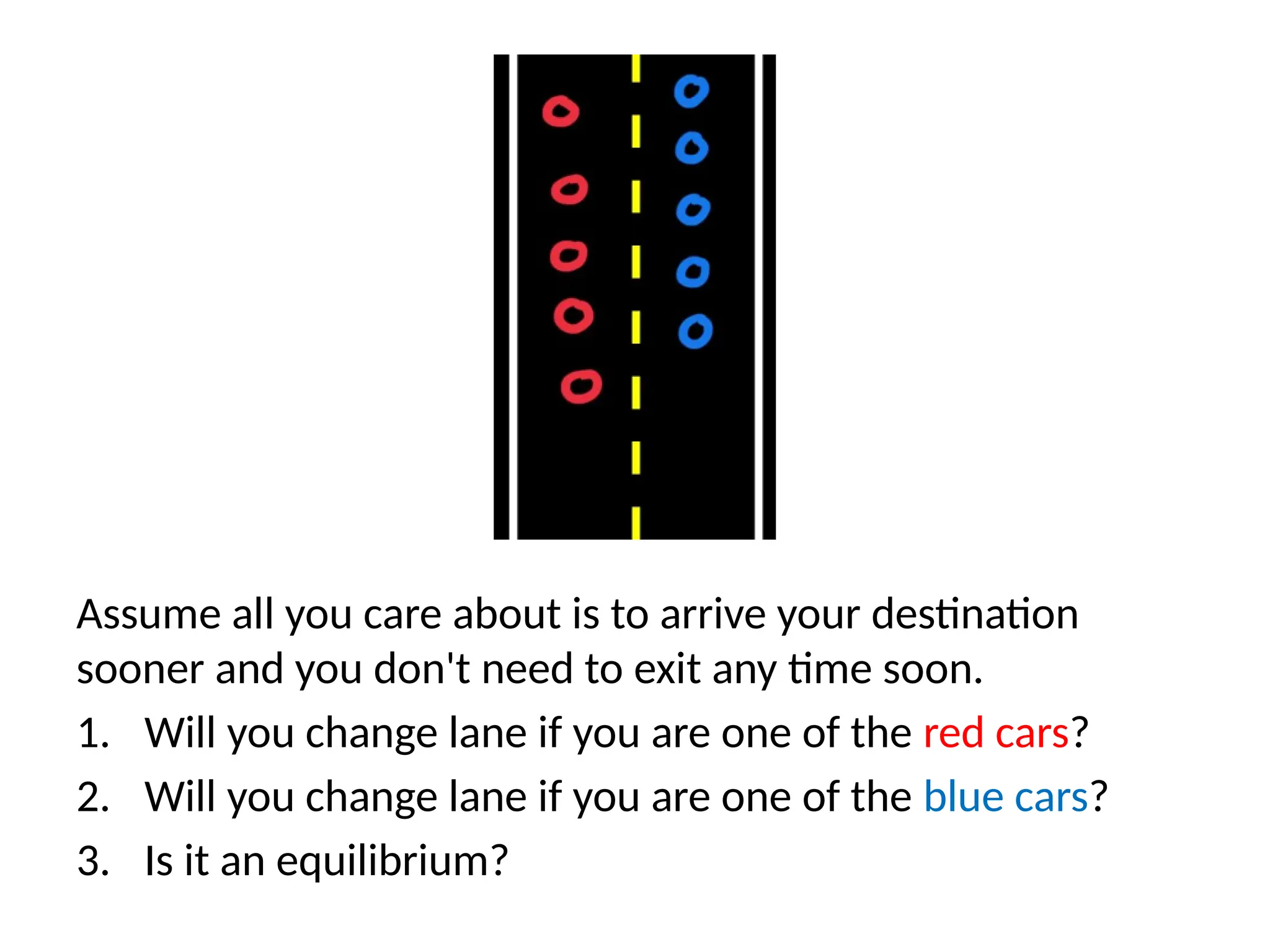
Assume all youcare about is to arrive your destination
sooner and you don't need to exit any time soon.
1. Will you change lane if you are one of the red cars?
2. Will you change lane if you are one of the blue cars?
3. Is it an equilibrium?
13.
The Economic Wayof Thinking
• Optimization: choosing the best feasible option with given
constraints (information, knowledge, budget, experience,
training, etc).
• Equilibrium: a situation in which everyone is
simultaneously optimizing, so nobody would benefit
personally by changing his or her own behavior, given the
choices of others.
– This intro level class concentrates on the “good equilibria” only.
• Resource use is efficient if it is not possible to make
someone better off without making someone else worse
off.
14.
The Economic Wayof Thinking
Empiricism is analysis that uses data, evidence-
based analysis.
• Economists use data to develop theories, to
test theories, to evaluate the success of
different government policies, and to
determine what is causing things to happen in
the world.
The Circular-flow Model
Market:a group of buyers and sellers of a good or service and the
institution or arrangement by which they come together to trade
• A free market is one with few government restrictions on how
a good or service can be produced or sold, or on how a factor
of production can be employed.
• Goods (and services) markets are markets in which goods and
services are bought and sold.
• Factor markets are markets in which factors of production are
bought and sold.
– https://www.stlouisfed.org/education/economic-lowdown-podcast-ser
ies/episode-2-factors-of-production
17.
The Circular-flow Model
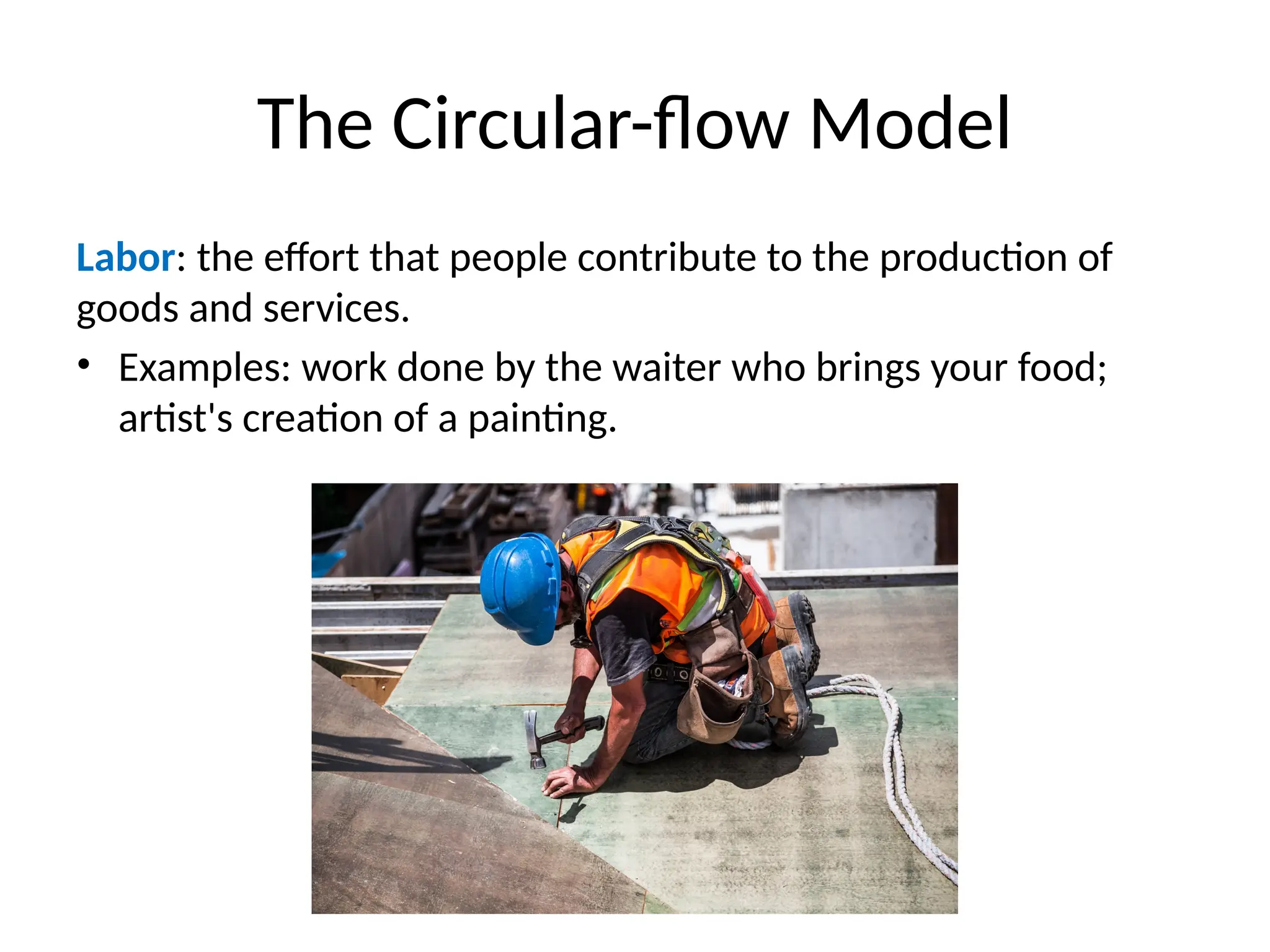
Labor:the effort that people contribute to the production of
goods and services.
• Examples: work done by the waiter who brings your food;
artist's creation of a painting.
18.
The Circular-flow Model
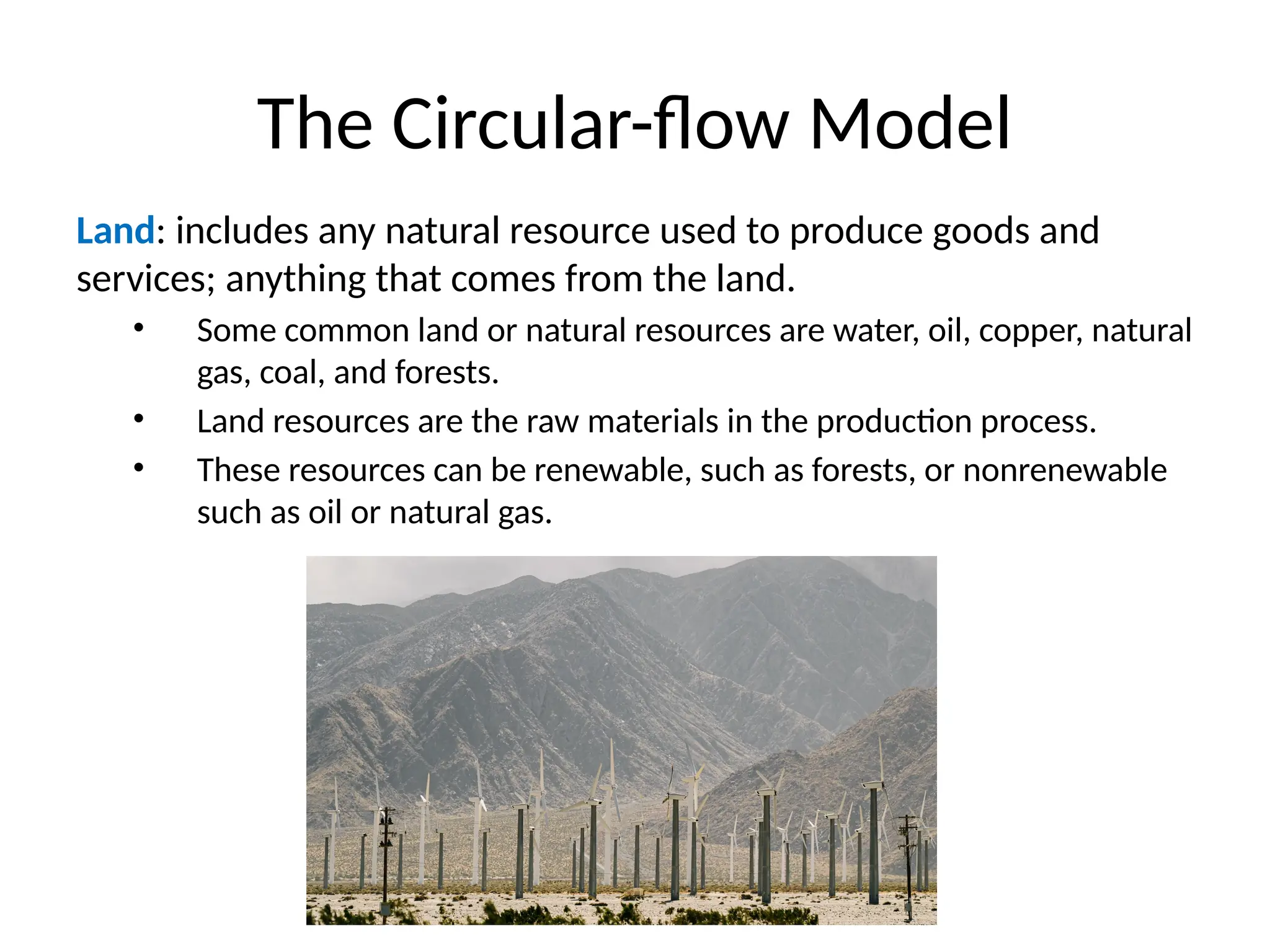
Land:includes any natural resource used to produce goods and
services; anything that comes from the land.
• Some common land or natural resources are water, oil, copper, natural
gas, coal, and forests.
• Land resources are the raw materials in the production process.
• These resources can be renewable, such as forests, or nonrenewable
such as oil or natural gas.
19.
The Circular-flow Model
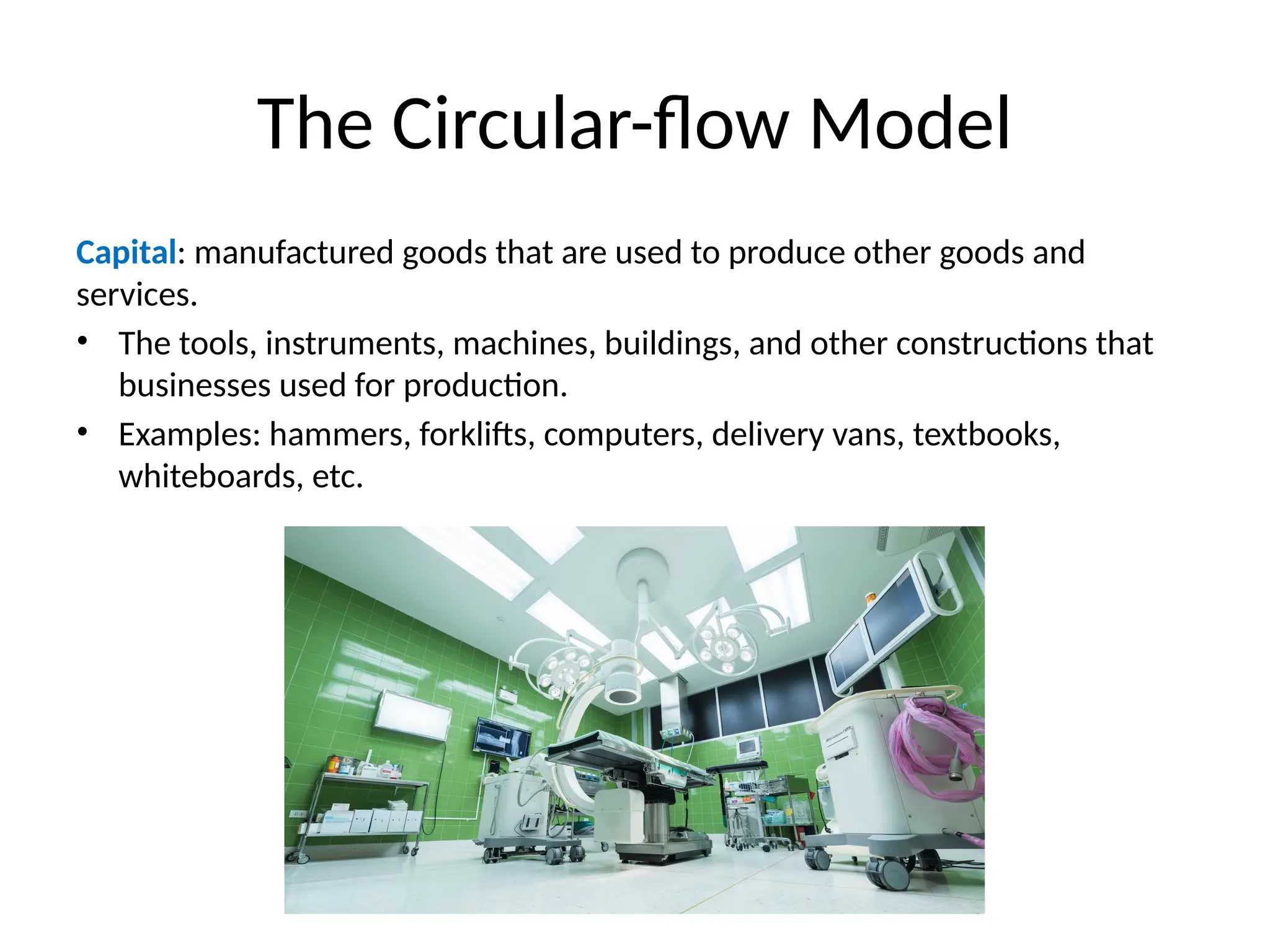
Capital:manufactured goods that are used to produce other goods and
services.
• The tools, instruments, machines, buildings, and other constructions that
businesses used for production.
• Examples: hammers, forklifts, computers, delivery vans, textbooks,
whiteboards, etc.
20.
The Circular-flow Model
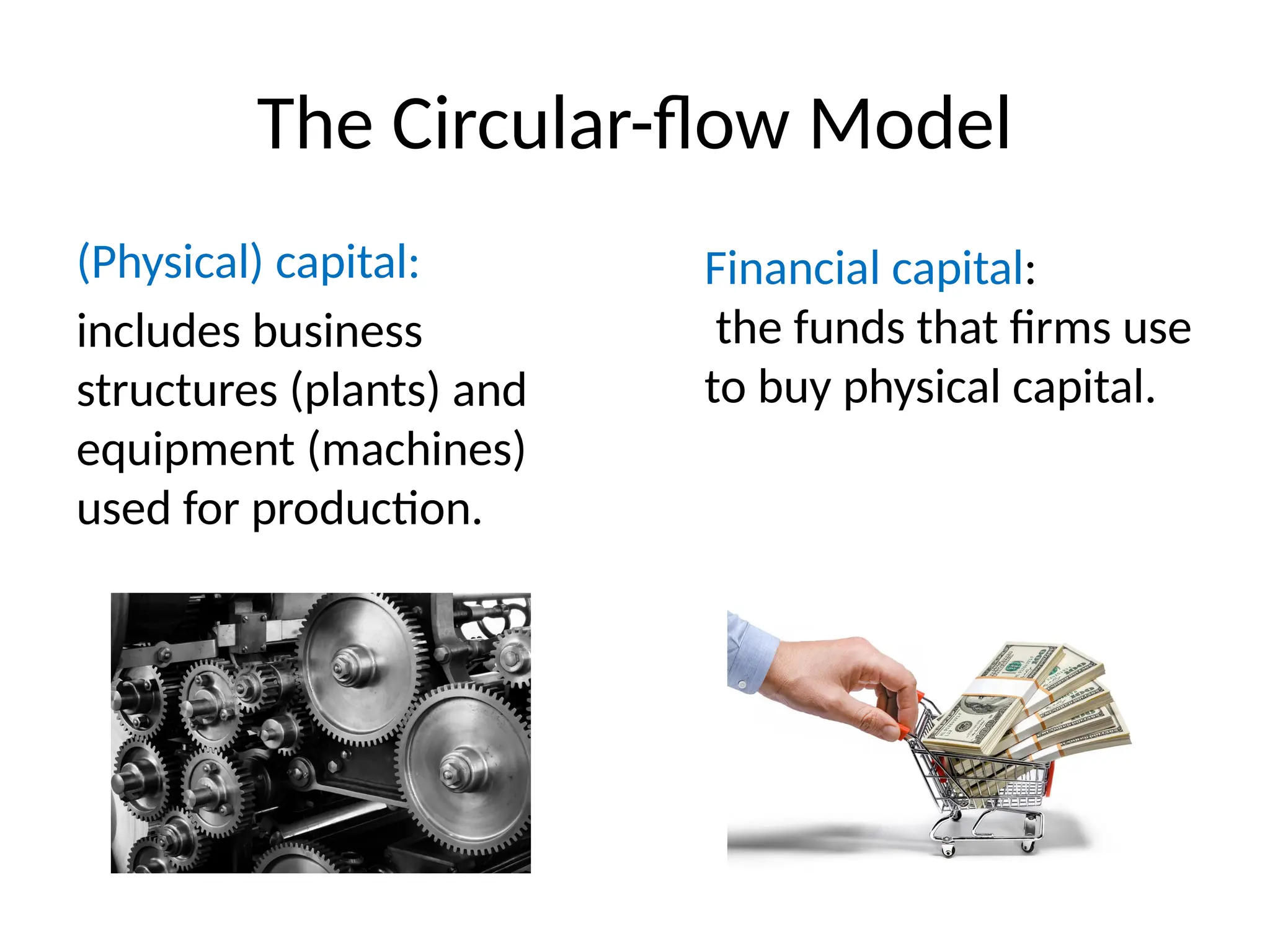
(Physical)capital:
includes business
structures (plants) and
equipment (machines)
used for production.
Financial capital:
the funds that firms use
to buy physical capital.
21.
The Circular-flow Model
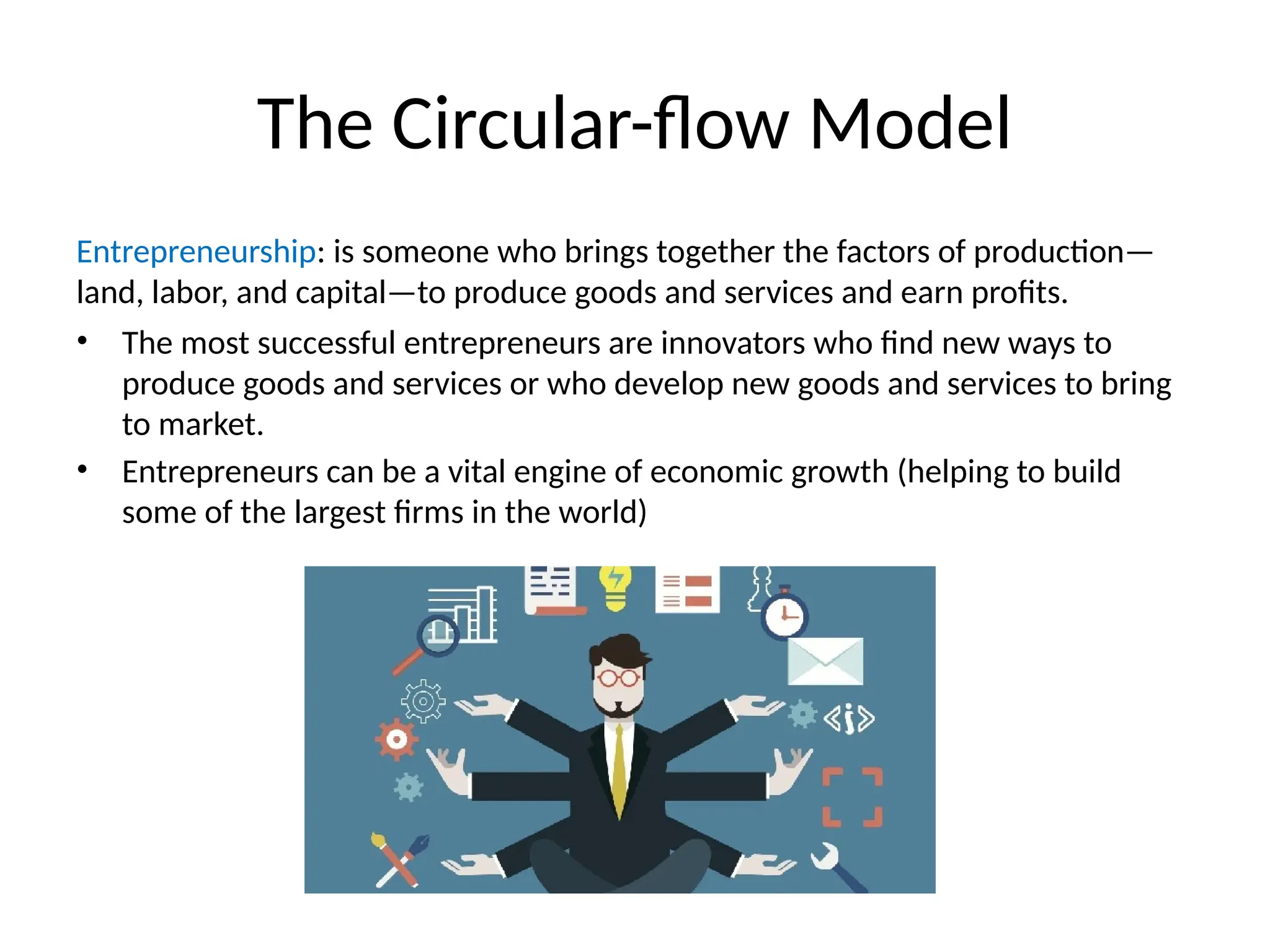
Entrepreneurship:is someone who brings together the factors of production—
land, labor, and capital—to produce goods and services and earn profits.
• The most successful entrepreneurs are innovators who find new ways to
produce goods and services or who develop new goods and services to bring
to market.
• Entrepreneurs can be a vital engine of economic growth (helping to build
some of the largest firms in the world)
22.
The Circular-flow Model
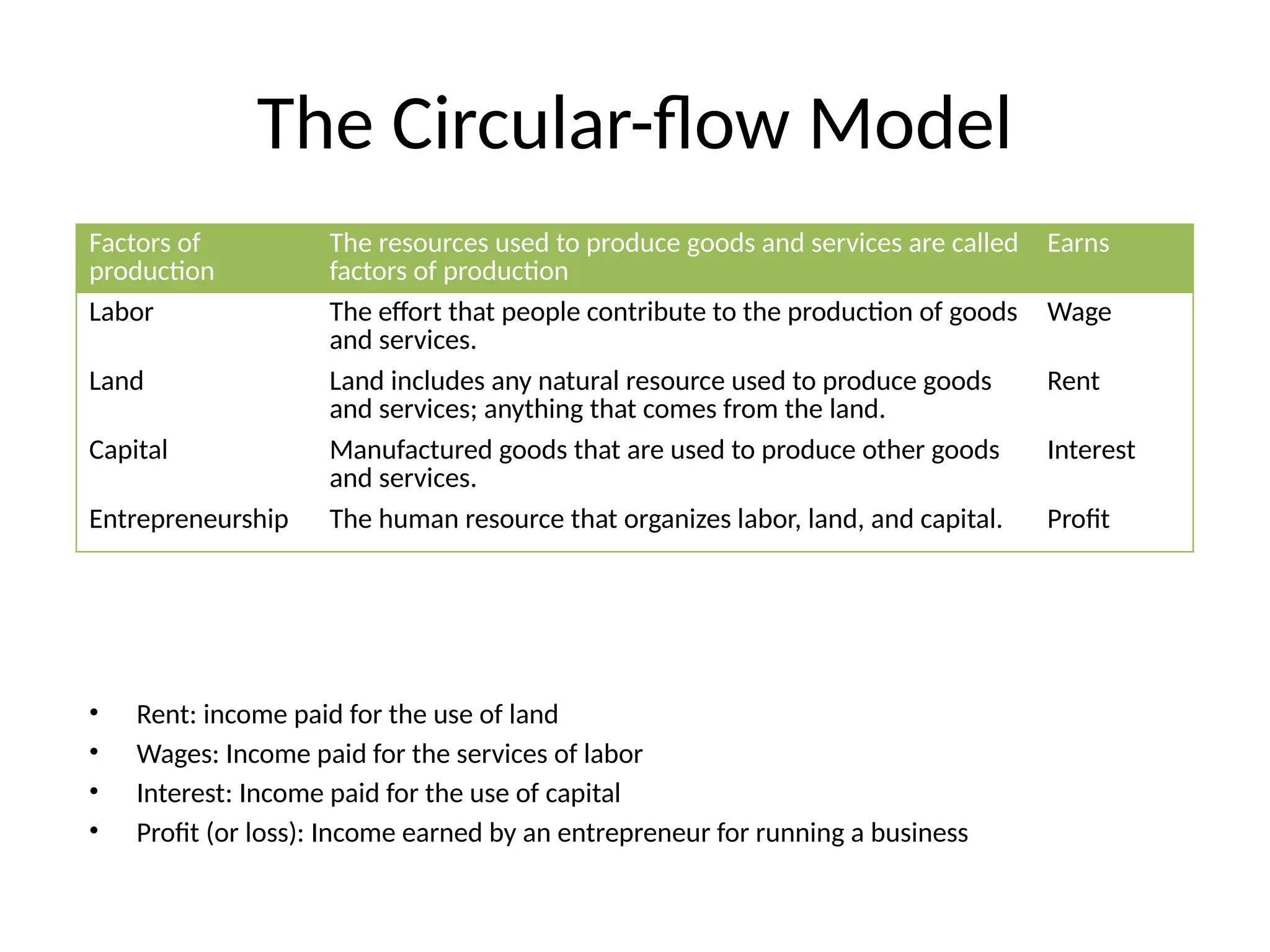
Factorsof
production
The resources used to produce goods and services are called
factors of production
Earns
Labor The effort that people contribute to the production of goods
and services.
Wage
Land Land includes any natural resource used to produce goods
and services; anything that comes from the land.
Rent
Capital Manufactured goods that are used to produce other goods
and services.
Interest
Entrepreneurship The human resource that organizes labor, land, and capital. Profit
• Rent: income paid for the use of land
• Wages: Income paid for the services of labor
• Interest: Income paid for the use of capital
• Profit (or loss): Income earned by an entrepreneur for running a business
23.
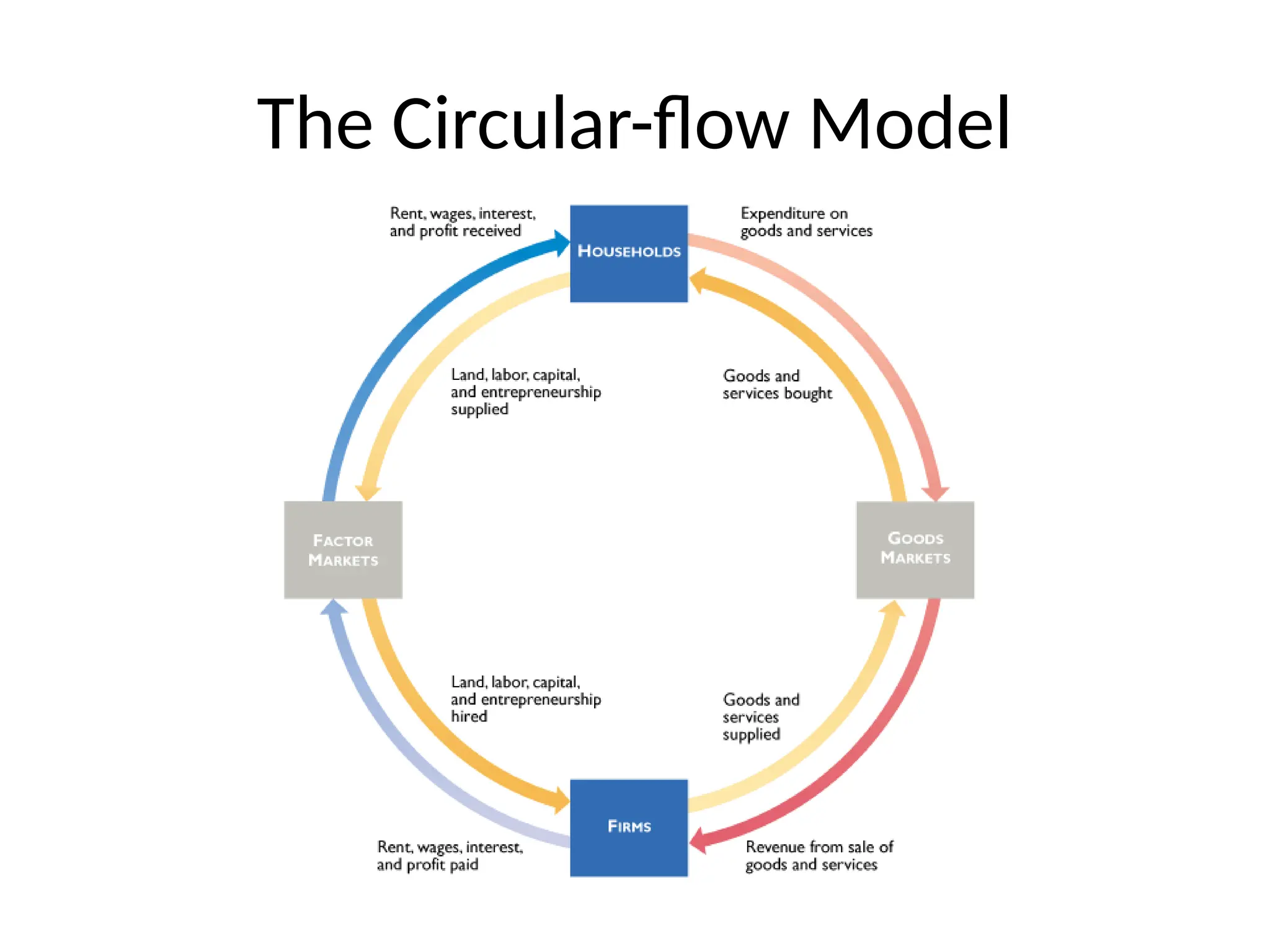
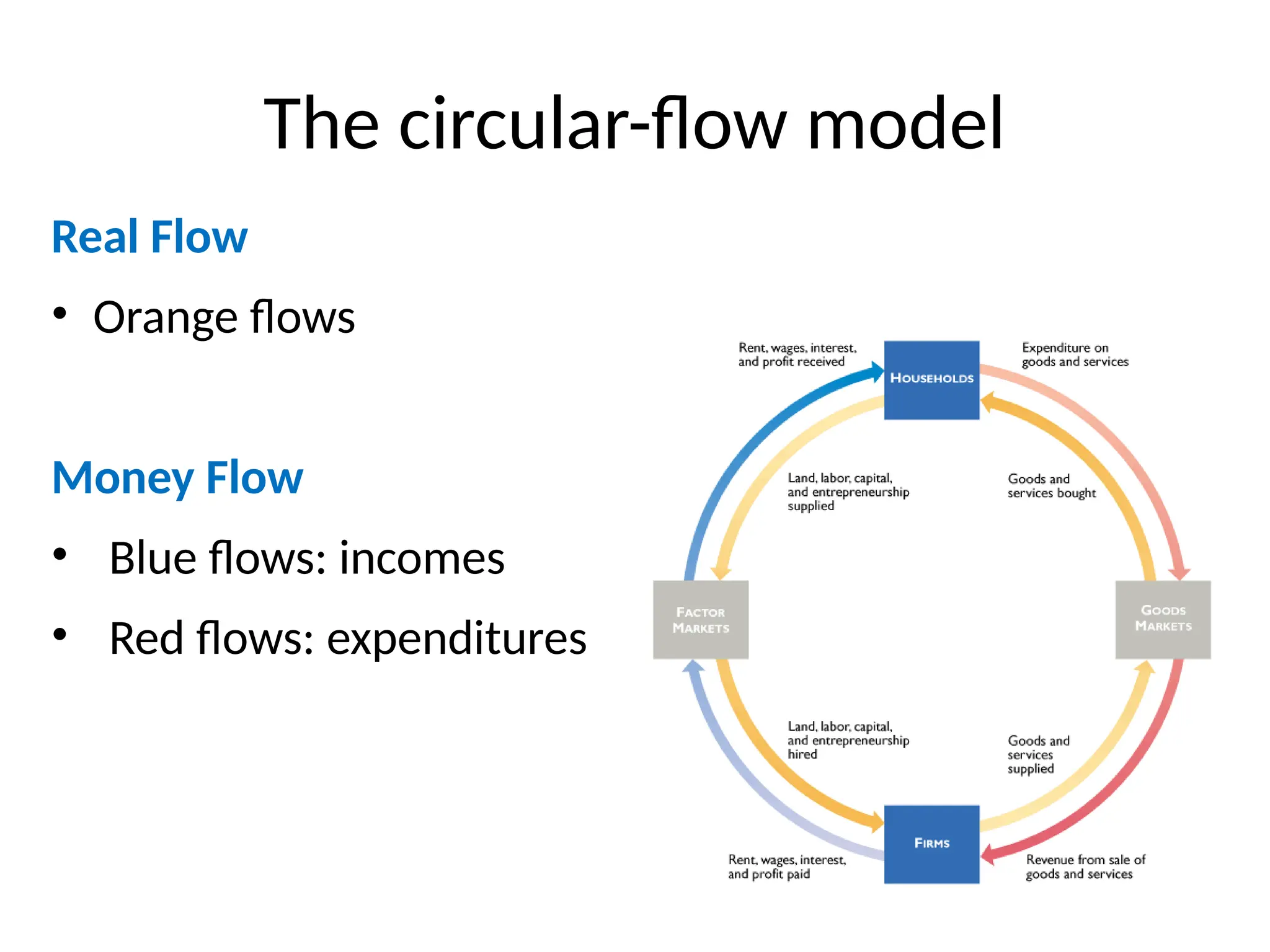
The Circular-flow Model
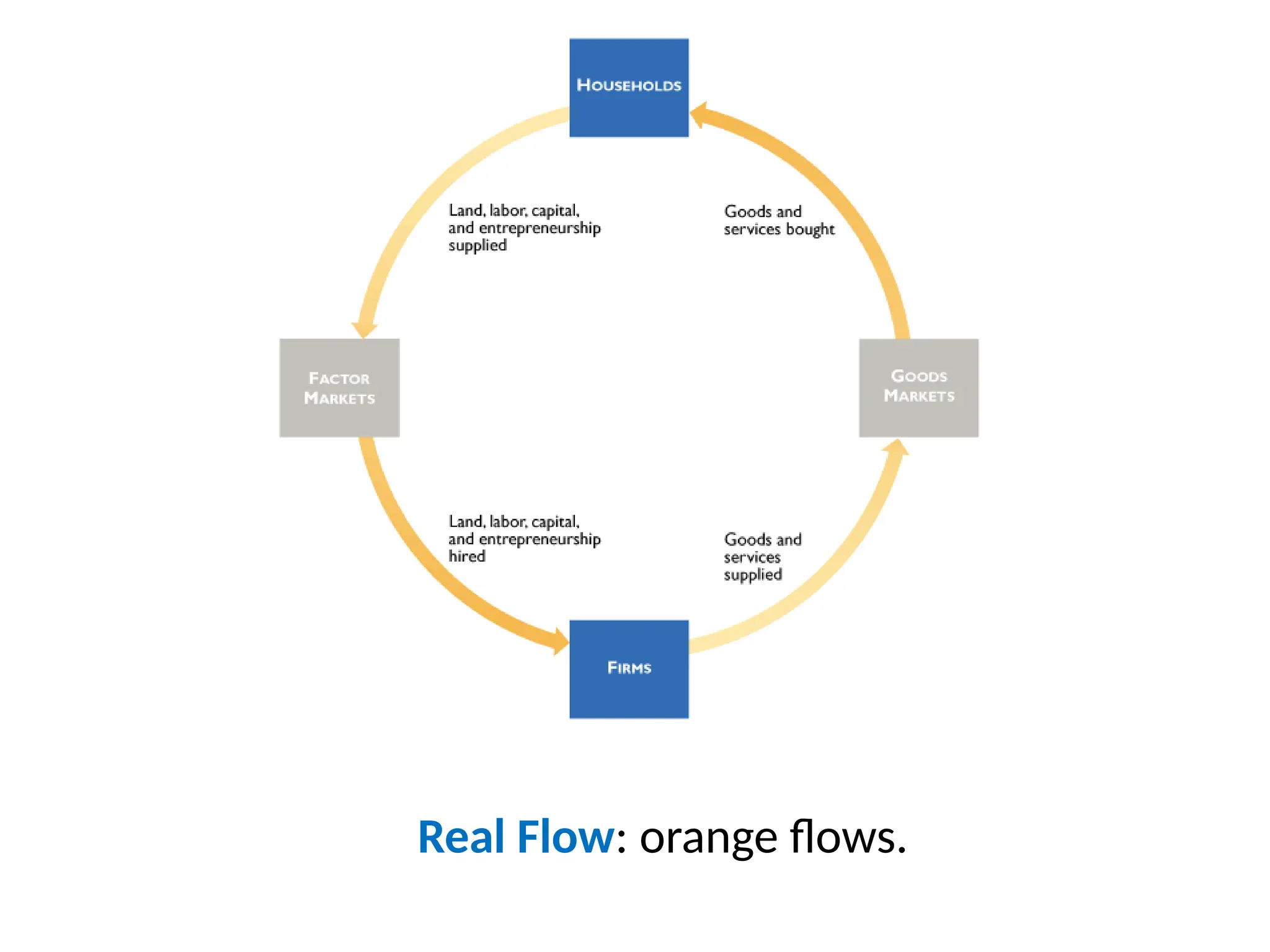
Realflow:
• In goods markets
o Who offers goods and
services?
o Who receives goods and
services?
• In factor markets (say labor
market)
o Who offers production
factors?
o Who receives production
factors?
The Circular-flow Model
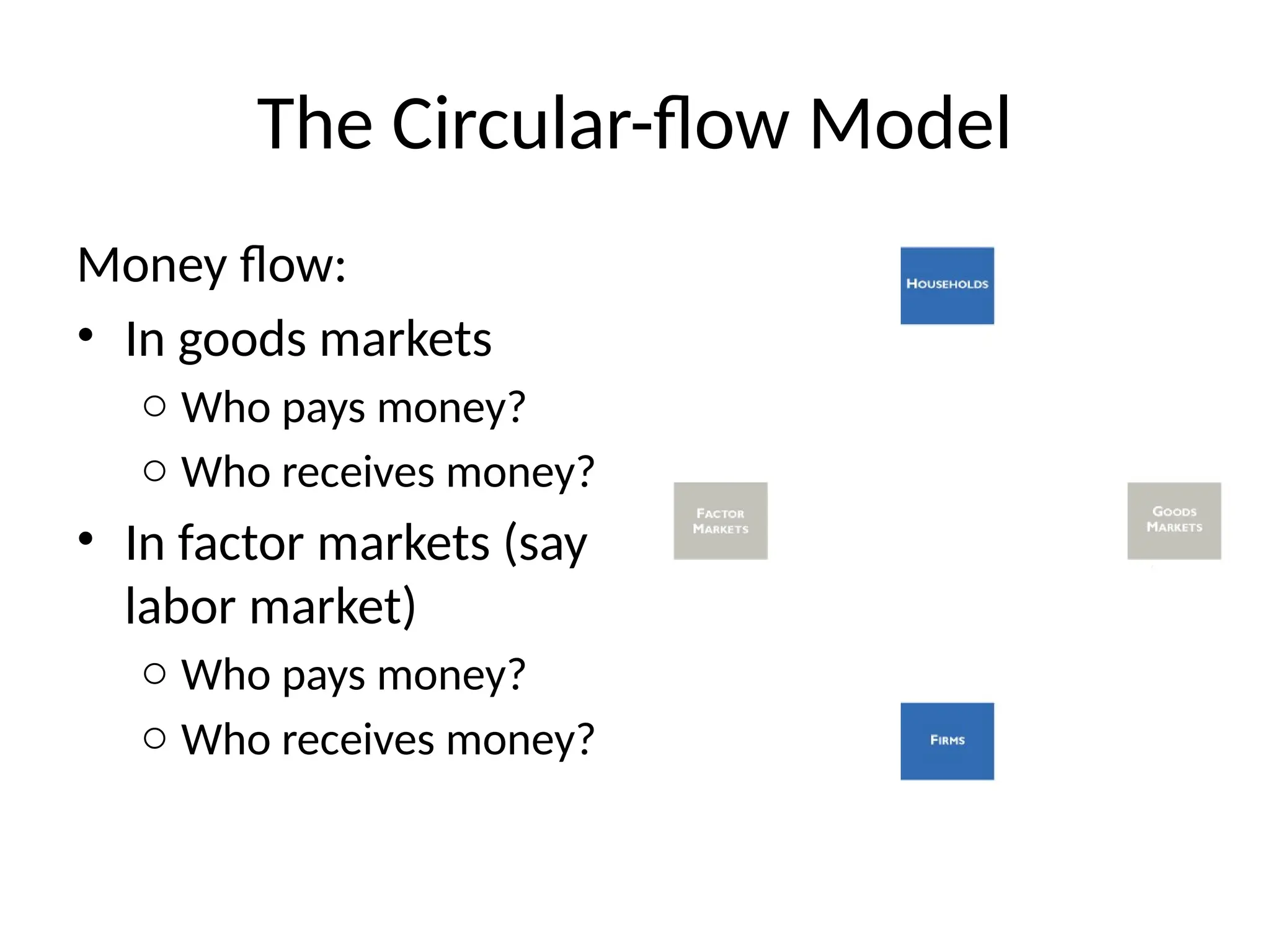
Moneyflow:
• In goods markets
o Who pays money?
o Who receives money?
• In factor markets (say
labor market)
o Who pays money?
o Who receives money?
The Circular-flow Model
Questions:
1.Are there any elements you want to add to
this 4-sector circular flow model?
2. Households do not always spend all their
income. Are savings a leakage from circular
flow?
28.
Economic Model
Economic model:simplified versions of reality
used to analyze real-world economic situations
• It is a description of some aspect of the
economic world that includes only those
features that are needed for the purpose at
hand.
29.
Economic Model
Economists developeconomic models to analyze real-world issues.
• Building an economic model often follows these steps:
1. Decide on the assumptions to use in developing the model.
2. Formulate a testable hypothesis.
3. Use economic data to test the hypothesis.
4. Revise the model if it fails to explain the economic data well.
5. Retain the revised model to help answer similar economic questions in the
future.
• Assumptions and simplifications: every model needs them in order to be
useful.
• Testability: good models generate testable predictions, which can be verified
or disproven using data.
• Economic variables: something measurable that can have different values,
such as the incomes of doctors.
30.
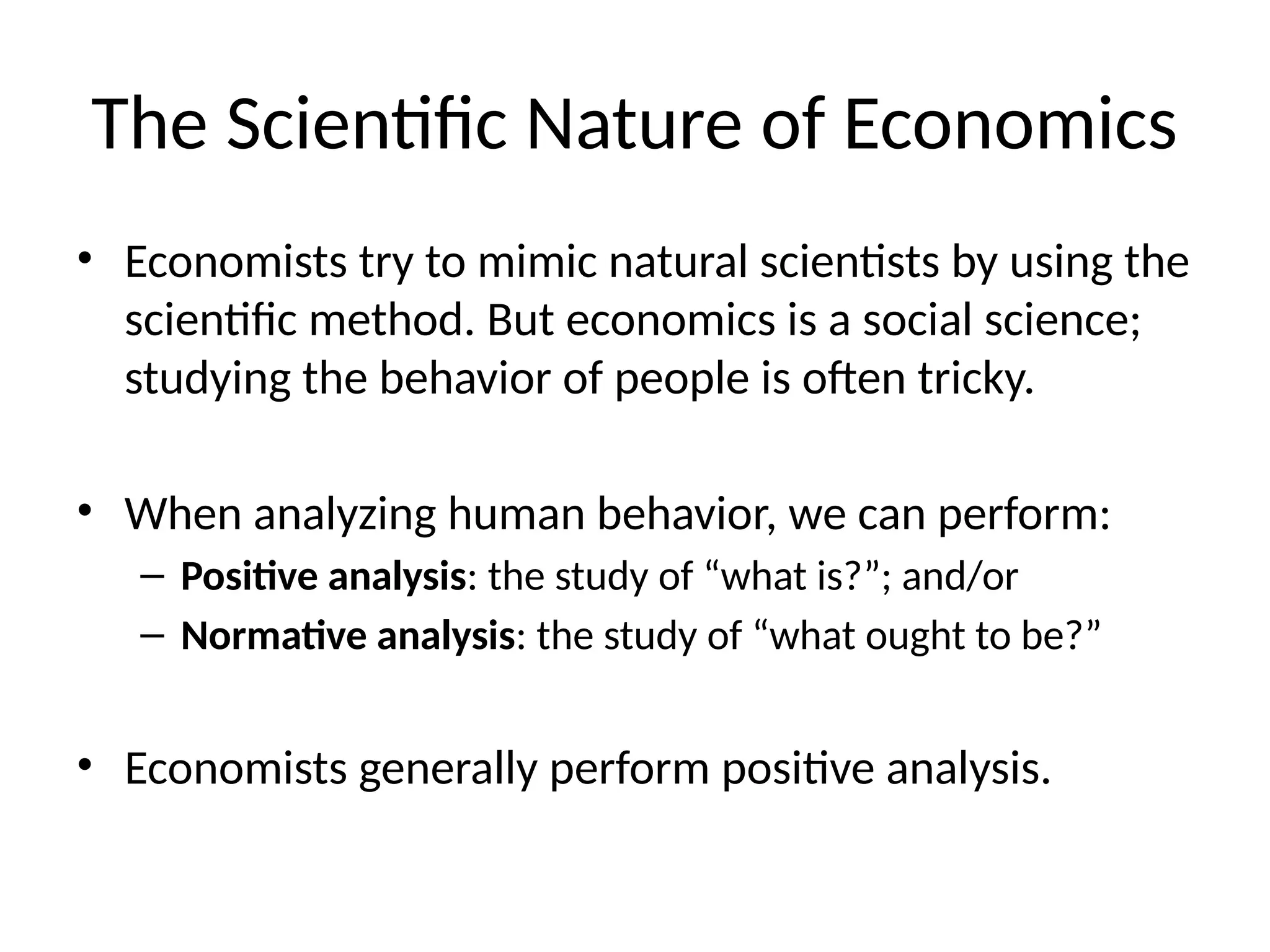
The Scientific Natureof Economics
• Economists try to mimic natural scientists by using the
scientific method. But economics is a social science;
studying the behavior of people is often tricky.
• When analyzing human behavior, we can perform:
– Positive analysis: the study of “what is?”; and/or
– Normative analysis: the study of “what ought to be?”
• Economists generally perform positive analysis.
31.
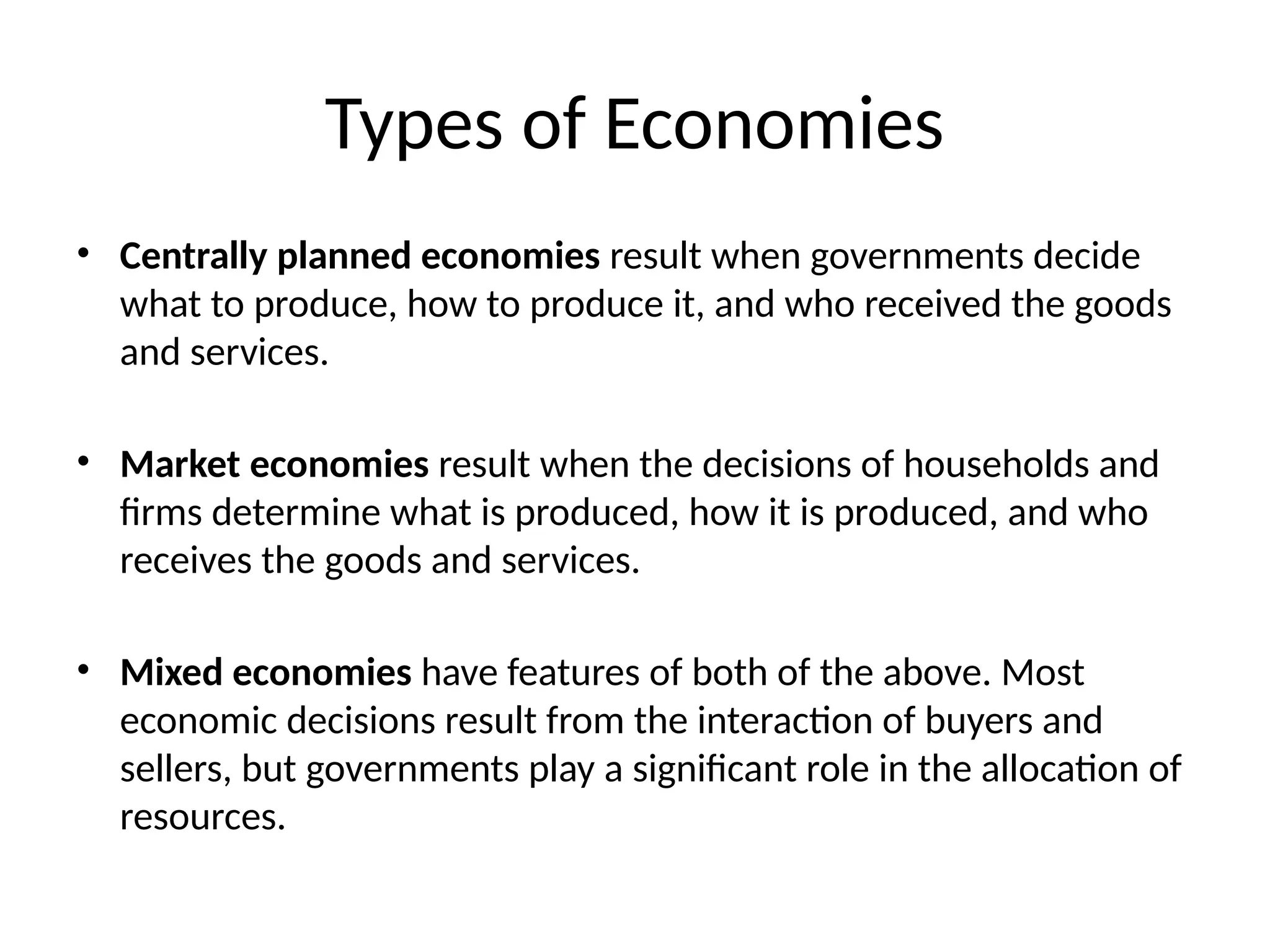
Types of Economies
•Centrally planned economies result when governments decide
what to produce, how to produce it, and who received the goods
and services.
• Market economies result when the decisions of households and
firms determine what is produced, how it is produced, and who
receives the goods and services.
• Mixed economies have features of both of the above. Most
economic decisions result from the interaction of buyers and
sellers, but governments play a significant role in the allocation of
resources.
32.
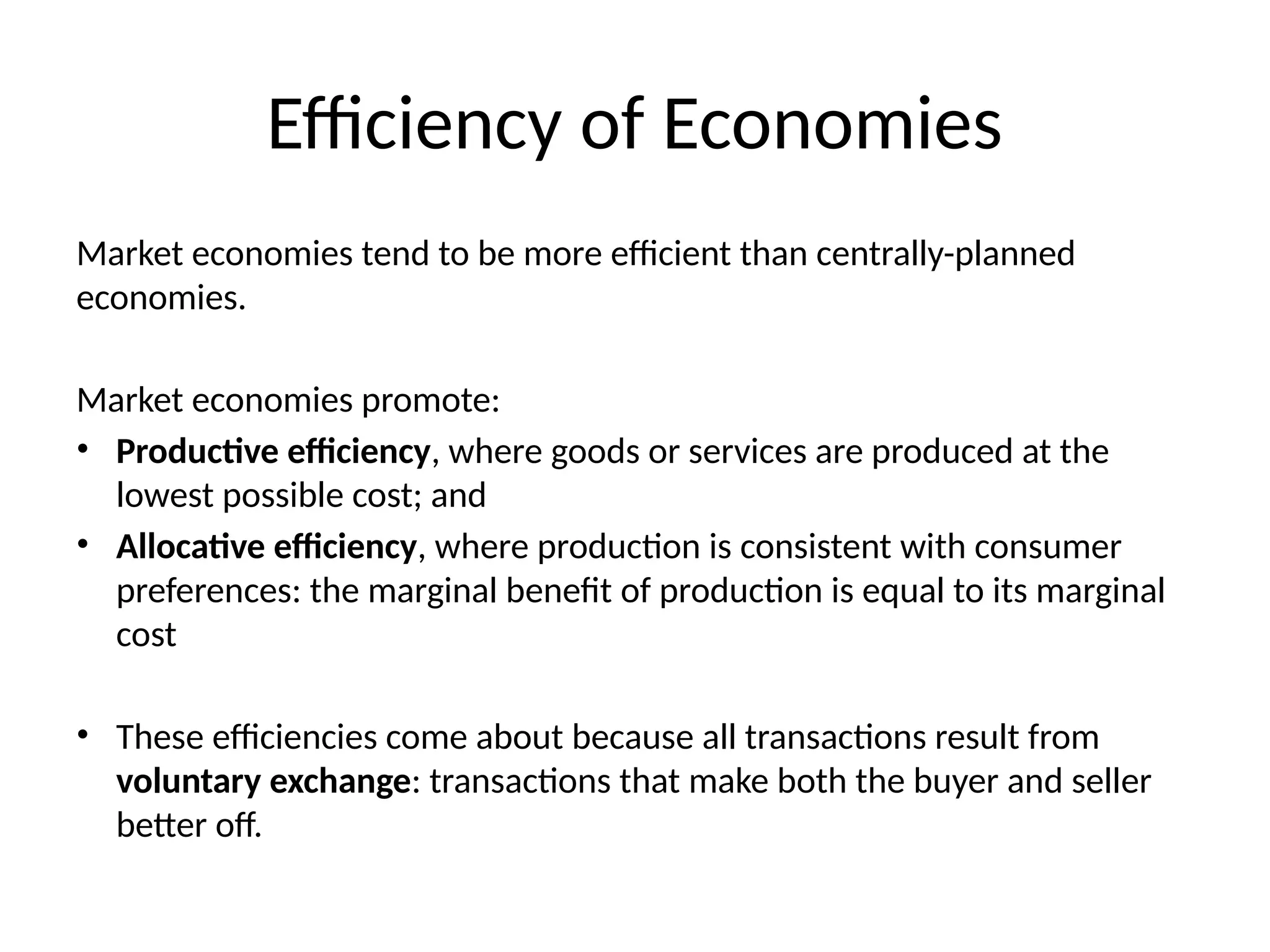
Efficiency of Economies
Marketeconomies tend to be more efficient than centrally-planned
economies.
Market economies promote:
• Productive efficiency, where goods or services are produced at the
lowest possible cost; and
• Allocative efficiency, where production is consistent with consumer
preferences: the marginal benefit of production is equal to its marginal
cost
• These efficiencies come about because all transactions result from
voluntary exchange: transactions that make both the buyer and seller
better off.
33.
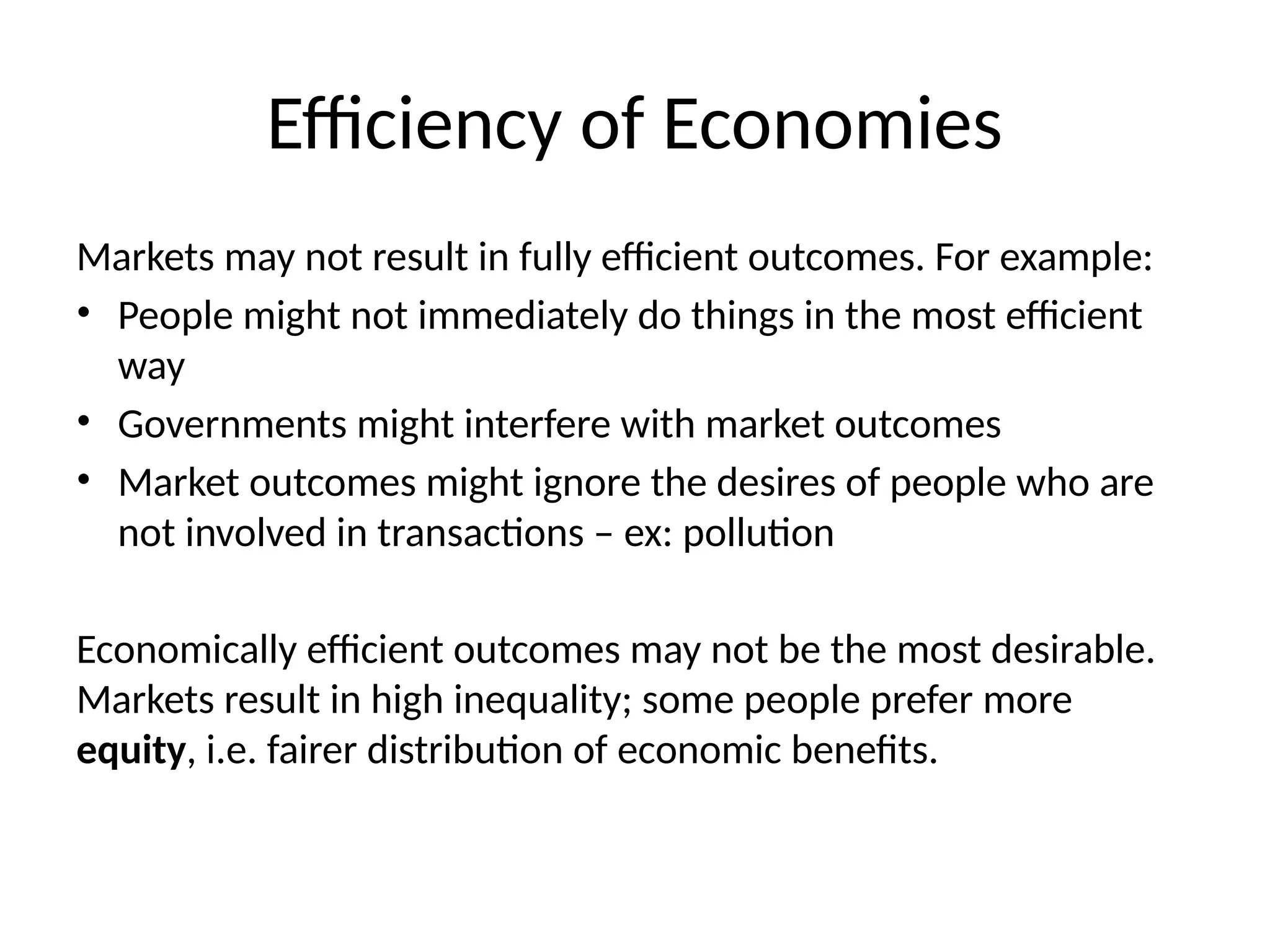
Efficiency of Economies
Marketsmay not result in fully efficient outcomes. For example:
• People might not immediately do things in the most efficient
way
• Governments might interfere with market outcomes
• Market outcomes might ignore the desires of people who are
not involved in transactions – ex: pollution
Economically efficient outcomes may not be the most desirable.
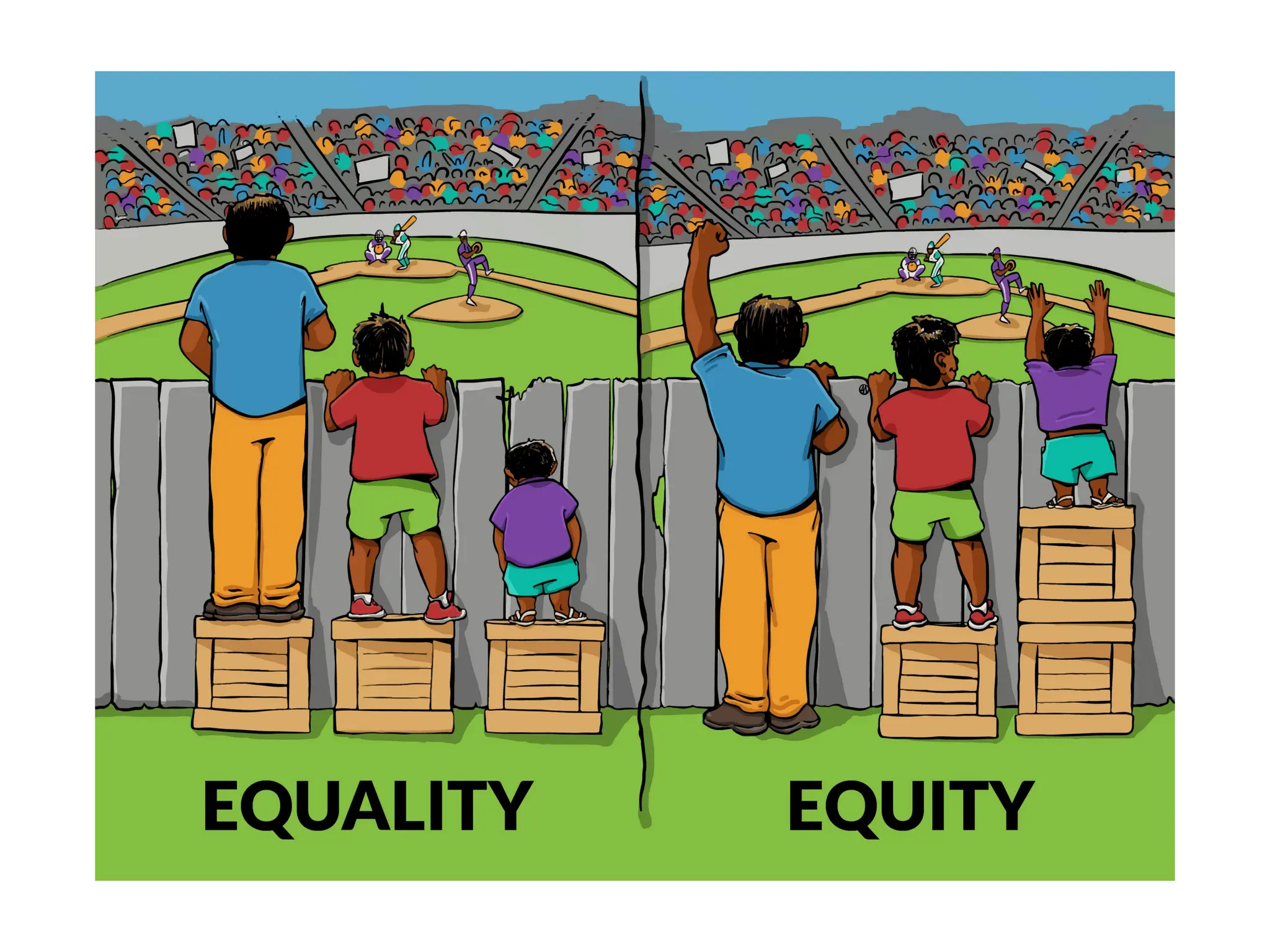
Markets result in high inequality; some people prefer more
equity, i.e. fairer distribution of economic benefits.