I.) Perfect competition
II.) Monopolistic competition
III.) Oligopoly
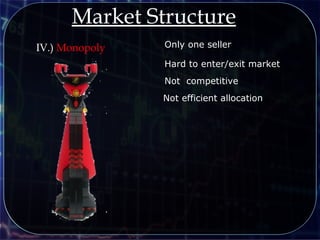
IV.) Monopoly
Market Structure
Market Structure
Models – a word of warning!
- Market structure deals with a number of economic
‘models’
- These models are a representation of reality to
help us to understand what may be happening in
real life
- There are extremes to the model that are unlikely
to occur in reality
- They still have value as they enable us to draw
comparisons and contrasts with what is observed
in reality 比较和对比什么是现实
- Models help therefore in analysing and evaluating
– they offer a benchmark 基准
- Even with these warnings, they do help
describe important concerns that you deal with
everyday you interact in any economic way:
-Degree of competition affects the consumer
will it benefit the consumer or not?
- Impacts on the performance and behaviour of
the company/companies involved.
Market Structure
We will start with the
structure that my vegetable
lady works in…
I.) Perfect competition
II.) Monopolistic competition
III.) Oligopoly
IV.) Monopoly
Market Structure
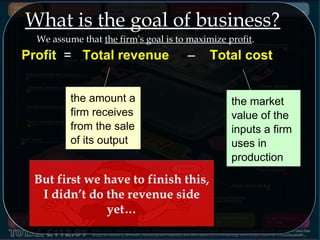
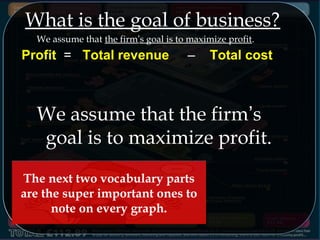
Profit = Total revenue – Total cost
the amount a
firm receives
from the sale
of its output
the market
value of the
inputs a firm
uses in
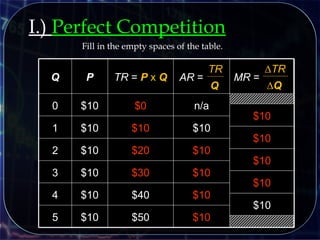
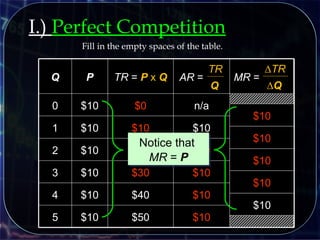
production
What is the goal of business?
We assume that the firm’s goal is to maximize profit.
But first we have to finish this,
I didn’t do the revenue side
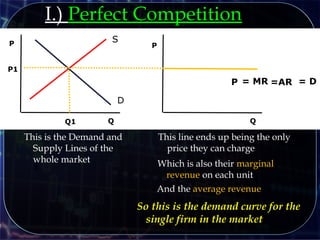
yet…
Profit = Total revenue – Total cost
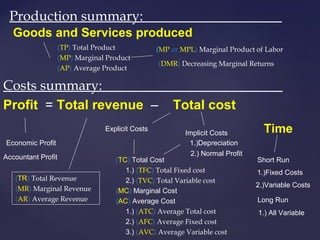
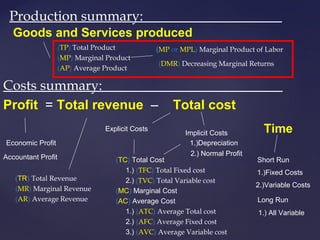
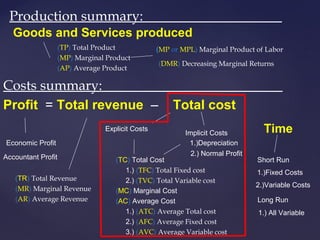
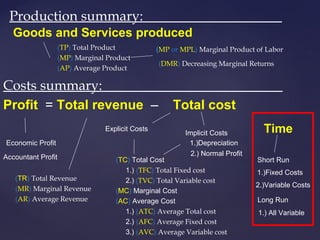
Costs summary:__________________________
Goods and Services produced
Time
Production summary:____________________
(TP) Total Product
(MP) Marginal Product
(AP) Average Product
Economic Profit
Accountant Profit
Explicit Costs
Implicit Costs
Short Run
1.)Fixed Costs
2.)Variable Costs
Long Run
1.) All Variable
(TC) Total Cost
1.) (TFC) Total Fixed cost
2.) (TVC) Total Variable cost
(MC) Marginal Cost
(AC) Average Cost
1.) (ATC) Average Total cost
2.) (AFC) Average Fixed cost
3.) (AVC) Average Variable cost
1.)Depreciation
2.) Normal Profit
(MP or MPL) Marginal Product of Labor
(DMR) Decreasing Marginal Returns
(TR) Total Revenue
(MR) Marginal Revenue
(AR) Average Revenue
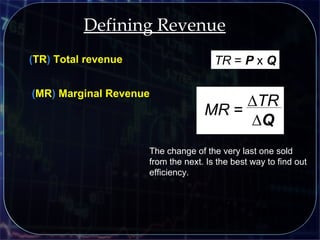
Defining Revenue
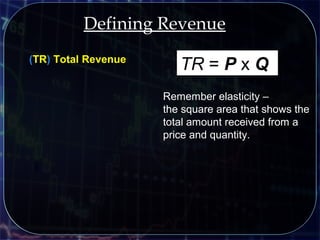
(TR) Total Revenue
TR = P x Q
Remember elasticity –
the square area that shows the
total amount received from a
price and quantity.
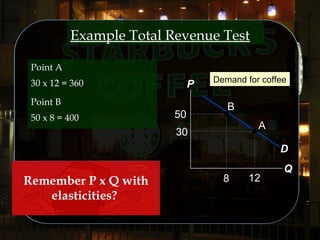
P
Q
D
50
8
B
30
12
A
Demand for coffee
Point A
30 x 12 = 360
Point B
50 x 8 = 400
Example Total Revenue Test
Remember P x Q with
elasticities?
(MR) Marginal Revenue
Defining Revenue
(TR) Total revenue TR = P x Q
∆TR
∆Q
MR =
TR
Q
AR =
The change of the very last one sold
from the next. Is the best way to find out
efficiency.
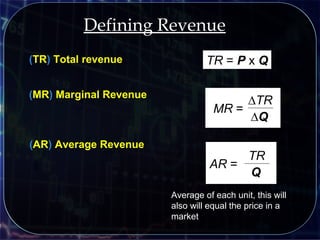
(AR) Average Revenue
(MR) Marginal Revenue
Defining Revenue
(TR) Total revenue TR = P x Q
∆TR
∆Q
MR =
TR
Q
AR =
Average of each unit, this will
also will equal the price in a
market
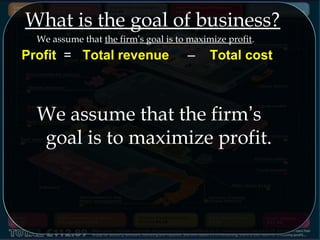
Profit = Total revenue – Total cost
What is the goal of business?
We assume that the firm’s goal is to maximize profit.
We assume that the firm’s
goal is to maximize profit.
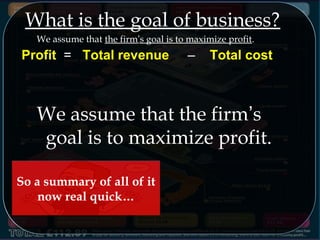
Profit = Total revenue – Total cost
What is the goal of business?
We assume that the firm’s goal is to maximize profit.
We assume that the firm’s
goal is to maximize profit.
So a summary of all of it
now real quick…
Profit = Total revenue – Total cost
Costs summary:__________________________
Goods and Services produced
Time
Production summary:____________________
(TP) Total Product
(MP) Marginal Product
(AP) Average Product
Economic Profit
Accountant Profit
Explicit Costs
Implicit Costs
Short Run
1.)Fixed Costs
2.)Variable Costs
Long Run
1.) All Variable
(TC) Total Cost
1.) (TFC) Total Fixed cost
2.) (TVC) Total Variable cost
(MC) Marginal Cost
(AC) Average Cost
1.) (ATC) Average Total cost
2.) (AFC) Average Fixed cost
3.) (AVC) Average Variable cost
1.)Depreciation
2.) Normal Profit
(MP or MPL) Marginal Product of Labor
(DMR) Decreasing Marginal Returns
(TR) Total Revenue
(MR) Marginal Revenue
(AR) Average Revenue
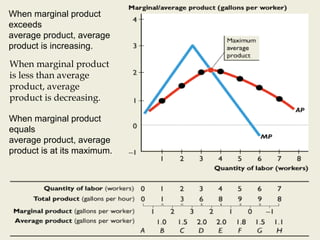
When marginal product
exceeds
average product, average
product is increasing.
When marginal product
is less than average
product, average
product is decreasing.
When marginal product
equals
average product, average
product is at its maximum.
Profit = Total revenue – Total cost
Costs summary:__________________________
Goods and Services produced
Time
Production summary:____________________
(TP) Total Product
(MP) Marginal Product
(AP) Average Product
Economic Profit
Accountant Profit
Explicit Costs
Implicit Costs
Short Run
1.)Fixed Costs
2.)Variable Costs
Long Run
1.) All Variable
(TC) Total Cost
1.) (TFC) Total Fixed cost
2.) (TVC) Total Variable cost
(MC) Marginal Cost
(AC) Average Cost
1.) (ATC) Average Total cost
2.) (AFC) Average Fixed cost
3.) (AVC) Average Variable cost
1.)Depreciation
2.) Normal Profit
(MP or MPL) Marginal Product of Labor
(DMR) Decreasing Marginal Returns
(TR) Total Revenue
(MR) Marginal Revenue
(AR) Average Revenue
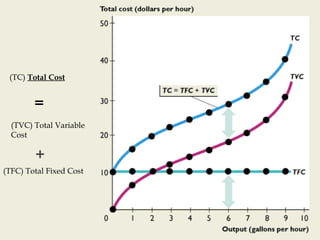
(TC) Total Cost
(TFC) Total Fixed Cost
(TVC) Total Variable
Cost
+
=
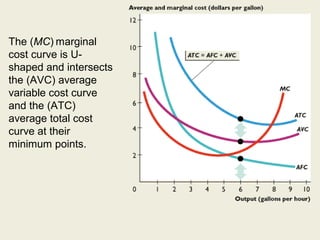
The (MC) marginal
cost curve is U-
shaped and intersects
the (AVC) average
variable cost curve
and the (ATC)
average total cost
curve at their
minimum points.
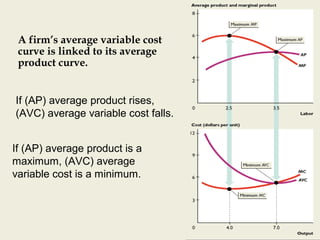
A firm’s average variable cost
curve is linked to its average
product curve.
If (AP) average product rises,
(AVC) average variable cost falls.
If (AP) average product is a
maximum, (AVC) average
variable cost is a minimum.
Profit = Total revenue – Total cost
Costs summary:__________________________
Goods and Services produced
Time
Production summary:____________________
(TP) Total Product
(MP) Marginal Product
(AP) Average Product
Economic Profit
Accountant Profit
Explicit Costs
Implicit Costs
Short Run
1.)Fixed Costs
2.)Variable Costs
Long Run
1.) All Variable
(TC) Total Cost
1.) (TFC) Total Fixed cost
2.) (TVC) Total Variable cost
(MC) Marginal Cost
(AC) Average Cost
1.) (ATC) Average Total cost
2.) (AFC) Average Fixed cost
3.) (AVC) Average Variable cost
1.)Depreciation
2.) Normal Profit
(MP or MPL) Marginal Product of Labor
(DMR) Decreasing Marginal Returns
(TR) Total Revenue
(MR) Marginal Revenue
(AR) Average Revenue
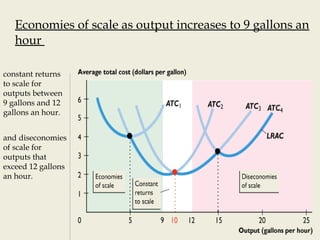
Economies of scale as output increases to 9 gallons an
hour
constant returns
to scale for
outputs between
9 gallons and 12
gallons an hour.
and diseconomies
of scale for
outputs that
exceed 12 gallons
an hour.
Profit = Total revenue – Total cost
What is the goal of business?
We assume that the firm’s goal is to maximize profit.
We assume that the firm’s
goal is to maximize profit.
The next two vocabulary parts
are the super important ones to
note on every graph.
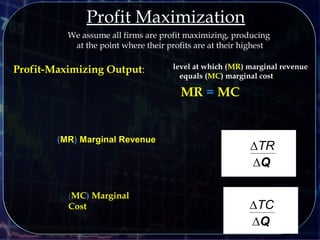
(MR) Marginal Revenue
Profit Maximization
∆TR
∆Q
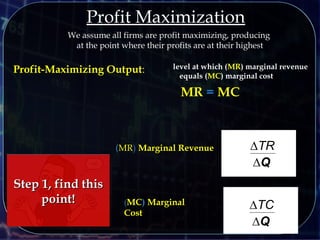
Profit-Maximizing Output: level at which (MR) marginal revenue
equals (MC) marginal cost
MR = MC
We assume all firms are profit maximizing, producing
at the point where their profits are at their highest
(MC) Marginal
Cost ∆TC
∆Q
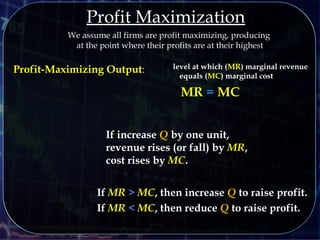
Profit Maximization
Profit-Maximizing Output: level at which (MR) marginal revenue
equals (MC) marginal cost
MR = MC
We assume all firms are profit maximizing, producing
at the point where their profits are at their highest
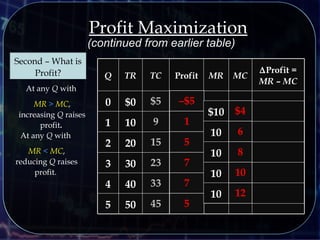
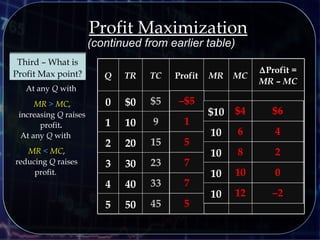
If increase Q by one unit,
revenue rises (or fall) by MR,
cost rises by MC.
If MR > MC, then increase Q to raise profit.
If MR < MC, then reduce Q to raise profit.
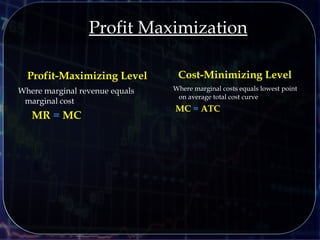
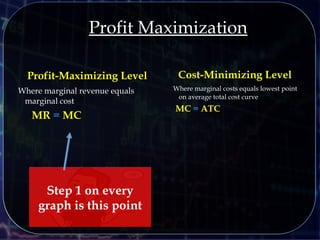
Profit-Maximizing Level
Where marginal revenue equals
marginal cost
MR = MC
Cost-Minimizing Level
Where marginal costs equals lowest point
on average total cost curve
MC = ATC
Profit Maximization
Profit-Maximizing Level
Where marginal revenue equals
marginal cost
MR = MC
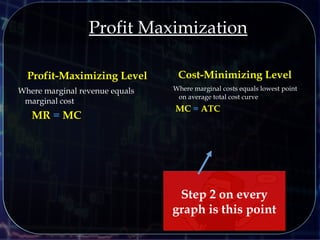
Cost-Minimizing Level
Where marginal costs equals lowest point
on average total cost curve
MC = ATC
Profit Maximization
Step 1 on every
graph is this point
Profit-Maximizing Level
Where marginal revenue equals
marginal cost
MR = MC
Cost-Minimizing Level
Where marginal costs equals lowest point
on average total cost curve
MC = ATC
Profit Maximization
Step 2 on every
graph is this point
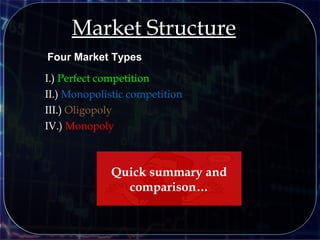
I.) Perfect competition
II.) Monopolistic competition
III.) Oligopoly
IV.) Monopoly
Four Market Types
Market Structure
Quick summary and
comparison…
I.) Perfect competition
Market Structure
Easy to enter/exit market
More competitive
Goods are very similar
Efficient allocation
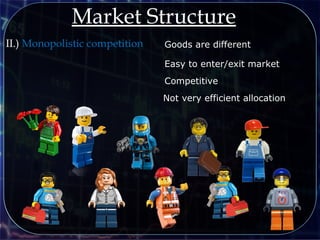
II.) Monopolistic competition
Market Structure
Easy to enter/exit market
Competitive
Goods are different
Not very efficient allocation
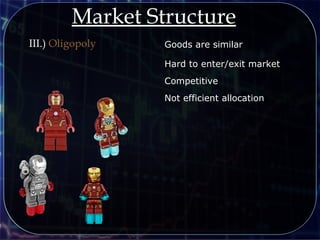
III.) Oligopoly
Market Structure
Hard to enter/exit market
Competitive
Goods are similar
Not efficient allocation
IV.) Monopoly
Market Structure
Hard to enter/exit market
Not competitive
Only one seller
Not efficient allocation
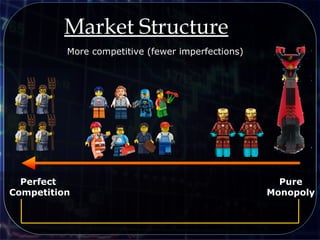
Market Structure
More competitive (fewer imperfections)
Perfect
Competition
Pure
Monopoly
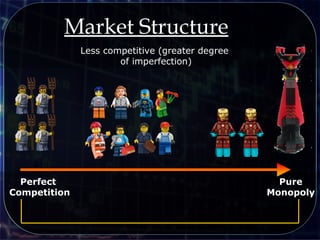
Market Structure
Perfect
Competition
Pure
Monopoly
Less competitive (greater degree
of imperfection)
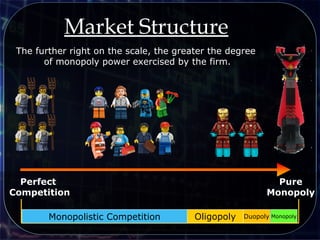
Market Structure
Perfect
Competition
Pure
Monopoly
The further right on the scale, the greater the degree
of monopoly power exercised by the firm.
Monopolistic Competition Oligopoly Duopoly Monopoly
Market Types
I.) perfect competition
Ok, finally…
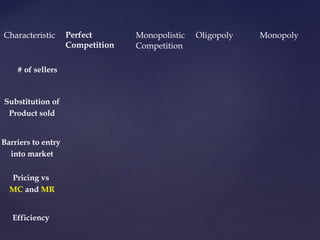
Characteristic Perfect
Competition
Monopolistic
Competition
Oligopoly Monopoly
Substitution of
Product sold
Barriers to entry
into market
Pricing vs
MC and MR
Efficiency
# of sellers
Characteristic Perfect
Competition
Monopolistic
Competition
Oligopoly Monopoly
Substitution of
Product sold
Barriers to entry
into market
Pricing vs
MC and MR
Efficiency
# of sellers
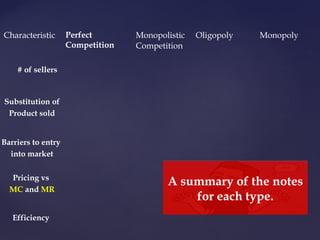
A summary of the notes
for each type.
Characteristic Perfect
Competition
Monopolistic
Competition
Oligopoly Monopoly
Substitution of
Product sold
Barriers to entry
into market
Pricing vs
MC and MR
Efficiency
# of sellers
Many
(price takers)
Only one product
type from all
sellers
No barriers to
enter/ exit
P =MC=MR
Efficient with zero
econ profit
P = ATC
I.) Perfect Competition
-Many firms sell an identical product to
many buyers.
She sells the same as
everyone else and there
are lots of sellers
Like my vegetableLike my vegetable
lady…lady…
I.) Perfect Competition
-Many firms sell an identical product to
many buyers.
-There are no restrictions on entry into (or
exit from) the market.
-Established firms have no advantage
over new firms.
-Sellers and buyers are well informed
about prices
Price Taker - is a firm that cannot influence
the price of the good or
service that it produces.
I.) Perfect Competition
Price Taker
(More on Price Taker…)
So, each one-unit increase in Q causes
revenue to rise by P, so MR = P.
A competitive firm can keep
increasing its output without
affecting the market price.
MR = P for a Competitive Firm and is a
perfectly elastic line
Fill in the empty spaces of the table.
$50$105
$40$104
$103
$102
$10$101
n/a$100
TRPQ MRAR
$10
I.) Perfect Competition
Fill in the empty spaces of the table.
$50$105
$40$104
$103
$10
$10
$10
$10$102
$10$101
n/a
$30
$20
$10
$0$100
TR = P x QPQ
∆TR
∆Q
MR =
TR
Q
AR =
$10
$10
$10
$10
$10
I.) Perfect Competition
Fill in the empty spaces of the table.
$50$105
$40$104
$103
$10
$10
$10
$10$102
$10$101
n/a
$30
$20
$10
$0$100
TR = P x QPQ
∆TR
∆Q
MR =
TR
Q
AR =
$10
$10
$10
$10
$10
Notice that
MR = P
Notice that
MR = P
I.) Perfect Competition
Market Types
I.) perfect competition
I have created a large number of graphs here,
however the transitions in the PPT make it easier to
follow, I recommend to download the other version of
the PPT to follow since I can’t make transitions here
in this version of the PPT.
P
Q
P
S
D
QQ1
P1
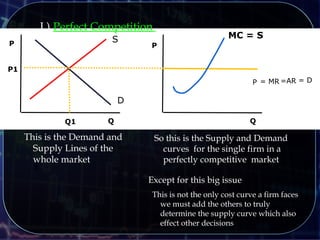
This is the Demand and
Supply Lines of the
whole market
P
This line ends up being the only
price they can charge
= MR
Which is also their marginal
revenue on each unit
= D=AR
And the average revenue
So this is the demand curve for the
single firm in the market
I.) Perfect Competition
(MR) Marginal Revenue
Profit Maximization
∆TR
∆Q
Profit-Maximizing Output: level at which (MR) marginal revenue
equals (MC) marginal cost
MR = MC
We assume all firms are profit maximizing, producing
at the point where their profits are at their highest
(MC) Marginal
Cost
∆TC
∆Q
Step 1, find thisStep 1, find this
point!point!
505
404
303
202
101
$00
∆Profit =
MR – MC
MCMRProfitTCTRQ
At any Q with
MR > MC,
increasing Q raises
profit.
10
10
10
10
$10
(continued from earlier table)
At any Q with
MR < MC,
reducing Q raises
profit.
Profit Maximization
First – What is
MC?
505
404
303
202
101
$00
∆Profit =
MR – MC
MCMRProfitTCTRQ
At any Q with
MR > MC,
increasing Q raises
profit.
10
10
10
10
$10
(continued from earlier table)
At any Q with
MR < MC,
reducing Q raises
profit.
Profit Maximization
First – What is
MC?
Second – What is
Profit?
505
404
303
202
101
$00
∆Profit =
MR – MC
MCMRProfitTCTRQ
At any Q with
MR > MC,
increasing Q raises
profit.
10
10
10
10
$10
(continued from earlier table)
At any Q with
MR < MC,
reducing Q raises
profit.
Profit Maximization
First – What is
MC?
Second – What is
Profit?
Third – What is
Profit Max point?
P=MR=AR=D
I.) Perfect Competition
Q
P
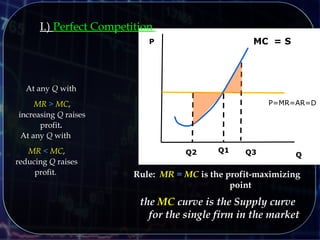
the MC curve is the Supply curve
for the single firm in the market
MC
Rule: MR = MC is the profit-maximizing
point
Q1Q2 Q3
= S
At any Q with
MR > MC,
increasing Q raises
profit.
At any Q with
MR < MC,
reducing Q raises
profit.
P
Q
I.) Perfect Competition
S
D
QQ1
P1
This is the Demand and
Supply Lines of the
whole market
P
So this is the Supply and Demand
curves for the single firm in a
perfectly competitive market
MC = S
Except for this big issue
This is not the only cost curve a firm faces
we must add the others to truly
determine the supply curve which also
effect other decisions
P = MR = D=AR
Short Run Costs
(AVC) Average
Variable Cost
(AFC) Average
Fixed Cost
(ATC) Average
Total Cost
will determine profits in the
short and long run.
Will determine when a firm shuts
down in the short run and exits
the market in the long run.
Don’t care very much about
this one
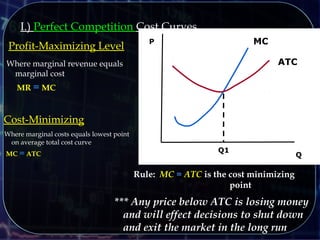
I.) Perfect Competition Cost Curves
Q
P
*** Any price below ATC is losing money
and will effect decisions to shut down
and exit the market in the long run
MC
Rule: MC = ATC is the cost minimizing
point
Q1
ATC
Profit-Maximizing Level
Where marginal revenue equals
marginal cost
MR = MC
Cost-Minimizing
Where marginal costs equals lowest point
on average total cost curve
MC = ATC
Putting it all together…
I will start at the easiest graph and go the harder graphs, but this
means I will have to do things a little bit out of order
Decisions are different in the long run and the short run
and I will start with the long run first since it is the
easiest graph and the graph that all the other ones are
moving towards anyway.
P
Q
S
D
QQ1
P1
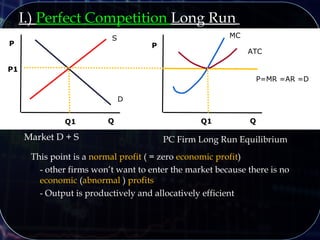
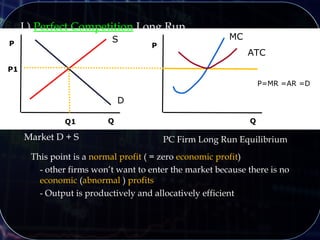
Market D + S
P
PC Firm Long Run Equilibrium
MC
This point is a normal profit ( = zero economic profit)
- other firms won’t want to enter the market because there is no
economic (abnormal ) profits
- Output is productively and allocatively efficient
ATC
P=MR =AR =D
I.) Perfect Competition Long Run
Q1
P
Q
S
D
QQ1
P1
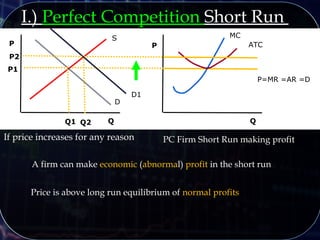
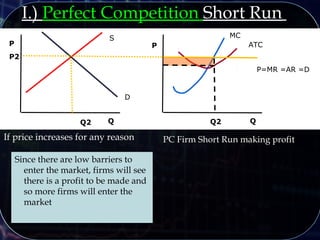
If price increases for any reason
P
PC Firm Short Run making profit
MC
A firm can make economic (abnormal) profit in the short run
ATC
P=MR =AR =D
I.) Perfect Competition Short Run
D1
Q2
P2
Price is above long run equilibrium of normal profits
I.) Perfect Competition Short Run
Q
P MC
Q1 Q2
ATC
P=MR =AR =D
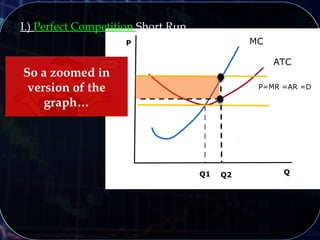
So a zoomed in
version of the
graph…
I.) Perfect Competition Short Run
Q
P MC
Q1 Q2
ATC
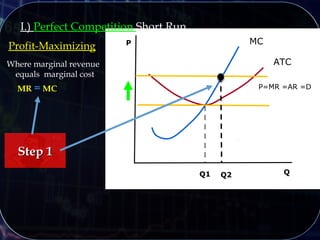
Profit-Maximizing
Where marginal revenue
equals marginal cost
MR = MC P=MR =AR =D
Step 1Step 1
I.) Perfect Competition Short Run
Q
P MC
Q1 Q2
ATC
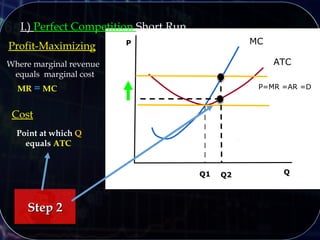
Profit-Maximizing
Where marginal revenue
equals marginal cost
MR = MC
Point at which Q
equals ATC
P=MR =AR =D
Cost
Step 2Step 2
I.) Perfect Competition Short Run
Q
P MC
Q1 Q2
ATC
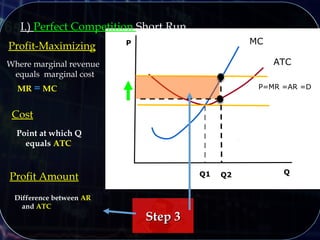
Profit-Maximizing
Where marginal revenue
equals marginal cost
MR = MC
Point at which Q
equals ATC
P=MR =AR =D
Cost
Difference between AR
and ATC
Profit Amount
Step 3Step 3
P
Q
S
QQ2
If price increases for any reason
P
PC Firm Short Run making profit
MC
Since there are low barriers to
enter the market, firms will see
there is a profit to be made and
so more firms will enter the
market
ATC
P=MR =AR =D
I.) Perfect Competition Short Run
D
Q2
P2
P
Q
S
QQ1
P1
P
MC
ATC
P=MR =AR =D
I.) Perfect Competition Short Run
D
Q1
P2
S1
Q2 Q2
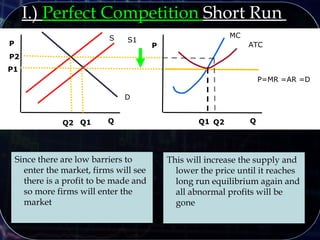
Since there are low barriers to
enter the market, firms will see
there is a profit to be made and
so more firms will enter the
market
This will increase the supply and
lower the price until it reaches
long run equilibrium again and
all abnormal profits will be
gone
P
Q
S
D
QQ1
P1
Market D + S
P
PC Firm Long Run Equilibrium
MC
This point is a normal profit ( = zero economic profit)
- other firms won’t want to enter the market because there is no
economic (abnormal ) profits
- Output is productively and allocatively efficient
ATC
P=MR =AR =D
I.) Perfect Competition Long Run
P
Q
S
D
QQ1
P1
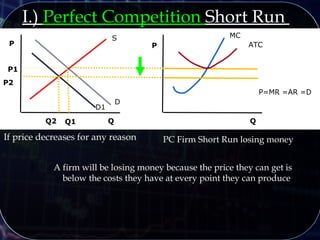
If price decreases for any reason
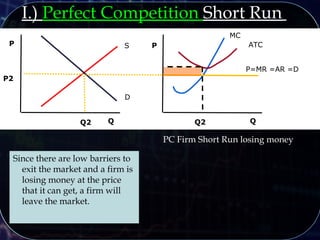
P
PC Firm Short Run losing money
MC
A firm will be losing money because the price they can get is
below the costs they have at every point they can produce
ATC
P=MR =AR =D
I.) Perfect Competition Short Run
D1
Q2
P2
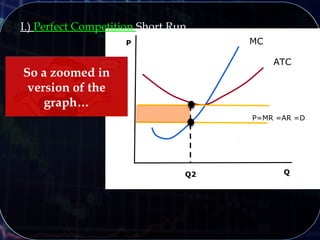
I.) Perfect Competition Short Run
Q
P MC
Q2
ATC
P=MR =AR =D
So a zoomed in
version of the
graph…
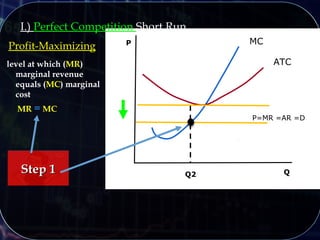
I.) Perfect Competition Short Run
Q
P MC
Q2
ATC
Profit-Maximizing
level at which (MR)
marginal revenue
equals (MC) marginal
cost
MR = MC
P=MR =AR =D
Step 1Step 1
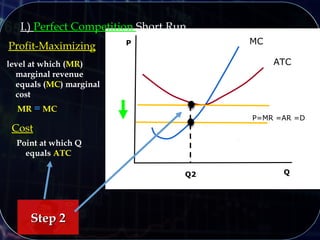
I.) Perfect Competition Short Run
Q
P MC
Q2
ATC
Profit-Maximizing
level at which (MR)
marginal revenue
equals (MC) marginal
cost
MR = MC
Point at which Q
equals ATC
P=MR =AR =D
Cost
Step 2Step 2
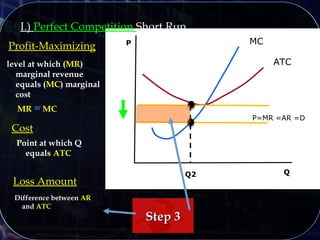
I.) Perfect Competition Short Run
Q
P MC
Q2
ATC
Profit-Maximizing
level at which (MR)
marginal revenue
equals (MC) marginal
cost
MR = MC
Point at which Q
equals ATC
P=MR =AR =D
Cost
Difference between AR
and ATC
Loss Amount
Step 3Step 3
P
Q QQ2
P
PC Firm Short Run losing money
MC
ATC
P=MR =AR =D
I.) Perfect Competition Short Run
D
Q2
P2
Since there are low barriers to
exit the market and a firm is
losing money at the price
that it can get, a firm will
leave the market.
S
P
Q
S
QQ1
P1
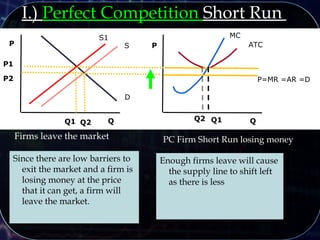
Firms leave the market
P
PC Firm Short Run losing money
MC
ATC
P=MR =AR =D
I.) Perfect Competition Short Run
D
Q2
S1
Since there are low barriers to
exit the market and a firm is
losing money at the price
that it can get, a firm will
leave the market.
Enough firms leave will cause
the supply line to shift left
as there is less
Q1 Q2
P2
P
Q Q
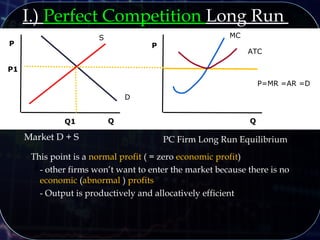
Market D + S
P
PC Firm Long Run Equilibrium
MC
This point is a normal profit ( = zero economic profit)
- other firms won’t want to enter the market because there is no
economic (abnormal ) profits
- Output is productively and allocatively efficient
ATC
P=MR =AR =D
I.) Perfect Competition Long Run
P1
D
S
Q1
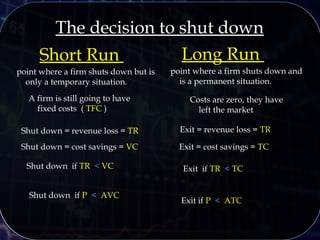
The decision to shut down
point where a firm shuts down but is
only a temporary situation.
point where a firm shuts down and
is a permanent situation.
Long RunShort Run
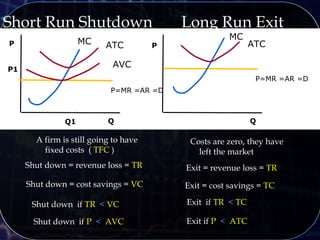
A firm is still going to have
fixed costs ( TFC )
Costs are zero, they have
left the market
Shut down = revenue loss = TR Exit = revenue loss = TR
Shut down = cost savings = VC
Shut down if TR < VC
Shut down if P < AVC
Exit = cost savings = TC
Exit if TR < TC
Exit if P < ATC
P
Q
S
D
QQ1
P1
Market D + S
P
PC Firm exit situation
MC
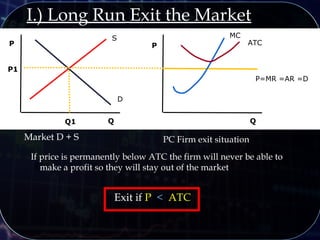
If price is permanently below ATC the firm will never be able to
make a profit so they will stay out of the market
ATC
P=MR =AR =D
I.) Long Run Exit the Market
Exit if P < ATC
P
Q
S
D
QQ1
P1
Market D + S
P
PC Firm shutdown situation
MC
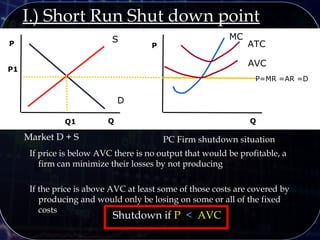
If price is below AVC there is no output that would be profitable, a
firm can minimize their losses by not producing
If the price is above AVC at least some of those costs are covered by
producing and would only be losing on some or all of the fixed
costs
ATC
P=MR =AR =D
I.) Short Run Shut down point
Shutdown if P < AVC
AVC
P
Q QQ1
P1
P
MC
ATC
P=MR =AR =D
Long Run ExitShort Run Shutdown
MC ATC
P=MR =AR =D
AVC
A firm is still going to have
fixed costs ( TFC )
Costs are zero, they have
left the market
Shut down = revenue loss = TR Exit = revenue loss = TR
Shut down = cost savings = VC
Shut down if TR < VC
Shut down if P < AVC
Exit = cost savings = TC
Exit if TR < TC
Exit if P < ATC
P
Q
S
QQ1
P1
P
MC
ATC
P=MR =AR =D
I.) Perfect Competition Short Run
D
Q2Q1
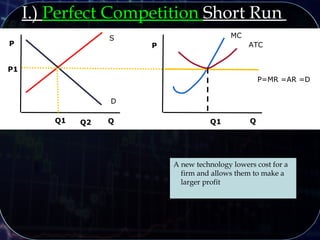
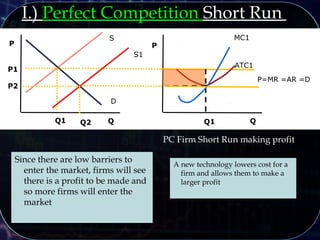
A new technology lowers cost for a
firm and allows them to make a
larger profit
P
Q
S
QQ1
P1
P
PC Firm Short Run making profit
MC
ATC
P=MR =AR =D
I.) Perfect Competition Short Run
D
Q2
ATC1
MC1
A new technology lowers cost for a
firm and allows them to make a
larger profit
Q1
P
Q
S
QQ1
P1
P
PC Firm Short Run making profit
P=MR =AR =D
I.) Perfect Competition Short Run
D
Q2
P2
ATC1
MC1
S1
A new technology lowers cost for a
firm and allows them to make a
larger profit
Since there are low barriers to
enter the market, firms will see
there is a profit to be made and
so more firms will enter the
market
Q1
P
Q QQ1
P
P=MR =AR =D
I.) Perfect Competition Long Run
D
Q2
S1
P2
P=MR =AR =D
ATC1
MC1
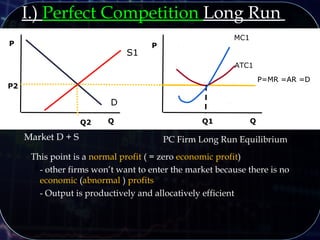
Market D + S PC Firm Long Run Equilibrium
This point is a normal profit ( = zero economic profit)
- other firms won’t want to enter the market because there is no
economic (abnormal ) profits
- Output is productively and allocatively efficient
P
Q
S
D
QQ1
P1
Market D + S
P
Perfectly Competitive Firm
MC
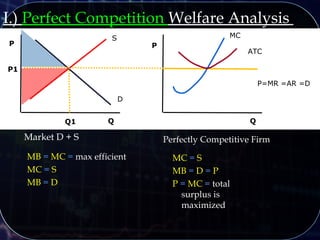
MB = MC = max efficient
MC = S
MB = D
ATC
P=MR =AR =D
I.) Perfect Competition Welfare Analysis
MC = S
MB = D = P
P = MC = total
surplus is
maximized
P
Q Q
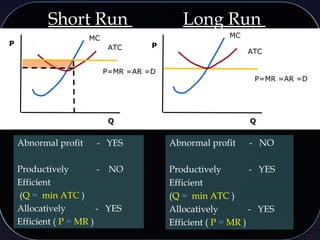
Abnormal profit - YES
Productively - NO
Efficient
(Q = min ATC )
Allocatively - YES
Efficient ( P = MC )
P
MC
ATC
P=MR =AR =D
Long RunShort Run
MC
ATC
P=MR =AR =D
Abnormal profit - NO
Productively - YES
Efficient
(Q = min ATC )
Allocatively - YES
Efficient ( P = MC )
I.) Perfect competition
Market Structure
So to
summarize…
I.) Perfect competition
Market Structure
Easy to enter/exit market
More competitive
Goods are very similar
Efficient allocation
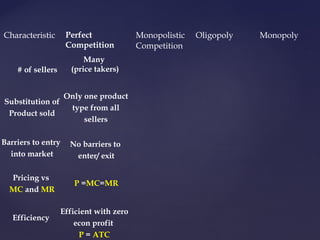
Characteristic Perfect
Competition
Monopolistic
Competition
Oligopoly Monopoly
Substitution of
Product sold
Barriers to entry
into market
Pricing vs
MC and MR
Efficiency
# of sellers
Many
(price takers)
Only one product
type from all
sellers
No barriers to
enter/ exit
P =MC=MR
Efficient with zero
econ profit
P = ATC
The End
Thank you 

Perfect competition SFLS online

  • 1.
    I.) Perfect competition II.)Monopolistic competition III.) Oligopoly IV.) Monopoly Market Structure
  • 2.
    Market Structure Models –a word of warning! - Market structure deals with a number of economic ‘models’ - These models are a representation of reality to help us to understand what may be happening in real life - There are extremes to the model that are unlikely to occur in reality - They still have value as they enable us to draw comparisons and contrasts with what is observed in reality 比较和对比什么是现实 - Models help therefore in analysing and evaluating – they offer a benchmark 基准
  • 3.
    - Even withthese warnings, they do help describe important concerns that you deal with everyday you interact in any economic way: -Degree of competition affects the consumer will it benefit the consumer or not? - Impacts on the performance and behaviour of the company/companies involved. Market Structure
  • 4.
    We will startwith the structure that my vegetable lady works in…
  • 5.
    I.) Perfect competition II.)Monopolistic competition III.) Oligopoly IV.) Monopoly Market Structure
  • 6.
    Profit = Totalrevenue – Total cost the amount a firm receives from the sale of its output the market value of the inputs a firm uses in production What is the goal of business? We assume that the firm’s goal is to maximize profit. But first we have to finish this, I didn’t do the revenue side yet…
  • 7.
    Profit = Totalrevenue – Total cost Costs summary:__________________________ Goods and Services produced Time Production summary:____________________ (TP) Total Product (MP) Marginal Product (AP) Average Product Economic Profit Accountant Profit Explicit Costs Implicit Costs Short Run 1.)Fixed Costs 2.)Variable Costs Long Run 1.) All Variable (TC) Total Cost 1.) (TFC) Total Fixed cost 2.) (TVC) Total Variable cost (MC) Marginal Cost (AC) Average Cost 1.) (ATC) Average Total cost 2.) (AFC) Average Fixed cost 3.) (AVC) Average Variable cost 1.)Depreciation 2.) Normal Profit (MP or MPL) Marginal Product of Labor (DMR) Decreasing Marginal Returns (TR) Total Revenue (MR) Marginal Revenue (AR) Average Revenue
  • 8.
    Defining Revenue (TR) TotalRevenue TR = P x Q Remember elasticity – the square area that shows the total amount received from a price and quantity.
  • 9.
    P Q D 50 8 B 30 12 A Demand for coffee PointA 30 x 12 = 360 Point B 50 x 8 = 400 Example Total Revenue Test Remember P x Q with elasticities?
  • 10.
    (MR) Marginal Revenue DefiningRevenue (TR) Total revenue TR = P x Q ∆TR ∆Q MR = TR Q AR = The change of the very last one sold from the next. Is the best way to find out efficiency.
  • 11.
    (AR) Average Revenue (MR)Marginal Revenue Defining Revenue (TR) Total revenue TR = P x Q ∆TR ∆Q MR = TR Q AR = Average of each unit, this will also will equal the price in a market
  • 12.
    Profit = Totalrevenue – Total cost What is the goal of business? We assume that the firm’s goal is to maximize profit. We assume that the firm’s goal is to maximize profit.
  • 13.
    Profit = Totalrevenue – Total cost What is the goal of business? We assume that the firm’s goal is to maximize profit. We assume that the firm’s goal is to maximize profit. So a summary of all of it now real quick…
  • 14.
    Profit = Totalrevenue – Total cost Costs summary:__________________________ Goods and Services produced Time Production summary:____________________ (TP) Total Product (MP) Marginal Product (AP) Average Product Economic Profit Accountant Profit Explicit Costs Implicit Costs Short Run 1.)Fixed Costs 2.)Variable Costs Long Run 1.) All Variable (TC) Total Cost 1.) (TFC) Total Fixed cost 2.) (TVC) Total Variable cost (MC) Marginal Cost (AC) Average Cost 1.) (ATC) Average Total cost 2.) (AFC) Average Fixed cost 3.) (AVC) Average Variable cost 1.)Depreciation 2.) Normal Profit (MP or MPL) Marginal Product of Labor (DMR) Decreasing Marginal Returns (TR) Total Revenue (MR) Marginal Revenue (AR) Average Revenue
  • 15.
    When marginal product exceeds averageproduct, average product is increasing. When marginal product is less than average product, average product is decreasing. When marginal product equals average product, average product is at its maximum.
  • 16.
    Profit = Totalrevenue – Total cost Costs summary:__________________________ Goods and Services produced Time Production summary:____________________ (TP) Total Product (MP) Marginal Product (AP) Average Product Economic Profit Accountant Profit Explicit Costs Implicit Costs Short Run 1.)Fixed Costs 2.)Variable Costs Long Run 1.) All Variable (TC) Total Cost 1.) (TFC) Total Fixed cost 2.) (TVC) Total Variable cost (MC) Marginal Cost (AC) Average Cost 1.) (ATC) Average Total cost 2.) (AFC) Average Fixed cost 3.) (AVC) Average Variable cost 1.)Depreciation 2.) Normal Profit (MP or MPL) Marginal Product of Labor (DMR) Decreasing Marginal Returns (TR) Total Revenue (MR) Marginal Revenue (AR) Average Revenue
  • 17.
    (TC) Total Cost (TFC)Total Fixed Cost (TVC) Total Variable Cost + =
  • 18.
    The (MC) marginal costcurve is U- shaped and intersects the (AVC) average variable cost curve and the (ATC) average total cost curve at their minimum points.
  • 19.
    A firm’s averagevariable cost curve is linked to its average product curve. If (AP) average product rises, (AVC) average variable cost falls. If (AP) average product is a maximum, (AVC) average variable cost is a minimum.
  • 20.
    Profit = Totalrevenue – Total cost Costs summary:__________________________ Goods and Services produced Time Production summary:____________________ (TP) Total Product (MP) Marginal Product (AP) Average Product Economic Profit Accountant Profit Explicit Costs Implicit Costs Short Run 1.)Fixed Costs 2.)Variable Costs Long Run 1.) All Variable (TC) Total Cost 1.) (TFC) Total Fixed cost 2.) (TVC) Total Variable cost (MC) Marginal Cost (AC) Average Cost 1.) (ATC) Average Total cost 2.) (AFC) Average Fixed cost 3.) (AVC) Average Variable cost 1.)Depreciation 2.) Normal Profit (MP or MPL) Marginal Product of Labor (DMR) Decreasing Marginal Returns (TR) Total Revenue (MR) Marginal Revenue (AR) Average Revenue
  • 21.
    Economies of scaleas output increases to 9 gallons an hour constant returns to scale for outputs between 9 gallons and 12 gallons an hour. and diseconomies of scale for outputs that exceed 12 gallons an hour.
  • 22.
    Profit = Totalrevenue – Total cost What is the goal of business? We assume that the firm’s goal is to maximize profit. We assume that the firm’s goal is to maximize profit. The next two vocabulary parts are the super important ones to note on every graph.
  • 23.
    (MR) Marginal Revenue ProfitMaximization ∆TR ∆Q Profit-Maximizing Output: level at which (MR) marginal revenue equals (MC) marginal cost MR = MC We assume all firms are profit maximizing, producing at the point where their profits are at their highest (MC) Marginal Cost ∆TC ∆Q
  • 24.
    Profit Maximization Profit-Maximizing Output:level at which (MR) marginal revenue equals (MC) marginal cost MR = MC We assume all firms are profit maximizing, producing at the point where their profits are at their highest If increase Q by one unit, revenue rises (or fall) by MR, cost rises by MC. If MR > MC, then increase Q to raise profit. If MR < MC, then reduce Q to raise profit.
  • 25.
    Profit-Maximizing Level Where marginalrevenue equals marginal cost MR = MC Cost-Minimizing Level Where marginal costs equals lowest point on average total cost curve MC = ATC Profit Maximization
  • 26.
    Profit-Maximizing Level Where marginalrevenue equals marginal cost MR = MC Cost-Minimizing Level Where marginal costs equals lowest point on average total cost curve MC = ATC Profit Maximization Step 1 on every graph is this point
  • 27.
    Profit-Maximizing Level Where marginalrevenue equals marginal cost MR = MC Cost-Minimizing Level Where marginal costs equals lowest point on average total cost curve MC = ATC Profit Maximization Step 2 on every graph is this point
  • 28.
    I.) Perfect competition II.)Monopolistic competition III.) Oligopoly IV.) Monopoly Four Market Types Market Structure Quick summary and comparison…
  • 29.
    I.) Perfect competition MarketStructure Easy to enter/exit market More competitive Goods are very similar Efficient allocation
  • 30.
    II.) Monopolistic competition MarketStructure Easy to enter/exit market Competitive Goods are different Not very efficient allocation
  • 31.
    III.) Oligopoly Market Structure Hardto enter/exit market Competitive Goods are similar Not efficient allocation
  • 32.
    IV.) Monopoly Market Structure Hardto enter/exit market Not competitive Only one seller Not efficient allocation
  • 33.
    Market Structure More competitive(fewer imperfections) Perfect Competition Pure Monopoly
  • 34.
  • 35.
    Market Structure Perfect Competition Pure Monopoly The furtherright on the scale, the greater the degree of monopoly power exercised by the firm. Monopolistic Competition Oligopoly Duopoly Monopoly
  • 36.
    Market Types I.) perfectcompetition Ok, finally…
  • 37.
    Characteristic Perfect Competition Monopolistic Competition Oligopoly Monopoly Substitutionof Product sold Barriers to entry into market Pricing vs MC and MR Efficiency # of sellers
  • 38.
    Characteristic Perfect Competition Monopolistic Competition Oligopoly Monopoly Substitutionof Product sold Barriers to entry into market Pricing vs MC and MR Efficiency # of sellers A summary of the notes for each type.
  • 39.
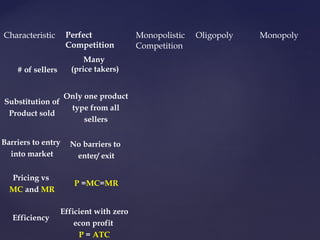
    Characteristic Perfect Competition Monopolistic Competition Oligopoly Monopoly Substitutionof Product sold Barriers to entry into market Pricing vs MC and MR Efficiency # of sellers Many (price takers) Only one product type from all sellers No barriers to enter/ exit P =MC=MR Efficient with zero econ profit P = ATC
  • 40.
    I.) Perfect Competition -Manyfirms sell an identical product to many buyers.
  • 41.
    She sells thesame as everyone else and there are lots of sellers
  • 42.
    Like my vegetableLikemy vegetable lady…lady…
  • 43.
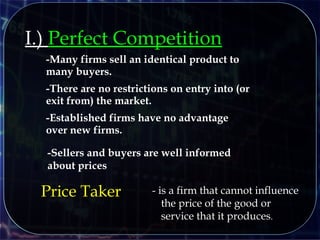
    I.) Perfect Competition -Manyfirms sell an identical product to many buyers. -There are no restrictions on entry into (or exit from) the market. -Established firms have no advantage over new firms. -Sellers and buyers are well informed about prices Price Taker - is a firm that cannot influence the price of the good or service that it produces.
  • 44.
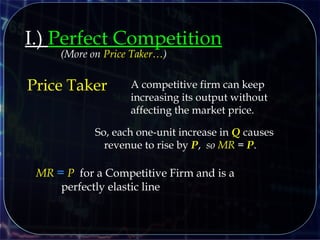
    I.) Perfect Competition PriceTaker (More on Price Taker…) So, each one-unit increase in Q causes revenue to rise by P, so MR = P. A competitive firm can keep increasing its output without affecting the market price. MR = P for a Competitive Firm and is a perfectly elastic line
  • 45.
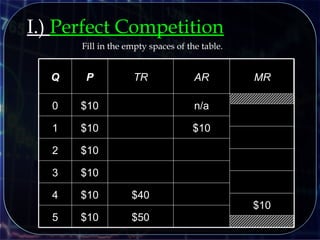
    Fill in theempty spaces of the table. $50$105 $40$104 $103 $102 $10$101 n/a$100 TRPQ MRAR $10 I.) Perfect Competition
  • 46.
    Fill in theempty spaces of the table. $50$105 $40$104 $103 $10 $10 $10 $10$102 $10$101 n/a $30 $20 $10 $0$100 TR = P x QPQ ∆TR ∆Q MR = TR Q AR = $10 $10 $10 $10 $10 I.) Perfect Competition
  • 47.
    Fill in theempty spaces of the table. $50$105 $40$104 $103 $10 $10 $10 $10$102 $10$101 n/a $30 $20 $10 $0$100 TR = P x QPQ ∆TR ∆Q MR = TR Q AR = $10 $10 $10 $10 $10 Notice that MR = P Notice that MR = P I.) Perfect Competition
  • 48.
    Market Types I.) perfectcompetition I have created a large number of graphs here, however the transitions in the PPT make it easier to follow, I recommend to download the other version of the PPT to follow since I can’t make transitions here in this version of the PPT.
  • 49.
    P Q P S D QQ1 P1 This is theDemand and Supply Lines of the whole market P This line ends up being the only price they can charge = MR Which is also their marginal revenue on each unit = D=AR And the average revenue So this is the demand curve for the single firm in the market I.) Perfect Competition
  • 50.
    (MR) Marginal Revenue ProfitMaximization ∆TR ∆Q Profit-Maximizing Output: level at which (MR) marginal revenue equals (MC) marginal cost MR = MC We assume all firms are profit maximizing, producing at the point where their profits are at their highest (MC) Marginal Cost ∆TC ∆Q Step 1, find thisStep 1, find this point!point!
  • 51.
    505 404 303 202 101 $00 ∆Profit = MR –MC MCMRProfitTCTRQ At any Q with MR > MC, increasing Q raises profit. 10 10 10 10 $10 (continued from earlier table) At any Q with MR < MC, reducing Q raises profit. Profit Maximization First – What is MC?
  • 52.
    505 404 303 202 101 $00 ∆Profit = MR –MC MCMRProfitTCTRQ At any Q with MR > MC, increasing Q raises profit. 10 10 10 10 $10 (continued from earlier table) At any Q with MR < MC, reducing Q raises profit. Profit Maximization First – What is MC? Second – What is Profit?
  • 53.
    505 404 303 202 101 $00 ∆Profit = MR –MC MCMRProfitTCTRQ At any Q with MR > MC, increasing Q raises profit. 10 10 10 10 $10 (continued from earlier table) At any Q with MR < MC, reducing Q raises profit. Profit Maximization First – What is MC? Second – What is Profit? Third – What is Profit Max point?
  • 54.
    P=MR=AR=D I.) Perfect Competition Q P theMC curve is the Supply curve for the single firm in the market MC Rule: MR = MC is the profit-maximizing point Q1Q2 Q3 = S At any Q with MR > MC, increasing Q raises profit. At any Q with MR < MC, reducing Q raises profit.
  • 55.
    P Q I.) Perfect Competition S D QQ1 P1 Thisis the Demand and Supply Lines of the whole market P So this is the Supply and Demand curves for the single firm in a perfectly competitive market MC = S Except for this big issue This is not the only cost curve a firm faces we must add the others to truly determine the supply curve which also effect other decisions P = MR = D=AR
  • 56.
    Short Run Costs (AVC)Average Variable Cost (AFC) Average Fixed Cost (ATC) Average Total Cost will determine profits in the short and long run. Will determine when a firm shuts down in the short run and exits the market in the long run. Don’t care very much about this one
  • 57.
    I.) Perfect CompetitionCost Curves Q P *** Any price below ATC is losing money and will effect decisions to shut down and exit the market in the long run MC Rule: MC = ATC is the cost minimizing point Q1 ATC Profit-Maximizing Level Where marginal revenue equals marginal cost MR = MC Cost-Minimizing Where marginal costs equals lowest point on average total cost curve MC = ATC
  • 58.
    Putting it alltogether… I will start at the easiest graph and go the harder graphs, but this means I will have to do things a little bit out of order Decisions are different in the long run and the short run and I will start with the long run first since it is the easiest graph and the graph that all the other ones are moving towards anyway.
  • 59.
    P Q S D QQ1 P1 Market D +S P PC Firm Long Run Equilibrium MC This point is a normal profit ( = zero economic profit) - other firms won’t want to enter the market because there is no economic (abnormal ) profits - Output is productively and allocatively efficient ATC P=MR =AR =D I.) Perfect Competition Long Run Q1
  • 60.
    P Q S D QQ1 P1 If price increasesfor any reason P PC Firm Short Run making profit MC A firm can make economic (abnormal) profit in the short run ATC P=MR =AR =D I.) Perfect Competition Short Run D1 Q2 P2 Price is above long run equilibrium of normal profits
  • 61.
    I.) Perfect CompetitionShort Run Q P MC Q1 Q2 ATC P=MR =AR =D So a zoomed in version of the graph…
  • 62.
    I.) Perfect CompetitionShort Run Q P MC Q1 Q2 ATC Profit-Maximizing Where marginal revenue equals marginal cost MR = MC P=MR =AR =D Step 1Step 1
  • 63.
    I.) Perfect CompetitionShort Run Q P MC Q1 Q2 ATC Profit-Maximizing Where marginal revenue equals marginal cost MR = MC Point at which Q equals ATC P=MR =AR =D Cost Step 2Step 2
  • 64.
    I.) Perfect CompetitionShort Run Q P MC Q1 Q2 ATC Profit-Maximizing Where marginal revenue equals marginal cost MR = MC Point at which Q equals ATC P=MR =AR =D Cost Difference between AR and ATC Profit Amount Step 3Step 3
  • 65.
    P Q S QQ2 If price increasesfor any reason P PC Firm Short Run making profit MC Since there are low barriers to enter the market, firms will see there is a profit to be made and so more firms will enter the market ATC P=MR =AR =D I.) Perfect Competition Short Run D Q2 P2
  • 66.
    P Q S QQ1 P1 P MC ATC P=MR =AR =D I.)Perfect Competition Short Run D Q1 P2 S1 Q2 Q2 Since there are low barriers to enter the market, firms will see there is a profit to be made and so more firms will enter the market This will increase the supply and lower the price until it reaches long run equilibrium again and all abnormal profits will be gone
  • 67.
    P Q S D QQ1 P1 Market D +S P PC Firm Long Run Equilibrium MC This point is a normal profit ( = zero economic profit) - other firms won’t want to enter the market because there is no economic (abnormal ) profits - Output is productively and allocatively efficient ATC P=MR =AR =D I.) Perfect Competition Long Run
  • 68.
    P Q S D QQ1 P1 If price decreasesfor any reason P PC Firm Short Run losing money MC A firm will be losing money because the price they can get is below the costs they have at every point they can produce ATC P=MR =AR =D I.) Perfect Competition Short Run D1 Q2 P2
  • 69.
    I.) Perfect CompetitionShort Run Q P MC Q2 ATC P=MR =AR =D So a zoomed in version of the graph…
  • 70.
    I.) Perfect CompetitionShort Run Q P MC Q2 ATC Profit-Maximizing level at which (MR) marginal revenue equals (MC) marginal cost MR = MC P=MR =AR =D Step 1Step 1
  • 71.
    I.) Perfect CompetitionShort Run Q P MC Q2 ATC Profit-Maximizing level at which (MR) marginal revenue equals (MC) marginal cost MR = MC Point at which Q equals ATC P=MR =AR =D Cost Step 2Step 2
  • 72.
    I.) Perfect CompetitionShort Run Q P MC Q2 ATC Profit-Maximizing level at which (MR) marginal revenue equals (MC) marginal cost MR = MC Point at which Q equals ATC P=MR =AR =D Cost Difference between AR and ATC Loss Amount Step 3Step 3
  • 73.
    P Q QQ2 P PC FirmShort Run losing money MC ATC P=MR =AR =D I.) Perfect Competition Short Run D Q2 P2 Since there are low barriers to exit the market and a firm is losing money at the price that it can get, a firm will leave the market. S
  • 74.
    P Q S QQ1 P1 Firms leave themarket P PC Firm Short Run losing money MC ATC P=MR =AR =D I.) Perfect Competition Short Run D Q2 S1 Since there are low barriers to exit the market and a firm is losing money at the price that it can get, a firm will leave the market. Enough firms leave will cause the supply line to shift left as there is less Q1 Q2 P2
  • 75.
    P Q Q Market D+ S P PC Firm Long Run Equilibrium MC This point is a normal profit ( = zero economic profit) - other firms won’t want to enter the market because there is no economic (abnormal ) profits - Output is productively and allocatively efficient ATC P=MR =AR =D I.) Perfect Competition Long Run P1 D S Q1
  • 76.
    The decision toshut down point where a firm shuts down but is only a temporary situation. point where a firm shuts down and is a permanent situation. Long RunShort Run A firm is still going to have fixed costs ( TFC ) Costs are zero, they have left the market Shut down = revenue loss = TR Exit = revenue loss = TR Shut down = cost savings = VC Shut down if TR < VC Shut down if P < AVC Exit = cost savings = TC Exit if TR < TC Exit if P < ATC
  • 77.
    P Q S D QQ1 P1 Market D +S P PC Firm exit situation MC If price is permanently below ATC the firm will never be able to make a profit so they will stay out of the market ATC P=MR =AR =D I.) Long Run Exit the Market Exit if P < ATC
  • 78.
    P Q S D QQ1 P1 Market D +S P PC Firm shutdown situation MC If price is below AVC there is no output that would be profitable, a firm can minimize their losses by not producing If the price is above AVC at least some of those costs are covered by producing and would only be losing on some or all of the fixed costs ATC P=MR =AR =D I.) Short Run Shut down point Shutdown if P < AVC AVC
  • 79.
    P Q QQ1 P1 P MC ATC P=MR =AR=D Long Run ExitShort Run Shutdown MC ATC P=MR =AR =D AVC A firm is still going to have fixed costs ( TFC ) Costs are zero, they have left the market Shut down = revenue loss = TR Exit = revenue loss = TR Shut down = cost savings = VC Shut down if TR < VC Shut down if P < AVC Exit = cost savings = TC Exit if TR < TC Exit if P < ATC
  • 80.
    P Q S QQ1 P1 P MC ATC P=MR =AR =D I.)Perfect Competition Short Run D Q2Q1 A new technology lowers cost for a firm and allows them to make a larger profit
  • 81.
    P Q S QQ1 P1 P PC Firm ShortRun making profit MC ATC P=MR =AR =D I.) Perfect Competition Short Run D Q2 ATC1 MC1 A new technology lowers cost for a firm and allows them to make a larger profit Q1
  • 82.
    P Q S QQ1 P1 P PC Firm ShortRun making profit P=MR =AR =D I.) Perfect Competition Short Run D Q2 P2 ATC1 MC1 S1 A new technology lowers cost for a firm and allows them to make a larger profit Since there are low barriers to enter the market, firms will see there is a profit to be made and so more firms will enter the market Q1
  • 83.
    P Q QQ1 P P=MR =AR=D I.) Perfect Competition Long Run D Q2 S1 P2 P=MR =AR =D ATC1 MC1 Market D + S PC Firm Long Run Equilibrium This point is a normal profit ( = zero economic profit) - other firms won’t want to enter the market because there is no economic (abnormal ) profits - Output is productively and allocatively efficient
  • 84.
    P Q S D QQ1 P1 Market D +S P Perfectly Competitive Firm MC MB = MC = max efficient MC = S MB = D ATC P=MR =AR =D I.) Perfect Competition Welfare Analysis MC = S MB = D = P P = MC = total surplus is maximized
  • 85.
    P Q Q Abnormal profit- YES Productively - NO Efficient (Q = min ATC ) Allocatively - YES Efficient ( P = MC ) P MC ATC P=MR =AR =D Long RunShort Run MC ATC P=MR =AR =D Abnormal profit - NO Productively - YES Efficient (Q = min ATC ) Allocatively - YES Efficient ( P = MC )
  • 86.
    I.) Perfect competition MarketStructure So to summarize…
  • 87.
    I.) Perfect competition MarketStructure Easy to enter/exit market More competitive Goods are very similar Efficient allocation
  • 88.
    Characteristic Perfect Competition Monopolistic Competition Oligopoly Monopoly Substitutionof Product sold Barriers to entry into market Pricing vs MC and MR Efficiency # of sellers Many (price takers) Only one product type from all sellers No barriers to enter/ exit P =MC=MR Efficient with zero econ profit P = ATC
  • 89.

Editor's Notes

  • #16 The grade point average versus marginal grade example (see slide 69) in the text is outstanding to use in class to describe how the marginal product and marginal cost curves relate to the average product and average cost curves. Once students can tell a story using the same intuition, they find drawing those curves much easier. While you have the curves drawn on the board or overhead, physically pull the average cost curves down (while marginal cost is below) or pull them up (when the marginal cost curve rises above). Use theatrics: raise your hands over your head and “pull down the curves.” If you have a more sports-oriented class, you can try using a batting average percentage and at-bat outcome example (if you had a .300 batting average and you struck out at your next at-bat [the marginal factor], your batting average is pulled down).
  • #22 Leave your students with two big ideas: First, a firm’s long-run production costs depend on the freedom to choose all inputs. Long-run flexibility enables firms to produce at a lower cost than is possible in the short run when some inputs are fixed. Second, in the short run, with one or more fixed inputs, production costs vary with output in a predictable way because they are directly linked to input productivity.
  • #46 This easy exercise requires students to apply the definitions from the previous slide. It also demonstrates that MR = P for a competitive firm. (The table in this exercise is similar to Table 1 in the chapter.)
  • #52 (The table on this slide is similar to Table 2 in the textbook.) For most students, seeing the complete table all at once is too much information. So, the table is animated as follows: Initially, the only columns displayed are the ones students saw at the end of the exercise in Active Learning 1: Q, TR, and MR. Then, TC appears, followed by MC. It might be useful to remind students of the relationship between MC and TC. Then, the Profit column appears. Students should be able to see that, at each value of Q, profit equals TR minus TC. The last column to appear is the change in profit. When the table is complete, we use it to show it is profitable to increase production whenever MR &amp;gt; MC, such as at Q = 0, 1, or 2. it is profitable to reduce production whenever MC &amp;gt; MR, such as at Q = 5.
  • #53 (The table on this slide is similar to Table 2 in the textbook.) For most students, seeing the complete table all at once is too much information. So, the table is animated as follows: Initially, the only columns displayed are the ones students saw at the end of the exercise in Active Learning 1: Q, TR, and MR. Then, TC appears, followed by MC. It might be useful to remind students of the relationship between MC and TC. Then, the Profit column appears. Students should be able to see that, at each value of Q, profit equals TR minus TC. The last column to appear is the change in profit. When the table is complete, we use it to show it is profitable to increase production whenever MR &amp;gt; MC, such as at Q = 0, 1, or 2. it is profitable to reduce production whenever MC &amp;gt; MR, such as at Q = 5.
  • #54 (The table on this slide is similar to Table 2 in the textbook.) For most students, seeing the complete table all at once is too much information. So, the table is animated as follows: Initially, the only columns displayed are the ones students saw at the end of the exercise in Active Learning 1: Q, TR, and MR. Then, TC appears, followed by MC. It might be useful to remind students of the relationship between MC and TC. Then, the Profit column appears. Students should be able to see that, at each value of Q, profit equals TR minus TC. The last column to appear is the change in profit. When the table is complete, we use it to show it is profitable to increase production whenever MR &amp;gt; MC, such as at Q = 0, 1, or 2. it is profitable to reduce production whenever MC &amp;gt; MR, such as at Q = 5.