The Engineering
Design Cycle
Overview
http://labs.ee.washington.edu/community/BasicEngDes/
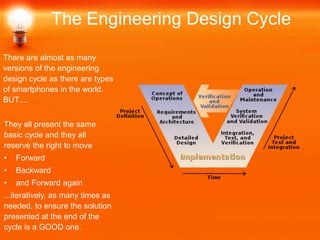
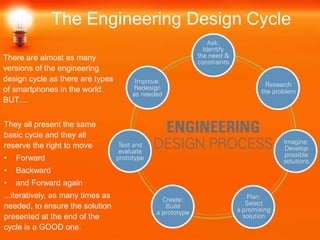
There are almost as many
versions of the engineering
design cycle as there are types
of smartphones in the world.
BUT....
The Engineering Design Cycle
Identify the
Problem
Construct
Prototype
Research the
Need
Select the
Best Solution
Design
Solutions
Redesign/
Iterate
Test and
Evaluate
Present the
Solution
They all present the same
basic cycle and they all
reserve the right to move
• Forward
• Backward
• and Forward again
...iteratively, as many times as
needed, to ensure the solution
presented at the end of the
cycle is a GOOD one.
There are almost as many
versions of the engineering
design cycle as there are types
of smartphones in the world.
BUT....
The Engineering Design Cycle
They all present the same
basic cycle and they all
reserve the right to move
• Forward
• Backward
• and Forward again
...iteratively, as many times as
needed, to ensure the solution
presented at the end of the
cycle is a GOOD one.
There are almost as many
versions of the engineering
design cycle as there are types
of smartphones in the world.
BUT....
The Engineering Design Cycle
They all present the same
basic cycle and they all
reserve the right to move
• Forward
• Backward
• and Forward again
...iteratively, as many times as
needed, to ensure the solution
presented at the end of the
cycle is a GOOD one.
The Engineering Design Cycle
Identify the
Problem
Construct
Prototype
Research the
Need
Select the
Best Solution
Design
Solutions
Redesign/
Iterate
Test and
Evaluate
Present the
Solution
Identify
the
Problem:
Who
NEEDS
What
BECAUSE
WHY?
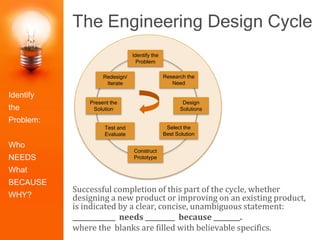
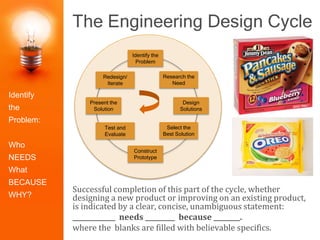
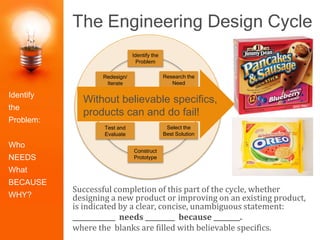
Successful completion of this part of the cycle, whether
designing a new product or improving on an existing product,
is indicated by a clear, concise, unambiguous statement:
_____________ needs _________ because ________.
where the blanks are filled with believable specifics.
The Engineering Design Cycle
Identify the
Problem
Construct
Prototype
Research the
Need
Select the
Best Solution
Design
Solutions
Redesign/
Iterate
Test and
Evaluate
Present the
Solution
Identify
the
Problem:
Who
NEEDS
What
BECAUSE
WHY?
Successful completion of this part of the cycle, whether
designing a new product or improving on an existing product,
is indicated by a clear, concise, unambiguous statement:
_____________ needs _________ because ________.
where the blanks are filled with believable specifics.
The Engineering Design Cycle
Identify the
Problem
Construct
Prototype
Research the
Need
Select the
Best Solution
Design
Solutions
Redesign/
Iterate
Test and
Evaluate
Present the
Solution
Identify
the
Problem:
Who
NEEDS
What
BECAUSE
WHY?
Successful completion of this part of the cycle, whether
designing a new product or improving on an existing product,
is indicated by a clear, concise, unambiguous statement:
_____________ needs _________ because ________.
where the blanks are filled with believable specifics.
Without believable specifics,
products can and do fail!
The Engineering Design Cycle
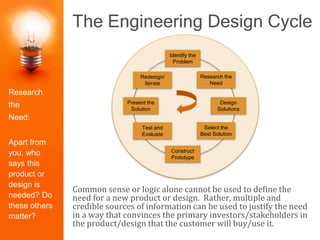
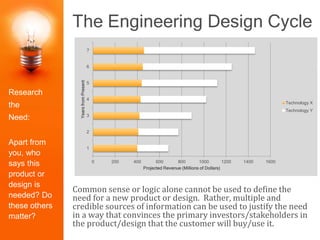
Common sense or logic alone cannot be used to define the
need for a new product or design. Rather, multiple and
credible sources of information can be used to justify the need
in a way that convinces the primary investors/stakeholders in
the product/design that the customer will buy/use it.
Research
the
Need:
Apart from
you, who
says this
product or
design is
needed? Do
these others
matter?
Identify the
Problem
Construct
Prototype
Research the
Need
Select the
Best Solution
Design
Solutions
Redesign/
Iterate
Test and
Evaluate
Present the
Solution
The Engineering Design Cycle
Common sense or logic alone cannot be used to define the
need for a new product or design. Rather, multiple and
credible sources of information can be used to justify the need
in a way that convinces the primary investors/stakeholders in
the product/design that the customer will buy/use it.
Research
the
Need:
Apart from
you, who
says this
product or
design is
needed? Do
these others
matter?
0 200 400 600 800 1000 1200 1400 1600
1
2
3
4
5
6
7
Projected Revenue (Millions of Dollars)
YearsfromPresent
Technology X
Technology Y
The Engineering Design Cycle
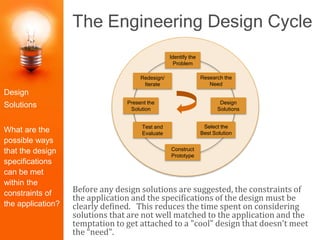
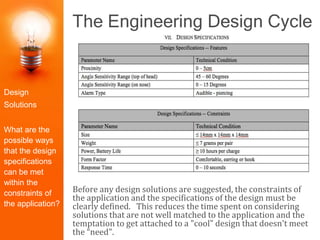
Before any design solutions are suggested, the constraints of
the application and the specifications of the design must be
clearly defined. This reduces the time spent on considering
solutions that are not well matched to the application and the
temptation to get attached to a "cool" design that doesn't meet
the “need".
Identify the
Problem
Construct
Prototype
Research the
Need
Select the
Best Solution
Design
Solutions
Redesign/
Iterate
Test and
Evaluate
Present the
Solution
Design
Solutions
What are the
possible ways
that the design
specifications
can be met
within the
constraints of
the application?
The Engineering Design Cycle
Before any design solutions are suggested, the constraints of
the application and the specifications of the design must be
clearly defined. This reduces the time spent on considering
solutions that are not well matched to the application and the
temptation to get attached to a "cool" design that doesn't meet
the “need".
Identify the
Problem
Construct
Prototype
Research the
Need
Select the
Best Solution
Design
Solutions
Redesign/Iter
ate
Test and
Evaluate
Present the
Solution
Design
Solutions
What are the
possible ways
that the design
specifications
can be met
within the
constraints of
the application?
The Engineering Design Cycle
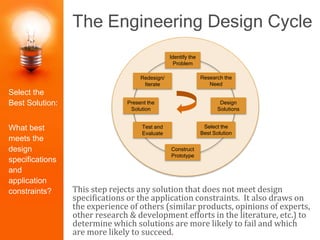
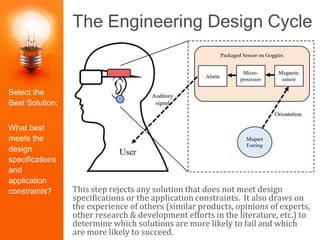
This step rejects any solution that does not meet design
specifications or the application constraints. It also draws on
the experience of others (similar products, opinions of experts,
other research & development efforts in the literature, etc.) to
determine which solutions are more likely to fail and which
are more likely to succeed.
Identify the
Problem
Construct
Prototype
Research the
Need
Select the
Best Solution
Design
Solutions
Redesign/
Iterate
Test and
Evaluate
Present the
Solution
Select the
Best Solution:
What best
meets the
design
specifications
and
application
constraints?
The Engineering Design Cycle
This step rejects any solution that does not meet design
specifications or the application constraints. It also draws on
the experience of others (similar products, opinions of experts,
other research & development efforts in the literature, etc.) to
determine which solutions are more likely to fail and which
are more likely to succeed.
Identify the
Problem
Construct
Prototype
Research the
Need
Select the
Best Solution
Design
Solutions
Redesign/Iter
ate
Test and
Evaluate
Present the
Solution
Select the
Best Solution:
What best
meets the
design
specifications
and
application
constraints?
The Engineering Design Cycle
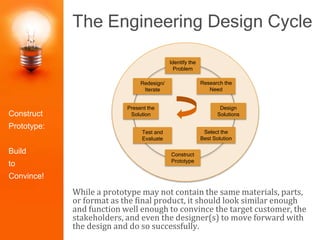
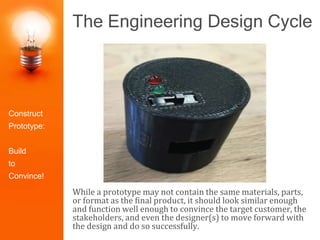
While a prototype may not contain the same materials, parts,
or format as the final product, it should look similar enough
and function well enough to convince the target customer, the
stakeholders, and even the designer(s) to move forward with
the design and do so successfully.
Identify the
Problem
Construct
Prototype
Research the
Need
Select the
Best Solution
Design
Solutions
Redesign/
Iterate
Test and
Evaluate
Present the
SolutionConstruct
Prototype:
Build
to
Convince!
The Engineering Design Cycle
While a prototype may not contain the same materials, parts,
or format as the final product, it should look similar enough
and function well enough to convince the target customer, the
stakeholders, and even the designer(s) to move forward with
the design and do so successfully.
Identify the
Problem
Construct
Prototype
Research the
Need
Select the
Best Solution
Design
Solutions
Redesign/Iter
ate
Test and
Evaluate
Present the
SolutionConstruct
Prototype:
Build
to
Convince!
The Engineering Design Cycle
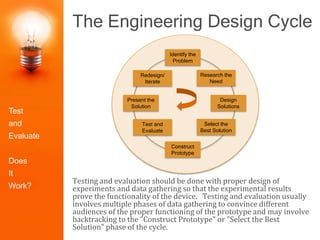
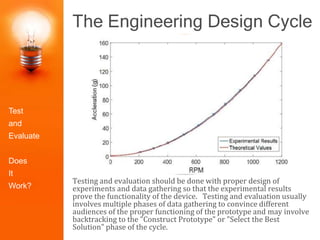
Testing and evaluation should be done with proper design of
experiments and data gathering so that the experimental results
prove the functionality of the device. Testing and evaluation usually
involves multiple phases of data gathering to convince different
audiences of the proper functioning of the prototype and may involve
backtracking to the "Construct Prototype" or "Select the Best
Solution" phase of the cycle.
Identify the
Problem
Construct
Prototype
Research the
Need
Select the
Best Solution
Design
Solutions
Redesign/
Iterate
Test and
Evaluate
Present the
Solution
Test
and
Evaluate
Does
It
Work?
The Engineering Design Cycle
Testing and evaluation should be done with proper design of
experiments and data gathering so that the experimental results
prove the functionality of the device. Testing and evaluation usually
involves multiple phases of data gathering to convince different
audiences of the proper functioning of the prototype and may involve
backtracking to the "Construct Prototype" or "Select the Best
Solution" phase of the cycle.
Identify the
Problem
Construct
Prototype
Research the
Need
Select the
Best Solution
Design
Solutions
Redesign/Iter
ate
Test and
Evaluate
Present the
Solution
Test
and
Evaluate
Does
It
Work?
The Engineering Design Cycle
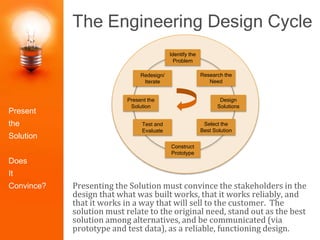
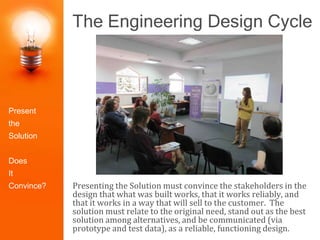
Presenting the Solution must convince the stakeholders in the
design that what was built works, that it works reliably, and
that it works in a way that will sell to the customer. The
solution must relate to the original need, stand out as the best
solution among alternatives, and be communicated (via
prototype and test data), as a reliable, functioning design.
Identify the
Problem
Construct
Prototype
Research the
Need
Select the
Best Solution
Design
Solutions
Redesign/
Iterate
Test and
Evaluate
Present the
Solution
Present
the
Solution
Does
It
Convince?
The Engineering Design Cycle
Presenting the Solution must convince the stakeholders in the
design that what was built works, that it works reliably, and
that it works in a way that will sell to the customer. The
solution must relate to the original need, stand out as the best
solution among alternatives, and be communicated (via
prototype and test data), as a reliable, functioning design.
Identify the
Problem
Construct
Prototype
Research the
Need
Select the
Best Solution
Design
Solutions
Redesign/Iter
ate
Test and
Evaluate
Present the
Solution
Present
the
Solution
Does
It
Convince?
The Engineering Design Cycle
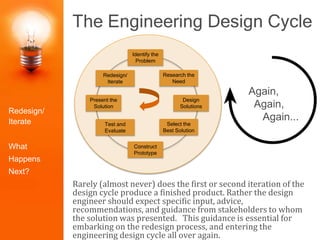
Rarely (almost never) does the first or second iteration of the
design cycle produce a finished product. Rather the design
engineer should expect specific input, advice,
recommendations, and guidance from stakeholders to whom
the solution was presented. This guidance is essential for
embarking on the redesign process, and entering the
engineering design cycle all over again.
Identify the
Problem
Construct
Prototype
Research the
Need
Select the
Best Solution
Design
Solutions
Redesign/
Iterate
Test and
Evaluate
Present the
Solution
Redesign/
Iterate
What
Happens
Next?
The Engineering Design Cycle
Rarely (almost never) does the first or second iteration of the
design cycle produce a finished product. Rather the design
engineer should expect specific input, advice,
recommendations, and guidance from stakeholders to whom
the solution was presented. This guidance is essential for
embarking on the redesign process, and entering the
engineering design cycle all over again.
Identify the
Problem
Construct
Prototype
Research the
Need
Select the
Best Solution
Design
Solutions
Redesign/
Iterate
Test and
Evaluate
Present the
Solution
Redesign/
Iterate
What
Happens
Next?
Again,
Again,
Again...
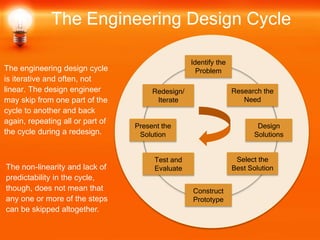
The engineering design cycle
is iterative and often, not
linear. The design engineer
may skip from one part of the
cycle to another and back
again, repeating all or part of
the cycle during a redesign.
The Engineering Design Cycle
Identify the
Problem
Construct
Prototype
Research the
Need
Select the
Best Solution
Design
Solutions
Redesign/
Iterate
Test and
Evaluate
Present the
Solution
The non-linearity and lack of
predictability in the cycle,
though, does not mean that
any one or more of the steps
can be skipped altogether.
Complete Educational Materials (including assignments,
quizzes, and recorded lectures) on the topic of Basic
Engineering Design can be found at:
http://labs.ee.washington.edu/community/BasicEngDes/
The Engineering Design Cycle

Basic Engineering Design: Overview

  • 1.
  • 2.
    There are almostas many versions of the engineering design cycle as there are types of smartphones in the world. BUT.... The Engineering Design Cycle Identify the Problem Construct Prototype Research the Need Select the Best Solution Design Solutions Redesign/ Iterate Test and Evaluate Present the Solution They all present the same basic cycle and they all reserve the right to move • Forward • Backward • and Forward again ...iteratively, as many times as needed, to ensure the solution presented at the end of the cycle is a GOOD one.
  • 3.
    There are almostas many versions of the engineering design cycle as there are types of smartphones in the world. BUT.... The Engineering Design Cycle They all present the same basic cycle and they all reserve the right to move • Forward • Backward • and Forward again ...iteratively, as many times as needed, to ensure the solution presented at the end of the cycle is a GOOD one.
  • 4.
    There are almostas many versions of the engineering design cycle as there are types of smartphones in the world. BUT.... The Engineering Design Cycle They all present the same basic cycle and they all reserve the right to move • Forward • Backward • and Forward again ...iteratively, as many times as needed, to ensure the solution presented at the end of the cycle is a GOOD one.
  • 5.
    The Engineering DesignCycle Identify the Problem Construct Prototype Research the Need Select the Best Solution Design Solutions Redesign/ Iterate Test and Evaluate Present the Solution Identify the Problem: Who NEEDS What BECAUSE WHY? Successful completion of this part of the cycle, whether designing a new product or improving on an existing product, is indicated by a clear, concise, unambiguous statement: _____________ needs _________ because ________. where the blanks are filled with believable specifics.
  • 6.
    The Engineering DesignCycle Identify the Problem Construct Prototype Research the Need Select the Best Solution Design Solutions Redesign/ Iterate Test and Evaluate Present the Solution Identify the Problem: Who NEEDS What BECAUSE WHY? Successful completion of this part of the cycle, whether designing a new product or improving on an existing product, is indicated by a clear, concise, unambiguous statement: _____________ needs _________ because ________. where the blanks are filled with believable specifics.
  • 7.
    The Engineering DesignCycle Identify the Problem Construct Prototype Research the Need Select the Best Solution Design Solutions Redesign/ Iterate Test and Evaluate Present the Solution Identify the Problem: Who NEEDS What BECAUSE WHY? Successful completion of this part of the cycle, whether designing a new product or improving on an existing product, is indicated by a clear, concise, unambiguous statement: _____________ needs _________ because ________. where the blanks are filled with believable specifics. Without believable specifics, products can and do fail!
  • 8.
    The Engineering DesignCycle Common sense or logic alone cannot be used to define the need for a new product or design. Rather, multiple and credible sources of information can be used to justify the need in a way that convinces the primary investors/stakeholders in the product/design that the customer will buy/use it. Research the Need: Apart from you, who says this product or design is needed? Do these others matter? Identify the Problem Construct Prototype Research the Need Select the Best Solution Design Solutions Redesign/ Iterate Test and Evaluate Present the Solution
  • 9.
    The Engineering DesignCycle Common sense or logic alone cannot be used to define the need for a new product or design. Rather, multiple and credible sources of information can be used to justify the need in a way that convinces the primary investors/stakeholders in the product/design that the customer will buy/use it. Research the Need: Apart from you, who says this product or design is needed? Do these others matter? 0 200 400 600 800 1000 1200 1400 1600 1 2 3 4 5 6 7 Projected Revenue (Millions of Dollars) YearsfromPresent Technology X Technology Y
  • 10.
    The Engineering DesignCycle Before any design solutions are suggested, the constraints of the application and the specifications of the design must be clearly defined. This reduces the time spent on considering solutions that are not well matched to the application and the temptation to get attached to a "cool" design that doesn't meet the “need". Identify the Problem Construct Prototype Research the Need Select the Best Solution Design Solutions Redesign/ Iterate Test and Evaluate Present the Solution Design Solutions What are the possible ways that the design specifications can be met within the constraints of the application?
  • 11.
    The Engineering DesignCycle Before any design solutions are suggested, the constraints of the application and the specifications of the design must be clearly defined. This reduces the time spent on considering solutions that are not well matched to the application and the temptation to get attached to a "cool" design that doesn't meet the “need". Identify the Problem Construct Prototype Research the Need Select the Best Solution Design Solutions Redesign/Iter ate Test and Evaluate Present the Solution Design Solutions What are the possible ways that the design specifications can be met within the constraints of the application?
  • 12.
    The Engineering DesignCycle This step rejects any solution that does not meet design specifications or the application constraints. It also draws on the experience of others (similar products, opinions of experts, other research & development efforts in the literature, etc.) to determine which solutions are more likely to fail and which are more likely to succeed. Identify the Problem Construct Prototype Research the Need Select the Best Solution Design Solutions Redesign/ Iterate Test and Evaluate Present the Solution Select the Best Solution: What best meets the design specifications and application constraints?
  • 13.
    The Engineering DesignCycle This step rejects any solution that does not meet design specifications or the application constraints. It also draws on the experience of others (similar products, opinions of experts, other research & development efforts in the literature, etc.) to determine which solutions are more likely to fail and which are more likely to succeed. Identify the Problem Construct Prototype Research the Need Select the Best Solution Design Solutions Redesign/Iter ate Test and Evaluate Present the Solution Select the Best Solution: What best meets the design specifications and application constraints?
  • 14.
    The Engineering DesignCycle While a prototype may not contain the same materials, parts, or format as the final product, it should look similar enough and function well enough to convince the target customer, the stakeholders, and even the designer(s) to move forward with the design and do so successfully. Identify the Problem Construct Prototype Research the Need Select the Best Solution Design Solutions Redesign/ Iterate Test and Evaluate Present the SolutionConstruct Prototype: Build to Convince!
  • 15.
    The Engineering DesignCycle While a prototype may not contain the same materials, parts, or format as the final product, it should look similar enough and function well enough to convince the target customer, the stakeholders, and even the designer(s) to move forward with the design and do so successfully. Identify the Problem Construct Prototype Research the Need Select the Best Solution Design Solutions Redesign/Iter ate Test and Evaluate Present the SolutionConstruct Prototype: Build to Convince!
  • 16.
    The Engineering DesignCycle Testing and evaluation should be done with proper design of experiments and data gathering so that the experimental results prove the functionality of the device. Testing and evaluation usually involves multiple phases of data gathering to convince different audiences of the proper functioning of the prototype and may involve backtracking to the "Construct Prototype" or "Select the Best Solution" phase of the cycle. Identify the Problem Construct Prototype Research the Need Select the Best Solution Design Solutions Redesign/ Iterate Test and Evaluate Present the Solution Test and Evaluate Does It Work?
  • 17.
    The Engineering DesignCycle Testing and evaluation should be done with proper design of experiments and data gathering so that the experimental results prove the functionality of the device. Testing and evaluation usually involves multiple phases of data gathering to convince different audiences of the proper functioning of the prototype and may involve backtracking to the "Construct Prototype" or "Select the Best Solution" phase of the cycle. Identify the Problem Construct Prototype Research the Need Select the Best Solution Design Solutions Redesign/Iter ate Test and Evaluate Present the Solution Test and Evaluate Does It Work?
  • 18.
    The Engineering DesignCycle Presenting the Solution must convince the stakeholders in the design that what was built works, that it works reliably, and that it works in a way that will sell to the customer. The solution must relate to the original need, stand out as the best solution among alternatives, and be communicated (via prototype and test data), as a reliable, functioning design. Identify the Problem Construct Prototype Research the Need Select the Best Solution Design Solutions Redesign/ Iterate Test and Evaluate Present the Solution Present the Solution Does It Convince?
  • 19.
    The Engineering DesignCycle Presenting the Solution must convince the stakeholders in the design that what was built works, that it works reliably, and that it works in a way that will sell to the customer. The solution must relate to the original need, stand out as the best solution among alternatives, and be communicated (via prototype and test data), as a reliable, functioning design. Identify the Problem Construct Prototype Research the Need Select the Best Solution Design Solutions Redesign/Iter ate Test and Evaluate Present the Solution Present the Solution Does It Convince?
  • 20.
    The Engineering DesignCycle Rarely (almost never) does the first or second iteration of the design cycle produce a finished product. Rather the design engineer should expect specific input, advice, recommendations, and guidance from stakeholders to whom the solution was presented. This guidance is essential for embarking on the redesign process, and entering the engineering design cycle all over again. Identify the Problem Construct Prototype Research the Need Select the Best Solution Design Solutions Redesign/ Iterate Test and Evaluate Present the Solution Redesign/ Iterate What Happens Next?
  • 21.
    The Engineering DesignCycle Rarely (almost never) does the first or second iteration of the design cycle produce a finished product. Rather the design engineer should expect specific input, advice, recommendations, and guidance from stakeholders to whom the solution was presented. This guidance is essential for embarking on the redesign process, and entering the engineering design cycle all over again. Identify the Problem Construct Prototype Research the Need Select the Best Solution Design Solutions Redesign/ Iterate Test and Evaluate Present the Solution Redesign/ Iterate What Happens Next? Again, Again, Again...
  • 22.
    The engineering designcycle is iterative and often, not linear. The design engineer may skip from one part of the cycle to another and back again, repeating all or part of the cycle during a redesign. The Engineering Design Cycle Identify the Problem Construct Prototype Research the Need Select the Best Solution Design Solutions Redesign/ Iterate Test and Evaluate Present the Solution The non-linearity and lack of predictability in the cycle, though, does not mean that any one or more of the steps can be skipped altogether.
  • 23.
    Complete Educational Materials(including assignments, quizzes, and recorded lectures) on the topic of Basic Engineering Design can be found at: http://labs.ee.washington.edu/community/BasicEngDes/ The Engineering Design Cycle