Unit-ii
Jayanth
1
2
Main components of robot:-
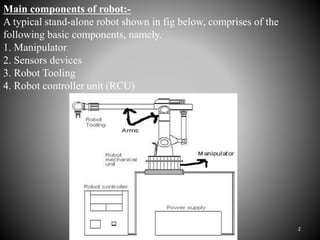
A typical stand-alone robot shown in fig below, comprises of the
following basic components, namely.
1. Manipulator
2. Sensors devices
3. Robot Tooling
4. Robot controller unit (RCU)
Manipulator:
It consists of base, arm, & wrist similar to a human arm. It
also includes power source either electric, hydraulic or
pneumatic on receiving signals from robot controller this
mechanical unit will be activated. The movement of
manipulator can be in relation to it’s coordinate system.
Which may be Cartesian, cylindrical..etc.
Depending on the controller, movement may be point to
point motion or continuous motion. The manipulator is
composed of 3 divisions,
i. The major linkages ii. The minor linkages (wrist
components) iii. The end effectors (gripper or tool)
3
Sensors devices:
These elements in form the robot controller about the status of the
manipulator. These sensors can be
either analog or digital and combination. These are…
i. visual ii. Non – visual
Robot Tooling:
Robot tooling is nothing but hand or gripper of the robot also
called as the “” end effectors”. It is provided at the end of the arm.
It is design depends on the nature of the work to be performed by
the robot.
4
Robot controller unit (RCU):
The instructions to the robot to perform the desired tasks are
input through the key board of this unit. The controller
converts the input programs to suitable signals which activate
the manipulator to perform the desired tasks.
Types of robot arms (OR) function line
diagram representation of robot arms
i. Cartesian robot
ii. Cylinder robot
iii. Polar robot
iv. Joint arm
5
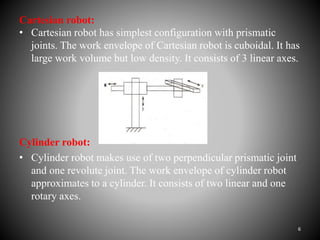
Cartesian robot:
• Cartesian robot has simplest configuration with prismatic
joints. The work envelope of Cartesian robot is cuboidal. It has
large work volume but low density. It consists of 3 linear axes.
Cylinder robot:
• Cylinder robot makes use of two perpendicular prismatic joint
and one revolute joint. The work envelope of cylinder robot
approximates to a cylinder. It consists of two linear and one
rotary axes.
6
7
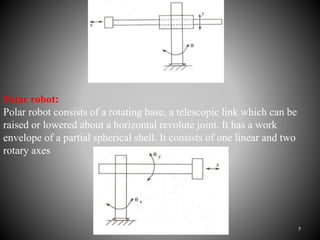
Polar robot:
Polar robot consists of a rotating base, a telescopic link which can be
raised or lowered about a horizontal revolute joint. It has a work
envelope of a partial spherical shell. It consists of one linear and two
rotary axes
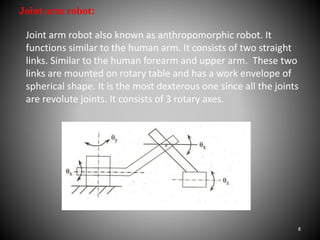
Joint arm robot:
Joint arm robot also known as anthropomorphic robot. It
functions similar to the human arm. It consists of two straight
links. Similar to the human forearm and upper arm. These two
links are mounted on rotary table and has a work envelope of
spherical shape. It is the most dexterous one since all the joints
are revolute joints. It consists of 3 rotary axes.
8
Different types of joints are used in robots:-
The different types of joint are used in robots are,
1. Prismatic Joint (Linear Motion)
2. Revolute Joint (Rotational Motion)
3. Screw Joint (Linear and Rotational Motion)
4. Spherical Joint
5. Planar Joint
6. Cylindrical Joint
7. Twisting Joint
9
10

Components of industrial robotics

  • 1.
  • 2.
    2 Main components ofrobot:- A typical stand-alone robot shown in fig below, comprises of the following basic components, namely. 1. Manipulator 2. Sensors devices 3. Robot Tooling 4. Robot controller unit (RCU)
  • 3.
    Manipulator: It consists ofbase, arm, & wrist similar to a human arm. It also includes power source either electric, hydraulic or pneumatic on receiving signals from robot controller this mechanical unit will be activated. The movement of manipulator can be in relation to it’s coordinate system. Which may be Cartesian, cylindrical..etc. Depending on the controller, movement may be point to point motion or continuous motion. The manipulator is composed of 3 divisions, i. The major linkages ii. The minor linkages (wrist components) iii. The end effectors (gripper or tool) 3
  • 4.
    Sensors devices: These elementsin form the robot controller about the status of the manipulator. These sensors can be either analog or digital and combination. These are… i. visual ii. Non – visual Robot Tooling: Robot tooling is nothing but hand or gripper of the robot also called as the “” end effectors”. It is provided at the end of the arm. It is design depends on the nature of the work to be performed by the robot. 4
  • 5.
    Robot controller unit(RCU): The instructions to the robot to perform the desired tasks are input through the key board of this unit. The controller converts the input programs to suitable signals which activate the manipulator to perform the desired tasks. Types of robot arms (OR) function line diagram representation of robot arms i. Cartesian robot ii. Cylinder robot iii. Polar robot iv. Joint arm 5
  • 6.
    Cartesian robot: • Cartesianrobot has simplest configuration with prismatic joints. The work envelope of Cartesian robot is cuboidal. It has large work volume but low density. It consists of 3 linear axes. Cylinder robot: • Cylinder robot makes use of two perpendicular prismatic joint and one revolute joint. The work envelope of cylinder robot approximates to a cylinder. It consists of two linear and one rotary axes. 6
  • 7.
    7 Polar robot: Polar robotconsists of a rotating base, a telescopic link which can be raised or lowered about a horizontal revolute joint. It has a work envelope of a partial spherical shell. It consists of one linear and two rotary axes
  • 8.
    Joint arm robot: Jointarm robot also known as anthropomorphic robot. It functions similar to the human arm. It consists of two straight links. Similar to the human forearm and upper arm. These two links are mounted on rotary table and has a work envelope of spherical shape. It is the most dexterous one since all the joints are revolute joints. It consists of 3 rotary axes. 8
  • 9.
    Different types ofjoints are used in robots:- The different types of joint are used in robots are, 1. Prismatic Joint (Linear Motion) 2. Revolute Joint (Rotational Motion) 3. Screw Joint (Linear and Rotational Motion) 4. Spherical Joint 5. Planar Joint 6. Cylindrical Joint 7. Twisting Joint 9
  • 10.