The Engineering
Design Cycle
http://labs.ee.washington.edu/community/BasicEngDes/BasicEngDes_RedesignIterate/
Part 8:
Redesign & Iterate
A problem has been identified
and researched. The need to
solve it has been proven with
credible sources. A range of
solutions have been identified
and the best of the bunch has
been selected. A prototype has
been constructed, tested,
evaluated, and presented.
Now...
Redesign and Iterate
• A broad range of feedback
should be collected,
documented, and digested by
the design team so that the
next iteration of the design is
the best move forward.
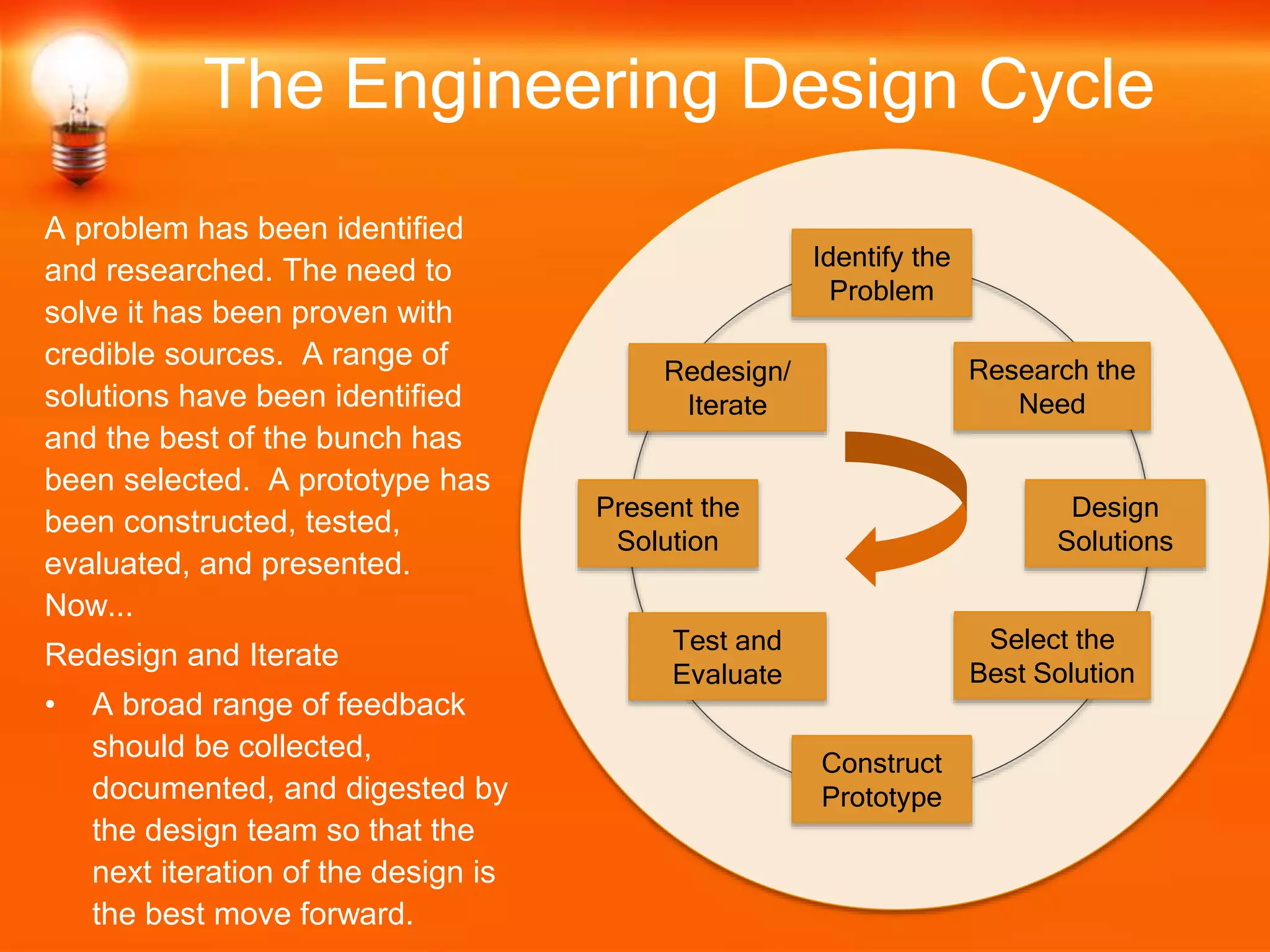
The Engineering Design Cycle
Identify the
Problem
Construct
Prototype
Research the
Need
Select the
Best Solution
Design
Solutions
Redesign/
Iterate
Test and
Evaluate
Present the
Solution
Redesign & Iterate
What does the Design Say?
Redesign and
Iterate
Collecting
Feedback
during the
Engineering
Design
Cycle
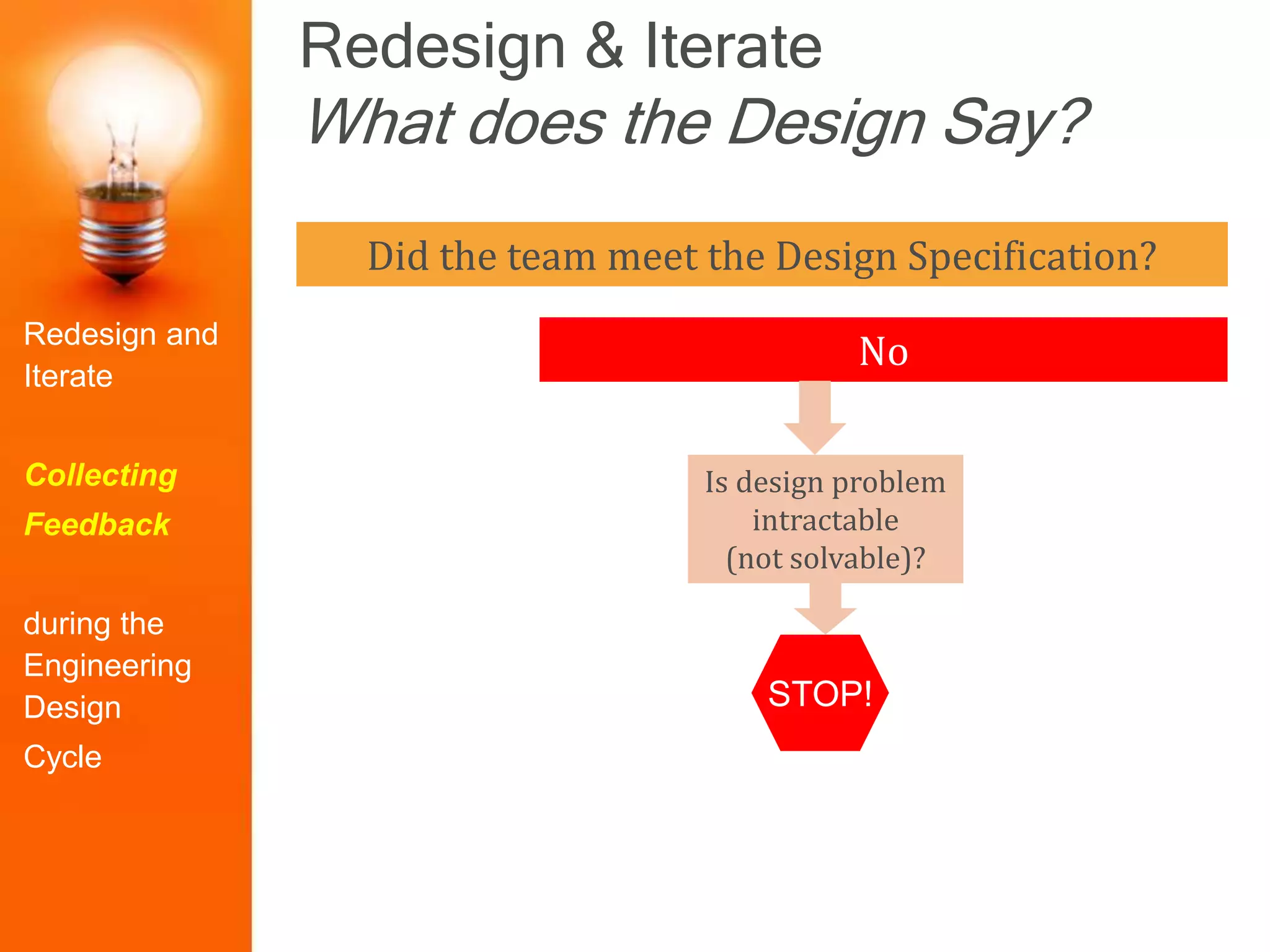
Did the team meet the Design Specification?
No
Is design problem
intractable
(not solvable)?
STOP!
Redesign & Iterate
What does the Design Say?
Redesign and
Iterate
Collecting
Feedback
during the
Engineering
Design
Cycle
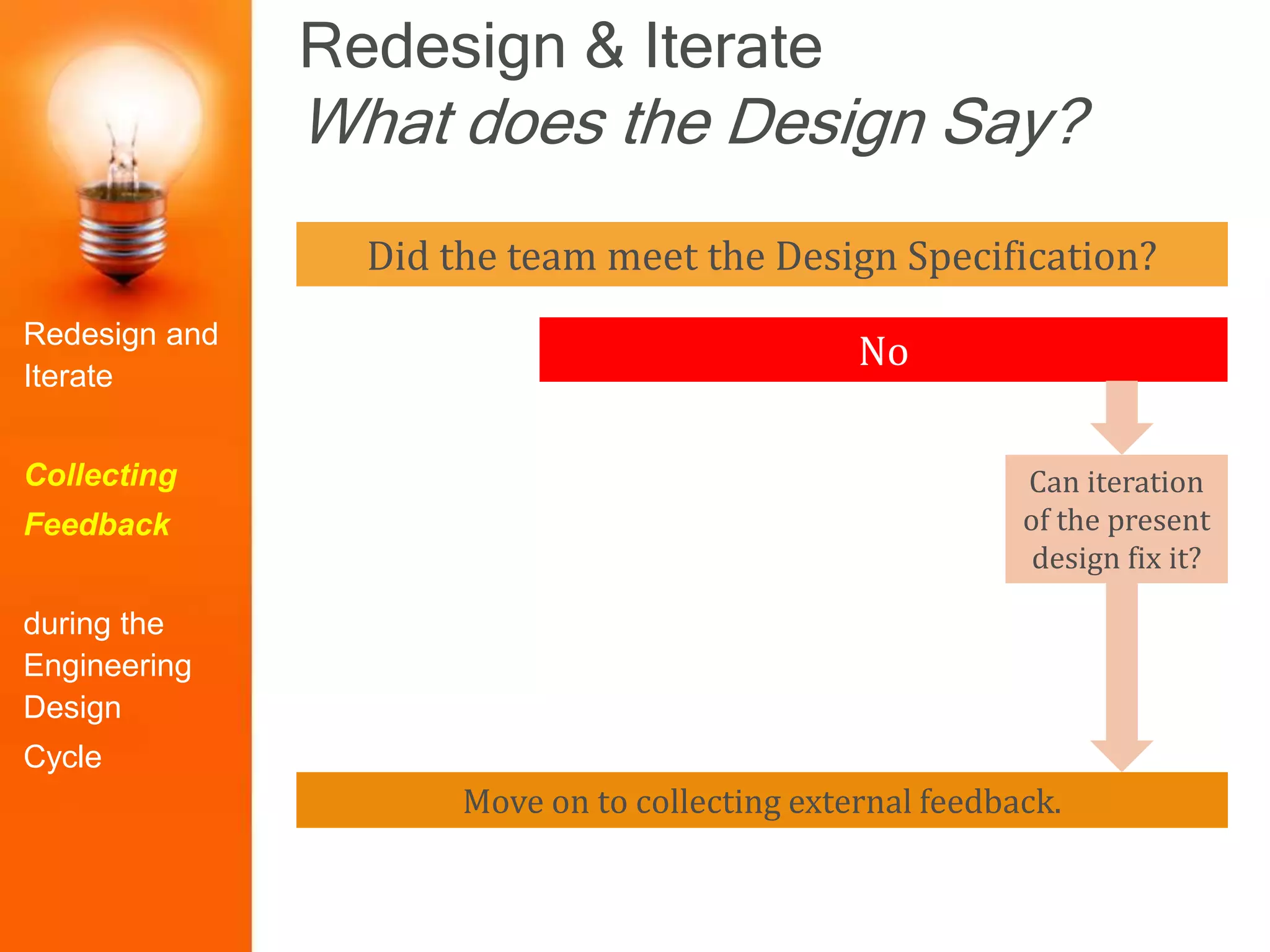
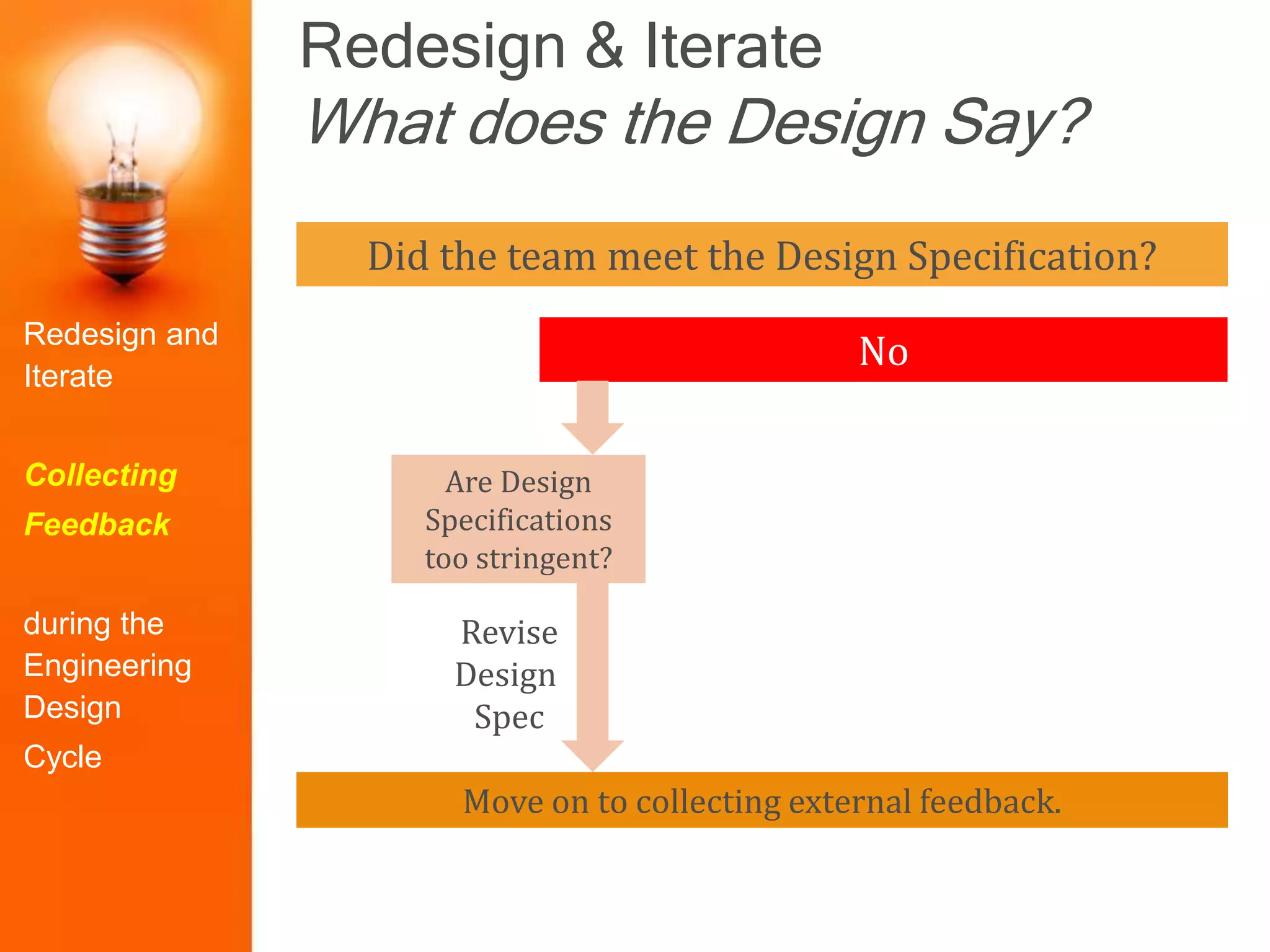
Did the team meet the Design Specification?
No
Move on to collecting external feedback.
Can iteration
of the present
design fix it?
Redesign & Iterate
What does the Design Say?
Redesign and
Iterate
Collecting
Feedback
during the
Engineering
Design
Cycle
Did the team meet the Design Specification?
No
Move on to collecting external feedback.
Are Design
Specifications
too stringent?
Revise
Design
Spec
Redesign & Iterate
What does the Design Say?
Redesign and
Iterate
Collecting
Feedback
during the
Engineering
Design
Cycle
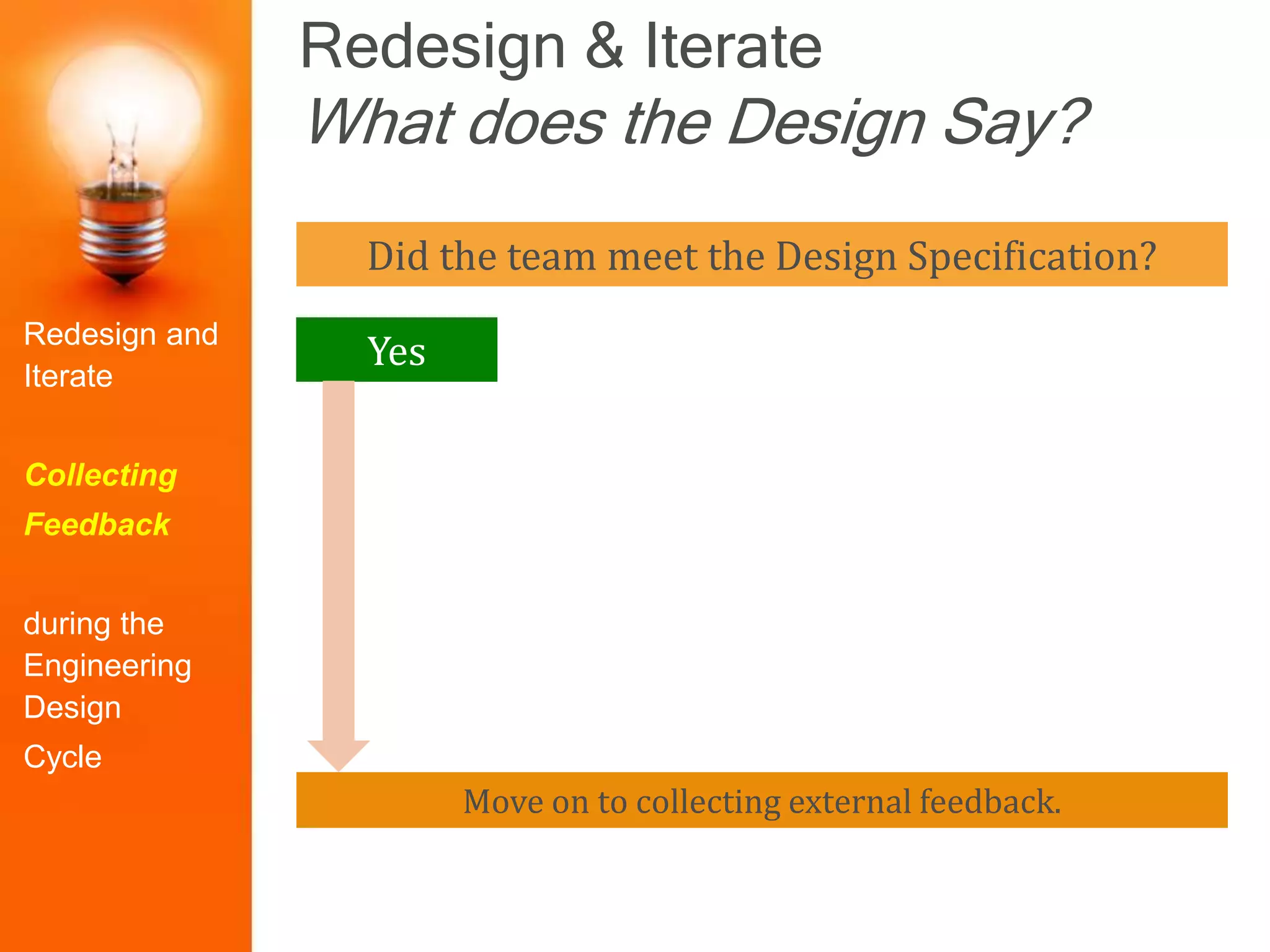
Did the team meet the Design Specification?
Move on to collecting external feedback.
Yes
Collecting Feedback
• Defer Judgment
• Separate the message from the
messenger
• Listen, actively
• Refrain from showing emotion
• Take copious notes
Strategy
In the Moment
Redesign and
Iterate
Collecting
Feedback
during the
Engineering
Design
Cycle
Collecting Feedback
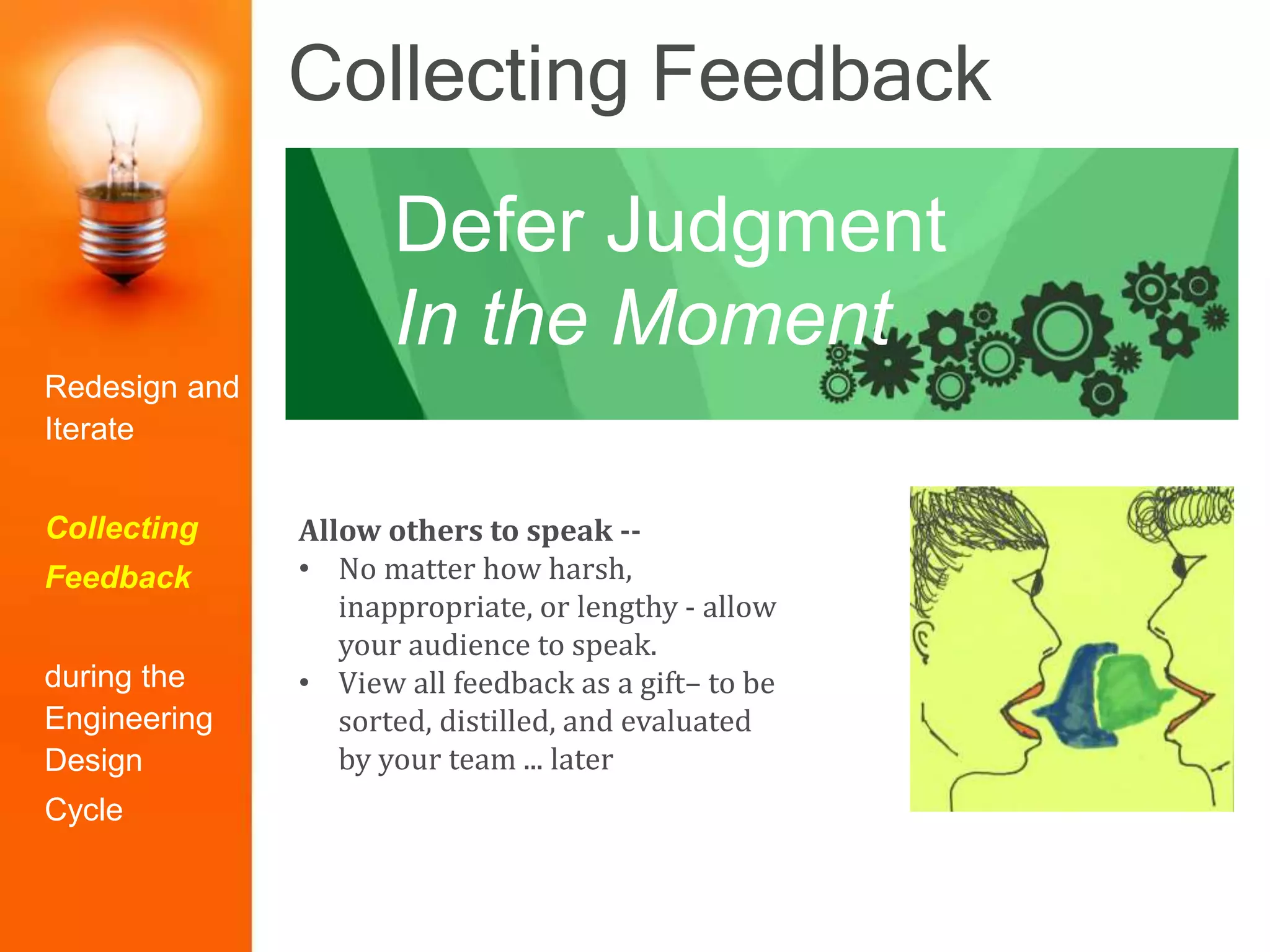
Allow others to speak --
• No matter how harsh,
inappropriate, or lengthy - allow
your audience to speak.
• View all feedback as a gift– to be
sorted, distilled, and evaluated
by your team ... later
Defer Judgment
In the Moment
Redesign and
Iterate
Collecting
Feedback
during the
Engineering
Design
Cycle
Collecting Feedback
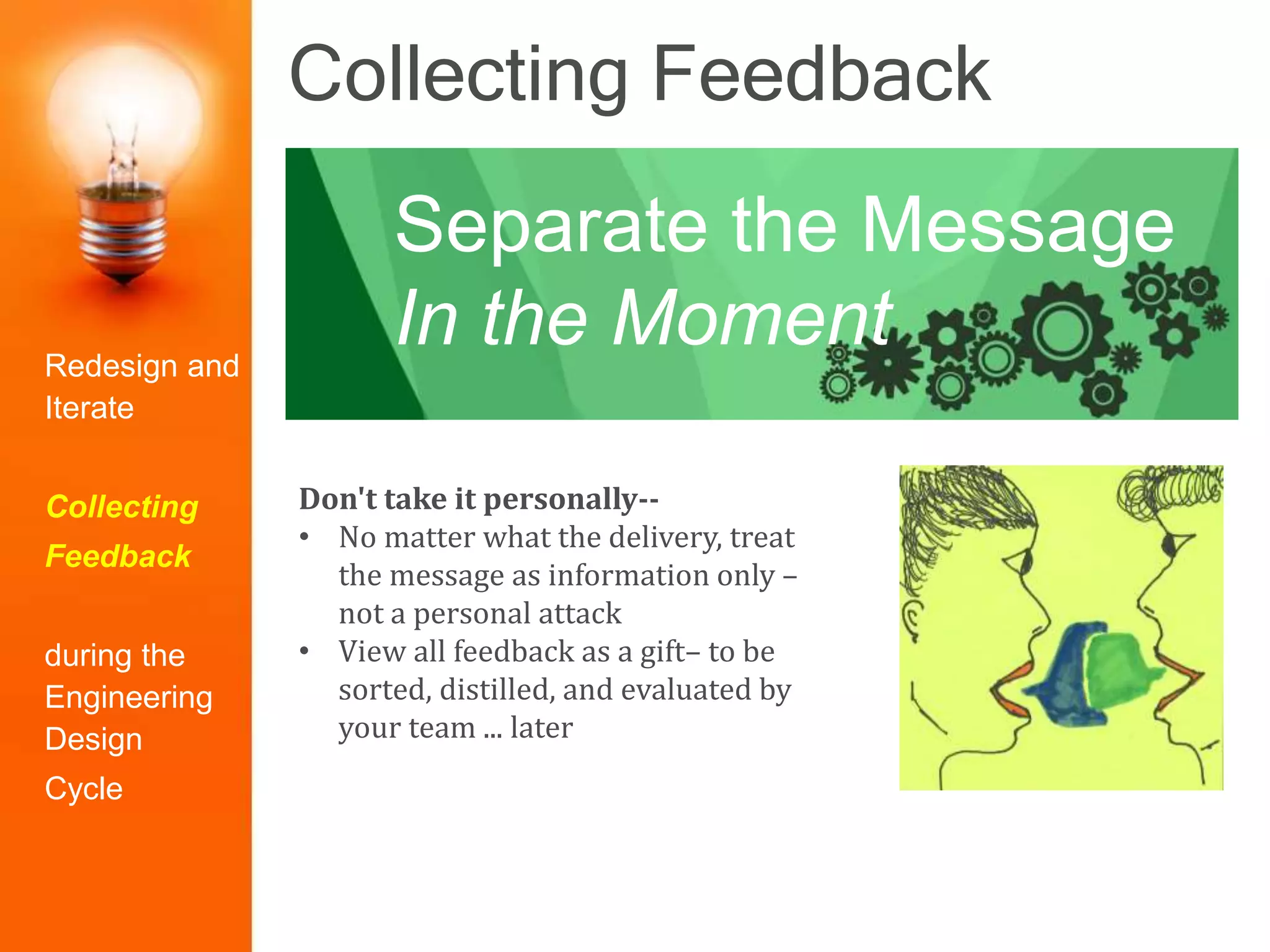
Don't take it personally--
• No matter what the delivery, treat
the message as information only –
not a personal attack
• View all feedback as a gift– to be
sorted, distilled, and evaluated by
your team ... later
Separate the Message
In the MomentRedesign and
Iterate
Collecting
Feedback
during the
Engineering
Design
Cycle
Collecting Feedback
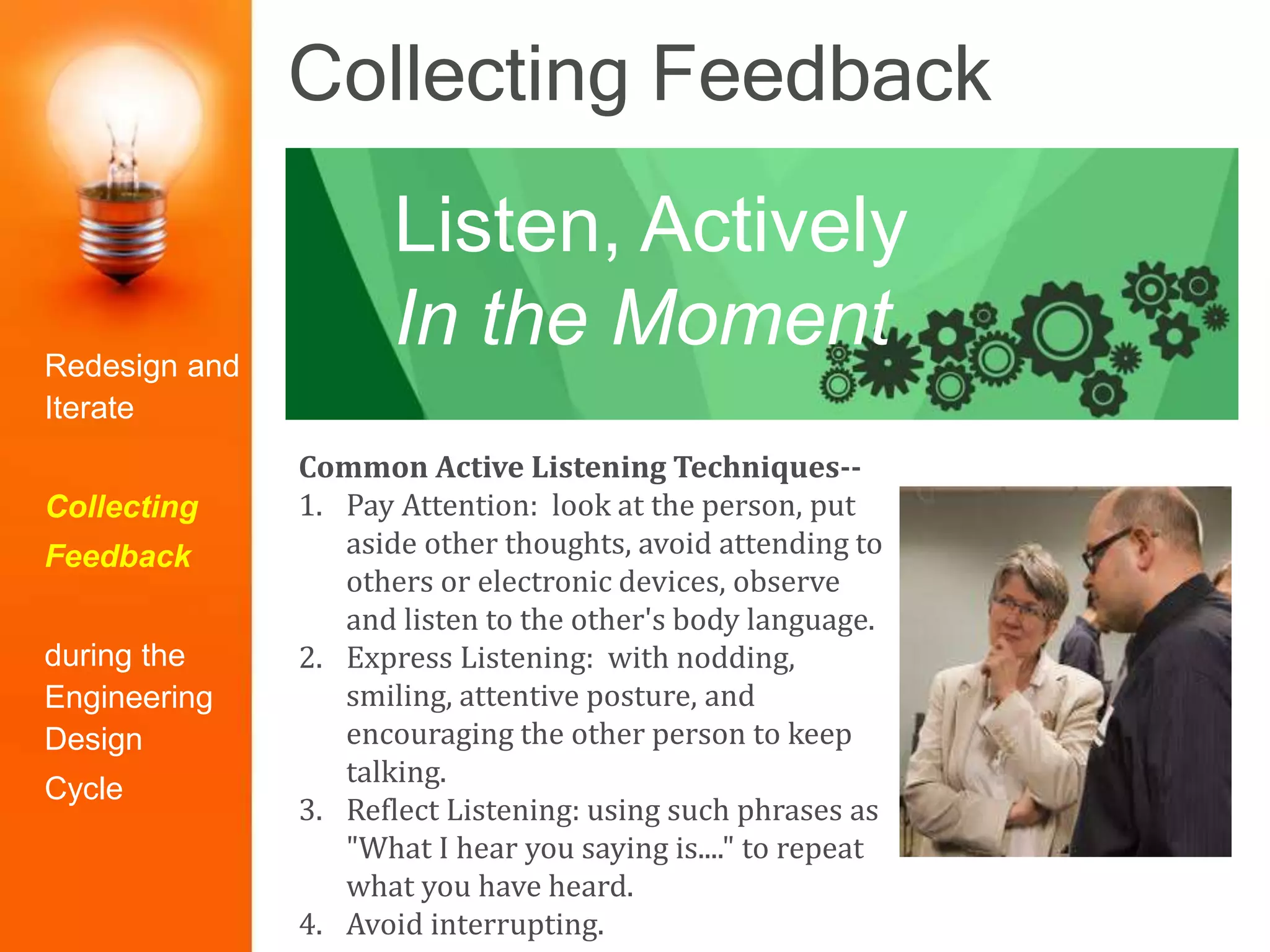
Common Active Listening Techniques--
1. Pay Attention: look at the person, put
aside other thoughts, avoid attending to
others or electronic devices, observe
and listen to the other's body language.
2. Express Listening: with nodding,
smiling, attentive posture, and
encouraging the other person to keep
talking.
3. Reflect Listening: using such phrases as
"What I hear you saying is...." to repeat
what you have heard.
4. Avoid interrupting.
Listen, Actively
In the MomentRedesign and
Iterate
Collecting
Feedback
during the
Engineering
Design
Cycle
Collecting Feedback
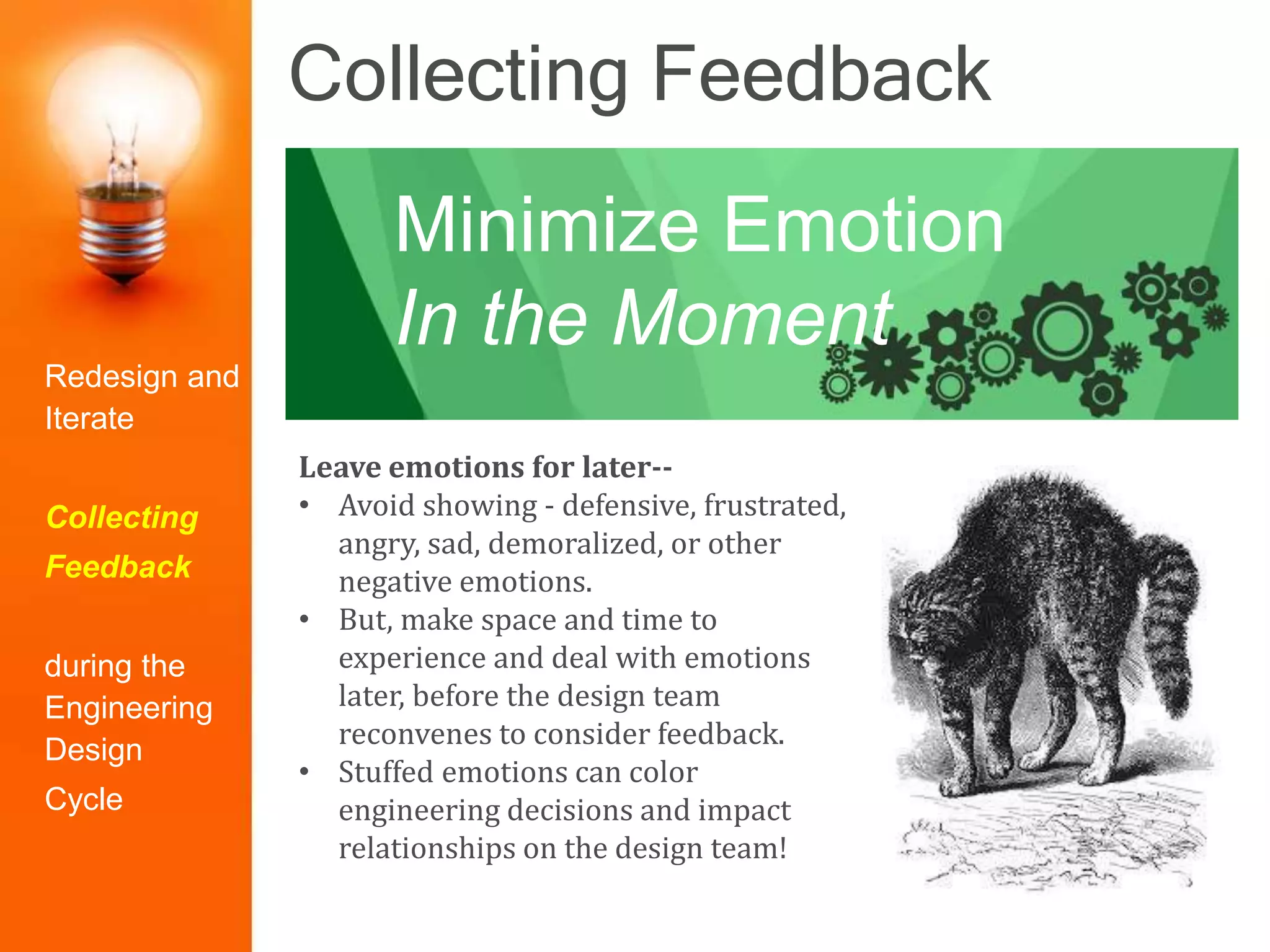
Leave emotions for later--
• Avoid showing - defensive, frustrated,
angry, sad, demoralized, or other
negative emotions.
• But, make space and time to
experience and deal with emotions
later, before the design team
reconvenes to consider feedback.
• Stuffed emotions can color
engineering decisions and impact
relationships on the design team!
Minimize Emotion
In the Moment
Redesign and
Iterate
Collecting
Feedback
during the
Engineering
Design
Cycle
Collecting Feedback
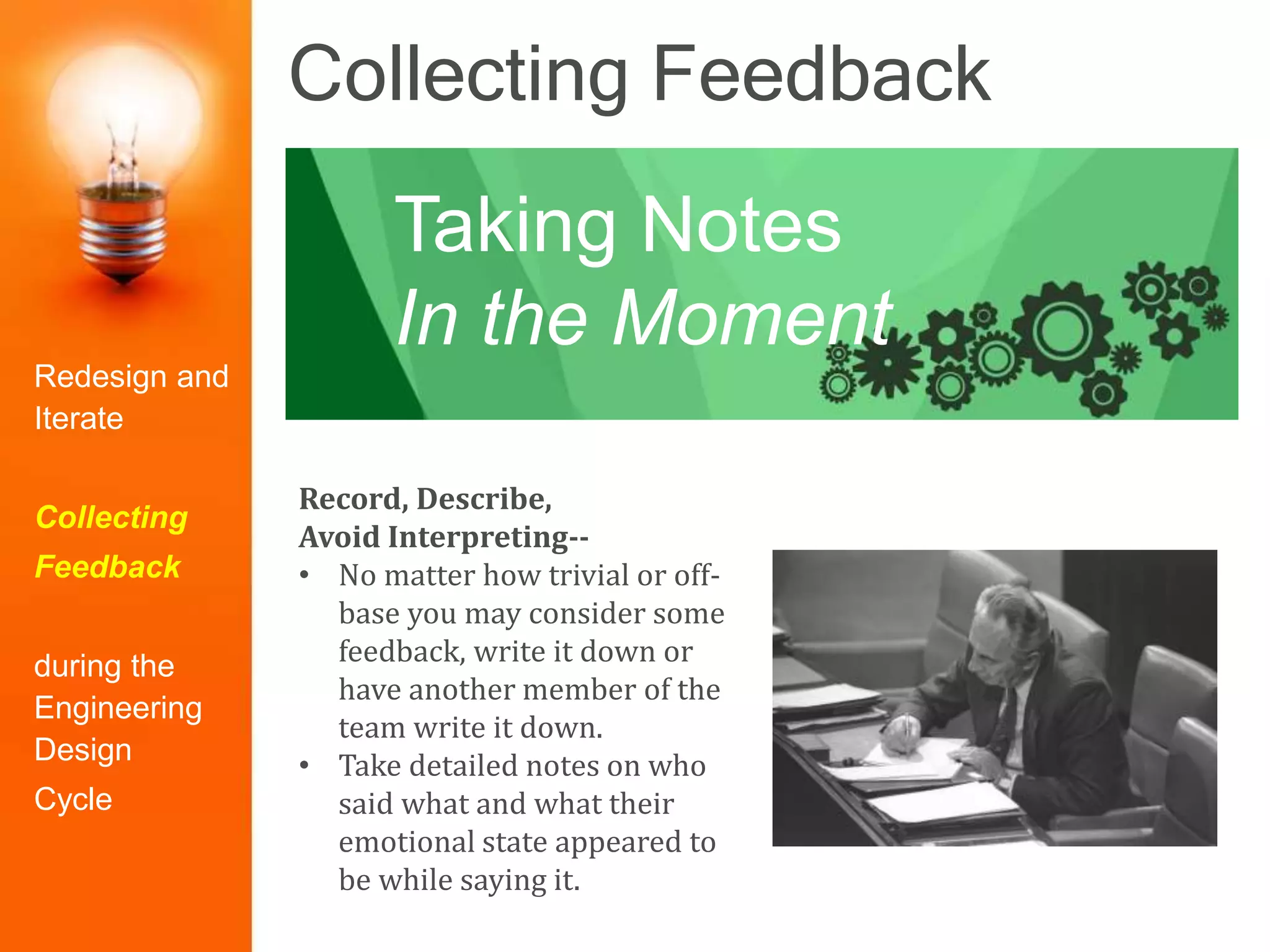
Record, Describe,
Avoid Interpreting--
• No matter how trivial or off-
base you may consider some
feedback, write it down or
have another member of the
team write it down.
• Take detailed notes on who
said what and what their
emotional state appeared to
be while saying it.
Taking Notes
In the Moment
Redesign and
Iterate
Collecting
Feedback
during the
Engineering
Design
Cycle
Digesting Feedback
Redesign and
Iterate
Digesting
Feedback
during the
Engineering
Design
Cycle
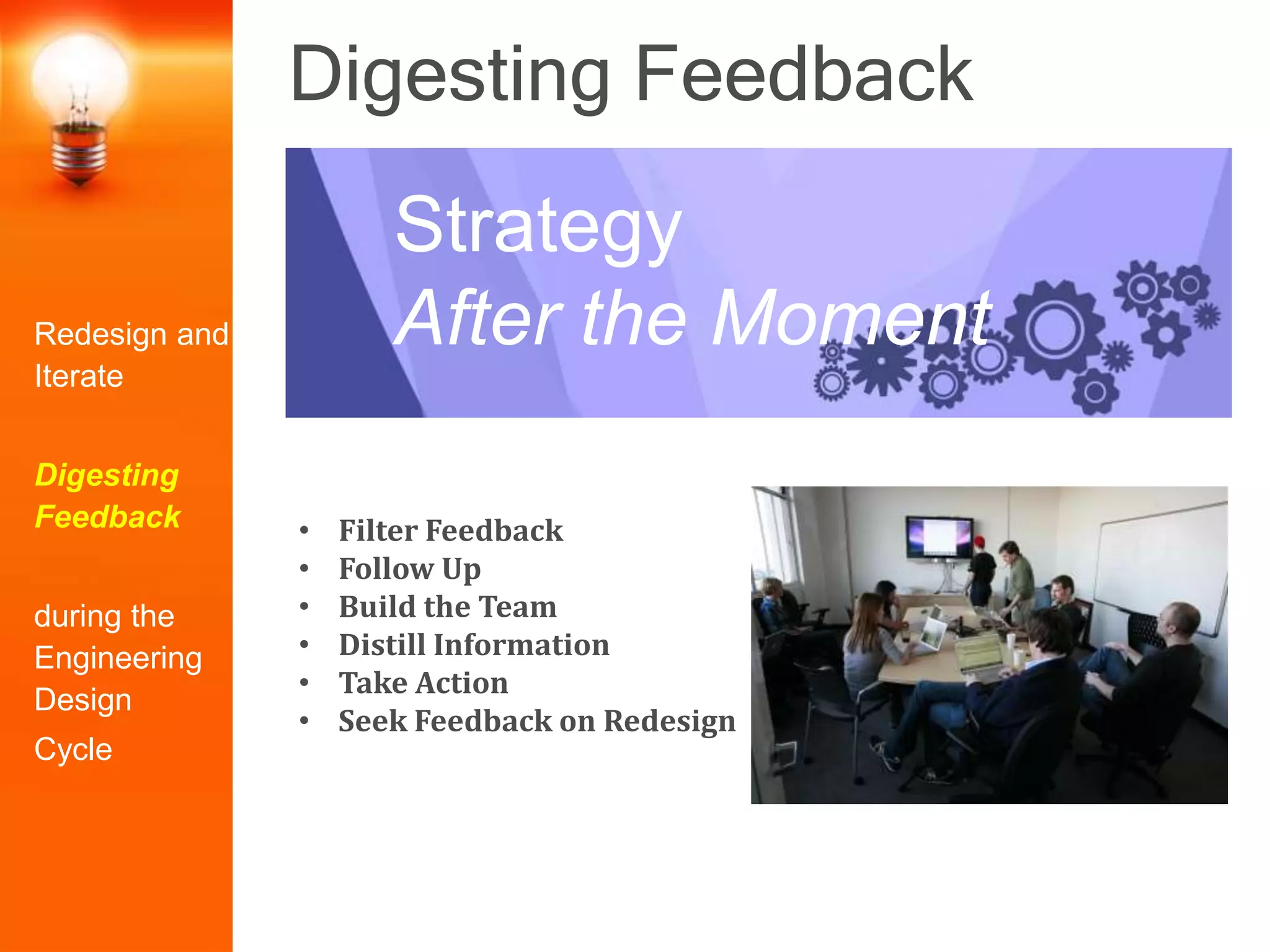
• Filter Feedback
• Follow Up
• Build the Team
• Distill Information
• Take Action
• Seek Feedback on Redesign
Strategy
After the Moment
Digesting Feedback
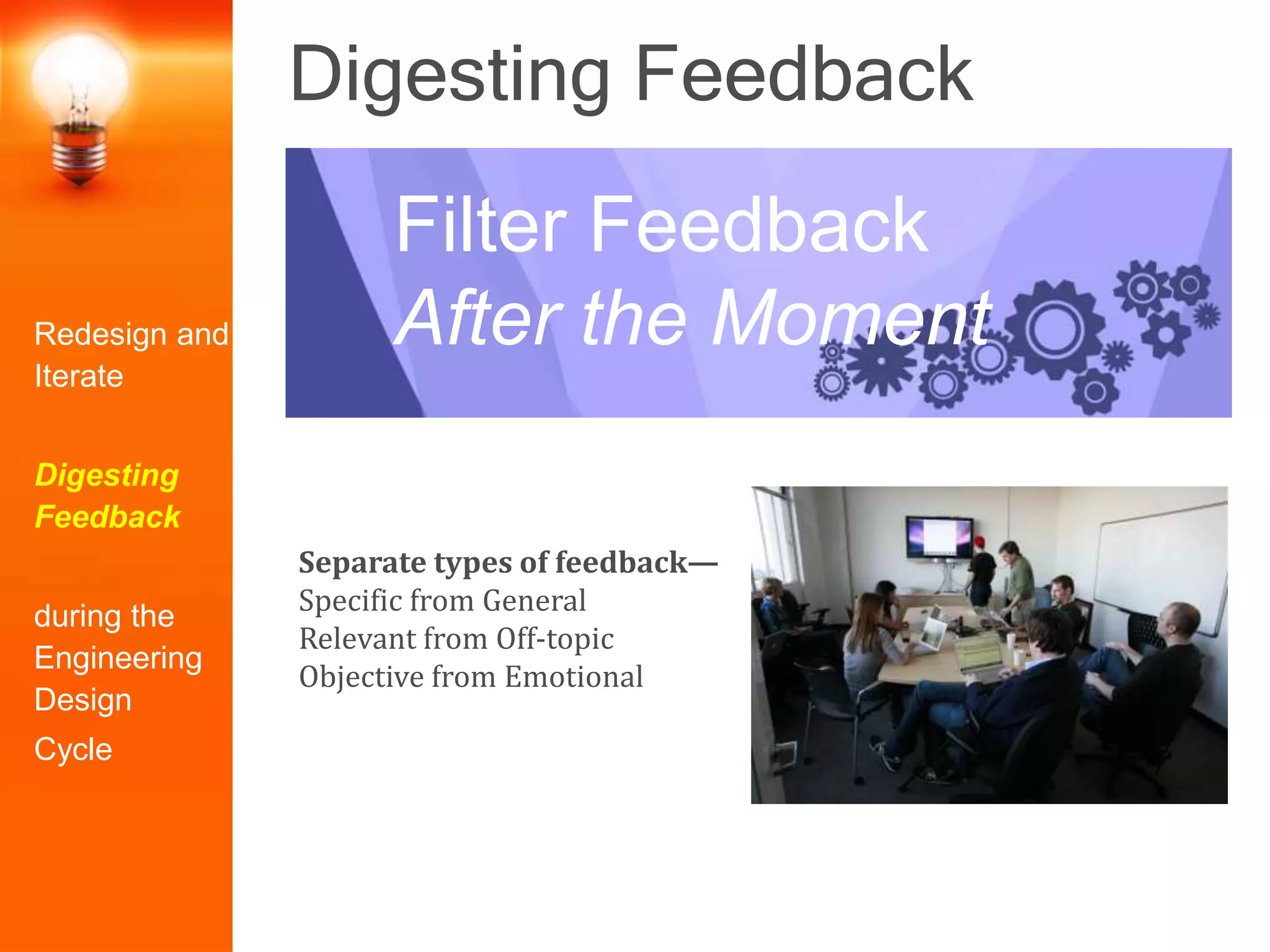
Separate types of feedback—
Specific from General
Relevant from Off-topic
Objective from Emotional
Filter Feedback
After the MomentRedesign and
Iterate
Digesting
Feedback
during the
Engineering
Design
Cycle
Digesting Feedback
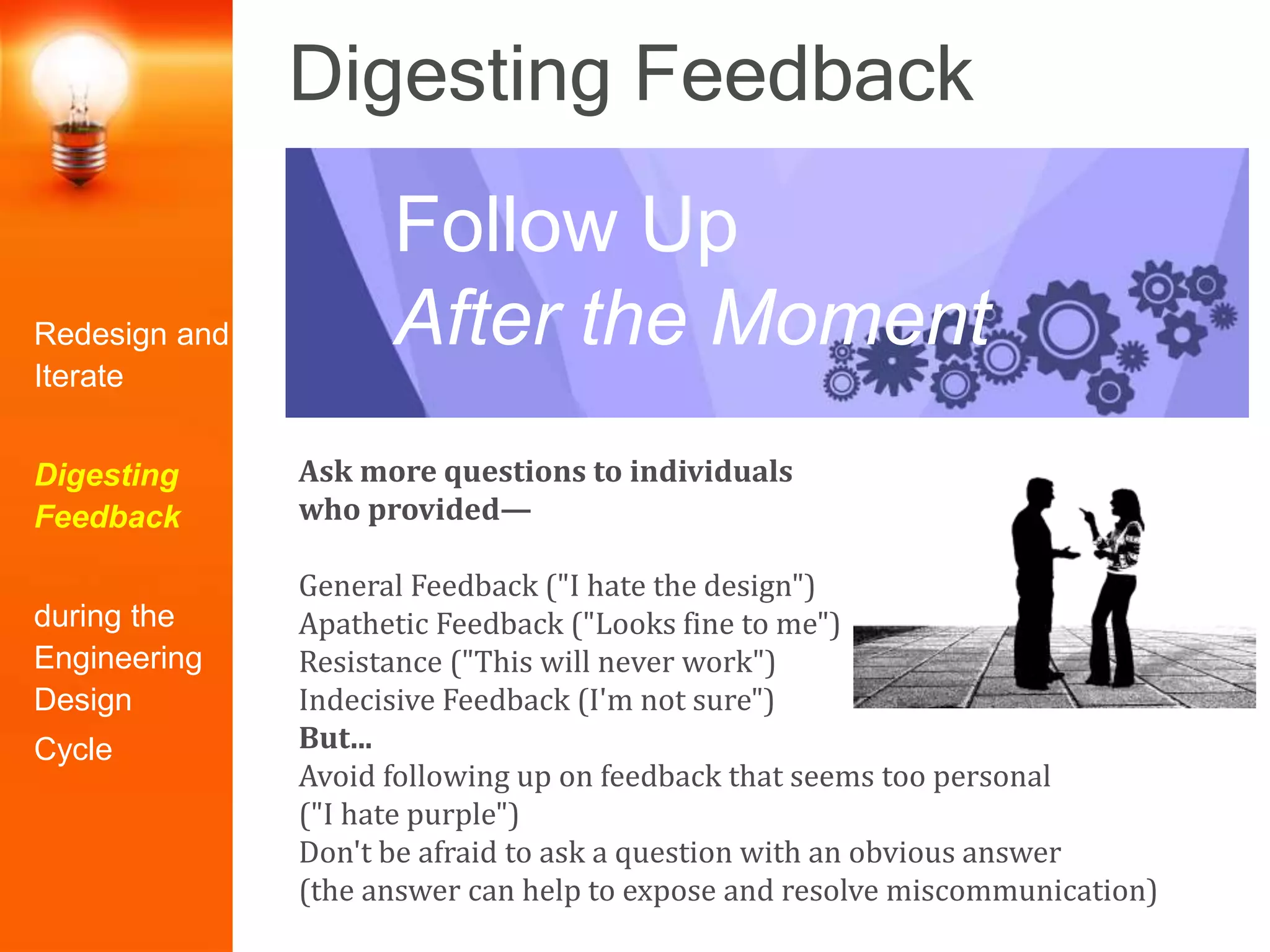
Ask more questions to individuals
who provided—
General Feedback ("I hate the design")
Apathetic Feedback ("Looks fine to me")
Resistance ("This will never work")
Indecisive Feedback (I'm not sure")
But...
Avoid following up on feedback that seems too personal
("I hate purple")
Don't be afraid to ask a question with an obvious answer
(the answer can help to expose and resolve miscommunication)
Follow Up
After the MomentRedesign and
Iterate
Digesting
Feedback
during the
Engineering
Design
Cycle
Digesting Feedback
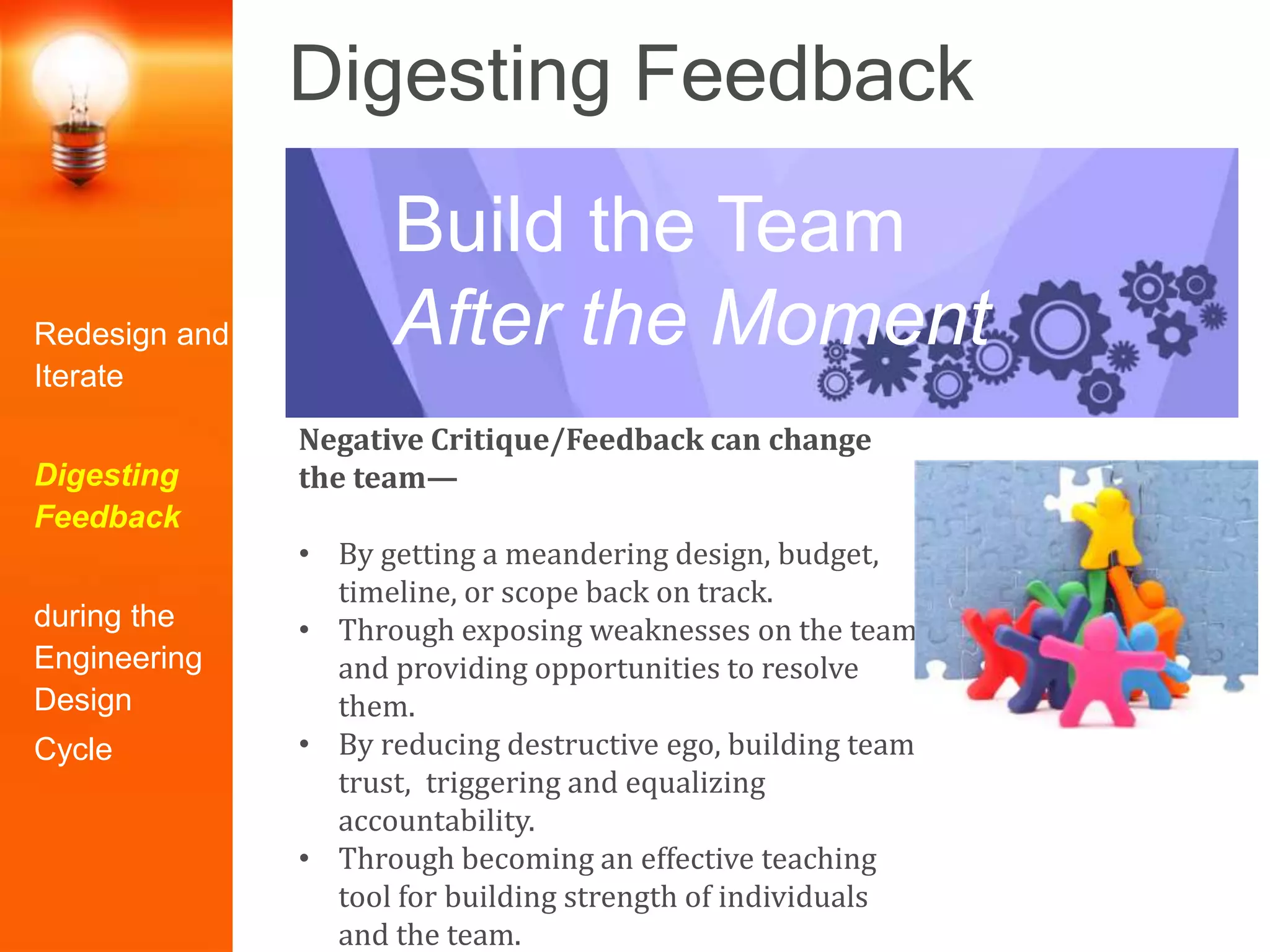
Negative Critique/Feedback can change
the team—
• By getting a meandering design, budget,
timeline, or scope back on track.
• Through exposing weaknesses on the team
and providing opportunities to resolve
them.
• By reducing destructive ego, building team
trust, triggering and equalizing
accountability.
• Through becoming an effective teaching
tool for building strength of individuals
and the team.
Build the Team
After the MomentRedesign and
Iterate
Digesting
Feedback
during the
Engineering
Design
Cycle
Digesting Feedback
Evaluating, reducing, crystallizing --
• Eliminating feedback that is too general.
• Separating feedback that is too personal from what is actionable.
• Identifying what is practical and what is unrealistic.
• Using results of testing the design to reinforce some forms of
feedback over others.
• Identifying opportunities to communicate the design better to
avoid miscommunication and misinterpretation.
Distill Information
After the MomentRedesign and
Iterate
Digesting
Feedback
during the
Engineering
Design
Cycle
Digesting Feedback
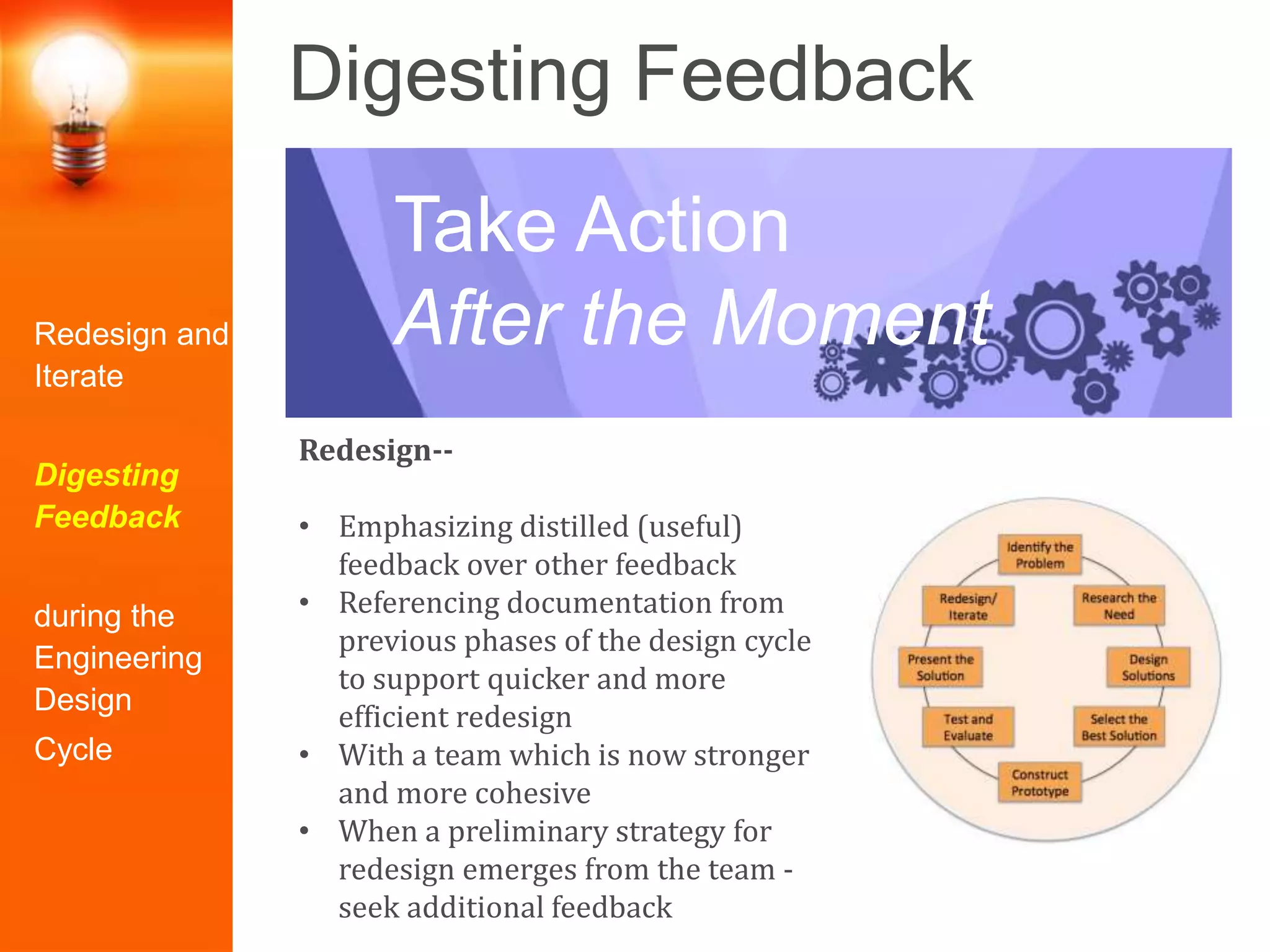
Redesign--
• Emphasizing distilled (useful)
feedback over other feedback
• Referencing documentation from
previous phases of the design cycle
to support quicker and more
efficient redesign
• With a team which is now stronger
and more cohesive
• When a preliminary strategy for
redesign emerges from the team -
seek additional feedback
Take Action
After the MomentRedesign and
Iterate
Digesting
Feedback
during the
Engineering
Design
Cycle
Digesting Feedback
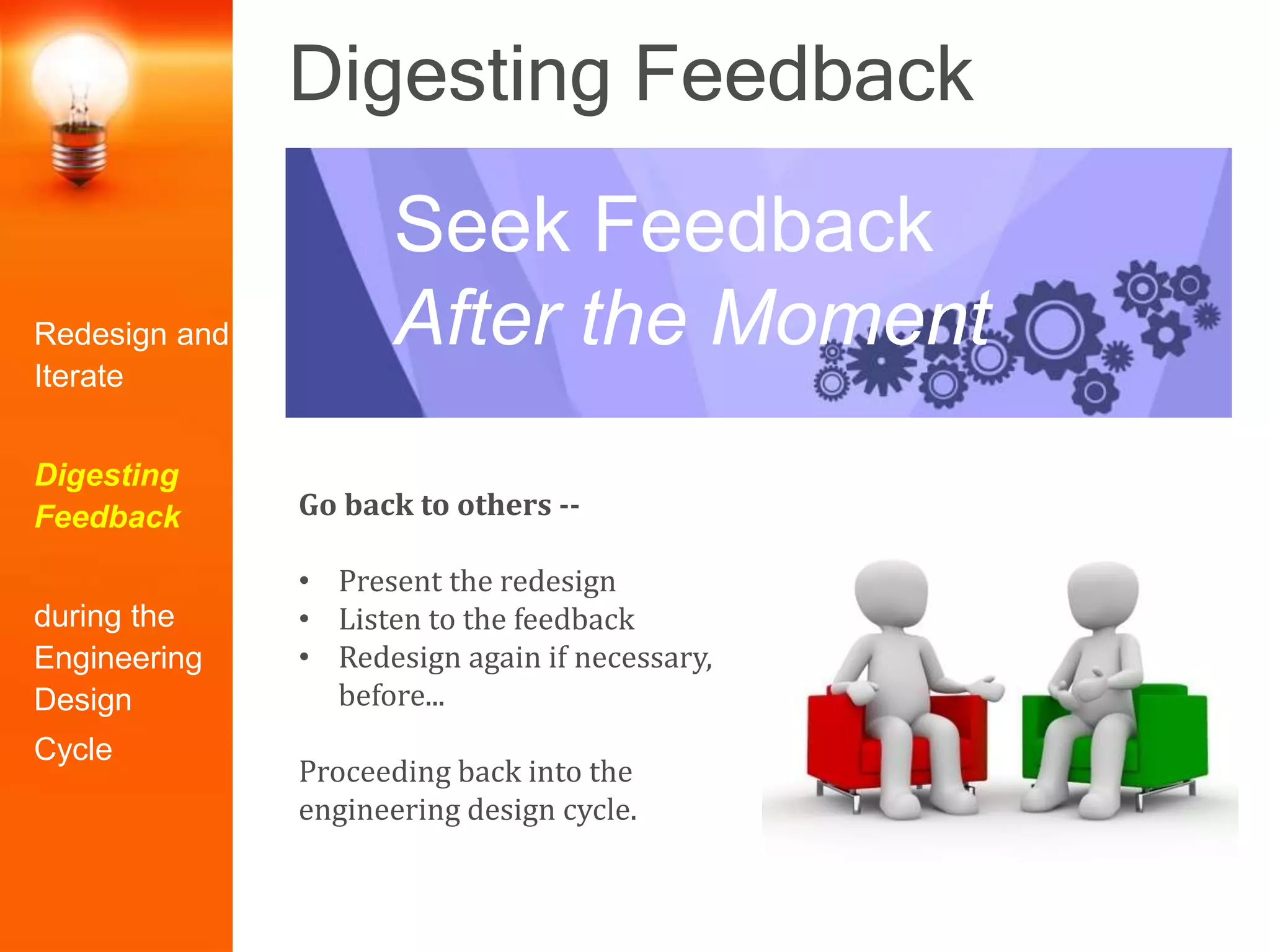
Go back to others --
• Present the redesign
• Listen to the feedback
• Redesign again if necessary,
before...
Proceeding back into the
engineering design cycle.
Seek Feedback
After the MomentRedesign and
Iterate
Digesting
Feedback
during the
Engineering
Design
Cycle
Redesign & Iterate
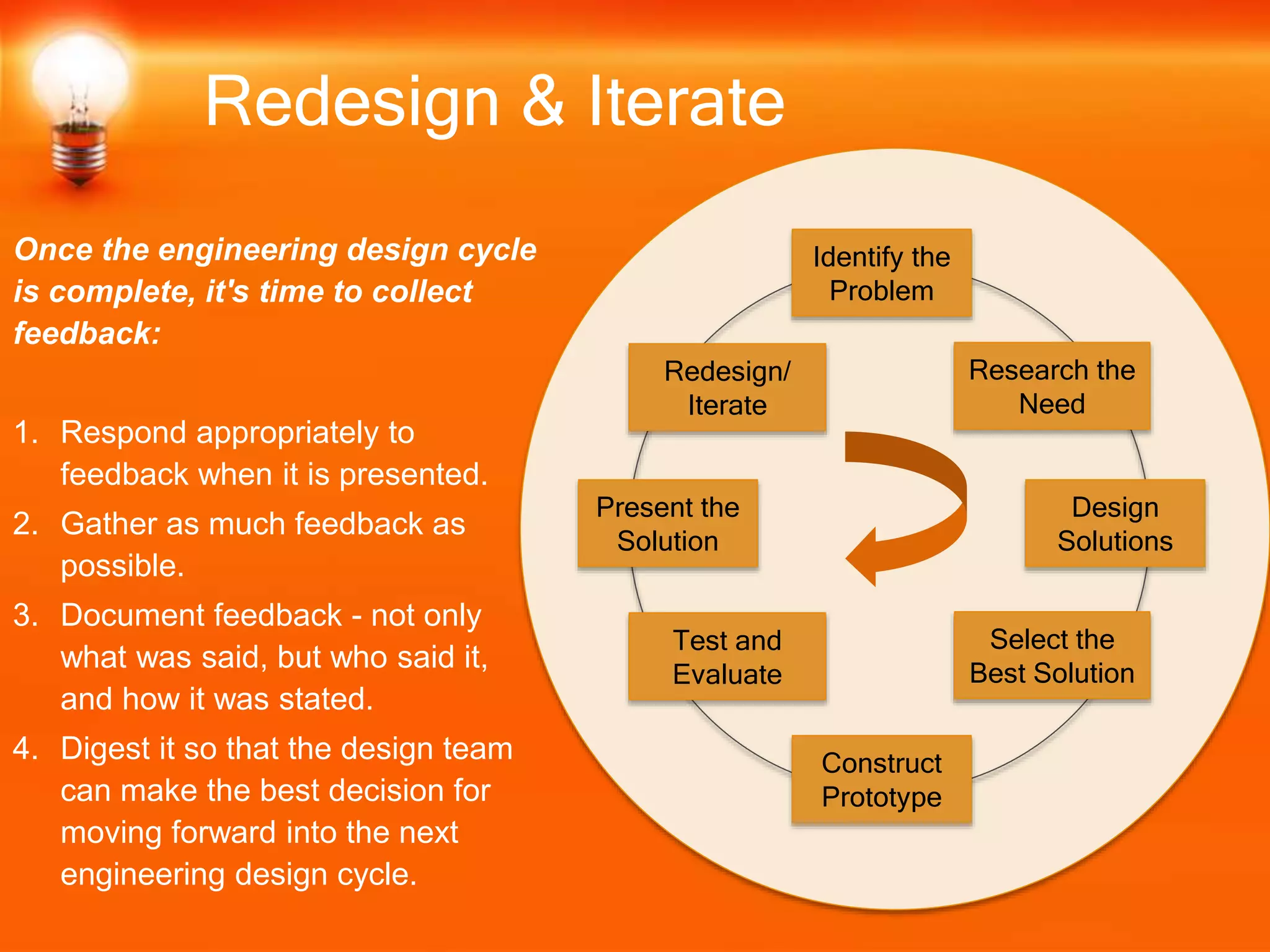
Once the engineering design cycle
is complete, it's time to collect
feedback:
1. Respond appropriately to
feedback when it is presented.
2. Gather as much feedback as
possible.
3. Document feedback - not only
what was said, but who said it,
and how it was stated.
4. Digest it so that the design team
can make the best decision for
moving forward into the next
engineering design cycle.
Identify the
Problem
Construct
Prototype
Research the
Need
Select the
Best Solution
Design
Solutions
Redesign/
Iterate
Test and
Evaluate
Present the
Solution
Thanks for joining us as we explored the eighth and last step of
the Engineering Design Cycle: Redesign & Iterate
Complete Educational Materials (including assignments,
quizzes, and recorded lectures) on the topic of Basic
Engineering Design can be found at:
http://labs.ee.washington.edu/community/BasicEngDes/
The Engineering Design Cycle

Basic Engineering Design (Part 8)): Redesigning & Iterating

  • 1.
  • 2.
    A problem hasbeen identified and researched. The need to solve it has been proven with credible sources. A range of solutions have been identified and the best of the bunch has been selected. A prototype has been constructed, tested, evaluated, and presented. Now... Redesign and Iterate • A broad range of feedback should be collected, documented, and digested by the design team so that the next iteration of the design is the best move forward. The Engineering Design Cycle Identify the Problem Construct Prototype Research the Need Select the Best Solution Design Solutions Redesign/ Iterate Test and Evaluate Present the Solution
  • 3.
    Redesign & Iterate Whatdoes the Design Say? Redesign and Iterate Collecting Feedback during the Engineering Design Cycle Did the team meet the Design Specification? No Is design problem intractable (not solvable)? STOP!
  • 4.
    Redesign & Iterate Whatdoes the Design Say? Redesign and Iterate Collecting Feedback during the Engineering Design Cycle Did the team meet the Design Specification? No Move on to collecting external feedback. Can iteration of the present design fix it?
  • 5.
    Redesign & Iterate Whatdoes the Design Say? Redesign and Iterate Collecting Feedback during the Engineering Design Cycle Did the team meet the Design Specification? No Move on to collecting external feedback. Are Design Specifications too stringent? Revise Design Spec
  • 6.
    Redesign & Iterate Whatdoes the Design Say? Redesign and Iterate Collecting Feedback during the Engineering Design Cycle Did the team meet the Design Specification? Move on to collecting external feedback. Yes
  • 7.
    Collecting Feedback • DeferJudgment • Separate the message from the messenger • Listen, actively • Refrain from showing emotion • Take copious notes Strategy In the Moment Redesign and Iterate Collecting Feedback during the Engineering Design Cycle
  • 8.
    Collecting Feedback Allow othersto speak -- • No matter how harsh, inappropriate, or lengthy - allow your audience to speak. • View all feedback as a gift– to be sorted, distilled, and evaluated by your team ... later Defer Judgment In the Moment Redesign and Iterate Collecting Feedback during the Engineering Design Cycle
  • 9.
    Collecting Feedback Don't takeit personally-- • No matter what the delivery, treat the message as information only – not a personal attack • View all feedback as a gift– to be sorted, distilled, and evaluated by your team ... later Separate the Message In the MomentRedesign and Iterate Collecting Feedback during the Engineering Design Cycle
  • 10.
    Collecting Feedback Common ActiveListening Techniques-- 1. Pay Attention: look at the person, put aside other thoughts, avoid attending to others or electronic devices, observe and listen to the other's body language. 2. Express Listening: with nodding, smiling, attentive posture, and encouraging the other person to keep talking. 3. Reflect Listening: using such phrases as "What I hear you saying is...." to repeat what you have heard. 4. Avoid interrupting. Listen, Actively In the MomentRedesign and Iterate Collecting Feedback during the Engineering Design Cycle
  • 11.
    Collecting Feedback Leave emotionsfor later-- • Avoid showing - defensive, frustrated, angry, sad, demoralized, or other negative emotions. • But, make space and time to experience and deal with emotions later, before the design team reconvenes to consider feedback. • Stuffed emotions can color engineering decisions and impact relationships on the design team! Minimize Emotion In the Moment Redesign and Iterate Collecting Feedback during the Engineering Design Cycle
  • 12.
    Collecting Feedback Record, Describe, AvoidInterpreting-- • No matter how trivial or off- base you may consider some feedback, write it down or have another member of the team write it down. • Take detailed notes on who said what and what their emotional state appeared to be while saying it. Taking Notes In the Moment Redesign and Iterate Collecting Feedback during the Engineering Design Cycle
  • 13.
    Digesting Feedback Redesign and Iterate Digesting Feedback duringthe Engineering Design Cycle • Filter Feedback • Follow Up • Build the Team • Distill Information • Take Action • Seek Feedback on Redesign Strategy After the Moment
  • 14.
    Digesting Feedback Separate typesof feedback— Specific from General Relevant from Off-topic Objective from Emotional Filter Feedback After the MomentRedesign and Iterate Digesting Feedback during the Engineering Design Cycle
  • 15.
    Digesting Feedback Ask morequestions to individuals who provided— General Feedback ("I hate the design") Apathetic Feedback ("Looks fine to me") Resistance ("This will never work") Indecisive Feedback (I'm not sure") But... Avoid following up on feedback that seems too personal ("I hate purple") Don't be afraid to ask a question with an obvious answer (the answer can help to expose and resolve miscommunication) Follow Up After the MomentRedesign and Iterate Digesting Feedback during the Engineering Design Cycle
  • 16.
    Digesting Feedback Negative Critique/Feedbackcan change the team— • By getting a meandering design, budget, timeline, or scope back on track. • Through exposing weaknesses on the team and providing opportunities to resolve them. • By reducing destructive ego, building team trust, triggering and equalizing accountability. • Through becoming an effective teaching tool for building strength of individuals and the team. Build the Team After the MomentRedesign and Iterate Digesting Feedback during the Engineering Design Cycle
  • 17.
    Digesting Feedback Evaluating, reducing,crystallizing -- • Eliminating feedback that is too general. • Separating feedback that is too personal from what is actionable. • Identifying what is practical and what is unrealistic. • Using results of testing the design to reinforce some forms of feedback over others. • Identifying opportunities to communicate the design better to avoid miscommunication and misinterpretation. Distill Information After the MomentRedesign and Iterate Digesting Feedback during the Engineering Design Cycle
  • 18.
    Digesting Feedback Redesign-- • Emphasizingdistilled (useful) feedback over other feedback • Referencing documentation from previous phases of the design cycle to support quicker and more efficient redesign • With a team which is now stronger and more cohesive • When a preliminary strategy for redesign emerges from the team - seek additional feedback Take Action After the MomentRedesign and Iterate Digesting Feedback during the Engineering Design Cycle
  • 19.
    Digesting Feedback Go backto others -- • Present the redesign • Listen to the feedback • Redesign again if necessary, before... Proceeding back into the engineering design cycle. Seek Feedback After the MomentRedesign and Iterate Digesting Feedback during the Engineering Design Cycle
  • 20.
    Redesign & Iterate Oncethe engineering design cycle is complete, it's time to collect feedback: 1. Respond appropriately to feedback when it is presented. 2. Gather as much feedback as possible. 3. Document feedback - not only what was said, but who said it, and how it was stated. 4. Digest it so that the design team can make the best decision for moving forward into the next engineering design cycle. Identify the Problem Construct Prototype Research the Need Select the Best Solution Design Solutions Redesign/ Iterate Test and Evaluate Present the Solution
  • 21.
    Thanks for joiningus as we explored the eighth and last step of the Engineering Design Cycle: Redesign & Iterate Complete Educational Materials (including assignments, quizzes, and recorded lectures) on the topic of Basic Engineering Design can be found at: http://labs.ee.washington.edu/community/BasicEngDes/ The Engineering Design Cycle