LOGO
Design and analysis of
Centrifugal blower
By Using CFD
Project members and Project guide
www.themegallery.com
Project Team:
Project Guide:
Md.Hasheer (Asst. Professor)
Project Leader:
Shaik Mustaq Elahi (L12ME 1010)
Team Members:
Siva Subrahmanyam (L12ME1017)
Priyanka (Y11ME937)
Shaik Akram (Y11ME946)
Mounika (Y11ME952)
ABSTRACT
Impeller blades are one of important element of a
centrifugal fan . They are mostly categorized into
six types: AF, BI, BC, FC, RT, RB among which the
BI i.e. impeller with back blades are considered as
highly effective. The succeeding paper presents the
performance enhancement a centrifugal blower with
impellers having various types of blades.
www.themegallery.com
Contents
1
2
3
Literature review4
Introduction
Project Background
Details of the project upto now
1.Introduction
 Compressors , blowers and fans are all the members of
the same family of machines called turbo machines.
 A turbo machine is power or head generating machine
which employs the dynamic action of a rotating
element (i.e. the rotor) the action of the rotor changes
the energy level of the continuously flowing fluid
through the turbo machine.
Centrifugal blower :-
 A centrifugal blower is a mechanical device which is
used for circulating air or other gases at a pressure of
1.5 to 2.75 bars
Definition & Principle of working
www.themegallery.com
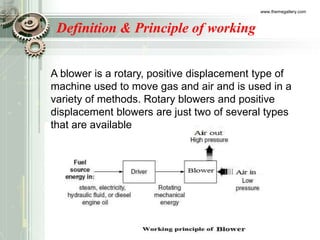
A blower is a rotary, positive displacement type of
machine used to move gas and air and is used in a
variety of methods. Rotary blowers and positive
displacement blowers are just two of several types
that are available
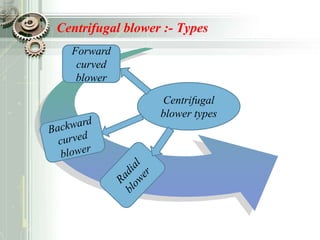
Centrifugal blower :- Types
Centrifugal
blower types
Forward
curved
blower
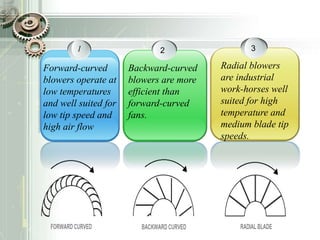
1
Forward-curved
blowers operate at
low temperatures
and well suited for
low tip speed and
high air flow
2
Backward-curved
blowers are more
efficient than
forward-curved
fans.
3
Radial blowers
are industrial
work-horses well
suited for high
temperature and
medium blade tip
speeds.
www.themegallery.com
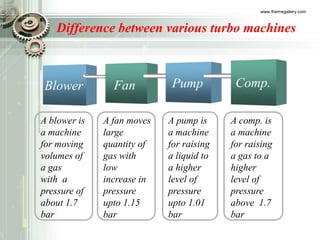
Difference between various turbo machines
Blower PumpFan Comp.
A blower is
a machine
for moving
volumes of
a gas
with a
pressure of
about 1.7
bar
A fan moves
large
quantity of
gas with
low
increase in
pressure
upto 1.15
bar
A pump is
a machine
for raising
a liquid to
a higher
level of
pressure
upto 1.01
bar
A comp. is
a machine
for raising
a gas to a
higher
level of
pressure
above 1.7
bar
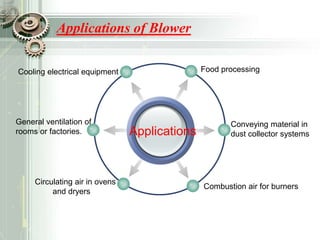
Applications
Conveying material in
dust collector systems
Applications of Blower
Food processing
Circulating air in ovens
and dryers
General ventilation of
rooms or factories.
Cooling electrical equipment
Combustion air for burners
2.Project background
Computational fluid dynamics :-
Computational fluid dynamics, usually abbreviated
as CFD, is a branch of fluid mechanics that uses
numerical methods and algorithms to solve and
analyze problems that involve fluid flows.
Cfd software involves two tools
1. Gambit ( pre- processor)
2. fluent ( solver & post processor)
www.themegallery.com
CFD(Computational Fluid Dynamics)
CFD is one of the branches of fluid mechanics that uses
numerical methods and algorithms to solve and analyze problems
that involve fluid flows.
Computer are used to perform the millions of calculations
required to simulate the interaction of fluid and gases with the
complex surfaces used in engineering.
However, even with simplified equations and by using high speed
super computers, only approximate solutions can be achieved in
many cases.
More accurate codes that can accurately and quickly simulate
even complex scenarios such as supersonic or turbulent flows are
an on going area of research.
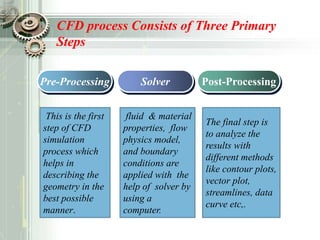
CFD process Consists of Three Primary
Steps
Pre-Processing Solver Post-Processing
This is the first
step of CFD
simulation
process which
helps in
describing the
geometry in the
best possible
manner.
fluid & material
properties, flow
physics model,
and boundary
conditions are
applied with the
help of solver by
using a
computer.
The final step is
to analyze the
results with
different methods
like contour plots,
vector plot,
streamlines, data
curve etc,.
Advantages of cfd
1. It provides the flexibility to change design parameters
without the expense of hardware changes.
2. It has a faster turnaround time than experiments.
3. It guides the engineer to the root of problems, and is
therefore well suited for trouble-shooting.
4. It provides comprehensive information about a flow
field, especially in regions where measurements are
either difficult or impossible to obtain.
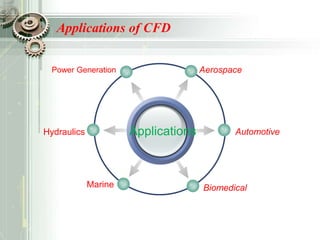
Applications
Power Generation
Automotive
Biomedical
Applications of CFD
Aerospace
Hydraulics
Marine
www.themegallery.com
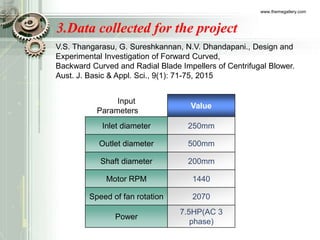
3.Data collected for the project
Input
ParametersMDK
Value
Inlet diameter 250mm
Outlet diameter 500mm
Shaft diameter 200mm
Motor RPM 1440
Speed of fan rotation 2070
Power
7.5HP(AC 3
phase)
V.S. Thangarasu, G. Sureshkannan, N.V. Dhandapani., Design and
Experimental Investigation of Forward Curved,
Backward Curved and Radial Blade Impellers of Centrifugal Blower.
Aust. J. Basic & Appl. Sci., 9(1): 71-75, 2015
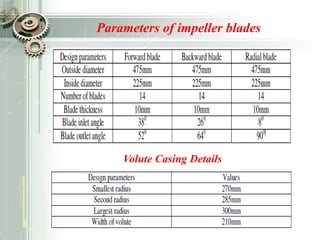
Parameters of impeller blades
Volute Casing Details
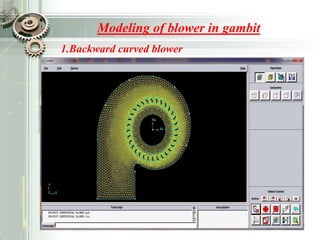
Modeling of blower in gambit
1.Backward curved blower
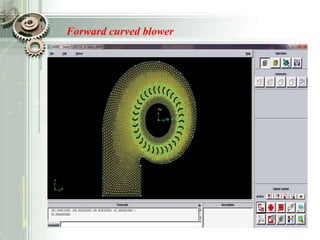
Forward curved blower
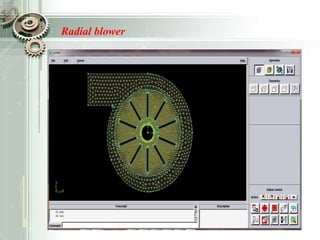
Radial blower
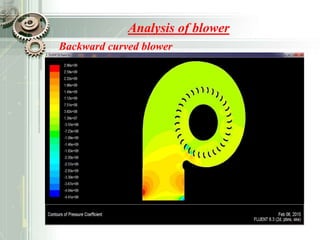
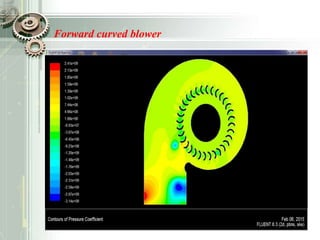
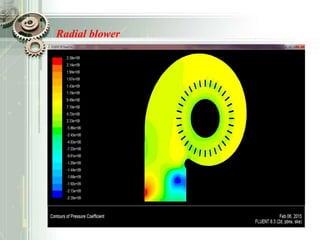
Analysis of blower
Backward curved blower
Forward curved blower
Radial blower
4.Literature and Review
XinweiShu et al (2009) showed how the
performance can be improved by
properly reshaping its blade a developed
multipoint optimisation approach.
They conducted test on the forward blade.
Singh O. P. et al (2011) investigated
the effect of geometric parameters of
centrifugal blower with forward
and backward curved blades.
Sun-Sheng Yang et al conducted
performance on centrifugal blower
theoretically, numerically and
experimentally.
Choon-Man Jang et al (2013) analysed
the effect of design variables on the
performance of centrifugal blowers.
They found that the casing height of
the design variable is more sensitive
on the function of efficiency compared
to that of casing width.
LOGO

PROJECT REVIEW PPT

  • 1.
    LOGO Design and analysisof Centrifugal blower By Using CFD
  • 2.
    Project members andProject guide www.themegallery.com Project Team: Project Guide: Md.Hasheer (Asst. Professor) Project Leader: Shaik Mustaq Elahi (L12ME 1010) Team Members: Siva Subrahmanyam (L12ME1017) Priyanka (Y11ME937) Shaik Akram (Y11ME946) Mounika (Y11ME952)
  • 3.
    ABSTRACT Impeller blades areone of important element of a centrifugal fan . They are mostly categorized into six types: AF, BI, BC, FC, RT, RB among which the BI i.e. impeller with back blades are considered as highly effective. The succeeding paper presents the performance enhancement a centrifugal blower with impellers having various types of blades. www.themegallery.com
  • 4.
  • 5.
    1.Introduction  Compressors ,blowers and fans are all the members of the same family of machines called turbo machines.  A turbo machine is power or head generating machine which employs the dynamic action of a rotating element (i.e. the rotor) the action of the rotor changes the energy level of the continuously flowing fluid through the turbo machine. Centrifugal blower :-  A centrifugal blower is a mechanical device which is used for circulating air or other gases at a pressure of 1.5 to 2.75 bars
  • 6.
    Definition & Principleof working www.themegallery.com A blower is a rotary, positive displacement type of machine used to move gas and air and is used in a variety of methods. Rotary blowers and positive displacement blowers are just two of several types that are available
  • 7.
    Centrifugal blower :-Types Centrifugal blower types Forward curved blower
  • 8.
    1 Forward-curved blowers operate at lowtemperatures and well suited for low tip speed and high air flow 2 Backward-curved blowers are more efficient than forward-curved fans. 3 Radial blowers are industrial work-horses well suited for high temperature and medium blade tip speeds.
  • 9.
    www.themegallery.com Difference between variousturbo machines Blower PumpFan Comp. A blower is a machine for moving volumes of a gas with a pressure of about 1.7 bar A fan moves large quantity of gas with low increase in pressure upto 1.15 bar A pump is a machine for raising a liquid to a higher level of pressure upto 1.01 bar A comp. is a machine for raising a gas to a higher level of pressure above 1.7 bar
  • 10.
    Applications Conveying material in dustcollector systems Applications of Blower Food processing Circulating air in ovens and dryers General ventilation of rooms or factories. Cooling electrical equipment Combustion air for burners
  • 11.
    2.Project background Computational fluiddynamics :- Computational fluid dynamics, usually abbreviated as CFD, is a branch of fluid mechanics that uses numerical methods and algorithms to solve and analyze problems that involve fluid flows. Cfd software involves two tools 1. Gambit ( pre- processor) 2. fluent ( solver & post processor) www.themegallery.com
  • 12.
    www.themegallery.com CFD(Computational Fluid Dynamics) CFDis one of the branches of fluid mechanics that uses numerical methods and algorithms to solve and analyze problems that involve fluid flows. Computer are used to perform the millions of calculations required to simulate the interaction of fluid and gases with the complex surfaces used in engineering. However, even with simplified equations and by using high speed super computers, only approximate solutions can be achieved in many cases. More accurate codes that can accurately and quickly simulate even complex scenarios such as supersonic or turbulent flows are an on going area of research.
  • 13.
    CFD process Consistsof Three Primary Steps Pre-Processing Solver Post-Processing This is the first step of CFD simulation process which helps in describing the geometry in the best possible manner. fluid & material properties, flow physics model, and boundary conditions are applied with the help of solver by using a computer. The final step is to analyze the results with different methods like contour plots, vector plot, streamlines, data curve etc,.
  • 14.
    Advantages of cfd 1.It provides the flexibility to change design parameters without the expense of hardware changes. 2. It has a faster turnaround time than experiments. 3. It guides the engineer to the root of problems, and is therefore well suited for trouble-shooting. 4. It provides comprehensive information about a flow field, especially in regions where measurements are either difficult or impossible to obtain.
  • 15.
  • 16.
    www.themegallery.com 3.Data collected forthe project Input ParametersMDK Value Inlet diameter 250mm Outlet diameter 500mm Shaft diameter 200mm Motor RPM 1440 Speed of fan rotation 2070 Power 7.5HP(AC 3 phase) V.S. Thangarasu, G. Sureshkannan, N.V. Dhandapani., Design and Experimental Investigation of Forward Curved, Backward Curved and Radial Blade Impellers of Centrifugal Blower. Aust. J. Basic & Appl. Sci., 9(1): 71-75, 2015
  • 17.
    Parameters of impellerblades Volute Casing Details
  • 18.
    Modeling of blowerin gambit 1.Backward curved blower
  • 19.
  • 20.
  • 21.
  • 22.
  • 23.
  • 24.
    4.Literature and Review XinweiShuet al (2009) showed how the performance can be improved by properly reshaping its blade a developed multipoint optimisation approach. They conducted test on the forward blade. Singh O. P. et al (2011) investigated the effect of geometric parameters of centrifugal blower with forward and backward curved blades.
  • 25.
    Sun-Sheng Yang etal conducted performance on centrifugal blower theoretically, numerically and experimentally. Choon-Man Jang et al (2013) analysed the effect of design variables on the performance of centrifugal blowers. They found that the casing height of the design variable is more sensitive on the function of efficiency compared to that of casing width.
  • 26.