The Engineering
Design Cycle
Part 3:
Design Solutions
http://labs.ee.washington.edu/community/BasicEngDes/BasicEngDes_DesignSolution/
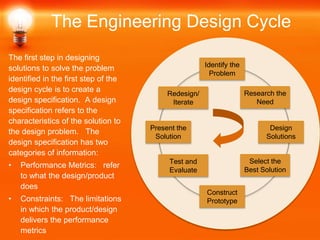
The first step in designing
solutions to solve the problem
identified in the first step of the
design cycle is to create a
design specification. A design

specification refers to the
characteristics of the solution to
the design problem. The
design specification has two
categories of information:
• Performance Metrics: refer
to what the design/product
does
• Constraints: The limitations
in which the product/design
delivers the performance
metrics
The Engineering Design Cycle
Identify the
Problem
Construct
Prototype
Research the
Need
Select the
Best Solution
Design
Solutions
Redesign/
Iterate
Test and
Evaluate
Present the
Solution
The Design Specification:
Performance Metrics
Creating a
Design
Specification
during the
Design
Solutions
phase of the
Engineering
Design
Cycle
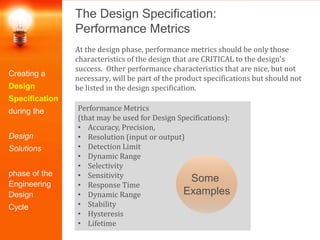
At the design phase, performance metrics should be only those
characteristics of the design that are CRITICAL to the design's
success. Other performance characteristics that are nice, but not
necessary, will be part of the product specifications but should not
be listed in the design specification.
The Design Specification:
Performance Metrics
Creating a
Design
Specification
during the
Design
Solutions
phase of the
Engineering
Design
Cycle
At the design phase, performance metrics should be only those
characteristics of the design that are CRITICAL to the design's
success. Other performance characteristics that are nice, but not
necessary, will be part of the product specifications but should not
be listed in the design specification.
Performance Metrics
(that may be used for Design Specifications):
• Accuracy, Precision,
• Resolution (input or output)
• Detection Limit
• Dynamic Range
• Selectivity
• Sensitivity
• Response Time
• Dynamic Range
• Stability
• Hysteresis
• Lifetime
Some
Examples
The Design Specification:
Performance Metrics
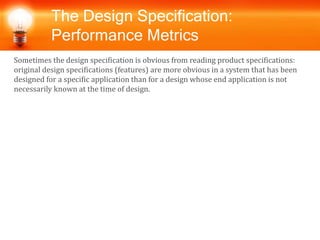
Sometimes the design specification is obvious from reading product specifications:
original design specifications (features) are more obvious in a system that has been
designed for a specific application than for a design whose end application is not
necessarily known at the time of design.
The Design Specification:
Performance Metrics
Sometimes the design specification is obvious from reading product specifications:
original design specifications (features) are more obvious in a system that has been
designed for a specific application than for a design whose end application is not
necessarily known at the time of design.
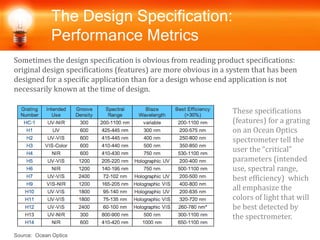
These specifications
(features) for a grating
on an Ocean Optics
spectrometer tell the
user the “critical”
parameters (intended
use, spectral range,
best efficiency) which
all emphasize the
colors of light that will
be best detected by
the spectrometer.
Source: Ocean Optics
The Design Specification:
Performance Metrics
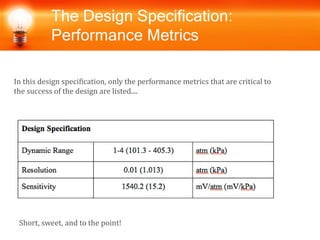
In this design specification, only the performance metrics that are critical to
the success of the design are listed....
The Design Specification:
Performance Metrics
In this design specification, only the performance metrics that are critical to
the success of the design are listed....
Short, sweet, and to the point!
The Design Specification:
Constraints
Constraints are either those parameters that limit the scope of the
design but are nevertheless essential to meeting the design goals
and application for a product, prototype, or proof-of-concept.
Creating a
Design
Specification
during the
Design
Solutions
phase of the
Engineering
Design
Cycle
The Design Specification:
Constraints
Constraints are either those parameters that limit the scope of the
design but are nevertheless essential to meeting the design goals
and application for a product, prototype, or proof-of-concept.
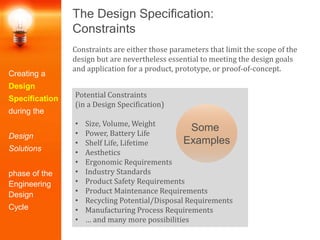
Potential Constraints
(in a Design Specification)
• Size, Volume, Weight
• Power, Battery Life
• Shelf Life, Lifetime
• Aesthetics
• Ergonomic Requirements
• Industry Standards
• Product Safety Requirements
• Product Maintenance Requirements
• Recycling Potential/Disposal Requirements
• Manufacturing Process Requirements
• … and many more possibilities
Creating a
Design
Specification
during the
Design
Solutions
phase of the
Engineering
Design
Cycle
Some
Examples
The Design Specification:
Constraints
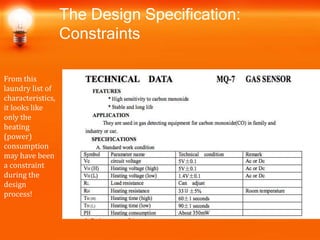
From this
laundry list of
characteristics,
it looks like
only the
heating
(power)
consumption
may have been
a constraint
during the
design
process!
Source: Hanwei Electronics
The Design Specification:
Constraints
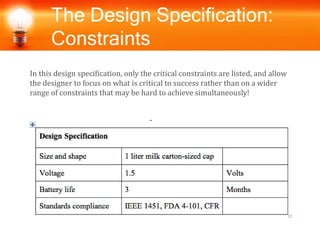
In this design specification, only the critical constraints are listed, and allow
the designer to focus on what is critical to success rather than on a wider
range of constraints that may be hard to achieve simultaneously!
The Design Specification:
Constraints
In this design specification, only the critical constraints are listed, and allow
the designer to focus on what is critical to success rather than on a wider
range of constraints that may be hard to achieve simultaneously!
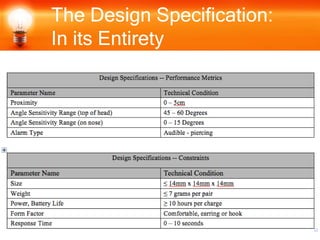
The Design Specification:
In its Entirety
The Product Specification:
In its Entirety
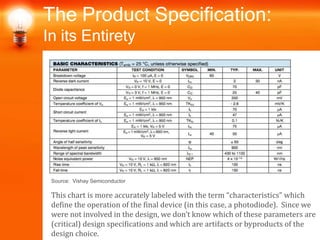
This chart is more accurately labeled with the term “characteristics” which
define the operation of the final device (in this case, a photodiode). Since we
were not involved in the design, we don’t know which of these parameters are
(critical) design specifications and which are artifacts or byproducts of the
design choice.
Source: Vishay Semiconductor
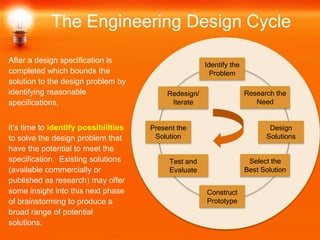
After a design specification is
completed which bounds the
solution to the design problem by
identifying reasonable
specifications,
it’s time to identify possibilities
to solve the design problem that
have the potential to meet the
specification. Existing solutions
(available commercially or
published as research) may offer
some insight into this next phase
of brainstorming to produce a
broad range of potential
solutions.
The Engineering Design Cycle
Identify the
Problem
Construct
Prototype
Research the
Need
Select the
Best Solution
Design
Solutions
Redesign/
Iterate
Test and
Evaluate
Present the
Solution
Identifying Possible Solutions
Identifying
Possibilities
during the
Design
Solutions
phase of the
Engineering
Design
Cycle
Look for existing and similar products
Search on the Web
Identifying Possible Solutions
Identifying
Possibilities
during the
Design
Solutions
phase of the
Engineering
Design
Cycle
Look for existing and similar products
Ask Potential Users
Tap Professional Networks
Identifying Possible Solutions
Identifying
Possibilities
during the
Design
Solutions
phase of the
Engineering
Design
Cycle
Look for existing and similar products
Search Patents online
Identifying Possible Solutions
Identifying
Possibilities
during the
Design
Solutions
phase of the
Engineering
Design
Cycle
Look for existing and similar products
Search peer reviewed literature
(especially review articles on
application or product type)
Identifying Possible Solutions
Identifying
Possibilities
during the
Design
Solutions
phase of the
Engineering
Design
Cycle
Look for existing and similar products
Peruse ads and articles in
relevant trade magazines
Identifying Possible Solutions
Brainstorm Design Solutions
This stage of
brainstorming is
best done in a group
of no more than 6
people
Identifying
Possibilities
during the
Design
Solutions
phase of the
Engineering
Design
Cycle
Identifying Possible Solutions
Brainstorm Design Solutions
Look around
you at how
products are
designed
Identifying
Possibilities
during the
Design
Solutions
phase of the
Engineering
Design
Cycle
Identifying Possible Solutions
Brainstorm Design Solutions
Go to the places where the
product would/could be
used and observe
Identifying
Possibilities
during the
Design
Solutions
phase of the
Engineering
Design
Cycle
Identifying Possible Solutions
Brainstorm Design Solutions
Use a tool that works to
stimulate ideas (mind
maps, post it notes, etc.)
Identifying
Possibilities
during the
Design
Solutions
phase of the
Engineering
Design
Cycle
Identifying Possible Solutions
Brainstorm Design Solutions
Record all ideas and organize
them in some way that makes
sense to the design team.
Identifying
Possibilities
during the
Design
Solutions
phase of the
Engineering
Design
Cycle
Using Mind Maps for Brainstorming
Start in the center with an image of the design as a final product,
using at least 3 colors, and giving some indication of the application
of the product/design.
• Group ideas around the central image according to the design
type, design approach, or other organizing feature.
– Use multiple colors throughout the mind map, for visual stimulation and also
for encoding or grouping.
– Use emphasis and show associations in your mind map.
– Keep the mind map clear by using radial hierarchy or outlines to embrace
your branches.
– Lines on the map should be connected, starting from the central image. The
lines become thinner as they radiate out from the center.
• Use images, symbols, codes, and dimensions throughout the
mind map to reduce text and make it easy to follow.
Adapted from Source: Buzan, Tony (1974)
Identifying
Possibilities
during the
Design
Solutions
phase of the
Engineering
Design
Cycle
Using Mind Maps for Brainstorming
Start in the center with an image of the design as a final product,
using at least 3 colors, and giving some indication of the application
of the product/design.
• Group ideas around the central image according to the design
type, design approach, or other organizing feature.
– Use multiple colors throughout the mind map, for visual stimulation and also
for encoding or grouping.
– Use emphasis and show associations in your mind map.
– Keep the mind map clear by using radial hierarchy or outlines to embrace
your branches.
– Lines on the map should be connected, starting from the central image. The
lines become thinner as they radiate out from the center.
• Use images, symbols, codes, and dimensions throughout the
mind map to reduce text and make it easy to follow.
Adapted from Source: Buzan, Tony (1974)
Develop your own personal style of mind mapping that
serves the needs of your design team and design process!
Identifying
Possibilities
during the
Design
Solutions
phase of the
Engineering
Design
Cycle
Using Mind Maps for Brainstorming
Group ideas around the central image according to the design type,
design approach, or other organizing feature.
Identifying
Possibilities
during the
Design
Solutions
phase of the
Engineering
Design
Cycle
Using Mind Maps for Brainstorming
Group ideas around the central image according to the design type,
design approach, or other organizing feature.
Identifying
Possibilities
during the
Design
Solutions
phase of the
Engineering
Design
Cycle
Using MindMaps for Brainstorming
Even a rough start can be a good start!
Identifying
Possibilities
during the
Design
Solutions
phase of the
Engineering
Design
Cycle
Using Mind Maps for Brainstorming
Use Color and Images to make the mind map easy to navigate!
Identifying
Possibilities
during the
Design
Solutions
phase of the
Engineering
Design
Cycle
Using Mind Maps for Brainstorming
Use Color and Images to make the mind map easy to navigate!
Identifying
Possibilities
during the
Design
Solutions
phase of the
Engineering
Design
Cycle
Using Mind Maps for Brainstorming
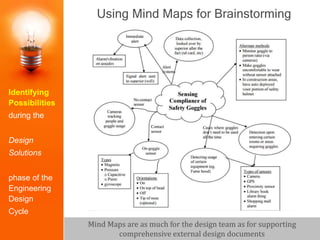
Mind Maps are as much for the design team as for supporting
comprehensive external design documents
Identifying
Possibilities
during the
Design
Solutions
phase of the
Engineering
Design
Cycle
Using Mind Maps for Brainstorming
Mind Maps are as much for the design team as for supporting
comprehensive external design documents
Identifying
Possibilities
during the
Design
Solutions
phase of the
Engineering
Design
Cycle
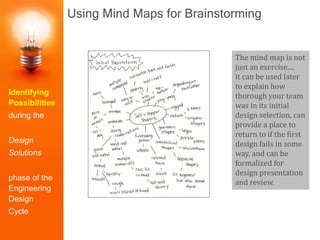
Using Mind Maps for Brainstorming
The mind map is not
just an exercise....
it can be used later
to explain how
thorough your team
was in its initial
design selection, can
provide a place to
return to if the first
design fails in some
way, and can be
formalized for
design presentation
and review.
Identifying
Possibilities
during the
Design
Solutions
phase of the
Engineering
Design
Cycle
Using Mind Maps for Brainstorming
The mind map is not
just an exercise....
it can be used later
to explain how
thorough your team
was in its initial
design selection, can
provide a place to
return to if the first
design fails in some
way, and can be
formalized for
design presentation
and review.
Identifying
Possibilities
during the
Design
Solutions
phase of the
Engineering
Design
Cycle
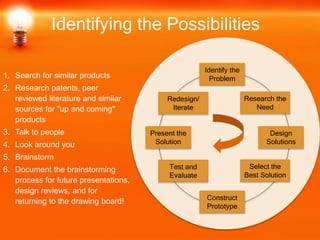
Identifying the Possibilities
1. Search for similar products
2. Research patents, peer
reviewed literature and similar
sources for "up and coming"
products
3. Talk to people
4. Look around you
5. Brainstorm
6. Document the brainstorming
process for future presentations,
design reviews, and for
returning to the drawing board!
Identify the
Problem
Construct
Prototype
Research the
Need
Select the
Best Solution
Design
Solutions
Redesign/
Iterate
Test and
Evaluate
Present the
Solution
Thanks for joining us as we explored the third step of the
Engineering Design Cycle: Design Solutions.
Complete Educational Materials (including assignments,
quizzes, and recorded lectures) on the topic of Basic
Engineering Design can be found at:
http://labs.ee.washington.edu/community/BasicEngDes/
The Engineering Design Cycle

Basic Engineering Design (Part 3): Designing Solutions

  • 1.
    The Engineering Design Cycle Part3: Design Solutions http://labs.ee.washington.edu/community/BasicEngDes/BasicEngDes_DesignSolution/
  • 2.
    The first stepin designing solutions to solve the problem identified in the first step of the design cycle is to create a design specification. A design specification refers to the characteristics of the solution to the design problem. The design specification has two categories of information: • Performance Metrics: refer to what the design/product does • Constraints: The limitations in which the product/design delivers the performance metrics The Engineering Design Cycle Identify the Problem Construct Prototype Research the Need Select the Best Solution Design Solutions Redesign/ Iterate Test and Evaluate Present the Solution
  • 3.
    The Design Specification: PerformanceMetrics Creating a Design Specification during the Design Solutions phase of the Engineering Design Cycle At the design phase, performance metrics should be only those characteristics of the design that are CRITICAL to the design's success. Other performance characteristics that are nice, but not necessary, will be part of the product specifications but should not be listed in the design specification.
  • 4.
    The Design Specification: PerformanceMetrics Creating a Design Specification during the Design Solutions phase of the Engineering Design Cycle At the design phase, performance metrics should be only those characteristics of the design that are CRITICAL to the design's success. Other performance characteristics that are nice, but not necessary, will be part of the product specifications but should not be listed in the design specification. Performance Metrics (that may be used for Design Specifications): • Accuracy, Precision, • Resolution (input or output) • Detection Limit • Dynamic Range • Selectivity • Sensitivity • Response Time • Dynamic Range • Stability • Hysteresis • Lifetime Some Examples
  • 5.
    The Design Specification: PerformanceMetrics Sometimes the design specification is obvious from reading product specifications: original design specifications (features) are more obvious in a system that has been designed for a specific application than for a design whose end application is not necessarily known at the time of design.
  • 6.
    The Design Specification: PerformanceMetrics Sometimes the design specification is obvious from reading product specifications: original design specifications (features) are more obvious in a system that has been designed for a specific application than for a design whose end application is not necessarily known at the time of design. These specifications (features) for a grating on an Ocean Optics spectrometer tell the user the “critical” parameters (intended use, spectral range, best efficiency) which all emphasize the colors of light that will be best detected by the spectrometer. Source: Ocean Optics
  • 7.
    The Design Specification: PerformanceMetrics In this design specification, only the performance metrics that are critical to the success of the design are listed....
  • 8.
    The Design Specification: PerformanceMetrics In this design specification, only the performance metrics that are critical to the success of the design are listed.... Short, sweet, and to the point!
  • 9.
    The Design Specification: Constraints Constraintsare either those parameters that limit the scope of the design but are nevertheless essential to meeting the design goals and application for a product, prototype, or proof-of-concept. Creating a Design Specification during the Design Solutions phase of the Engineering Design Cycle
  • 10.
    The Design Specification: Constraints Constraintsare either those parameters that limit the scope of the design but are nevertheless essential to meeting the design goals and application for a product, prototype, or proof-of-concept. Potential Constraints (in a Design Specification) • Size, Volume, Weight • Power, Battery Life • Shelf Life, Lifetime • Aesthetics • Ergonomic Requirements • Industry Standards • Product Safety Requirements • Product Maintenance Requirements • Recycling Potential/Disposal Requirements • Manufacturing Process Requirements • … and many more possibilities Creating a Design Specification during the Design Solutions phase of the Engineering Design Cycle Some Examples
  • 11.
    The Design Specification: Constraints Fromthis laundry list of characteristics, it looks like only the heating (power) consumption may have been a constraint during the design process! Source: Hanwei Electronics
  • 12.
    The Design Specification: Constraints Inthis design specification, only the critical constraints are listed, and allow the designer to focus on what is critical to success rather than on a wider range of constraints that may be hard to achieve simultaneously!
  • 13.
    The Design Specification: Constraints Inthis design specification, only the critical constraints are listed, and allow the designer to focus on what is critical to success rather than on a wider range of constraints that may be hard to achieve simultaneously!
  • 14.
  • 15.
    The Product Specification: Inits Entirety This chart is more accurately labeled with the term “characteristics” which define the operation of the final device (in this case, a photodiode). Since we were not involved in the design, we don’t know which of these parameters are (critical) design specifications and which are artifacts or byproducts of the design choice. Source: Vishay Semiconductor
  • 16.
    After a designspecification is completed which bounds the solution to the design problem by identifying reasonable specifications, it’s time to identify possibilities to solve the design problem that have the potential to meet the specification. Existing solutions (available commercially or published as research) may offer some insight into this next phase of brainstorming to produce a broad range of potential solutions. The Engineering Design Cycle Identify the Problem Construct Prototype Research the Need Select the Best Solution Design Solutions Redesign/ Iterate Test and Evaluate Present the Solution
  • 17.
    Identifying Possible Solutions Identifying Possibilities duringthe Design Solutions phase of the Engineering Design Cycle Look for existing and similar products Search on the Web
  • 18.
    Identifying Possible Solutions Identifying Possibilities duringthe Design Solutions phase of the Engineering Design Cycle Look for existing and similar products Ask Potential Users Tap Professional Networks
  • 19.
    Identifying Possible Solutions Identifying Possibilities duringthe Design Solutions phase of the Engineering Design Cycle Look for existing and similar products Search Patents online
  • 20.
    Identifying Possible Solutions Identifying Possibilities duringthe Design Solutions phase of the Engineering Design Cycle Look for existing and similar products Search peer reviewed literature (especially review articles on application or product type)
  • 21.
    Identifying Possible Solutions Identifying Possibilities duringthe Design Solutions phase of the Engineering Design Cycle Look for existing and similar products Peruse ads and articles in relevant trade magazines
  • 22.
    Identifying Possible Solutions BrainstormDesign Solutions This stage of brainstorming is best done in a group of no more than 6 people Identifying Possibilities during the Design Solutions phase of the Engineering Design Cycle
  • 23.
    Identifying Possible Solutions BrainstormDesign Solutions Look around you at how products are designed Identifying Possibilities during the Design Solutions phase of the Engineering Design Cycle
  • 24.
    Identifying Possible Solutions BrainstormDesign Solutions Go to the places where the product would/could be used and observe Identifying Possibilities during the Design Solutions phase of the Engineering Design Cycle
  • 25.
    Identifying Possible Solutions BrainstormDesign Solutions Use a tool that works to stimulate ideas (mind maps, post it notes, etc.) Identifying Possibilities during the Design Solutions phase of the Engineering Design Cycle
  • 26.
    Identifying Possible Solutions BrainstormDesign Solutions Record all ideas and organize them in some way that makes sense to the design team. Identifying Possibilities during the Design Solutions phase of the Engineering Design Cycle
  • 27.
    Using Mind Mapsfor Brainstorming Start in the center with an image of the design as a final product, using at least 3 colors, and giving some indication of the application of the product/design. • Group ideas around the central image according to the design type, design approach, or other organizing feature. – Use multiple colors throughout the mind map, for visual stimulation and also for encoding or grouping. – Use emphasis and show associations in your mind map. – Keep the mind map clear by using radial hierarchy or outlines to embrace your branches. – Lines on the map should be connected, starting from the central image. The lines become thinner as they radiate out from the center. • Use images, symbols, codes, and dimensions throughout the mind map to reduce text and make it easy to follow. Adapted from Source: Buzan, Tony (1974) Identifying Possibilities during the Design Solutions phase of the Engineering Design Cycle
  • 28.
    Using Mind Mapsfor Brainstorming Start in the center with an image of the design as a final product, using at least 3 colors, and giving some indication of the application of the product/design. • Group ideas around the central image according to the design type, design approach, or other organizing feature. – Use multiple colors throughout the mind map, for visual stimulation and also for encoding or grouping. – Use emphasis and show associations in your mind map. – Keep the mind map clear by using radial hierarchy or outlines to embrace your branches. – Lines on the map should be connected, starting from the central image. The lines become thinner as they radiate out from the center. • Use images, symbols, codes, and dimensions throughout the mind map to reduce text and make it easy to follow. Adapted from Source: Buzan, Tony (1974) Develop your own personal style of mind mapping that serves the needs of your design team and design process! Identifying Possibilities during the Design Solutions phase of the Engineering Design Cycle
  • 29.
    Using Mind Mapsfor Brainstorming Group ideas around the central image according to the design type, design approach, or other organizing feature. Identifying Possibilities during the Design Solutions phase of the Engineering Design Cycle
  • 30.
    Using Mind Mapsfor Brainstorming Group ideas around the central image according to the design type, design approach, or other organizing feature. Identifying Possibilities during the Design Solutions phase of the Engineering Design Cycle
  • 31.
    Using MindMaps forBrainstorming Even a rough start can be a good start! Identifying Possibilities during the Design Solutions phase of the Engineering Design Cycle
  • 32.
    Using Mind Mapsfor Brainstorming Use Color and Images to make the mind map easy to navigate! Identifying Possibilities during the Design Solutions phase of the Engineering Design Cycle
  • 33.
    Using Mind Mapsfor Brainstorming Use Color and Images to make the mind map easy to navigate! Identifying Possibilities during the Design Solutions phase of the Engineering Design Cycle
  • 34.
    Using Mind Mapsfor Brainstorming Mind Maps are as much for the design team as for supporting comprehensive external design documents Identifying Possibilities during the Design Solutions phase of the Engineering Design Cycle
  • 35.
    Using Mind Mapsfor Brainstorming Mind Maps are as much for the design team as for supporting comprehensive external design documents Identifying Possibilities during the Design Solutions phase of the Engineering Design Cycle
  • 36.
    Using Mind Mapsfor Brainstorming The mind map is not just an exercise.... it can be used later to explain how thorough your team was in its initial design selection, can provide a place to return to if the first design fails in some way, and can be formalized for design presentation and review. Identifying Possibilities during the Design Solutions phase of the Engineering Design Cycle
  • 37.
    Using Mind Mapsfor Brainstorming The mind map is not just an exercise.... it can be used later to explain how thorough your team was in its initial design selection, can provide a place to return to if the first design fails in some way, and can be formalized for design presentation and review. Identifying Possibilities during the Design Solutions phase of the Engineering Design Cycle
  • 38.
    Identifying the Possibilities 1.Search for similar products 2. Research patents, peer reviewed literature and similar sources for "up and coming" products 3. Talk to people 4. Look around you 5. Brainstorm 6. Document the brainstorming process for future presentations, design reviews, and for returning to the drawing board! Identify the Problem Construct Prototype Research the Need Select the Best Solution Design Solutions Redesign/ Iterate Test and Evaluate Present the Solution
  • 39.
    Thanks for joiningus as we explored the third step of the Engineering Design Cycle: Design Solutions. Complete Educational Materials (including assignments, quizzes, and recorded lectures) on the topic of Basic Engineering Design can be found at: http://labs.ee.washington.edu/community/BasicEngDes/ The Engineering Design Cycle