CONCEPTS IN ECONOMICS
Definition
Definition of the subject comes from the economist Lionel
Robbins, who said in 1935 that
"Economics is a social science that studies human behaviour
as a relationship between ends and scarce means which have
alternative uses. That is, economics is the study of the trade-
offs involved when choosing between alternate sets of
decisions."
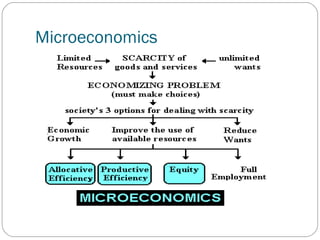
Basic economic problem
The basic economic problem is about scarcity and
choice since there are only a limited amount of resources
available to produce the unlimited amount of goods and
services we desire.
All societies face the problem of
having to decide:
What goods and services to produce
How best to produce goods and services
Who is to receive goods and services
Economic Systems
Traditional economy(Barter System)
Free market economy
Planned or command economy
Mixed economy
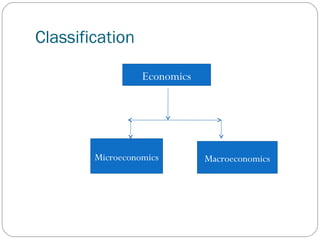
Classification
Economics
Microeconomics Macroeconomics
Microeconomics
Utility
Term given by Jeremy Bentham
The term utility refers to the want satisfying power or capacity of
a commodity or service., assumed by the consumer to constitute
his demand for that commodity or service.
Utility is a subjective term.
Utility is a relative term. It depends on time and place.
Utility has no moral or ethical consideration.
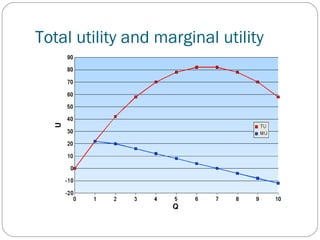
Consumers experience diminishing utility as they increase their
consumption.
Marginal and Total utility
Total utility is the utility derived by consuming all units of a
commodity
TU=∑MU
Marginal utility is the utility derived by consuming an extra
unit of output
MU=TU(n)-TU(n-1)
Total utility and marginal utility
Production
Production refers to the output of goods and services
produced by businesses within a market. This production
creates the supply that allows our needs and wants to be
satisfied. To simplify the idea of the production function,
economists create a number of time periods for analysis.
Types of production function
Short run production
The short run is a period of time when there is at least one
fixed factor input. This is usually the capital input such as plant
and machinery and the stock of buildings and technology. In the
short run, the output of a business expands when more variable
factors of production (e.g. labour, raw materials and components)
are employed.
Long run production
In the long run, all of the factors of production can change
giving a business the opportunity to increase the scale of its
operations. For example a business may grow by adding extra
labour and capital to the production process and introducing new
technology into their operations
Costs of production
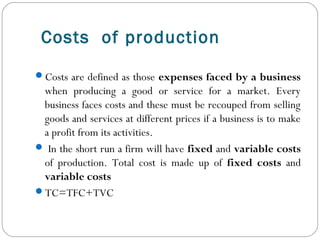
Costs are defined as those expenses faced by a business
when producing a good or service for a market. Every
business faces costs and these must be recouped from selling
goods and services at different prices if a business is to make
a profit from its activities.
 In the short run a firm will have fixed and variable costs
of production. Total cost is made up of fixed costs and
variable costs
TC=TFC+TVC
opportunity cost
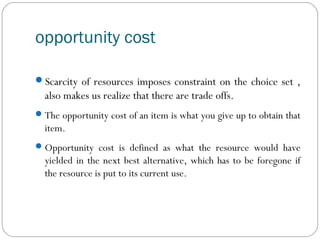
Scarcity of resources imposes constraint on the choice set ,
also makes us realize that there are trade offs.
The opportunity cost of an item is what you give up to obtain that
item.
Opportunity cost is defined as what the resource would have
yielded in the next best alternative, which has to be foregone if
the resource is put to its current use.
Profits
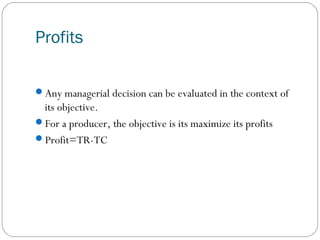
Any managerial decision can be evaluated in the context of
its objective.
For a producer, the objective is its maximize its profits
Profit=TR-TC
Market
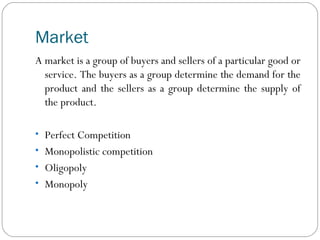
A market is a group of buyers and sellers of a particular good or
service. The buyers as a group determine the demand for the
product and the sellers as a group determine the supply of
the product.
• Perfect Competition
• Monopolistic competition
• Oligopoly
• Monopoly
Equilibrium
The word equilibrium means it is a state from which there is
no tendency to change.
Equilibrium denotes in economics absence of change in
movement.
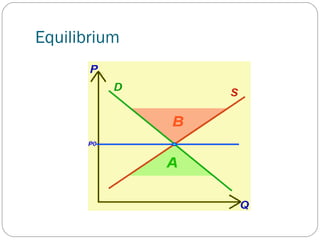
When demand and supply are equal at a particular price, it is
the state of equilibrium.
Equilibrium
Partial equilibrium: Partial equilibrium also known
microeconomic analysis is a study of the equilibrium position
of an individual , a firm, an industry or a group of industries
viewed in isolation
 General equilibrium: General equilibrium is an extensive
study of a number of economic variables , their
interrelationship, for understanding the working of the
economic system as a whole.
 It helps to understand the working of the economic system.
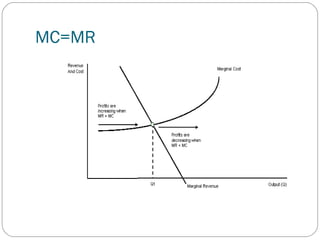
Margin
Marginal changes are small, incremental adjustments to an
existing plan of action
 Marginal changes in costs or benefits motivate people to
respond.
The decision to choose one alternative over another occurs
when that alternative’s marginal benefits exceed its marginal
costs.
MC=MR
Managerial economics
Managerial economics involves application of economic
principles to the future of the firm or business enterprise.
According to McNair and Meriam,’ Managerial economics
consists of the use of economic modes of thought to analyze
business situations.’
Characteristics
 It is mainly a study of a business enterprise
 It is concerned with microeconomic concepts
 It is concerned with decision making of an economic nature.
 It takes the help of statistical tools to find numerical values of
economic parameters
 It is useful for prediction
 It uses macroeconomic factors in determining business
strategies
Scope of managerial economics
1) Theory of demand and demand forecasting
2) Pricing
3) Cost analysis
4) Resource allocation
5) Profit analysis
6) Investment analysis
7) Strategic planning
8)Business Environment
Economic theory and managerial
economics
1) Opportunity cost
2) Elasticity of demand
3) Revenue concepts
4) Production function
5) Demand theory
6) Fiscal and monetary policies
7) Theory of international trade
8) National income
9) Business cycles
Specific role of Managerial
economist
Sales forecasting
Market research
Economic analysis of competitors
Pricing
Capital projects
Production

Concepts in economics

  • 1.
  • 2.
    Definition Definition of thesubject comes from the economist Lionel Robbins, who said in 1935 that "Economics is a social science that studies human behaviour as a relationship between ends and scarce means which have alternative uses. That is, economics is the study of the trade- offs involved when choosing between alternate sets of decisions."
  • 3.
    Basic economic problem Thebasic economic problem is about scarcity and choice since there are only a limited amount of resources available to produce the unlimited amount of goods and services we desire.
  • 4.
    All societies facethe problem of having to decide: What goods and services to produce How best to produce goods and services Who is to receive goods and services
  • 5.
    Economic Systems Traditional economy(BarterSystem) Free market economy Planned or command economy Mixed economy
  • 6.
  • 7.
  • 8.
    Utility Term given byJeremy Bentham The term utility refers to the want satisfying power or capacity of a commodity or service., assumed by the consumer to constitute his demand for that commodity or service. Utility is a subjective term. Utility is a relative term. It depends on time and place. Utility has no moral or ethical consideration. Consumers experience diminishing utility as they increase their consumption.
  • 9.
    Marginal and Totalutility Total utility is the utility derived by consuming all units of a commodity TU=∑MU Marginal utility is the utility derived by consuming an extra unit of output MU=TU(n)-TU(n-1)
  • 10.
    Total utility andmarginal utility
  • 11.
    Production Production refers tothe output of goods and services produced by businesses within a market. This production creates the supply that allows our needs and wants to be satisfied. To simplify the idea of the production function, economists create a number of time periods for analysis.
  • 12.
    Types of productionfunction Short run production The short run is a period of time when there is at least one fixed factor input. This is usually the capital input such as plant and machinery and the stock of buildings and technology. In the short run, the output of a business expands when more variable factors of production (e.g. labour, raw materials and components) are employed. Long run production In the long run, all of the factors of production can change giving a business the opportunity to increase the scale of its operations. For example a business may grow by adding extra labour and capital to the production process and introducing new technology into their operations
  • 13.
    Costs of production Costsare defined as those expenses faced by a business when producing a good or service for a market. Every business faces costs and these must be recouped from selling goods and services at different prices if a business is to make a profit from its activities.  In the short run a firm will have fixed and variable costs of production. Total cost is made up of fixed costs and variable costs TC=TFC+TVC
  • 14.
    opportunity cost Scarcity ofresources imposes constraint on the choice set , also makes us realize that there are trade offs. The opportunity cost of an item is what you give up to obtain that item. Opportunity cost is defined as what the resource would have yielded in the next best alternative, which has to be foregone if the resource is put to its current use.
  • 15.
    Profits Any managerial decisioncan be evaluated in the context of its objective. For a producer, the objective is its maximize its profits Profit=TR-TC
  • 16.
    Market A market isa group of buyers and sellers of a particular good or service. The buyers as a group determine the demand for the product and the sellers as a group determine the supply of the product. • Perfect Competition • Monopolistic competition • Oligopoly • Monopoly
  • 17.
    Equilibrium The word equilibriummeans it is a state from which there is no tendency to change. Equilibrium denotes in economics absence of change in movement. When demand and supply are equal at a particular price, it is the state of equilibrium.
  • 18.
  • 19.
    Partial equilibrium: Partialequilibrium also known microeconomic analysis is a study of the equilibrium position of an individual , a firm, an industry or a group of industries viewed in isolation  General equilibrium: General equilibrium is an extensive study of a number of economic variables , their interrelationship, for understanding the working of the economic system as a whole.  It helps to understand the working of the economic system.
  • 20.
    Margin Marginal changes aresmall, incremental adjustments to an existing plan of action  Marginal changes in costs or benefits motivate people to respond. The decision to choose one alternative over another occurs when that alternative’s marginal benefits exceed its marginal costs.
  • 21.
  • 22.
    Managerial economics Managerial economicsinvolves application of economic principles to the future of the firm or business enterprise. According to McNair and Meriam,’ Managerial economics consists of the use of economic modes of thought to analyze business situations.’
  • 23.
    Characteristics  It ismainly a study of a business enterprise  It is concerned with microeconomic concepts  It is concerned with decision making of an economic nature.  It takes the help of statistical tools to find numerical values of economic parameters  It is useful for prediction  It uses macroeconomic factors in determining business strategies
  • 24.
    Scope of managerialeconomics 1) Theory of demand and demand forecasting 2) Pricing 3) Cost analysis 4) Resource allocation 5) Profit analysis 6) Investment analysis 7) Strategic planning 8)Business Environment
  • 25.
    Economic theory andmanagerial economics 1) Opportunity cost 2) Elasticity of demand 3) Revenue concepts 4) Production function 5) Demand theory 6) Fiscal and monetary policies 7) Theory of international trade 8) National income 9) Business cycles
  • 26.
    Specific role ofManagerial economist Sales forecasting Market research Economic analysis of competitors Pricing Capital projects Production