Scarcity and the Science of Economics“We witness scarcity with each year’s “hot” new product.”What is Economics?
Fundamental Economic ProblemScarcity: Condition where unlimited human wants face limited resources.Effects almost every decision we make.
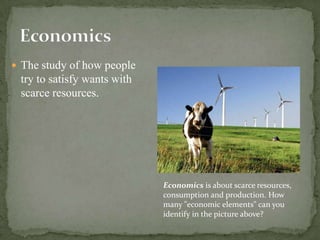
The study of how people try to satisfy wants with scarce resources.EconomicsEconomics is about scarce resources, consumption and production. How many "economic elements" can you identify in the picture above?
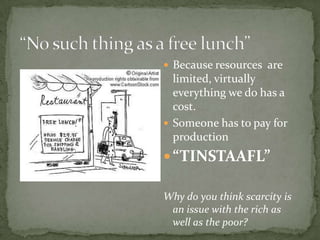
Needs and WantsNeed: Required for survival.Want: Desired for satisfaction.“No such thing as a free lunch”Because resources  are limited, virtually everything we do has a cost.Someone has to pay for production“TINSTAAFL”Why do you think scarcity is an issue with the rich as well as the poor?
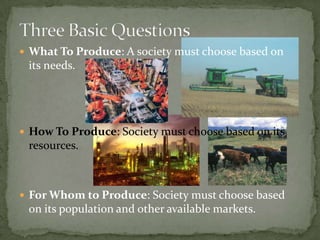
Three Basic QuestionsWhat To Produce: A society must choose based on its needs.How To Produce: Society must choose based on its resources.For Whom to Produce: Society must choose based on its population and other available markets.
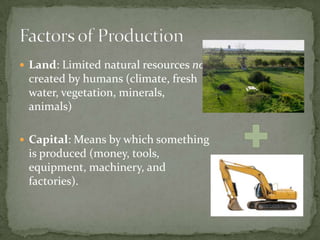
Land: Limited natural resources not created by humans (climate, fresh water, vegetation, minerals, animals)Capital: Means by which something is produced (money, tools, equipment, machinery, and factories).Factors of Production
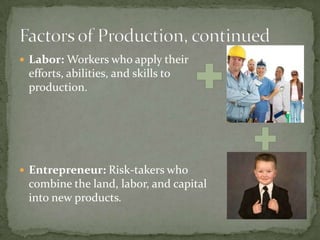
Labor: Workers who apply their efforts, abilities, and skills to production.Entrepreneur: Risk-takers who combine the land, labor, and capital into new products.Factors of Production, continued
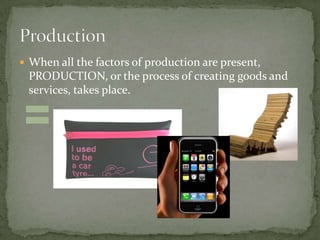
When all the factors of production are present, PRODUCTION, or the process of creating goods and services, takes place.Production
Describes economic activity- Gross Domestic Product (GDP), unemployment rate, government spending, tax rates…Analyzes economic activity and answers the “why’s” and “how’s”-why prices go up and down, or how do taxes affect savings.The Scope of Economics
Economists offer an explanation of the economy and its activities to the society’s population. Prediction: We want to know what’s around the corner to better prepare ourselves for the unknown.Will prices rise or fall?Will income increase or decrease?Economics is a social science because it looks at the decisions people make and how they react to those decisions.The Scope of Economics, continued
Basic Economic Concepts “20% of the world’s people who live in the wealthiest nations consume 86% of the world’s goods and services.  The 20% who live in the poorest nations consume only 1.3%”Section 2
Goods: Item that is economically useful or satisfies an economic want.Consumer good: Intended for final use by individualsCapital goods: Manufactured goods which are used to produce other goods and services.  Ex.?Durable goods: Any product that lasts longer than 3 years when used on a regular basis. Ex?Nondurable goods: Any product that lasts less than 3 years when used on a regular basis. Ex?Goods, Services, Consumers
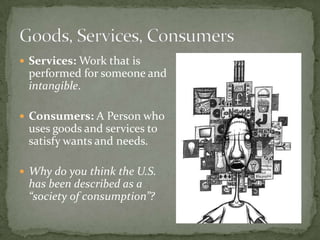
Services: Work that is performed for someone and intangible.Consumers: A Person who uses goods and services to satisfy wants and needs.Why do you think the U.S. has been described as a “society of consumption”?Goods, Services, Consumers
Value: A worth that can be expressed in dollars and cents.Scarcity by itself is not enough to create value.  For something to have value, it must also have utility.Value, Utility, and Wealth
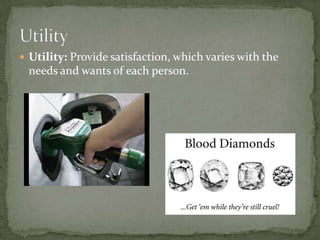
Utility: Provide satisfaction, which varies with the needs and wants of each person.Utility
WealthThe accumulation of goods that are tangible, scarce, useful, and transferable from one person to another.A nation’s wealth is comprised of all items, including natural resources, factories, etc.Does not include services!!
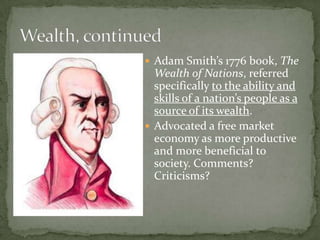
Adam Smith’s 1776 book, The Wealth of Nations, referred specifically to the ability and skills of a nation’s people as a source of its wealth.Advocated a free market economy as more productive and more beneficial to society. Comments? Criticisms?Wealth, continued
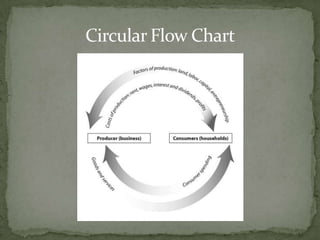
The Circular Flow of Economic ActivityWealth that is generated by the economy is made possible by a circular flow of economic activity.
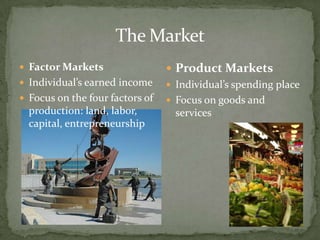
The MarketFactor MarketsIndividual’s earned incomeFocus on the four factors of production: land, labor, capital, entrepreneurshipProduct MarketsIndividual’s spending placeFocus on goods and services
Circular Flow Chart
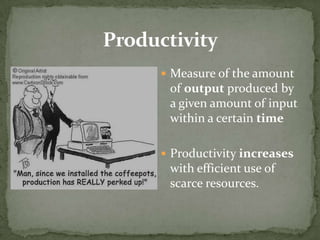
ProductivityMeasure of the amount of output produced by a given amount of input within a certain timeProductivity increases with efficient use of scarce resources.
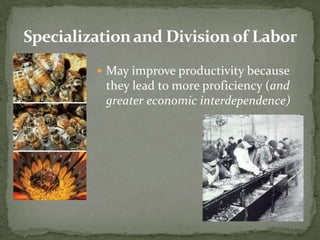
Specialization and Division of LaborMay improve productivity because they lead to more proficiency (and greater economic interdependence)
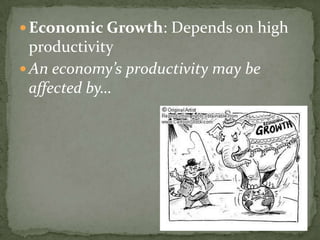
Economic Growth: Depends on high productivityAn economy’s productivity may be affected by…
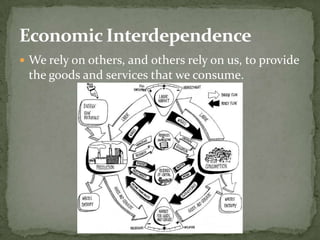
Economic InterdependenceWe rely on others, and others rely on us, to provide the goods and services that we consume.
Section 3: Economic Choices and Decision Making“Catch a man a fish, and you can sell it to him. Teach a man to fish, and you ruin a wonderful business opportunity.”
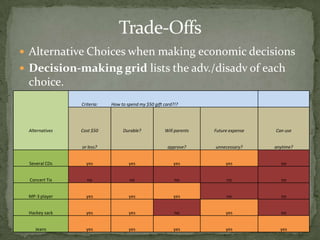
Trade-OffsAlternative Choices when making economic decisionsDecision-making grid lists the adv./disadv of each choice.
Opportunity CostThe cost of the next best alternative among a person’s choices.The cost may be the money, time or resources a person gives up, or sacrifices, to make his/her final choice.Discussion Question:What are some important economic decisions you will be facing within the next 5 weeks? 5 months?  One year?  Five years?
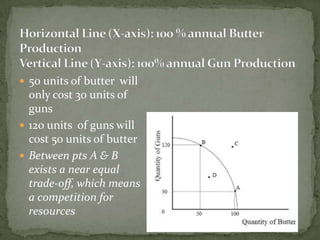
Production Possibilities FrontierDiagram illustrating the concept of opportunity cost.It shows the various combinations of goods and/or services an economy can produce when all productive resources are fully employed.Identifying possible alternatives allows an economy to examine how it can best put its limited resources into production.Considering different ways to fully employ its resources allows an economy to analyze the combination of goods/services that lead to maximum output.
Horizontal Line (X-axis): 100 % annual Butter ProductionVertical Line (Y-axis): 100% annual Gun Production50 units of butter  will only cost 30 units of guns120 units  of guns will cost 50 units of butterBetween pts A & B exists a near equal trade-off, which means a competition for resources
Production Possibilities continuedOpportunity Costs: Expressed in terms of trade-offs, or in terms of things given up to get something elseThe Cost of idle resources: If some resources are not employed, it is difficult for any company, nation, or individual to reach its true potentialEconomic Growth: Any increase in resources and/or productivity causes the production possibilities frontier to move outward
Build simple models to analyze or describe actual economic situations.Employ Cost-Benefit Analysis: Compare the cost of an action to the benefits received (Ex. ?)Baby Steps: Make decisions by taking small, incremental steps toward the final goalThinking Like an Economist:Strategies that will help us make the best choices
Studying economics will help us know how the economy works on a daily basis.Helps us understand the Free Enterprise economy where consumers and privately owned businesses, not the government, make a majority of the economic decisions. The Road Ahead
Helps us become better decision-makers, both in our personal and professional lives AND at the voting booth!!Economics for Citizens
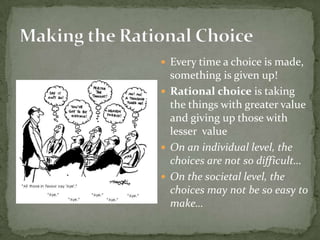
Every time a choice is made, something is given up!Rational choice is taking the things with greater value and giving up those with lesser  valueOn an individual level, the choices are not so difficult…On the societal level, the choices may not be so easy to make…Making the Rational Choice
What is economics unit1week1

What is economics unit1week1

  • 1.
    Scarcity and theScience of Economics“We witness scarcity with each year’s “hot” new product.”What is Economics?
  • 2.
    Fundamental Economic ProblemScarcity:Condition where unlimited human wants face limited resources.Effects almost every decision we make.
  • 3.
    The study ofhow people try to satisfy wants with scarce resources.EconomicsEconomics is about scarce resources, consumption and production. How many "economic elements" can you identify in the picture above?
  • 4.
    Needs and WantsNeed:Required for survival.Want: Desired for satisfaction.“No such thing as a free lunch”Because resources are limited, virtually everything we do has a cost.Someone has to pay for production“TINSTAAFL”Why do you think scarcity is an issue with the rich as well as the poor?
  • 5.
    Three Basic QuestionsWhatTo Produce: A society must choose based on its needs.How To Produce: Society must choose based on its resources.For Whom to Produce: Society must choose based on its population and other available markets.
  • 6.
    Land: Limited naturalresources not created by humans (climate, fresh water, vegetation, minerals, animals)Capital: Means by which something is produced (money, tools, equipment, machinery, and factories).Factors of Production
  • 7.
    Labor: Workers whoapply their efforts, abilities, and skills to production.Entrepreneur: Risk-takers who combine the land, labor, and capital into new products.Factors of Production, continued
  • 8.
    When all thefactors of production are present, PRODUCTION, or the process of creating goods and services, takes place.Production
  • 9.
    Describes economic activity-Gross Domestic Product (GDP), unemployment rate, government spending, tax rates…Analyzes economic activity and answers the “why’s” and “how’s”-why prices go up and down, or how do taxes affect savings.The Scope of Economics
  • 10.
    Economists offer anexplanation of the economy and its activities to the society’s population. Prediction: We want to know what’s around the corner to better prepare ourselves for the unknown.Will prices rise or fall?Will income increase or decrease?Economics is a social science because it looks at the decisions people make and how they react to those decisions.The Scope of Economics, continued
  • 11.
    Basic Economic Concepts“20% of the world’s people who live in the wealthiest nations consume 86% of the world’s goods and services. The 20% who live in the poorest nations consume only 1.3%”Section 2
  • 12.
    Goods: Item thatis economically useful or satisfies an economic want.Consumer good: Intended for final use by individualsCapital goods: Manufactured goods which are used to produce other goods and services. Ex.?Durable goods: Any product that lasts longer than 3 years when used on a regular basis. Ex?Nondurable goods: Any product that lasts less than 3 years when used on a regular basis. Ex?Goods, Services, Consumers
  • 13.
    Services: Work thatis performed for someone and intangible.Consumers: A Person who uses goods and services to satisfy wants and needs.Why do you think the U.S. has been described as a “society of consumption”?Goods, Services, Consumers
  • 14.
    Value: A worththat can be expressed in dollars and cents.Scarcity by itself is not enough to create value. For something to have value, it must also have utility.Value, Utility, and Wealth
  • 15.
    Utility: Provide satisfaction,which varies with the needs and wants of each person.Utility
  • 16.
    WealthThe accumulation ofgoods that are tangible, scarce, useful, and transferable from one person to another.A nation’s wealth is comprised of all items, including natural resources, factories, etc.Does not include services!!
  • 17.
    Adam Smith’s 1776book, The Wealth of Nations, referred specifically to the ability and skills of a nation’s people as a source of its wealth.Advocated a free market economy as more productive and more beneficial to society. Comments? Criticisms?Wealth, continued
  • 18.
    The Circular Flowof Economic ActivityWealth that is generated by the economy is made possible by a circular flow of economic activity.
  • 19.
    The MarketFactor MarketsIndividual’searned incomeFocus on the four factors of production: land, labor, capital, entrepreneurshipProduct MarketsIndividual’s spending placeFocus on goods and services
  • 20.
  • 21.
    ProductivityMeasure of theamount of output produced by a given amount of input within a certain timeProductivity increases with efficient use of scarce resources.
  • 22.
    Specialization and Divisionof LaborMay improve productivity because they lead to more proficiency (and greater economic interdependence)
  • 23.
    Economic Growth: Dependson high productivityAn economy’s productivity may be affected by…
  • 24.
    Economic InterdependenceWe relyon others, and others rely on us, to provide the goods and services that we consume.
  • 25.
    Section 3: EconomicChoices and Decision Making“Catch a man a fish, and you can sell it to him. Teach a man to fish, and you ruin a wonderful business opportunity.”
  • 26.
    Trade-OffsAlternative Choices whenmaking economic decisionsDecision-making grid lists the adv./disadv of each choice.
  • 27.
    Opportunity CostThe costof the next best alternative among a person’s choices.The cost may be the money, time or resources a person gives up, or sacrifices, to make his/her final choice.Discussion Question:What are some important economic decisions you will be facing within the next 5 weeks? 5 months? One year? Five years?
  • 28.
    Production Possibilities FrontierDiagramillustrating the concept of opportunity cost.It shows the various combinations of goods and/or services an economy can produce when all productive resources are fully employed.Identifying possible alternatives allows an economy to examine how it can best put its limited resources into production.Considering different ways to fully employ its resources allows an economy to analyze the combination of goods/services that lead to maximum output.
  • 29.
    Horizontal Line (X-axis):100 % annual Butter ProductionVertical Line (Y-axis): 100% annual Gun Production50 units of butter will only cost 30 units of guns120 units of guns will cost 50 units of butterBetween pts A & B exists a near equal trade-off, which means a competition for resources
  • 30.
    Production Possibilities continuedOpportunityCosts: Expressed in terms of trade-offs, or in terms of things given up to get something elseThe Cost of idle resources: If some resources are not employed, it is difficult for any company, nation, or individual to reach its true potentialEconomic Growth: Any increase in resources and/or productivity causes the production possibilities frontier to move outward
  • 31.
    Build simple modelsto analyze or describe actual economic situations.Employ Cost-Benefit Analysis: Compare the cost of an action to the benefits received (Ex. ?)Baby Steps: Make decisions by taking small, incremental steps toward the final goalThinking Like an Economist:Strategies that will help us make the best choices
  • 32.
    Studying economics willhelp us know how the economy works on a daily basis.Helps us understand the Free Enterprise economy where consumers and privately owned businesses, not the government, make a majority of the economic decisions. The Road Ahead
  • 33.
    Helps us becomebetter decision-makers, both in our personal and professional lives AND at the voting booth!!Economics for Citizens
  • 34.
    Every time achoice is made, something is given up!Rational choice is taking the things with greater value and giving up those with lesser valueOn an individual level, the choices are not so difficult…On the societal level, the choices may not be so easy to make…Making the Rational Choice