1WHAT IS ECONOMICS?
© 2016 Pearson Education
After studying this chapter, you will be able to:
 Define economics and distinguish between
microeconomics and macroeconomics
 Explain the two big questions of economics
 Explain the key ideas that define the economic way of
thinking
 Explain how economists go about their work as social
scientists and policy advisers
© 2016 Pearson Education
All economic questions arise because we want more than
we can get.
Our inability to satisfy all our wants is called scarcity.
Because we face scarcity, we must make choices.
The choices we make depend on the incentives we face.
An incentive is a reward that encourages an action or a
penalty that discourages an action.
Definition of Economics
© 2016 Pearson Education
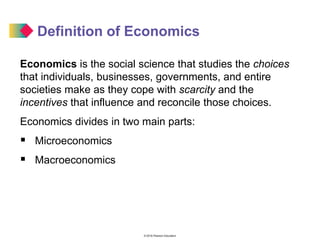
Economics is the social science that studies the choices
that individuals, businesses, governments, and entire
societies make as they cope with scarcity and the
incentives that influence and reconcile those choices.
Economics divides in two main parts:
 Microeconomics
 Macroeconomics
Definition of Economics
© 2016 Pearson Education
Definition of Economics
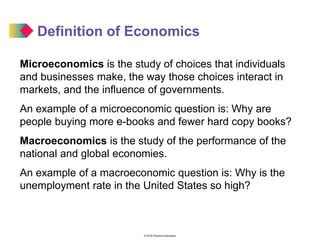
Microeconomics is the study of choices that individuals
and businesses make, the way those choices interact in
markets, and the influence of governments.
An example of a microeconomic question is: Why are
people buying more e-books and fewer hard copy books?
Macroeconomics is the study of the performance of the
national and global economies.
An example of a macroeconomic question is: Why is the
unemployment rate in the United States so high?
© 2016 Pearson Education
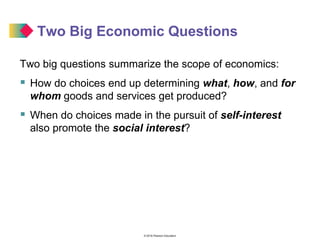
Two big questions summarize the scope of economics:
 How do choices end up determining what, how, and for
whom goods and services get produced?
 When do choices made in the pursuit of self-interest
also promote the social interest?
Two Big Economic Questions
© 2016 Pearson Education
What, How, and For Whom?
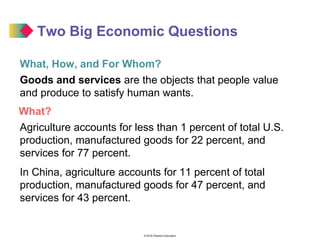
Goods and services are the objects that people value
and produce to satisfy human wants.
What?
Agriculture accounts for less than 1 percent of total U.S.
production, manufactured goods for 22 percent, and
services for 77 percent.
In China, agriculture accounts for 11 percent of total
production, manufactured goods for 47 percent, and
services for 43 percent.
Two Big Economic Questions
© 2016 Pearson Education
Two Big Economic Questions
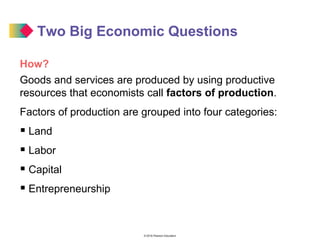
How?
Goods and services are produced by using productive
resources that economists call factors of production.
Factors of production are grouped into four categories:
 Land
 Labor
 Capital
 Entrepreneurship
© 2016 Pearson Education
Two Big Economic Questions
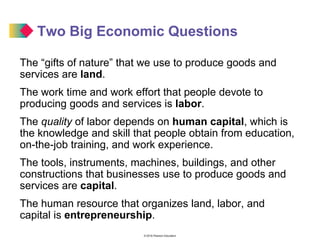
The “gifts of nature” that we use to produce goods and
services are land.
The work time and work effort that people devote to
producing goods and services is labor.
The quality of labor depends on human capital, which is
the knowledge and skill that people obtain from education,
on-the-job training, and work experience.
The tools, instruments, machines, buildings, and other
constructions that businesses use to produce goods and
services are capital.
The human resource that organizes land, labor, and
capital is entrepreneurship.
© 2016 Pearson Education
Two Big Economic Questions
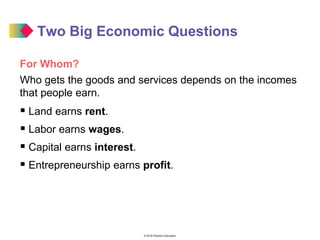
For Whom?
Who gets the goods and services depends on the incomes
that people earn.
 Land earns rent.
 Labor earns wages.
 Capital earns interest.
 Entrepreneurship earns profit.
© 2016 Pearson Education
Two Big Economic Questions
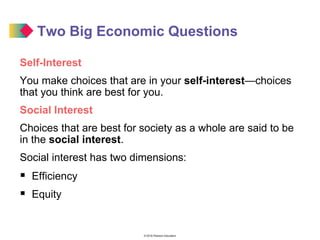
Self-Interest
You make choices that are in your self-interest—choices
that you think are best for you.
Social Interest
Choices that are best for society as a whole are said to be
in the social interest.
Social interest has two dimensions:
 Efficiency
 Equity
© 2016 Pearson Education
Two Big Economic Questions
Efficiency and Social Interest
Resource use is efficient if it is not possible to make
someone better off without making someone else worse
off.
Equity is fairness, but economists have a variety of views
about what is fair.
Fair Shares and Social Interest
The idea that the social interest requires “fair shares” is a
deeply held one.
But what is fair?
© 2016 Pearson Education
Four topics that generate discussion and that illustrate
tension between self-interest and social interest are:
 Globalization
 The information-age monopolies
 Climate change
 Economic instability
Two Big Economic Questions
© 2016 Pearson Education
Two Big Economic Questions
Globalization
Globalization means the expansion of international trade,
borrowing and lending, and investment.
Globalization is in the self-interest of consumers who buy
low-cost imported goods and services.
Globalization is also in the self-interest of the multinational
firms that produce in low-cost regions and sell in high-
price regions.
But is globalization in the self-interest of low-wage workers
in other countries and U.S. firms that can’t compete with
low-cost imports?
Is globalization in the social interest?
© 2016 Pearson Education
Two Big Economic Questions
The Information-Age Monopolies
The technological change of the past forty years has been
called the Information Revolution.
The information revolution has clearly served your self-
interest: It has provided your cell-phone, laptop, loads of
handy applications, and the Internet.
It has also served the self-interest of Bill Gates of
Microsoft and Gordon Moore of Intel, both of whom have
seen their wealth soar.
But did the information revolution serve the social interest?
© 2016 Pearson Education
Two Big Economic Questions
Climate Change
Climate change is a huge political issue today.
Every serious political leader is acutely aware of the
problem and of the popularity of having proposals that
might lower carbon emissions.
Burning fossil fuels to generate electricity and to power
airplanes, automobiles, and trucks pours a staggering
28 billion tons—4 tons per person—of carbon dioxide into
the atmosphere each year.
© 2016 Pearson Education
Economic Way of Thinking
Six key ideas define the economic way of thinking:
 A choice is a tradeoff.
 People make rational choices by comparing benefits
and costs.
 Benefit is what you gain from something.
 Cost is what you must give up to get something.
 Most choices are “how-much” choices made at the
margin.
 Choices respond to incentives.
© 2016 Pearson Education
Economic Way of Thinking
A Choice Is a Tradeoff
The economic way of thinking places scarcity and its
implication, choice, at center stage.
You can think about every choice as a tradeoff—an
exchange—giving up one thing to get something else.
On Saturday night, will you study or have fun?
You can’t study and have fun at the same time, so you
must make a choice.
Whatever you choose, you could have chosen something
else. Your choice is a tradeoff.
© 2016 Pearson Education
Economic Way of Thinking
Making a Rational Choice
A rational choice is one that compares costs and
benefits and achieves the greatest benefit over cost for the
person making the choice.
Only the wants of the person making a choice are relevant
to determine its rationality.
The idea of rational choice provides an answer to the first
question: What goods and services will be produced and
in what quantities?
The answer is: Those that people rationally choose to buy!
© 2016 Pearson Education
The Economic Way of Thinking
How do people choose rationally?
The answers turn on benefits and costs.
Benefit: What you Gain
The benefit of something is the gain or pleasure that it
brings and is determined by preferences
Preferences are what a person likes and dislikes and the
intensity of those feelings.
© 2016 Pearson Education
The Economic Way of Thinking
Cost: What you Must Give Up
The opportunity cost of something is the highest-valued
alternative that must be given up to get it.
What is your opportunity cost of going to a live concert?
Opportunity cost has two components:
1. The things you can’t afford to buy if you purchase the
concert ticket.
2. The things you can’t do with your time if you attend the
concert.
© 2016 Pearson Education
The Economic Way of Thinking
How Much? Choosing at the Margin
You can allocate the next hour between studying and
instant messaging your friends.
The choice is not all or nothing, but you must decide how
many minutes to allocate to each activity.
To make this decision, you compare the benefit of a little
bit more study time with its cost—you make your choice at
the margin.
© 2016 Pearson Education
The Economic Way of Thinking
To make a choice at the margin, you evaluate the
consequences of making incremental changes in the use
of your time.
The benefit from pursuing an incremental increase in an
activity is its marginal benefit.
The opportunity cost of pursuing an incremental increase
in an activity is its marginal cost.
If the marginal benefit from an incremental increase in an
activity exceeds its marginal cost, your rational choice is to
do more of that activity.
© 2016 Pearson Education
The Economic Way of Thinking
Choices Respond to Incentives
A change in marginal cost or a change in marginal benefit
changes the incentives that we face and leads us to
change our choice.
The central idea of economics is that we can predict how
choices will change by looking at changes in incentives.
Incentives are also the key to reconciling self-interest and
the social interest.
© 2016 Pearson Education
Economist as Social Scientist
Economists distinguish between two types of statement:
 Positive statements
 Normative statements
A positive statement can be tested by checking it against
facts.
A normative statement expresses an opinion and cannot
be tested.
Economics: A Social Science and
Policy Tool
© 2016 Pearson Education
Economics: A Social Science and
Policy Tool
Unscrambling Cause and Effect
The task of economic science is to discover positive
statements that are consistent with what we observe in the
world and that enable us to understand how the economic
world works.
Economists create and test economic models.
An economic model is a description of some aspect of
the economic world that includes only those features that
are needed for the purpose at hand.
© 2016 Pearson Education
Graphs in Economics
APPENDIX
© 2016 Pearson Education
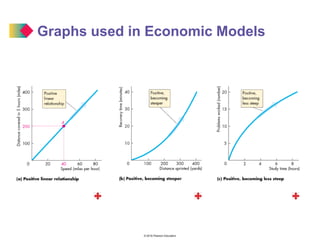
Variables That Move in the Same Direction
A relationship between two variables that move in the
same direction is called a positive relationship or a
direct relationship.
A line that slopes upward shows a positive relationship.
A relationship shown by a straight line is called a linear
relationship.
The three graphs on the next slide show positive
relationships.
Graphs used in Economic Models
© 2016 Pearson Education
Graphs used in Economic Models
© 2016 Pearson Education
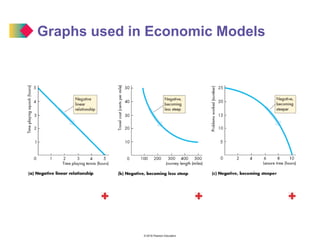
Variables That Move in Opposite Directions
A relationship between two variables that move in
opposite directions is called a negative relationship or an
inverse relationship.
A line that slopes downward shows a negative
relationship.
The three graphs on the next slide show negative
relationships.
Graphs used in Economic Models
© 2016 Pearson Education
Graphs used in Economic Models
© 2016 Pearson Education
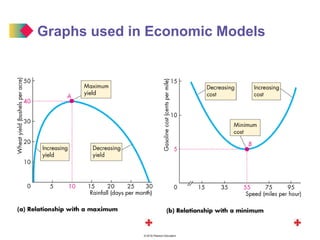
Variables That Have a Maximum or a Minimum
The two graphs on the next slide show relationships that
have a maximum and a minimum.
These relationships are positive over part of their range
and negative over the other part.
Graphs used in Economic Models
© 2016 Pearson Education
Graphs used in Economic Models

Chapter 1 lecture presentation

  • 2.
  • 3.
    © 2016 PearsonEducation After studying this chapter, you will be able to:  Define economics and distinguish between microeconomics and macroeconomics  Explain the two big questions of economics  Explain the key ideas that define the economic way of thinking  Explain how economists go about their work as social scientists and policy advisers
  • 4.
    © 2016 PearsonEducation All economic questions arise because we want more than we can get. Our inability to satisfy all our wants is called scarcity. Because we face scarcity, we must make choices. The choices we make depend on the incentives we face. An incentive is a reward that encourages an action or a penalty that discourages an action. Definition of Economics
  • 5.
    © 2016 PearsonEducation Economics is the social science that studies the choices that individuals, businesses, governments, and entire societies make as they cope with scarcity and the incentives that influence and reconcile those choices. Economics divides in two main parts:  Microeconomics  Macroeconomics Definition of Economics
  • 6.
    © 2016 PearsonEducation Definition of Economics Microeconomics is the study of choices that individuals and businesses make, the way those choices interact in markets, and the influence of governments. An example of a microeconomic question is: Why are people buying more e-books and fewer hard copy books? Macroeconomics is the study of the performance of the national and global economies. An example of a macroeconomic question is: Why is the unemployment rate in the United States so high?
  • 7.
    © 2016 PearsonEducation Two big questions summarize the scope of economics:  How do choices end up determining what, how, and for whom goods and services get produced?  When do choices made in the pursuit of self-interest also promote the social interest? Two Big Economic Questions
  • 8.
    © 2016 PearsonEducation What, How, and For Whom? Goods and services are the objects that people value and produce to satisfy human wants. What? Agriculture accounts for less than 1 percent of total U.S. production, manufactured goods for 22 percent, and services for 77 percent. In China, agriculture accounts for 11 percent of total production, manufactured goods for 47 percent, and services for 43 percent. Two Big Economic Questions
  • 9.
    © 2016 PearsonEducation Two Big Economic Questions How? Goods and services are produced by using productive resources that economists call factors of production. Factors of production are grouped into four categories:  Land  Labor  Capital  Entrepreneurship
  • 10.
    © 2016 PearsonEducation Two Big Economic Questions The “gifts of nature” that we use to produce goods and services are land. The work time and work effort that people devote to producing goods and services is labor. The quality of labor depends on human capital, which is the knowledge and skill that people obtain from education, on-the-job training, and work experience. The tools, instruments, machines, buildings, and other constructions that businesses use to produce goods and services are capital. The human resource that organizes land, labor, and capital is entrepreneurship.
  • 11.
    © 2016 PearsonEducation Two Big Economic Questions For Whom? Who gets the goods and services depends on the incomes that people earn.  Land earns rent.  Labor earns wages.  Capital earns interest.  Entrepreneurship earns profit.
  • 12.
    © 2016 PearsonEducation Two Big Economic Questions Self-Interest You make choices that are in your self-interest—choices that you think are best for you. Social Interest Choices that are best for society as a whole are said to be in the social interest. Social interest has two dimensions:  Efficiency  Equity
  • 13.
    © 2016 PearsonEducation Two Big Economic Questions Efficiency and Social Interest Resource use is efficient if it is not possible to make someone better off without making someone else worse off. Equity is fairness, but economists have a variety of views about what is fair. Fair Shares and Social Interest The idea that the social interest requires “fair shares” is a deeply held one. But what is fair?
  • 14.
    © 2016 PearsonEducation Four topics that generate discussion and that illustrate tension between self-interest and social interest are:  Globalization  The information-age monopolies  Climate change  Economic instability Two Big Economic Questions
  • 15.
    © 2016 PearsonEducation Two Big Economic Questions Globalization Globalization means the expansion of international trade, borrowing and lending, and investment. Globalization is in the self-interest of consumers who buy low-cost imported goods and services. Globalization is also in the self-interest of the multinational firms that produce in low-cost regions and sell in high- price regions. But is globalization in the self-interest of low-wage workers in other countries and U.S. firms that can’t compete with low-cost imports? Is globalization in the social interest?
  • 16.
    © 2016 PearsonEducation Two Big Economic Questions The Information-Age Monopolies The technological change of the past forty years has been called the Information Revolution. The information revolution has clearly served your self- interest: It has provided your cell-phone, laptop, loads of handy applications, and the Internet. It has also served the self-interest of Bill Gates of Microsoft and Gordon Moore of Intel, both of whom have seen their wealth soar. But did the information revolution serve the social interest?
  • 17.
    © 2016 PearsonEducation Two Big Economic Questions Climate Change Climate change is a huge political issue today. Every serious political leader is acutely aware of the problem and of the popularity of having proposals that might lower carbon emissions. Burning fossil fuels to generate electricity and to power airplanes, automobiles, and trucks pours a staggering 28 billion tons—4 tons per person—of carbon dioxide into the atmosphere each year.
  • 18.
    © 2016 PearsonEducation Economic Way of Thinking Six key ideas define the economic way of thinking:  A choice is a tradeoff.  People make rational choices by comparing benefits and costs.  Benefit is what you gain from something.  Cost is what you must give up to get something.  Most choices are “how-much” choices made at the margin.  Choices respond to incentives.
  • 19.
    © 2016 PearsonEducation Economic Way of Thinking A Choice Is a Tradeoff The economic way of thinking places scarcity and its implication, choice, at center stage. You can think about every choice as a tradeoff—an exchange—giving up one thing to get something else. On Saturday night, will you study or have fun? You can’t study and have fun at the same time, so you must make a choice. Whatever you choose, you could have chosen something else. Your choice is a tradeoff.
  • 20.
    © 2016 PearsonEducation Economic Way of Thinking Making a Rational Choice A rational choice is one that compares costs and benefits and achieves the greatest benefit over cost for the person making the choice. Only the wants of the person making a choice are relevant to determine its rationality. The idea of rational choice provides an answer to the first question: What goods and services will be produced and in what quantities? The answer is: Those that people rationally choose to buy!
  • 21.
    © 2016 PearsonEducation The Economic Way of Thinking How do people choose rationally? The answers turn on benefits and costs. Benefit: What you Gain The benefit of something is the gain or pleasure that it brings and is determined by preferences Preferences are what a person likes and dislikes and the intensity of those feelings.
  • 22.
    © 2016 PearsonEducation The Economic Way of Thinking Cost: What you Must Give Up The opportunity cost of something is the highest-valued alternative that must be given up to get it. What is your opportunity cost of going to a live concert? Opportunity cost has two components: 1. The things you can’t afford to buy if you purchase the concert ticket. 2. The things you can’t do with your time if you attend the concert.
  • 23.
    © 2016 PearsonEducation The Economic Way of Thinking How Much? Choosing at the Margin You can allocate the next hour between studying and instant messaging your friends. The choice is not all or nothing, but you must decide how many minutes to allocate to each activity. To make this decision, you compare the benefit of a little bit more study time with its cost—you make your choice at the margin.
  • 24.
    © 2016 PearsonEducation The Economic Way of Thinking To make a choice at the margin, you evaluate the consequences of making incremental changes in the use of your time. The benefit from pursuing an incremental increase in an activity is its marginal benefit. The opportunity cost of pursuing an incremental increase in an activity is its marginal cost. If the marginal benefit from an incremental increase in an activity exceeds its marginal cost, your rational choice is to do more of that activity.
  • 25.
    © 2016 PearsonEducation The Economic Way of Thinking Choices Respond to Incentives A change in marginal cost or a change in marginal benefit changes the incentives that we face and leads us to change our choice. The central idea of economics is that we can predict how choices will change by looking at changes in incentives. Incentives are also the key to reconciling self-interest and the social interest.
  • 26.
    © 2016 PearsonEducation Economist as Social Scientist Economists distinguish between two types of statement:  Positive statements  Normative statements A positive statement can be tested by checking it against facts. A normative statement expresses an opinion and cannot be tested. Economics: A Social Science and Policy Tool
  • 27.
    © 2016 PearsonEducation Economics: A Social Science and Policy Tool Unscrambling Cause and Effect The task of economic science is to discover positive statements that are consistent with what we observe in the world and that enable us to understand how the economic world works. Economists create and test economic models. An economic model is a description of some aspect of the economic world that includes only those features that are needed for the purpose at hand.
  • 28.
    © 2016 PearsonEducation Graphs in Economics APPENDIX
  • 29.
    © 2016 PearsonEducation Variables That Move in the Same Direction A relationship between two variables that move in the same direction is called a positive relationship or a direct relationship. A line that slopes upward shows a positive relationship. A relationship shown by a straight line is called a linear relationship. The three graphs on the next slide show positive relationships. Graphs used in Economic Models
  • 30.
    © 2016 PearsonEducation Graphs used in Economic Models
  • 31.
    © 2016 PearsonEducation Variables That Move in Opposite Directions A relationship between two variables that move in opposite directions is called a negative relationship or an inverse relationship. A line that slopes downward shows a negative relationship. The three graphs on the next slide show negative relationships. Graphs used in Economic Models
  • 32.
    © 2016 PearsonEducation Graphs used in Economic Models
  • 33.
    © 2016 PearsonEducation Variables That Have a Maximum or a Minimum The two graphs on the next slide show relationships that have a maximum and a minimum. These relationships are positive over part of their range and negative over the other part. Graphs used in Economic Models
  • 34.
    © 2016 PearsonEducation Graphs used in Economic Models