FUNDAMENTALS OF
ECONOMICS Lesson 1
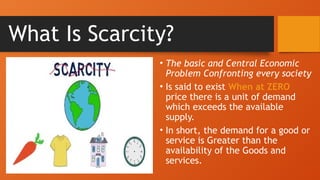
What Is Scarcity?
• The basic and Central Economic
Problem Confronting every society
• Is said to exist When at ZERO
price there is a unit of demand
which exceeds the available
supply.
• In short, the demand for a good or
service is Greater than the
availability of the Goods and
services.
What is Economics?
• A science that deals with the Management of Scarce
Resources. It is also described as a scientific study on how
individuals and Society generally make choices.
• RELATIONSHIP BETWEEN ECONOMICS AND SCARCITY
The problem of Scarcity gave birth to the study of
Economics. Their Relationship is such that if there is no
scarcity, there is no need for economics.
Ceteris Paribus Assumption
• The Assumption of Ceteris Paribus is important in studying
ECONOMICS
• It means “all other things held constant or all else equal.
• It is used as a device to analyze the relationship between 2
variables while the other factors are held unchanged
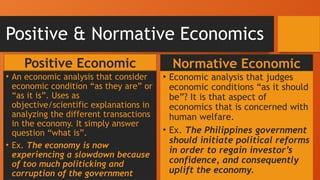
Positive & Normative Economics
• An economic analysis that consider
economic condition “as they are” or
“as it is”. Uses as
objective/scientific explanations in
analyzing the different transactions
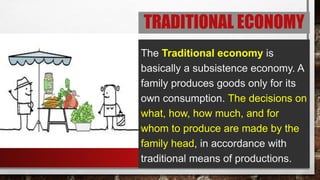
in the economy. It simply answer
question “what is”.
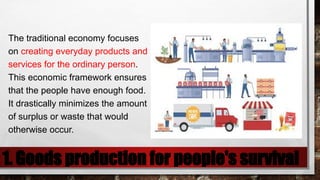
• Ex. The economy is now
experiencing a slowdown because
of too much politicking and
corruption of the government
• Economic analysis that judges
economic conditions “as it should
be”? It is that aspect of
economics that is concerned with
human welfare.
• Ex. The Philippines government
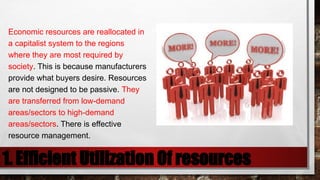
should initiate political reforms
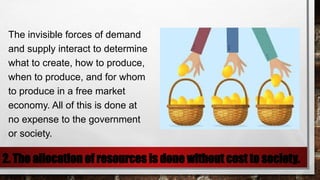
in order to regain investor’s
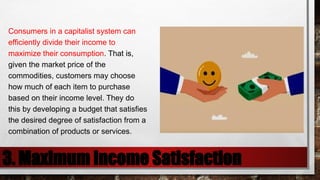
confidence, and consequently
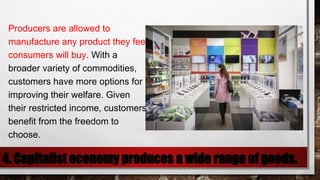
uplift the economy.
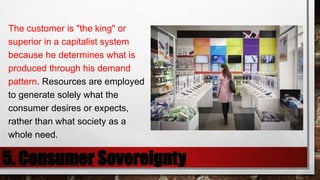
Positive Economic Normative Economic
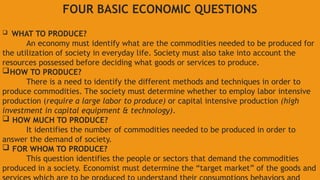
FOUR BASIC ECONOMIC QUESTIONS
 WHAT TO PRODUCE?
An economy must identify what are the commodities needed to be produced for
the utilization of society in everyday life. Society must also take into account the
resources possessed before deciding what goods or services to produce.
HOW TO PRODUCE?
There is a need to identify the different methods and techniques in order to
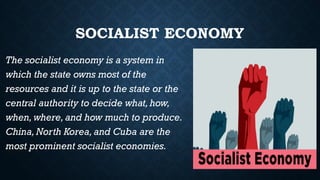
produce commodities. The society must determine whether to employ labor intensive
production (require a large labor to produce) or capital intensive production (high
investment in capital equipment & technology).
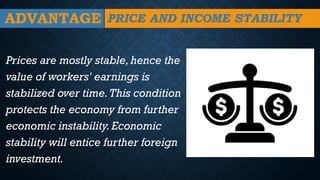
 HOW MUCH TO PRODUCE?
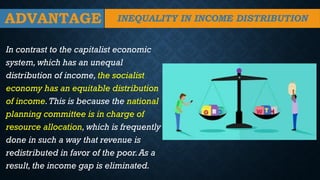
It identifies the number of commodities needed to be produced in order to
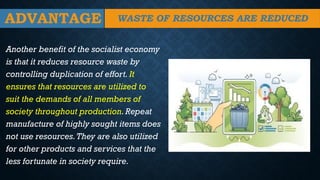
answer the demand of society.
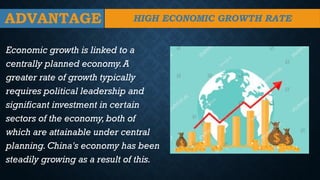
 FOR WHOM TO PRODUCE?
This question identifies the people or sectors that demand the commodities
produced in a society. Economist must determine the “target market” of the goods and
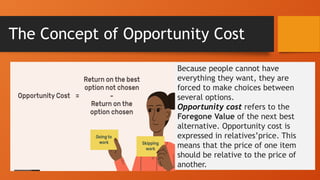
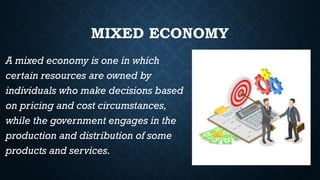
The Concept of Opportunity Cost
Because people cannot have
everything they want, they are
forced to make choices between
several options.
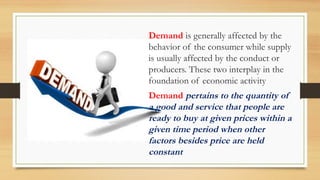
Opportunity cost refers to the
Foregone Value of the next best
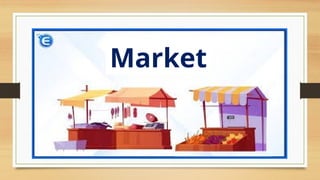
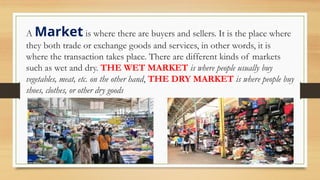
alternative. Opportunity cost is
expressed in relatives’price. This
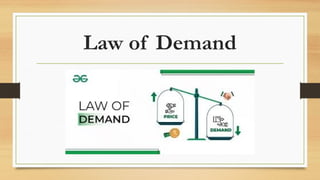
means that the price of one item
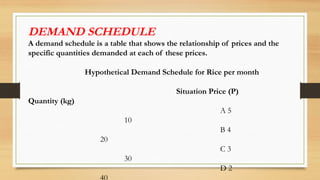
should be relative to the price of
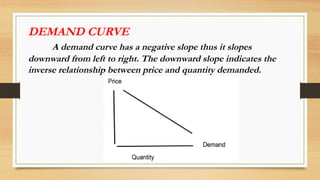
another.
FUNDAMENTALS OF ECONOMICS:
ECONOMICS TERMS AND THE
THEORY OF
OPPORTUNITY COST
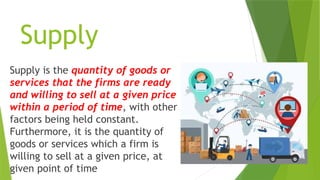
Lesson 2
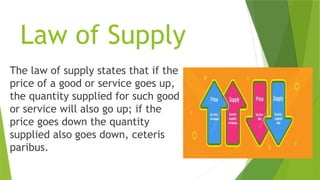
The idea of opportunity cost arises from the concept of
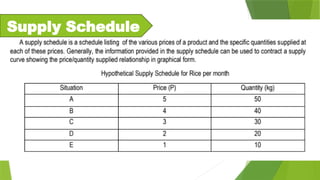
scarcity.When you choose an action, the Opportunity cost
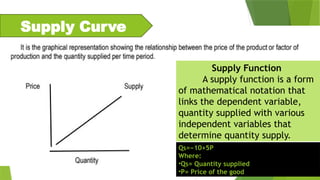
is what you must give up. It is the value of the next best
chance, to put it another way.
Scarcity has a direct impact on opportunity cost.When
determining how to spend their money and time, people
must decide between many options.
OPPORTUNITY COST AND THE INDIVIDUAL
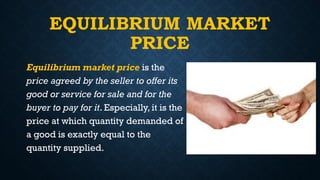
If this student had just PHP15,500.00 to spend, he
would purchase the most important thing on the
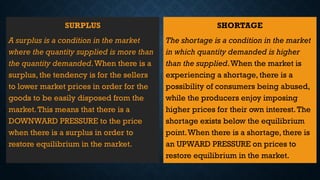
scale of choice, a laptop.The laptop's opportunity
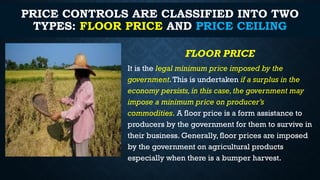
cost would be the textbooks and lecture notes that
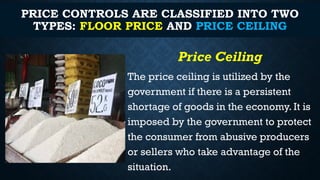
he might have purchased with his nominal salary
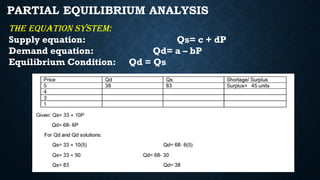
(PHP15,500.00), but not the rest of the things. He
would have bought lecture notes instead of new
shoes and food if he had PHP15,500.00 in his
pocket. As a result, we understand how the idea of
opportunity cost may assist a student in making
the optimal decision and maximizing happiness
given his limited financial resources.
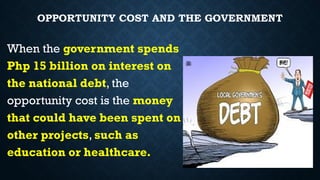
OPPORTUNITY COST AND THE GOVERNMENT
When the government spends
Php 15 billion on interest on
the national debt, the
opportunity cost is the money
that could have been spent on
other projects, such as
education or healthcare.
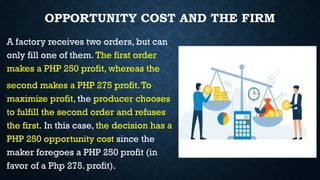
OPPORTUNITY COST AND THE FIRM
A factory receives two orders, but can
only fill one of them. The first order
makes a PHP 250 profit, whereas the
second makes a PHP 275 profit.To
maximize profit, the producer chooses
to fulfill the second order and refuses
the first. In this case, the decision has a
PHP 250 opportunity cost since the
maker foregoes a PHP 250 profit (in
favor of a Php 275. profit).
IMPORTANT ECONOMIC TERMS
1.WEALTH - Refers to anything that has a functional value (usually in money) which can be
traded for goods and services.
2. CONSUMPTION - This refers to the direct utilization or usage of the available goods and
services by the buyer or the consumer sector.
3. PRODUCTION - It is defined as the formation by firms of an output (product and services). It
is the combination of land, labor, and capital in order to produce outputs of goods and services.
4. DISTRIBUTION - This is the process of allocating or apportioning scarce resources to be
utilized by the household, the business sector, and the rest of the world.
5. EXCHANGE- This is the process of exchanging products and services for money or anything
equivalent to it. It also involves purchasing products and services through barter or the market.
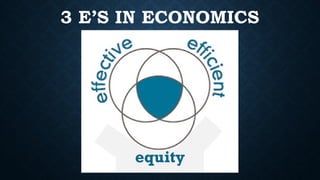
3 E’S IN ECONOMICS
equity
EFFICIENCY
Refers to productivity and proper allocation of economic resources.
Economic efficiency is when all goods and factors of production in an
economy are distributed or allocated to their most valuable uses and
waste is eliminated or minimized.
Economic efficiency refers to a condition of affairs in which all
resources are distributed efficiently to best benefit each individual or
business while reducing waste and inefficiency.
EQUITY
Equity refers to fairness or justice, and achieving it is considered as an economic
goal. Despite widespread acceptance of the value of fairness, it is frequently
seen as a too normative idea since it is difficult to define and assess. Equity refers
to how money and opportunity are allocated equitably among different
groups in society.
While technological innovation may improve productivity,it may also have a
negative impact on worker employment.Manual labor may be unnecessary due to
the existence of modern technology and machines,resulting in worker
retrenchment or displacement.(Viray,
EFFECTIVENESS
The term "effectiveness" refers to achieving goals and objectives.
Economics is a useful instrument that may be used to other fields. For
example,
regardless of the output, manufacturing using both manual and
technology developments will be beneficial to society and the rest
of the world. Furthermore, produced goods or services will be
deemed effective if they meet both parties' objectives, namely,
customer satisfaction and business profit.
MAJOR BRANCHES OF ECONOMICS:
MICROECONOMICS AND
MACROECONOMICS
Lesson 3
MICROECONOMICS
This is the branch of economics that deals with the individual
decisions of units of economy firms and households and how their
choices determine relative prices of goods and factors of production
MACROECONOMICS
It is the branch of economics that studies the relationship among
the broad economic aggregates like national income, national output,
money supply, bank deposits, total volumes of savings, investment,
consumption, expenditure, the general price level of commodities,
government spending, inflation, recession, employment, and money
supply
FACTORS OF PRODUCTIONS
LAND
LABOR
CAPITAL
ENTREPRENEURSHIP
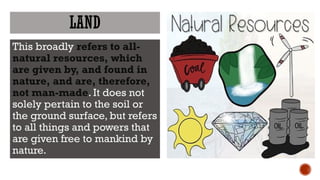
LAND
This broadly refers to all-
natural resources, which
are given by, and found in
nature, and are, therefore,
not man-made. It does not
solely pertain to the soil or
the ground surface, but refers
to all things and powers that
are given free to mankind by
nature.
LABOR
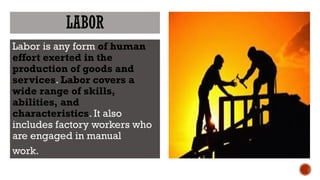
Labor is any form of human
effort exerted in the
production of goods and
services. Labor covers a
wide range of skills,
abilities, and
characteristics. It also
includes factory workers who
are engaged in manual
work.
CAPITAL
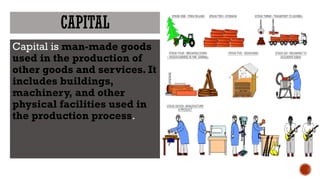
Capital is man-made goods
used in the production of
other goods and services. It
includes buildings,
machinery, and other
physical facilities used in
the production process.
ENTREPRENEURSHIP
An entrepreneur is a person
who organizes, manages,
and assumes the risks of
firms, taking a new idea or
a new product and turning
into a successful business.
TYPES OF ECONOMIC SYSTEMS
To address economic problems, several economic systems have
been created and applied throughout history.
Traditional Economy
Command Economy
Market Economy
Socialism
Mixed Economy
TRADITIONAL ECONOMY
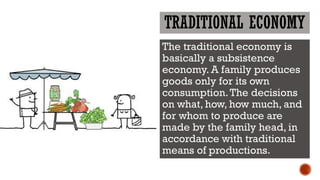
The traditional economy is
basically a subsistence
economy. A family produces
goods only for its own
consumption.The decisions
on what, how, how much, and
for whom to produce are
made by the family head, in
accordance with traditional
means of productions.
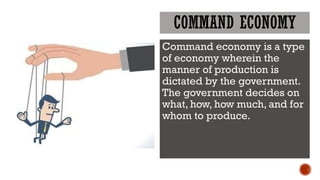
COMMAND ECONOMY
Command economy is a type
of economy wherein the
manner of production is
dictated by the government.
The government decides on
what, how, how much, and for
whom to produce.
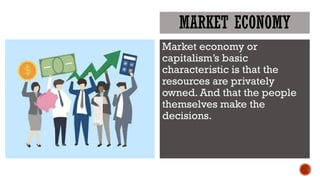
MARKET ECONOMY
Market economy or
capitalism’s basic
characteristic is that the
resources are privately
owned. And that the people
themselves make the
decisions.
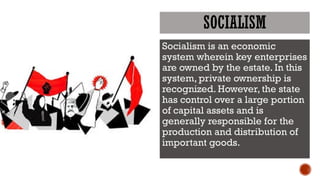
SOCIALISM
Socialism is an economic
system wherein key enterprises
are owned by the estate. In this
system, private ownership is
recognized. However, the state
has control over a large portion
of capital assets and is
generally responsible for the
production and distribution of
important goods.
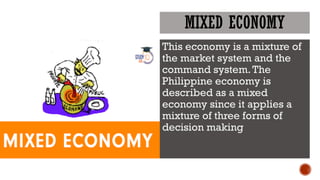
MIXED ECONOMY
This economy is a mixture of
the market system and the
command system.The
Philippine economy is
described as a mixed
economy since it applies a
mixture of three forms of
decision making
ECONOMIC SYSTEM PART 1-
TRADITIONAL AND
CAPITALIST ECONOMY
LESSON 4
TYPES OF ECONOMIC SYSTEM
An Economic System is a way for communities or
governments to organize and distribute resources, services,
and products throughout a geographical region or country.
The components of production, such as land, capital, labor,
and physical resources, are regulated by economic systems.
TRADITIONAL ECONOMY
The Traditional economy is
basically a subsistence economy. A
family produces goods only for its
own consumption. The decisions on
what, how, how much, and for
whom to produce are made by the
family head, in accordance with
traditional means of productions.
ADVANTAGES OF TRADITIONAL ECONOMY
Goods production for people's survival
Understanding people's roles
Less harmful to environment
People's Harmony
1. Goods production for people's survival
The traditional economy focuses
on creating everyday products and
services for the ordinary person.
This economic framework ensures
that the people have enough food.
It drastically minimizes the amount
of surplus or waste that would
otherwise occur.
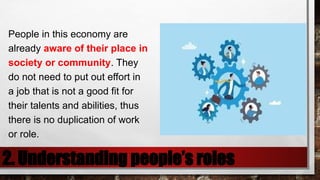
2. Understanding people’s roles
People in this economy are
already aware of their place in
society or community. They
do not need to put out effort in
a job that is not a good fit for
their talents and abilities, thus
there is no duplication of work
or role.
3. Less harmful to environment
Because traditional economy is based on
people's culture and belief systems, it will
always maintain an environmentally friendly
atmosphere that tries to meet people's
needs effectively and appropriately without
harming the environment. Because of
cultural belief systems that restrict local
people from using natural resources for
commercial gain, essential virgin forests,
rivers, and eco-systems have been
preserved in some locations.
4. People's Harmony
Cooperation and healthy
relationships are encouraged
in a traditional economy. It
gives everyone an equal
opportunity to practice working
with others in a pleasant and
cooperative manner.
DIS-ADVANTAGES OF TRADITIONAL
ECONOMY
Vulnerable type of Economy
Adaptability to change
People’s living standard are lower
VULNERABLE TYPE OF ECONOMY
Because of the constant variations in weather conditions, a traditional
economy is more vulnerable. The economy is just not prepared to
withstand foreign economic shocks while still taking advantage of
global technological breakthroughs. This has a significant impact on
people's access to food and services. As the economy continues to
deteriorate (worsen), there is a larger risk of food and service
shortages.
ADAPTABILITY TO CHANGE
Because traditional economies are heavily influenced by
conventions and other societal ideas, there is a larger
probability that they will change when these factors alter.
People would only use the characteristics that were only
imparted by some of their ancestors. They will no longer adopt
new features of society in order to enhance themselves.
PEOPLE'S LIVING STANDARDS ARE LOWER
People in the Conventional economy aren't particularly skilled at
accumulating money. People become addicted to basic occupations
and activities, even when there are better prospects for them to take
on highly competent and satisfying careers, demonstrating the low
standards they practice. People believe that such tasks are beyond
their ability, cultural background, and skill set. Only their ancestors'
habits and traditions would qualify.
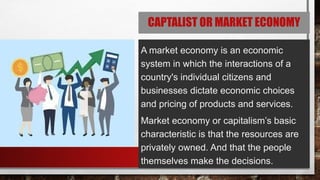
CAPTALIST OR MARKET ECONOMY
A market economy is an economic
system in which the interactions of a
country's individual citizens and
businesses dictate economic choices
and pricing of products and services.
Market economy or capitalism’s basic
characteristic is that the resources are
privately owned. And that the people
themselves make the decisions.
ADVANTAGES OF CAPITALIST OR MARKET ECONOMY

Efficient Utilization Of resources

The allocation of resources is done without cost to society.

Maximum Income Satisfaction

Capitalist economy produces a wide range of goods.

Consumer Sovereignty

Enhanced Entrepreneurial Initiatives

Production of High-Quality Products
1. Efficient Utilization Of resources
Economic resources are reallocated in
a capitalist system to the regions
where they are most required by
society. This is because manufacturers
provide what buyers desire. Resources
are not designed to be passive. They
are transferred from low-demand
areas/sectors to high-demand
areas/sectors. There is effective
resource management.
2. The allocation of resources is done without cost to society.
The invisible forces of demand
and supply interact to determine
what to create, how to produce,
when to produce, and for whom
to produce in a free market
economy. All of this is done at
no expense to the government
or society.
3. Maximum Income Satisfaction
Consumers in a capitalist system can
efficiently divide their income to
maximize their consumption. That is,
given the market price of the
commodities, customers may choose
how much of each item to purchase
based on their income level. They do
this by developing a budget that satisfies
the desired degree of satisfaction from a
combination of products or services.
4. Capitalist economy produces a wide range of goods.
Producers are allowed to
manufacture any product they feel
consumers will buy. With a
broader variety of commodities,
customers have more options for
improving their welfare. Given
their restricted income, customers
benefit from the freedom to
choose.
5. Consumer Sovereignty
The customer is "the king" or
superior in a capitalist system
because he determines what is
produced through his demand
pattern. Resources are employed
to generate solely what the
consumer desires or expects,
rather than what society as a
whole need.
6. Enhanced Entrepreneurial Initiatives
Private initiative and innovation are
encouraged, resulting in inventions
and technological advancements. It
boosts self-esteem and allows
entrepreneurs to focus their efforts on
building their own company rather
than waiting to be hired by the
government or others. As a result of
the capitalist economy, more self-
employed positions are created,
cutting unemployment significantly.
7. Production of High-Quality Products
Because of unrestricted rivalry
among producers, a free market
economy results in the
development of high-quality
commodities. Competition drives
the development of state the art
technology, resulting in the
production of high- quality goods
and services for the advantage of
the customer.
DIS-ADVANTAGES OF CAPITALIST
ECONOMY
It increase income Inequality
Price Instability is Possible
It may lead to wastage of Resources
IT INCREASES INCOME INEQUALITY.
When consumer demand for goods increases, the wealthy
who have access to resources create and profit. The poor
lack access to productive resources. As a result, they are
pushed out of industry and manufacturing. The wealthy will
continue to create things in demand after they have made a
profit. As a result, the rich gain richer and the poor get poorer.
PRICE INSTABILITY IS POSSIBLE
Prices in a capitalist system are governed by supply and
demand. Demand fluctuates owing to changes in taste and
fashion, growing populations, and so forth. As a result, prices
may fluctuate from time to time, resulting in inflationary
pressures and unpredictability.
IT MAY LEAD TO WASTAGE OF RESOURCES
Because producers are profit-driven, certain fundamental goods and
services may not be produced. For example, in Ghana, large areas of
cropland are being transformed to bio-diesel/energy crops like
sugarcane and jetropha, which are in high demand. In the following
years, the production of important food crops such as yam, maize, and
others may drop. As a result, resource allocation may not be efficient.
Profit motives have the potential to do significant harm to society.
ECONOMIC SYSTEM AND THEIR
FUNCTIONS
PART 2 SOCIALIST AND MIXED
ECONOMY
Lesson 6
SOCIALIST ECONOMY
The socialist economy is a system in
which the state owns most of the
resources and it is up to the state or the
central authority to decide what,how,
when,where, and how much to produce.
China,North Korea,and Cuba are the
most prominent socialist economies.
FEATURES OF SOCIALIST
ECONOMY
The allocation of resources in the production of products and
services is determined by the state.
The goal of governance is to ensure the social welfare of all citizens.
There can be Lack of Competition since the government takes
control of the system
ADVANTAGES OF A SOCIALIST
ECONOMY
 Price and income stability
 Inequality in income distribution
 Waste of resources is reduced
 High economic growth rate
 Consumers are less exploited.
ADVANTAGE
Prices are mostly stable,hence the
value of workers' earnings is
stabilized over time.This condition
protects the economy from further
economic instability.Economic
stability will entice further foreign
investment.
PRICE AND INCOME STABILITY
ADVANTAGE
In contrast to the capitalist economic
system, which has an unequal
distribution of income, the socialist
economy has an equitable distribution
of income.This is because the national
planning committee is in charge of
resource allocation, which is frequently
done in such a way that revenue is
redistributed in favor of the poor.As a
result, the income gap is eliminated.
INEQUALITY IN INCOME DISTRIBUTION
ADVANTAGE
Another benefit of the socialist economy
is that it reduces resource waste by
controlling duplication of effort. It
ensures that resources are utilized to
suit the demands of all members of
society throughout production.Repeat
manufacture of highly sought items does
not use resources.They are also utilized
for other products and services that the
less fortunate in society require.
WASTE OF RESOURCES ARE REDUCED
ADVANTAGE
Economic growth is linked to a
centrally planned economy.A
greater rate of growth typically
requires political leadership and
significant investment in certain
sectors of the economy,both of
which are attainable under central
planning.China's economy has been
steadily growing as a result of this.
HIGH ECONOMIC GROWTH RATE
ADVANTAGE
The customer is not abused since
goods are available at reasonable
prices.Because there are no profit
motives, this is achievable.Not only a
few wealthy customers with higher
demand levels,but the demands of
the vast majority of consumers,
particularly lower and medium
income workers,are satisfied.
CONSUMER ARE LESS EXPLOITED
DIS-ADVANTAGE OF SOCIALIST
ECONOMY
1.Substandard products may be produced due to a lack of competition
in this economy.
2.The consumer’s supremacy is limited because what to produce is
decided by central planning authority.
3.In a socialist economy,consumers are not exposed to a wide range
of goods,limiting their power of choice.
4.Bribery,corruption,and inefficiency are all possible scenarios.This
is because those in charge of the state and public institutions are
unaccountable to anybody and a mass wealth intended for the people.
MIXED ECONOMY
A mixed economy is one in which
certain resources are owned by
individuals who make decisions based
on pricing and cost circumstances,
while the government engages in the
production and distribution of some
products and services.
FEATURES OF MIXED ECONOMY
The government and private individuals run in tandem transport services,
broadcasting services, hospitals, schools, etc.
Ownership of resources is shared by the state and the private individuals
Resources in the form of land, labor, capital and entrepreneurship are in the
hands of both the government and private individuals.
Prices of goods and services are determined by government and market forces
Producers select strategies that reduce costs while increasing output.The
government usually invests in both labor- intensive businesses and well-
capitalized businesses that provide essential services to the public.
ADVANTAGE OF MIXED ECONOMY
1. It encourages the private sector and gives it the capacity to grow. It promotes
capital formation within the country.
2. In a capitalist economy, there is both economic and occupational freedom. Every
individual has the freedom to pursue any vocation he desires. Similarly, every
producer has the ability to make production and consumption decisions.
3. Both the private and public sectors seek for resource utilization.The public sector
works for the common good, whereas the private sector makes the best use of these
resources in order to maximize profit.
4. Both the government and the private sector work together to construct
socioeconomic structures. Furthermore, the government enacts several legislative
measures to protect the interests of the poor and disadvantaged members of society.
DIS-ADVANTAGE OF MIXED ECONOMY
1. Because of government constraints and regulations, the private sector
does not have the full flexibility it demands, making it ineffective.
2. Certain decisions, particularly in the public sector, are usually delayed.
These delays obstruct the economy’s ability to run smoothly.
3.Wastage of resources is another issue with the mixed economic system.
Intermediaries receive a portion of the funding provided to various
public-sector operations. As a result, resources may be misappropriated
or abused.
Basic Analysis of
Demand
Lesson 6
Demand is generally affected by the
behavior of the consumer while supply
is usually affected by the conduct or
producers. These two interplay in the
foundation of economic activity
Demand pertains to the quantity of
a good and service that people are
ready to buy at given prices within a
given time period when other
factors besides price are held
constant
Market
A Market is where there are buyers and sellers. It is the place where
they both trade or exchange goods and services, in other words, it is
where the transaction takes place. There are different kinds of markets
such as wet and dry. THE WET MARKET is where people usually buy
vegetables, meat, etc. on the other hand, THE DRY MARKET is where people buy
shoes, clothes, or other dry goods
Law of Demand
Law of Demand
The law of demand states that if price goes UP; the
quantity demanded will go DOWN. Conversely, if the
prices go DOWN, the quantity demanded will go UP
ceteris paribus. The reason for this is because consumers
always tend to MAXIMIZE SATISFACTION.
DEMAND SCHEDULE
A demand schedule is a table that shows the relationship of prices and the
specific quantities demanded at each of these prices.
Hypothetical Demand Schedule for Rice per month
Situation Price (P)
Quantity (kg)
A 5
10
B 4
20
C 3
30
D 2
DEMAND CURVE
A demand curve has a negative slope thus it slopes
downward from left to right. The downward slope indicates the
inverse relationship between price and quantity demanded.
DEMAND FUNCTION
A demand function shows The relationship between
demand for a commodity and the factors that determine or
influence this demand.
A DEMAND FUNCTION is a mathematical expression that shows
the relationship between the quantity of a good demanded and its
price, along with other influencing factors like income, tastes, and prices
of related goods.
Forces That Causes the Demand Curve to Change
There are several reasons why demand changes and thus cause the demand curve to
change the following are the more general reasons for the change in demand.
 Taste of preferences
Tastes or preferences pertain to the likes or dislikes of a consumer for certain goods
and services
 Changing incomes
Increasing incomes of households raise the demand or certain goods services or vice
versa.
 Occasional or seasonal products
The various events or seasons in a given year also result in a movement of the demand
curve with reference to the particular goods.
Forces That Causes the Demand Curve to Change
 Population Change
An increasing population leads to an increase in the demand for some types of goods
and services and vice versa. More people simply mean that more goods or services are
to be demanded.
 Substitute Goods
Substitute goods are goods that are interchanged with other goods. In a situation where
the price of particular good increases, a consumer will tend to look for closely related
commodities.
 Expectations of the future Prices
If the buyers expect the price of a good or services to rise (or fall) in the future, it may
cause the current demand to increase (or decrease). Also, expectations about the future
alters demand for a specific commodity.
Basic Analysis of
Supply
Lesson 7
Supply
Supply is the quantity of goods or
services that the firms are ready
and willing to sell at a given price
within a period of time, with other
factors being held constant.
Furthermore, it is the quantity of
goods or services which a firm is
willing to sell at a given price, at
given point of time
Law of Supply
The law of supply states that if the
price of a good or service goes up,
the quantity supplied for such good
or service will also go up; if the
price goes down the quantity
supplied also goes down, ceteris
paribus.
Supply Schedule
Supply Curve
Supply Function
A supply function is a form
of mathematical notation that
links the dependent variable,
quantity supplied with various
independent variables that
determine quantity supply.
Qs​
=−10+5P
Where:
•Qs= Quantity supplied
•P= Price of the good
Just like demands, there are also forces that cause the
supply curve to change.
 OPTIMIZATION OF THE USE OF FACTORS OF
PRODUCTION
An optimization in the utilization of resources will increase
supply, while a failure to achieve such will result in a decrease
in supply. Optimization refers to the process or methodology of
making something.
 TECHNOLOGICAL CHANGE
The introduction of cost-reducing innovation in production
technology increases supply on one hand.
FORCES THAT CAUSE THE SUPPLY CURVE TO EXCHANGE
 FUTURE EXPECTATION
This factor impacts sellers as much as buyers. If
sellers anticipate a rise in prices, they may choose to hold
back the current supply to take advantage of the future
increase in price, thus decreasing market supply.
 NUMBER OF SELLERS
The number of sellers has a direct impact on the
quantity supplied. Simply put, the more sellers there are in
the market, the greater supply of goods and services will
be available.
FORCES THAT CAUSE THE SUPPLY CURVE TO EXCHANGE
 WEATHER CONDITIONS
Bad weather such as typhoons, drought, or other natural
disasters, reduces the supply of agricultural commodities while
good weather has an opposite impact. For instance, if a typhoon
destroys the vegetable farms in Benguet Province, the supply of
vegetables particularly in the markets of metro manila will
decline.
FORCES THAT CAUSE THE SUPPLY CURVE TO EXCHANGE
MARKET
EQUILIBRIUM
Lesson 8
EQUILIBRIUM
Equilibrium generally pertains to a
balance that exists when quantity
demanded equals quantity supplied.
Equilibrium is the general agreement
of the buyer and the seller at a
particular price and at a particular
quantity. At the equilibrium point, there
are always two sides of the story, the
side of the buyer and that of the seller.
EQUILIBRIUM MARKET
PRICE
Equilibrium market price is the
price agreed by the seller to offer its
good or service for sale and for the
buyer to pay for it. Especially, it is the
price at which quantity demanded of
a good is exactly equal to the
quantity supplied.
WHAT HAPPENS WHEN
THERE IS MARKET
DISEQUILIBRIUM?
SURPLUS
A surplus is a condition in the market
where the quantity supplied is more than
the quantity demanded.When there is a
surplus, the tendency is for the sellers
to lower market prices in order for the
goods to be easily disposed from the
market.This means that there is a
DOWNWARD PRESSURE to the price
when there is a surplus in order to
restore equilibrium in the market.
SHORTAGE
The shortage is a condition in the market
in which quantity demanded is higher
than the supplied.When the market is
experiencing a shortage, there is a
possibility of consumers being abused,
while the producers enjoy imposing
higher prices for their own interest.The
shortage exists below the equilibrium
point.When there is a shortage, there is
an UPWARD PRESSURE on prices to
restore equilibrium in the market.
PRICE CONTROLS ARE CLASSIFIED INTO TWO
TYPES: FLOOR PRICE AND PRICE CEILING
FLOOR PRICE
It is the legal minimum price imposed by the
government.This is undertaken if a surplus in the
economy persists,in this case,the government may
impose a minimum price on producer’s
commodities. A floor price is a form assistance to
producers by the government for them to survive in
their business. Generally, floor prices are imposed
by the government on agricultural products
especially when there is a bumper harvest.
PRICE CONTROLS ARE CLASSIFIED INTO TWO
TYPES: FLOOR PRICE AND PRICE CEILING
Price Ceiling
The price ceiling is utilized by the
government if there is a persistent
shortage of goods in the economy. It is
imposed by the government to protect
the consumer from abusive producers
or sellers who take advantage of the
situation.
PARTIAL EQUILIBRIUM ANALYSIS
The Equation system:
Supply equation: Qs= c + dP
Demand equation: Qd= a – bP
Equilibrium Condition: Qd = Qs
PARTIAL EQUILIBRIUM ANALYSIS
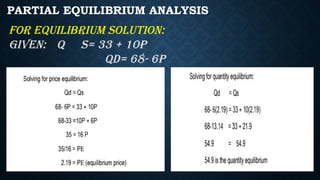
For equilibrium solution:
Given: Q s= 33 + 10P
Qd= 68- 6P
Lesson-1-8, basic micro economics bsba finance

Lesson-1-8, basic micro economics bsba finance

  • 1.
  • 2.
    What Is Scarcity? •The basic and Central Economic Problem Confronting every society • Is said to exist When at ZERO price there is a unit of demand which exceeds the available supply. • In short, the demand for a good or service is Greater than the availability of the Goods and services.
  • 3.
    What is Economics? •A science that deals with the Management of Scarce Resources. It is also described as a scientific study on how individuals and Society generally make choices. • RELATIONSHIP BETWEEN ECONOMICS AND SCARCITY The problem of Scarcity gave birth to the study of Economics. Their Relationship is such that if there is no scarcity, there is no need for economics.
  • 4.
    Ceteris Paribus Assumption •The Assumption of Ceteris Paribus is important in studying ECONOMICS • It means “all other things held constant or all else equal. • It is used as a device to analyze the relationship between 2 variables while the other factors are held unchanged
  • 5.
    Positive & NormativeEconomics • An economic analysis that consider economic condition “as they are” or “as it is”. Uses as objective/scientific explanations in analyzing the different transactions in the economy. It simply answer question “what is”. • Ex. The economy is now experiencing a slowdown because of too much politicking and corruption of the government • Economic analysis that judges economic conditions “as it should be”? It is that aspect of economics that is concerned with human welfare. • Ex. The Philippines government should initiate political reforms in order to regain investor’s confidence, and consequently uplift the economy. Positive Economic Normative Economic
  • 6.
    FOUR BASIC ECONOMICQUESTIONS  WHAT TO PRODUCE? An economy must identify what are the commodities needed to be produced for the utilization of society in everyday life. Society must also take into account the resources possessed before deciding what goods or services to produce. HOW TO PRODUCE? There is a need to identify the different methods and techniques in order to produce commodities. The society must determine whether to employ labor intensive production (require a large labor to produce) or capital intensive production (high investment in capital equipment & technology).  HOW MUCH TO PRODUCE? It identifies the number of commodities needed to be produced in order to answer the demand of society.  FOR WHOM TO PRODUCE? This question identifies the people or sectors that demand the commodities produced in a society. Economist must determine the “target market” of the goods and
  • 7.
    The Concept ofOpportunity Cost Because people cannot have everything they want, they are forced to make choices between several options. Opportunity cost refers to the Foregone Value of the next best alternative. Opportunity cost is expressed in relatives’price. This means that the price of one item should be relative to the price of another.
  • 8.
    FUNDAMENTALS OF ECONOMICS: ECONOMICSTERMS AND THE THEORY OF OPPORTUNITY COST Lesson 2
  • 9.
    The idea ofopportunity cost arises from the concept of scarcity.When you choose an action, the Opportunity cost is what you must give up. It is the value of the next best chance, to put it another way. Scarcity has a direct impact on opportunity cost.When determining how to spend their money and time, people must decide between many options.
  • 10.
    OPPORTUNITY COST ANDTHE INDIVIDUAL If this student had just PHP15,500.00 to spend, he would purchase the most important thing on the scale of choice, a laptop.The laptop's opportunity cost would be the textbooks and lecture notes that he might have purchased with his nominal salary (PHP15,500.00), but not the rest of the things. He would have bought lecture notes instead of new shoes and food if he had PHP15,500.00 in his pocket. As a result, we understand how the idea of opportunity cost may assist a student in making the optimal decision and maximizing happiness given his limited financial resources.
  • 11.
    OPPORTUNITY COST ANDTHE GOVERNMENT When the government spends Php 15 billion on interest on the national debt, the opportunity cost is the money that could have been spent on other projects, such as education or healthcare.
  • 12.
    OPPORTUNITY COST ANDTHE FIRM A factory receives two orders, but can only fill one of them. The first order makes a PHP 250 profit, whereas the second makes a PHP 275 profit.To maximize profit, the producer chooses to fulfill the second order and refuses the first. In this case, the decision has a PHP 250 opportunity cost since the maker foregoes a PHP 250 profit (in favor of a Php 275. profit).
  • 13.
    IMPORTANT ECONOMIC TERMS 1.WEALTH- Refers to anything that has a functional value (usually in money) which can be traded for goods and services. 2. CONSUMPTION - This refers to the direct utilization or usage of the available goods and services by the buyer or the consumer sector. 3. PRODUCTION - It is defined as the formation by firms of an output (product and services). It is the combination of land, labor, and capital in order to produce outputs of goods and services. 4. DISTRIBUTION - This is the process of allocating or apportioning scarce resources to be utilized by the household, the business sector, and the rest of the world. 5. EXCHANGE- This is the process of exchanging products and services for money or anything equivalent to it. It also involves purchasing products and services through barter or the market.
  • 14.
    3 E’S INECONOMICS equity
  • 15.
    EFFICIENCY Refers to productivityand proper allocation of economic resources. Economic efficiency is when all goods and factors of production in an economy are distributed or allocated to their most valuable uses and waste is eliminated or minimized. Economic efficiency refers to a condition of affairs in which all resources are distributed efficiently to best benefit each individual or business while reducing waste and inefficiency.
  • 16.
    EQUITY Equity refers tofairness or justice, and achieving it is considered as an economic goal. Despite widespread acceptance of the value of fairness, it is frequently seen as a too normative idea since it is difficult to define and assess. Equity refers to how money and opportunity are allocated equitably among different groups in society. While technological innovation may improve productivity,it may also have a negative impact on worker employment.Manual labor may be unnecessary due to the existence of modern technology and machines,resulting in worker retrenchment or displacement.(Viray,
  • 17.
    EFFECTIVENESS The term "effectiveness"refers to achieving goals and objectives. Economics is a useful instrument that may be used to other fields. For example, regardless of the output, manufacturing using both manual and technology developments will be beneficial to society and the rest of the world. Furthermore, produced goods or services will be deemed effective if they meet both parties' objectives, namely, customer satisfaction and business profit.
  • 18.
    MAJOR BRANCHES OFECONOMICS: MICROECONOMICS AND MACROECONOMICS Lesson 3
  • 19.
    MICROECONOMICS This is thebranch of economics that deals with the individual decisions of units of economy firms and households and how their choices determine relative prices of goods and factors of production MACROECONOMICS It is the branch of economics that studies the relationship among the broad economic aggregates like national income, national output, money supply, bank deposits, total volumes of savings, investment, consumption, expenditure, the general price level of commodities, government spending, inflation, recession, employment, and money supply
  • 20.
  • 21.
    LAND This broadly refersto all- natural resources, which are given by, and found in nature, and are, therefore, not man-made. It does not solely pertain to the soil or the ground surface, but refers to all things and powers that are given free to mankind by nature.
  • 22.
    LABOR Labor is anyform of human effort exerted in the production of goods and services. Labor covers a wide range of skills, abilities, and characteristics. It also includes factory workers who are engaged in manual work.
  • 23.
    CAPITAL Capital is man-madegoods used in the production of other goods and services. It includes buildings, machinery, and other physical facilities used in the production process.
  • 24.
    ENTREPRENEURSHIP An entrepreneur isa person who organizes, manages, and assumes the risks of firms, taking a new idea or a new product and turning into a successful business.
  • 25.
    TYPES OF ECONOMICSYSTEMS To address economic problems, several economic systems have been created and applied throughout history. Traditional Economy Command Economy Market Economy Socialism Mixed Economy
  • 26.
    TRADITIONAL ECONOMY The traditionaleconomy is basically a subsistence economy. A family produces goods only for its own consumption.The decisions on what, how, how much, and for whom to produce are made by the family head, in accordance with traditional means of productions.
  • 27.
    COMMAND ECONOMY Command economyis a type of economy wherein the manner of production is dictated by the government. The government decides on what, how, how much, and for whom to produce.
  • 28.
    MARKET ECONOMY Market economyor capitalism’s basic characteristic is that the resources are privately owned. And that the people themselves make the decisions.
  • 29.
    SOCIALISM Socialism is aneconomic system wherein key enterprises are owned by the estate. In this system, private ownership is recognized. However, the state has control over a large portion of capital assets and is generally responsible for the production and distribution of important goods.
  • 30.
    MIXED ECONOMY This economyis a mixture of the market system and the command system.The Philippine economy is described as a mixed economy since it applies a mixture of three forms of decision making
  • 31.
    ECONOMIC SYSTEM PART1- TRADITIONAL AND CAPITALIST ECONOMY LESSON 4
  • 32.
    TYPES OF ECONOMICSYSTEM An Economic System is a way for communities or governments to organize and distribute resources, services, and products throughout a geographical region or country. The components of production, such as land, capital, labor, and physical resources, are regulated by economic systems.
  • 33.
    TRADITIONAL ECONOMY The Traditionaleconomy is basically a subsistence economy. A family produces goods only for its own consumption. The decisions on what, how, how much, and for whom to produce are made by the family head, in accordance with traditional means of productions.
  • 34.
    ADVANTAGES OF TRADITIONALECONOMY Goods production for people's survival Understanding people's roles Less harmful to environment People's Harmony
  • 35.
    1. Goods productionfor people's survival The traditional economy focuses on creating everyday products and services for the ordinary person. This economic framework ensures that the people have enough food. It drastically minimizes the amount of surplus or waste that would otherwise occur.
  • 36.
    2. Understanding people’sroles People in this economy are already aware of their place in society or community. They do not need to put out effort in a job that is not a good fit for their talents and abilities, thus there is no duplication of work or role.
  • 37.
    3. Less harmfulto environment Because traditional economy is based on people's culture and belief systems, it will always maintain an environmentally friendly atmosphere that tries to meet people's needs effectively and appropriately without harming the environment. Because of cultural belief systems that restrict local people from using natural resources for commercial gain, essential virgin forests, rivers, and eco-systems have been preserved in some locations.
  • 38.
    4. People's Harmony Cooperationand healthy relationships are encouraged in a traditional economy. It gives everyone an equal opportunity to practice working with others in a pleasant and cooperative manner.
  • 39.
    DIS-ADVANTAGES OF TRADITIONAL ECONOMY Vulnerabletype of Economy Adaptability to change People’s living standard are lower
  • 40.
    VULNERABLE TYPE OFECONOMY Because of the constant variations in weather conditions, a traditional economy is more vulnerable. The economy is just not prepared to withstand foreign economic shocks while still taking advantage of global technological breakthroughs. This has a significant impact on people's access to food and services. As the economy continues to deteriorate (worsen), there is a larger risk of food and service shortages.
  • 41.
    ADAPTABILITY TO CHANGE Becausetraditional economies are heavily influenced by conventions and other societal ideas, there is a larger probability that they will change when these factors alter. People would only use the characteristics that were only imparted by some of their ancestors. They will no longer adopt new features of society in order to enhance themselves.
  • 42.
    PEOPLE'S LIVING STANDARDSARE LOWER People in the Conventional economy aren't particularly skilled at accumulating money. People become addicted to basic occupations and activities, even when there are better prospects for them to take on highly competent and satisfying careers, demonstrating the low standards they practice. People believe that such tasks are beyond their ability, cultural background, and skill set. Only their ancestors' habits and traditions would qualify.
  • 43.
    CAPTALIST OR MARKETECONOMY A market economy is an economic system in which the interactions of a country's individual citizens and businesses dictate economic choices and pricing of products and services. Market economy or capitalism’s basic characteristic is that the resources are privately owned. And that the people themselves make the decisions.
  • 44.
    ADVANTAGES OF CAPITALISTOR MARKET ECONOMY  Efficient Utilization Of resources  The allocation of resources is done without cost to society.  Maximum Income Satisfaction  Capitalist economy produces a wide range of goods.  Consumer Sovereignty  Enhanced Entrepreneurial Initiatives  Production of High-Quality Products
  • 45.
    1. Efficient UtilizationOf resources Economic resources are reallocated in a capitalist system to the regions where they are most required by society. This is because manufacturers provide what buyers desire. Resources are not designed to be passive. They are transferred from low-demand areas/sectors to high-demand areas/sectors. There is effective resource management.
  • 46.
    2. The allocationof resources is done without cost to society. The invisible forces of demand and supply interact to determine what to create, how to produce, when to produce, and for whom to produce in a free market economy. All of this is done at no expense to the government or society.
  • 47.
    3. Maximum IncomeSatisfaction Consumers in a capitalist system can efficiently divide their income to maximize their consumption. That is, given the market price of the commodities, customers may choose how much of each item to purchase based on their income level. They do this by developing a budget that satisfies the desired degree of satisfaction from a combination of products or services.
  • 48.
    4. Capitalist economyproduces a wide range of goods. Producers are allowed to manufacture any product they feel consumers will buy. With a broader variety of commodities, customers have more options for improving their welfare. Given their restricted income, customers benefit from the freedom to choose.
  • 49.
    5. Consumer Sovereignty Thecustomer is "the king" or superior in a capitalist system because he determines what is produced through his demand pattern. Resources are employed to generate solely what the consumer desires or expects, rather than what society as a whole need.
  • 50.
    6. Enhanced EntrepreneurialInitiatives Private initiative and innovation are encouraged, resulting in inventions and technological advancements. It boosts self-esteem and allows entrepreneurs to focus their efforts on building their own company rather than waiting to be hired by the government or others. As a result of the capitalist economy, more self- employed positions are created, cutting unemployment significantly.
  • 51.
    7. Production ofHigh-Quality Products Because of unrestricted rivalry among producers, a free market economy results in the development of high-quality commodities. Competition drives the development of state the art technology, resulting in the production of high- quality goods and services for the advantage of the customer.
  • 52.
    DIS-ADVANTAGES OF CAPITALIST ECONOMY Itincrease income Inequality Price Instability is Possible It may lead to wastage of Resources
  • 53.
    IT INCREASES INCOMEINEQUALITY. When consumer demand for goods increases, the wealthy who have access to resources create and profit. The poor lack access to productive resources. As a result, they are pushed out of industry and manufacturing. The wealthy will continue to create things in demand after they have made a profit. As a result, the rich gain richer and the poor get poorer.
  • 54.
    PRICE INSTABILITY ISPOSSIBLE Prices in a capitalist system are governed by supply and demand. Demand fluctuates owing to changes in taste and fashion, growing populations, and so forth. As a result, prices may fluctuate from time to time, resulting in inflationary pressures and unpredictability.
  • 55.
    IT MAY LEADTO WASTAGE OF RESOURCES Because producers are profit-driven, certain fundamental goods and services may not be produced. For example, in Ghana, large areas of cropland are being transformed to bio-diesel/energy crops like sugarcane and jetropha, which are in high demand. In the following years, the production of important food crops such as yam, maize, and others may drop. As a result, resource allocation may not be efficient. Profit motives have the potential to do significant harm to society.
  • 56.
    ECONOMIC SYSTEM ANDTHEIR FUNCTIONS PART 2 SOCIALIST AND MIXED ECONOMY Lesson 6
  • 57.
    SOCIALIST ECONOMY The socialisteconomy is a system in which the state owns most of the resources and it is up to the state or the central authority to decide what,how, when,where, and how much to produce. China,North Korea,and Cuba are the most prominent socialist economies.
  • 58.
    FEATURES OF SOCIALIST ECONOMY Theallocation of resources in the production of products and services is determined by the state. The goal of governance is to ensure the social welfare of all citizens. There can be Lack of Competition since the government takes control of the system
  • 59.
    ADVANTAGES OF ASOCIALIST ECONOMY  Price and income stability  Inequality in income distribution  Waste of resources is reduced  High economic growth rate  Consumers are less exploited.
  • 60.
    ADVANTAGE Prices are mostlystable,hence the value of workers' earnings is stabilized over time.This condition protects the economy from further economic instability.Economic stability will entice further foreign investment. PRICE AND INCOME STABILITY
  • 61.
    ADVANTAGE In contrast tothe capitalist economic system, which has an unequal distribution of income, the socialist economy has an equitable distribution of income.This is because the national planning committee is in charge of resource allocation, which is frequently done in such a way that revenue is redistributed in favor of the poor.As a result, the income gap is eliminated. INEQUALITY IN INCOME DISTRIBUTION
  • 62.
    ADVANTAGE Another benefit ofthe socialist economy is that it reduces resource waste by controlling duplication of effort. It ensures that resources are utilized to suit the demands of all members of society throughout production.Repeat manufacture of highly sought items does not use resources.They are also utilized for other products and services that the less fortunate in society require. WASTE OF RESOURCES ARE REDUCED
  • 63.
    ADVANTAGE Economic growth islinked to a centrally planned economy.A greater rate of growth typically requires political leadership and significant investment in certain sectors of the economy,both of which are attainable under central planning.China's economy has been steadily growing as a result of this. HIGH ECONOMIC GROWTH RATE
  • 64.
    ADVANTAGE The customer isnot abused since goods are available at reasonable prices.Because there are no profit motives, this is achievable.Not only a few wealthy customers with higher demand levels,but the demands of the vast majority of consumers, particularly lower and medium income workers,are satisfied. CONSUMER ARE LESS EXPLOITED
  • 65.
    DIS-ADVANTAGE OF SOCIALIST ECONOMY 1.Substandardproducts may be produced due to a lack of competition in this economy. 2.The consumer’s supremacy is limited because what to produce is decided by central planning authority. 3.In a socialist economy,consumers are not exposed to a wide range of goods,limiting their power of choice. 4.Bribery,corruption,and inefficiency are all possible scenarios.This is because those in charge of the state and public institutions are unaccountable to anybody and a mass wealth intended for the people.
  • 66.
    MIXED ECONOMY A mixedeconomy is one in which certain resources are owned by individuals who make decisions based on pricing and cost circumstances, while the government engages in the production and distribution of some products and services.
  • 67.
    FEATURES OF MIXEDECONOMY The government and private individuals run in tandem transport services, broadcasting services, hospitals, schools, etc. Ownership of resources is shared by the state and the private individuals Resources in the form of land, labor, capital and entrepreneurship are in the hands of both the government and private individuals. Prices of goods and services are determined by government and market forces Producers select strategies that reduce costs while increasing output.The government usually invests in both labor- intensive businesses and well- capitalized businesses that provide essential services to the public.
  • 68.
    ADVANTAGE OF MIXEDECONOMY 1. It encourages the private sector and gives it the capacity to grow. It promotes capital formation within the country. 2. In a capitalist economy, there is both economic and occupational freedom. Every individual has the freedom to pursue any vocation he desires. Similarly, every producer has the ability to make production and consumption decisions. 3. Both the private and public sectors seek for resource utilization.The public sector works for the common good, whereas the private sector makes the best use of these resources in order to maximize profit. 4. Both the government and the private sector work together to construct socioeconomic structures. Furthermore, the government enacts several legislative measures to protect the interests of the poor and disadvantaged members of society.
  • 69.
    DIS-ADVANTAGE OF MIXEDECONOMY 1. Because of government constraints and regulations, the private sector does not have the full flexibility it demands, making it ineffective. 2. Certain decisions, particularly in the public sector, are usually delayed. These delays obstruct the economy’s ability to run smoothly. 3.Wastage of resources is another issue with the mixed economic system. Intermediaries receive a portion of the funding provided to various public-sector operations. As a result, resources may be misappropriated or abused.
  • 70.
  • 71.
    Demand is generallyaffected by the behavior of the consumer while supply is usually affected by the conduct or producers. These two interplay in the foundation of economic activity Demand pertains to the quantity of a good and service that people are ready to buy at given prices within a given time period when other factors besides price are held constant
  • 72.
  • 73.
    A Market iswhere there are buyers and sellers. It is the place where they both trade or exchange goods and services, in other words, it is where the transaction takes place. There are different kinds of markets such as wet and dry. THE WET MARKET is where people usually buy vegetables, meat, etc. on the other hand, THE DRY MARKET is where people buy shoes, clothes, or other dry goods
  • 74.
  • 75.
    Law of Demand Thelaw of demand states that if price goes UP; the quantity demanded will go DOWN. Conversely, if the prices go DOWN, the quantity demanded will go UP ceteris paribus. The reason for this is because consumers always tend to MAXIMIZE SATISFACTION.
  • 76.
    DEMAND SCHEDULE A demandschedule is a table that shows the relationship of prices and the specific quantities demanded at each of these prices. Hypothetical Demand Schedule for Rice per month Situation Price (P) Quantity (kg) A 5 10 B 4 20 C 3 30 D 2
  • 77.
    DEMAND CURVE A demandcurve has a negative slope thus it slopes downward from left to right. The downward slope indicates the inverse relationship between price and quantity demanded.
  • 78.
    DEMAND FUNCTION A demandfunction shows The relationship between demand for a commodity and the factors that determine or influence this demand. A DEMAND FUNCTION is a mathematical expression that shows the relationship between the quantity of a good demanded and its price, along with other influencing factors like income, tastes, and prices of related goods.
  • 79.
    Forces That Causesthe Demand Curve to Change There are several reasons why demand changes and thus cause the demand curve to change the following are the more general reasons for the change in demand.  Taste of preferences Tastes or preferences pertain to the likes or dislikes of a consumer for certain goods and services  Changing incomes Increasing incomes of households raise the demand or certain goods services or vice versa.  Occasional or seasonal products The various events or seasons in a given year also result in a movement of the demand curve with reference to the particular goods.
  • 80.
    Forces That Causesthe Demand Curve to Change  Population Change An increasing population leads to an increase in the demand for some types of goods and services and vice versa. More people simply mean that more goods or services are to be demanded.  Substitute Goods Substitute goods are goods that are interchanged with other goods. In a situation where the price of particular good increases, a consumer will tend to look for closely related commodities.  Expectations of the future Prices If the buyers expect the price of a good or services to rise (or fall) in the future, it may cause the current demand to increase (or decrease). Also, expectations about the future alters demand for a specific commodity.
  • 81.
  • 82.
    Supply Supply is thequantity of goods or services that the firms are ready and willing to sell at a given price within a period of time, with other factors being held constant. Furthermore, it is the quantity of goods or services which a firm is willing to sell at a given price, at given point of time
  • 83.
    Law of Supply Thelaw of supply states that if the price of a good or service goes up, the quantity supplied for such good or service will also go up; if the price goes down the quantity supplied also goes down, ceteris paribus.
  • 84.
  • 85.
    Supply Curve Supply Function Asupply function is a form of mathematical notation that links the dependent variable, quantity supplied with various independent variables that determine quantity supply. Qs​ =−10+5P Where: •Qs= Quantity supplied •P= Price of the good
  • 86.
    Just like demands,there are also forces that cause the supply curve to change.  OPTIMIZATION OF THE USE OF FACTORS OF PRODUCTION An optimization in the utilization of resources will increase supply, while a failure to achieve such will result in a decrease in supply. Optimization refers to the process or methodology of making something.  TECHNOLOGICAL CHANGE The introduction of cost-reducing innovation in production technology increases supply on one hand. FORCES THAT CAUSE THE SUPPLY CURVE TO EXCHANGE
  • 87.
     FUTURE EXPECTATION Thisfactor impacts sellers as much as buyers. If sellers anticipate a rise in prices, they may choose to hold back the current supply to take advantage of the future increase in price, thus decreasing market supply.  NUMBER OF SELLERS The number of sellers has a direct impact on the quantity supplied. Simply put, the more sellers there are in the market, the greater supply of goods and services will be available. FORCES THAT CAUSE THE SUPPLY CURVE TO EXCHANGE
  • 88.
     WEATHER CONDITIONS Badweather such as typhoons, drought, or other natural disasters, reduces the supply of agricultural commodities while good weather has an opposite impact. For instance, if a typhoon destroys the vegetable farms in Benguet Province, the supply of vegetables particularly in the markets of metro manila will decline. FORCES THAT CAUSE THE SUPPLY CURVE TO EXCHANGE
  • 89.

  • 90.

    EQUILIBRIUM Equilibrium generally pertainsto a balance that exists when quantity demanded equals quantity supplied. Equilibrium is the general agreement of the buyer and the seller at a particular price and at a particular quantity. At the equilibrium point, there are always two sides of the story, the side of the buyer and that of the seller.
  • 91.
    EQUILIBRIUM MARKET PRICE Equilibrium marketprice is the price agreed by the seller to offer its good or service for sale and for the buyer to pay for it. Especially, it is the price at which quantity demanded of a good is exactly equal to the quantity supplied.
  • 92.
    WHAT HAPPENS WHEN THEREIS MARKET DISEQUILIBRIUM?
  • 93.
    SURPLUS A surplus isa condition in the market where the quantity supplied is more than the quantity demanded.When there is a surplus, the tendency is for the sellers to lower market prices in order for the goods to be easily disposed from the market.This means that there is a DOWNWARD PRESSURE to the price when there is a surplus in order to restore equilibrium in the market. SHORTAGE The shortage is a condition in the market in which quantity demanded is higher than the supplied.When the market is experiencing a shortage, there is a possibility of consumers being abused, while the producers enjoy imposing higher prices for their own interest.The shortage exists below the equilibrium point.When there is a shortage, there is an UPWARD PRESSURE on prices to restore equilibrium in the market.
  • 94.
    PRICE CONTROLS ARECLASSIFIED INTO TWO TYPES: FLOOR PRICE AND PRICE CEILING FLOOR PRICE It is the legal minimum price imposed by the government.This is undertaken if a surplus in the economy persists,in this case,the government may impose a minimum price on producer’s commodities. A floor price is a form assistance to producers by the government for them to survive in their business. Generally, floor prices are imposed by the government on agricultural products especially when there is a bumper harvest.
  • 95.
    PRICE CONTROLS ARECLASSIFIED INTO TWO TYPES: FLOOR PRICE AND PRICE CEILING Price Ceiling The price ceiling is utilized by the government if there is a persistent shortage of goods in the economy. It is imposed by the government to protect the consumer from abusive producers or sellers who take advantage of the situation.
  • 96.
    PARTIAL EQUILIBRIUM ANALYSIS TheEquation system: Supply equation: Qs= c + dP Demand equation: Qd= a – bP Equilibrium Condition: Qd = Qs
  • 97.
    PARTIAL EQUILIBRIUM ANALYSIS Forequilibrium solution: Given: Q s= 33 + 10P Qd= 68- 6P

Editor's Notes

  • #3 Scarce Resource- means something that people need or want but there is only limited amount of it. Ex: Water, money or time we can’t have as much as we want, so we have to use it wisely
  • #4 We are only changing one thing and keeping everything else the same
  • #7 In short its about what you have to give up to buy what you want in terms of goods and services.
  • #16 Technological innovation is one of the opportunity that are allocated in different group.
  • #28 Ex. Private stores
  • #29 Socialism is an economic system where the government controls major industries and resources, while some private ownership is still allowed.
  • #30 Socialism is an economic system where the government controls major industries and resources, while some private ownership is still allowed.
  • #38 When we say harmony it’s about like getting into a peaceful agreement, working together peacefully. Kahit ano pang lahi ka, san ka nagmula, mahirap or mayaman.
  • #40 Vulnerable means we’re prone to danger or risk, for example typhoon, earthquake and other natural disaster Deteriorate- Worsen
  • #41 Convention-nakasanayan factor alter –things that cause change
  • #42 Conventional Economy- give full freedom to everyone to carry out economic act.
  • #45 Resource are not designed to be passive which means – they take action instead letting things happen to them
  • #58 Social welfare- programs that are designed to help people
  • #60 Entice means attract
  • #65 Substandard- defects/not established quality Bribery – pangungutong not accountable- not required to explain or justify
  • #67 Social welfare- programs that are designed to help people
  • #68 Social welfare- programs that are designed to help people
  • #69 Social welfare- programs that are designed to help people
  • #78 Simple form: Qd​=f(P) Qd- quantity demanded P- Price for good
  • #85 The intercept (-10) indicates that when price is 0, quantity supplied would be -10 (which is not realistic in practice, but mathematically it sets the starting point of the line). The slope (5) means that for every 1-unit increase in price, the quantity supplied increases by 5 units.
  • #95 A price ceiling is the highest price that can be charged for a product, set by the government. It is used to make things more affordable for people.