Welcome to Summer Economics Ms. J. Hernandez [email_address]
Materials You Will Need to Bring to Class EVERYDAY Notebook with Pockets for Handouts Black or blue pen Red Pen Highlighter Calculator
Other Materials You will Need for Outside of Class Textbook: Economics Principles and Practices Access to Internet Access to Computer and Printer Laptop Availability?
Chapter 1 What is Economics? Economics is the social science dealing with the study of how people satisfy seemingly unlimited and competing wants with the use of limited resources. Scarcity & Choice Video
1-1: Scarcity  and the Science of Economics Please read pages 6 – 7. Define these key vocabulary terms: Scarcity Need Want TINSTAAFL Answer the following questions: What is the fundamental economic problem facing all societies? What is the difference between a need and a want? Video
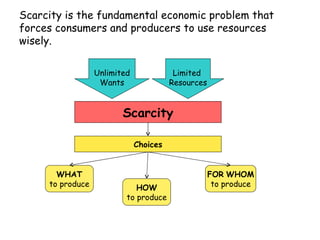
Scarcity is the fundamental economic problem that forces consumers and producers to use resources wisely. Unlimited Wants Limited  Resources Scarcity Choices WHAT to produce HOW to produce FOR   WHOM to produce
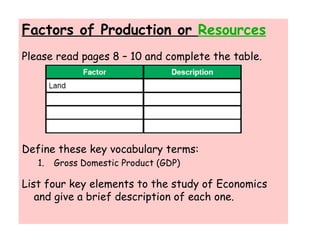
Factors of Production or  Resources Please read pages 8 – 10 and complete the table. Define these key vocabulary terms: Gross Domestic Product (GDP) List four key elements to the study of Economics and give a brief description of each one.
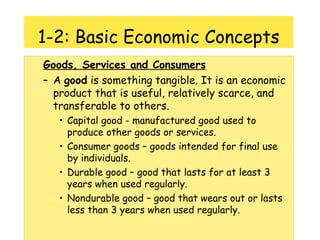
1-2: Basic Economic Concepts Goods, Services and Consumers A  good  is something tangible. It is an economic product that is useful, relatively scarce, and transferable to others. Capital good - manufactured good used to produce other goods or services. Consumer goods – goods intended for final use by individuals. Durable good – good that lasts for at least 3 years when used regularly. Nondurable good – good that wears out or lasts less than 3 years when used regularly.
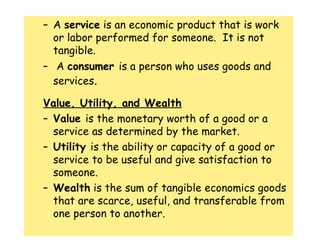
A  service  is an economic product that is work or labor performed for someone.  It is not tangible. A  consumer  is a person who uses goods and services .  Value, Utility, and Wealth Value  is the monetary worth of a good or a service as determined by the market. Utility  is the ability or capacity of a good or service to be useful and give satisfaction to someone. Wealth  is the sum of tangible economics goods that are scarce, useful, and transferable from one person to another.
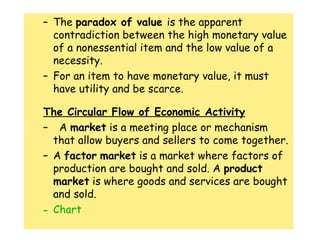
The  paradox of value  is the apparent contradiction between the high monetary value of a nonessential item and the low value of a necessity. For an item to have monetary value, it must have utility and be scarce.  The Circular Flow of Economic Activity A  market  is a meeting place or mechanism that allow buyers and sellers to come together. A  factor   market  is a market where factors of production are bought and sold. A  product   market  is where goods and services are bought and sold.  Chart
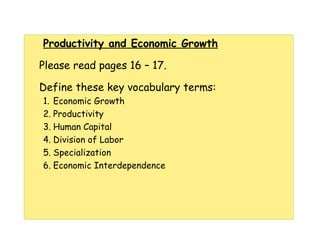
Productivity and Economic Growth Please read pages 16 – 17. Define these key vocabulary terms: Economic Growth Productivity Human Capital Division of Labor Specialization Economic Interdependence
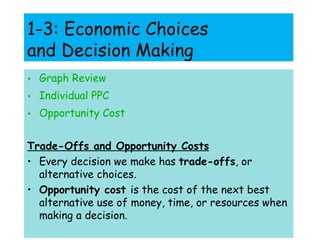
1-3: Economic Choices  and Decision Making Graph Review Individual PPC Opportunity Cost Trade-Offs and Opportunity Costs Every decision we make has  trade-offs , or alternative choices. Opportunity cost  is the cost of the next best alternative use of money, time, or resources when making a decision.
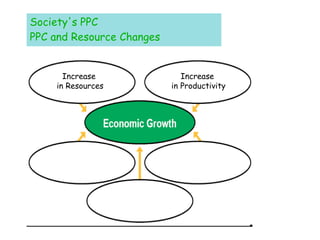
Society's PPC PPC and Resource Changes Increase  in Resources Increase  in Productivity
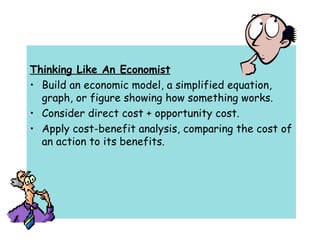
Thinking Like An Economist Build an economic model, a simplified equation, graph, or figure showing how something works. Consider direct cost + opportunity cost. Apply cost-benefit analysis, comparing the cost of an action to its benefits.

Economics 1 1

  • 1.
    Welcome to SummerEconomics Ms. J. Hernandez [email_address]
  • 2.
    Materials You WillNeed to Bring to Class EVERYDAY Notebook with Pockets for Handouts Black or blue pen Red Pen Highlighter Calculator
  • 3.
    Other Materials Youwill Need for Outside of Class Textbook: Economics Principles and Practices Access to Internet Access to Computer and Printer Laptop Availability?
  • 4.
    Chapter 1 Whatis Economics? Economics is the social science dealing with the study of how people satisfy seemingly unlimited and competing wants with the use of limited resources. Scarcity & Choice Video
  • 5.
    1-1: Scarcity and the Science of Economics Please read pages 6 – 7. Define these key vocabulary terms: Scarcity Need Want TINSTAAFL Answer the following questions: What is the fundamental economic problem facing all societies? What is the difference between a need and a want? Video
  • 6.
    Scarcity is thefundamental economic problem that forces consumers and producers to use resources wisely. Unlimited Wants Limited Resources Scarcity Choices WHAT to produce HOW to produce FOR WHOM to produce
  • 7.
    Factors of Productionor Resources Please read pages 8 – 10 and complete the table. Define these key vocabulary terms: Gross Domestic Product (GDP) List four key elements to the study of Economics and give a brief description of each one.
  • 8.
    1-2: Basic EconomicConcepts Goods, Services and Consumers A good is something tangible. It is an economic product that is useful, relatively scarce, and transferable to others. Capital good - manufactured good used to produce other goods or services. Consumer goods – goods intended for final use by individuals. Durable good – good that lasts for at least 3 years when used regularly. Nondurable good – good that wears out or lasts less than 3 years when used regularly.
  • 9.
    A service is an economic product that is work or labor performed for someone. It is not tangible. A consumer is a person who uses goods and services . Value, Utility, and Wealth Value is the monetary worth of a good or a service as determined by the market. Utility is the ability or capacity of a good or service to be useful and give satisfaction to someone. Wealth is the sum of tangible economics goods that are scarce, useful, and transferable from one person to another.
  • 10.
    The paradoxof value is the apparent contradiction between the high monetary value of a nonessential item and the low value of a necessity. For an item to have monetary value, it must have utility and be scarce. The Circular Flow of Economic Activity A market is a meeting place or mechanism that allow buyers and sellers to come together. A factor market is a market where factors of production are bought and sold. A product market is where goods and services are bought and sold. Chart
  • 11.
    Productivity and EconomicGrowth Please read pages 16 – 17. Define these key vocabulary terms: Economic Growth Productivity Human Capital Division of Labor Specialization Economic Interdependence
  • 12.
    1-3: Economic Choices and Decision Making Graph Review Individual PPC Opportunity Cost Trade-Offs and Opportunity Costs Every decision we make has trade-offs , or alternative choices. Opportunity cost is the cost of the next best alternative use of money, time, or resources when making a decision.
  • 13.
    Society's PPC PPCand Resource Changes Increase in Resources Increase in Productivity
  • 14.
    Thinking Like AnEconomist Build an economic model, a simplified equation, graph, or figure showing how something works. Consider direct cost + opportunity cost. Apply cost-benefit analysis, comparing the cost of an action to its benefits.