Basic Economic ConceptsBasic Economic Concepts
DR. KANEEZ FATIMA
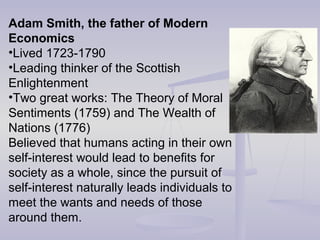
Adam Smith, the father of Modern
Economics
•Lived 1723-1790
•Leading thinker of the Scottish
Enlightenment
•Two great works: The Theory of Moral
Sentiments (1759) and The Wealth of
Nations (1776)
Believed that humans acting in their own
self-interest would lead to benefits for
society as a whole, since the pursuit of
self-interest naturally leads individuals to
meet the wants and needs of those
around them.
What is Economics?What is Economics?
Quiz Choose the correct answerQuiz Choose the correct answer
 Economics is the political science that deals with
unemployment, inflation, taxes, business cycles,
money, supply, and trade.
 Economics is the social science that studies
money and banking
 Economics is the social science that examines the
interaction of demand and supply
 Economics is the social science concerned with
the problem of scarcity
Economics?Economics?
 The social science concerned with how
individuals and societies decide how to satisfy
there unlimited wants given our limited resources.
 I can’t buy a car if I don’t have an income!
 The science of decision making
 How to make decisions
Economics is divided into two main fields
of study
 Macroeconomics – branch of economics that
deals with economic theory and the economic
decisions of large bodies like the government.
 Theories of Economics
 Countries and their governments
 Trade between countries
 Microeconomics – branch of economics that
deals with behavior and decisions of smaller
unit like individuals and businesses.
 Families, businesses, and communities
 Domestic economies
Microeconomics: Studies the behaviors of
INDIVIDUALS within an economy: Consumers and
producers in particular markets.
Examples of microeconomic topics:
•The Automobile market in Switzerland or Japan,
•The market for movie tickets in India,
•The market for airline tickets between the US and
Europe,
•The market for vacations to Spain,
•The market for international school teachers.
Macroeconomics: Studies the total effect on a
nation's people of all the economic activity within that
nation. The four main concerns of macroeconomics
are:
1.total output of a nation,
2.the average price level of a nation,
3.the level of employment (or unemployment) in the
nation and
4.distribution of income in the nation
Examples of macroeconomic topics:
•Unemployment in Pakistan, inflation in Sri Lanka,
economic growth in China, the gap between the rich
and the poor in North & South America
Microeconomics examines Macroeconomics examines
• Individual marketsIndividual markets
• the behavior of firmsthe behavior of firms
(companies) and consumers(companies) and consumers
• the allocation of land, labor andthe allocation of land, labor and
capital resourcescapital resources
• Supply and demandSupply and demand
• The efficiency of marketsThe efficiency of markets
• Product marketsProduct markets
• Supply and DemandSupply and Demand
• Profit maximizationProfit maximization
• Utility maximizationUtility maximization
• CompetitionCompetition
• Resource marketsResource markets
• Market failureMarket failure
• National marketsNational markets
• Total output and income ofTotal output and income of
nationsnations
• Total supply and demand of theTotal supply and demand of the
nationnation
• Taxes and government spendingTaxes and government spending
• Interest rates and central banksInterest rates and central banks
• Unemployment and inflationUnemployment and inflation
• Income distributionIncome distribution
• Economics growth andEconomics growth and
developmentdevelopment
• International tradeInternational trade
Microeconomics vs. Macroeconomics
The two main units in your economics course can be broken
down into many smaller topics. Some of them are identified
below.
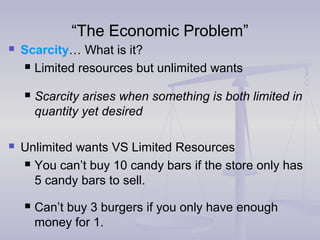
““The Economic Problem”The Economic Problem”
 Scarcity… What is it?
 Limited resources but unlimited wants
 Scarcity arises when something is both limited in
quantity yet desired
 Unlimited wants VS Limited Resources
 You can’t buy 10 candy bars if the store only has
5 candy bars to sell.
 Can’t buy 3 burgers if you only have enough
money for 1.
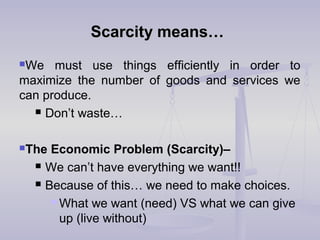
Scarcity means…Scarcity means…
We must use things efficiently in order to
maximize the number of goods and services we
can produce.
 Don’t waste…
The Economic Problem (Scarcity)–
 We can’t have everything we want!!
 Because of this… we need to make choices.
 What we want (need) VS what we can give
up (live without)
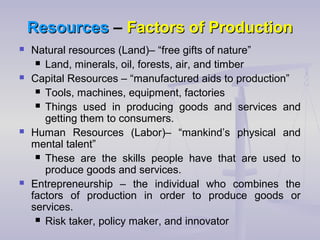
ResourcesResources –– Factors of ProductionFactors of Production
 Natural resources (Land)– “free gifts of nature”
 Land, minerals, oil, forests, air, and timber
 Capital Resources – “manufactured aids to production”
 Tools, machines, equipment, factories
 Things used in producing goods and services and
getting them to consumers.
 Human Resources (Labor)– “mankind’s physical and
mental talent”
 These are the skills people have that are used to
produce goods and services.
 Entrepreneurship – the individual who combines the
factors of production in order to produce goods or
services.
 Risk taker, policy maker, and innovator
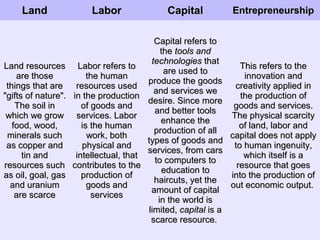
LandLand LaborLabor CapitalCapital EntrepreneurshipEntrepreneurship
Land resourcesLand resources
are thoseare those
things that arethings that are
"gifts of nature"."gifts of nature".
The soil inThe soil in
which we growwhich we grow
food, wood,food, wood,
minerals suchminerals such
as copper andas copper and
tin andtin and
resources suchresources such
as oil, goal, gasas oil, goal, gas
and uraniumand uranium
are scarceare scarce
Labor refers toLabor refers to
the humanthe human
resources usedresources used
in the productionin the production
of goods andof goods and
services. Laborservices. Labor
is the humanis the human
work, bothwork, both
physical andphysical and
intellectual, thatintellectual, that
contributes to thecontributes to the
production ofproduction of
goods andgoods and
servicesservices
Capital refers toCapital refers to
thethe tools andtools and
technologiestechnologies thatthat
are used toare used to
produce the goodsproduce the goods
and services weand services we
desire. Since moredesire. Since more
and better toolsand better tools
enhance theenhance the
production of allproduction of all
types of goods andtypes of goods and
services, from carsservices, from cars
to computers toto computers to
education toeducation to
haircuts, yet thehaircuts, yet the
amount of capitalamount of capital
in the world isin the world is
limited,limited, capitalcapital is ais a
scarce resource.scarce resource.
This refers to theThis refers to the
innovation andinnovation and
creativity applied increativity applied in
the production ofthe production of
goods and services.goods and services.
The physical scarcityThe physical scarcity
of land, labor andof land, labor and
capital does not applycapital does not apply
to human ingenuity,to human ingenuity,
which itself is awhich itself is a
resource that goesresource that goes
into the production ofinto the production of
out economic output.out economic output.
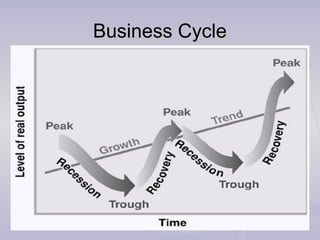
Business CycleBusiness Cycle
Parts of the Business CycleParts of the Business Cycle
 Peak (boom)– Highest point in the
economic cycle.
 Economy is at its best and will likely begin to
contract.
 Recession (contraction)– decline in the
economies performance that could lead to
depression.
 Not long term and does not always impact
other economies
 Trough (depression)– A sustained
economic downturn that impacts our
economy and that of other countries.
 Lowest economic point
 Recovery (expansion)- Economic activity
begins to pick up and depression begins
to end.
 Economic growth occurs
3 Basic Economic Questions3 Basic Economic Questions
 What to produce?
 With limited resources, deciding what is
needed the most is often a factor in
determining what will be produced. What is
the need or want of this product?
 What is the point of making a product that no
one is going to buy. Businesses need to
make money…so they choose products that
people want.
3 Basic Questions Cont…3 Basic Questions Cont…
 How should it be produced?
 Technology, labor, capital, ect.
 getting the lowest cost to make the product.
 Are we going to make the product from
scratch or will a machine be making the
product.
 What will each option cost?
 Will having new technology allow us to lower
our expenses?
3 Basic Questions Cont…3 Basic Questions Cont…
 Whom should it be produced for?
 Who is going to use this product?
 Did Apple market the ipod to the large population
of elderly people in the U.S. or the youth? Why?
 Most goods and services are distributed to
individuals through a price system.
 If you want it and can afford to buy it…you will.
 Products can also be distributed through other
means; force, first come, lottery, majority, ect.
InflationInflation
 The rate at which the general level of prices for
goods and services is rising, and, subsequently,
purchasing power is falling.
 As inflation rises, every dollar will buy a
smaller percentage of a good. For example, if
the inflation rate is 2%, then a $1 pack of gum
will cost $1.02 in a year.
Economic Growth vs. Economic Development
Two of the key areas of study in economics are those of growth
and development. Sometimes these concepts are thought of as
the same, but they are not.
Economic Growth: This refers to the increase in the total output
of goods and services by a nation over time.
•It is also sometimes defined as an increase in household
income over time.
•It is purely a monetary measure of the increases in the material
well being of a nation.
Economic Development: This refers to the improvement in
peoples’ standard of living over time.
•Measured by improvements in health, education, equality, life
expectancy and so on
•Incorporate income as well, but is a much broader measure
than growth
THANK YOU!THANK YOU!

Economic concepts presentation

  • 1.
    Basic Economic ConceptsBasicEconomic Concepts DR. KANEEZ FATIMA
  • 2.
    Adam Smith, thefather of Modern Economics •Lived 1723-1790 •Leading thinker of the Scottish Enlightenment •Two great works: The Theory of Moral Sentiments (1759) and The Wealth of Nations (1776) Believed that humans acting in their own self-interest would lead to benefits for society as a whole, since the pursuit of self-interest naturally leads individuals to meet the wants and needs of those around them.
  • 3.
    What is Economics?Whatis Economics? Quiz Choose the correct answerQuiz Choose the correct answer  Economics is the political science that deals with unemployment, inflation, taxes, business cycles, money, supply, and trade.  Economics is the social science that studies money and banking  Economics is the social science that examines the interaction of demand and supply  Economics is the social science concerned with the problem of scarcity
  • 4.
    Economics?Economics?  The socialscience concerned with how individuals and societies decide how to satisfy there unlimited wants given our limited resources.  I can’t buy a car if I don’t have an income!  The science of decision making  How to make decisions
  • 5.
    Economics is dividedinto two main fields of study  Macroeconomics – branch of economics that deals with economic theory and the economic decisions of large bodies like the government.  Theories of Economics  Countries and their governments  Trade between countries  Microeconomics – branch of economics that deals with behavior and decisions of smaller unit like individuals and businesses.  Families, businesses, and communities  Domestic economies
  • 6.
    Microeconomics: Studies thebehaviors of INDIVIDUALS within an economy: Consumers and producers in particular markets. Examples of microeconomic topics: •The Automobile market in Switzerland or Japan, •The market for movie tickets in India, •The market for airline tickets between the US and Europe, •The market for vacations to Spain, •The market for international school teachers.
  • 7.
    Macroeconomics: Studies thetotal effect on a nation's people of all the economic activity within that nation. The four main concerns of macroeconomics are: 1.total output of a nation, 2.the average price level of a nation, 3.the level of employment (or unemployment) in the nation and 4.distribution of income in the nation Examples of macroeconomic topics: •Unemployment in Pakistan, inflation in Sri Lanka, economic growth in China, the gap between the rich and the poor in North & South America
  • 8.
    Microeconomics examines Macroeconomicsexamines • Individual marketsIndividual markets • the behavior of firmsthe behavior of firms (companies) and consumers(companies) and consumers • the allocation of land, labor andthe allocation of land, labor and capital resourcescapital resources • Supply and demandSupply and demand • The efficiency of marketsThe efficiency of markets • Product marketsProduct markets • Supply and DemandSupply and Demand • Profit maximizationProfit maximization • Utility maximizationUtility maximization • CompetitionCompetition • Resource marketsResource markets • Market failureMarket failure • National marketsNational markets • Total output and income ofTotal output and income of nationsnations • Total supply and demand of theTotal supply and demand of the nationnation • Taxes and government spendingTaxes and government spending • Interest rates and central banksInterest rates and central banks • Unemployment and inflationUnemployment and inflation • Income distributionIncome distribution • Economics growth andEconomics growth and developmentdevelopment • International tradeInternational trade Microeconomics vs. Macroeconomics The two main units in your economics course can be broken down into many smaller topics. Some of them are identified below.
  • 9.
    ““The Economic Problem”TheEconomic Problem”  Scarcity… What is it?  Limited resources but unlimited wants  Scarcity arises when something is both limited in quantity yet desired  Unlimited wants VS Limited Resources  You can’t buy 10 candy bars if the store only has 5 candy bars to sell.  Can’t buy 3 burgers if you only have enough money for 1.
  • 10.
    Scarcity means…Scarcity means… Wemust use things efficiently in order to maximize the number of goods and services we can produce.  Don’t waste… The Economic Problem (Scarcity)–  We can’t have everything we want!!  Because of this… we need to make choices.  What we want (need) VS what we can give up (live without)
  • 11.
    ResourcesResources –– Factorsof ProductionFactors of Production  Natural resources (Land)– “free gifts of nature”  Land, minerals, oil, forests, air, and timber  Capital Resources – “manufactured aids to production”  Tools, machines, equipment, factories  Things used in producing goods and services and getting them to consumers.  Human Resources (Labor)– “mankind’s physical and mental talent”  These are the skills people have that are used to produce goods and services.  Entrepreneurship – the individual who combines the factors of production in order to produce goods or services.  Risk taker, policy maker, and innovator
  • 12.
    LandLand LaborLabor CapitalCapitalEntrepreneurshipEntrepreneurship Land resourcesLand resources are thoseare those things that arethings that are "gifts of nature"."gifts of nature". The soil inThe soil in which we growwhich we grow food, wood,food, wood, minerals suchminerals such as copper andas copper and tin andtin and resources suchresources such as oil, goal, gasas oil, goal, gas and uraniumand uranium are scarceare scarce Labor refers toLabor refers to the humanthe human resources usedresources used in the productionin the production of goods andof goods and services. Laborservices. Labor is the humanis the human work, bothwork, both physical andphysical and intellectual, thatintellectual, that contributes to thecontributes to the production ofproduction of goods andgoods and servicesservices Capital refers toCapital refers to thethe tools andtools and technologiestechnologies thatthat are used toare used to produce the goodsproduce the goods and services weand services we desire. Since moredesire. Since more and better toolsand better tools enhance theenhance the production of allproduction of all types of goods andtypes of goods and services, from carsservices, from cars to computers toto computers to education toeducation to haircuts, yet thehaircuts, yet the amount of capitalamount of capital in the world isin the world is limited,limited, capitalcapital is ais a scarce resource.scarce resource. This refers to theThis refers to the innovation andinnovation and creativity applied increativity applied in the production ofthe production of goods and services.goods and services. The physical scarcityThe physical scarcity of land, labor andof land, labor and capital does not applycapital does not apply to human ingenuity,to human ingenuity, which itself is awhich itself is a resource that goesresource that goes into the production ofinto the production of out economic output.out economic output.
  • 13.
  • 14.
    Parts of theBusiness CycleParts of the Business Cycle  Peak (boom)– Highest point in the economic cycle.  Economy is at its best and will likely begin to contract.  Recession (contraction)– decline in the economies performance that could lead to depression.  Not long term and does not always impact other economies
  • 15.
     Trough (depression)–A sustained economic downturn that impacts our economy and that of other countries.  Lowest economic point  Recovery (expansion)- Economic activity begins to pick up and depression begins to end.  Economic growth occurs
  • 16.
    3 Basic EconomicQuestions3 Basic Economic Questions  What to produce?  With limited resources, deciding what is needed the most is often a factor in determining what will be produced. What is the need or want of this product?  What is the point of making a product that no one is going to buy. Businesses need to make money…so they choose products that people want.
  • 17.
    3 Basic QuestionsCont…3 Basic Questions Cont…  How should it be produced?  Technology, labor, capital, ect.  getting the lowest cost to make the product.  Are we going to make the product from scratch or will a machine be making the product.  What will each option cost?  Will having new technology allow us to lower our expenses?
  • 18.
    3 Basic QuestionsCont…3 Basic Questions Cont…  Whom should it be produced for?  Who is going to use this product?  Did Apple market the ipod to the large population of elderly people in the U.S. or the youth? Why?  Most goods and services are distributed to individuals through a price system.  If you want it and can afford to buy it…you will.  Products can also be distributed through other means; force, first come, lottery, majority, ect.
  • 19.
    InflationInflation  The rateat which the general level of prices for goods and services is rising, and, subsequently, purchasing power is falling.  As inflation rises, every dollar will buy a smaller percentage of a good. For example, if the inflation rate is 2%, then a $1 pack of gum will cost $1.02 in a year.
  • 20.
    Economic Growth vs.Economic Development Two of the key areas of study in economics are those of growth and development. Sometimes these concepts are thought of as the same, but they are not. Economic Growth: This refers to the increase in the total output of goods and services by a nation over time. •It is also sometimes defined as an increase in household income over time. •It is purely a monetary measure of the increases in the material well being of a nation. Economic Development: This refers to the improvement in peoples’ standard of living over time. •Measured by improvements in health, education, equality, life expectancy and so on •Incorporate income as well, but is a much broader measure than growth
  • 21.