




Introduction to Automatic
Control System
FACULTY: PROF. Y. M. KHAN
Asst. Professor,
Dept. of Mechanical Engineering, ICEEM, Aurangabad
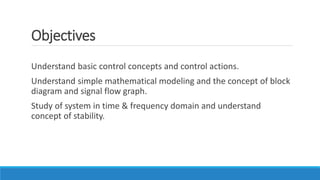
Objectives
Understand basic control concepts and control actions.
Understand simple mathematical modeling and the concept of block
diagram and signal flow graph.
Study of system in time & frequency domain and understand
concept of stability.
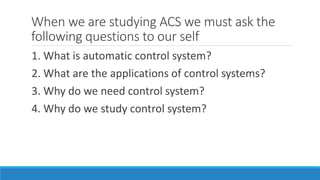
When we are studying ACS we must ask the
following questions to our self
1. What is automatic control system?
2. What are the applications of control systems?
3. Why do we need control system?
4. Why do we study control system?
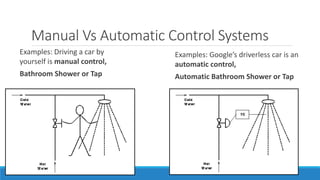
Manual Vs Automatic Control Systems
Examples: Google’s driverless car is an
automatic control,
Automatic Bathroom Shower or Tap
Examples: Driving a car by
yourself is manual control,
Bathroom Shower or Tap
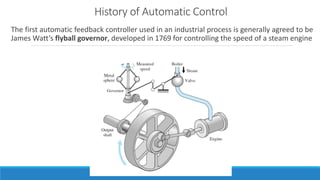
History of Automatic Control
The first automatic feedback controller used in an industrial process is generally agreed to be
James Watt’s flyball governor, developed in 1769 for controlling the speed of a steam engine
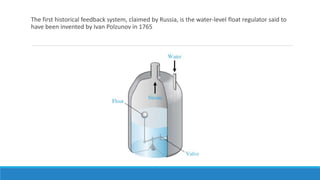
The first historical feedback system, claimed by Russia, is the water-level float regulator said to
have been invented by Ivan Polzunov in 1765
Introduction & Representation
of Control System Components
FACULTY: PROF. Y. M. KHAN
Subject: ACS
Asst. Professor,
Dept. of Mechanical Engineering, ICEEM, Aurangabad
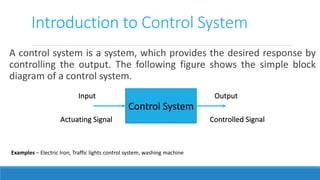
Introduction to Control System
A control system is a system, which provides the desired response by
controlling the output. The following figure shows the simple block
diagram of a control system.
Control System
Input
Actuating Signal
Output
Controlled Signal
Examples − Electric Iron, Traffic lights control system, washing machine
Practically every aspect of our day-to-day life is affected less or more by
some control system.
A bathroom toilet tank, a refrigerator, an air conditioner, a geezer, an
automatic iron, an automobile all are control system.
These systems are also used in industrial processes for more output.
We find control systems in the quality control of products, weapons
system, transportation systems, power system, space technology, robotics
and many more.
The Need for Control Systems
Open Loop and Closed Loop Control Systems
Control Systems can be classified as open loop control
systems and closed loop control systems based on the
feedback path.
Classification of Control Systems
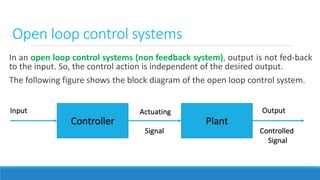
Open loop control systems
In an open loop control systems (non feedback system), output is not fed-back
to the input. So, the control action is independent of the desired output.
The following figure shows the block diagram of the open loop control system.
Plant
Controller
Input Actuating Output
Controlled
Signal
Signal
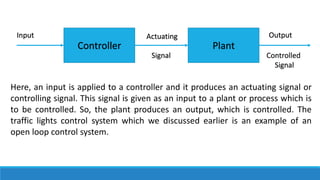
Here, an input is applied to a controller and it produces an actuating signal or
controlling signal. This signal is given as an input to a plant or process which is
to be controlled. So, the plant produces an output, which is controlled. The
traffic lights control system which we discussed earlier is an example of an
open loop control system.
Plant
Controller
Input Actuating Output
Controlled
Signal
Signal
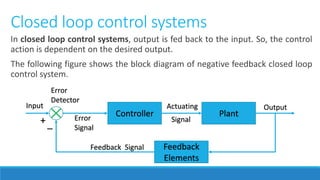
Closed loop control systems
In closed loop control systems, output is fed back to the input. So, the control
action is dependent on the desired output.
The following figure shows the block diagram of negative feedback closed loop
control system.
Plant
Controller
Input Actuating Output
Signal
Feedback
Elements
Feedback Signal
Error
Signal
Error
Detector
+ _
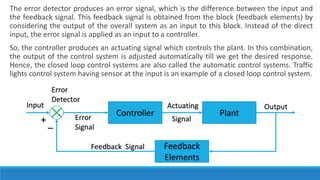
The error detector produces an error signal, which is the difference between the input and
the feedback signal. This feedback signal is obtained from the block (feedback elements) by
considering the output of the overall system as an input to this block. Instead of the direct
input, the error signal is applied as an input to a controller.
So, the controller produces an actuating signal which controls the plant. In this combination,
the output of the control system is adjusted automatically till we get the desired response.
Hence, the closed loop control systems are also called the automatic control systems. Traffic
lights control system having sensor at the input is an example of a closed loop control system.
Plant
Controller
Input Actuating Output
Signal
Feedback
Elements
Feedback Signal
Error
Signal
Error
Detector
+ _
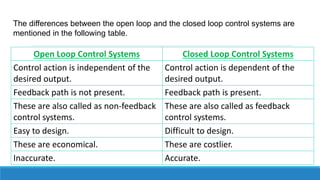
Open Loop Control Systems Closed Loop Control Systems
Control action is independent of the
desired output.
Control action is dependent of the
desired output.
Feedback path is not present. Feedback path is present.
These are also called as non-feedback
control systems.
These are also called as feedback
control systems.
Easy to design. Difficult to design.
These are economical. These are costlier.
Inaccurate. Accurate.
The differences between the open loop and the closed loop control systems are
mentioned in the following table.
Continuous time and Discrete-time Control Systems
Control Systems can be classified as continuous time control systems and
discrete time control systems based on the type of the signal used.
In continuous time control systems, all the signals are continuous in time.
But, in discrete time control systems, there exists one or more discrete time
signals.
SISO and MIMO Control Systems
Control Systems can be classified as SISO control systems and MIMO control
systems based on the number of inputs and outputs present.
SISO (Single Input and Single Output) control systems have one input and
one output. Whereas, MIMO (Multiple Inputs and Multiple Outputs) control
systems have more than one input and more than one output.
Feedback
If either the output or some part of the output is returned to the input side and utilized as
part of the system input, then it is known as feedback. Feedback plays an important role in
order to improve the performance of the control systems. In this chapter, let us discuss the
types of feedback & effects of feedback.
Types of Feedback
There are two types of feedback −
•Positive feedback
•Negative feedback
Positive Feedback
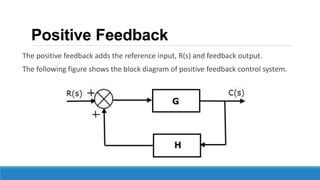
The positive feedback adds the reference input, R(s) and feedback output.
The following figure shows the block diagram of positive feedback control system.
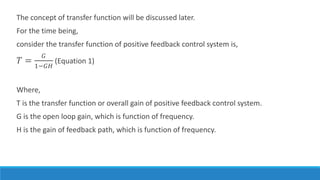
The concept of transfer function will be discussed later.
For the time being,
consider the transfer function of positive feedback control system is,
𝑇 =
𝐺
1−𝐺𝐻
(Equation 1)
Where,
T is the transfer function or overall gain of positive feedback control system.
G is the open loop gain, which is function of frequency.
H is the gain of feedback path, which is function of frequency.
Negative Feedback
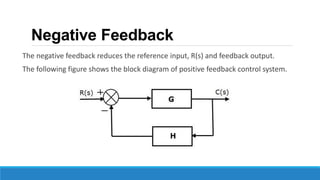
The negative feedback reduces the reference input, R(s) and feedback output.
The following figure shows the block diagram of positive feedback control system.
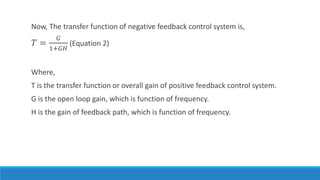
Now, The transfer function of negative feedback control system is,
𝑇 =
𝐺
1+𝐺𝐻
(Equation 2)
Where,
T is the transfer function or overall gain of positive feedback control system.
G is the open loop gain, which is function of frequency.
H is the gain of feedback path, which is function of frequency.
Essential Requirements of a Good Control
System
1. Focus on Objectives
The control system should always focus on objectives. It should aim to achieve the objectives of
the organization.
2. Suitability
The control system should be suitable to the needs of the organisation.
3. Promptness
The control system should be prompt. That is, it should find out the deviations quickly. This will
help the management to correct the deviations quickly.
4. Flexibility
The control system should be flexible. It should change according to the changes
in plans, situations, environments, etc. A rigid control system will always fail.
Hence flexibility is necessary for a control system.
5. Forward Looking
The control system should be forward-looking. It should forecast the future
deviations. That is, it should find out the deviations before it happens. It should
also take steps to prevent these future deviations.
6. Economical
The control system should be economical. This means the cost of the control
system should not be more than its benefits.
7. Simplicity
The control system should not be complicated. It should be easy to understand and simple to use.
Those who are going to use the control system should understand it clearly and completely.
8. Motivating
The control system should be motivating. That is, it should give more importance to preventing
the mistakes and less importance to punishing the employees. So, it should encourage, not
discourage the employees.
9. Suggestive
The control system should be suggestive and it should give complete answers for the following
questions :- What is the Problem? Where is the Problem? How to solve the Problem?
10. Proper Standards
The control system should have proper standards. The standards should be very clear. They should
be definite, verifiable, specific and measurable. They should not be too high or too low.
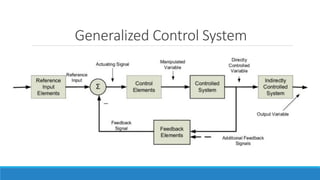
Generalized Control System
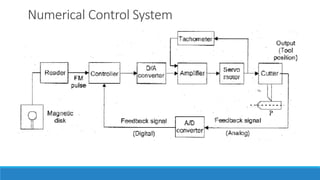
Numerical Control System
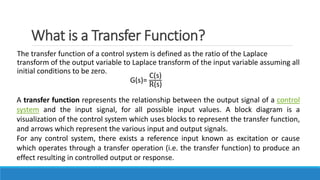
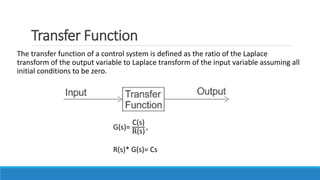
What is a Transfer Function?
The transfer function of a control system is defined as the ratio of the Laplace
transform of the output variable to Laplace transform of the input variable assuming all
initial conditions to be zero.
G(s)=
C(s)
R(s)
A transfer function represents the relationship between the output signal of a control
system and the input signal, for all possible input values. A block diagram is a
visualization of the control system which uses blocks to represent the transfer function,
and arrows which represent the various input and output signals.
For any control system, there exists a reference input known as excitation or cause
which operates through a transfer operation (i.e. the transfer function) to produce an
effect resulting in controlled output or response.
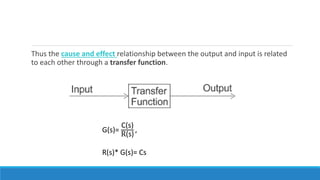
Thus the cause and effect relationship between the output and input is related
to each other through a transfer function.
G(s)=
C(s)
R(s)
,
R(s)* G(s)= Cs
Procedure for determining the transfer function of a control
system are as follows:
1. We form the equations for the system.
2. Now we take Laplace transform of the system equations, assuming initial
conditions as zero.
3. Specify system output and input.
4. Lastly we take the ratio of the Laplace transform of the output and the
Laplace transform of the input which is the required transfer function.
It is not necessary that output and input of a control system are of same category.
For example, in electric motors the input is electrical signal whereas the output is
mechanical signal.
Similarly in an electric generator, the input is mechanical signal and the output is
electrical signal, since mechanical energy is required to produce electricity in a
generator.
But for mathematical analysis, of a system all kinds of signals should be represented
in a similar form.
This is done by transforming all kinds of signal to their Laplace form.
Also the transfer function of a system is represented by Laplace form by dividing
output Laplace transfer function to input Laplace transfer function.
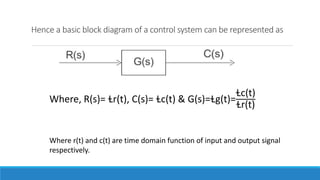
Hence a basic block diagram of a control system can be represented as
Where, R(s)= Ɫr(t), C(s)= Ɫc(t) & G(s)=Ɫg(t)=
Ɫc(t)
Ɫr(t)
Where r(t) and c(t) are time domain function of input and output signal
respectively.
Examples to Draw Block Diagram
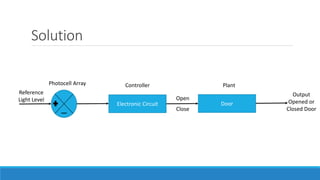
Draw a block diagram of control system in which door automatically opens when a customer
come near it and door close when he goes away from the door.
Solution
Electronic Circuit Door
Photocell Array
Reference
Light Level
Controller Plant
Open
Close
Output
Opened or
Closed Door
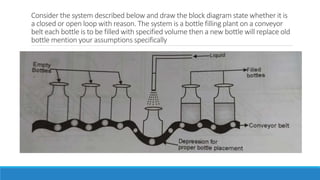
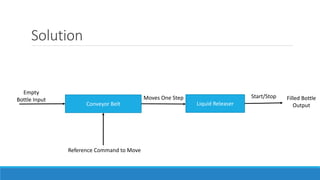
Consider the system described below and draw the block diagram state whether it is
a closed or open loop with reason. The system is a bottle filling plant on a conveyor
belt each bottle is to be filled with specified volume then a new bottle will replace old
bottle mention your assumptions specifically
Conveyor Belt Liquid Releaser
Empty
Bottle Input
Start/Stop
Moves One Step
Reference Command to Move
Filled Bottle
Output
Solution
Transfer Function
The transfer function of a control system is defined as the ratio of the Laplace
transform of the output variable to Laplace transform of the input variable assuming all
initial conditions to be zero.
G(s)=
C(s)
R(s)
,
R(s)* G(s)= Cs
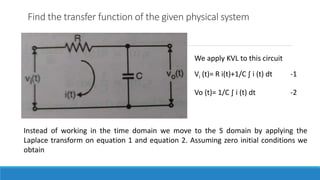
Find the transfer function of the given physical system
We apply KVL to this circuit
Vi (t)= R i(t)+1/C ∫ i (t) dt -1
Vo (t)= 1/C ∫ i (t) dt -2
Instead of working in the time domain we move to the S domain by applying the
Laplace transform on equation 1 and equation 2. Assuming zero initial conditions we
obtain
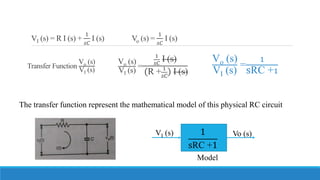
VI (s) = R I (s) +
1
𝑠𝐶
I (s) Vo (s) =
1
𝑠𝐶
I (s)
Transfer Function
Vo (s)
VI (s)
Vo (s)
VI (s)
=
1
𝑠𝐶
I (s)
(R +1
𝑠𝐶
) I (s)
Vo (s)
VI (s)
=
1
sRC +1
The transfer function represent the mathematical model of this physical RC circuit
1
sRC +1
VI (s) Vo (s)
Model
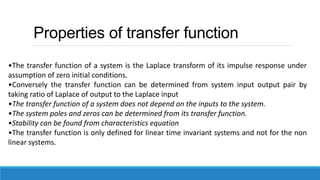
Properties of transfer function
•The transfer function of a system is the Laplace transform of its impulse response under
assumption of zero initial conditions.
•Conversely the transfer function can be determined from system input output pair by
taking ratio of Laplace of output to the Laplace input
•The transfer function of a system does not depend on the inputs to the system.
•The system poles and zeros can be determined from its transfer function.
•Stability can be found from characteristics equation
•The transfer function is only defined for linear time invariant systems and not for the non
linear systems.
Advantages of Transfer function
1. If transfer function of a system is known, the response of the system to any input
can be determined very easily.
2. A transfer function is a mathematical model and it gives the gain of the system.
3. Since it involves the Laplace transform, the terms are simple algebraic
expressions and no differential terms are present.
4. Poles and zeroes of a system can be determined from the knowledge of
the transfer function of the system.
Disadvantages of Transfer function
1. Transfer function does not take into account the initial conditions.
2. The transfer function can be defined for linear systems only.
3. No inferences can be drawn about the physical structure of the system.
Mathematical modeling and representation of
a physical system
Introduction
A physical system is a system in which physical objects are connected to perform an
objective. We cannot represent any physical system in its real form. Therefore, we
have to make assumptions for analysis and synthesis of systems.
An idealized physical system is called a physical model.
A physical system can be modeled in different ways depending upon the problem and
required accuracy with which we have to deal.
Most of the control system we see are mechanical and electrical or a combination of
both.
E.g An Elevator
The process of drawing the block diagram for mechanical and
electrical systems to find the performance and the transfer functions
is called the mathematical modeling of the control system.
There are two types of physical system:
Mechanical system.
Electrical system.
Mechanical Systems are all about motions and the motion in
mechanical system can be categorized in two types
A. Translational
B. Rotational
A. Translational
Translational or Linear system: The motion that takes place along a
straight line is called a translational motion. There are three different
types of forces that we have to study.
1. Mass/ Inertia Force
2. Spring
3. Friction/Damping Force
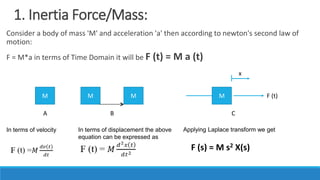
1. Inertia Force/Mass:
Consider a body of mass 'M' and acceleration 'a' then according to newton's second law of
motion:
F = M*a in terms of Time Domain it will be F (t) = M a (t)
M M M M F (t)
x
A B C
In terms of displacement the above
equation can be expressed as
In terms of velocity Applying Laplace transform we get
F (s) = M s2 X(s)
2. Spring Force:
We all have seen spring and we know how it contracts and retracts on application of force.
A mechanical system could have an actual spring or spring like component in it e.g. belt or cable.
Springs are non linear device but their deformation is linear for short distance.
Consider a spring shown in figure
We require force to deform the spring . Here the force is proportional to the displacement.
Net displacement of application of force F(t) at end A is x1 - x2
Therefore, F(t) = K[x1 (t) –x2 (t)]
If the force is applied at B end the relationship is
1
x2
A
B
F(t) = K[x2 (t) –x1 (t)]
Applying Laplace Transform
F(s) = K[X1 (s) –X2 (s)]
• K '= spring constant of stiffness
3. Damping Force/ Friction:
Whenever there is motion there exist friction. Friction exists between moving body and a
fixed support or between surfaces. Sometime viscous friction is sometimes introduced
intentionally which is shown as dashpot or damper.
For viscous friction, we assume that the damping force is proportional to the velocity.
2
x1
FD(t) = B
𝒅
𝒅𝒕
[x1(t) –x2(t)]
Applying Laplace FD(s) = Bs [X2 (s) –X1 (s)]
B. Rotational Motion
Rotational System: When the motion of a body takes place about a fixed axis, this type of
motion is known as rotational motion. There are three types of torques that resist the
rotational motion. In rotational motion force gets replaced by torque(T), displacement by
angular displacement(θ), velocity by angular velocity (ω) and acceleration by angular
acceleration (α).
1. Inertia Torque
2. Damper
3. Spring Torque
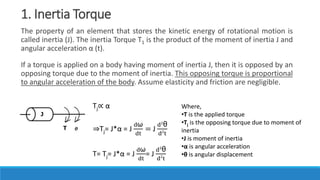
1. Inertia Torque
The property of an element that stores the kinetic energy of rotational motion is
called inertia (J). The inertia Torque T1 is the product of the moment of inertia J and
angular acceleration α (t).
If a torque is applied on a body having moment of inertia J, then it is opposed by an
opposing torque due to the moment of inertia. This opposing torque is proportional
to angular acceleration of the body. Assume elasticity and friction are negligible.
Tj∝ α
⇒Tj= J*α = J
dω
dt
= J
d2
θ
d2
t
T= Tj= J*α = J
dω
dt
= J
d2
θ
d2
t
Where,
•T is the applied torque
•Tj is the opposing torque due to moment of
inertia
•J is moment of inertia
•α is angular acceleration
•θ is angular displacement
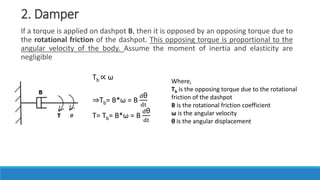
2. Damper
If a torque is applied on dashpot B, then it is opposed by an opposing torque due to
the rotational friction of the dashpot. This opposing torque is proportional to the
angular velocity of the body. Assume the moment of inertia and elasticity are
negligible
Tb ∝ ω
⇒Tb= B*ω = B
dθ
dt
T= Tb= B*ω = B
dθ
dt
Where,
Tb is the opposing torque due to the rotational
friction of the dashpot
B is the rotational friction coefficient
ω is the angular velocity
θ is the angular displacement
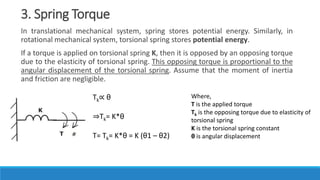
3. Spring Torque
In translational mechanical system, spring stores potential energy. Similarly, in
rotational mechanical system, torsional spring stores potential energy.
If a torque is applied on torsional spring K, then it is opposed by an opposing torque
due to the elasticity of torsional spring. This opposing torque is proportional to the
angular displacement of the torsional spring. Assume that the moment of inertia
and friction are negligible.
Tk∝ θ
⇒Tk= K*θ
T= Tk= K*θ = K (θ1 – θ2)
Where,
T is the applied torque
Tk is the opposing torque due to elasticity of
torsional spring
K is the torsional spring constant
θ is angular displacement
Translational Elements
Sr No Element Figure Relation with Force
1 Mass
2 Spring
3 Friction
M F (t)
x
1
x2
A
B
2
x1
F(t) = K[x1 (t) –x2 (t)]
FD(t) = B
𝒅
𝒅𝒕
[x1 (t) –x2 (t)]
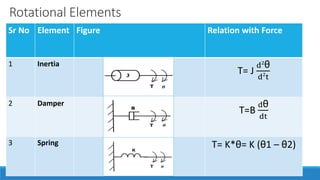
Rotational Elements
Sr No Element Figure Relation with Force
1 Inertia
T= J
d2
θ
d2
t
2 Damper
T=B
dθ
dt
3 Spring T= K*θ= K (θ1 – θ2)
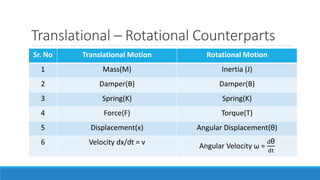
Translational – Rotational Counterparts
Sr. No Translational Motion Rotational Motion
1 Mass(M) Inertia (J)
2 Damper(B) Damper(B)
3 Spring(K) Spring(K)
4 Force(F) Torque(T)
5 Displacement(x) Angular Displacement(θ)
6 Velocity dx/dt = v Angular Velocity ω =
dθ
dt
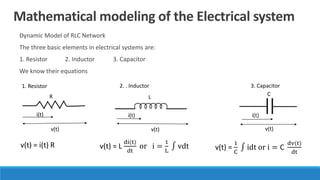
Mathematical modeling of the Electrical system
Dynamic Model of RLC Network
The three basic elements in electrical systems are:
1. Resistor 2. Inductor 3. Capacitor
We know their equations
R
i(t)
v(t)
1. Resistor
v(t) = i(t) R
i(t)
v(t)
2. . Inductor 3. Capacitor
v(t) = L
di(t)
dt
or i =
1
L
∫ vdt
i(t)
v(t)
L
C
v(t) =
1
C
∫ idt or i = C
dv(t)
dt
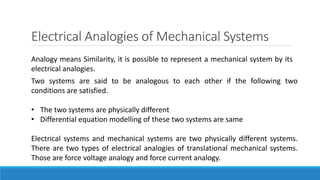
Electrical Analogies of Mechanical Systems
Analogy means Similarity, it is possible to represent a mechanical system by its
electrical analogies.
Two systems are said to be analogous to each other if the following two
conditions are satisfied.
• The two systems are physically different
• Differential equation modelling of these two systems are same
Electrical systems and mechanical systems are two physically different systems.
There are two types of electrical analogies of translational mechanical systems.
Those are force voltage analogy and force current analogy.
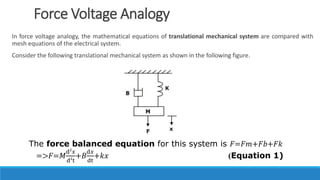
In force voltage analogy, the mathematical equations of translational mechanical system are compared with
mesh equations of the electrical system.
Consider the following translational mechanical system as shown in the following figure.
The force balanced equation for this system is 𝐹=𝐹𝑚+𝐹𝑏+𝐹𝑘
=>𝐹=𝑀
d2
𝑥
d2
t
+𝐵
d𝑥
dt
+𝑘𝑥 (Equation 1)
Force Voltage Analogy
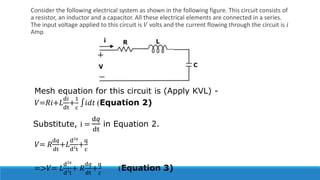
Consider the following electrical system as shown in the following figure. This circuit consists of
a resistor, an inductor and a capacitor. All these electrical elements are connected in a series.
The input voltage applied to this circuit is 𝑉 volts and the current flowing through the circuit is 𝑖
Amp
Mesh equation for this circuit is (Apply KVL) -
𝑉=𝑅𝑖+𝐿
d𝑖
dt
+
1
c
∫𝑖𝑑𝑡 (Equation 2)
Substitute, i =
d𝑞
dt
in Equation 2.
𝑉= 𝑅
d𝑞
dt
+𝐿
d2𝑞
d2
t
+
q
c
=>𝑉= 𝐿
d2𝑞
d2
t
+ 𝑅
d𝑞
dt
+
q
c
(Equation 3)
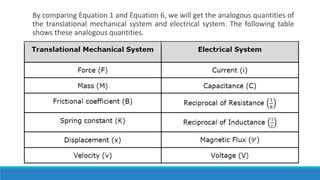
Translational
Mechanical System
Equation Figure Electrical System Equation Figure
Input- Force (F) F = m a Input- Voltage (V) V = I R
Output- Velocity (v) Output- Current (i)
Mass (M) Inductance (L) v=L
di
dt
Damper/Friction
(B)
FD= B
𝒅
𝒅𝒕
[x1–x2] Resistance(R) v= i R
Spring (K) F = K[x1 –x2 ] Reciprocal of
Capacitance (1/𝐶)
v =
1
C
∫ idt
Displacement (x) Charge (q)
M F (t) i(t)
v(t)
2 x1
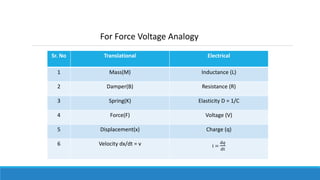
By comparing Equation 1 and Equation 3, we will get the analogous quantities of the translational
mechanical system and electrical system. The following table shows these analogous quantities.
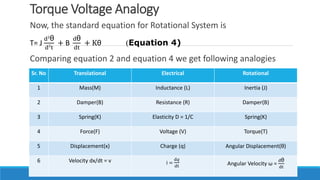
Now, the standard equation for Rotational System is
T= J
d2
θ
d2
t
+ B
dθ
dt
+ Kθ (Equation 4)
Torque Voltage Analogy
Comparing equation 2 and equation 4 we get following analogies
Sr. No Translational Electrical Rotational
1 Mass(M) Inductance (L) Inertia (J)
2 Damper(B) Resistance (R) Damper(B)
3 Spring(K) Elasticity D = 1/C Spring(K)
4 Force(F) Voltage (V) Torque(T)
5 Displacement(x) Charge (q) Angular Displacement(θ)
6 Velocity dx/dt = v i =
d𝑞
dt Angular Velocity ω =
dθ
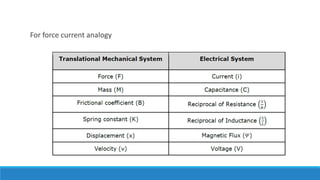
dt
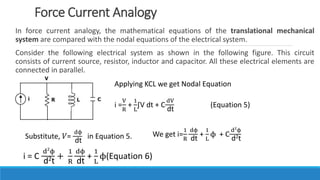
In force current analogy, the mathematical equations of the translational mechanical
system are compared with the nodal equations of the electrical system.
Consider the following electrical system as shown in the following figure. This circuit
consists of current source, resistor, inductor and capacitor. All these electrical elements are
connected in parallel.
Force Current Analogy
Applying KCL we get Nodal Equation
i =
V
R
+
1
L
∫V dt + C
dV
dt
(Equation 5)
Substitute, 𝑉=
dϕ
dt
in Equation 5. We get i=
1
R
dϕ
dt
+
1
L
ϕ + C
d2
ϕ
d2t
i = C
d2
ϕ
d2t
+
1
R
dϕ
dt
+
1
L
ϕ(Equation 6)
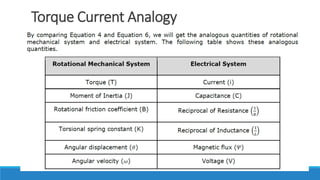
By comparing Equation 1 and Equation 6, we will get the analogous quantities of
the translational mechanical system and electrical system. The following table
shows these analogous quantities.
Torque Current Analogy
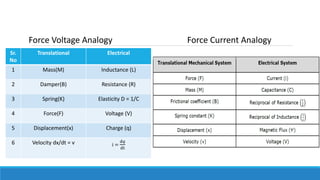
Sr.
No
Translational Electrical
1 Mass(M) Inductance (L)
2 Damper(B) Resistance (R)
3 Spring(K) Elasticity D = 1/C
4 Force(F) Voltage (V)
5 Displacement(x) Charge (q)
6 Velocity dx/dt = v i =
d𝑞
dt
Force Current Analogy
Force Voltage Analogy
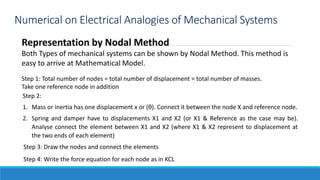
Numerical on Electrical Analogies of Mechanical Systems
Representation by Nodal Method
Both Types of mechanical systems can be shown by Nodal Method. This method is
easy to arrive at Mathematical Model.
Step 1: Total number of nodes = total number of displacement = total number of masses.
Take one reference node in addition
Step 2:
1. Mass or inertia has one displacement x or (θ). Connect it between the node X and reference node.
2. Spring and damper have to displacements X1 and X2 (or X1 & Reference as the case may be).
Analyse connect the element between X1 and X2 (where X1 & X2 represent to displacement at
the two ends of each element)
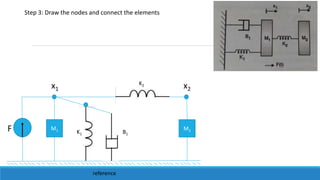
Step 3: Draw the nodes and connect the elements
Step 4: Write the force equation for each node as in KCL
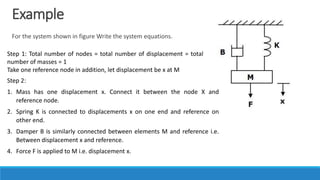
For the system shown in figure Write the system equations.
Example
Step 1: Total number of nodes = total number of displacement = total
number of masses = 1
Take one reference node in addition, let displacement be x at M
Step 2:
1. Mass has one displacement x. Connect it between the node X and
reference node.
2. Spring K is connected to displacements x on one end and reference on
other end.
3. Damper B is similarly connected between elements M and reference i.e.
Between displacement x and reference.
4. Force F is applied to M i.e. displacement x.
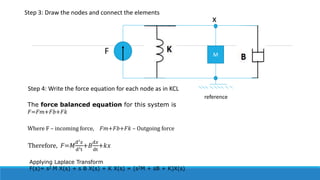
Step 3: Draw the nodes and connect the elements
M
x
F
Step 4: Write the force equation for each node as in KCL
Applying Laplace Transform
F(s)= s2 M X(s) + s B X(s) + K X(s) = (s2M + sB + K)X(s)
The force balanced equation for this system is
𝐹=𝐹𝑚+𝐹𝑏+𝐹𝑘
Where F – incoming force, 𝐹𝑚+𝐹𝑏+𝐹𝑘 – Outgoing force
Therefore, 𝐹=𝑀
d2
𝑥
d2
t
+𝐵
d𝑥
dt
+𝑘𝑥
reference
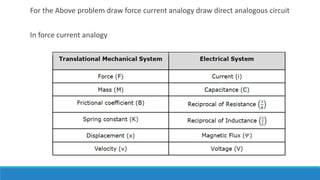
For the Above problem draw force current analogy draw direct analogous circuit
In force current analogy
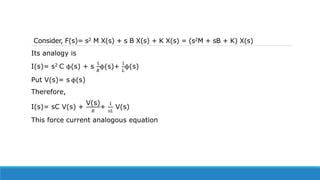
Its analogy is
I(s)= s2 C ϕ(s) + s
1
𝑅
ϕ(s)+
1
𝐿
ϕ(s)
Put V(s)= s ϕ(s)
Therefore,
I(s)= sC V(s) +
V(s)
𝑅
+
1
𝑠𝐿
V(s)
This force current analogous equation
Consider, F(s)= s2 M X(s) + s B X(s) + K X(s) = (s2M + sB + K) X(s)
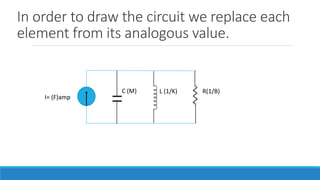
In order to draw the circuit we replace each
element from its analogous value.
I= (F)amp
C (M) L (1/K) R(1/B)
Sr.
No
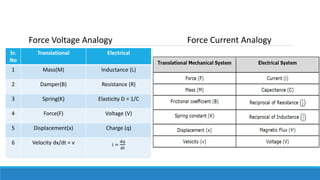
Translational Electrical
1 Mass(M) Inductance (L)
2 Damper(B) Resistance (R)
3 Spring(K) Elasticity D = 1/C
4 Force(F) Voltage (V)
5 Displacement(x) Charge (q)
6 Velocity dx/dt = v i =
d𝑞
dt
Force Current Analogy
Force Voltage Analogy
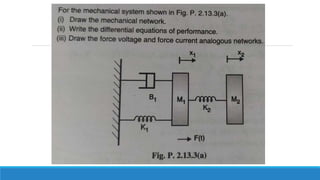
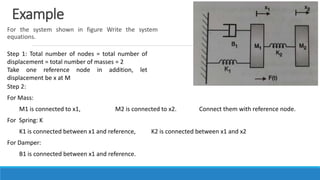
For the system shown in figure Write the system
equations.
Example
Step 1: Total number of nodes = total number of
displacement = total number of masses = 2
Take one reference node in addition, let
displacement be x at M
Step 2:
For Mass:
M1 is connected to x1, M2 is connected to x2. Connect them with reference node.
For Spring: K
K1 is connected between x1 and reference, K2 is connected between x1 and x2
For Damper:
B1 is connected between x1 and reference.
Step 3: Draw the nodes and connect the elements
F
x1
reference
x2
M1 M2
K1 B1
K2
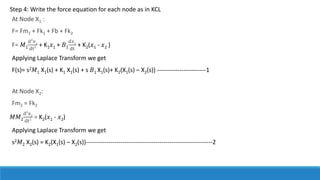
At Node X1 :
F= Fm1 + Fk1 + Fb + Fk2
F= 𝑀1
d2
𝑥1
dt2 + K1𝑥1 + 𝐵1
d𝑥1
dt
+ K2(𝑥1 - 𝑥2 )
Applying Laplace Transform we get
F(s)= s2𝑀1 X1(s) + K1 X1(s) + s 𝐵1 X1(s)+ K2(X1(s) – X2(s)) ------------------------1
At Node X2:
Fm2 = Fk2
𝑀
𝑀 2
d2
x2
dt2 = K2(𝑥1 - 𝑥2)
Applying Laplace Transform we get
s2𝑀2 X2(s) = K2(X1(s) – X2(s))--------------------------------------------------------------2
Step 4: Write the force equation for each node as in KCL
For force current analogy
Its analogy is
I(s)= s2 C1ϕ1(s) +
1
𝐿1
ϕ1 (s) + s
1
𝑅1
ϕ1 (s) +
1
𝐿2
[ϕ1 (s) – ϕ2 (s)]
Put V(s)= s ϕ(s)
Therefore,
I(s)= sC1 V1(s) +
1
𝑠𝐿1
V1(s) +
V1(s)
𝑅1
+
1
𝑠𝐿2
[V1 (s) – V2 (s)]-------------3
This force current analogous equation for equation number 1
Consider, Equation no 1
F(s)= s2 𝑀1 X1(s) + K1 X1(s) + s 𝐵1 X1(s)+ K2(X1(s) – X2(s))
Its analogy is
s2 C2ϕ2(s) =
1
𝐿2
[ϕ1 (s) – ϕ2 (s)]
Put V(s)= s ϕ(s)
Therefore,
sC2 V2(s) =
1
𝑠𝐿2
[V1 (s) – V2 (s)]----------------------4
This force current analogous equation for equation number 2
Consider, Equation no 2
s2 𝑀2 X2(s) = K2(X1(s) – X2(s))
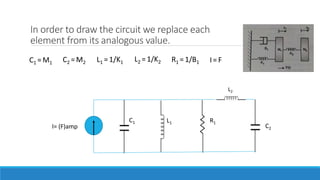
In order to draw the circuit we replace each
element from its analogous value.
I= (F)amp
C1 L1 R1
C1 = M1 C2 = M2 L1 = 1/K1 L2 = 1/K2 R1 = 1/B1 I= F
C2
L2
Sr. No Translational Electrical
1 Mass(M) Inductance (L)
2 Damper(B) Resistance (R)
3 Spring(K) Elasticity D = 1/C
4 Force(F) Voltage (V)
5 Displacement(x) Charge (q)
6 Velocity dx/dt = v i =
d𝑞
dt
For Force Voltage Analogy
Its analogy is
V(s)= s2 L1q1(s) +
1
𝐶1
q1 (s) + s 𝑅1 q1 (s) +
1
𝐶2
[q1 (s) – q2 (s)]
Put I(s)= sq(s)
Therefore,
V(s)= sL1 I1(s) +
1
𝑠𝐶1
I1(s) + R1I1 (s) +
1
𝑠𝐶2
[I1 (s) – I2 (s)]----------------5
This force voltage analogous equation for equation number 1
Consider, Equation no 1
F(s)= s2 𝑀1 X1(s) + K1 X1(s) + s 𝐵1 X1(s)+ K2(X1(s) – X2(s))
Its analogy is
s2 L2q2(s) =
1
𝐶2
[q1 (s) – q2 (s)]
Put I(s)= sq(s)
Therefore,
sL2I2(s) =
1
𝑠𝐶2
[I1 (s) – I2 (s)]---------------------6
This force voltage analogous equation for equation number 2
Consider, Equation no 2
s2 𝑀2 X2(s) = K2(X1(s) – X2(s))
In order to draw the circuit we replace each
element from its analogous value.
V= (F)volt
C1
L1 R1
C1 = 1/K1 C2 = 1/K2
L1 =M1 L2 = M2 R1 = B1 V = F
C2
L2
I1
Consider eq 5
V(s)= sL1 I1(s) +
1
𝑠𝐶1
I1(s) + R1I1 (s) +
1
𝑠𝐶2
[I1 (s) – I2 (s)]
I1 Flow in C1, R1, L1 hence they are in series.
I1 and I2 flows in C2 hence C2 is common both.
I2 flows in L2 . Hence from above conclusions we draw the circuit
Introduction to Automatic Control Systems

Introduction to Automatic Control Systems

  • 1.
    Introduction to Automatic ControlSystem FACULTY: PROF. Y. M. KHAN Asst. Professor, Dept. of Mechanical Engineering, ICEEM, Aurangabad
  • 2.
    Objectives Understand basic controlconcepts and control actions. Understand simple mathematical modeling and the concept of block diagram and signal flow graph. Study of system in time & frequency domain and understand concept of stability.
  • 3.
    When we arestudying ACS we must ask the following questions to our self 1. What is automatic control system? 2. What are the applications of control systems? 3. Why do we need control system? 4. Why do we study control system?
  • 4.
    Manual Vs AutomaticControl Systems Examples: Google’s driverless car is an automatic control, Automatic Bathroom Shower or Tap Examples: Driving a car by yourself is manual control, Bathroom Shower or Tap
  • 5.
    History of AutomaticControl The first automatic feedback controller used in an industrial process is generally agreed to be James Watt’s flyball governor, developed in 1769 for controlling the speed of a steam engine
  • 6.
    The first historicalfeedback system, claimed by Russia, is the water-level float regulator said to have been invented by Ivan Polzunov in 1765
  • 7.
    Introduction & Representation ofControl System Components FACULTY: PROF. Y. M. KHAN Subject: ACS Asst. Professor, Dept. of Mechanical Engineering, ICEEM, Aurangabad
  • 8.
    Introduction to ControlSystem A control system is a system, which provides the desired response by controlling the output. The following figure shows the simple block diagram of a control system. Control System Input Actuating Signal Output Controlled Signal Examples − Electric Iron, Traffic lights control system, washing machine
  • 9.
    Practically every aspectof our day-to-day life is affected less or more by some control system. A bathroom toilet tank, a refrigerator, an air conditioner, a geezer, an automatic iron, an automobile all are control system. These systems are also used in industrial processes for more output. We find control systems in the quality control of products, weapons system, transportation systems, power system, space technology, robotics and many more. The Need for Control Systems
  • 10.
    Open Loop andClosed Loop Control Systems Control Systems can be classified as open loop control systems and closed loop control systems based on the feedback path. Classification of Control Systems
  • 11.
    Open loop controlsystems In an open loop control systems (non feedback system), output is not fed-back to the input. So, the control action is independent of the desired output. The following figure shows the block diagram of the open loop control system. Plant Controller Input Actuating Output Controlled Signal Signal
  • 12.
    Here, an inputis applied to a controller and it produces an actuating signal or controlling signal. This signal is given as an input to a plant or process which is to be controlled. So, the plant produces an output, which is controlled. The traffic lights control system which we discussed earlier is an example of an open loop control system. Plant Controller Input Actuating Output Controlled Signal Signal
  • 13.
    Closed loop controlsystems In closed loop control systems, output is fed back to the input. So, the control action is dependent on the desired output. The following figure shows the block diagram of negative feedback closed loop control system. Plant Controller Input Actuating Output Signal Feedback Elements Feedback Signal Error Signal Error Detector + _
  • 14.
    The error detectorproduces an error signal, which is the difference between the input and the feedback signal. This feedback signal is obtained from the block (feedback elements) by considering the output of the overall system as an input to this block. Instead of the direct input, the error signal is applied as an input to a controller. So, the controller produces an actuating signal which controls the plant. In this combination, the output of the control system is adjusted automatically till we get the desired response. Hence, the closed loop control systems are also called the automatic control systems. Traffic lights control system having sensor at the input is an example of a closed loop control system. Plant Controller Input Actuating Output Signal Feedback Elements Feedback Signal Error Signal Error Detector + _
  • 15.
    Open Loop ControlSystems Closed Loop Control Systems Control action is independent of the desired output. Control action is dependent of the desired output. Feedback path is not present. Feedback path is present. These are also called as non-feedback control systems. These are also called as feedback control systems. Easy to design. Difficult to design. These are economical. These are costlier. Inaccurate. Accurate. The differences between the open loop and the closed loop control systems are mentioned in the following table.
  • 16.
    Continuous time andDiscrete-time Control Systems Control Systems can be classified as continuous time control systems and discrete time control systems based on the type of the signal used. In continuous time control systems, all the signals are continuous in time. But, in discrete time control systems, there exists one or more discrete time signals. SISO and MIMO Control Systems Control Systems can be classified as SISO control systems and MIMO control systems based on the number of inputs and outputs present. SISO (Single Input and Single Output) control systems have one input and one output. Whereas, MIMO (Multiple Inputs and Multiple Outputs) control systems have more than one input and more than one output.
  • 17.
    Feedback If either theoutput or some part of the output is returned to the input side and utilized as part of the system input, then it is known as feedback. Feedback plays an important role in order to improve the performance of the control systems. In this chapter, let us discuss the types of feedback & effects of feedback.
  • 18.
    Types of Feedback Thereare two types of feedback − •Positive feedback •Negative feedback
  • 19.
    Positive Feedback The positivefeedback adds the reference input, R(s) and feedback output. The following figure shows the block diagram of positive feedback control system.
  • 20.
    The concept oftransfer function will be discussed later. For the time being, consider the transfer function of positive feedback control system is, 𝑇 = 𝐺 1−𝐺𝐻 (Equation 1) Where, T is the transfer function or overall gain of positive feedback control system. G is the open loop gain, which is function of frequency. H is the gain of feedback path, which is function of frequency.
  • 21.
    Negative Feedback The negativefeedback reduces the reference input, R(s) and feedback output. The following figure shows the block diagram of positive feedback control system.
  • 22.
    Now, The transferfunction of negative feedback control system is, 𝑇 = 𝐺 1+𝐺𝐻 (Equation 2) Where, T is the transfer function or overall gain of positive feedback control system. G is the open loop gain, which is function of frequency. H is the gain of feedback path, which is function of frequency.
  • 23.
    Essential Requirements ofa Good Control System 1. Focus on Objectives The control system should always focus on objectives. It should aim to achieve the objectives of the organization. 2. Suitability The control system should be suitable to the needs of the organisation. 3. Promptness The control system should be prompt. That is, it should find out the deviations quickly. This will help the management to correct the deviations quickly.
  • 24.
    4. Flexibility The controlsystem should be flexible. It should change according to the changes in plans, situations, environments, etc. A rigid control system will always fail. Hence flexibility is necessary for a control system. 5. Forward Looking The control system should be forward-looking. It should forecast the future deviations. That is, it should find out the deviations before it happens. It should also take steps to prevent these future deviations. 6. Economical The control system should be economical. This means the cost of the control system should not be more than its benefits.
  • 25.
    7. Simplicity The controlsystem should not be complicated. It should be easy to understand and simple to use. Those who are going to use the control system should understand it clearly and completely. 8. Motivating The control system should be motivating. That is, it should give more importance to preventing the mistakes and less importance to punishing the employees. So, it should encourage, not discourage the employees. 9. Suggestive The control system should be suggestive and it should give complete answers for the following questions :- What is the Problem? Where is the Problem? How to solve the Problem? 10. Proper Standards The control system should have proper standards. The standards should be very clear. They should be definite, verifiable, specific and measurable. They should not be too high or too low.
  • 26.
  • 27.
  • 28.
    What is aTransfer Function? The transfer function of a control system is defined as the ratio of the Laplace transform of the output variable to Laplace transform of the input variable assuming all initial conditions to be zero. G(s)= C(s) R(s) A transfer function represents the relationship between the output signal of a control system and the input signal, for all possible input values. A block diagram is a visualization of the control system which uses blocks to represent the transfer function, and arrows which represent the various input and output signals. For any control system, there exists a reference input known as excitation or cause which operates through a transfer operation (i.e. the transfer function) to produce an effect resulting in controlled output or response.
  • 29.
    Thus the causeand effect relationship between the output and input is related to each other through a transfer function. G(s)= C(s) R(s) , R(s)* G(s)= Cs
  • 30.
    Procedure for determiningthe transfer function of a control system are as follows: 1. We form the equations for the system. 2. Now we take Laplace transform of the system equations, assuming initial conditions as zero. 3. Specify system output and input. 4. Lastly we take the ratio of the Laplace transform of the output and the Laplace transform of the input which is the required transfer function.
  • 31.
    It is notnecessary that output and input of a control system are of same category. For example, in electric motors the input is electrical signal whereas the output is mechanical signal. Similarly in an electric generator, the input is mechanical signal and the output is electrical signal, since mechanical energy is required to produce electricity in a generator. But for mathematical analysis, of a system all kinds of signals should be represented in a similar form. This is done by transforming all kinds of signal to their Laplace form. Also the transfer function of a system is represented by Laplace form by dividing output Laplace transfer function to input Laplace transfer function.
  • 32.
    Hence a basicblock diagram of a control system can be represented as Where, R(s)= Ɫr(t), C(s)= Ɫc(t) & G(s)=Ɫg(t)= Ɫc(t) Ɫr(t) Where r(t) and c(t) are time domain function of input and output signal respectively.
  • 33.
    Examples to DrawBlock Diagram Draw a block diagram of control system in which door automatically opens when a customer come near it and door close when he goes away from the door.
  • 34.
    Solution Electronic Circuit Door PhotocellArray Reference Light Level Controller Plant Open Close Output Opened or Closed Door
  • 35.
    Consider the systemdescribed below and draw the block diagram state whether it is a closed or open loop with reason. The system is a bottle filling plant on a conveyor belt each bottle is to be filled with specified volume then a new bottle will replace old bottle mention your assumptions specifically
  • 36.
    Conveyor Belt LiquidReleaser Empty Bottle Input Start/Stop Moves One Step Reference Command to Move Filled Bottle Output Solution
  • 37.
    Transfer Function The transferfunction of a control system is defined as the ratio of the Laplace transform of the output variable to Laplace transform of the input variable assuming all initial conditions to be zero. G(s)= C(s) R(s) , R(s)* G(s)= Cs
  • 38.
    Find the transferfunction of the given physical system We apply KVL to this circuit Vi (t)= R i(t)+1/C ∫ i (t) dt -1 Vo (t)= 1/C ∫ i (t) dt -2 Instead of working in the time domain we move to the S domain by applying the Laplace transform on equation 1 and equation 2. Assuming zero initial conditions we obtain
  • 39.
    VI (s) =R I (s) + 1 𝑠𝐶 I (s) Vo (s) = 1 𝑠𝐶 I (s) Transfer Function Vo (s) VI (s) Vo (s) VI (s) = 1 𝑠𝐶 I (s) (R +1 𝑠𝐶 ) I (s) Vo (s) VI (s) = 1 sRC +1 The transfer function represent the mathematical model of this physical RC circuit 1 sRC +1 VI (s) Vo (s) Model
  • 40.
    Properties of transferfunction •The transfer function of a system is the Laplace transform of its impulse response under assumption of zero initial conditions. •Conversely the transfer function can be determined from system input output pair by taking ratio of Laplace of output to the Laplace input •The transfer function of a system does not depend on the inputs to the system. •The system poles and zeros can be determined from its transfer function. •Stability can be found from characteristics equation •The transfer function is only defined for linear time invariant systems and not for the non linear systems.
  • 41.
    Advantages of Transferfunction 1. If transfer function of a system is known, the response of the system to any input can be determined very easily. 2. A transfer function is a mathematical model and it gives the gain of the system. 3. Since it involves the Laplace transform, the terms are simple algebraic expressions and no differential terms are present. 4. Poles and zeroes of a system can be determined from the knowledge of the transfer function of the system.
  • 42.
    Disadvantages of Transferfunction 1. Transfer function does not take into account the initial conditions. 2. The transfer function can be defined for linear systems only. 3. No inferences can be drawn about the physical structure of the system.
  • 43.
    Mathematical modeling andrepresentation of a physical system Introduction A physical system is a system in which physical objects are connected to perform an objective. We cannot represent any physical system in its real form. Therefore, we have to make assumptions for analysis and synthesis of systems. An idealized physical system is called a physical model. A physical system can be modeled in different ways depending upon the problem and required accuracy with which we have to deal. Most of the control system we see are mechanical and electrical or a combination of both. E.g An Elevator
  • 44.
    The process ofdrawing the block diagram for mechanical and electrical systems to find the performance and the transfer functions is called the mathematical modeling of the control system. There are two types of physical system: Mechanical system. Electrical system.
  • 45.
    Mechanical Systems areall about motions and the motion in mechanical system can be categorized in two types A. Translational B. Rotational
  • 46.
    A. Translational Translational orLinear system: The motion that takes place along a straight line is called a translational motion. There are three different types of forces that we have to study. 1. Mass/ Inertia Force 2. Spring 3. Friction/Damping Force
  • 47.
    1. Inertia Force/Mass: Considera body of mass 'M' and acceleration 'a' then according to newton's second law of motion: F = M*a in terms of Time Domain it will be F (t) = M a (t) M M M M F (t) x A B C In terms of displacement the above equation can be expressed as In terms of velocity Applying Laplace transform we get F (s) = M s2 X(s)
  • 48.
    2. Spring Force: Weall have seen spring and we know how it contracts and retracts on application of force. A mechanical system could have an actual spring or spring like component in it e.g. belt or cable. Springs are non linear device but their deformation is linear for short distance. Consider a spring shown in figure We require force to deform the spring . Here the force is proportional to the displacement. Net displacement of application of force F(t) at end A is x1 - x2 Therefore, F(t) = K[x1 (t) –x2 (t)] If the force is applied at B end the relationship is 1 x2 A B F(t) = K[x2 (t) –x1 (t)] Applying Laplace Transform F(s) = K[X1 (s) –X2 (s)] • K '= spring constant of stiffness
  • 49.
    3. Damping Force/Friction: Whenever there is motion there exist friction. Friction exists between moving body and a fixed support or between surfaces. Sometime viscous friction is sometimes introduced intentionally which is shown as dashpot or damper. For viscous friction, we assume that the damping force is proportional to the velocity. 2 x1 FD(t) = B 𝒅 𝒅𝒕 [x1(t) –x2(t)] Applying Laplace FD(s) = Bs [X2 (s) –X1 (s)]
  • 50.
    B. Rotational Motion RotationalSystem: When the motion of a body takes place about a fixed axis, this type of motion is known as rotational motion. There are three types of torques that resist the rotational motion. In rotational motion force gets replaced by torque(T), displacement by angular displacement(θ), velocity by angular velocity (ω) and acceleration by angular acceleration (α). 1. Inertia Torque 2. Damper 3. Spring Torque
  • 51.
    1. Inertia Torque Theproperty of an element that stores the kinetic energy of rotational motion is called inertia (J). The inertia Torque T1 is the product of the moment of inertia J and angular acceleration α (t). If a torque is applied on a body having moment of inertia J, then it is opposed by an opposing torque due to the moment of inertia. This opposing torque is proportional to angular acceleration of the body. Assume elasticity and friction are negligible. Tj∝ α ⇒Tj= J*α = J dω dt = J d2 θ d2 t T= Tj= J*α = J dω dt = J d2 θ d2 t Where, •T is the applied torque •Tj is the opposing torque due to moment of inertia •J is moment of inertia •α is angular acceleration •θ is angular displacement
  • 52.
    2. Damper If atorque is applied on dashpot B, then it is opposed by an opposing torque due to the rotational friction of the dashpot. This opposing torque is proportional to the angular velocity of the body. Assume the moment of inertia and elasticity are negligible Tb ∝ ω ⇒Tb= B*ω = B dθ dt T= Tb= B*ω = B dθ dt Where, Tb is the opposing torque due to the rotational friction of the dashpot B is the rotational friction coefficient ω is the angular velocity θ is the angular displacement
  • 53.
    3. Spring Torque Intranslational mechanical system, spring stores potential energy. Similarly, in rotational mechanical system, torsional spring stores potential energy. If a torque is applied on torsional spring K, then it is opposed by an opposing torque due to the elasticity of torsional spring. This opposing torque is proportional to the angular displacement of the torsional spring. Assume that the moment of inertia and friction are negligible. Tk∝ θ ⇒Tk= K*θ T= Tk= K*θ = K (θ1 – θ2) Where, T is the applied torque Tk is the opposing torque due to elasticity of torsional spring K is the torsional spring constant θ is angular displacement
  • 54.
    Translational Elements Sr NoElement Figure Relation with Force 1 Mass 2 Spring 3 Friction M F (t) x 1 x2 A B 2 x1 F(t) = K[x1 (t) –x2 (t)] FD(t) = B 𝒅 𝒅𝒕 [x1 (t) –x2 (t)]
  • 55.
    Rotational Elements Sr NoElement Figure Relation with Force 1 Inertia T= J d2 θ d2 t 2 Damper T=B dθ dt 3 Spring T= K*θ= K (θ1 – θ2)
  • 56.
    Translational – RotationalCounterparts Sr. No Translational Motion Rotational Motion 1 Mass(M) Inertia (J) 2 Damper(B) Damper(B) 3 Spring(K) Spring(K) 4 Force(F) Torque(T) 5 Displacement(x) Angular Displacement(θ) 6 Velocity dx/dt = v Angular Velocity ω = dθ dt
  • 57.
    Mathematical modeling ofthe Electrical system Dynamic Model of RLC Network The three basic elements in electrical systems are: 1. Resistor 2. Inductor 3. Capacitor We know their equations R i(t) v(t) 1. Resistor v(t) = i(t) R i(t) v(t) 2. . Inductor 3. Capacitor v(t) = L di(t) dt or i = 1 L ∫ vdt i(t) v(t) L C v(t) = 1 C ∫ idt or i = C dv(t) dt
  • 58.
    Electrical Analogies ofMechanical Systems Analogy means Similarity, it is possible to represent a mechanical system by its electrical analogies. Two systems are said to be analogous to each other if the following two conditions are satisfied. • The two systems are physically different • Differential equation modelling of these two systems are same Electrical systems and mechanical systems are two physically different systems. There are two types of electrical analogies of translational mechanical systems. Those are force voltage analogy and force current analogy.
  • 59.
    In force voltageanalogy, the mathematical equations of translational mechanical system are compared with mesh equations of the electrical system. Consider the following translational mechanical system as shown in the following figure. The force balanced equation for this system is 𝐹=𝐹𝑚+𝐹𝑏+𝐹𝑘 =>𝐹=𝑀 d2 𝑥 d2 t +𝐵 d𝑥 dt +𝑘𝑥 (Equation 1) Force Voltage Analogy
  • 60.
    Consider the followingelectrical system as shown in the following figure. This circuit consists of a resistor, an inductor and a capacitor. All these electrical elements are connected in a series. The input voltage applied to this circuit is 𝑉 volts and the current flowing through the circuit is 𝑖 Amp Mesh equation for this circuit is (Apply KVL) - 𝑉=𝑅𝑖+𝐿 d𝑖 dt + 1 c ∫𝑖𝑑𝑡 (Equation 2) Substitute, i = d𝑞 dt in Equation 2. 𝑉= 𝑅 d𝑞 dt +𝐿 d2𝑞 d2 t + q c =>𝑉= 𝐿 d2𝑞 d2 t + 𝑅 d𝑞 dt + q c (Equation 3)
  • 61.
    Translational Mechanical System Equation FigureElectrical System Equation Figure Input- Force (F) F = m a Input- Voltage (V) V = I R Output- Velocity (v) Output- Current (i) Mass (M) Inductance (L) v=L di dt Damper/Friction (B) FD= B 𝒅 𝒅𝒕 [x1–x2] Resistance(R) v= i R Spring (K) F = K[x1 –x2 ] Reciprocal of Capacitance (1/𝐶) v = 1 C ∫ idt Displacement (x) Charge (q) M F (t) i(t) v(t) 2 x1 By comparing Equation 1 and Equation 3, we will get the analogous quantities of the translational mechanical system and electrical system. The following table shows these analogous quantities.
  • 62.
    Now, the standardequation for Rotational System is T= J d2 θ d2 t + B dθ dt + Kθ (Equation 4) Torque Voltage Analogy Comparing equation 2 and equation 4 we get following analogies Sr. No Translational Electrical Rotational 1 Mass(M) Inductance (L) Inertia (J) 2 Damper(B) Resistance (R) Damper(B) 3 Spring(K) Elasticity D = 1/C Spring(K) 4 Force(F) Voltage (V) Torque(T) 5 Displacement(x) Charge (q) Angular Displacement(θ) 6 Velocity dx/dt = v i = d𝑞 dt Angular Velocity ω = dθ dt
  • 63.
    In force currentanalogy, the mathematical equations of the translational mechanical system are compared with the nodal equations of the electrical system. Consider the following electrical system as shown in the following figure. This circuit consists of current source, resistor, inductor and capacitor. All these electrical elements are connected in parallel. Force Current Analogy Applying KCL we get Nodal Equation i = V R + 1 L ∫V dt + C dV dt (Equation 5) Substitute, 𝑉= dϕ dt in Equation 5. We get i= 1 R dϕ dt + 1 L ϕ + C d2 ϕ d2t i = C d2 ϕ d2t + 1 R dϕ dt + 1 L ϕ(Equation 6)
  • 64.
    By comparing Equation1 and Equation 6, we will get the analogous quantities of the translational mechanical system and electrical system. The following table shows these analogous quantities.
  • 65.
  • 66.
    Sr. No Translational Electrical 1 Mass(M)Inductance (L) 2 Damper(B) Resistance (R) 3 Spring(K) Elasticity D = 1/C 4 Force(F) Voltage (V) 5 Displacement(x) Charge (q) 6 Velocity dx/dt = v i = d𝑞 dt Force Current Analogy Force Voltage Analogy
  • 67.
    Numerical on ElectricalAnalogies of Mechanical Systems Representation by Nodal Method Both Types of mechanical systems can be shown by Nodal Method. This method is easy to arrive at Mathematical Model. Step 1: Total number of nodes = total number of displacement = total number of masses. Take one reference node in addition Step 2: 1. Mass or inertia has one displacement x or (θ). Connect it between the node X and reference node. 2. Spring and damper have to displacements X1 and X2 (or X1 & Reference as the case may be). Analyse connect the element between X1 and X2 (where X1 & X2 represent to displacement at the two ends of each element) Step 3: Draw the nodes and connect the elements Step 4: Write the force equation for each node as in KCL
  • 68.
    For the systemshown in figure Write the system equations. Example Step 1: Total number of nodes = total number of displacement = total number of masses = 1 Take one reference node in addition, let displacement be x at M Step 2: 1. Mass has one displacement x. Connect it between the node X and reference node. 2. Spring K is connected to displacements x on one end and reference on other end. 3. Damper B is similarly connected between elements M and reference i.e. Between displacement x and reference. 4. Force F is applied to M i.e. displacement x.
  • 69.
    Step 3: Drawthe nodes and connect the elements M x F Step 4: Write the force equation for each node as in KCL Applying Laplace Transform F(s)= s2 M X(s) + s B X(s) + K X(s) = (s2M + sB + K)X(s) The force balanced equation for this system is 𝐹=𝐹𝑚+𝐹𝑏+𝐹𝑘 Where F – incoming force, 𝐹𝑚+𝐹𝑏+𝐹𝑘 – Outgoing force Therefore, 𝐹=𝑀 d2 𝑥 d2 t +𝐵 d𝑥 dt +𝑘𝑥 reference
  • 70.
    For the Aboveproblem draw force current analogy draw direct analogous circuit In force current analogy
  • 71.
    Its analogy is I(s)=s2 C ϕ(s) + s 1 𝑅 ϕ(s)+ 1 𝐿 ϕ(s) Put V(s)= s ϕ(s) Therefore, I(s)= sC V(s) + V(s) 𝑅 + 1 𝑠𝐿 V(s) This force current analogous equation Consider, F(s)= s2 M X(s) + s B X(s) + K X(s) = (s2M + sB + K) X(s)
  • 72.
    In order todraw the circuit we replace each element from its analogous value. I= (F)amp C (M) L (1/K) R(1/B)
  • 73.
    Sr. No Translational Electrical 1 Mass(M)Inductance (L) 2 Damper(B) Resistance (R) 3 Spring(K) Elasticity D = 1/C 4 Force(F) Voltage (V) 5 Displacement(x) Charge (q) 6 Velocity dx/dt = v i = d𝑞 dt Force Current Analogy Force Voltage Analogy
  • 75.
    For the systemshown in figure Write the system equations. Example Step 1: Total number of nodes = total number of displacement = total number of masses = 2 Take one reference node in addition, let displacement be x at M Step 2: For Mass: M1 is connected to x1, M2 is connected to x2. Connect them with reference node. For Spring: K K1 is connected between x1 and reference, K2 is connected between x1 and x2 For Damper: B1 is connected between x1 and reference.
  • 76.
    Step 3: Drawthe nodes and connect the elements F x1 reference x2 M1 M2 K1 B1 K2
  • 77.
    At Node X1: F= Fm1 + Fk1 + Fb + Fk2 F= 𝑀1 d2 𝑥1 dt2 + K1𝑥1 + 𝐵1 d𝑥1 dt + K2(𝑥1 - 𝑥2 ) Applying Laplace Transform we get F(s)= s2𝑀1 X1(s) + K1 X1(s) + s 𝐵1 X1(s)+ K2(X1(s) – X2(s)) ------------------------1 At Node X2: Fm2 = Fk2 𝑀 𝑀 2 d2 x2 dt2 = K2(𝑥1 - 𝑥2) Applying Laplace Transform we get s2𝑀2 X2(s) = K2(X1(s) – X2(s))--------------------------------------------------------------2 Step 4: Write the force equation for each node as in KCL
  • 78.
  • 79.
    Its analogy is I(s)=s2 C1ϕ1(s) + 1 𝐿1 ϕ1 (s) + s 1 𝑅1 ϕ1 (s) + 1 𝐿2 [ϕ1 (s) – ϕ2 (s)] Put V(s)= s ϕ(s) Therefore, I(s)= sC1 V1(s) + 1 𝑠𝐿1 V1(s) + V1(s) 𝑅1 + 1 𝑠𝐿2 [V1 (s) – V2 (s)]-------------3 This force current analogous equation for equation number 1 Consider, Equation no 1 F(s)= s2 𝑀1 X1(s) + K1 X1(s) + s 𝐵1 X1(s)+ K2(X1(s) – X2(s))
  • 80.
    Its analogy is s2C2ϕ2(s) = 1 𝐿2 [ϕ1 (s) – ϕ2 (s)] Put V(s)= s ϕ(s) Therefore, sC2 V2(s) = 1 𝑠𝐿2 [V1 (s) – V2 (s)]----------------------4 This force current analogous equation for equation number 2 Consider, Equation no 2 s2 𝑀2 X2(s) = K2(X1(s) – X2(s))
  • 81.
    In order todraw the circuit we replace each element from its analogous value. I= (F)amp C1 L1 R1 C1 = M1 C2 = M2 L1 = 1/K1 L2 = 1/K2 R1 = 1/B1 I= F C2 L2
  • 82.
    Sr. No TranslationalElectrical 1 Mass(M) Inductance (L) 2 Damper(B) Resistance (R) 3 Spring(K) Elasticity D = 1/C 4 Force(F) Voltage (V) 5 Displacement(x) Charge (q) 6 Velocity dx/dt = v i = d𝑞 dt For Force Voltage Analogy
  • 83.
    Its analogy is V(s)=s2 L1q1(s) + 1 𝐶1 q1 (s) + s 𝑅1 q1 (s) + 1 𝐶2 [q1 (s) – q2 (s)] Put I(s)= sq(s) Therefore, V(s)= sL1 I1(s) + 1 𝑠𝐶1 I1(s) + R1I1 (s) + 1 𝑠𝐶2 [I1 (s) – I2 (s)]----------------5 This force voltage analogous equation for equation number 1 Consider, Equation no 1 F(s)= s2 𝑀1 X1(s) + K1 X1(s) + s 𝐵1 X1(s)+ K2(X1(s) – X2(s))
  • 84.
    Its analogy is s2L2q2(s) = 1 𝐶2 [q1 (s) – q2 (s)] Put I(s)= sq(s) Therefore, sL2I2(s) = 1 𝑠𝐶2 [I1 (s) – I2 (s)]---------------------6 This force voltage analogous equation for equation number 2 Consider, Equation no 2 s2 𝑀2 X2(s) = K2(X1(s) – X2(s))
  • 85.
    In order todraw the circuit we replace each element from its analogous value. V= (F)volt C1 L1 R1 C1 = 1/K1 C2 = 1/K2 L1 =M1 L2 = M2 R1 = B1 V = F C2 L2 I1 Consider eq 5 V(s)= sL1 I1(s) + 1 𝑠𝐶1 I1(s) + R1I1 (s) + 1 𝑠𝐶2 [I1 (s) – I2 (s)] I1 Flow in C1, R1, L1 hence they are in series. I1 and I2 flows in C2 hence C2 is common both. I2 flows in L2 . Hence from above conclusions we draw the circuit