
Basic Cephalometrics
Mark H. Taylor, D.D.S., F.A.C.D.
Cephalometrics is a technique employing
oriented radiographs for the purpose of
making head measurements.
Purpose of Cephalometrics
• Study craniofacial growth
• Diagnosis
• Planning orthodontic treatment
• Evaluation of treated cases
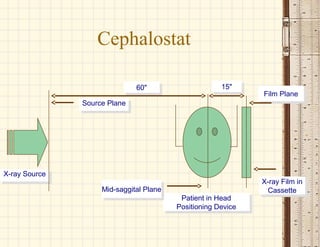
15"15"60"60"
Source PlaneSource Plane
X-ray SourceX-ray Source
Patient in Head
Positioning Device
Patient in Head
Positioning Device
Mid-saggital PlaneMid-saggital Plane
Film PlaneFilm Plane
X-ray Film in
Cassette
X-ray Film in
Cassette
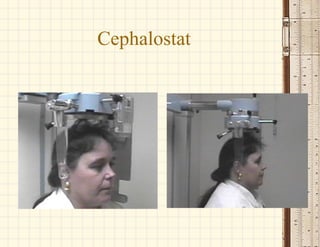
Cephalostat
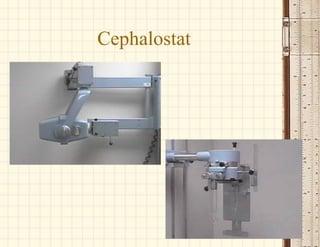
Cephalostat
Cephalostat
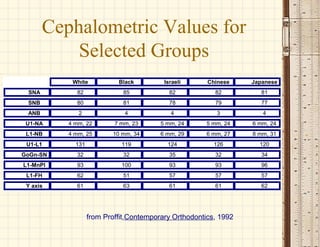
White Black Israeli Chinese Japanese
SNA 82 85 82 82 81
SNB 80 81 78 79 77
ANB 2 4 4 3 4
U1-NA 4 mm, 22 7 mm, 23 5 mm, 24 5 mm, 24 6 mm, 24
L1-NB 4 mm, 25 10 mm, 34 6 mm, 29 6 mm, 27 8 mm, 31
U1-L1 131 119 124 126 120
GoGn-SN 32 32 35 32 34
L1-MnPl 93 100 93 93 96
L1-FH 62 51 57 57 57
Y axis 61 63 61 61 62
from Proffit,Contemporary Orthodontics, 1992
Cephalometric Values for
Selected Groups
What Are We Trying to
Accomplish?
• Find out skeletal classification
– anteroposterior
– vertical
• Find out angulation of incisors
• Consider soft tissue
– facial profile
– airway considerations
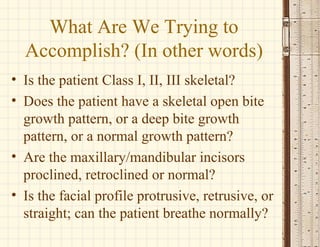
What Are We Trying to
Accomplish? (In other words)
• Is the patient Class I, II, III skeletal?
• Does the patient have a skeletal open bite
growth pattern, or a deep bite growth
pattern, or a normal growth pattern?
• Are the maxillary/mandibular incisors
proclined, retroclined or normal?
• Is the facial profile protrusive, retrusive, or
straight; can the patient breathe normally?
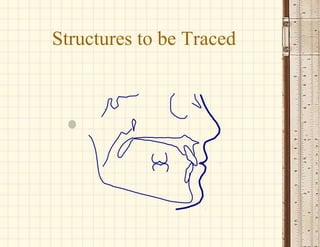
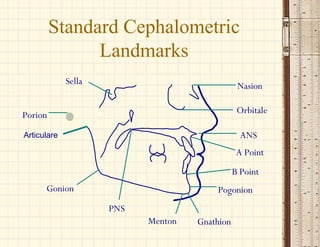
Structures to be Traced
Sella
Porion
Gonion
PNS
Menton Gnathion
Pogonion
B Point
A Point
ANS
Orbitale
Nasion
Articulare
Standard Cephalometric
Landmarks
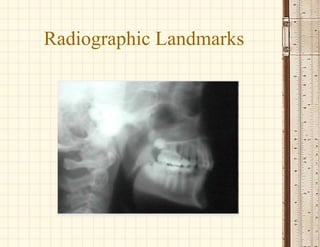
Radiographic Landmarks
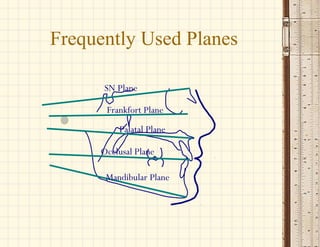
SN Plane
Frankfort Plane
Palatal Plane
Occlusal Plane
Mandibular Plane
Frequently Used Planes
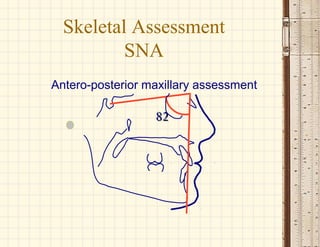
8282
Antero-posterior maxillary assessment
Skeletal Assessment
SNA
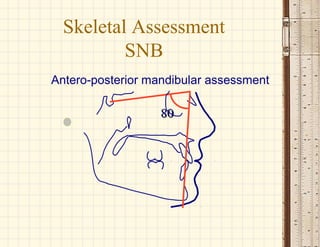
8080
Antero-posterior mandibular assessment
Skeletal Assessment
SNB
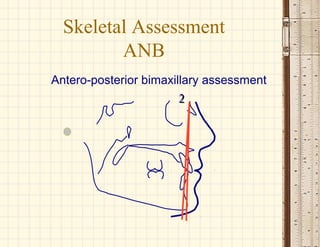
22
Antero-posterior bimaxillary assessment
Skeletal Assessment
ANB
-1 mm-1 mm
BO anterior toBO anterior to
AOAO
Skeletal Assessment
Wits (AO-BO)
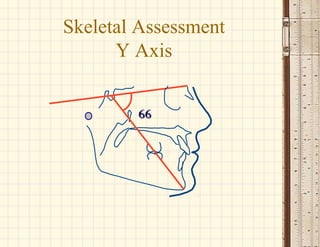
6666
Skeletal Assessment
Y Axis
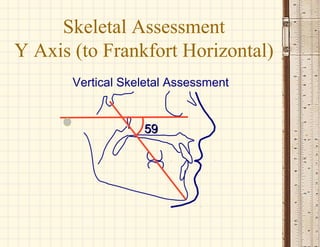
5959
Vertical Skeletal Assessment
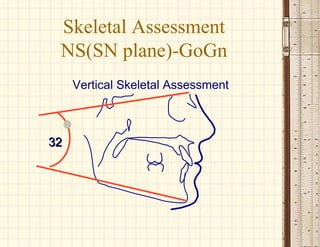
Skeletal Assessment
Y Axis (to Frankfort Horizontal)
3232
Vertical Skeletal Assessment
Skeletal Assessment
NS(SN plane)-GoGn
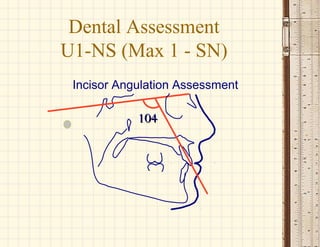
104104
Incisor Angulation Assessment
Dental Assessment
U1-NS (Max 1 - SN)
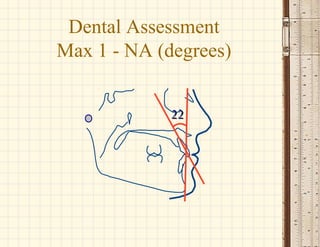
2222
Dental Assessment
Max 1 - NA (degrees)
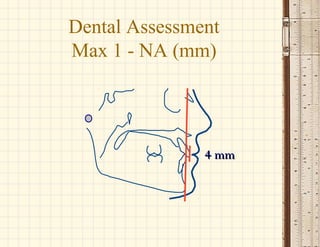
4 mm4 mm
Dental Assessment
Max 1 - NA (mm)
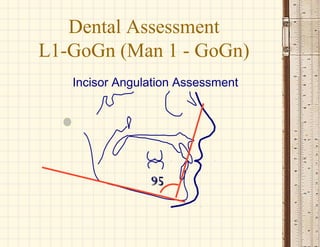
9595
Incisor Angulation Assessment
Dental Assessment
L1-GoGn (Man 1 - GoGn)
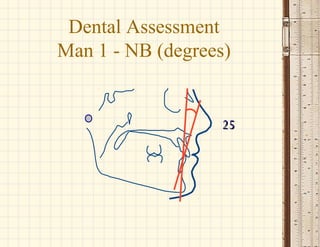
2525
Dental Assessment
Man 1 - NB (degrees)
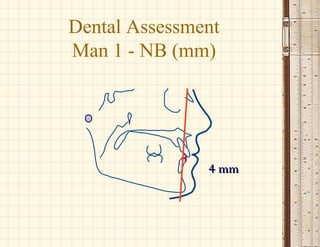
4 mm4 mm
Dental Assessment
Man 1 - NB (mm)
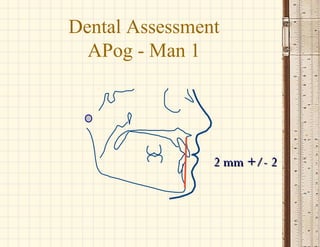
2 mm +/- 22 mm +/- 2
Dental Assessment
APog - Man 1
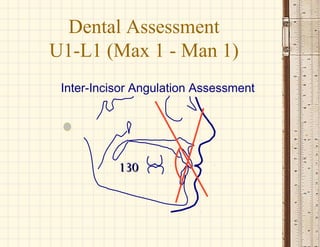
130130
Inter-Incisor Angulation Assessment
Dental Assessment
U1-L1 (Max 1 - Man 1)
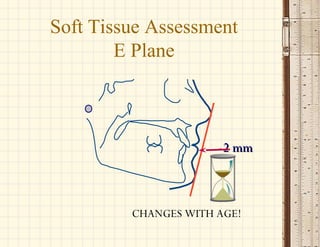
-2 mm-2 mm
CHANGES WITH AGE!
Soft Tissue Assessment
E Plane
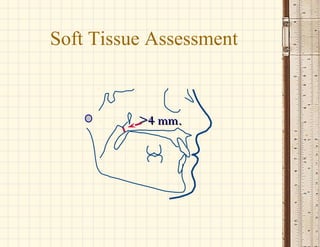
>4 mm.>4 mm.
Soft Tissue Assessment
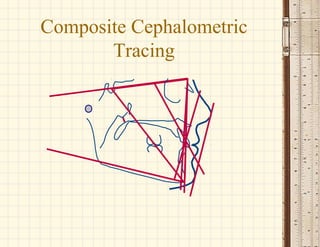
Composite Cephalometric
Tracing
Children with airway obstruction, when
compared to normal controls, show:
Nasorespiratory Considerations
• Increased total and lower face heights
• More retrognathic mandibles
• Steeper (increased) mandibular plane
angles
• Spontaneous improvement after
reestablishment of normal respiration
Cases

Basic cephalometrics