Bends in orthodonticsBends in orthodontics
Three order of toothThree order of tooth
movement bendsmovement bends
Done by Dr Noor Altamimi
Supervised by Dr Ahmad Altarawneh
Dr Jumana Tbaishat
Dr Bashar Almomani
Dr Anwar Alrahamneh
At the finishing stage, given both the
variations of individual tooth anatomy and
bracket placement errors, some minor
adjustments of tooth position may be
needed.
This may require either a bracket
repositioning which may require going
back to a light flexible archwire or placing
a compensating bends in archwire.
Rectangular steel finishing wires are too stiff
in bending for tooth positioing, for both the
0.018 & 0.022 slot appliances.
In the 18 slot, 0.017*0.025 TMA usually is
satisfactory, in the 22 slot appliance, If there
are any torque changes to be made in the
wire, it is best to use a 0.019 × 0.025
titanium molybdenum alloy (TMA) finishing
wire in a 0.022 slot.
GENERAL PRINCIPLES OF WIREGENERAL PRINCIPLES OF WIRE
BENDINGBENDING
 AII BENDS IN ORTHODONTIC WIRES ARE PLACED BY
THE FINGERS, PLIERS ARE MEANT TO HOLD THE
WIRE FIRMLY AND ASSIST IN WIRE BENDING.
 ALWAYS HOLD THE PLIER USING A PALM GRIP.
 BEFORE STARTING TO BEND THE WIRE, ESTABLISH
A FIRM GRIP OVER THE WIRE.
 IN GENERAL,SHARP BENDS SHOULD BE AVOIDED
TO PREVENT INCORPORATION OF STRESSES WHICH
CAN LEAD TO THE FRACTURE OF THE WIRE LATER
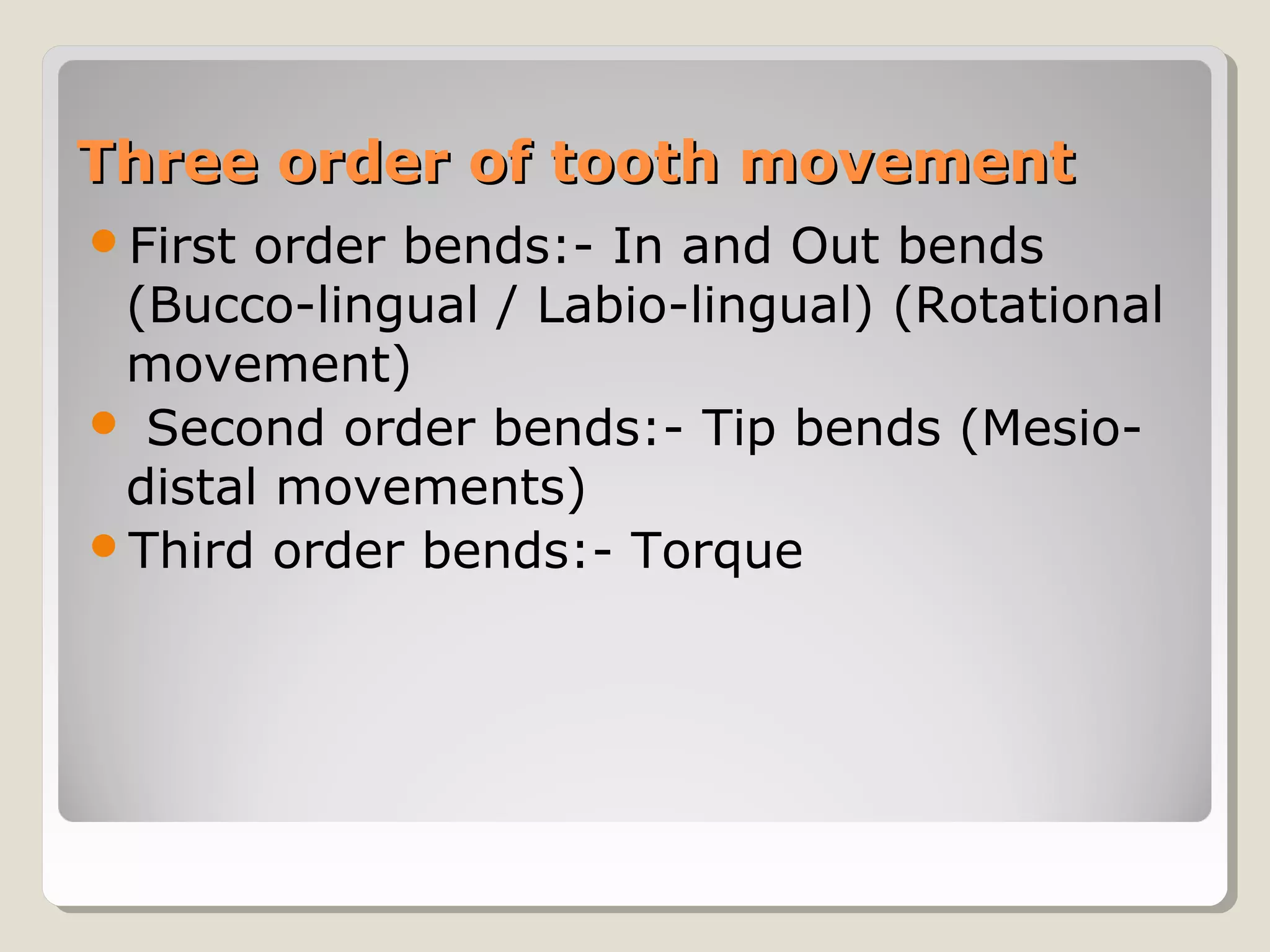
Three order of tooth movementThree order of tooth movement
First order bends:- In and Out bends
(Bucco-lingual / Labio-lingual) (Rotational
movement)
 Second order bends:- Tip bends (Mesio-
distal movements)
Third order bends:- Torque
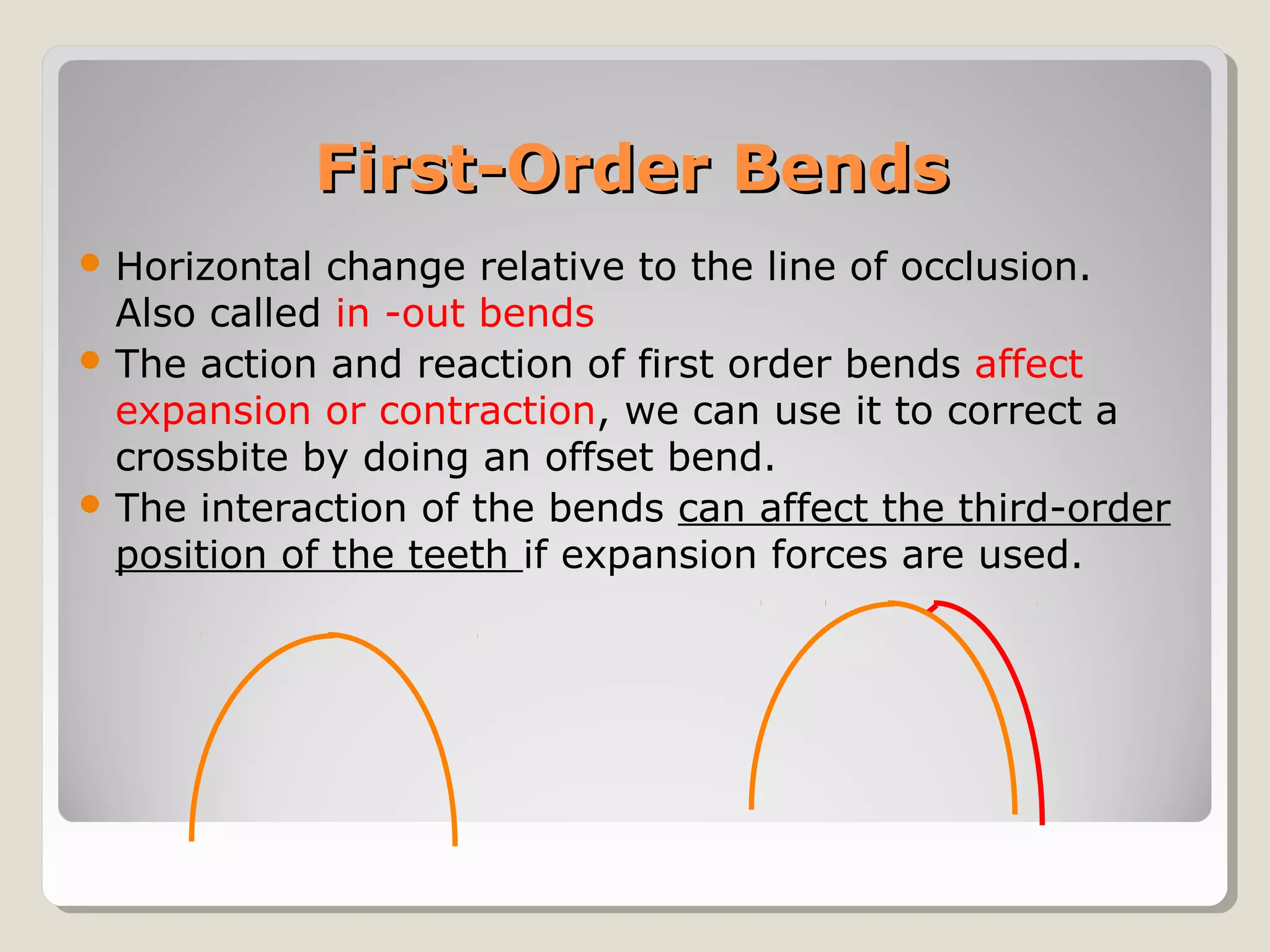
First-Order BendsFirst-Order Bends
 Horizontal change relative to the line of occlusion.
Also called in -out bends
 The action and reaction of first order bends affect
expansion or contraction, we can use it to correct a
crossbite by doing an offset bend.
 The interaction of the bends can affect the third-order
position of the teeth if expansion forces are used.
 An outward bend a few millimeters behind the canine
bracket results primarily in expansion of the molar,
with little or no rotation (with the unequal segments,
this approximates the one-third position between the
units of the two-couple system
 To contour the arch wire in accordance to the buccal
surfaces of teeth, which vary in their labio-lingual
thickness and do not conform to an arch.
 The extent of each bend is dictated by the labio-
lingual thickness of individual teeth so that a smooth
curve of incisors and canines on their lingual surface
can be achieved.
In preadujsted edgewise brackets this is built
in bracket base, we notice bracket base of
the central is the thinnest and that’s of the
lateral is thick, but sometimes according to
tooth morphology we need to add first order
bends to compensate for different thickness.
First order bends also help in derotation
(Molar offset).
First order bend in between premolar and
molar is also known as anti-rotation or
toe-in bend.
First order bends are
- Lateral inset.
- Canine eminence
- Molar offset
- Antirotation bend
An outward bend behind the canine
combined with a toe-in bend at the molar
results in expansion and mesial-out
rotation of the molar.
First order bendFirst order bend
*Double tap for video
First order special plierFirst order special plier
Hammerhead pliers (step pliers)
There are available Step-pliers to make
bends in various “step heights”. The most
commonly used are 1 mm, .75 mm, .5 mm
and .25 mm Step-pliers.
They can be used to make step in/out or
step up/down.
If Step pliers are used, steps can be
quickly, efficiently and easily bent on NiTi
wires
Second-order bendsSecond-order bends
 Bends in the occluso-gingival direction to maintain
the final angulation of teeth. Represent a vertical
change.
 In the incisal area, second order bends (artistic
bends) provide the ideal angulation to these teeth.
 In posterior region, second order bends maintain the
distal tipping of the pre-molars and molars and cause
bite opening (pseudo bite opening).
Second order bends can be used :
As an in aid in paralleling roots adjacent
to extraction spaces
As one method of setting up posterior
anchorage
As a mean of artistically positioning teeth
Second order bend types:
Tip back bends
V bends
Artistic positioning bends
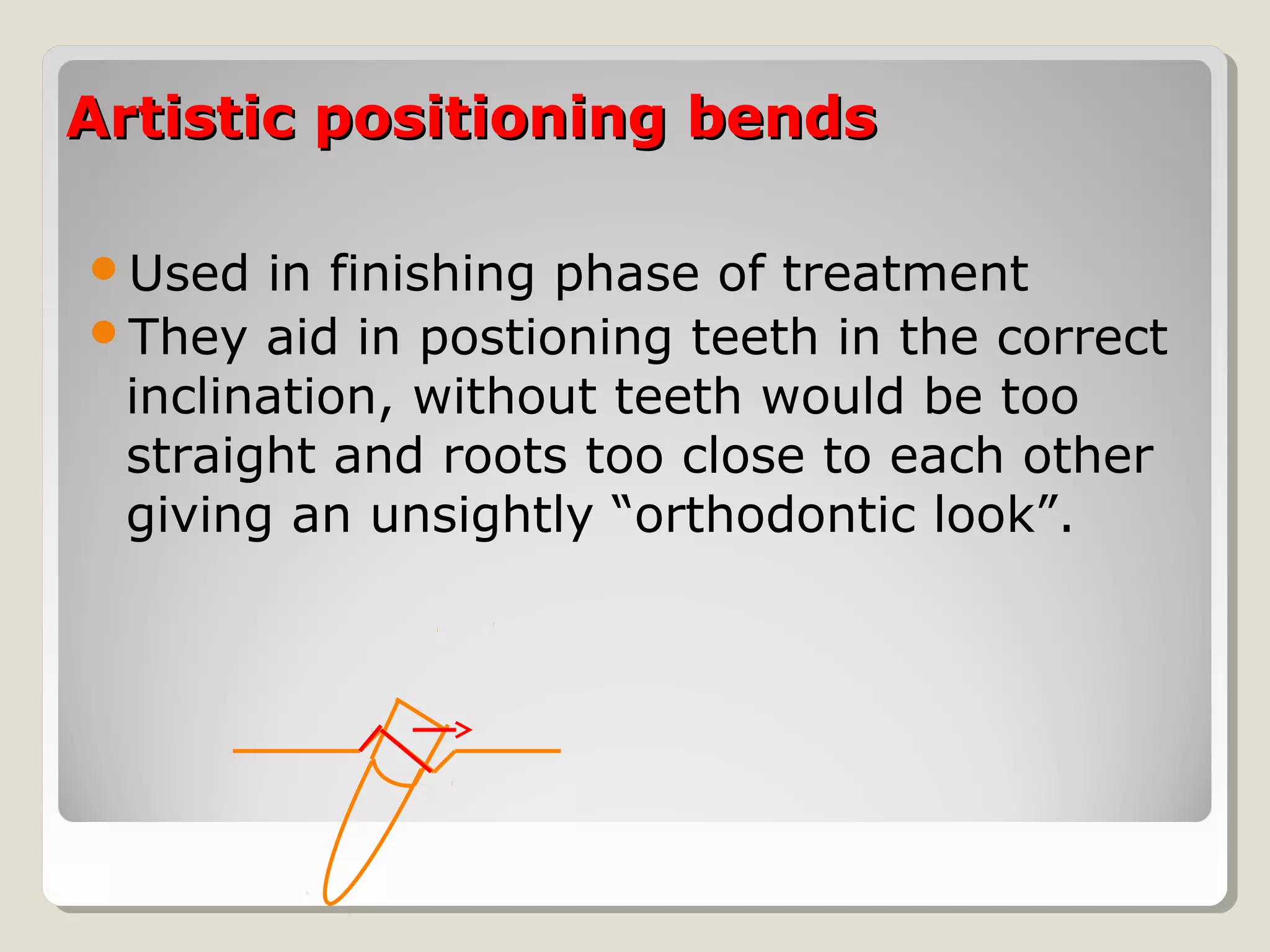
Artistic positioning bendsArtistic positioning bends
Used in finishing phase of treatment
They aid in postioning teeth in the correct
inclination, without teeth would be too
straight and roots too close to each other
giving an unsightly “orthodontic look”.
Tip back bendsTip back bends
An upward and downward bend
They are used for preparing anchorage in
posterior segment
Usually placed between 5,6 & 6,7.
Tip back bends should be at least 20
degrees.
Tip back bendsTip back bends
*Double tap for video
Second order special pliersSecond order special pliers
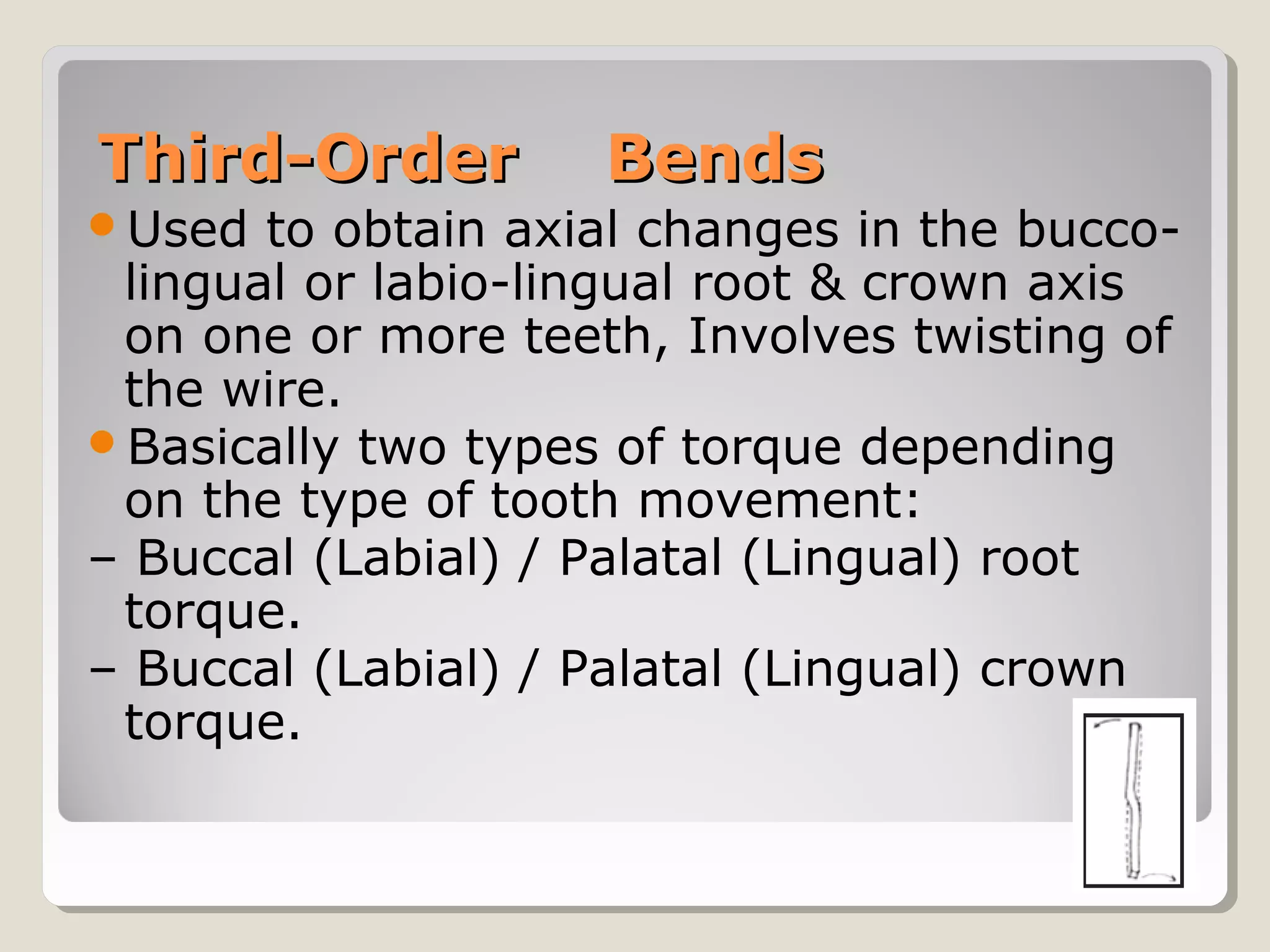
Third-OrderThird-Order BendsBends
Used to obtain axial changes in the bucco-
lingual or labio-lingual root & crown axis
on one or more teeth, Involves twisting of
the wire.
Basically two types of torque depending
on the type of tooth movement:
– Buccal (Labial) / Palatal (Lingual) root
torque.
– Buccal (Labial) / Palatal (Lingual) crown
torque.
Placing anterior torque in archwirePlacing anterior torque in archwire
*Double tap for video
Rose torquing pliersRose torquing pliers
These are usually used in pairs to give
individual labial or lingual torque

Bends

  • 1.
    Bends in orthodonticsBendsin orthodontics Three order of toothThree order of tooth movement bendsmovement bends Done by Dr Noor Altamimi Supervised by Dr Ahmad Altarawneh Dr Jumana Tbaishat Dr Bashar Almomani Dr Anwar Alrahamneh
  • 2.
    At the finishingstage, given both the variations of individual tooth anatomy and bracket placement errors, some minor adjustments of tooth position may be needed. This may require either a bracket repositioning which may require going back to a light flexible archwire or placing a compensating bends in archwire.
  • 3.
    Rectangular steel finishingwires are too stiff in bending for tooth positioing, for both the 0.018 & 0.022 slot appliances. In the 18 slot, 0.017*0.025 TMA usually is satisfactory, in the 22 slot appliance, If there are any torque changes to be made in the wire, it is best to use a 0.019 × 0.025 titanium molybdenum alloy (TMA) finishing wire in a 0.022 slot.
  • 4.
    GENERAL PRINCIPLES OFWIREGENERAL PRINCIPLES OF WIRE BENDINGBENDING  AII BENDS IN ORTHODONTIC WIRES ARE PLACED BY THE FINGERS, PLIERS ARE MEANT TO HOLD THE WIRE FIRMLY AND ASSIST IN WIRE BENDING.  ALWAYS HOLD THE PLIER USING A PALM GRIP.  BEFORE STARTING TO BEND THE WIRE, ESTABLISH A FIRM GRIP OVER THE WIRE.  IN GENERAL,SHARP BENDS SHOULD BE AVOIDED TO PREVENT INCORPORATION OF STRESSES WHICH CAN LEAD TO THE FRACTURE OF THE WIRE LATER
  • 5.
    Three order oftooth movementThree order of tooth movement First order bends:- In and Out bends (Bucco-lingual / Labio-lingual) (Rotational movement)  Second order bends:- Tip bends (Mesio- distal movements) Third order bends:- Torque
  • 6.
    First-Order BendsFirst-Order Bends Horizontal change relative to the line of occlusion. Also called in -out bends  The action and reaction of first order bends affect expansion or contraction, we can use it to correct a crossbite by doing an offset bend.  The interaction of the bends can affect the third-order position of the teeth if expansion forces are used.
  • 7.
     An outwardbend a few millimeters behind the canine bracket results primarily in expansion of the molar, with little or no rotation (with the unequal segments, this approximates the one-third position between the units of the two-couple system
  • 8.
     To contourthe arch wire in accordance to the buccal surfaces of teeth, which vary in their labio-lingual thickness and do not conform to an arch.  The extent of each bend is dictated by the labio- lingual thickness of individual teeth so that a smooth curve of incisors and canines on their lingual surface can be achieved.
  • 9.
    In preadujsted edgewisebrackets this is built in bracket base, we notice bracket base of the central is the thinnest and that’s of the lateral is thick, but sometimes according to tooth morphology we need to add first order bends to compensate for different thickness.
  • 10.
    First order bendsalso help in derotation (Molar offset). First order bend in between premolar and molar is also known as anti-rotation or toe-in bend.
  • 11.
    First order bendsare - Lateral inset. - Canine eminence - Molar offset - Antirotation bend
  • 12.
    An outward bendbehind the canine combined with a toe-in bend at the molar results in expansion and mesial-out rotation of the molar.
  • 13.
    First order bendFirstorder bend *Double tap for video
  • 15.
    First order specialplierFirst order special plier Hammerhead pliers (step pliers) There are available Step-pliers to make bends in various “step heights”. The most commonly used are 1 mm, .75 mm, .5 mm and .25 mm Step-pliers. They can be used to make step in/out or step up/down. If Step pliers are used, steps can be quickly, efficiently and easily bent on NiTi wires
  • 17.
    Second-order bendsSecond-order bends Bends in the occluso-gingival direction to maintain the final angulation of teeth. Represent a vertical change.  In the incisal area, second order bends (artistic bends) provide the ideal angulation to these teeth.  In posterior region, second order bends maintain the distal tipping of the pre-molars and molars and cause bite opening (pseudo bite opening).
  • 18.
    Second order bendscan be used : As an in aid in paralleling roots adjacent to extraction spaces As one method of setting up posterior anchorage As a mean of artistically positioning teeth
  • 19.
    Second order bendtypes: Tip back bends V bends Artistic positioning bends
  • 20.
    Artistic positioning bendsArtisticpositioning bends Used in finishing phase of treatment They aid in postioning teeth in the correct inclination, without teeth would be too straight and roots too close to each other giving an unsightly “orthodontic look”.
  • 21.
    Tip back bendsTipback bends An upward and downward bend They are used for preparing anchorage in posterior segment Usually placed between 5,6 & 6,7. Tip back bends should be at least 20 degrees.
  • 22.
    Tip back bendsTipback bends *Double tap for video
  • 23.
    Second order specialpliersSecond order special pliers
  • 24.
    Third-OrderThird-Order BendsBends Used toobtain axial changes in the bucco- lingual or labio-lingual root & crown axis on one or more teeth, Involves twisting of the wire. Basically two types of torque depending on the type of tooth movement: – Buccal (Labial) / Palatal (Lingual) root torque. – Buccal (Labial) / Palatal (Lingual) crown torque.
  • 25.
    Placing anterior torquein archwirePlacing anterior torque in archwire *Double tap for video
  • 26.
    Rose torquing pliersRosetorquing pliers These are usually used in pairs to give individual labial or lingual torque

Editor's Notes

  • #4 proffit
  • #15 Lateral inset
  • #17 Pliers are held 90 to the wires to achieve step in/out
  • #19 Andrews vs roth