Department of Orthodontics
Journal club on
Downs WB Analysis of the dento-facial profile .
Angle orthod 1956;26:191
Presented by-
Dr. Pratik Yadav
PG 1st Year
Analysis
• Skeletal and dental relationships are
measured by reference to a landmark or plane
drawn on the lateral cephalogram.
• These can be either ‘ hand traced’ or more
commonly now digitised using specialized
cephalometric software (e.g. QuickCeph
(Mac), Dolphin Imaging (Windows)
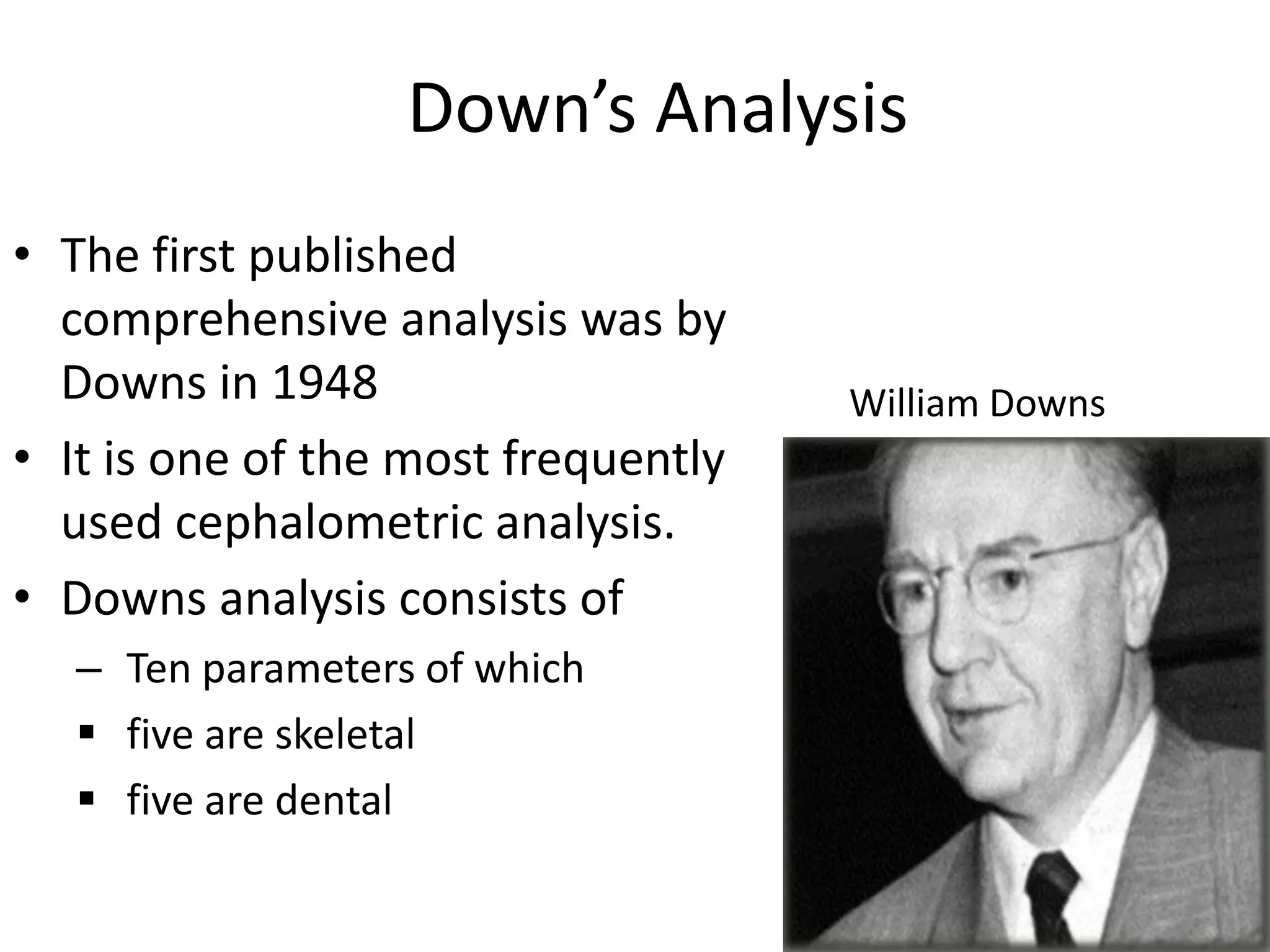
• The first published
comprehensive analysis was by
Downs in 1948
• It is one of the most frequently
used cephalometric analysis.
• Downs analysis consists of
– Ten parameters of which
 five are skeletal
 five are dental
William Downs
Down’s Analysis
• These ten variables were obtained from
comparison and correlation of 20 Caucasian
patients,10 males and 10 females, having
clinically excellent occlusion and were
untreated by orthodontics means
• Patients age is 12-17 years
Reference Plane
• ACCORDING TO DOWN
“Balance of face is determined by position of
mandible”.
• In order to find this balance DOWNS use
FRANKFURT HORIZONTAL PLANE as a reference
plane i.e. line from anatomic porion to orbitale.
• Downs elected to use this plane as a reference
base from which he determine the degree of
retrognathism, orthognathism, or prognathism
Skeletal Parameters
Facial angle;
• it is the inside inferior angle formed by
intersection of nasion-pogonion plane
andF.H. plane.
• average value; 87.8’ ( 82 –95’)
Significance;
• indication of antero- posterior positioning
of mandible in relation to upper face .
Interpretation
• increased in skeletal class III with
prominent chin
• decreased in skeletal class II
Angle of Connvexity
• Nasion-point A to point A-
pogonion.
• Average value; 0⁰(-8.5 to 10⁰)
Significance;
• A positive angle suggest a
prominent maxillary denture base
in relation to mandible.
• Negative angle is indicative of
prognathic profile
Mandibular plane angle
• Intersection of mandibular plane
with F.H Plane.
• Average value; 21.9⁰ ( 17 to 28⁰)
• Mandibular plane according to
DOWNS is “tangent to gonial angle
and lowest point of symphsis
• High MP angle occur in both
retrusive & protrusive face and are
suggestive of unfavourable
hyperdivergent face
Y-Axis
• Sella gnathion to F.H. plane.
• Average value; 59⁰ ( 53 to 66⁰)
Interpretation
• Increased in class II facial patterns.
and also Indicates vertical growth
pattern of mandible
• Decreased in class III facial patterns
and also indicate horizontal
patterns of mandible growth
A-B plane angle
• point A–point B to nasion–pogonion.
• Average value; -4.6⁰ (-9 to 0⁰)
Significance;
• indicative of maxillo mandibular
relationship in relation to facial plane.
• Negative since point B is positioned
behind point A.
• Positive in class III malocclusion or
class I malocclusion with mandible
prominence
Dental parameters
Cant of occlusal plane;
• OCCLUSAL PLANE TO F.H. Plane
• Average value; 9.3⁰ ( 1.5 to 14⁰)
• Gives a measure of slope of
occlusal plane relative to F.H.
Plane .
• Increase in class II facial paterns
• Decreases in long rami
Inter incisal angle; (135.4±5.8)
Angle between long axes of upper
and lower incisors.
• Average value: 135.4⁰ ( 130 to
150.5⁰)
• decreased in class I bimaxillary
protrusion & class II division 1
• Increases in class II division 2
Incisor occlusal plane angle;
• This is the inside inferior angle formed
by the intersection between the long
axis of lover central incisor and the
occlusal plane and is read as a plus or
minus deviation from a right angle
• Average value: 14.5⁰ ( 3.5 to 20⁰)
• An increase in this angle is suggestive of
increased lower incisor proclination
Incisor mandibular plane angle:
• This angel is formed by intersection of
the long axis of the lower incisor and the
mandibular plane.
• Average value: 1.4⁰(-8.2 to 7⁰)
• An increase in this angle is suggestive of
increased lower incisor proclination
Upper incisor to A-pog line (2.7+-1.8)
• This is a linear measurement
between the incisal edge of the
maxillary central incisor and the
line joining point A to pogonion.
• This distance is on an average 2.7
mm(range-1 to 5mm)
• The measurement is more in
patients presenting with upper
incisor proclination
Cephalomtric polygon
• Because of the difficulty of
developing a suitable mental
picture of a sizable table of
figures varhirs & Adams developd
a polygon that express the
reading graphically
• By reversing the maximum and
minimum limits , it was possible
to indicate class II on the left side
& class III on the right

Downs analysis

  • 1.
    Department of Orthodontics Journalclub on Downs WB Analysis of the dento-facial profile . Angle orthod 1956;26:191 Presented by- Dr. Pratik Yadav PG 1st Year
  • 2.
    Analysis • Skeletal anddental relationships are measured by reference to a landmark or plane drawn on the lateral cephalogram. • These can be either ‘ hand traced’ or more commonly now digitised using specialized cephalometric software (e.g. QuickCeph (Mac), Dolphin Imaging (Windows)
  • 3.
    • The firstpublished comprehensive analysis was by Downs in 1948 • It is one of the most frequently used cephalometric analysis. • Downs analysis consists of – Ten parameters of which  five are skeletal  five are dental William Downs Down’s Analysis
  • 4.
    • These tenvariables were obtained from comparison and correlation of 20 Caucasian patients,10 males and 10 females, having clinically excellent occlusion and were untreated by orthodontics means • Patients age is 12-17 years
  • 5.
    Reference Plane • ACCORDINGTO DOWN “Balance of face is determined by position of mandible”. • In order to find this balance DOWNS use FRANKFURT HORIZONTAL PLANE as a reference plane i.e. line from anatomic porion to orbitale. • Downs elected to use this plane as a reference base from which he determine the degree of retrognathism, orthognathism, or prognathism
  • 6.
    Skeletal Parameters Facial angle; •it is the inside inferior angle formed by intersection of nasion-pogonion plane andF.H. plane. • average value; 87.8’ ( 82 –95’) Significance; • indication of antero- posterior positioning of mandible in relation to upper face . Interpretation • increased in skeletal class III with prominent chin • decreased in skeletal class II
  • 7.
    Angle of Connvexity •Nasion-point A to point A- pogonion. • Average value; 0⁰(-8.5 to 10⁰) Significance; • A positive angle suggest a prominent maxillary denture base in relation to mandible. • Negative angle is indicative of prognathic profile
  • 8.
    Mandibular plane angle •Intersection of mandibular plane with F.H Plane. • Average value; 21.9⁰ ( 17 to 28⁰) • Mandibular plane according to DOWNS is “tangent to gonial angle and lowest point of symphsis • High MP angle occur in both retrusive & protrusive face and are suggestive of unfavourable hyperdivergent face
  • 9.
    Y-Axis • Sella gnathionto F.H. plane. • Average value; 59⁰ ( 53 to 66⁰) Interpretation • Increased in class II facial patterns. and also Indicates vertical growth pattern of mandible • Decreased in class III facial patterns and also indicate horizontal patterns of mandible growth
  • 10.
    A-B plane angle •point A–point B to nasion–pogonion. • Average value; -4.6⁰ (-9 to 0⁰) Significance; • indicative of maxillo mandibular relationship in relation to facial plane. • Negative since point B is positioned behind point A. • Positive in class III malocclusion or class I malocclusion with mandible prominence
  • 11.
    Dental parameters Cant ofocclusal plane; • OCCLUSAL PLANE TO F.H. Plane • Average value; 9.3⁰ ( 1.5 to 14⁰) • Gives a measure of slope of occlusal plane relative to F.H. Plane . • Increase in class II facial paterns • Decreases in long rami
  • 12.
    Inter incisal angle;(135.4±5.8) Angle between long axes of upper and lower incisors. • Average value: 135.4⁰ ( 130 to 150.5⁰) • decreased in class I bimaxillary protrusion & class II division 1 • Increases in class II division 2
  • 13.
    Incisor occlusal planeangle; • This is the inside inferior angle formed by the intersection between the long axis of lover central incisor and the occlusal plane and is read as a plus or minus deviation from a right angle • Average value: 14.5⁰ ( 3.5 to 20⁰) • An increase in this angle is suggestive of increased lower incisor proclination Incisor mandibular plane angle: • This angel is formed by intersection of the long axis of the lower incisor and the mandibular plane. • Average value: 1.4⁰(-8.2 to 7⁰) • An increase in this angle is suggestive of increased lower incisor proclination
  • 14.
    Upper incisor toA-pog line (2.7+-1.8) • This is a linear measurement between the incisal edge of the maxillary central incisor and the line joining point A to pogonion. • This distance is on an average 2.7 mm(range-1 to 5mm) • The measurement is more in patients presenting with upper incisor proclination
  • 15.
    Cephalomtric polygon • Becauseof the difficulty of developing a suitable mental picture of a sizable table of figures varhirs & Adams developd a polygon that express the reading graphically • By reversing the maximum and minimum limits , it was possible to indicate class II on the left side & class III on the right