By 
DR.FAIZAN ALI
Skeletal and dental relationships are measured by 
reference to a landmark or plane drawn on the lateral 
cephalogram. 
These can be either ‘ hand traced’ or more commonly 
now digitised using specialized cephalometric 
software (e.g. QuickCeph (Mac), Dolphin Imaging 
(Windows)).
Two basic approaches 
Metric approach - use of selected linear and angular 
measures 
Graphic approach - “overlay” of individual’s tracing on 
a reference template and visual inspection of degree of 
variation
The analysis is usually given in tabular form with data 
expressed either as a linear measurement (in mm or a 
proportion (%)) or as an angle (degrees) 
The advantage of angular measurements is that they 
are not influenced by image magnification or patient 
size. Standard deviation for each measurement allows 
the clinician to easily see where their patient differs most 
significantly from the norm
An alternative presentation of normative data is to 
express it graphically in the form of a template. 
This is superimposed on the patient’ s cephalogram to 
see where the patient varies from the norm. 
An example is the Proportionate Template, which is 
useful in determining the degree of anteroposterior 
(AP) and vertical skeletal dysplasia present in adult 
patients. 
This can then be used as a guide for planning for 
orthognathic (jaw) surgery
Evaluating relationships, both horizontal and vertical 
of 5 major functional components of the face: 
the cranial base; 
the maxilla; the mandible, 
the maxillary and mandibular dento-alveolus
Cephalometric Analyses 
Down’s(1948) 
Wylie(1947,1952) 
Rediel(1952) 
Steiner’s(1953) 
Tweed’s(1954) 
Sassouni(1955) 
Bjork (1961) 
Eastman(1970) 
Jaraback(1972)
Harvold(1974) 
Wits(1975) 
Ricketts(1979) 
Pancherz(1982) 
McNamara’s(1983) 
Holdaway(soft tissue)1983 
Bass(aesthetic)1991
DOWNS 
ANALYSIS
The first published comprehensive analysis was by 
Downs in 1948 
It is one of the most frequently used cephalometric 
analysis. 
Downs analysis consists of 
Ten parameters of which 
five are skeletal and 
five are dental.
These ten variables were obtained from comparison 
and correlation of 20 Caucasian patients,10 males and 
10 females, having clinically excellent occlusion and 
were untreated by orthodontics means 
Patients age is 12-17 years
ACCORDING TO DOWN 
“Balance of face is determined by position of 
mandible” 
In order to find this balance DOWNS use 
FRANKFURT HORIZONTAL PLANE as a reference 
plane i.e. line from anatomic porion to orbitale. 
Downs elected to use this plane as a reference base 
from which he determine the degree of retrognathism, 
orthognathism, or prognathism.
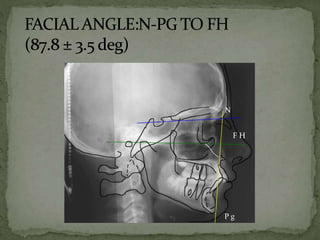
Facial angle; 
it is the inside inferior angle formed by intersection of 
nasion-pogonion plane andF.H. plane. 
average value; 87.8’ ( 82 –95’) 
Significance; 
indication of antero- posterior positioning of 
mandible in relation to upper face. 
Interpretation 
increased in skeletal class III with prominent chin 
decreased in skeletal class II.
F H 
N 
P g
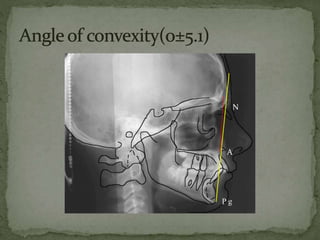
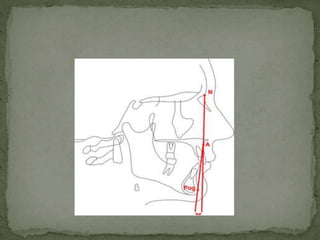
Nasion-point A to point A-pogonion. 
Average value; 0’ (-8.5 to 10’). 
Significance; 
A positive angle suggest a prominent maxillary denture 
base in relation to mandible. 
Negative angle is indicative of prognathic profile.
N 
A
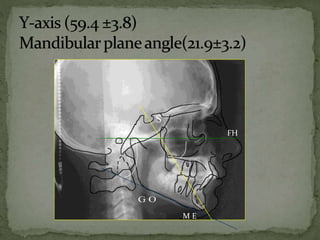
Intersection of mandibular plane with F.H Plane. 
Average value; 21.9’ ( 17 to 28’) 
Mandibular plane according to DOWNS is 
“tangent to gonial angle and lowest point of symphsis”
Sella gnathion to F.H. plane. 
Average value; 59’ ( 53’ to 66’) 
Interpretation 
Increased in class II facial patterns. and also Indicates 
vertical growth pattern of mandible 
Decreased in class III facial patterns and also indicate 
horizontal patterns of mandible growth
M E 
FH
point A–point B to nasion–pogonion. 
Average value; -4.6’ (-9 to 0’) 
Significance; 
indicative of maxillo mandibular relationship in 
relation to facial plane. 
Negative since point B is positioned behind point A. 
Positive in class III malocclusion or class I 
malocclusion with mandible prominence
Cant of occlusal plane; (9.3±3.8) 
OCCLUSAL PLANE TO F.H. Plane 
Average value; 9.3 ( 1.5 to 14’) 
Gives a measure of slope of occlusal plane relative to 
F.H. Plane. 
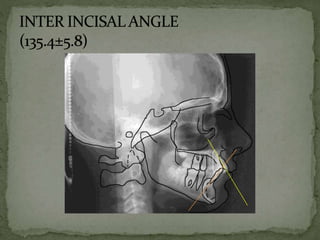
Inter incisal angle; (135.4±5.8) 
Angle between long axes of upper and lower incisors. 
Average value: 135.4’ ( 130 to 150.5’) 
increased in class I bimaxillary protrusion
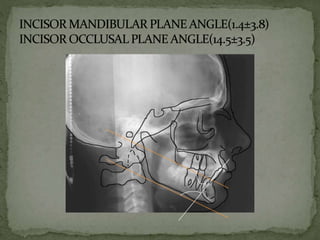
Incisor occlusal plane angle; 
This is the inside inferior angle formed by the intersection 
between the long axis of lover central incisor and the 
occlusal plane and is read as a plus or minus deviation from 
a right angle 
Average value: 14.5” ( 3.5 to 20’) 
An increase in this angle is suggestive of increased lower 
incisor proclination. 
Incisor mandibular plane angle: 
This angel is formed by intersection of the long axis of the 
lower incisor and the mandibular plane. 
Average value: 1.4’(-8.2 to 7’) 
An increase in this angle is suggestive of increased lower 
incisor proclination
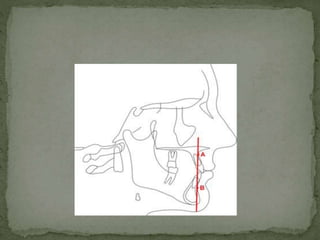
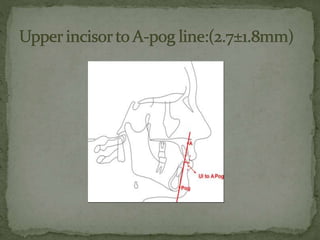
This is a linear measurement between the incisal edge 
of the maxillary central incisor and the line joining 
point A to pogonion. 
This distance is on an average 2.7 mm(range-1 to 5mm) 
The measurement is more in patients presenting with 
upper incisor proclination
Individual variability 
Ethnic variability 
Gender variability
THANK YOU

Cephalometric Analysis in Orthodontics

  • 1.
  • 2.
    Skeletal and dentalrelationships are measured by reference to a landmark or plane drawn on the lateral cephalogram. These can be either ‘ hand traced’ or more commonly now digitised using specialized cephalometric software (e.g. QuickCeph (Mac), Dolphin Imaging (Windows)).
  • 3.
    Two basic approaches Metric approach - use of selected linear and angular measures Graphic approach - “overlay” of individual’s tracing on a reference template and visual inspection of degree of variation
  • 4.
    The analysis isusually given in tabular form with data expressed either as a linear measurement (in mm or a proportion (%)) or as an angle (degrees) The advantage of angular measurements is that they are not influenced by image magnification or patient size. Standard deviation for each measurement allows the clinician to easily see where their patient differs most significantly from the norm
  • 5.
    An alternative presentationof normative data is to express it graphically in the form of a template. This is superimposed on the patient’ s cephalogram to see where the patient varies from the norm. An example is the Proportionate Template, which is useful in determining the degree of anteroposterior (AP) and vertical skeletal dysplasia present in adult patients. This can then be used as a guide for planning for orthognathic (jaw) surgery
  • 6.
    Evaluating relationships, bothhorizontal and vertical of 5 major functional components of the face: the cranial base; the maxilla; the mandible, the maxillary and mandibular dento-alveolus
  • 7.
    Cephalometric Analyses Down’s(1948) Wylie(1947,1952) Rediel(1952) Steiner’s(1953) Tweed’s(1954) Sassouni(1955) Bjork (1961) Eastman(1970) Jaraback(1972)
  • 8.
    Harvold(1974) Wits(1975) Ricketts(1979) Pancherz(1982) McNamara’s(1983) Holdaway(soft tissue)1983 Bass(aesthetic)1991
  • 9.
  • 10.
    The first publishedcomprehensive analysis was by Downs in 1948 It is one of the most frequently used cephalometric analysis. Downs analysis consists of Ten parameters of which five are skeletal and five are dental.
  • 11.
    These ten variableswere obtained from comparison and correlation of 20 Caucasian patients,10 males and 10 females, having clinically excellent occlusion and were untreated by orthodontics means Patients age is 12-17 years
  • 12.
    ACCORDING TO DOWN “Balance of face is determined by position of mandible” In order to find this balance DOWNS use FRANKFURT HORIZONTAL PLANE as a reference plane i.e. line from anatomic porion to orbitale. Downs elected to use this plane as a reference base from which he determine the degree of retrognathism, orthognathism, or prognathism.
  • 13.
    Facial angle; itis the inside inferior angle formed by intersection of nasion-pogonion plane andF.H. plane. average value; 87.8’ ( 82 –95’) Significance; indication of antero- posterior positioning of mandible in relation to upper face. Interpretation increased in skeletal class III with prominent chin decreased in skeletal class II.
  • 14.
    F H N P g
  • 15.
    Nasion-point A topoint A-pogonion. Average value; 0’ (-8.5 to 10’). Significance; A positive angle suggest a prominent maxillary denture base in relation to mandible. Negative angle is indicative of prognathic profile.
  • 16.
  • 18.
    Intersection of mandibularplane with F.H Plane. Average value; 21.9’ ( 17 to 28’) Mandibular plane according to DOWNS is “tangent to gonial angle and lowest point of symphsis”
  • 19.
    Sella gnathion toF.H. plane. Average value; 59’ ( 53’ to 66’) Interpretation Increased in class II facial patterns. and also Indicates vertical growth pattern of mandible Decreased in class III facial patterns and also indicate horizontal patterns of mandible growth
  • 20.
  • 21.
    point A–point Bto nasion–pogonion. Average value; -4.6’ (-9 to 0’) Significance; indicative of maxillo mandibular relationship in relation to facial plane. Negative since point B is positioned behind point A. Positive in class III malocclusion or class I malocclusion with mandible prominence
  • 23.
    Cant of occlusalplane; (9.3±3.8) OCCLUSAL PLANE TO F.H. Plane Average value; 9.3 ( 1.5 to 14’) Gives a measure of slope of occlusal plane relative to F.H. Plane. Inter incisal angle; (135.4±5.8) Angle between long axes of upper and lower incisors. Average value: 135.4’ ( 130 to 150.5’) increased in class I bimaxillary protrusion
  • 25.
    Incisor occlusal planeangle; This is the inside inferior angle formed by the intersection between the long axis of lover central incisor and the occlusal plane and is read as a plus or minus deviation from a right angle Average value: 14.5” ( 3.5 to 20’) An increase in this angle is suggestive of increased lower incisor proclination. Incisor mandibular plane angle: This angel is formed by intersection of the long axis of the lower incisor and the mandibular plane. Average value: 1.4’(-8.2 to 7’) An increase in this angle is suggestive of increased lower incisor proclination
  • 27.
    This is alinear measurement between the incisal edge of the maxillary central incisor and the line joining point A to pogonion. This distance is on an average 2.7 mm(range-1 to 5mm) The measurement is more in patients presenting with upper incisor proclination
  • 29.
    Individual variability Ethnicvariability Gender variability
  • 30.