• Types 
LATERAL CEPHALOGRAM 
FRONTAL CEPHALOGRAM 
• USES 
Helps in orthodontic diagnosis. 
Helps in classification of skeletal and dental 
abnormalities. 
Helps in planning treatment of an individual. 
Helps in evaluation of treatment results. 
Helps in predicting growth related changes.
LANDMARKS
Horizontal Planes in Cephalometry
Cephalometric Analysis 
• Downs Analysis 
• Steiner Analysis 
• Tweed Analysis 
• Wits Appraisal
Downs Analysis 
• It is one of the most frequently used 
cephalometric analysis. 
• Downs analysis consists of ten 
parameters of which five are skeletal 
and five are dental.
Skeletal Parameters 
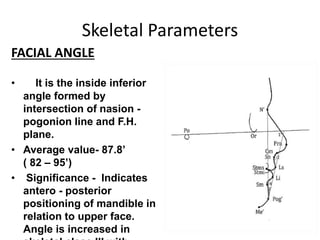
FACIAL ANGLE 
• It is the inside inferior 
angle formed by 
intersection of nasion - 
pogonion line and F.H. 
plane. 
• Average value- 87.8’ 
( 82 – 95’) 
• Significance - Indicates 
antero - posterior 
positioning of mandible in 
relation to upper face. 
Angle is increased in 
skeletal class III with
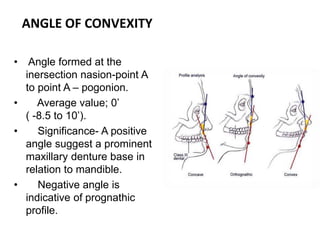
ANGLE OF CONVEXITY 
• Angle formed at the 
inersection nasion-point A 
to point A – pogonion. 
• Average value; 0’ 
( -8.5 to 10’). 
• Significance- A positive 
angle suggest a prominent 
maxillary denture base in 
relation to mandible. 
• Negative angle is 
indicative of prognathic 
profile.
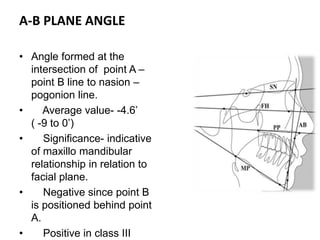
A-B PLANE ANGLE 
• Angle formed at the 
intersection of point A – 
point B line to nasion – 
pogonion line. 
• Average value- -4.6’ 
( -9 to 0’) 
• Significance- indicative 
of maxillo mandibular 
relationship in relation to 
facial plane. 
• Negative since point B 
is positioned behind point 
A. 
• Positive in class III
MANDIBULAR PLANE ANGLE 
• Angle formed at the 
intersection of mandibular 
plane with F.H. 
Plane. 
• Average value- 
21.9’ ( 17 to 28’)
Y-AXIS 
• Angle formed b/w sella 
gnathion to F.H. plane. 
• Average value; 59’ ( 53’ 
to 66’) 
• Angle is larger in class 
II facial patterns. 
Indicates growth pattern 
of a individual.
CANT OF OCCLUSAL PLANE 
• Angle formed b/w 
occlusal plane to F.H. 
Plane 
• Average value- 9.3 ( 
1.5 to 14’) 
• Gives a measure of 
slope of occlusal plane 
relative to F.H. Plane.
INTER INCISAL ANGLE 
• Angle between long axes 
of upper and lower 
incisors. 
• Average value: 135.4’ ( 
130 to 150.5’) 
• Decreased in case of 
bidental protrusion
INCISOR OCCLUSAL 
PLANE ANGLE 
• This is the inside inferior 
angle formed by the 
intersection between the 
long axis of lover central 
incisor and the occlusal 
plane and is read as a 
plus or minus deviation 
from a right angle 
• Average value: 14.5” ( 
3.5 to 20’) 
• An increase in this 
angle is suggestive of 
increased lower incisor 
proclination.
INCISOR MANDIBULAR PLANE 
ANGLE 
• This angel is formed by 
intersection of the long 
axis of the lower incisor 
and the mandibular plane. 
• Average value: 1.4’(-8.2 
to 7’) 
• An increase in this angle 
is suggestive of increased 
lower incisor proclination.
UPPER INCISOR TO A-POG 
• This is a linear 
measurement between 
the incisal edge of the 
maxillary central incisor 
and the line joining point 
A to pogonion. This 
distance is on an average 
4mm mm(rang-1 to 5 
mm) 
• The measurement is 
more in patients 
presenting with upper 
incisor proclination.
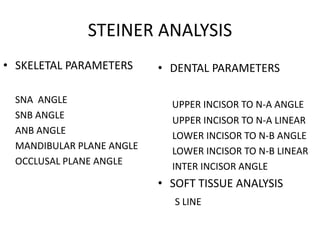
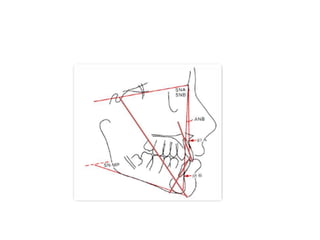
STEINER ANALYSIS 
• SKELETAL PARAMETERS 
SNA ANGLE 
SNB ANGLE 
ANB ANGLE 
MANDIBULAR PLANE ANGLE 
OCCLUSAL PLANE ANGLE 
• DENTAL PARAMETERS 
UPPER INCISOR TO N-A ANGLE 
UPPER INCISOR TO N-A LINEAR 
LOWER INCISOR TO N-B ANGLE 
LOWER INCISOR TO N-B LINEAR 
INTER INCISOR ANGLE 
• SOFT TISSUE ANALYSIS 
S LINE
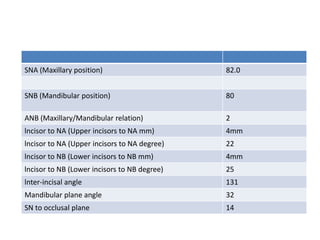
SNA (Maxillary position) 82.0 
SNB (Mandibular position) 80 
ANB (Maxillary/Mandibular relation) 2 
lncisor to NA (Upper incisors to NA mm) 4mm 
lncisor to NA (Upper incisors to NA degree) 22 
lncisor to NB (Lower incisors to NB mm) 4mm 
lncisor to NB (Lower incisors to NB degree) 25 
lnter-incisal angle 131 
Mandibular plane angle 32 
SN to occlusal plane 14
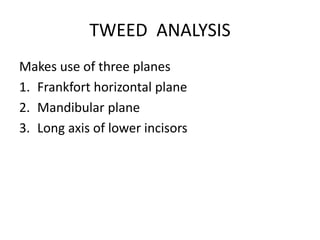
TWEED ANALYSIS 
Makes use of three planes 
1. Frankfort horizontal plane 
2. Mandibular plane 
3. Long axis of lower incisors
FMA (Frankfurt plane to 
mandibular plane) 
16-35 
FMIA (Frankfurt plane to lower 
incisor angulation) 
85-95 
IMPA (Lower incisor to 
mandibular plane) 
60-75
WITS APPRAISAL 
• Measures the relationship of maxilla and 
mandible to each other and to the sagital 
plane 
• Used where ANB are not realiable 
• Perpendicular are drawn from point A and 
point B to the functional occlusal plane to 
form AO and BO
Cephalometric Analysis

Cephalometric Analysis

  • 2.
    • Types LATERALCEPHALOGRAM FRONTAL CEPHALOGRAM • USES Helps in orthodontic diagnosis. Helps in classification of skeletal and dental abnormalities. Helps in planning treatment of an individual. Helps in evaluation of treatment results. Helps in predicting growth related changes.
  • 3.
  • 4.
  • 5.
    Cephalometric Analysis •Downs Analysis • Steiner Analysis • Tweed Analysis • Wits Appraisal
  • 6.
    Downs Analysis •It is one of the most frequently used cephalometric analysis. • Downs analysis consists of ten parameters of which five are skeletal and five are dental.
  • 7.
    Skeletal Parameters FACIALANGLE • It is the inside inferior angle formed by intersection of nasion - pogonion line and F.H. plane. • Average value- 87.8’ ( 82 – 95’) • Significance - Indicates antero - posterior positioning of mandible in relation to upper face. Angle is increased in skeletal class III with
  • 8.
    ANGLE OF CONVEXITY • Angle formed at the inersection nasion-point A to point A – pogonion. • Average value; 0’ ( -8.5 to 10’). • Significance- A positive angle suggest a prominent maxillary denture base in relation to mandible. • Negative angle is indicative of prognathic profile.
  • 9.
    A-B PLANE ANGLE • Angle formed at the intersection of point A – point B line to nasion – pogonion line. • Average value- -4.6’ ( -9 to 0’) • Significance- indicative of maxillo mandibular relationship in relation to facial plane. • Negative since point B is positioned behind point A. • Positive in class III
  • 10.
    MANDIBULAR PLANE ANGLE • Angle formed at the intersection of mandibular plane with F.H. Plane. • Average value- 21.9’ ( 17 to 28’)
  • 11.
    Y-AXIS • Angleformed b/w sella gnathion to F.H. plane. • Average value; 59’ ( 53’ to 66’) • Angle is larger in class II facial patterns. Indicates growth pattern of a individual.
  • 12.
    CANT OF OCCLUSALPLANE • Angle formed b/w occlusal plane to F.H. Plane • Average value- 9.3 ( 1.5 to 14’) • Gives a measure of slope of occlusal plane relative to F.H. Plane.
  • 13.
    INTER INCISAL ANGLE • Angle between long axes of upper and lower incisors. • Average value: 135.4’ ( 130 to 150.5’) • Decreased in case of bidental protrusion
  • 14.
    INCISOR OCCLUSAL PLANEANGLE • This is the inside inferior angle formed by the intersection between the long axis of lover central incisor and the occlusal plane and is read as a plus or minus deviation from a right angle • Average value: 14.5” ( 3.5 to 20’) • An increase in this angle is suggestive of increased lower incisor proclination.
  • 15.
    INCISOR MANDIBULAR PLANE ANGLE • This angel is formed by intersection of the long axis of the lower incisor and the mandibular plane. • Average value: 1.4’(-8.2 to 7’) • An increase in this angle is suggestive of increased lower incisor proclination.
  • 16.
    UPPER INCISOR TOA-POG • This is a linear measurement between the incisal edge of the maxillary central incisor and the line joining point A to pogonion. This distance is on an average 4mm mm(rang-1 to 5 mm) • The measurement is more in patients presenting with upper incisor proclination.
  • 17.
    STEINER ANALYSIS •SKELETAL PARAMETERS SNA ANGLE SNB ANGLE ANB ANGLE MANDIBULAR PLANE ANGLE OCCLUSAL PLANE ANGLE • DENTAL PARAMETERS UPPER INCISOR TO N-A ANGLE UPPER INCISOR TO N-A LINEAR LOWER INCISOR TO N-B ANGLE LOWER INCISOR TO N-B LINEAR INTER INCISOR ANGLE • SOFT TISSUE ANALYSIS S LINE
  • 18.
    SNA (Maxillary position)82.0 SNB (Mandibular position) 80 ANB (Maxillary/Mandibular relation) 2 lncisor to NA (Upper incisors to NA mm) 4mm lncisor to NA (Upper incisors to NA degree) 22 lncisor to NB (Lower incisors to NB mm) 4mm lncisor to NB (Lower incisors to NB degree) 25 lnter-incisal angle 131 Mandibular plane angle 32 SN to occlusal plane 14
  • 22.
    TWEED ANALYSIS Makesuse of three planes 1. Frankfort horizontal plane 2. Mandibular plane 3. Long axis of lower incisors
  • 23.
    FMA (Frankfurt planeto mandibular plane) 16-35 FMIA (Frankfurt plane to lower incisor angulation) 85-95 IMPA (Lower incisor to mandibular plane) 60-75
  • 24.
    WITS APPRAISAL •Measures the relationship of maxilla and mandible to each other and to the sagital plane • Used where ANB are not realiable • Perpendicular are drawn from point A and point B to the functional occlusal plane to form AO and BO