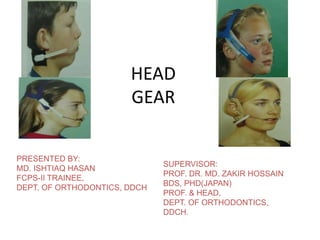
HEAD
GEAR
PRESENTED BY:
MD. ISHTIAQ HASAN
FCPS-II TRAINEE,
DEPT. OF ORTHODONTICS, DDCH
SUPERVISOR:
PROF. DR. MD. ZAKIR HOSSAIN
BDS, PHD(JAPAN)
PROF. & HEAD,
DEPT. OF ORTHODONTICS,
DDCH.
WHAT IS HEAD GEAR
• The orthodontic or
orthopaedic appliance which
deliver force intraorally or to
the chin from a cranial extra-
oral support.
COMPONENTS
Facebow or a pair of ‘J’ hooks
Force element
Head cap
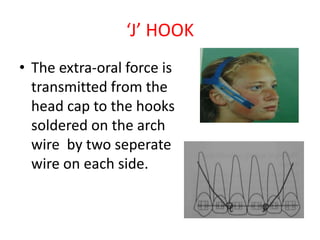
‘J’ HOOK
• The extra-oral force is
transmitted from the
head cap to the hooks
soldered on the arch
wire by two seperate
wire on each side.
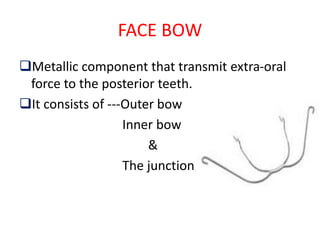
FACE BOW
Metallic component that transmit extra-oral
force to the posterior teeth.
It consists of ---Outer bow
Inner bow
&
The junction
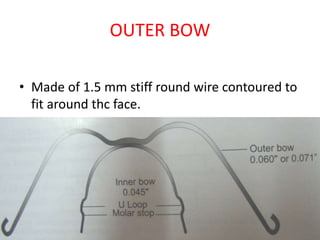
OUTER BOW
• Made of 1.5 mm stiff round wire contoured to
fit around thc face.
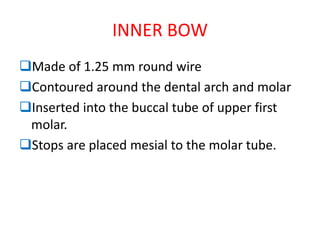
INNER BOW
Made of 1.25 mm round wire
Contoured around the dental arch and molar
Inserted into the buccal tube of upper first
molar.
Stops are placed mesial to the molar tube.
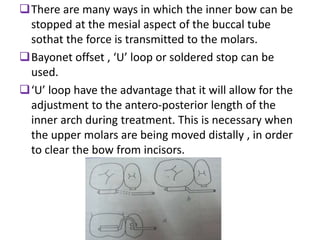
There are many ways in which the inner bow can be
stopped at the mesial aspect of the buccal tube
sothat the force is transmitted to the molars.
Bayonet offset , ‘U’ loop or soldered stop can be
used.
‘U’ loop have the advantage that it will allow for the
adjustment to the antero-posterior length of the
inner arch during treatment. This is necessary when
the upper molars are being moved distally , in order
to clear the bow from incisors.
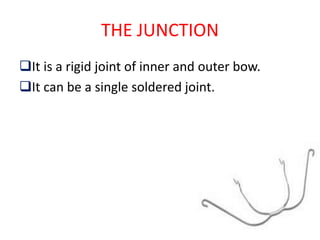
THE JUNCTION
It is a rigid joint of inner and outer bow.
It can be a single soldered joint.
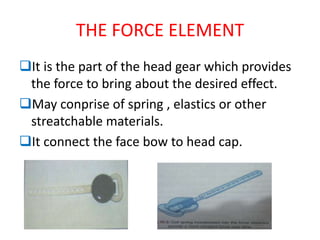
THE FORCE ELEMENT
It is the part of the head gear which provides
the force to bring about the desired effect.
May conprise of spring , elastics or other
streatchable materials.
It connect the face bow to head cap.
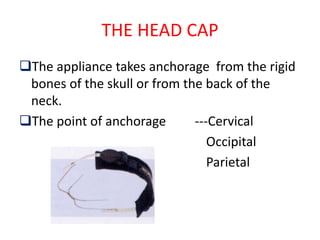
THE HEAD CAP
The appliance takes anchorage from the rigid
bones of the skull or from the back of the
neck.
The point of anchorage ---Cervical
Occipital
Parietal
HOW TO CONSTRUCT HEAD GEAR
PRINCIPLES OF USE OF HEAD GEAR
• Head gear have the ability to move the
dentition and the maxilla in all 3 planes of
space. The following factors should be
considered when planning the use of head
gear---
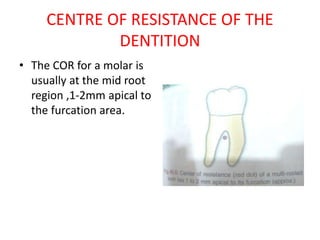
CENTRE OF RESISTANCE OF THE
DENTITION
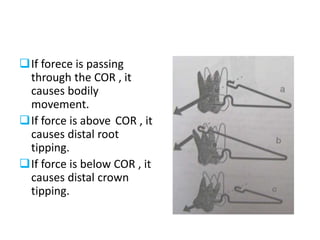
• The COR for a molar is
usually at the mid root
region ,1-2mm apical to
the furcation area.
If forece is passing
through the COR , it
causes bodily
movement.
If force is above COR , it
causes distal root
tipping.
If force is below COR , it
causes distal crown
tipping.
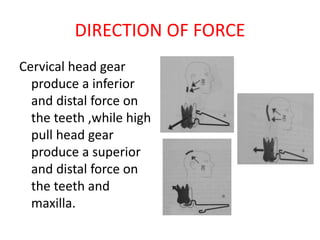
DIRECTION OF FORCE
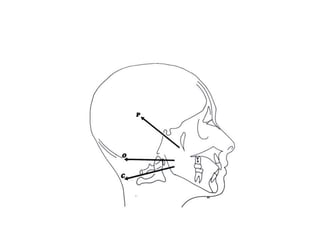
Cervical head gear
produce a inferior
and distal force on
the teeth ,while high
pull head gear
produce a superior
and distal force on
the teeth and
maxilla.
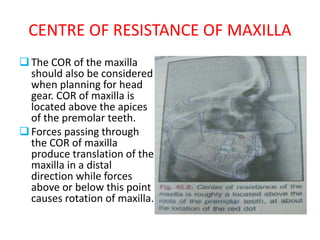
CENTRE OF RESISTANCE OF MAXILLA
The COR of the maxilla
should also be considered
when planning for head
gear. COR of maxilla is
located above the apices
of the premolar teeth.
Forces passing through
the COR of maxilla
produce translation of the
maxilla in a distal
direction while forces
above or below this point
causes rotation of maxilla.
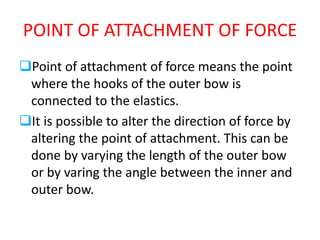
POINT OF ATTACHMENT OF FORCE
Point of attachment of force means the point
where the hooks of the outer bow is
connected to the elastics.
It is possible to alter the direction of force by
altering the point of attachment. This can be
done by varying the length of the outer bow
or by varing the angle between the inner and
outer bow.
MAGNITUDE OF FORCE
• To measure the force level , strain gauge
should be used.
• Some commercial head gear , force level
indicator built into the traction spring.
• Excessive force level will result in the
appliance being difficult to place and pt will
very quickly complain of discomfort.
TYPES OF HEAD GEAR
• Cervical head gear
• Occipital head gear
• High pull head gear
• Combination head gear
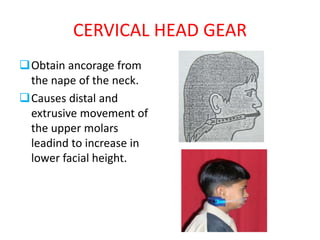
CERVICAL HEAD GEAR
Obtain ancorage from
the nape of the neck.
Causes distal and
extrusive movement of
the upper molars
leadind to increase in
lower facial height.
INDICATION
• Generally indicated in class-II deep bite cases
sothat lower facial height can be increased.
CONTRA-INDICATION
Pt with long face syndrome
Open bite cases
Gummy smile
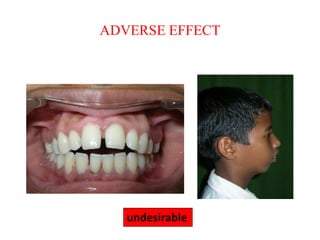
ADVERSE EFFECT
undesirable
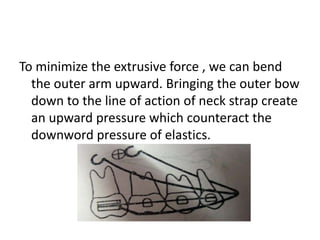
To minimize the extrusive force , we can bend
the outer arm upward. Bringing the outer bow
down to the line of action of neck strap create
an upward pressure which counteract the
downword pressure of elastics.
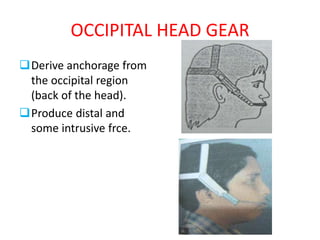
OCCIPITAL HEAD GEAR
Derive anchorage from
the occipital region
(back of the head).
Produce distal and
some intrusive frce.
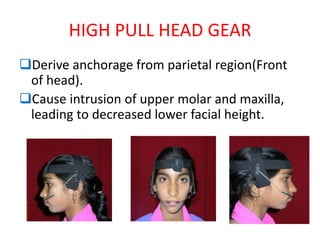
HIGH PULL HEAD GEAR
Derive anchorage from parietal region(Front
of head).
Cause intrusion of upper molar and maxilla,
leading to decreased lower facial height.
INDICATION
In class-II long face patient.
Open bite cases
CONTRAINDICATION
Deep bite cases.
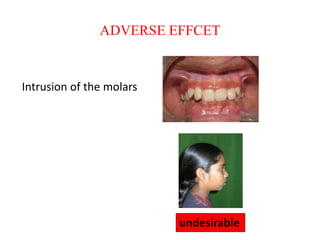
ADVERSE EFFCET
Intrusion of the molars
undesirable
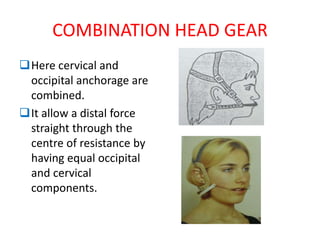
COMBINATION HEAD GEAR
Here cervical and
occipital anchorage are
combined.
It allow a distal force
straight through the
centre of resistance by
having equal occipital
and cervical
components.
USES OF HEAD GEAR
ORTHOPAEDIC EFFECT
Forces applied onto the maxilla can be used to
restrict its downward and forward growth.
For this , distal force should be applied
through the COR of the maxilla.
350-450 gm force on each side for a minimum
of 12-14 hrs/day are required for this.
ANCHORAGE REINFORCEMENT
When intra-oral anchorage is insufficient ,
then head gear can be used.
300 gm/side force level for 10 hrs/day is
needed for this.
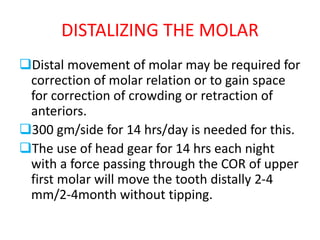
DISTALIZING THE MOLAR
Distal movement of molar may be required for
correction of molar relation or to gain space
for correction of crowding or retraction of
anteriors.
300 gm/side for 14 hrs/day is needed for this.
The use of head gear for 14 hrs each night
with a force passing through the COR of upper
first molar will move the tooth distally 2-4
mm/2-4month without tipping.
DISTALIZING THE MOLAR
As the molar move distally, the bow will impinge
against the incisors, so it is necessary to lengthen
the inner arch. The ‘U’ loop need to expand to
increase the length of the inner arch.
Occlusion should be checked and ensure that the
distal movement is not hampered by the
interference of the lower molar.
If it happens , a removable appliance with
anterior bite plane can be used.
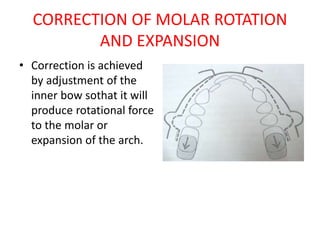
CORRECTION OF MOLAR ROTATION
AND EXPANSION
• Correction is achieved
by adjustment of the
inner bow sothat it will
produce rotational force
to the molar or
expansion of the arch.
SPACE MAINTAINER
Most effective method of maintaining arch
length is by the use of head gear.
The mesial movement of molar is protected
and the face bow does not interfere with the
erupting teeth.
For this , 8 hrs/day wear is sufficient.
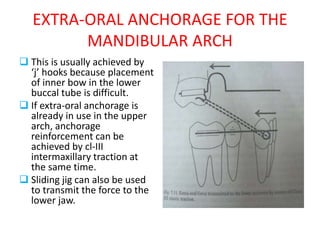
EXTRA-ORAL ANCHORAGE FOR THE
MANDIBULAR ARCH
 This is usually achieved by
‘j’ hooks because placement
of inner bow in the lower
buccal tube is difficult.
 If extra-oral anchorage is
already in use in the upper
arch, anchorage
reinforcement can be
achieved by cl-III
intermaxillary traction at
the same time.
 Sliding jig can also be used
to transmit the force to the
lower jaw.
PRACTICAL MANAGEMENT
At first , select the appropiate size of face bow.
Then determine the COR of tooth mentally.
Mark the COR on the pt’s cheek.
Choose the type of head gear.
Allow the outer bow to rest away from chek and
adjust its length and position with respect to COR
to achieve proper line of force.
Monitor for changes as treatment proceed and
adjust the force line of action if necessary.
Since extra-oral traction depends on pt’s co-operation ,
it is vitally important at each visit to assess wheather
the appliance has been worn sufficiently or not.
A ‘time sheet’ should give to the pt where he will keep
record about the time of wearing of head gear.
Pt should be asked to fit the head gear and observed to
ensure that he is familiar with the insertion.
Any difficulty in fitting may be a sign of poor co-
operation.
The head cap should give the appearance of having
been worn. The elastic should lost some of its
elasticity.
THE MOST IMPORTANT ELEMENT
COMPLIANCE!
CASE
PRESENTATION
PARTICULARS OF THE PATIENT WITH
PRESENTING COMPLAINS:
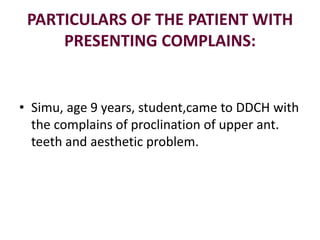
• Simu, age 9 years, student,came to DDCH with
the complains of proclination of upper ant.
teeth and aesthetic problem.
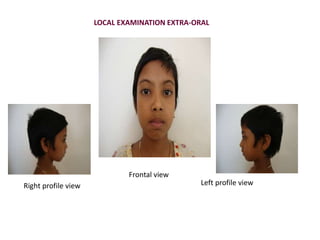
LOCAL EXAMINATION EXTRA-ORAL
Right profile view
Frontal view
Left profile view
Her face appeared to be symmetrical with convex profile.
Shape of the head : Mesocephalic.
Facial profile : Convex
Facial divergence : posterior.
Vertical relation : normal
Shape of the face : Oval.
Facial symmetry : Symmetrical.
Lips : Potentially competent.
Upper lip line : Normal.
Lower lip line : Low
Naso-labial angle : Normal
Mento-labial depression : Deep
Breathing : Nasal .
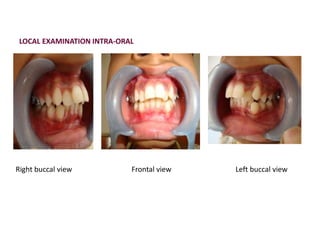
LOCAL EXAMINATION INTRA-ORAL
Frontal viewRight buccal view Left buccal view
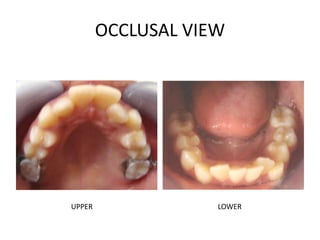
OCCLUSAL VIEW
UPPER LOWER
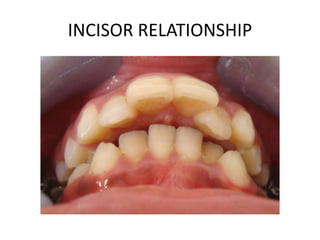
INCISOR RELATIONSHIP
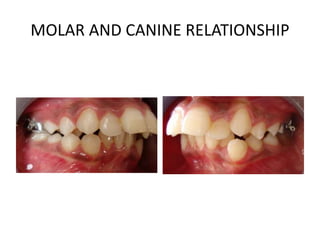
MOLAR AND CANINE RELATIONSHIP
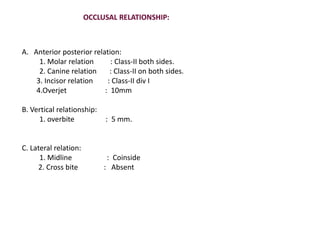
OCCLUSAL RELATIONSHIP:
A. Anterior posterior relation:
1. Molar relation : Class-II both sides.
2. Canine relation : Class-II on both sides.
3. Incisor relation : Class-II div I
4.Overjet : 10mm
B. Vertical relationship:
1. overbite : 5 mm.
C. Lateral relation:
1. Midline : Coinside
2. Cross bite : Absent
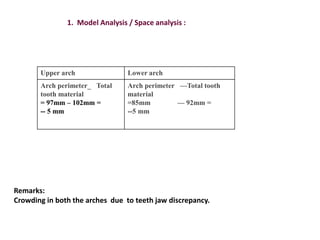
1. Model Analysis / Space analysis :
Upper arch Lower arch
Arch perimeter_ Total
tooth material
= 97mm – 102mm =
-- 5 mm
Arch perimeter —Total tooth
material
=85mm — 92mm =
--5 mm
Remarks:
Crowding in both the arches due to teeth jaw discrepancy.
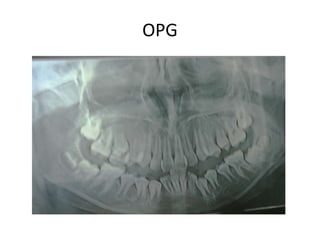
OPG
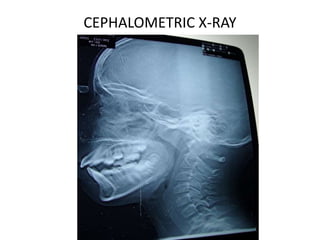
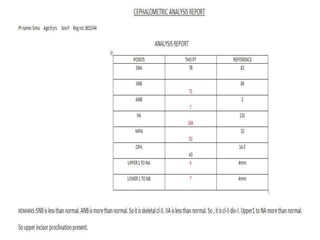
CEPHALOMETRIC X-RAY
AETIOLOGY
• DENTOALVEOLAR DISPROPORTION
• THUMB SUCKING
• FAMILY HISTORY(MOTHER)
DIAGNOSIS :
It is a case of class II div I malocclusion with crowding &
proclination of upper anterior segment; crowding of
lower ant segment. Canine & molar relationship is class II
on both side.
Treatment plan:
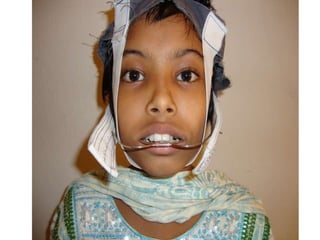
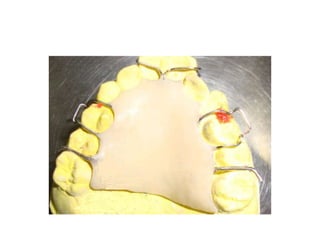
1 . URA with ant. bite plane to open the bite.
2.URA with palatal finger spring(1 mm SS wire) on
to fascilate distal movement of the upper molars
with bands and extra-oral traction.
3. Reasses the case for further treatment.
6 6
Head gear in orthodontics

Head gear in orthodontics

  • 3.
    HEAD GEAR PRESENTED BY: MD. ISHTIAQHASAN FCPS-II TRAINEE, DEPT. OF ORTHODONTICS, DDCH SUPERVISOR: PROF. DR. MD. ZAKIR HOSSAIN BDS, PHD(JAPAN) PROF. & HEAD, DEPT. OF ORTHODONTICS, DDCH.
  • 4.
    WHAT IS HEADGEAR • The orthodontic or orthopaedic appliance which deliver force intraorally or to the chin from a cranial extra- oral support.
  • 5.
    COMPONENTS Facebow or apair of ‘J’ hooks Force element Head cap
  • 6.
    ‘J’ HOOK • Theextra-oral force is transmitted from the head cap to the hooks soldered on the arch wire by two seperate wire on each side.
  • 7.
    FACE BOW Metallic componentthat transmit extra-oral force to the posterior teeth. It consists of ---Outer bow Inner bow & The junction
  • 8.
    OUTER BOW • Madeof 1.5 mm stiff round wire contoured to fit around thc face.
  • 9.
    INNER BOW Made of1.25 mm round wire Contoured around the dental arch and molar Inserted into the buccal tube of upper first molar. Stops are placed mesial to the molar tube.
  • 10.
    There are manyways in which the inner bow can be stopped at the mesial aspect of the buccal tube sothat the force is transmitted to the molars. Bayonet offset , ‘U’ loop or soldered stop can be used. ‘U’ loop have the advantage that it will allow for the adjustment to the antero-posterior length of the inner arch during treatment. This is necessary when the upper molars are being moved distally , in order to clear the bow from incisors.
  • 11.
    THE JUNCTION It isa rigid joint of inner and outer bow. It can be a single soldered joint.
  • 12.
    THE FORCE ELEMENT Itis the part of the head gear which provides the force to bring about the desired effect. May conprise of spring , elastics or other streatchable materials. It connect the face bow to head cap.
  • 13.
    THE HEAD CAP Theappliance takes anchorage from the rigid bones of the skull or from the back of the neck. The point of anchorage ---Cervical Occipital Parietal
  • 15.
  • 16.
    PRINCIPLES OF USEOF HEAD GEAR • Head gear have the ability to move the dentition and the maxilla in all 3 planes of space. The following factors should be considered when planning the use of head gear---
  • 17.
    CENTRE OF RESISTANCEOF THE DENTITION • The COR for a molar is usually at the mid root region ,1-2mm apical to the furcation area.
  • 18.
    If forece ispassing through the COR , it causes bodily movement. If force is above COR , it causes distal root tipping. If force is below COR , it causes distal crown tipping.
  • 19.
    DIRECTION OF FORCE Cervicalhead gear produce a inferior and distal force on the teeth ,while high pull head gear produce a superior and distal force on the teeth and maxilla.
  • 20.
    CENTRE OF RESISTANCEOF MAXILLA The COR of the maxilla should also be considered when planning for head gear. COR of maxilla is located above the apices of the premolar teeth. Forces passing through the COR of maxilla produce translation of the maxilla in a distal direction while forces above or below this point causes rotation of maxilla.
  • 22.
    POINT OF ATTACHMENTOF FORCE Point of attachment of force means the point where the hooks of the outer bow is connected to the elastics. It is possible to alter the direction of force by altering the point of attachment. This can be done by varying the length of the outer bow or by varing the angle between the inner and outer bow.
  • 23.
    MAGNITUDE OF FORCE •To measure the force level , strain gauge should be used. • Some commercial head gear , force level indicator built into the traction spring. • Excessive force level will result in the appliance being difficult to place and pt will very quickly complain of discomfort.
  • 24.
    TYPES OF HEADGEAR • Cervical head gear • Occipital head gear • High pull head gear • Combination head gear
  • 25.
    CERVICAL HEAD GEAR Obtainancorage from the nape of the neck. Causes distal and extrusive movement of the upper molars leadind to increase in lower facial height.
  • 26.
    INDICATION • Generally indicatedin class-II deep bite cases sothat lower facial height can be increased.
  • 27.
    CONTRA-INDICATION Pt with longface syndrome Open bite cases Gummy smile
  • 28.
  • 29.
    To minimize theextrusive force , we can bend the outer arm upward. Bringing the outer bow down to the line of action of neck strap create an upward pressure which counteract the downword pressure of elastics.
  • 30.
    OCCIPITAL HEAD GEAR Deriveanchorage from the occipital region (back of the head). Produce distal and some intrusive frce.
  • 31.
    HIGH PULL HEADGEAR Derive anchorage from parietal region(Front of head). Cause intrusion of upper molar and maxilla, leading to decreased lower facial height.
  • 32.
    INDICATION In class-II longface patient. Open bite cases
  • 33.
  • 34.
    ADVERSE EFFCET Intrusion ofthe molars undesirable
  • 35.
    COMBINATION HEAD GEAR Herecervical and occipital anchorage are combined. It allow a distal force straight through the centre of resistance by having equal occipital and cervical components.
  • 36.
  • 37.
    ORTHOPAEDIC EFFECT Forces appliedonto the maxilla can be used to restrict its downward and forward growth. For this , distal force should be applied through the COR of the maxilla. 350-450 gm force on each side for a minimum of 12-14 hrs/day are required for this.
  • 38.
    ANCHORAGE REINFORCEMENT When intra-oralanchorage is insufficient , then head gear can be used. 300 gm/side force level for 10 hrs/day is needed for this.
  • 39.
    DISTALIZING THE MOLAR Distalmovement of molar may be required for correction of molar relation or to gain space for correction of crowding or retraction of anteriors. 300 gm/side for 14 hrs/day is needed for this. The use of head gear for 14 hrs each night with a force passing through the COR of upper first molar will move the tooth distally 2-4 mm/2-4month without tipping.
  • 40.
    DISTALIZING THE MOLAR Asthe molar move distally, the bow will impinge against the incisors, so it is necessary to lengthen the inner arch. The ‘U’ loop need to expand to increase the length of the inner arch. Occlusion should be checked and ensure that the distal movement is not hampered by the interference of the lower molar. If it happens , a removable appliance with anterior bite plane can be used.
  • 41.
    CORRECTION OF MOLARROTATION AND EXPANSION • Correction is achieved by adjustment of the inner bow sothat it will produce rotational force to the molar or expansion of the arch.
  • 42.
    SPACE MAINTAINER Most effectivemethod of maintaining arch length is by the use of head gear. The mesial movement of molar is protected and the face bow does not interfere with the erupting teeth. For this , 8 hrs/day wear is sufficient.
  • 43.
    EXTRA-ORAL ANCHORAGE FORTHE MANDIBULAR ARCH  This is usually achieved by ‘j’ hooks because placement of inner bow in the lower buccal tube is difficult.  If extra-oral anchorage is already in use in the upper arch, anchorage reinforcement can be achieved by cl-III intermaxillary traction at the same time.  Sliding jig can also be used to transmit the force to the lower jaw.
  • 44.
    PRACTICAL MANAGEMENT At first, select the appropiate size of face bow. Then determine the COR of tooth mentally. Mark the COR on the pt’s cheek. Choose the type of head gear. Allow the outer bow to rest away from chek and adjust its length and position with respect to COR to achieve proper line of force. Monitor for changes as treatment proceed and adjust the force line of action if necessary.
  • 45.
    Since extra-oral tractiondepends on pt’s co-operation , it is vitally important at each visit to assess wheather the appliance has been worn sufficiently or not. A ‘time sheet’ should give to the pt where he will keep record about the time of wearing of head gear. Pt should be asked to fit the head gear and observed to ensure that he is familiar with the insertion. Any difficulty in fitting may be a sign of poor co- operation. The head cap should give the appearance of having been worn. The elastic should lost some of its elasticity.
  • 46.
    THE MOST IMPORTANTELEMENT COMPLIANCE!
  • 47.
  • 48.
    PARTICULARS OF THEPATIENT WITH PRESENTING COMPLAINS: • Simu, age 9 years, student,came to DDCH with the complains of proclination of upper ant. teeth and aesthetic problem.
  • 49.
    LOCAL EXAMINATION EXTRA-ORAL Rightprofile view Frontal view Left profile view
  • 50.
    Her face appearedto be symmetrical with convex profile. Shape of the head : Mesocephalic. Facial profile : Convex Facial divergence : posterior. Vertical relation : normal Shape of the face : Oval. Facial symmetry : Symmetrical. Lips : Potentially competent. Upper lip line : Normal. Lower lip line : Low Naso-labial angle : Normal Mento-labial depression : Deep Breathing : Nasal .
  • 51.
    LOCAL EXAMINATION INTRA-ORAL FrontalviewRight buccal view Left buccal view
  • 52.
  • 53.
  • 54.
    MOLAR AND CANINERELATIONSHIP
  • 55.
    OCCLUSAL RELATIONSHIP: A. Anteriorposterior relation: 1. Molar relation : Class-II both sides. 2. Canine relation : Class-II on both sides. 3. Incisor relation : Class-II div I 4.Overjet : 10mm B. Vertical relationship: 1. overbite : 5 mm. C. Lateral relation: 1. Midline : Coinside 2. Cross bite : Absent
  • 56.
    1. Model Analysis/ Space analysis : Upper arch Lower arch Arch perimeter_ Total tooth material = 97mm – 102mm = -- 5 mm Arch perimeter —Total tooth material =85mm — 92mm = --5 mm Remarks: Crowding in both the arches due to teeth jaw discrepancy.
  • 57.
  • 58.
  • 60.
    AETIOLOGY • DENTOALVEOLAR DISPROPORTION •THUMB SUCKING • FAMILY HISTORY(MOTHER)
  • 61.
    DIAGNOSIS : It isa case of class II div I malocclusion with crowding & proclination of upper anterior segment; crowding of lower ant segment. Canine & molar relationship is class II on both side.
  • 62.
    Treatment plan: 1 .URA with ant. bite plane to open the bite. 2.URA with palatal finger spring(1 mm SS wire) on to fascilate distal movement of the upper molars with bands and extra-oral traction. 3. Reasses the case for further treatment. 6 6