CEPHALOMETRICSByShameel ahmed shariffGUIDED BY:DR. SHASHIKALA Professor and H.O.D., Dept. Of orthodontics.DR. APARNA.DR. ROSHAN.DR. SHEELA.
CONTENTSIntroductionHistoryEquipmentTechnical aspectPositioning of the patientExposure parametersTypesUsesLandmarks and planesAnalysis
Assessment of cranio-facial structures forms a part of orthodontic diagnosis. Craniometry can be said to be the forerunner of cephalometry.Craniometry involved measurements of cranio facial dimensions of skulls of dead persons.This method was not practical in living individual due to soft tissue envelope that made direct measurement difficult and far reliable.Introduction

Cephalometry was a modification of anthropological studies and craniometry.

PACINI in 1922 published the first paper on cephalometry.
But it was BROADENT(USA) and HOFRATH(Germany) who introduced and popularized in 1931.
Clinical application of cephalometry was introduced by DOWNS.History
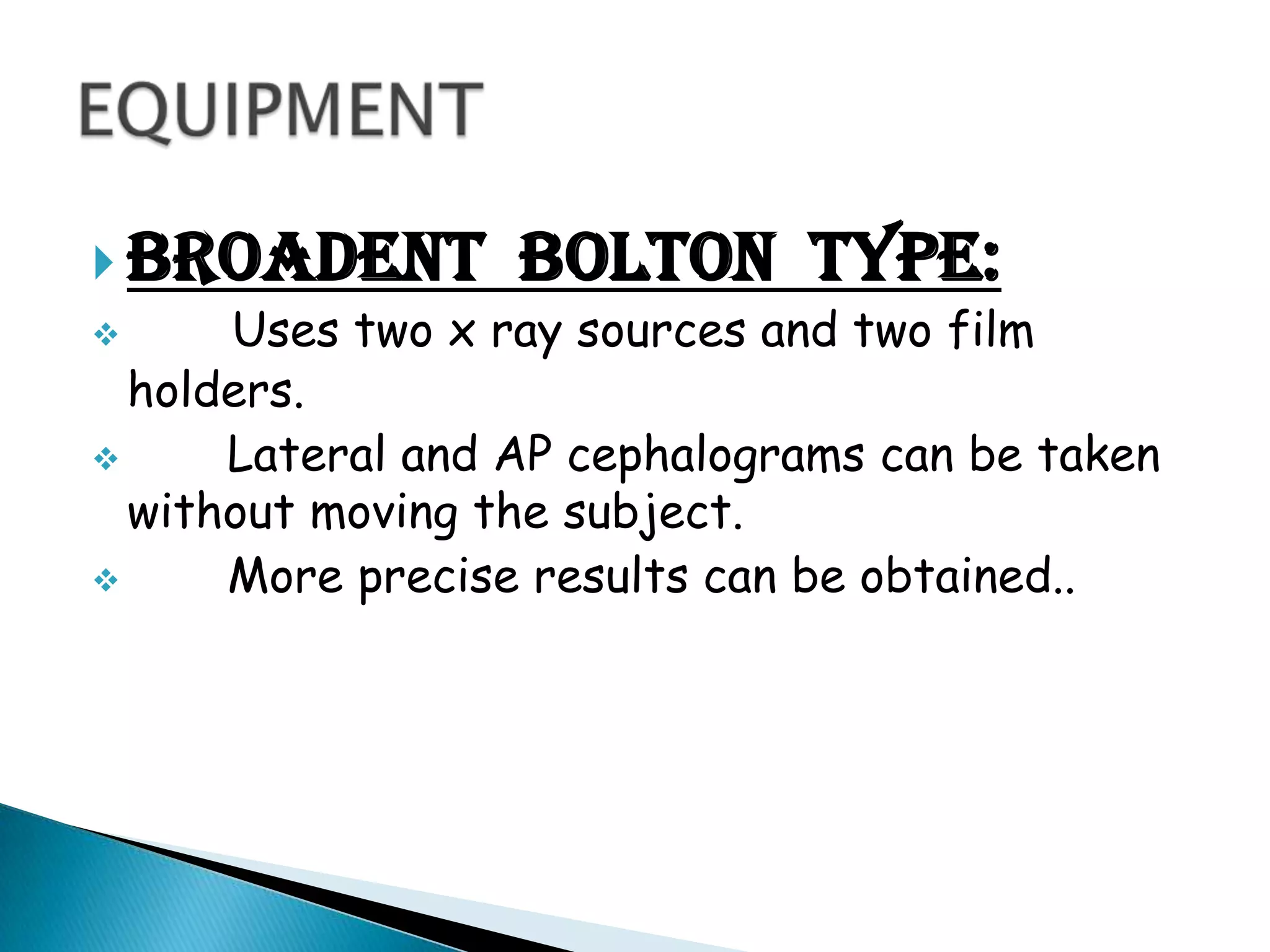
Broadent  bolton  type: Uses two x ray sources and two film holders.
       Lateral and AP cephalograms can be taken without moving the subject.
       More precise results can be obtained..EQUIPMENT
Broadent  bolton  type
HIGHLEYS TYPEUses one x ray source and one film holder
Patient is repositioned for various projections..
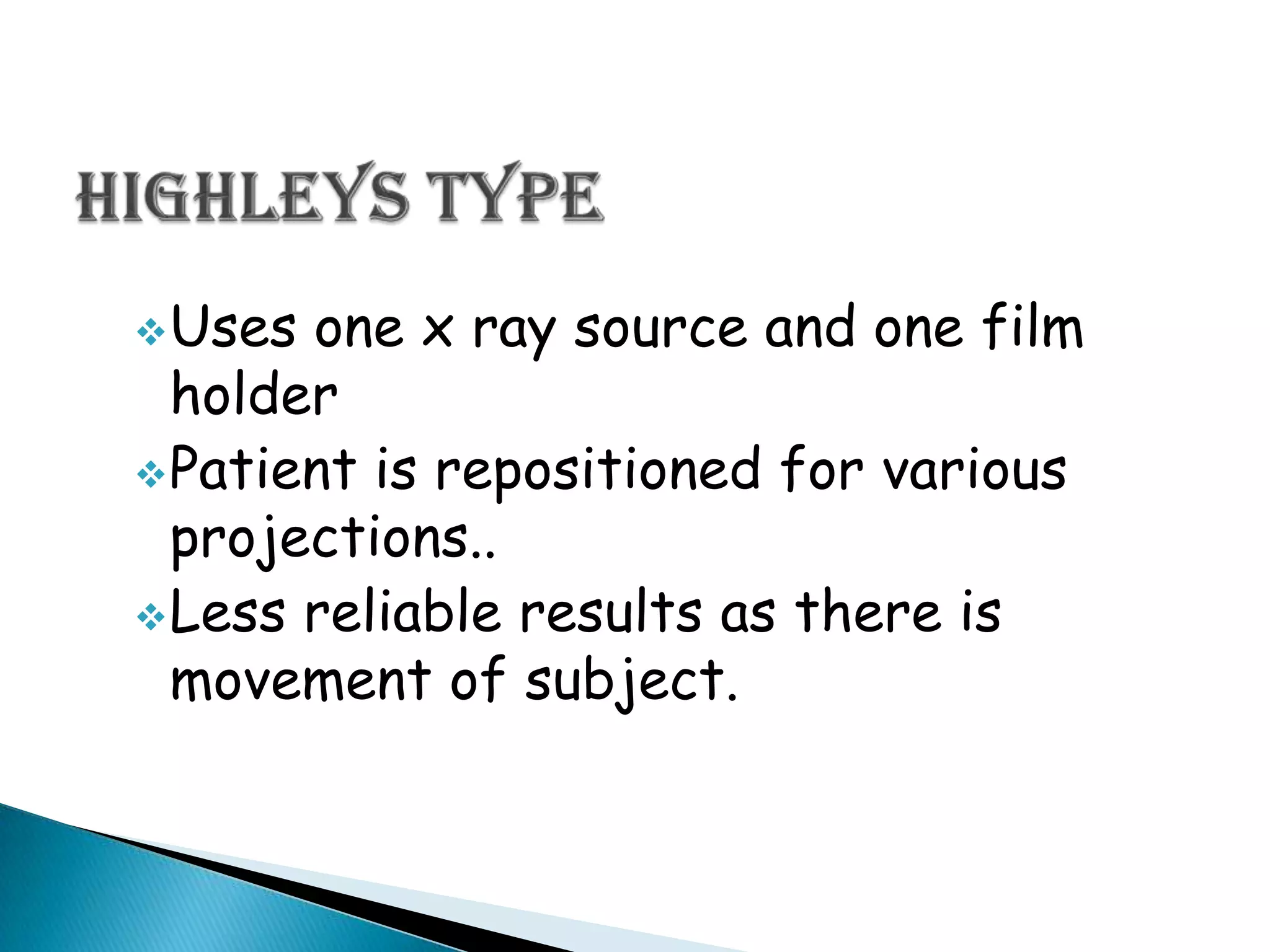
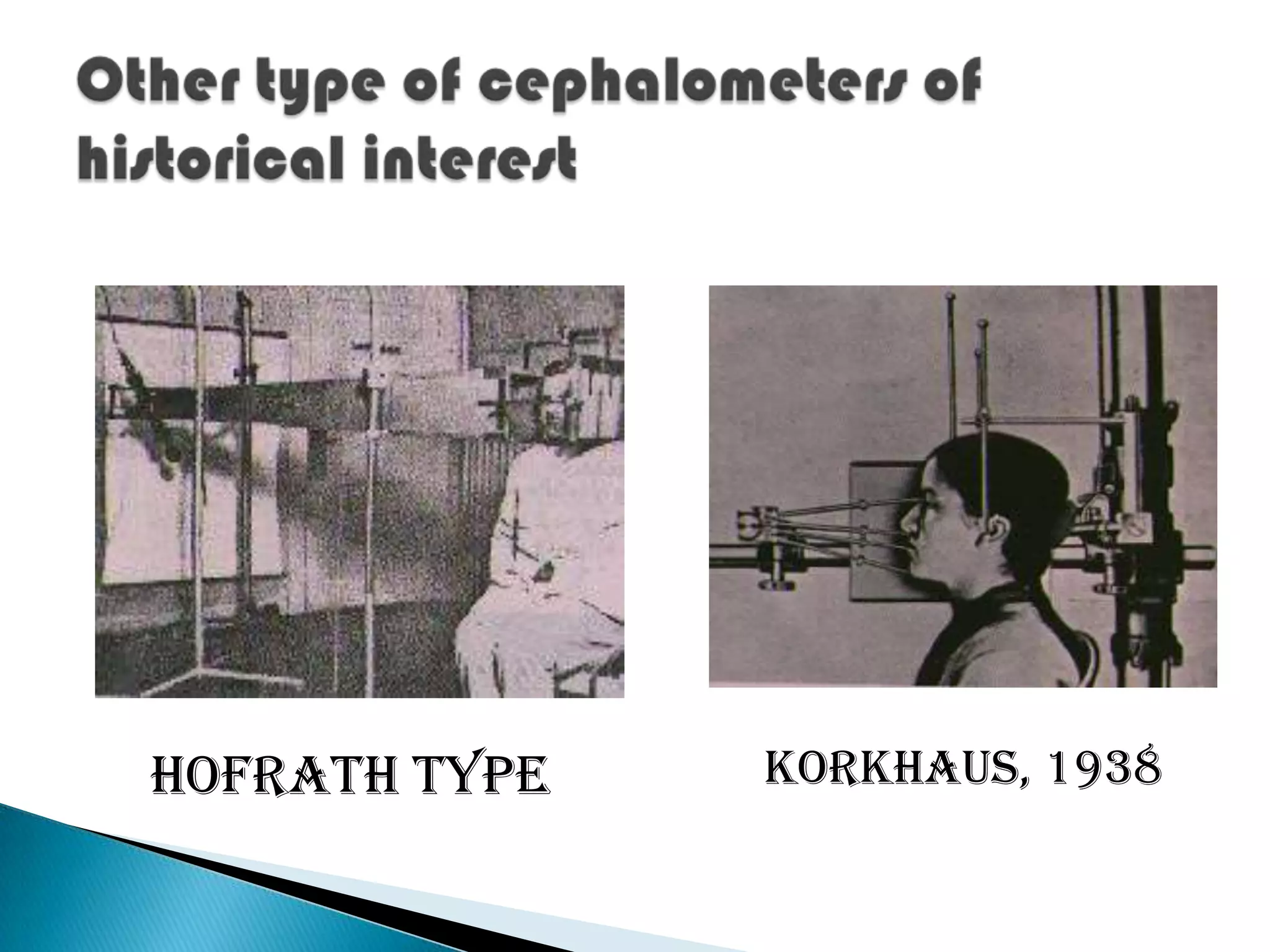
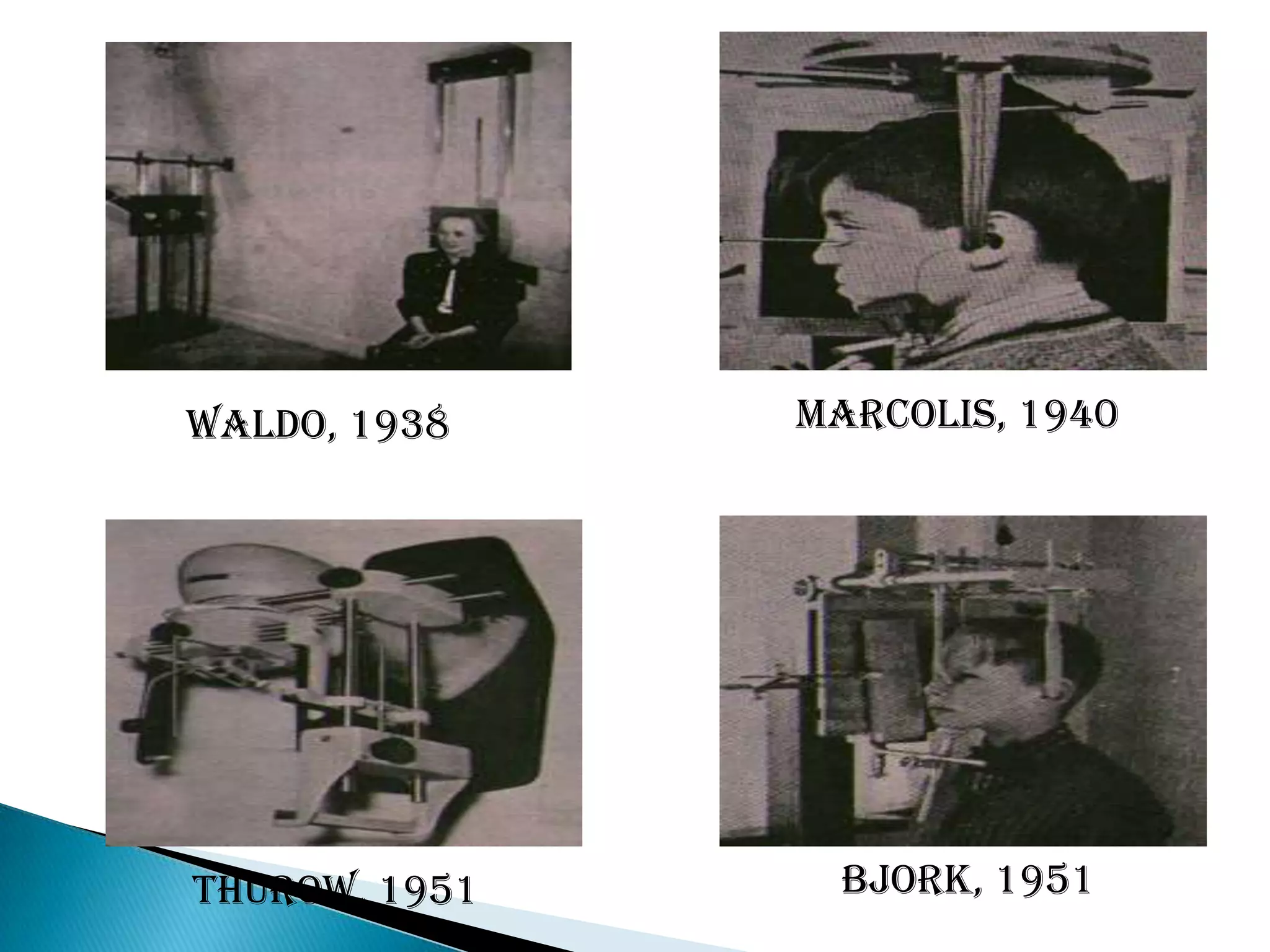
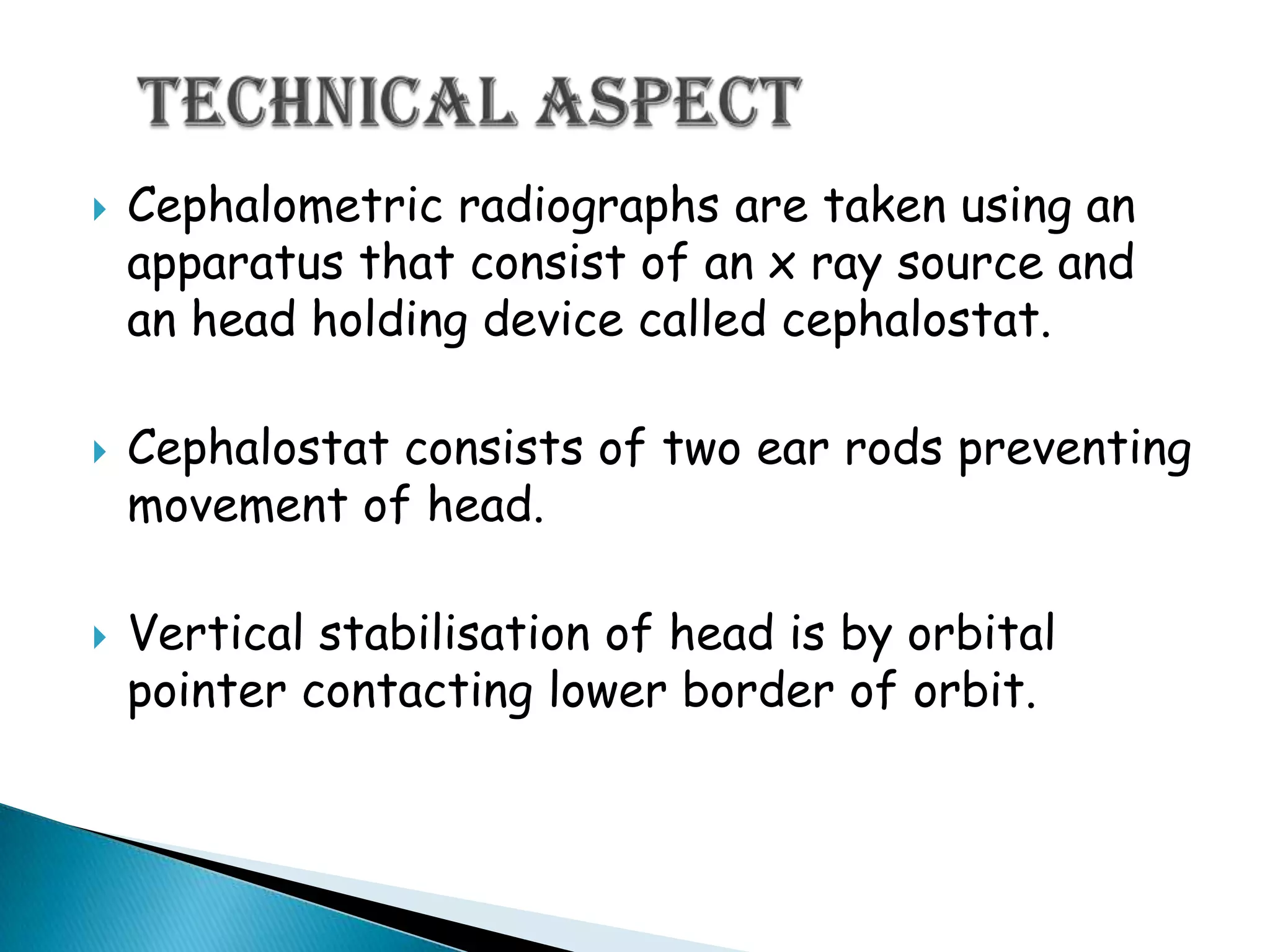
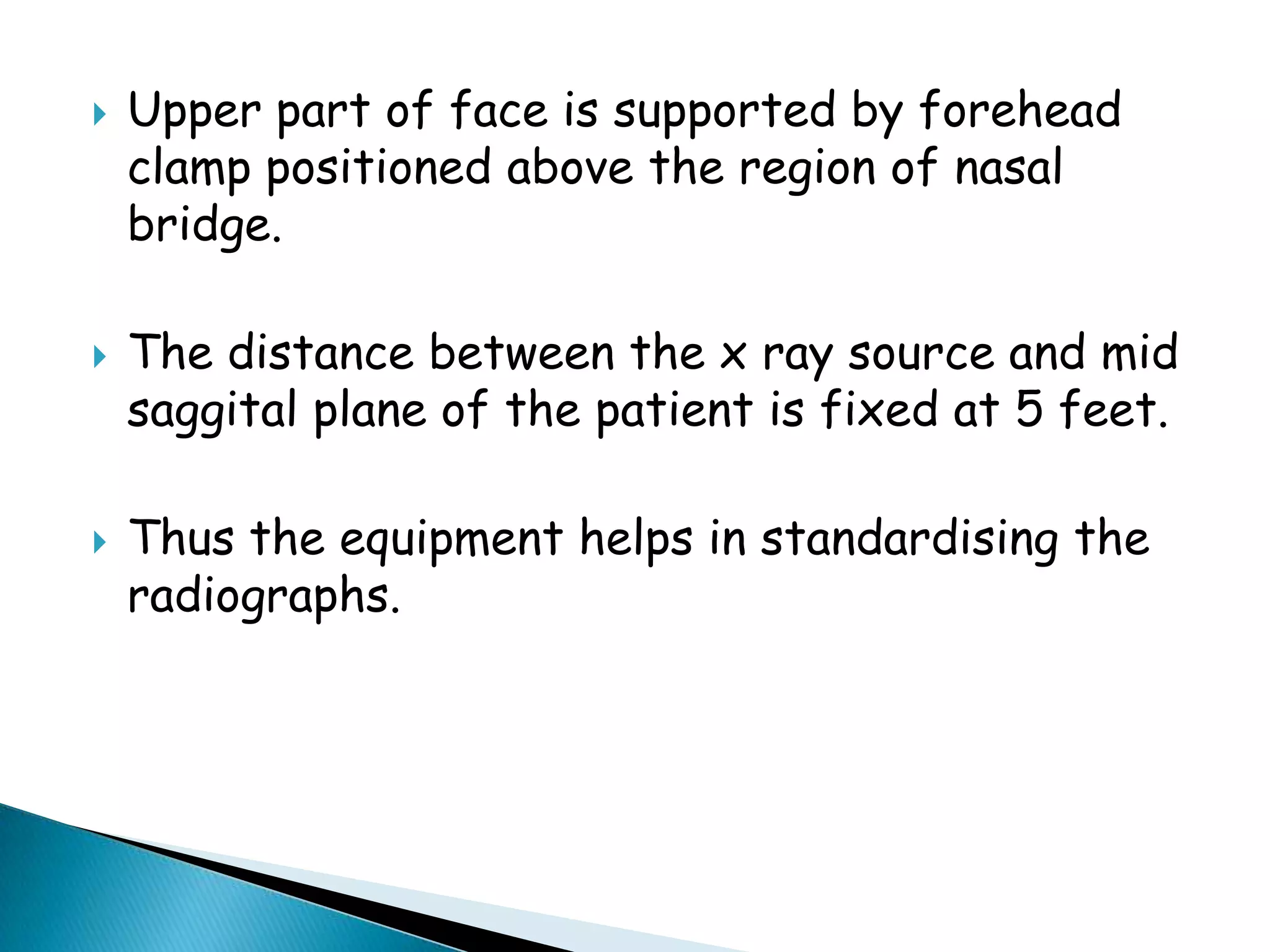
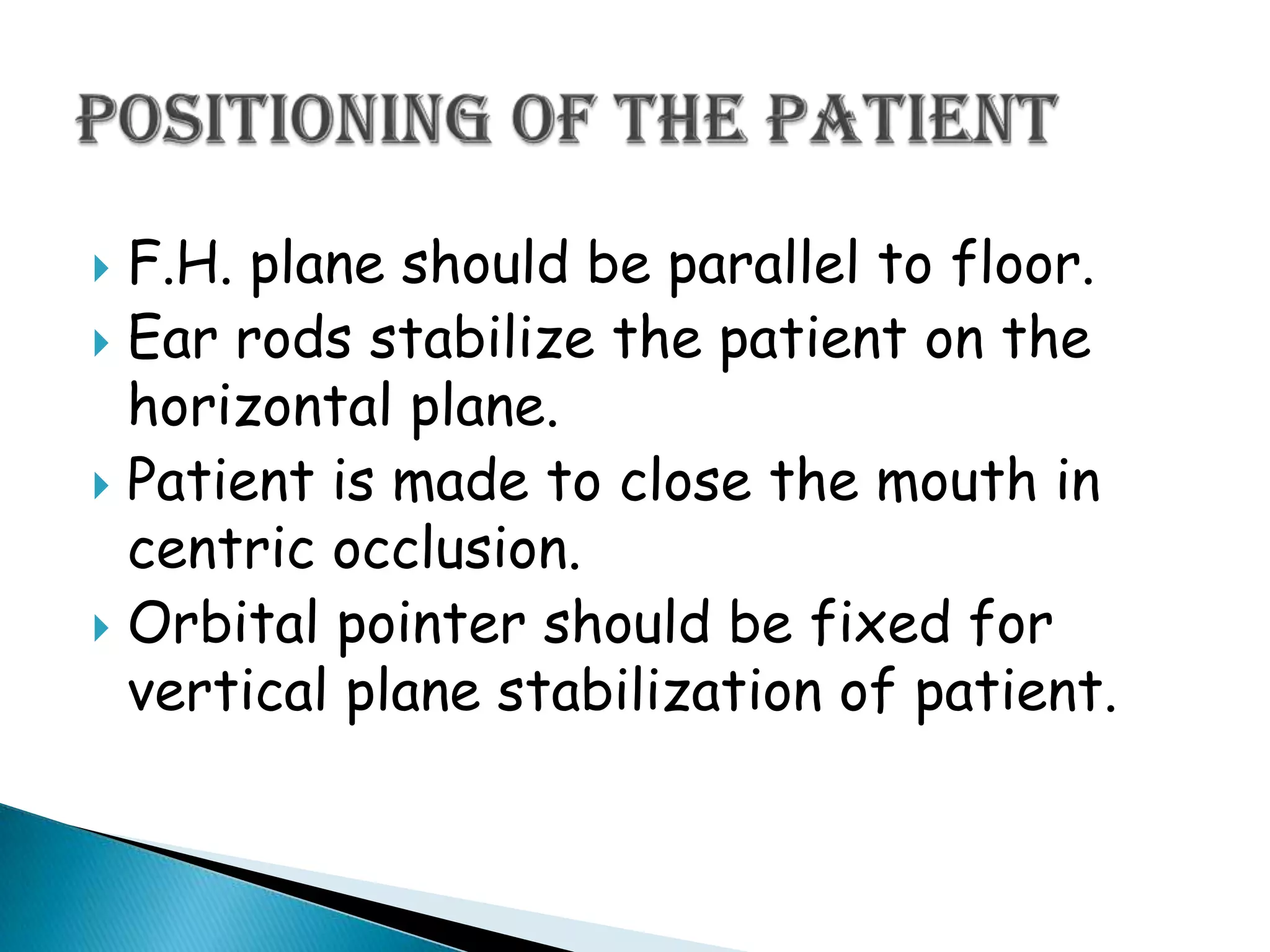
Less reliable results as there is movement of subject.Other type of cephalometers of historical interestKorkhaus, 1938HOFRATH TYPE
Marcolis, 1940Waldo, 1938Bjork, 1951Thurow, 1951
Technical aspectCephalometric radiographs are taken using an apparatus that consist of an x ray source and an head holding device called cephalostat.Cephalostat consists of two ear rods preventing movement of head.Vertical stabilisation of head is by orbital pointer contacting lower border of orbit.
Upper part of face is supported by forehead clamp positioned above the region of nasal bridge.The distance between the x ray source and mid saggital plane of the patient is fixed at 5 feet.Thus the equipment helps in standardising the radiographs.
F.H. plane should be parallel to floor.Ear rods stabilize the patient on the horizontal plane.Patient is made to close the mouth in centric occlusion.Orbital pointer should be fixed for vertical plane stabilization of patient.POSITIONING OF THE PATIENT
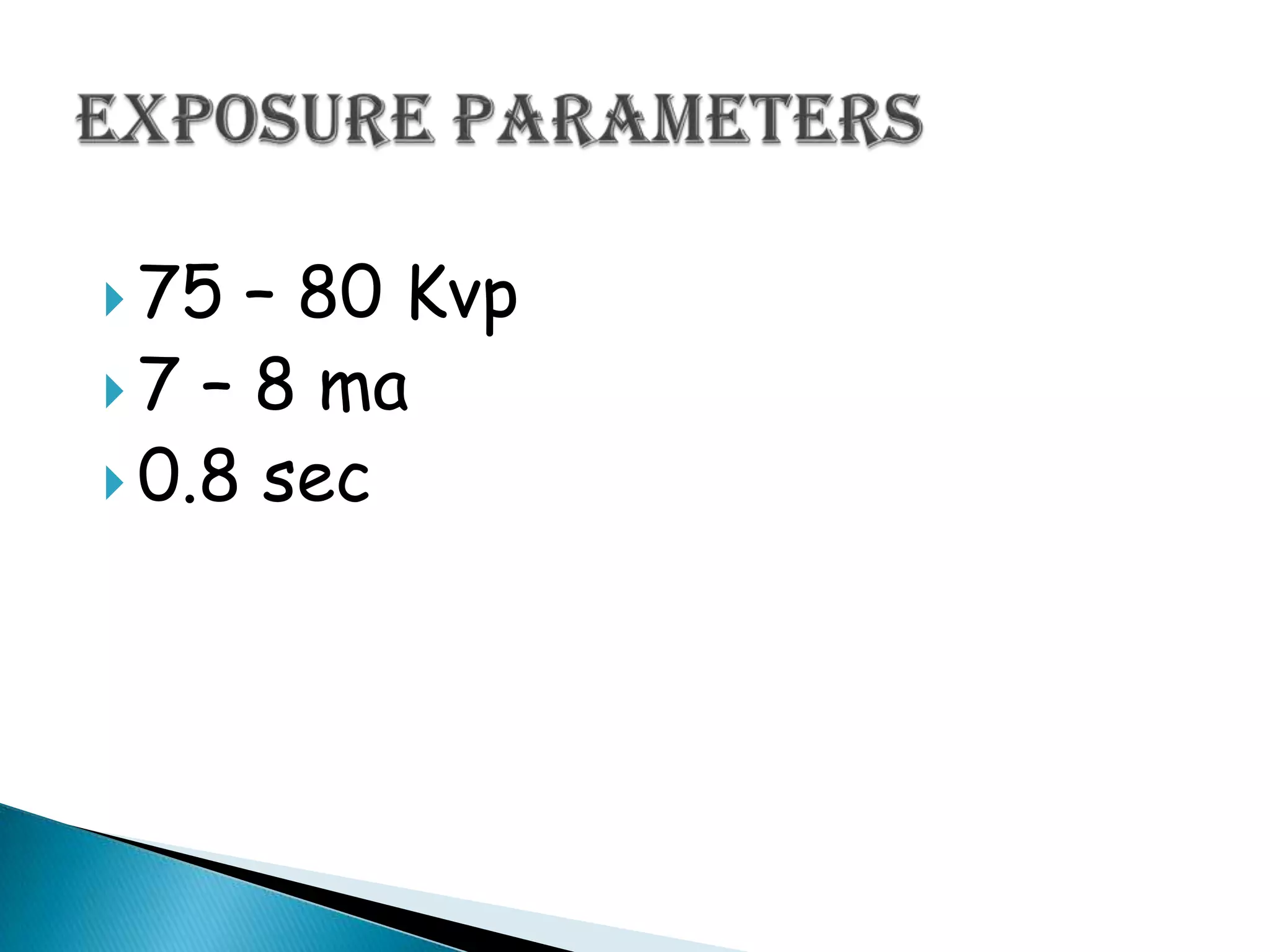
75 โ€“ 80 Kvp7 โ€“ 8 ma0.8 secExposure parameters
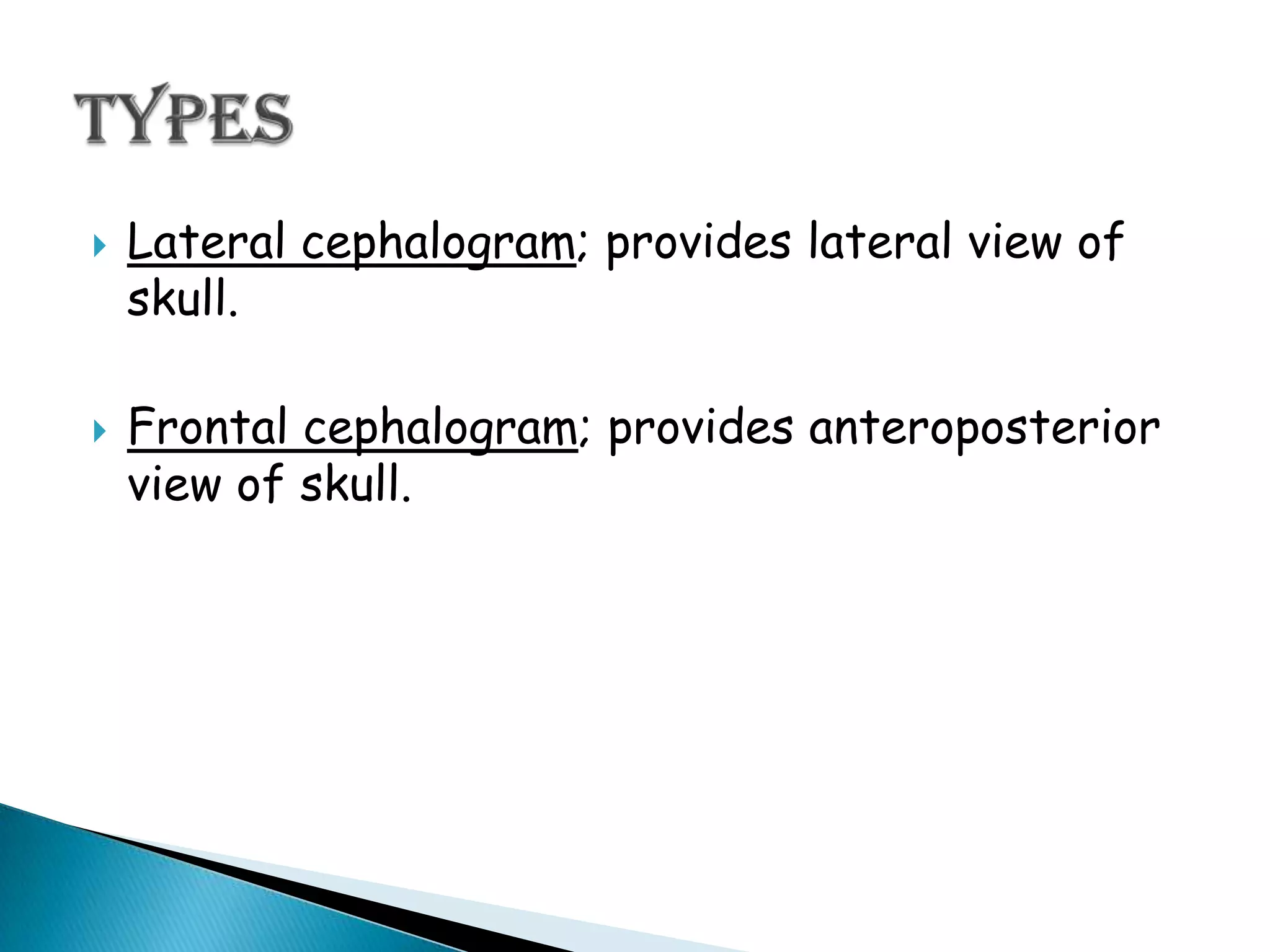
Lateral cephalogram; provides lateral view of skull.Frontal cephalogram; provides anteroposterior view of skull.Types
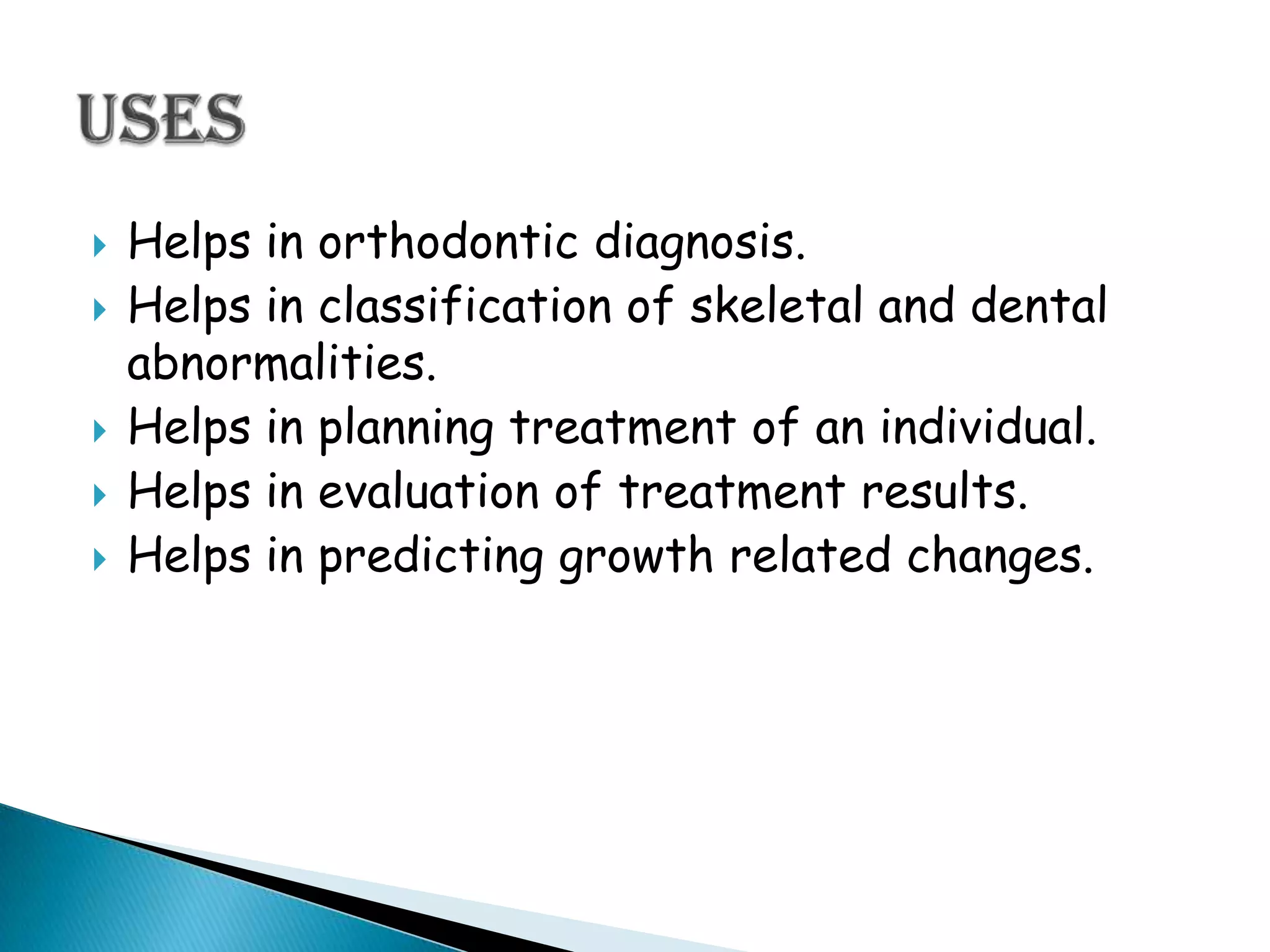
Helps in orthodontic diagnosis.Helps in classification of skeletal and dental abnormalities.Helps in planning treatment of an individual.Helps in evaluation of treatment results.Helps in predicting growth related changes.Uses
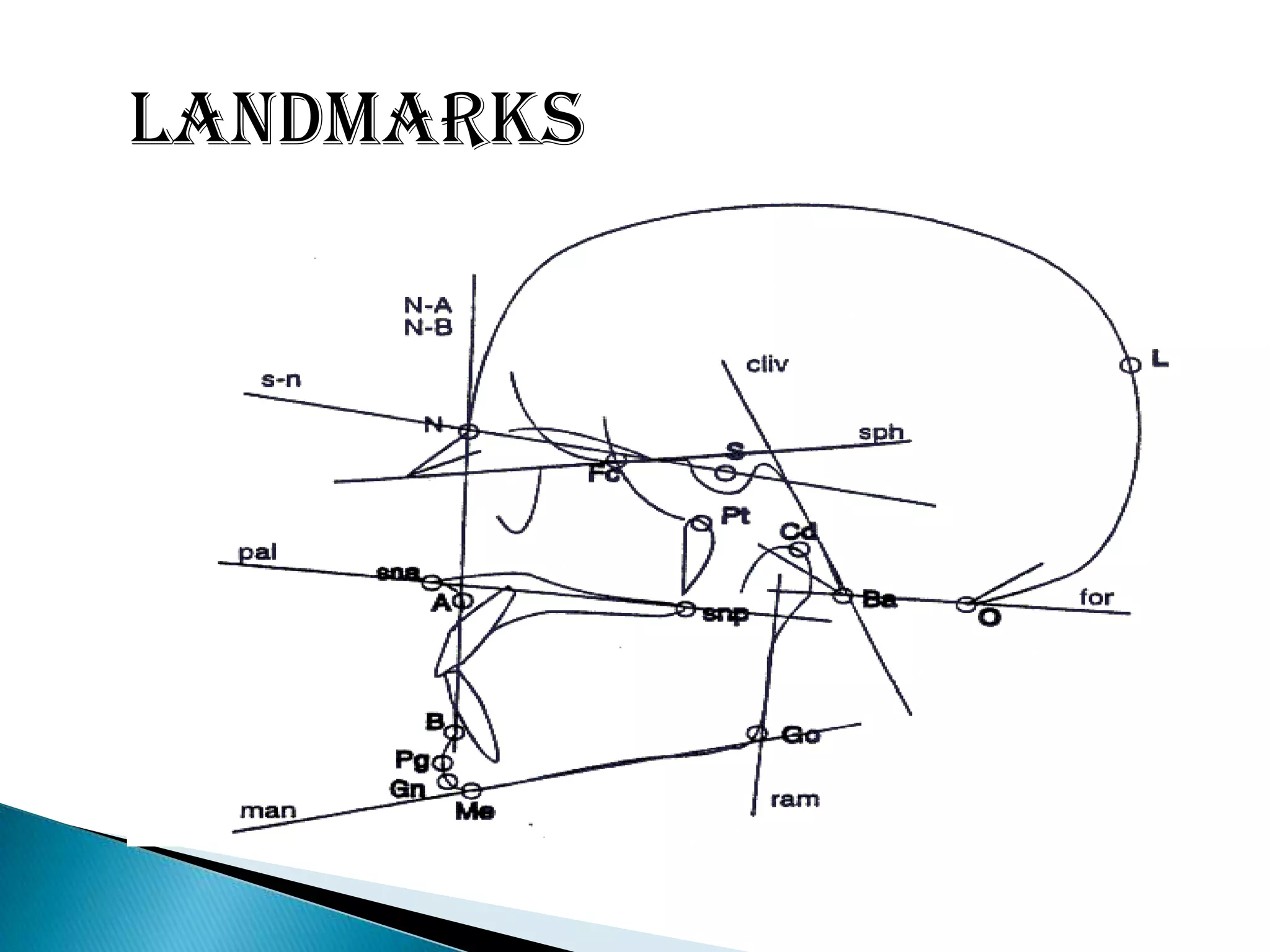
LANDMARKS
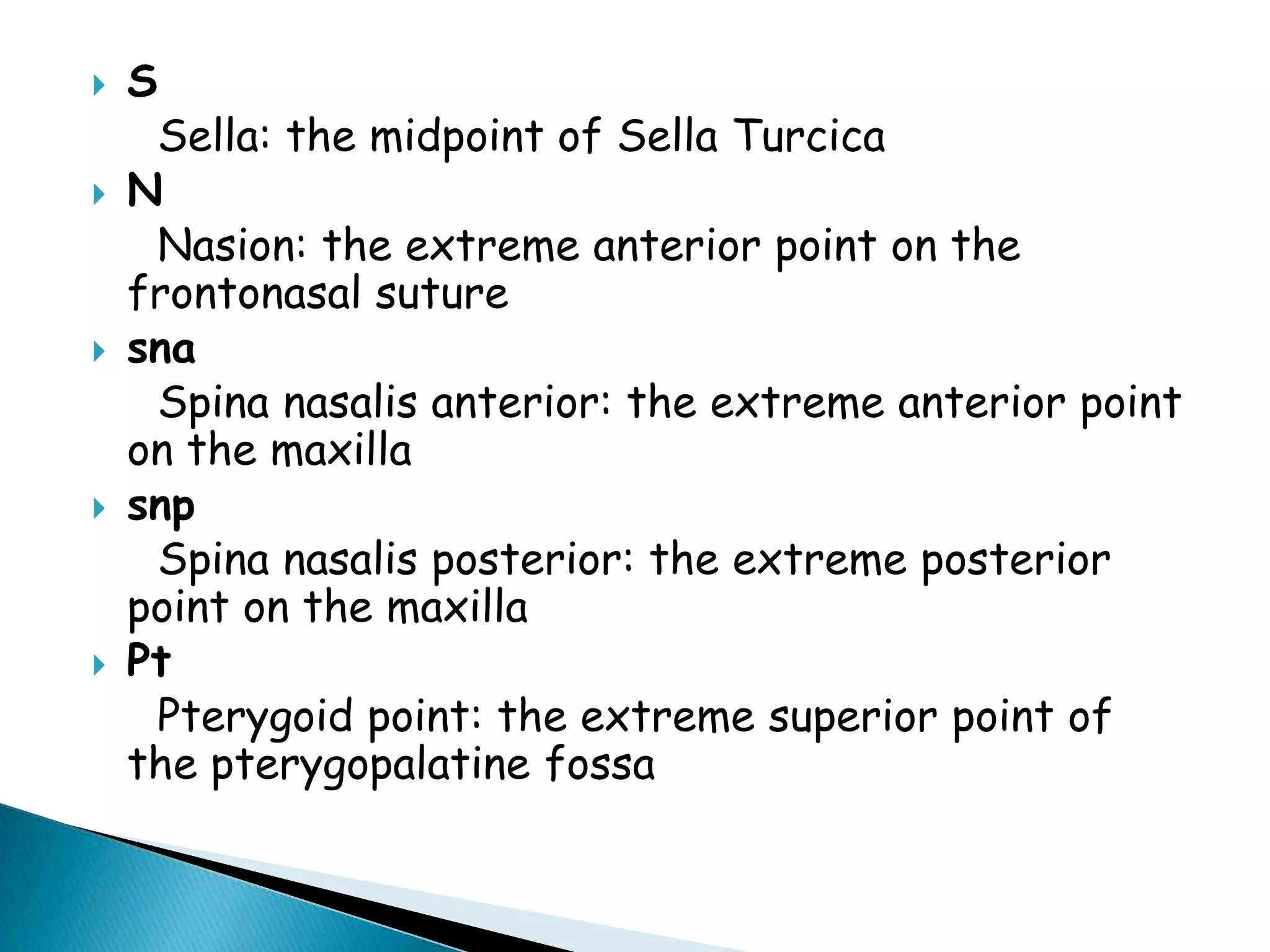
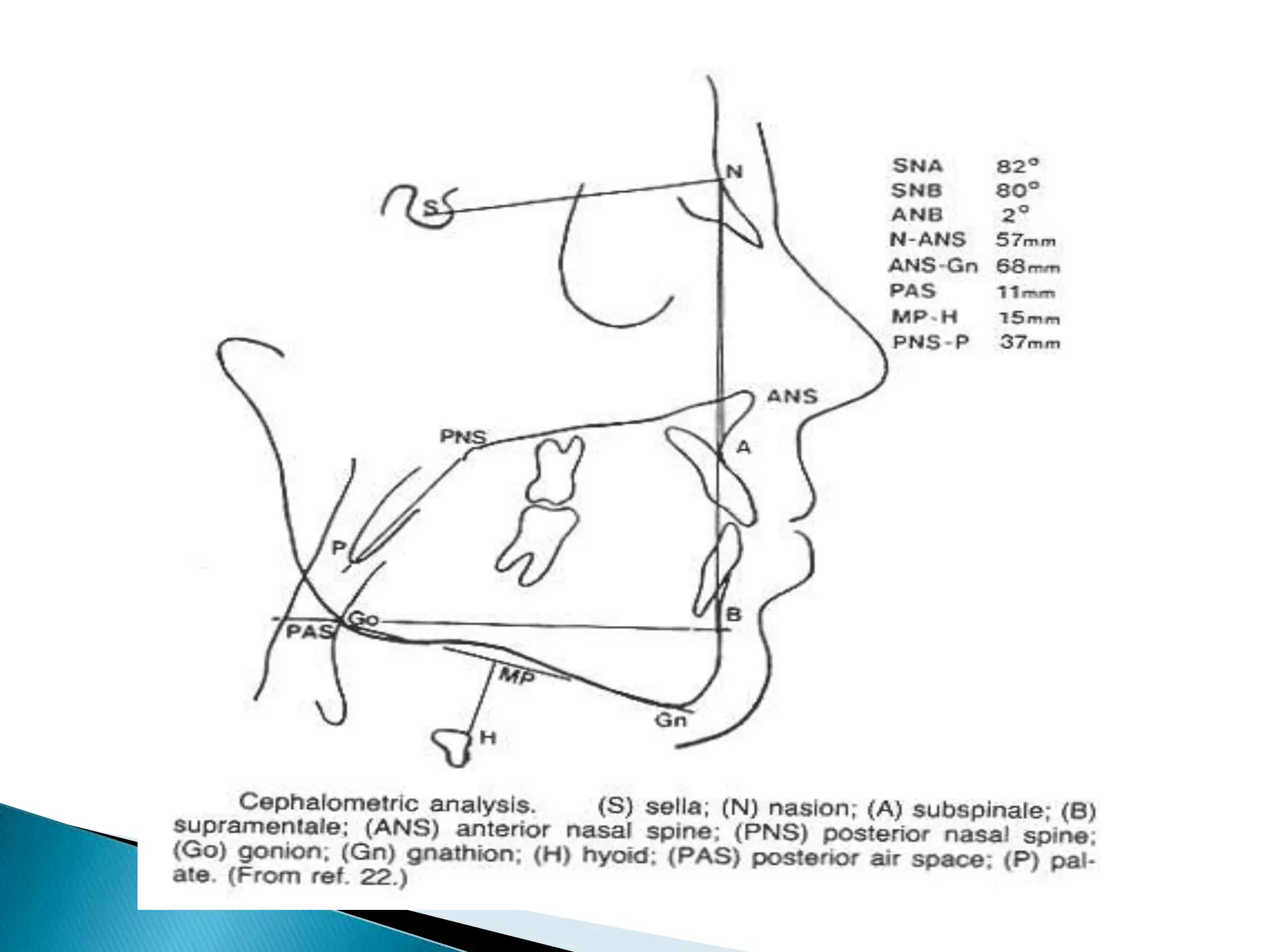
S     Sella: the midpoint of Sella TurcicaN     Nasion: the extreme anterior point on the frontonasal suturesna     Spina nasalis anterior: the extreme anterior point on the maxillasnp     Spina nasalis posterior: the extreme posterior point on the maxillaPtPterygoid point: the extreme superior point of the pterygopalatine fossa
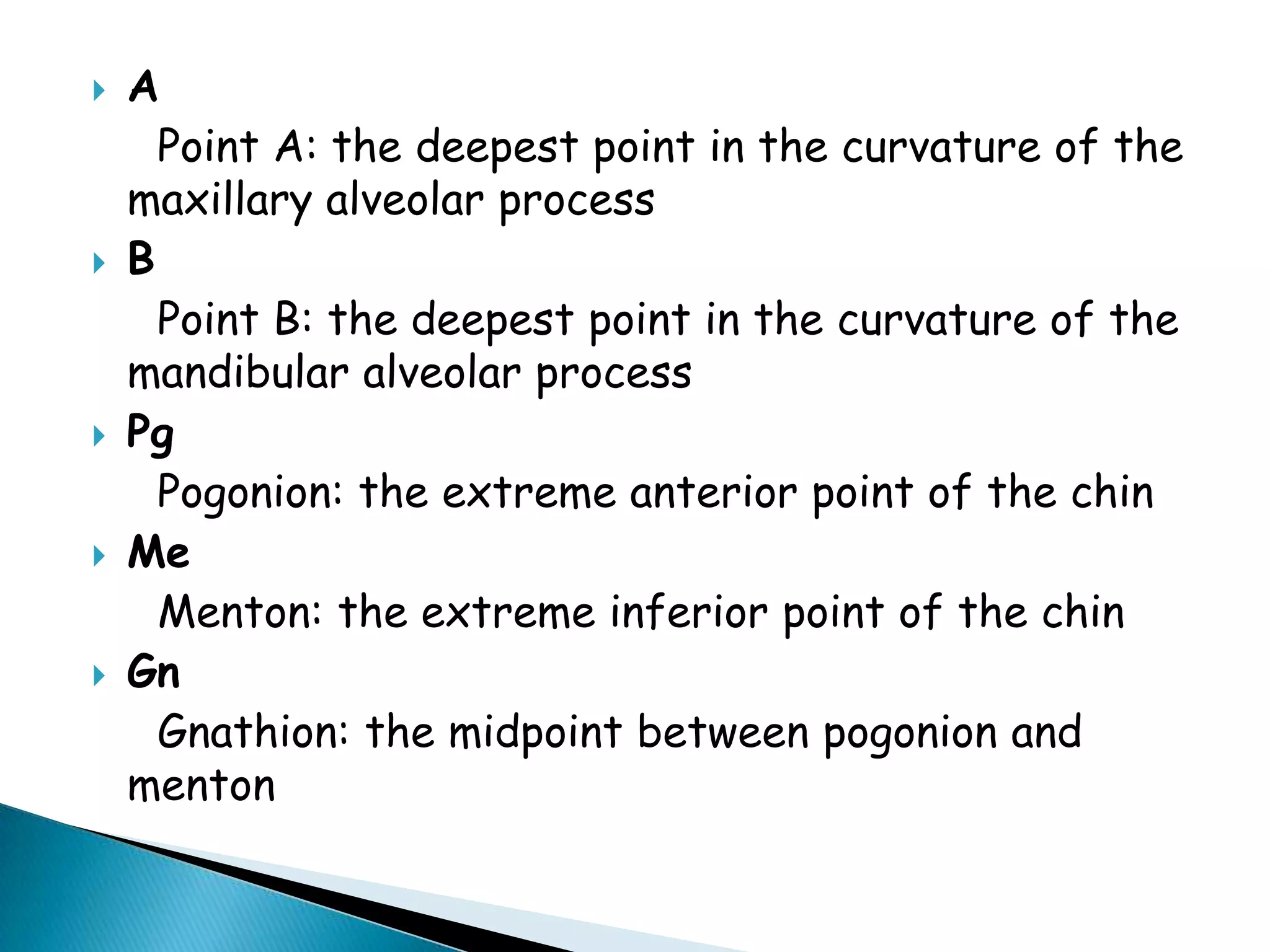
A     Point A: the deepest point in the curvature of the maxillary alveolar processB     Point B: the deepest point in the curvature of the mandibular alveolar processPg     Pogonion: the extreme anterior point of the chinMe     Menton: the extreme inferior point of the chinGn     Gnathion: the midpoint between pogonion and menton
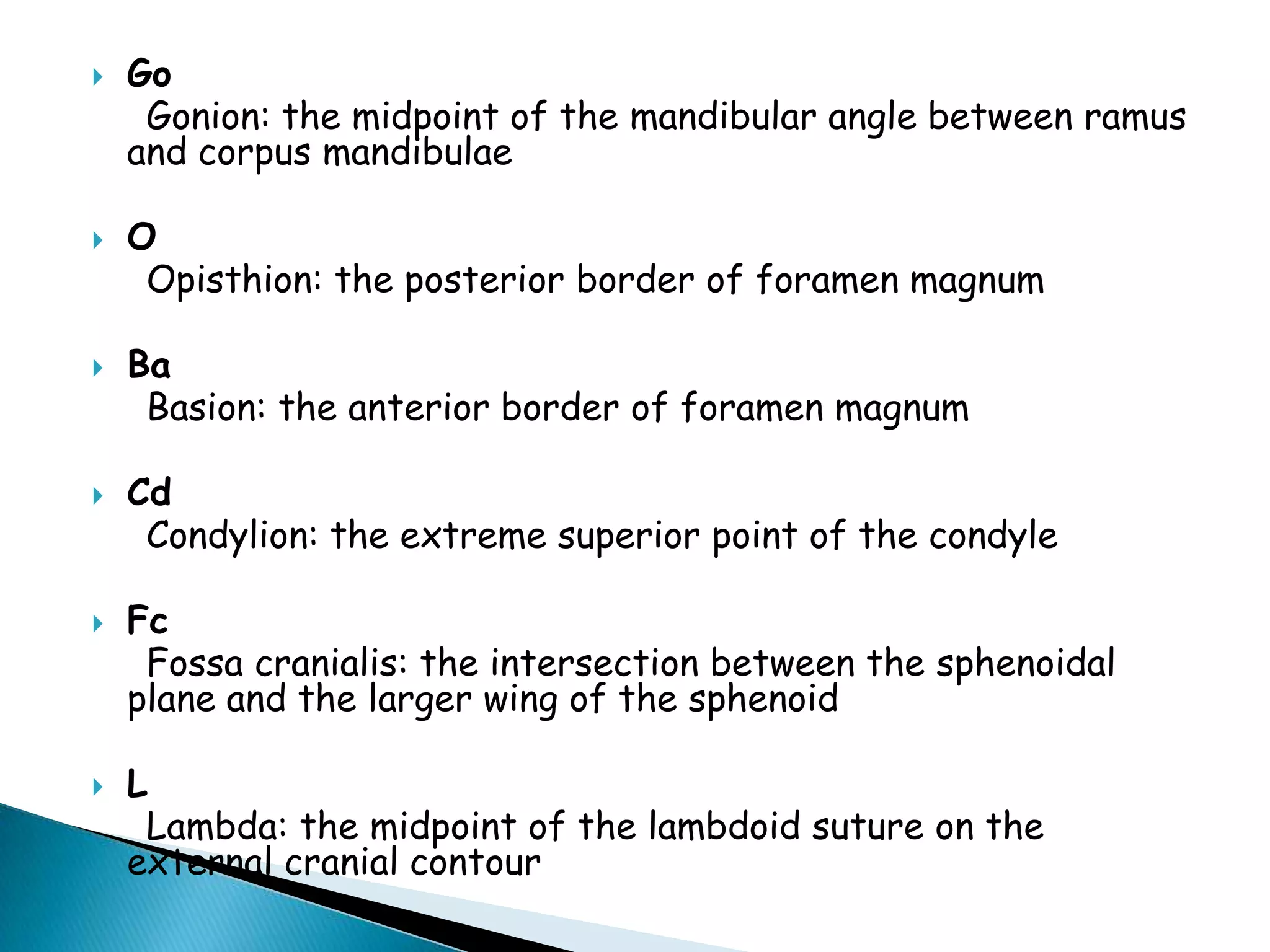
Go     Gonion: the midpoint of the mandibular angle between ramus and corpus mandibulaeO     Opisthion: the posterior border of foramen magnumBa     Basion: the anterior border of foramen magnumCd     Condylion: the extreme superior point of the condyleFc     Fossa cranialis: the intersection between the sphenoidal plane and the larger wing of the sphenoidL     Lambda: the midpoint of the lambdoid suture on the external cranial contour
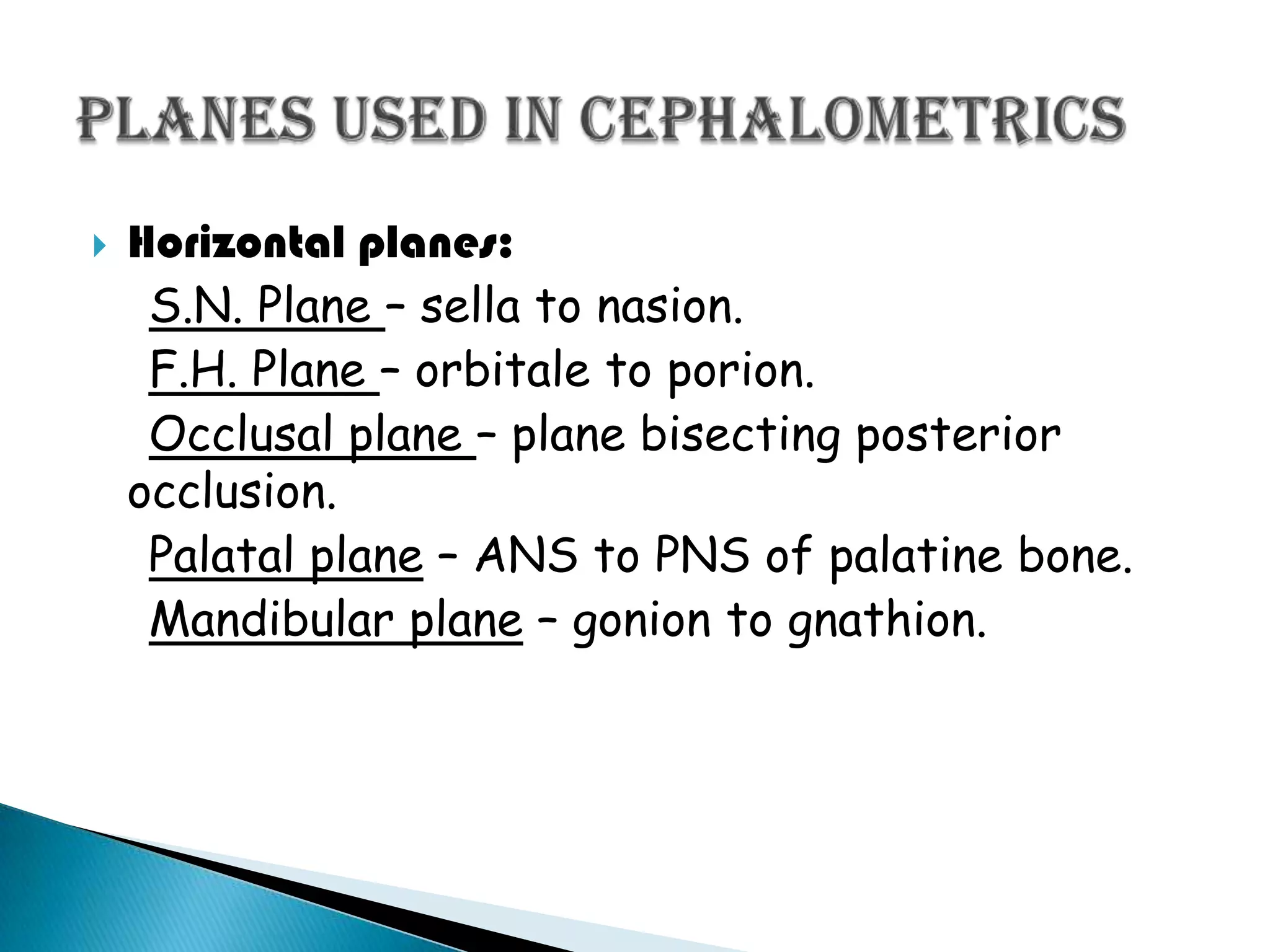
Horizontal planes:S.N. Plane โ€“ sella to nasion.F.H. Plane โ€“ orbitale to porion.Occlusal plane โ€“ plane bisecting posterior occlusion.Palatal plane โ€“ ANS to PNS of palatine bone.Mandibular plane โ€“ gonion to gnathion. Planes used in cephalometrics
VERTICAL PLANES:A-Pog line โ€“ point A on maxilla to pogonion on mandible.Facial plane โ€“ nasion to pogonion,Facial axis โ€“ ptm point to gnathion.E-plane โ€“ esthethic plane is a line between the most anterior point of soft tissue nose to soft tissue chin.
It is one of the most frequently used cephalometric analysis.Downs analysis consists of ten parameters of which five are skeletal and five are dental.Downs analysis;
Facial angle;    it is the inside inferior angle formed by intersection of nasion-pogonion plane and F.H.  plane.     average value; 87.8โ€™ ( 82 โ€“ 95โ€™)    significance;  indication of antero- posterior positioning of mandible in relation to upper face. Angle is increased in skeletal class III with prominent chin while decreased in skeletal class II.Skeletal parameters;
Angle of convexity;    Nasion-point A to point A โ€“ pogonion.    Average value; 0โ€™ ( -8.5 to 10โ€™).    Significance; A positive angle suggest a prominent maxillary denture bace in relation to mandible.    Negative angle is indicative of prognathic profile.
A-B plane angle;    point A โ€“ point B to nasion โ€“ pogonion.    Average value; -4.6โ€™ ( -9 to 0โ€™)    Significance; indicative of maxillo mandibular relationship in relation to facial plane.    Negative since point B is positioned behind point A.    Positive in class III malocclusion.
Mandibular plane angle;    Intersection of mandibular plane with F.H.        Plane.    Average value; 21.9โ€™ ( 17 to 28โ€™)Y-Axis;    Sella gnathion to F.H. plane.    Average value; 59โ€™ ( 53โ€™ to 66โ€™)    Angle is larger in class II facial patterns. Indicates growth pattern of a individual.
Cant of occlusal plane;    OCCLUSAL PLANE TO F.H. Plane    Average value; 9.3 ( 1.5 to 14โ€™)    Gives a measure of slope of occlusal plane  relative to F.H. Plane.Inter incisal angle;    Angle between long axes of upper and lower incisors.    Average value: 135.4โ€™ ( 130 to 150.5โ€™)    increased in class I bimaxillary protrusion.DENTAL PARAMETERS
Incisor occlusal plane angle;    This is the inside inferior angle formed by the intersection between the long axis of lover central incisor and the occlusal plane and is read as a plus or minus deviation from a right angle     Average value: 14.5โ€ ( 3.5 to 20โ€™)     An increase in this angle is suggestive of increased lover incisor proclination.  Incisor mandibular plane angle:     This angel is formed by intersection of the long axis of the lower incisor and the mandibular plane.    Average value: 1.4โ€™(-8.2 to 7โ€™)    An increase in this angle is suggestive of increased lower incisor proclination.
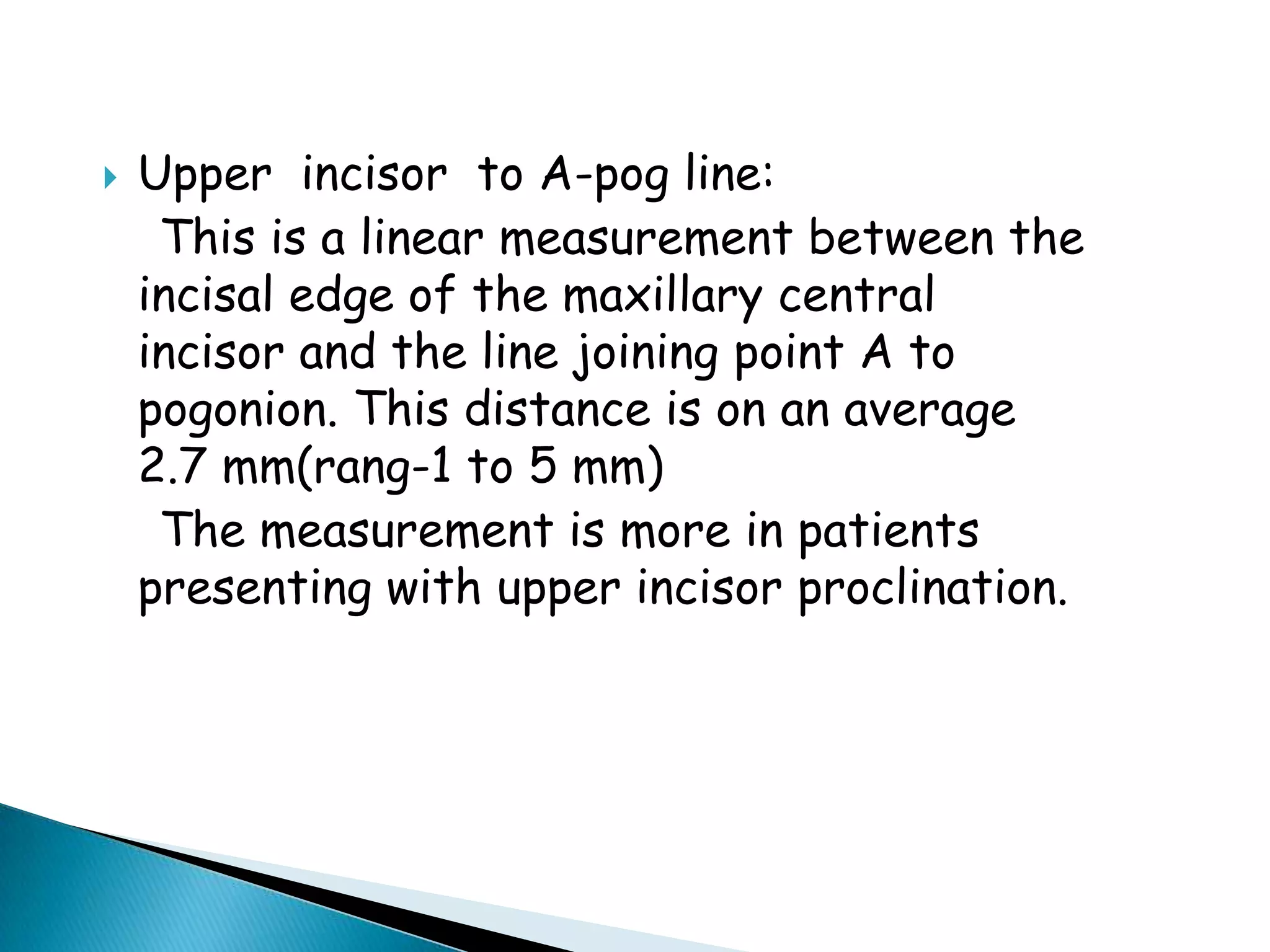
Upper  incisor  to A-pog line:    This is a linear measurement between the incisal edge of the maxillary central incisor and the line joining point A to pogonion. This distance is on an average 2.7 mm(rang-1 to 5 mm)    The measurement is more in patients presenting with upper incisor proclination.
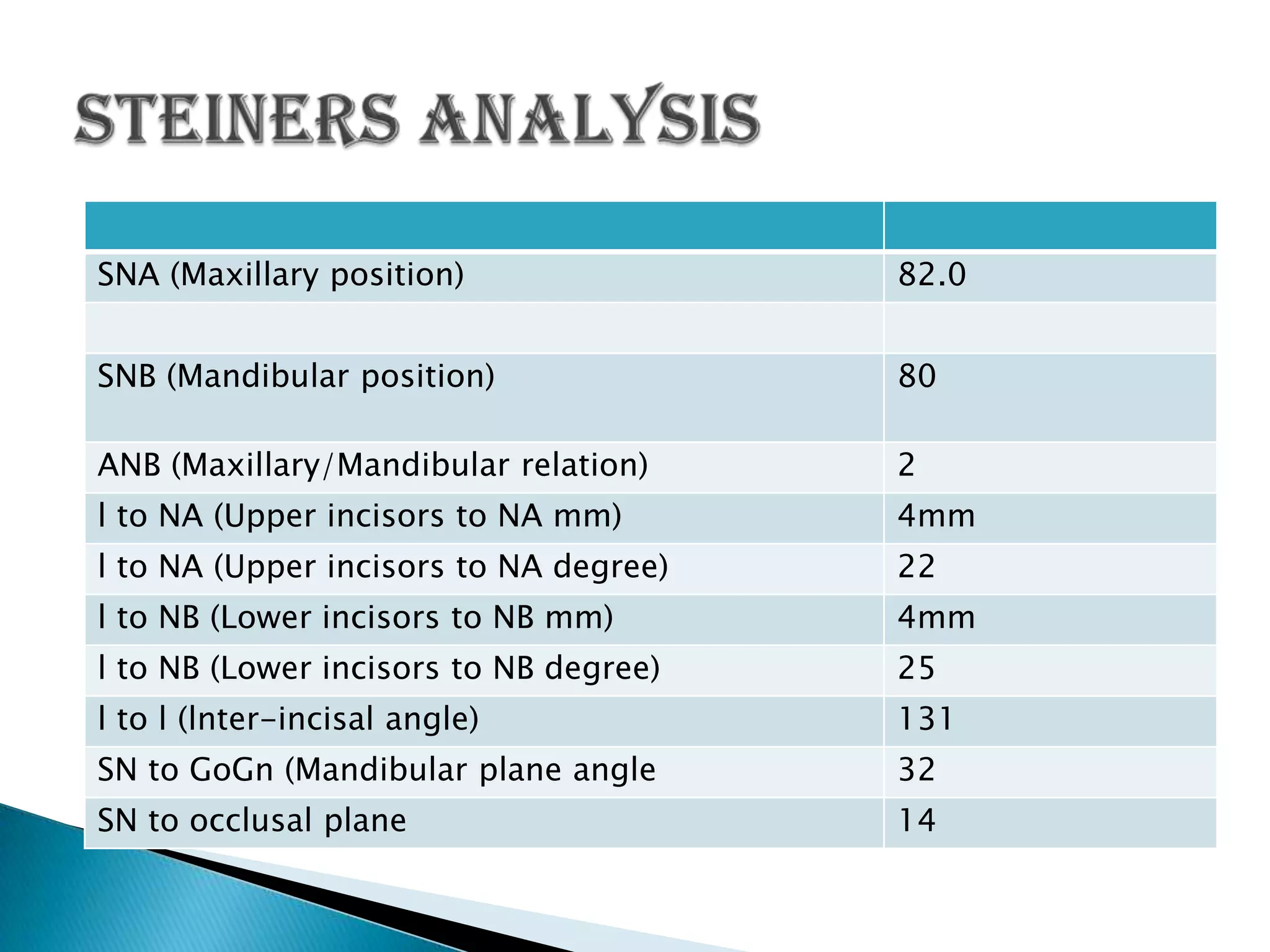
Steiners analysis
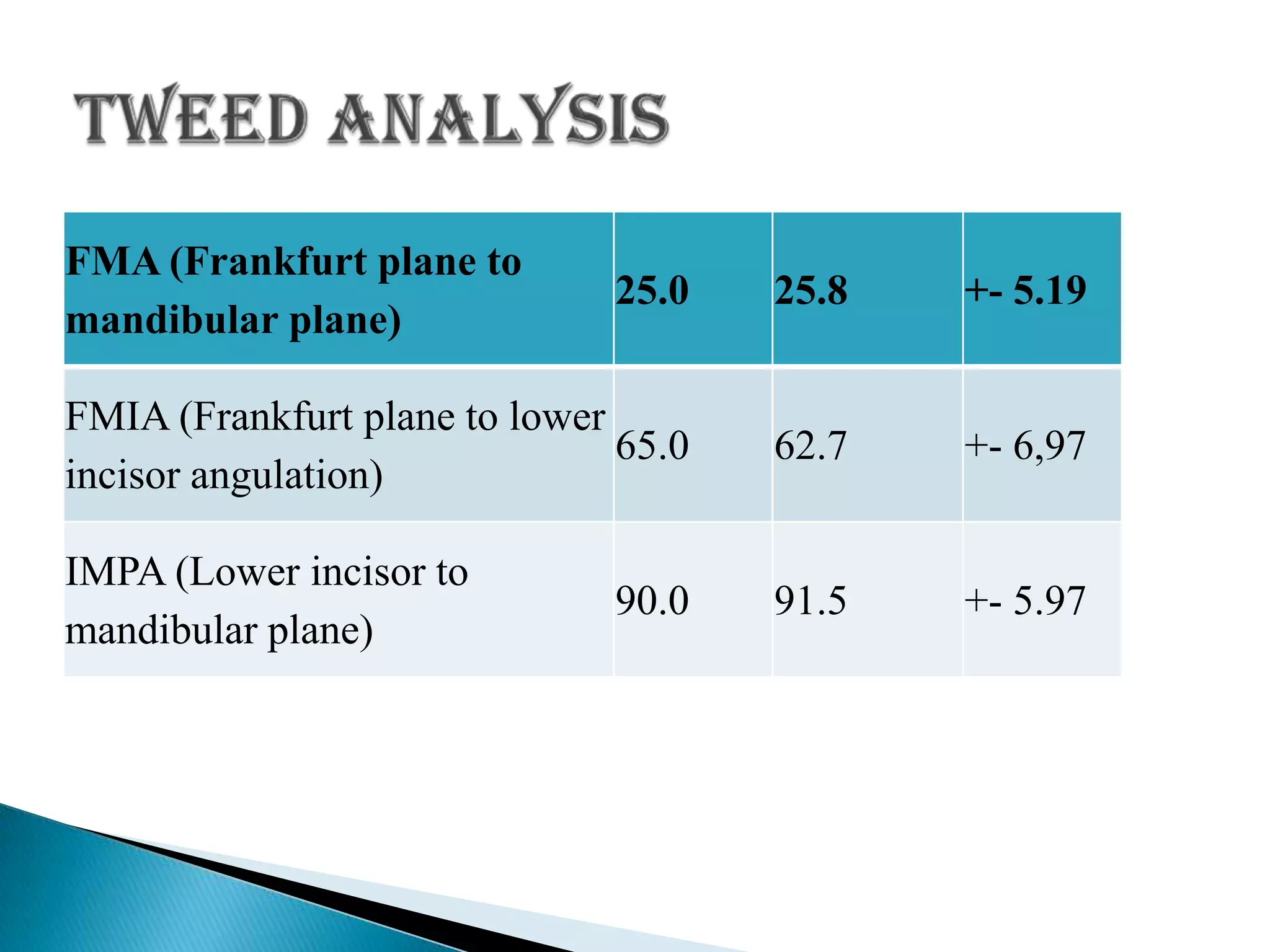
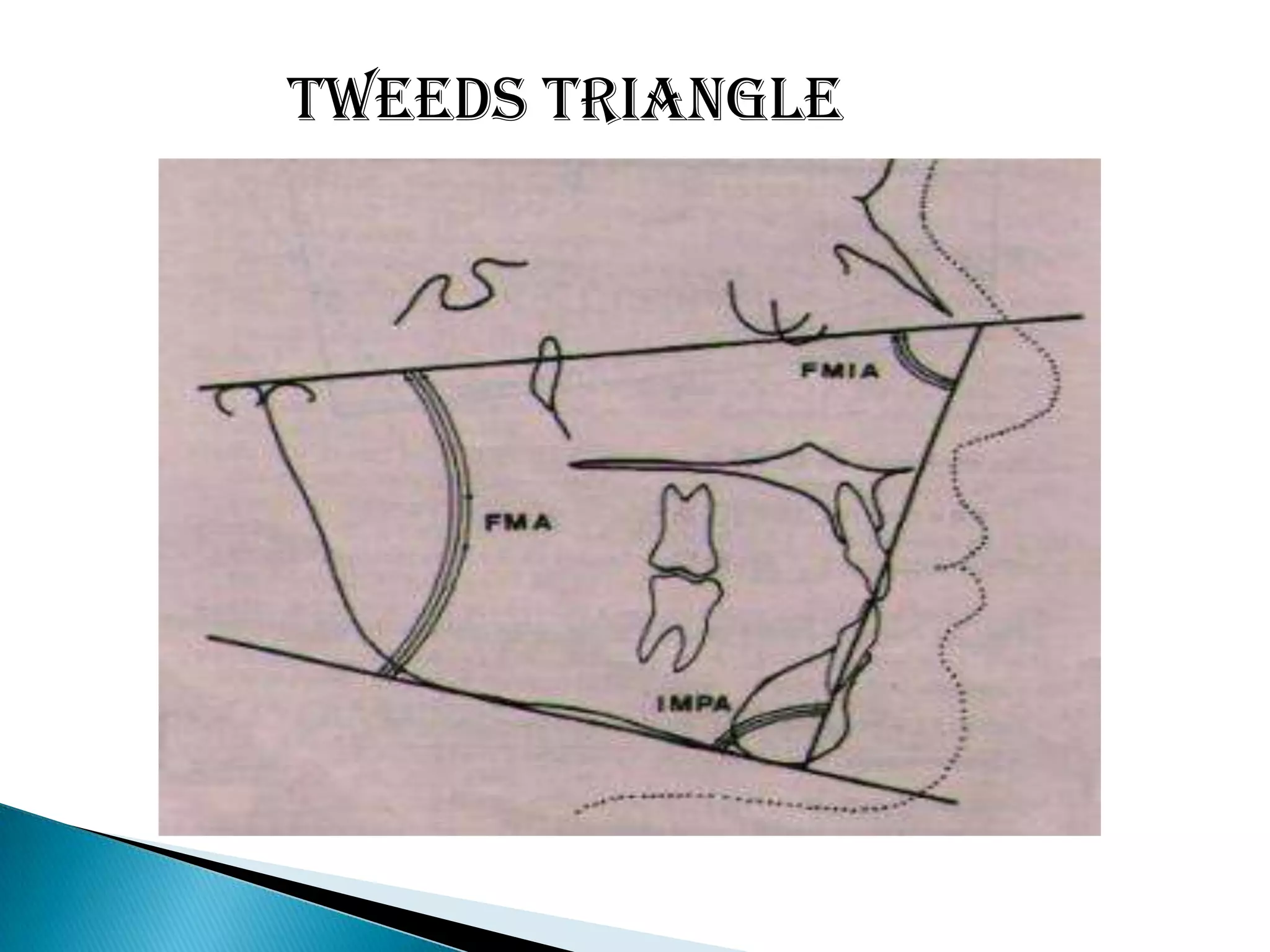
TWEED ANALYSIS
TWEEDS TRIANGLE
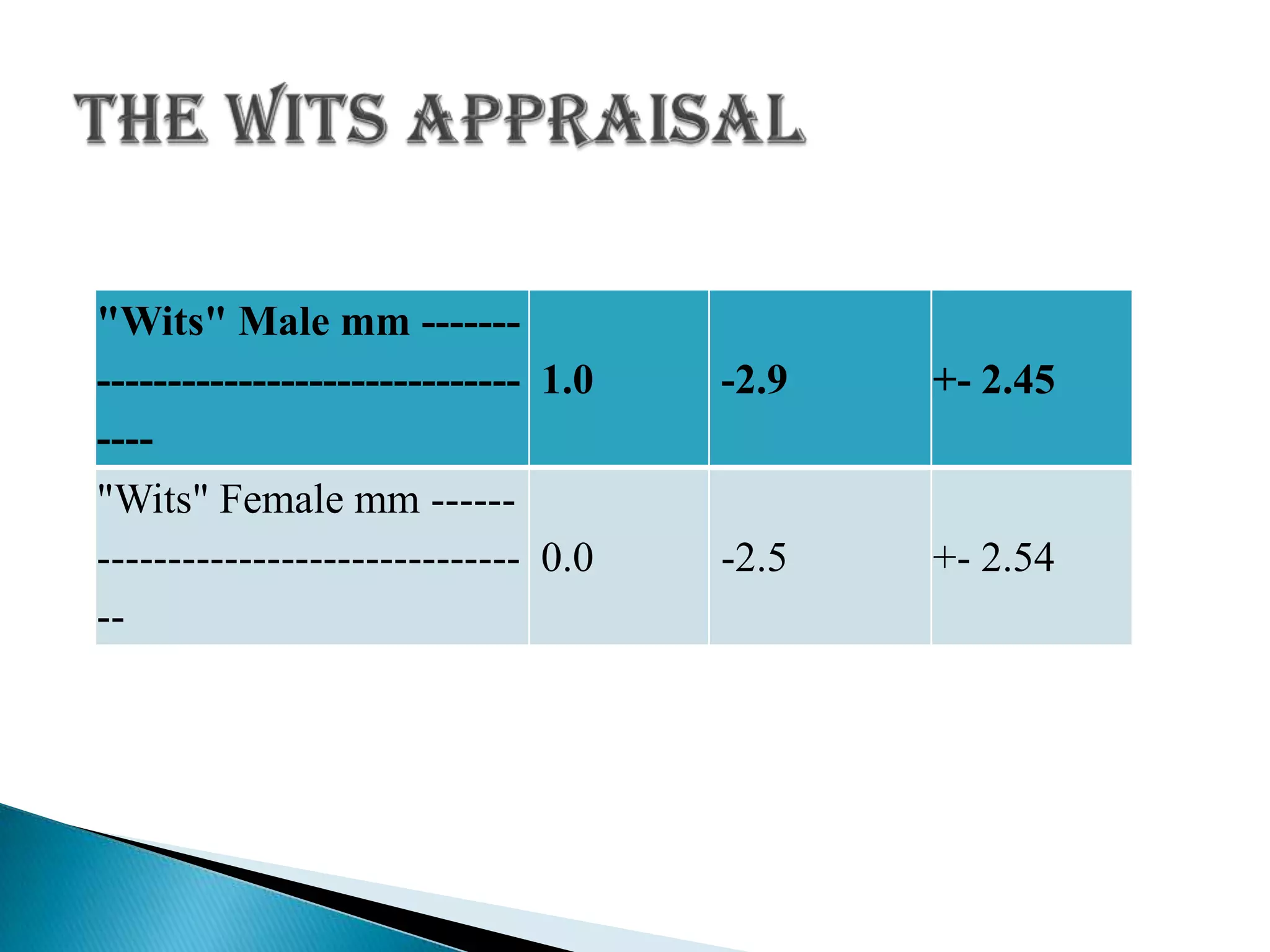
THE WITS APPRAISAL

Cephalometrics, diagnostic tool

  • 1.
    CEPHALOMETRICSByShameel ahmed shariffGUIDEDBY:DR. SHASHIKALA Professor and H.O.D., Dept. Of orthodontics.DR. APARNA.DR. ROSHAN.DR. SHEELA.
  • 2.
    CONTENTSIntroductionHistoryEquipmentTechnical aspectPositioning ofthe patientExposure parametersTypesUsesLandmarks and planesAnalysis
  • 3.
    Assessment of cranio-facialstructures forms a part of orthodontic diagnosis. Craniometry can be said to be the forerunner of cephalometry.Craniometry involved measurements of cranio facial dimensions of skulls of dead persons.This method was not practical in living individual due to soft tissue envelope that made direct measurement difficult and far reliable.Introduction
  • 4.
    Cephalometry was amodification of anthropological studies and craniometry.
  • 5.
    PACINI in 1922published the first paper on cephalometry.
  • 6.
    But it wasBROADENT(USA) and HOFRATH(Germany) who introduced and popularized in 1931.
  • 7.
    Clinical application ofcephalometry was introduced by DOWNS.History
  • 8.
    Broadent bolton type: Uses two x ray sources and two film holders.
  • 9.
    Lateral and AP cephalograms can be taken without moving the subject.
  • 10.
    More precise results can be obtained..EQUIPMENT
  • 11.
  • 12.
    HIGHLEYS TYPEUses onex ray source and one film holder
  • 13.
    Patient is repositionedfor various projections..
  • 14.
    Less reliable resultsas there is movement of subject.Other type of cephalometers of historical interestKorkhaus, 1938HOFRATH TYPE
  • 15.
  • 16.
    Technical aspectCephalometric radiographsare taken using an apparatus that consist of an x ray source and an head holding device called cephalostat.Cephalostat consists of two ear rods preventing movement of head.Vertical stabilisation of head is by orbital pointer contacting lower border of orbit.
  • 17.
    Upper part offace is supported by forehead clamp positioned above the region of nasal bridge.The distance between the x ray source and mid saggital plane of the patient is fixed at 5 feet.Thus the equipment helps in standardising the radiographs.
  • 18.
    F.H. plane shouldbe parallel to floor.Ear rods stabilize the patient on the horizontal plane.Patient is made to close the mouth in centric occlusion.Orbital pointer should be fixed for vertical plane stabilization of patient.POSITIONING OF THE PATIENT
  • 19.
    75 โ€“ 80Kvp7 โ€“ 8 ma0.8 secExposure parameters
  • 20.
    Lateral cephalogram; provideslateral view of skull.Frontal cephalogram; provides anteroposterior view of skull.Types
  • 21.
    Helps in orthodonticdiagnosis.Helps in classification of skeletal and dental abnormalities.Helps in planning treatment of an individual.Helps in evaluation of treatment results.Helps in predicting growth related changes.Uses
  • 22.
  • 23.
    S Sella: the midpoint of Sella TurcicaN Nasion: the extreme anterior point on the frontonasal suturesna Spina nasalis anterior: the extreme anterior point on the maxillasnp Spina nasalis posterior: the extreme posterior point on the maxillaPtPterygoid point: the extreme superior point of the pterygopalatine fossa
  • 24.
    A Point A: the deepest point in the curvature of the maxillary alveolar processB Point B: the deepest point in the curvature of the mandibular alveolar processPg Pogonion: the extreme anterior point of the chinMe Menton: the extreme inferior point of the chinGn Gnathion: the midpoint between pogonion and menton
  • 25.
    Go Gonion: the midpoint of the mandibular angle between ramus and corpus mandibulaeO Opisthion: the posterior border of foramen magnumBa Basion: the anterior border of foramen magnumCd Condylion: the extreme superior point of the condyleFc Fossa cranialis: the intersection between the sphenoidal plane and the larger wing of the sphenoidL Lambda: the midpoint of the lambdoid suture on the external cranial contour
  • 26.
    Horizontal planes:S.N. Planeโ€“ sella to nasion.F.H. Plane โ€“ orbitale to porion.Occlusal plane โ€“ plane bisecting posterior occlusion.Palatal plane โ€“ ANS to PNS of palatine bone.Mandibular plane โ€“ gonion to gnathion. Planes used in cephalometrics
  • 27.
    VERTICAL PLANES:A-Pog lineโ€“ point A on maxilla to pogonion on mandible.Facial plane โ€“ nasion to pogonion,Facial axis โ€“ ptm point to gnathion.E-plane โ€“ esthethic plane is a line between the most anterior point of soft tissue nose to soft tissue chin.
  • 28.
    It is oneof the most frequently used cephalometric analysis.Downs analysis consists of ten parameters of which five are skeletal and five are dental.Downs analysis;
  • 29.
    Facial angle; it is the inside inferior angle formed by intersection of nasion-pogonion plane and F.H. plane. average value; 87.8โ€™ ( 82 โ€“ 95โ€™) significance; indication of antero- posterior positioning of mandible in relation to upper face. Angle is increased in skeletal class III with prominent chin while decreased in skeletal class II.Skeletal parameters;
  • 30.
    Angle of convexity; Nasion-point A to point A โ€“ pogonion. Average value; 0โ€™ ( -8.5 to 10โ€™). Significance; A positive angle suggest a prominent maxillary denture bace in relation to mandible. Negative angle is indicative of prognathic profile.
  • 31.
    A-B plane angle; point A โ€“ point B to nasion โ€“ pogonion. Average value; -4.6โ€™ ( -9 to 0โ€™) Significance; indicative of maxillo mandibular relationship in relation to facial plane. Negative since point B is positioned behind point A. Positive in class III malocclusion.
  • 32.
    Mandibular plane angle; Intersection of mandibular plane with F.H. Plane. Average value; 21.9โ€™ ( 17 to 28โ€™)Y-Axis; Sella gnathion to F.H. plane. Average value; 59โ€™ ( 53โ€™ to 66โ€™) Angle is larger in class II facial patterns. Indicates growth pattern of a individual.
  • 33.
    Cant of occlusalplane; OCCLUSAL PLANE TO F.H. Plane Average value; 9.3 ( 1.5 to 14โ€™) Gives a measure of slope of occlusal plane relative to F.H. Plane.Inter incisal angle; Angle between long axes of upper and lower incisors. Average value: 135.4โ€™ ( 130 to 150.5โ€™) increased in class I bimaxillary protrusion.DENTAL PARAMETERS
  • 34.
    Incisor occlusal planeangle; This is the inside inferior angle formed by the intersection between the long axis of lover central incisor and the occlusal plane and is read as a plus or minus deviation from a right angle Average value: 14.5โ€ ( 3.5 to 20โ€™) An increase in this angle is suggestive of increased lover incisor proclination. Incisor mandibular plane angle: This angel is formed by intersection of the long axis of the lower incisor and the mandibular plane. Average value: 1.4โ€™(-8.2 to 7โ€™) An increase in this angle is suggestive of increased lower incisor proclination.
  • 35.
    Upper incisor to A-pog line: This is a linear measurement between the incisal edge of the maxillary central incisor and the line joining point A to pogonion. This distance is on an average 2.7 mm(rang-1 to 5 mm) The measurement is more in patients presenting with upper incisor proclination.
  • 36.
  • 38.
  • 39.
  • 40.
  • 41.
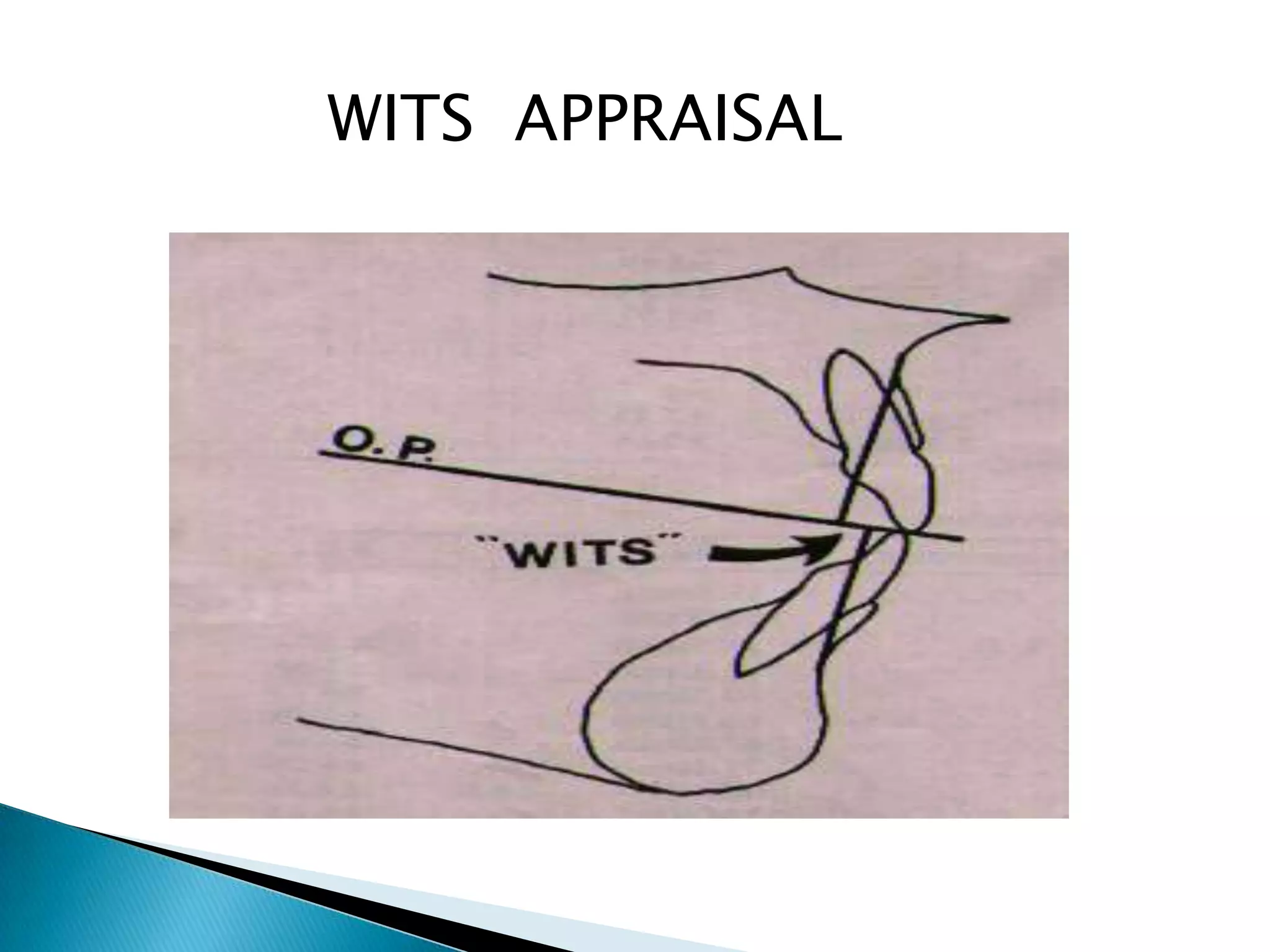
    It determines theextent to which mandible and maxilla are related to each other.Wits appraisal is used in cases where the ANB angle is considered not so reliable due to factors such as position of nasion or rotation of jaws.
  • 42.
    Method The methodincludes drawing an occlusal plane through overlapping cusps of first premolars and molars.Then perpendiculars are drawn to occlusal plane from point A and point B.The point of contact are termed as AO and BO.Distance between AO and BO gives antero posterior relationship between two jaws.
  • 43.
  • 44.
    Beggs techniques,Bishara,Graber, modernprinciples,M.S.Rani,Balaji,Internet,References
  • 45.
    Dr. Shashikala madam,MyParents, My Sister, Dr.Ayesha,My brother, Dr.SuhailMr. Sadakath,Librarian sir,Acknowledgements