
BRACKET PRESCRIPTION
DR. MUHAMAMAD SHARIQ SOHAIL
PGR ORTHODONTICS
FMH COLLEGE OF MEDICINE AND
DENTISTRY
PRESENTATION OUTLINE
• Introduction
• Types of Brackets
• Types of Brackets prescriptions
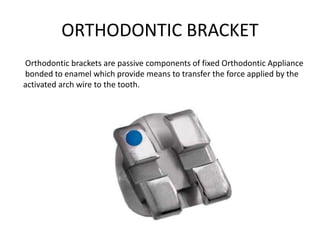
ORTHODONTIC BRACKET
Orthodontic brackets are passive components of fixed Orthodontic Appliance
bonded to enamel which provide means to transfer the force applied by the
activated arch wire to the tooth.
TYPES OF BRACKETS
• Metal brackets
• Ceramic brackets
• Plastic brackets
• Self ligating brackets
• Active and passive self ligating
• Invisalign-Invisible braces
• Lingual braces
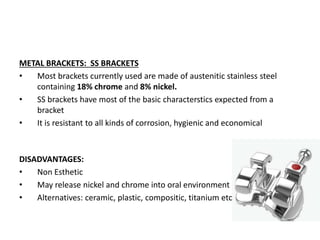
METAL BRACKETS: SS BRACKETS
• Most brackets currently used are made of austenitic stainless steel
containing 18% chrome and 8% nickel.
• SS brackets have most of the basic characterstics expected from a
bracket
• It is resistant to all kinds of corrosion, hygienic and economical
DISADVANTAGES:
• Non Esthetic
• May release nickel and chrome into oral environment
• Alternatives: ceramic, plastic, compositic, titanium etc
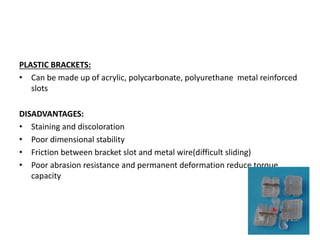
PLASTIC BRACKETS:
• Can be made up of acrylic, polycarbonate, polyurethane metal reinforced
slots
DISADVANTAGES:
• Staining and discoloration
• Poor dimensional stability
• Friction between bracket slot and metal wire(difficult sliding)
• Poor abrasion resistance and permanent deformation reduce torque
capacity
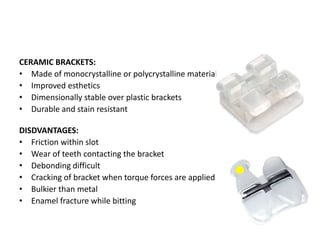
CERAMIC BRACKETS:
• Made of monocrystalline or polycrystalline material
• Improved esthetics
• Dimensionally stable over plastic brackets
• Durable and stain resistant
DISDVANTAGES:
• Friction within slot
• Wear of teeth contacting the bracket
• Debonding difficult
• Cracking of bracket when torque forces are applied
• Bulkier than metal
• Enamel fracture while bitting
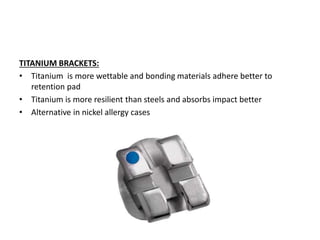
TITANIUM BRACKETS:
• Titanium is more wettable and bonding materials adhere better to
retention pad
• Titanium is more resilient than steels and absorbs impact better
• Alternative in nickel allergy cases
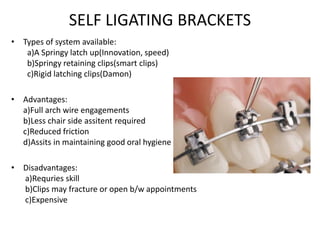
SELF LIGATING BRACKETS
• Types of system available:
a)A Springy latch up(Innovation, speed)
b)Springy retaining clips(smart clips)
c)Rigid latching clips(Damon)
• Advantages:
a)Full arch wire engagements
b)Less chair side assitent required
c)Reduced friction
d)Assits in maintaining good oral hygiene
• Disadvantages:
a)Requries skill
b)Clips may fracture or open b/w appointments
c)Expensive
WHY BRACKET SELECTION IS NECESSARY
FUNDAMENTALS OF TREATMENT MECHANICS:
• Bracket selection
• Archwire selection
• Bracket positioning
• Force levels
CHOOSING A BRACKET PRESCRIPTION:
• Torque
• Tip
• In –Out:
• Rotation:
• Slot:
BRIEF HISTORY
ANGLE’S PROGRESSION TO THE EDGEWISE APPLAINCE:
E Arch  Pin and Tube  Ribbon arch  Edge wise  Contemporary
edge wise.
CONTEMPORARY EDGEWISE:
1) Automatic rotational control
2)Alteration in bracket slot dimension
3)Straight wire prescription.
*Andrews developed straight wire appliance to eliminate need for wire
bending needed to compensate for varations in individual tooth anatomy
ANDREW’S
• 1ST Generation of preadjusted brackets
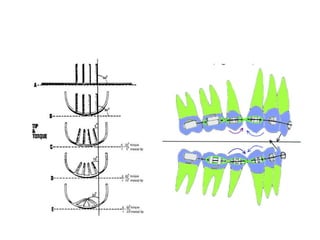
• He empahsized on Wagon wheel effect where tip was lost as torque
added so he chose to add additional tip to anterior brackets.
• He used basal bone of mandible as an arch form reference
• Rolar coaster effect: due to excessive force and use of elastic retraction
mechanics  deeping of anterior bite with creation of lateral open bite
• Modifications of Andrew’s:
1)Wide range of brackets
2)Extraction cases: Canine bracktes with anti tip, anti rotation, power
arms
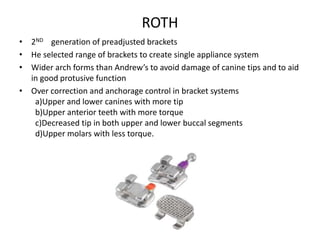
ROTH
• 2ND generation of preadjusted brackets
• He selected range of brackets to create single appliance system
• Wider arch forms than Andrew’s to avoid damage of canine tips and to aid
in good protusive function
• Over correction and anchorage control in bracket systems
a)Upper and lower canines with more tip
b)Upper anterior teeth with more torque
c)Decreased tip in both upper and lower buccal segments
d)Upper molars with less torque.
MC LAUGHIN AND BENNETT
• Sliding mechanics and continous light forces using SWA
• Mechanics: accurate bracket postioning
Lacebacks and bend backs for early anchorage control with
light arch wire force
• Anterior tip reduced and Torque increased in incisor and molar region.
Additional anterior tip disadvantage:
1)It Creates significant strain on anterior and posterior anchorage
2)Increased tendency of bite deepining during alignment stage
3)Brought upper canine roots close to premolar roots in some cases.
MC LAUGHIN AND BENNETT
Overview of MBT treatment philosophy:
• Bracket selection
• Versatility of bracket system
• Accuracy of bracket positioning with help of gauges
• Light continous force
• .022 vs 0.18 slot
• Anchorage control In early treatment
• Group movement
• Use of 3 arch forms
• 1 size of rectangular steel wire
• Arch wire hooks
• Methods of archwire ligation
• Awareness of tooth size discrepancies
• Persistence in finishing
MC LAUGHIN AND BENNETT
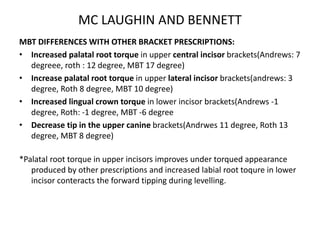
MBT DIFFERENCES WITH OTHER BRACKET PRESCRIPTIONS:
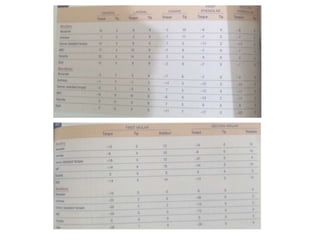
• Increased palatal root torque in upper central incisor brackets(Andrews: 7
degreee, roth : 12 degree, MBT 17 degree)
• Increase palatal root torque in upper lateral incisor brackets(andrews: 3
degree, Roth 8 degree, MBT 10 degree)
• Increased lingual crown torque in lower incisor brackets(Andrews -1
degree, Roth: -1 degree, MBT -6 degree
• Decrease tip in the upper canine brackets(Andrwes 11 degree, Roth 13
degree, MBT 8 degree)
*Palatal root torque in upper incisors improves under torqued appearance
produced by other prescriptions and increased labial root toqure in lower
incisor conteracts the forward tipping during levelling.
VERSATILITY
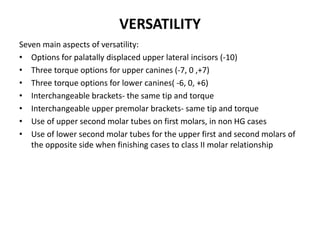
Seven main aspects of versatility:
• Options for palatally displaced upper lateral incisors (-10)
• Three torque options for upper canines (-7, 0 ,+7)
• Three torque options for lower canines( -6, 0, +6)
• Interchangeable brackets- the same tip and torque
• Interchangeable upper premolar brackets- same tip and torque
• Use of upper second molar tubes on first molars, in non HG cases
• Use of lower second molar tubes for the upper first and second molars of
the opposite side when finishing cases to class II molar relationship
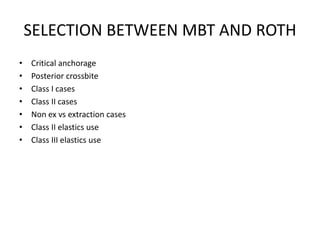
SELECTION BETWEEN MBT AND ROTH
• Critical anchorage
• Posterior crossbite
• Class I cases
• Class II cases
• Non ex vs extraction cases
• Class II elastics use
• Class III elastics use
Bracket prescription(Orthodontics)

Bracket prescription(Orthodontics)

  • 1.
    BRACKET PRESCRIPTION DR. MUHAMAMADSHARIQ SOHAIL PGR ORTHODONTICS FMH COLLEGE OF MEDICINE AND DENTISTRY
  • 2.
    PRESENTATION OUTLINE • Introduction •Types of Brackets • Types of Brackets prescriptions
  • 3.
    ORTHODONTIC BRACKET Orthodontic bracketsare passive components of fixed Orthodontic Appliance bonded to enamel which provide means to transfer the force applied by the activated arch wire to the tooth.
  • 4.
    TYPES OF BRACKETS •Metal brackets • Ceramic brackets • Plastic brackets • Self ligating brackets • Active and passive self ligating • Invisalign-Invisible braces • Lingual braces
  • 5.
    METAL BRACKETS: SSBRACKETS • Most brackets currently used are made of austenitic stainless steel containing 18% chrome and 8% nickel. • SS brackets have most of the basic characterstics expected from a bracket • It is resistant to all kinds of corrosion, hygienic and economical DISADVANTAGES: • Non Esthetic • May release nickel and chrome into oral environment • Alternatives: ceramic, plastic, compositic, titanium etc
  • 6.
    PLASTIC BRACKETS: • Canbe made up of acrylic, polycarbonate, polyurethane metal reinforced slots DISADVANTAGES: • Staining and discoloration • Poor dimensional stability • Friction between bracket slot and metal wire(difficult sliding) • Poor abrasion resistance and permanent deformation reduce torque capacity
  • 7.
    CERAMIC BRACKETS: • Madeof monocrystalline or polycrystalline material • Improved esthetics • Dimensionally stable over plastic brackets • Durable and stain resistant DISDVANTAGES: • Friction within slot • Wear of teeth contacting the bracket • Debonding difficult • Cracking of bracket when torque forces are applied • Bulkier than metal • Enamel fracture while bitting
  • 8.
    TITANIUM BRACKETS: • Titaniumis more wettable and bonding materials adhere better to retention pad • Titanium is more resilient than steels and absorbs impact better • Alternative in nickel allergy cases
  • 9.
    SELF LIGATING BRACKETS •Types of system available: a)A Springy latch up(Innovation, speed) b)Springy retaining clips(smart clips) c)Rigid latching clips(Damon) • Advantages: a)Full arch wire engagements b)Less chair side assitent required c)Reduced friction d)Assits in maintaining good oral hygiene • Disadvantages: a)Requries skill b)Clips may fracture or open b/w appointments c)Expensive
  • 10.
    WHY BRACKET SELECTIONIS NECESSARY FUNDAMENTALS OF TREATMENT MECHANICS: • Bracket selection • Archwire selection • Bracket positioning • Force levels CHOOSING A BRACKET PRESCRIPTION: • Torque • Tip • In –Out: • Rotation: • Slot:
  • 11.
    BRIEF HISTORY ANGLE’S PROGRESSIONTO THE EDGEWISE APPLAINCE: E Arch  Pin and Tube  Ribbon arch  Edge wise  Contemporary edge wise. CONTEMPORARY EDGEWISE: 1) Automatic rotational control 2)Alteration in bracket slot dimension 3)Straight wire prescription. *Andrews developed straight wire appliance to eliminate need for wire bending needed to compensate for varations in individual tooth anatomy
  • 12.
    ANDREW’S • 1ST Generationof preadjusted brackets • He empahsized on Wagon wheel effect where tip was lost as torque added so he chose to add additional tip to anterior brackets. • He used basal bone of mandible as an arch form reference • Rolar coaster effect: due to excessive force and use of elastic retraction mechanics  deeping of anterior bite with creation of lateral open bite • Modifications of Andrew’s: 1)Wide range of brackets 2)Extraction cases: Canine bracktes with anti tip, anti rotation, power arms
  • 14.
    ROTH • 2ND generationof preadjusted brackets • He selected range of brackets to create single appliance system • Wider arch forms than Andrew’s to avoid damage of canine tips and to aid in good protusive function • Over correction and anchorage control in bracket systems a)Upper and lower canines with more tip b)Upper anterior teeth with more torque c)Decreased tip in both upper and lower buccal segments d)Upper molars with less torque.
  • 15.
    MC LAUGHIN ANDBENNETT • Sliding mechanics and continous light forces using SWA • Mechanics: accurate bracket postioning Lacebacks and bend backs for early anchorage control with light arch wire force • Anterior tip reduced and Torque increased in incisor and molar region. Additional anterior tip disadvantage: 1)It Creates significant strain on anterior and posterior anchorage 2)Increased tendency of bite deepining during alignment stage 3)Brought upper canine roots close to premolar roots in some cases.
  • 16.
    MC LAUGHIN ANDBENNETT Overview of MBT treatment philosophy: • Bracket selection • Versatility of bracket system • Accuracy of bracket positioning with help of gauges • Light continous force • .022 vs 0.18 slot • Anchorage control In early treatment • Group movement • Use of 3 arch forms • 1 size of rectangular steel wire • Arch wire hooks • Methods of archwire ligation • Awareness of tooth size discrepancies • Persistence in finishing
  • 17.
    MC LAUGHIN ANDBENNETT MBT DIFFERENCES WITH OTHER BRACKET PRESCRIPTIONS: • Increased palatal root torque in upper central incisor brackets(Andrews: 7 degreee, roth : 12 degree, MBT 17 degree) • Increase palatal root torque in upper lateral incisor brackets(andrews: 3 degree, Roth 8 degree, MBT 10 degree) • Increased lingual crown torque in lower incisor brackets(Andrews -1 degree, Roth: -1 degree, MBT -6 degree • Decrease tip in the upper canine brackets(Andrwes 11 degree, Roth 13 degree, MBT 8 degree) *Palatal root torque in upper incisors improves under torqued appearance produced by other prescriptions and increased labial root toqure in lower incisor conteracts the forward tipping during levelling.
  • 18.
    VERSATILITY Seven main aspectsof versatility: • Options for palatally displaced upper lateral incisors (-10) • Three torque options for upper canines (-7, 0 ,+7) • Three torque options for lower canines( -6, 0, +6) • Interchangeable brackets- the same tip and torque • Interchangeable upper premolar brackets- same tip and torque • Use of upper second molar tubes on first molars, in non HG cases • Use of lower second molar tubes for the upper first and second molars of the opposite side when finishing cases to class II molar relationship
  • 19.
    SELECTION BETWEEN MBTAND ROTH • Critical anchorage • Posterior crossbite • Class I cases • Class II cases • Non ex vs extraction cases • Class II elastics use • Class III elastics use

Editor's Notes

  • #7 TO MINIMIZE FRICTION: 1)metal ss slots 2)Ceramic fillers(stable and have low friction)
  • #16 Anchorage control: light force reduced tip Laceback bendback
  • #19 Positive torque: root lingual crown labial
  • #20 Ceritical anchroage roth drains more anchorage than mbt Posterior crossbite roth… scissor bite mbt Clas II elastics: mbt in lower anteriors Class III elastics roth in lower anteriors