Articulators

• Dental articulator is an instrument or mechanical analogues of the
  TMJ & the upper & lower arches, advice to which casts of the upper
  and lower dentate or edentulous jaws can be attached for
  reproducing jaw relation and movement of the lower jaw relation to
  the upper.
• Purpose of an articulator:-
• *To hold the maxillary & mandibular cast in a determined fixed
  relationship.
• *To stimulate the jaw movements like opening & closing.
• *To produce border movements (extreme lateral & protrusive
  movements)
   Prof. Abdullateef Haidar
   A.haidar@live.com
Uses of an articulator:-

• *To diagnosis the state of occlusion in both the natural &
  relationship dentitions.
• *To plan dental procedures based on the relationship
  between opposing natural &artificial teeth .e.g. evaluation
  of the possibility of balanced occlusion.
• *To aid in the fabrication restorations & prosthodontic
  replacements.
• To correct & modify completed restorations.
• *To arrange artificial teeth
Uses of an articulator:-

• * The simplest form of articulator consists of two arms or
  bows united by a hinge. This type of instrument enables an
  accurate record of a single static relationship between the
  jaws to be maintained. And the only movement can be
  made is an opening and closing one about the hinge. It's
  known as a simple hinge articulator.
• * There are types of articulators. These articulators vary
  considerably in their capacity to stimulate jaw movement
  and relationship
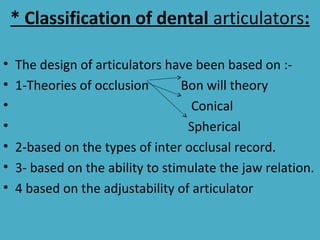
* Classification of dental articulators:

•   The design of articulators have been based on :-
•   1-Theories of occlusion       Bon will theory
•                                   Conical
•                                  Spherical
•   2-based on the types of inter occlusal record.
•   3- based on the ability to stimulate the jaw relation.
•   4 based on the adjustability of articulator
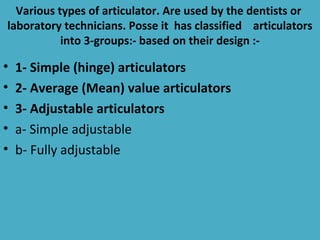
Various types of articulator. Are used by the dentists or
laboratory technicians. Posse it has classified articulators
           into 3-groups:- based on their design :-

•   1- Simple (hinge) articulators
•   2- Average (Mean) value articulators
•   3- Adjustable articulators
•   a- Simple adjustable
•   b- Fully adjustable
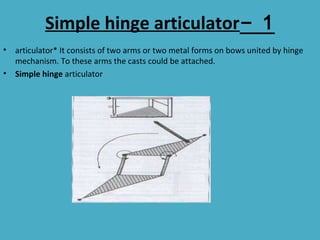
Simple hinge articulator- 1
•   articulator* It consists of two arms or two metal forms on bows united by hinge
    mechanism. To these arms the casts could be attached.
•   Simple hinge articulator
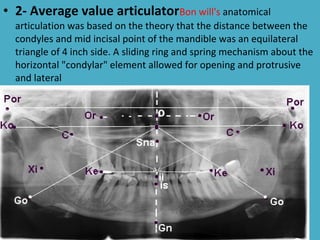
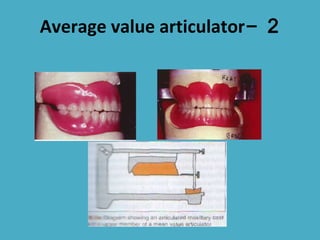
• 2- Average value articulatorBon will's anatomical
  articulation was based on the theory that the distance between the
  condyles and mid incisal point of the mandible was an equilateral
  triangle of 4 inch side. A sliding ring and spring mechanism about the
  horizontal "condylar" element allowed for opening and protrusive
  and lateral
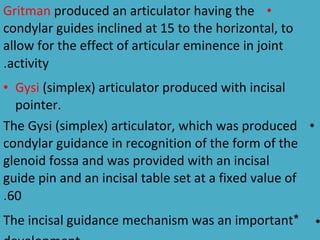
Gritman produced an articulator having the •
condylar guides inclined at 15 to the horizontal, to
allow for the effect of articular eminence in joint
.activity
• Gysi (simplex) articulator produced with incisal
  pointer.
The Gysi (simplex) articulator, which was produced •
condylar guidance in recognition of the form of the
glenoid fossa and was provided with an incisal
guide pin and an incisal table set at a fixed value of
.60
The incisal guidance mechanism was an important*         •
 
Average value articulator- 2
: Adjustable articulators- 3

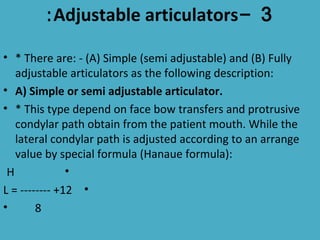
• * There are: - (A) Simple (semi adjustable) and (B) Fully
   adjustable articulators as the following description:
• A) Simple or semi adjustable articulator.
• * This type depend on face bow transfers and protrusive
   condylar path obtain from the patient mouth. While the
   lateral condylar path is adjusted according to an arrange
   value by special formula (Hanaue formula):
 H             •
L = -------- +12 •
•       8
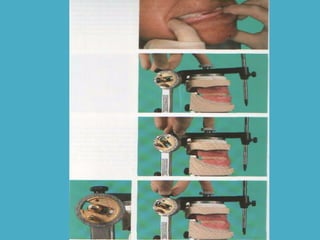
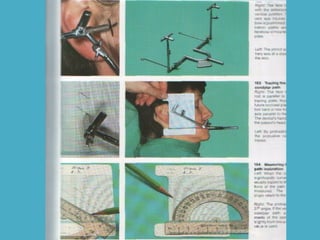
* Face Bow:

Face Bow: it is caliper-like device which is used to record* •
the relation ship between the inter-condylar axis and either
.the maxillary and mandibular arch
This relationship can be record or transferred to an*
articulator, so that casts of patient's jaws will assume the
same relationship to the hinge axis of articulator as that of
the upper or lower jaw of the patient to inter-condylar
.axis
:     Two types of face bow exist* •
Simple (arbitrary) face bow- 1 •
( The hinge axis (kinemetic FB- 2 •
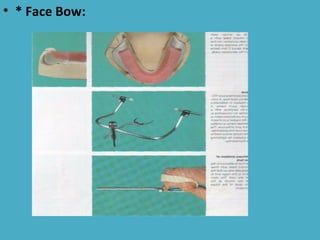
The face bow consist of (U) shaped body (frame) which is* •
large enough to extend from the TMJ about 5-7.5cm in
front of the face. The face bow have condyles indicators
(rods) touch the condyle region and this is the fork which
touch to the occlusal rim the condyle rod position in front
of the external auditory meatus 13mm on the line extend
.from the outer cantus of eye to the top of the tragus
The body of the face bow carries a joint for securing a* •
fork having an off set rod attached and another for orbital
.pointer
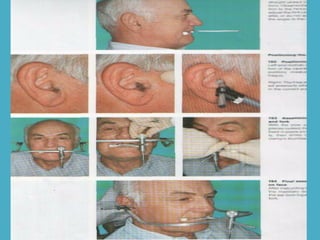
• * The face bow have the functions of locating the hinge axis
   and related the maxillary cast to this axis, and then to the
   facility of the mounting of the upper cast.
• * Face Bow:
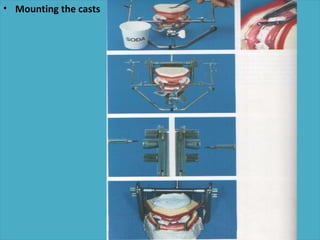
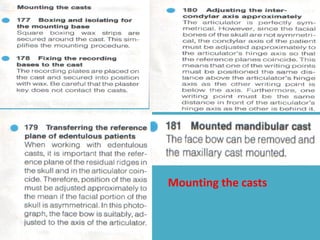
• Mounting the casts


  .
Mounting the casts
Dental Materials
                     Acrylic Resin

• Acrylic is the most commonly used polymer for denture
  base, it is lightweight and esthetically can be accepted.
  Acrylic is composed of chain of Methacrylate molecules
  linked together to give polymethyl methacrylate (PMMA),
  and it is either Heat Cure Acrylic or Cold Cure Acrylic.
• This is supplied as liquid and powder which are mixed
  together to be reacted and produce hard substance
  (denture base).
This is supplied as liquid and powder
   which are mixed together to be
reacted and produce hard substance
             (denture base).
  Powder composed of : 1) PMMA
            beads (polymer).
     Initiator (benzoyl peroxide).
   Pigments + Fibers some times.
• Liquid composed of : 1) Mathylmethacrylate
  (monomer).
• 2)Cross-Linking agent.
• 3) Inhibitor (hydroquinone). 4)Activator (in cold
  cured acrylic).
• Requisites for Dental Acrylic resin:
• 1- Biologic Consideration That it should be tasteless,
  odorless, nontoxic and have nonirritating to the oral
  tissues. It should be insoluble in saliva and have resistance
  to microbial growth.
• 2- Physical Properties: The resin should posses adequate
  strength and resilience to resist biting or chewing forces,
  excessive wear. It should be dimensional stable and include
   Prof. Abdullateef Haidar
  thermal changes.
   A.haidar@live.com
• Requisites for Dental Acrylic resin:
• 3- Esthetic Properties: The material should have sufficient
  translucency to be compatible with the appearance of oral
  cavity and also it should be Radio-opaque with x-ray.
• 4- Handling Characteristics: It should be easily to mix,
  shaped, cured and insert. The final product should be easy
  to polish and could be repair easily if it is fracture.
• 5- Economic Consideration: It should have low cost and
  should not require complex equipments.
• 6- Overall Performance of Methacrylate: Although the
  mathacrylate fulfill these requirements reasonably well, no
  resin till now met all the mentioned requirement.
• Manipulation:
• The powder and liquid should be mixed together in
  a ratio 2.5:1 by weight and 3:1 by volume as
  polymer/monomer ratio.
• The correct ratio is important because if we use
  high rate of powder, not all the polymer (powder)
  will be wet by monomer (liquid), so the acrylic will
  be granules. And if the liquid in high rate there will
  be shrinkage of the acrylic base due to uncomplete
  polymerization. So the more monomer
  more shrinkage.
• Activation and Curing:The mode of activation and curing of
  the resin mixture is either cold (self curing acrylic) or hot
  (heat curing acrylic) according to the acrylic type
• 1- Heat Cured Acrylic Resin: There are many method for
  polymerization acrylic resin, but the conventional method is by using
  hot-water bath container for 7hr at 700C , then 3hr at 1000C. This
  method can be used faster, also there is Microwave energy method,
  it is widely used for construction complete and partial denture.
• 2- Cold Cured Acrylic Resin (Self Curing): This type does not need
  external heating because it should be self curing and polymerization.
  It is end with inaccurate size so it will decrease the retention of the
  denture base also it is more porous, less resistance to the abrasion,
  has allergic reaction (more residual monomer). So it is consider as
  less strong than heat cured acrylic. It is not used to construct
  complete or partial denture due to its disadvantages, but it can be
  used in orthodontic appliance, repairing of dentures, relining and
  when ever strength is not needed.
• Glass Transmition Temperature (Tg):
• The temperature at which there is an abrupt
  increase in the thermal expansion coff, indicate
  increase molecular mobility. (it is character of glass
  structure) when the Tg below the glass structure
  loses its fluid characteristics and has sufficient
  resistance to deformation, in other word it mean
  softening temp. and this temp. apply for glass,
  acrylic resin, waxes.
• Properties of Acrylic:
•   1) The Tg of self cure is 900C and 1050C for heat cure.
•   2) Poor impact strength.
•   3) Resist fracture of mastication.
•   4) Thermal insulator.
•   5) Low specific gravity (not heavy).
•   6) Radiolucent and could be radio paqe with metal foil strips.
•   7) Absorb water (cold curing type is more).
•   8) Good esthetic and color.
•   9)Drying out of acrylic cause cracks.
•   10) Less hardness in compare with gold or chrom-cobalt.
•   11) Insoluble in the fluid that may be in contact with oral cavity.
•   12) Insufficient manipulation and curing process lead to porosity
    (gaseous porosity).
• Heat Activated Acrylic Resin:
• Heat-activated or heat-cured acrylic resin used in fabrication of
  nearly all denture bases. It need thermal energy for polymerization,
  that will provided using water path or microwave over or other type
  of heat and pleasure to reach the material to complete
  polymerization.
• Composition: As it discussed before that it composed from powder
  and liquid ,and the powder (polymer) consist of spheres of
  polymethylmeth acrylate and small amount of benzyl peroxide (the
  initiator). The liquid consist of un polymerized (methylmetha crylate)
  with small amount of hydroquinone as inhibitor to prevent
  undesirable polymerization or setting of the liquid during storage.
  Also the liquid or monomer consist of Glycoldimeth acrylare base
  used as cross-linking agent by the double bound per molecule.
• The storage of acrylic is recommended for limited time and
  temperature, because its properties will change within the time.
• Polymer-Monomer Interaction:
• When powder and liquid are mixed in the proper proportion, a
  workable mass is produced after passing different stages:
• 1- Sandy stage. 2- Sticky stage. 3- Dough stage (workable). 4-
  Rubber stage. 5- Stiff or Hard stage.
• According to ADA specification No.12 the mixture require at least
  5min to reach the dough stage which is the workable time, so we
  should consider this time during the manipulation process.
• Polymerization Cycle:
• The heating process used to control polymerization is
  called the polymerization cycle or curing cycle. This process
  should be controlled to avoid porosity or bubbles inside the
  denture base which may be happened by the effects of
  uncontrolled temperature (boiling of monomer).
• Chemically Activated Acrylic Resin:
• It also called Auto polymerizing Resin or Cold-curing
  or Self curing. The addition of tertiary amine
  (dimethyl-para-toluidine) to the liquid (monomer),
  the tertiary amine will work to decompose of the
  benzoyl peroxide when mixing the powder with the
  liquid.
• So that the fundamental difference between heat
  and cold curing acrylic is the method of dividing the
  benzoyl peroxide which is the initiator or reaction.

Articulators

  • 1.
    Articulators • Dental articulatoris an instrument or mechanical analogues of the TMJ & the upper & lower arches, advice to which casts of the upper and lower dentate or edentulous jaws can be attached for reproducing jaw relation and movement of the lower jaw relation to the upper. • Purpose of an articulator:- • *To hold the maxillary & mandibular cast in a determined fixed relationship. • *To stimulate the jaw movements like opening & closing. • *To produce border movements (extreme lateral & protrusive movements) Prof. Abdullateef Haidar A.haidar@live.com
  • 2.
    Uses of anarticulator:- • *To diagnosis the state of occlusion in both the natural & relationship dentitions. • *To plan dental procedures based on the relationship between opposing natural &artificial teeth .e.g. evaluation of the possibility of balanced occlusion. • *To aid in the fabrication restorations & prosthodontic replacements. • To correct & modify completed restorations. • *To arrange artificial teeth
  • 3.
    Uses of anarticulator:- • * The simplest form of articulator consists of two arms or bows united by a hinge. This type of instrument enables an accurate record of a single static relationship between the jaws to be maintained. And the only movement can be made is an opening and closing one about the hinge. It's known as a simple hinge articulator. • * There are types of articulators. These articulators vary considerably in their capacity to stimulate jaw movement and relationship
  • 4.
    * Classification ofdental articulators: • The design of articulators have been based on :- • 1-Theories of occlusion Bon will theory • Conical • Spherical • 2-based on the types of inter occlusal record. • 3- based on the ability to stimulate the jaw relation. • 4 based on the adjustability of articulator
  • 5.
    Various types ofarticulator. Are used by the dentists or laboratory technicians. Posse it has classified articulators into 3-groups:- based on their design :- • 1- Simple (hinge) articulators • 2- Average (Mean) value articulators • 3- Adjustable articulators • a- Simple adjustable • b- Fully adjustable
  • 6.
    Simple hinge articulator-1 • articulator* It consists of two arms or two metal forms on bows united by hinge mechanism. To these arms the casts could be attached. • Simple hinge articulator
  • 7.
    • 2- Averagevalue articulatorBon will's anatomical articulation was based on the theory that the distance between the condyles and mid incisal point of the mandible was an equilateral triangle of 4 inch side. A sliding ring and spring mechanism about the horizontal "condylar" element allowed for opening and protrusive and lateral
  • 8.
    Gritman produced anarticulator having the • condylar guides inclined at 15 to the horizontal, to allow for the effect of articular eminence in joint .activity • Gysi (simplex) articulator produced with incisal pointer. The Gysi (simplex) articulator, which was produced • condylar guidance in recognition of the form of the glenoid fossa and was provided with an incisal guide pin and an incisal table set at a fixed value of .60 The incisal guidance mechanism was an important* •
  • 9.
  • 10.
    : Adjustable articulators-3 • * There are: - (A) Simple (semi adjustable) and (B) Fully adjustable articulators as the following description: • A) Simple or semi adjustable articulator. • * This type depend on face bow transfers and protrusive condylar path obtain from the patient mouth. While the lateral condylar path is adjusted according to an arrange value by special formula (Hanaue formula): H • L = -------- +12 • • 8
  • 12.
    * Face Bow: FaceBow: it is caliper-like device which is used to record* • the relation ship between the inter-condylar axis and either .the maxillary and mandibular arch This relationship can be record or transferred to an* articulator, so that casts of patient's jaws will assume the same relationship to the hinge axis of articulator as that of the upper or lower jaw of the patient to inter-condylar .axis : Two types of face bow exist* • Simple (arbitrary) face bow- 1 • ( The hinge axis (kinemetic FB- 2 •
  • 13.
    The face bowconsist of (U) shaped body (frame) which is* • large enough to extend from the TMJ about 5-7.5cm in front of the face. The face bow have condyles indicators (rods) touch the condyle region and this is the fork which touch to the occlusal rim the condyle rod position in front of the external auditory meatus 13mm on the line extend .from the outer cantus of eye to the top of the tragus The body of the face bow carries a joint for securing a* • fork having an off set rod attached and another for orbital .pointer • * The face bow have the functions of locating the hinge axis and related the maxillary cast to this axis, and then to the facility of the mounting of the upper cast.
  • 14.
  • 17.
  • 18.
  • 19.
    Dental Materials Acrylic Resin • Acrylic is the most commonly used polymer for denture base, it is lightweight and esthetically can be accepted. Acrylic is composed of chain of Methacrylate molecules linked together to give polymethyl methacrylate (PMMA), and it is either Heat Cure Acrylic or Cold Cure Acrylic. • This is supplied as liquid and powder which are mixed together to be reacted and produce hard substance (denture base).
  • 20.
    This is suppliedas liquid and powder which are mixed together to be reacted and produce hard substance (denture base). Powder composed of : 1) PMMA beads (polymer). Initiator (benzoyl peroxide). Pigments + Fibers some times.
  • 21.
    • Liquid composedof : 1) Mathylmethacrylate (monomer). • 2)Cross-Linking agent. • 3) Inhibitor (hydroquinone). 4)Activator (in cold cured acrylic). • Requisites for Dental Acrylic resin: • 1- Biologic Consideration That it should be tasteless, odorless, nontoxic and have nonirritating to the oral tissues. It should be insoluble in saliva and have resistance to microbial growth. • 2- Physical Properties: The resin should posses adequate strength and resilience to resist biting or chewing forces, excessive wear. It should be dimensional stable and include Prof. Abdullateef Haidar thermal changes. A.haidar@live.com
  • 22.
    • Requisites forDental Acrylic resin: • 3- Esthetic Properties: The material should have sufficient translucency to be compatible with the appearance of oral cavity and also it should be Radio-opaque with x-ray. • 4- Handling Characteristics: It should be easily to mix, shaped, cured and insert. The final product should be easy to polish and could be repair easily if it is fracture. • 5- Economic Consideration: It should have low cost and should not require complex equipments. • 6- Overall Performance of Methacrylate: Although the mathacrylate fulfill these requirements reasonably well, no resin till now met all the mentioned requirement.
  • 23.
    • Manipulation: • Thepowder and liquid should be mixed together in a ratio 2.5:1 by weight and 3:1 by volume as polymer/monomer ratio. • The correct ratio is important because if we use high rate of powder, not all the polymer (powder) will be wet by monomer (liquid), so the acrylic will be granules. And if the liquid in high rate there will be shrinkage of the acrylic base due to uncomplete polymerization. So the more monomer more shrinkage.
  • 24.
    • Activation andCuring:The mode of activation and curing of the resin mixture is either cold (self curing acrylic) or hot (heat curing acrylic) according to the acrylic type • 1- Heat Cured Acrylic Resin: There are many method for polymerization acrylic resin, but the conventional method is by using hot-water bath container for 7hr at 700C , then 3hr at 1000C. This method can be used faster, also there is Microwave energy method, it is widely used for construction complete and partial denture. • 2- Cold Cured Acrylic Resin (Self Curing): This type does not need external heating because it should be self curing and polymerization. It is end with inaccurate size so it will decrease the retention of the denture base also it is more porous, less resistance to the abrasion, has allergic reaction (more residual monomer). So it is consider as less strong than heat cured acrylic. It is not used to construct complete or partial denture due to its disadvantages, but it can be used in orthodontic appliance, repairing of dentures, relining and when ever strength is not needed.
  • 25.
    • Glass TransmitionTemperature (Tg): • The temperature at which there is an abrupt increase in the thermal expansion coff, indicate increase molecular mobility. (it is character of glass structure) when the Tg below the glass structure loses its fluid characteristics and has sufficient resistance to deformation, in other word it mean softening temp. and this temp. apply for glass, acrylic resin, waxes.
  • 26.
    • Properties ofAcrylic: • 1) The Tg of self cure is 900C and 1050C for heat cure. • 2) Poor impact strength. • 3) Resist fracture of mastication. • 4) Thermal insulator. • 5) Low specific gravity (not heavy). • 6) Radiolucent and could be radio paqe with metal foil strips. • 7) Absorb water (cold curing type is more). • 8) Good esthetic and color. • 9)Drying out of acrylic cause cracks. • 10) Less hardness in compare with gold or chrom-cobalt. • 11) Insoluble in the fluid that may be in contact with oral cavity. • 12) Insufficient manipulation and curing process lead to porosity (gaseous porosity).
  • 27.
    • Heat ActivatedAcrylic Resin: • Heat-activated or heat-cured acrylic resin used in fabrication of nearly all denture bases. It need thermal energy for polymerization, that will provided using water path or microwave over or other type of heat and pleasure to reach the material to complete polymerization. • Composition: As it discussed before that it composed from powder and liquid ,and the powder (polymer) consist of spheres of polymethylmeth acrylate and small amount of benzyl peroxide (the initiator). The liquid consist of un polymerized (methylmetha crylate) with small amount of hydroquinone as inhibitor to prevent undesirable polymerization or setting of the liquid during storage. Also the liquid or monomer consist of Glycoldimeth acrylare base used as cross-linking agent by the double bound per molecule. • The storage of acrylic is recommended for limited time and temperature, because its properties will change within the time.
  • 28.
    • Polymer-Monomer Interaction: •When powder and liquid are mixed in the proper proportion, a workable mass is produced after passing different stages: • 1- Sandy stage. 2- Sticky stage. 3- Dough stage (workable). 4- Rubber stage. 5- Stiff or Hard stage. • According to ADA specification No.12 the mixture require at least 5min to reach the dough stage which is the workable time, so we should consider this time during the manipulation process. • Polymerization Cycle: • The heating process used to control polymerization is called the polymerization cycle or curing cycle. This process should be controlled to avoid porosity or bubbles inside the denture base which may be happened by the effects of uncontrolled temperature (boiling of monomer).
  • 29.
    • Chemically ActivatedAcrylic Resin: • It also called Auto polymerizing Resin or Cold-curing or Self curing. The addition of tertiary amine (dimethyl-para-toluidine) to the liquid (monomer), the tertiary amine will work to decompose of the benzoyl peroxide when mixing the powder with the liquid. • So that the fundamental difference between heat and cold curing acrylic is the method of dividing the benzoyl peroxide which is the initiator or reaction.