KARISHMA.S
II MDS
CEPHALOMETRICS
CONTENTS
Introduction
Radiographic cephalograms
Errors in cephalometry
Cephalometric landmarks
Classification of cephalometric analysis
Hard tissue analysis
Conclusion
References
introduction
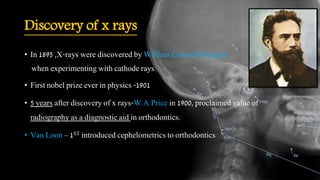
Discovery of x rays
• In 1895 ,X-rays were discovered by William Conrad Roentgen
when experimenting with cathode rays.
• First nobel prize ever in physics -1901
• 5 years after discovery of x rays-W.A.Price in 1900, proclaimed value of
radiography as a diagnostic aid in orthodontics.
• Van Loon – 1ST introduced cephelometrics to orthodontics
Broadbent B.H A new x ray technique and its application to orthodontia Angle ortho.1931;1:45-66
Broadbent –bolton cephalometer
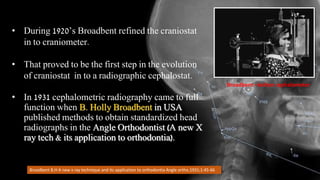
• During 1920’s Broadbent refined the craniostat
in to craniometer.
• That proved to be the first step in the evolution
of craniostat in to a radiographic cephalostat.
• In 1931 cephalometric radiography came to full
function when B. Holly Broadbent in USA
published methods to obtain standardized head
radiographs in the Angle Orthodontist (A new X
ray tech & its application to orthodontia).
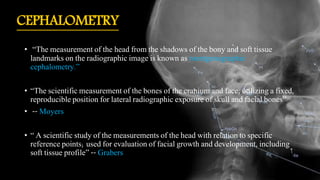
CEPHALOMETRY
• “The measurement of the head from the shadows of the bony and soft tissue
landmarks on the radiographic image is known as roentgenographic
cephalometry.”
• “The scientific measurement of the bones of the cranium and face, utilizing a fixed,
reproducible position for lateral radiographic exposure of skull and facial bones”
• -- Moyers
• “ A scientific study of the measurements of the head with relation to specific
reference points; used for evaluation of facial growth and development, including
soft tissue profile” -- Grabers
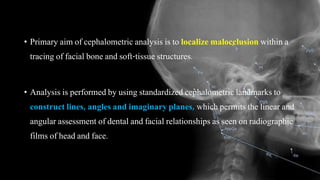
• Primary aim of cephalometric analysis is to localize malocclusion within a
tracing of facial bone and soft-tissue structures.
• Analysis is performed by using standardized cephalometric landmarks to
construct lines, angles and imaginary planes, which permits the linear and
angular assessment of dental and facial relationships as seen on radiographic
films of head and face.
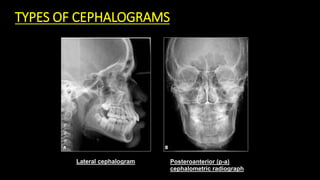
TYPES OF CEPHALOGRAMS
Posteroanterior (p-a)
cephalometric radiograph
Lateral cephalogram
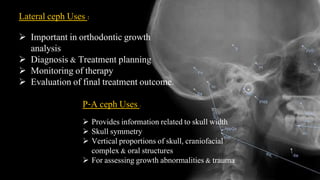
Lateral ceph Uses :
 Important in orthodontic growth
analysis
 Diagnosis & Treatment planning
 Monitoring of therapy
 Evaluation of final treatment outcome.
P-A ceph Uses :
 Provides information related to skull width
 Skull symmetry
 Vertical proportions of skull, craniofacial
complex & oral structures
 For assessing growth abnormalities & trauma
Principle of Cephalometric analysis
• To compare the patient with a normal reference group, so that
differences between the patient’s actual dentofacial relationships and
those expected for his/her racial or ethnic groups are revealed
-- Jacobson
Goals of Cephalometrics
To evaluate the relationships, both horizontally and vertically, of the five major
functional components of the face
• The cranium and the cranial base
• The skeletal maxilla
• The skeletal mandible
• The maxillary dentition and the alveolar process
• The mandibular dentition and the alveolar process
-- Jacobson
Uses of cephalometrics
Pre-treatment cephalogram of a case of malocclusion helps to establish the:
• Severity of dental malocclusion
• Severity of skeletal malocclusion
• Identify the location of dysplasia
• Evaluate soft tissue integument of face and its relationship to the dental hard
tissues and skeleton of face
• Evaluate nasopharyngeal airway, soft palate and position of tongue .
• Aids in treatment planning, decision on extraction/growth modifications/surgical
orthodontics and the type of mechanotherapy to be employed.
• Design and plan retention strategy
• Stage and post-treatment cephalograms are taken to monitor progress of
treatment and treatment outcome.
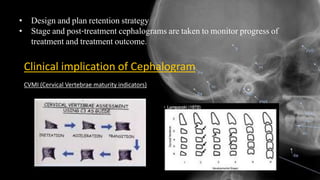
Clinical implication of Cephalogram
CVMI (Cervical Vertebrae maturity indicators)
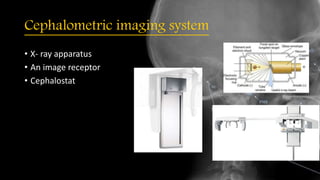
Cephalometric imaging system
• X- ray apparatus
• An image receptor
• Cephalostat
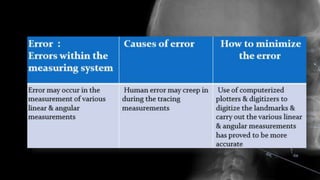
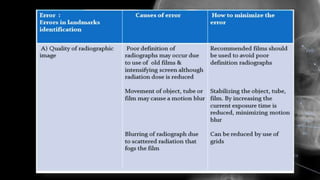
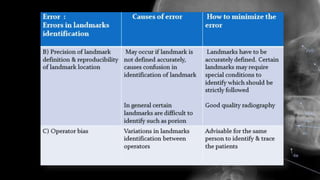
Cephalometric Errors
Errors may be caused by
• Projection errors
• Error in landmark identification
• Error in measurements
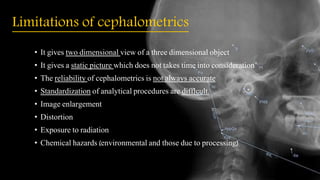
Limitations of cephalometrics
• It gives two dimensional view of a three dimensional object
• It gives a static picture which does not takes time into consideration
• The reliability of cephalometrics is not always accurate
• Standardization of analytical procedures are difficult.
• Image enlargement
• Distortion
• Exposure to radiation
• Chemical hazards (environmental and those due to processing)
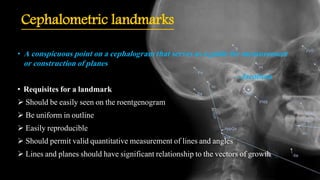
Cephalometric landmarks
• A conspicuous point on a cephalogram that serves as a guide for measurement
or construction of planes
– Jacobson
• Requisites for a landmark
 Should be easily seen on the roentgenogram
 Be uniform in outline
 Easily reproducible
 Should permit valid quantitative measurement of lines and angles
 Lines and planes should have significant relationship to the vectors of growth
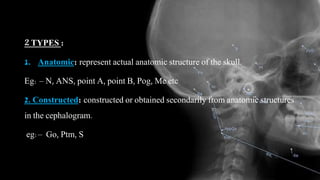
2 TYPES :
1. Anatomic: represent actual anatomic structure of the skull.
Eg: – N, ANS, point A, point B, Pog, Me etc
2. Constructed: constructed or obtained secondarily from anatomic structures
in the cephalogram.
eg:– Go, Ptm, S
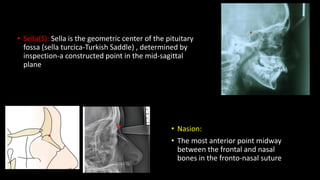
• Sella(S): Sella is the geometric center of the pituitary
fossa (sella turcica-Turkish Saddle) , determined by
inspection-a constructed point in the mid-sagittal
plane
• Nasion:
• The most anterior point midway
between the frontal and nasal
bones in the fronto-nasal suture
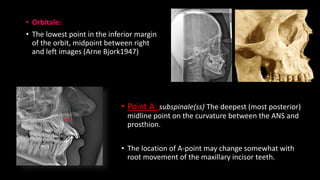
• Orbitale:
• The lowest point in the inferior margin
of the orbit, midpoint between right
and left images (Arne Bjork1947)
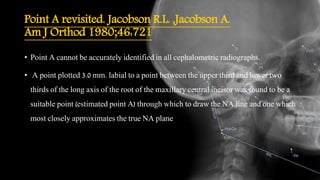
• Point A: subspinale(ss) The deepest (most posterior)
midline point on the curvature between the ANS and
prosthion.
• The location of A-point may change somewhat with
root movement of the maxillary incisor teeth.
Point A revisited. Jacobson R.L. ,Jacobson A.
Am J Orthod 1980;46:721
• Point A cannot be accurately identified in all cephalometric radiographs.
• A point plotted 3.0 mm. labial to a point between the upper third and lower two
thirds of the long axis of the root of the maxillary central incisor was found to be a
suitable point (estimated point A) through which to draw the NA line and one which
most closely approximates the true NA plane
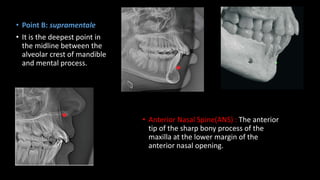
• Point B: supramentale
• It is the deepest point in
the midline between the
alveolar crest of mandible
and mental process.
• Anterior Nasal Spine(ANS) : The anterior
tip of the sharp bony process of the
maxilla at the lower margin of the
anterior nasal opening.
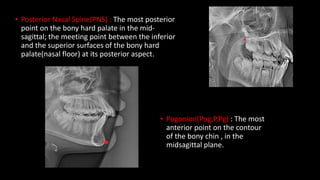
• Posterior Nasal Spine(PNS) : The most posterior
point on the bony hard palate in the mid-
sagittal; the meeting point between the inferior
and the superior surfaces of the bony hard
palate(nasal floor) at its posterior aspect.
• Pogonion(Pog,P,Pg) : The most
anterior point on the contour
of the bony chin , in the
midsagittal plane.
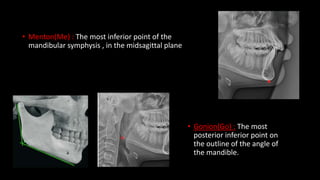
• Menton(Me) : The most inferior point of the
mandibular symphysis , in the midsagittal plane
• Gonion(Go) : The most
posterior inferior point on
the outline of the angle of
the mandible.
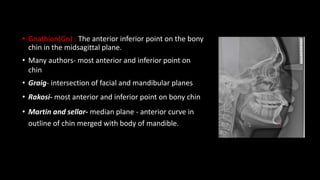
• Gnathion(Gn) : The anterior inferior point on the bony
chin in the midsagittal plane.
• Many authors- most anterior and inferior point on
chin
• Graig- intersection of facial and mandibular planes
• Rakosi- most anterior and inferior point on bony chin
• Martin and sellar- median plane - anterior curve in
outline of chin merged with body of mandible.
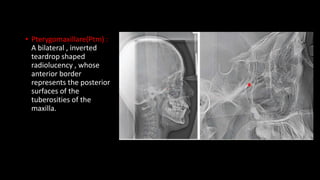
• Pterygomaxillare(Ptm) :
A bilateral , inverted
teardrop shaped
radiolucency , whose
anterior border
represents the posterior
surfaces of the
tuberosities of the
maxilla.
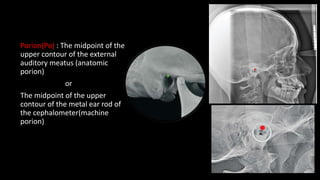
Porion(Po) : The midpoint of the
upper contour of the external
auditory meatus (anatomic
porion)
or
The midpoint of the upper
contour of the metal ear rod of
the cephalometer(machine
porion)
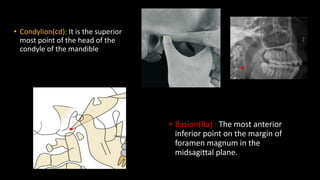
• Condylion(cd): It is the superior
most point of the head of the
condyle of the mandible
• Basion(Ba) : The most anterior
inferior point on the margin of
foramen magnum in the
midsagittal plane.
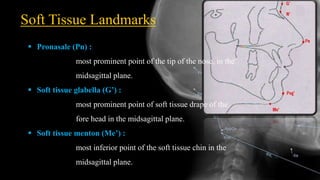
Soft Tissue Landmarks
 Pronasale (Pn) :
most prominent point of the tip of the nose, in the
midsagittal plane.
 Soft tissue glabella (G’) :
most prominent point of soft tissue drape of the
fore head in the midsagittal plane.
 Soft tissue menton (Me’) :
most inferior point of the soft tissue chin in the
midsagittal plane.
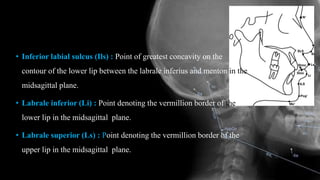
• Inferior labial sulcus (Ils) : Point of greatest concavity on the
contour of the lower lip between the labrale inferius and menton in the
midsagittal plane.
• Labrale inferior (Li) : Point denoting the vermillion border of the
lower lip in the midsagittal plane.
• Labrale superior (Ls) : Point denoting the vermillion border of the
upper lip in the midsagittal plane.
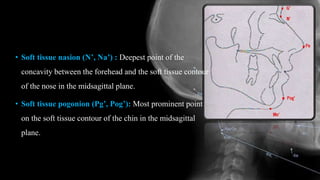
• Soft tissue nasion (N’, Na’) : Deepest point of the
concavity between the forehead and the soft tissue contour
of the nose in the midsagittal plane.
• Soft tissue pogonion (Pg’, Pog’): Most prominent point
on the soft tissue contour of the chin in the midsagittal
plane.
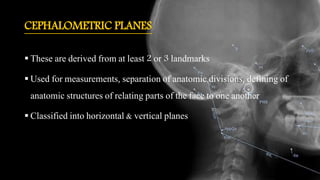
CEPHALOMETRIC PLANES
 These are derived from at least 2 or 3 landmarks
 Used for measurements, separation of anatomic divisions, defining of
anatomic structures of relating parts of the face to one another
 Classified into horizontal & vertical planes
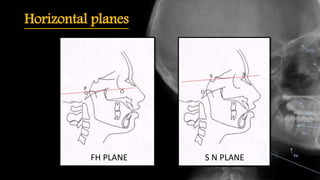
Horizontal planes
FH PLANE S N PLANE
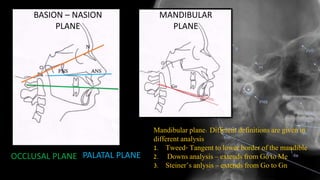
BASION – NASION
PLANE
PALATAL PLANEOCCLUSAL PLANE
MANDIBULAR
PLANE
Mandibular plane: Different definitions are given in
different analysis
1. Tweed- Tangent to lower border of the mandible
2. Downs analysis – extends from Go to Me
3. Steiner’s anlysis – extends from Go to Gn
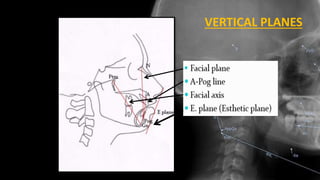
VERTICAL PLANES
Measurement analysis :
HARD TISSUE ANALYSIS
• Downs analysis
• Steiner analysis
• Tweed analysis
• Wits appraisal
• Rakosi’s
• Schwarz
• Rickets analysis
• Mc Namara analysis
• Cogs
SOFT TISSUE ANALYSIS
• Holdaway’s
• Arnett
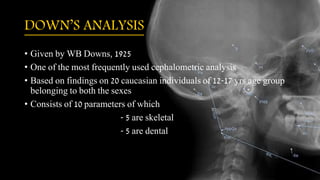
DOWN’S ANALYSIS
• Given by WB Downs, 1925
• One of the most frequently used cephalometric analysis
• Based on findings on 20 caucasian individuals of 12-17 yrs age group
belonging to both the sexes
• Consists of 10 parameters of which
- 5 are skeletal
- 5 are dental
Skeletal parameters :
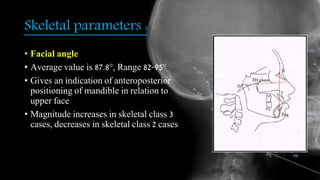
• Facial angle
• Average value is 87.8°, Range 82-95°
• Gives an indication of anteroposterior
positioning of mandible in relation to
upper face
• Magnitude increases in skeletal class 3
cases, decreases in skeletal class 2 cases
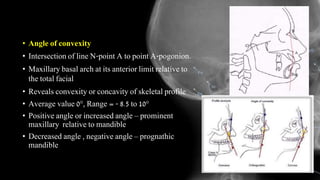
• Angle of convexity
• Intersection of line N-point A to point A-pogonion.
• Maxillary basal arch at its anterior limit relative to
the total facial
• Reveals convexity or concavity of skeletal profile
• Average value 0°, Range = - 8.5 to 10°
• Positive angle or increased angle – prominent
maxillary relative to mandible
• Decreased angle , negative angle – prognathic
mandible
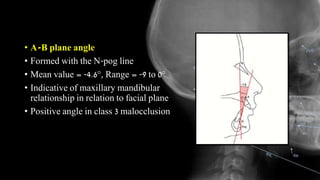
• A-B plane angle
• Formed with the N-pog line
• Mean value = -4.6°, Range = -9 to 0°
• Indicative of maxillary mandibular
relationship in relation to facial plane
• Positive angle in class 3 malocclusion
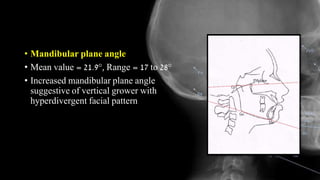
• Mandibular plane angle
• Mean value = 21.9°, Range = 17 to 28°
• Increased mandibular plane angle
suggestive of vertical grower with
hyperdivergent facial pattern
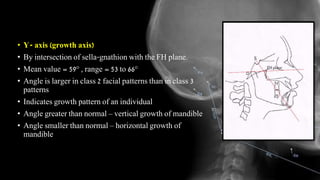
• Y- axis (growth axis)
• By intersection of sella-gnathion with the FH plane.
• Mean value = 59° , range = 53 to 66°
• Angle is larger in class 2 facial patterns than in class 3
patterns
• Indicates growth pattern of an individual
• Angle greater than normal – vertical growth of mandible
• Angle smaller than normal – horizontal growth of
mandible
Dental parameters
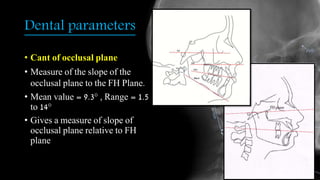
• Cant of occlusal plane
• Measure of the slope of the
occlusal plane to the FH Plane.
• Mean value = 9.3° , Range = 1.5
to 14°
• Gives a measure of slope of
occlusal plane relative to FH
plane
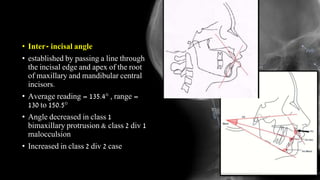
• Inter- incisal angle
• established by passing a line through
the incisal edge and apex of the root
of maxillary and mandibular central
incisors.
• Average reading = 135.4° , range =
130 to 150.5°
• Angle decreased in class 1
bimaxillary protrusion & class 2 div 1
malocculsion
• Increased in class 2 div 2 case
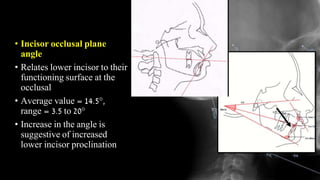
• Incisor occlusal plane
angle
• Relates lower incisor to their
functioning surface at the
occlusal plane.
• Average value = 14.5°,
range = 3.5 to 20°
• Increase in the angle is
suggestive of increased
lower incisor proclination
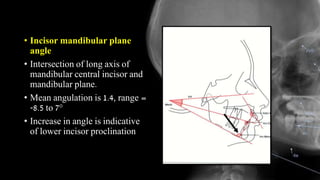
• Incisor mandibular plane
angle
• Intersection of long axis of
mandibular central incisor and
mandibular plane.
• Mean angulation is 1.4, range =
-8.5 to 7°
• Increase in angle is indicative
of lower incisor proclination
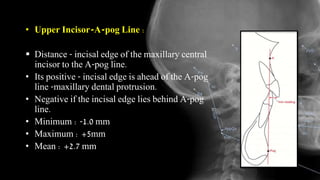
• Upper Incisor-A-pog Line :
 Distance - incisal edge of the maxillary central
incisor to the A-pog line.
• Its positive - incisal edge is ahead of the A-pog
line -maxillary dental protrusion.
• Negative if the incisal edge lies behind A-pog
line.
• Minimum : -1.0 mm
• Maximum : +5mm
• Mean : +2.7 mm
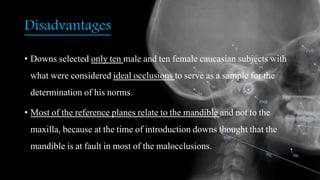
Disadvantages
• Downs selected only ten male and ten female caucasian subjects with
what were considered ideal occlusions to serve as a sample for the
determination of his norms.
• Most of the reference planes relate to the mandible and not to the
maxilla, because at the time of introduction downs thought that the
mandible is at fault in most of the malocclusions.
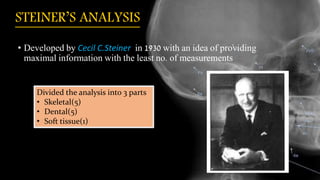
STEINER’S ANALYSIS
• Developed by Cecil C.Steiner in 1930 with an idea of providing
maximal information with the least no. of measurements
Divided the analysis into 3 parts
• Skeletal(5)
• Dental(5)
• Soft tissue(1)
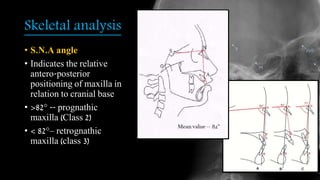
Skeletal analysis
• S.N.A angle
• Indicates the relative
antero-posterior
positioning of maxilla in
relation to cranial base
• >82° -- prognathic
maxilla (Class 2)
• < 82°– retrognathic
maxilla (class 3)
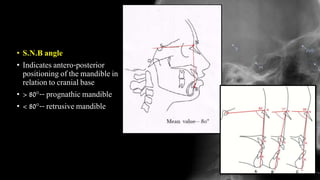
• S.N.B angle
• Indicates antero-posterior
positioning of the mandible in
relation to cranial base
• > 80°-- prognathic mandible
• < 80°-- retrusive mandible
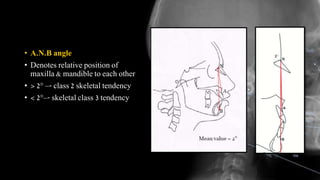
• A.N.B angle
• Denotes relative position of
maxilla & mandible to each other
• > 2° –- class 2 skeletal tendency
• < 2°–- skeletal class 3 tendency
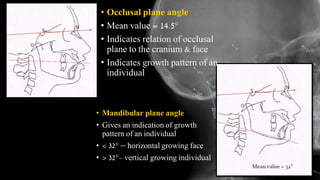
• Mandibular plane angle
• Gives an indication of growth
pattern of an individual
• < 32° -- horizontal growing face
• > 32°– vertical growing individual
• Occlusal plane angle
• Mean value = 14.5°
• Indicates relation of occlusal
plane to the cranium & face
• Indicates growth pattern of an
individual
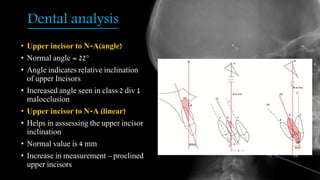
Dental analysis
• Upper incisor to N-A(angle)
• Normal angle = 22°
• Angle indicates relative inclination
of upper Incisors
• Increased angle seen in class 2 div 1
malocclusion
• Upper incisor to N-A (linear)
• Helps in asssessing the upper incisor
inclination
• Normal value is 4 mm
• Increase in measurement – proclined
upper incisors
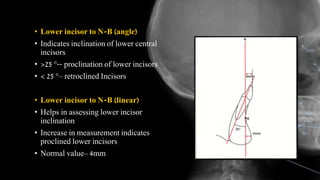
• Lower incisor to N-B (angle)
• Indicates inclination of lower central
incisors
• >25 °-- proclination of lower incisors
• < 25 °– retroclined Incisors
• Lower incisor to N-B (linear)
• Helps in assessing lower incisor
inclination
• Increase in measurement indicates
proclined lower incisors
• Normal value– 4mm
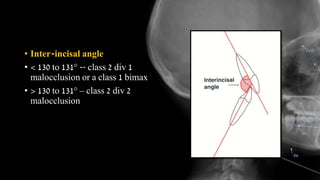
• Inter-incisal angle
• < 130 to 131° -- class 2 div 1
malocclusion or a class 1 bimax
• > 130 to 131° – class 2 div 2
malocclusion
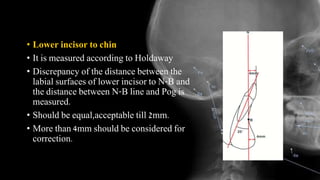
• Lower incisor to chin
• It is measured according to Holdaway
• Discrepancy of the distance between the
labial surfaces of lower incisor to N-B and
the distance between N-B line and Pog is
measured.
• Should be equal,acceptable till 2mm.
• More than 4mm should be considered for
correction.
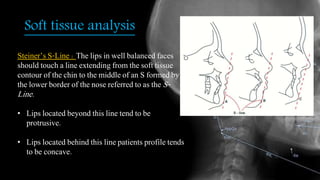
Soft tissue analysis
Steiner’s S-Line : The lips in well balanced faces
should touch a line extending from the soft tissue
contour of the chin to the middle of an S formed by
the lower border of the nose referred to as the S-
Line.
• Lips located beyond this line tend to be
protrusive.
• Lips located behind this line patients profile tends
to be concave.
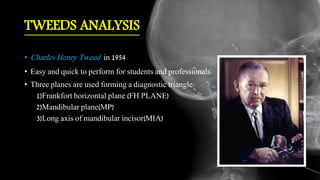
TWEEDS ANALYSIS
• Charles Henry Tweed in 1954
• Easy and quick to perform for students and professionals.
• Three planes are used forming a diagnostic triangle:
1)Frankfort horizontal plane (FH PLANE)
2)Mandibular plane(MP)
3)Long axis of mandibular incisor(MIA)
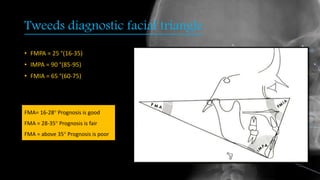
Tweeds diagnostic facial triangle
• FMPA = 25 °(16-35)
• IMPA = 90 °(85-95)
• FMIA = 65 °(60-75)
FMA= 16-28° Prognosis is good
FMA = 28-35° Prognosis is fair
FMA = above 35° Prognosis is poor
Limitation Of Tweed’s Triangle
The system was never intended to be a total facial analysis, it
was merely an aid to determine the relationships of certain teeth
relative to the inclination of the mandibular plane
Cephalometric Profile of Bangladeshis: Tweed’s Analysis
Rizvi HM, Hossain MZ. Cephalometric profile of bangladeshis: Tweed’s analysis. APOS Trends Orthod
2017;7:130-4.
INTRODUCTION: Tweed’s diagnostic triangle is simple yet provides a definite guideline in
treatment planning. The aim of the present study was to establish the Tweed’s norms for
Bangladeshi people.
METHODS: The study was conducted for 89 Bangladeshi young adults (45 males and 44 females),
aged 19–27 years, having balanced and harmonious facial profiles. Lateral cephalograms taken of
these subjects were used for a series of morphometric analyses.
RESULTS: All three angular parameters Frankfort-mandibular plane angle (FMA), Frankfort-
mandibular incisal angle (FMIA), incise mandibular plane angle (IMPA)were measured and found to
be 24.52°, 54.60°, and 100.88°, respectively. The mean FMA has been found to be 24.52° (with a
range of 14°–36°) which is quite close to Tweed’s norm and found to be statistically insignificant.
However, IMPA and FMIA values of Bangladeshis found to be statistically significantly different from
that of the Caucasians. The linear regression equation of IMPA on FMA was fitted, and the estimated
value of IMPA was computed for a given FMA.
CONCLUSION: The results support the idea that treatment objectives of IMPA should be
considered according to the facial pattern, i.e., FMA. Ethnic variations of norms cannot be
overlooked while outlining goals and planning the treatment.
WITS APPRAISAL
• Given in 1975 by ALEXANDER JACOBSON .
• To identify situations where the ANB reading does not accurately
represent the extent of anteroposterior jaw dysplasia.
• Created to be a simple clinical analysis
• It is a linear measurement and not an analysis in itself.
• It is used to measure the saggital skeletal discrepancy.
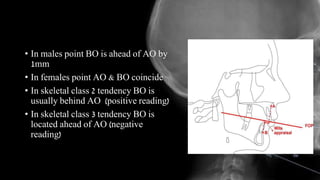
• In males point BO is ahead of AO by
1mm
• In females point AO & BO coincide
• In skeletal class 2 tendency BO is
usually behind AO (positive reading)
• In skeletal class 3 tendency BO is
located ahead of AO (negative
reading)
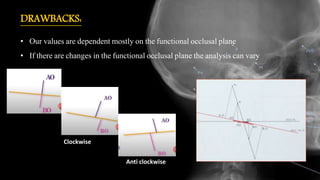
DRAWBACKS:
• Our values are dependent mostly on the functional occlusal plane
• If there are changes in the functional occlusal plane the analysis can vary
Clockwise
Anti clockwise
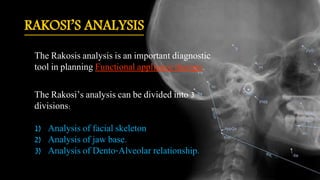
RAKOSI’S ANALYSIS
The Rakosis analysis is an important diagnostic
tool in planning Functional appliance therapy.
The Rakosi’s analysis can be divided into 3
divisions:
1) Analysis of facial skeleton
2) Analysis of jaw base.
3) Analysis of Dento-Alveolar relationship.
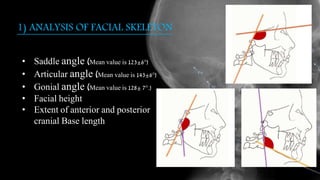
1) ANALYSIS OF FACIAL SKELETON
• Saddle angle (Mean value is 123±6°)
• Articular angle (Mean value is 143±6°)
• Gonial angle (Mean value is 128± 7°.)
• Facial height
• Extent of anterior and posterior
cranial Base length
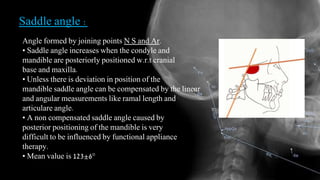
Saddle angle :
Angle formed by joining points N S and Ar.
• Saddle angle increases when the condyle and
mandible are posteriorly positioned w.r.t cranial
base and maxilla.
• Unless there is deviation in position of the
mandible saddle angle can be compensated by the linear
and angular measurements like ramal length and
articulare angle.
• A non compensated saddle angle caused by
posterior positioning of the mandible is very
difficult to be influenced by functional appliance
therapy.
• Mean value is 123±6°
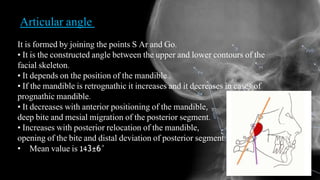
Articular angle
It is formed by joining the points S Ar and Go.
• It is the constructed angle between the upper and lower contours of the
facial skeleton.
• It depends on the position of the mandible .
• If the mandible is retrognathic it increases and it decreases in cases of
prognathic mandible.
• It decreases with anterior positioning of the mandible,
deep bite and mesial migration of the posterior segment.
• Increases with posterior relocation of the mandible,
opening of the bite and distal deviation of posterior segment.
• Mean value is 143±6°
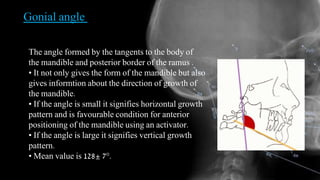
Gonial angle
The angle formed by the tangents to the body of
the mandible and posterior border of the ramus .
• It not only gives the form of the mandible but also
gives informtion about the direction of growth of
the mandible.
• If the angle is small it signifies horizontal growth
pattern and is favourable condition for anterior
positioning of the mandible using an activator.
• If the angle is large it signifies vertical growth
pattern.
• Mean value is 128± 7°.
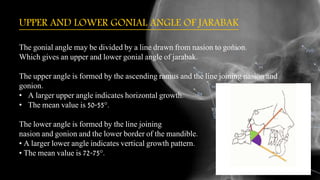
UPPER AND LOWER GONIAL ANGLE OF JARABAK
The gonial angle may be divided by a line drawn from nasion to gonion.
Which gives an upper and lower gonial angle of jarabak.
The upper angle is formed by the ascending ramus and the line joining nasion and
gonion.
• A larger upper angle indicates horizontal growth.
• The mean value is 50-55°.
The lower angle is formed by the line joining
nasion and gonion and the lower border of the mandible.
• A larger lower angle indicates vertical growth pattern.
• The mean value is 72-75°.
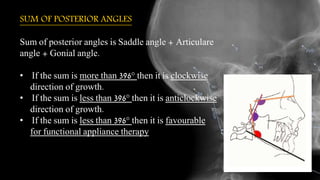
SUM OF POSTERIOR ANGLES
Sum of posterior angles is Saddle angle + Articulare
angle + Gonial angle.
• If the sum is more than 396° then it is clockwise
direction of growth.
• If the sum is less than 396° then it is anticlockwise
direction of growth.
• If the sum is less than 396° then it is favourable
for functional appliance therapy
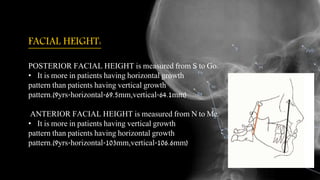
FACIAL HEIGHT:
POSTERIOR FACIAL HEIGHT is measured from S to Go.
• It is more in patients having horizontal growth
pattern than patients having vertical growth
pattern.(9yrs-horizontal-69.5mm,vertical-64.1mm)
ANTERIOR FACIAL HEIGHT is measured from N to Me.
• It is more in patients having vertical growth
pattern than patients having horizontal growth
pattern.(9yrs-horizontal-103mm,vertical-106.6mm)
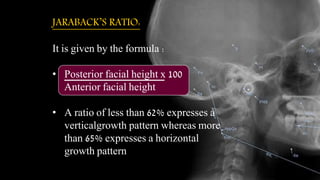
JARABACK’S RATIO:
It is given by the formula :
• Posterior facial height x 100
Anterior facial height
• A ratio of less than 62% expresses a
verticalgrowth pattern whereas more
than 65% expresses a horizontal
growth pattern.
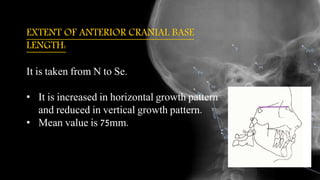
EXTENT OF ANTERIOR CRANIAL BASE
LENGTH:
It is taken from N to Se.
• It is increased in horizontal growth pattern
and reduced in vertical growth pattern.
• Mean value is 75mm.
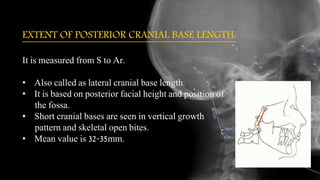
EXTENT OF POSTERIOR CRANIAL BASE LENGTH:
It is measured from S to Ar.
• Also called as lateral cranial base length.
• It is based on posterior facial height and position of
the fossa.
• Short cranial bases are seen in vertical growth
pattern and skeletal open bites.
• Mean value is 32-35mm.
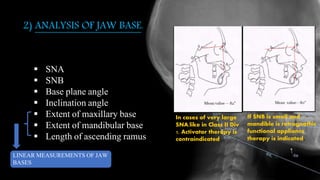
2) ANALYSIS OF JAW BASE.
 SNA
 SNB
 Base plane angle
 Inclination angle
 Extent of maxillary base
 Extent of mandibular base
 Length of ascending ramus
In cases of very large
SNA,like in Class II Div
1, Activator therapy is
contraindicated
If SNB is small and
mandible is retrognathic
functional appliance
therapy is indicated.
LINEAR MEASUREMENTS OF JAW
BASES
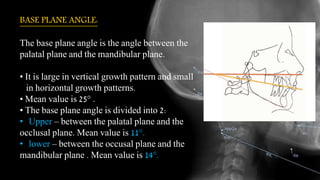
BASE PLANE ANGLE:
The base plane angle is the angle between the
palatal plane and the mandibular plane.
• It is large in vertical growth pattern and small
in horizontal growth patterns.
• Mean value is 25° .
• The base plane angle is divided into 2:
• Upper – between the palatal plane and the
occlusal plane. Mean value is 11°.
• lower – between the occusal plane and the
mandibular plane . Mean value is 14°.
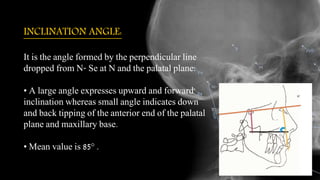
INCLINATION ANGLE:
It is the angle formed by the perpendicular line
dropped from N- Se at N and the palatal plane.
• A large angle expresses upward and forward
inclination whereas small angle indicates down
and back tipping of the anterior end of the palatal
plane and maxillary base.
• Mean value is 85° .
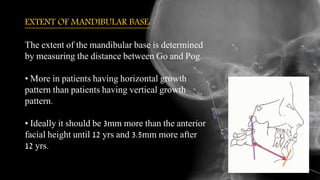
EXTENT OF MANDIBULAR BASE:
The extent of the mandibular base is determined
by measuring the distance between Go and Pog.
• More in patients having horizontal growth
pattern than patients having vertical growth
pattern.
• Ideally it should be 3mm more than the anterior
facial height until 12 yrs and 3.5mm more after
12 yrs.
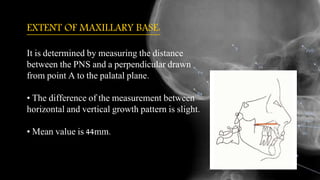
EXTENT OF MAXILLARY BASE:
It is determined by measuring the distance
between the PNS and a perpendicular drawn
from point A to the palatal plane.
• The difference of the measurement between
horizontal and vertical growth pattern is slight.
• Mean value is 44mm.
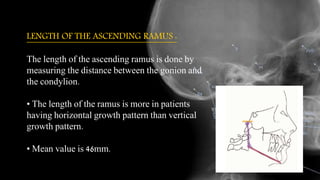
LENGTH OF THE ASCENDING RAMUS :
The length of the ascending ramus is done by
measuring the distance between the gonion and
the condylion.
• The length of the ramus is more in patients
having horizontal growth pattern than vertical
growth pattern.
• Mean value is 46mm.
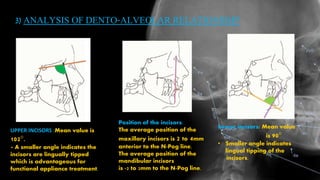
3) ANALYSIS OF DENTO-ALVEOLAR RELATIONSHIP
UPPER INCISORS :Mean value is
102°.
• A smaller angle indicates the
incisors are lingually tipped
which is advantageous for
functional appliance treatment.
Lower incisors: Mean value
is 90°
• Smaller angle indicates
lingual tipping of the
incisors.
Position of the incisors:
The average position of the
maxillary incisors is 2 to 4mm
anterior to the N-Pog line.
The average position of the
mandibular incisors
is -2 to 2mm to the N-Pog line.
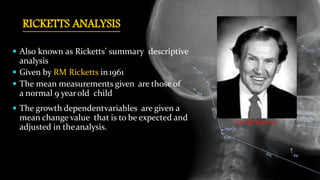
RICKETTS ANALYSIS
 Also known as Ricketts’ summary descriptive
analysis
 Given by RM Ricketts in1961
 The mean measurements given are those of
a normal 9 yearold child
 The growth dependentvariables are given a
mean change value that is to be expected and
adjusted in theanalysis.
Dr. RM Ricketts
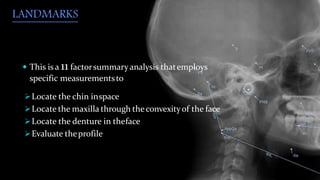
LANDMARKS
 This is a 11 factorsummaryanalysis thatemploys
specific measurementsto
Locate the chin inspace
Locate the maxilla through theconvexityof the face
Locate the denture in theface
Evaluate theprofile
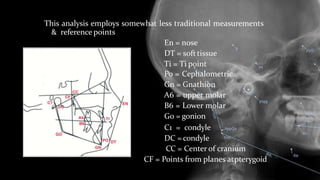
This analysis employs somewhat less traditional measurements
& reference points
En = nose
DT = softtissue
Ti = Ti point
Po = Cephalometric
Gn = Gnathion
A6 = upper molar
B6 = Lower molar
Go = gonion
C1 = condyle
DC = condyle
CC = Center of cranium
CF = Points from planes atpterygoid
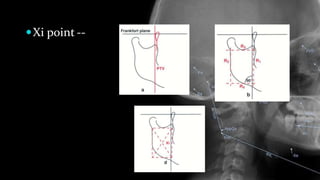
Xi point --
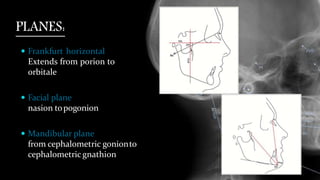
PLANES:
 Frankfurt horizontal --
Extends from porion to
orbitale
 Facial plane -- Extendsfrom
nasion topogonion
 Mandibular plane -- Extends
from cephalometric gonionto
cephalometricgnathion
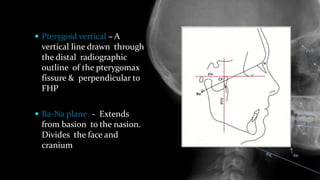
 Pterygoid vertical – A
vertical line drawn through
the distal radiographic
outline of the pterygomax
fissure & perpendicular to
FHP
 Ba-Na plane -- Extends
from basion to the nasion.
Divides the face and
cranium.
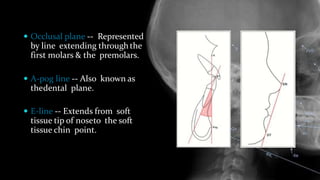
 Occlusal plane -- Represented
by line extending throughthe
first molars & the premolars.
 A-pog line -- Also known as
thedental plane.
 E-line -- Extends from soft
tissue tip of noseto the soft
tissue chin point.
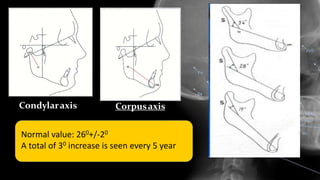
Condylaraxis Corpusaxis
Normal value: 260+/-20
A total of 30 increase is seen every 5 year
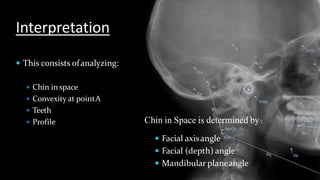
Interpretation
 This consists ofanalyzing:
 Chin in space
 Convexity at pointA
 Teeth
 Profile
 Facial axisangle
 Facial (depth) angle
 Mandibular planeangle
Chin in Space is determined by:
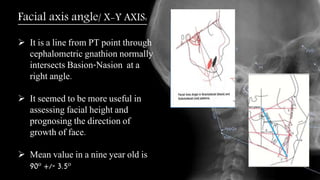
Facial axis angle/ X-Y AXIS:
 It is a line from PT point through
cephalometric gnathion normally
intersects Basion-Nasion at a
right angle.
 It seemed to be more useful in
assessing facial height and
prognosing the direction of
growth of face.
 Mean value in a nine year old is
90o +/- 3.5o
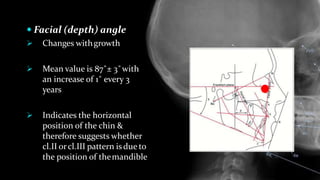
 Facial (depth) angle
 Changes withgrowth
 Mean value is 87˚± 3˚with
an increase of 1˚ every 3
years
 Indicates the horizontal
position of the chin &
therefore suggests whether
cl.II orcl.III pattern isdue to
the position of themandible
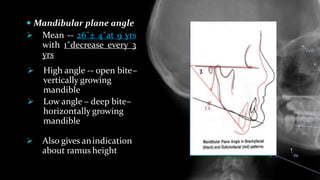
 Mandibular plane angle
 Mean -- 26˚± 4˚at 9 yrs
with 1˚decrease every 3
yrs
 High angle -- open bite–
vertically growing
mandible
 Low angle – deep bite–
horizontally growing
mandible
 Also gives anindication
about ramus height
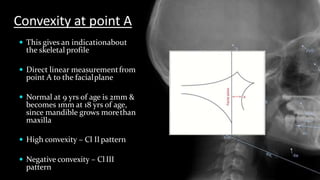
Convexity at point A
 This gives an indicationabout
the skeletal profile
 Direct linear measurementfrom
point A to the facialplane
 Normal at 9 yrs of age is 2mm &
becomes 1mm at 18 yrs of age,
since mandible grows morethan
maxilla
 High convexity – Cl IIpattern
 Negative convexity – Cl III
pattern
Teeth
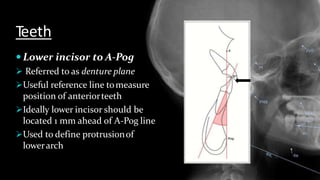
 Lower incisor to A-Pog
 Referred to as denture plane
Useful reference line tomeasure
position of anteriorteeth
Ideally lower incisor should be
located 1 mm ahead of A-Pog line
Used to define protrusionof
lowerarch
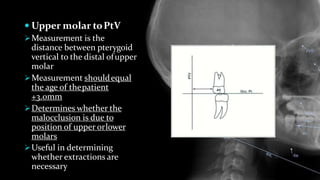
 Upper molar toPtV
Measurement is the
distance between pterygoid
vertical to the distal ofupper
molar
Measurement shouldequal
the age of thepatient
+3.0mm
Determines whether the
malocclusion is due to
position of upper orlower
molars
Useful in determining
whether extractions are
necessary
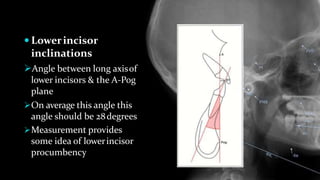
 Lowerincisor
inclinations
Angle between long axisof
lower incisors & the A-Pog
plane
On average this angle this
angle should be 28degrees
Measurement provides
some idea of lowerincisor
procumbency
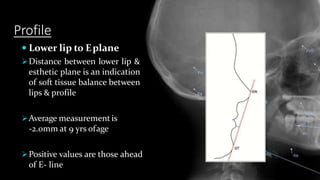
Profile
 Lower lip to Eplane
Distance between lower lip &
esthetic plane is an indication
of soft tissue balance between
lips & profile
Average measurement is
-2.0mm at 9 yrs ofage
Positive values are those ahead
of E- line
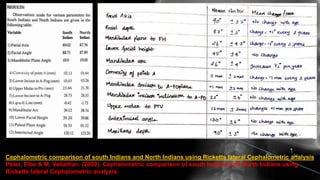
Cephalometric comparison of south Indians and North Indians using Ricketts lateral Cephalometric analysis
Peter, Elbe & M, Valiathan. (2000). Cephalometric comparison of south Indians and North Indians using
Ricketts lateral Cephalometric analysis.
Mc NAMARA ANALYSIS
 Given By Mc Namara JA, 1984
 In an effort to create a clinically useful
analysis, the craniofacial skeletal complex
is divided into five majorsections.
1. Maxilla to cranial base
2. Maxilla to mandible
3. Mandible to cranialbase
4. Dentition
5. Airway
MAXILLA TO CRANIAL BASE
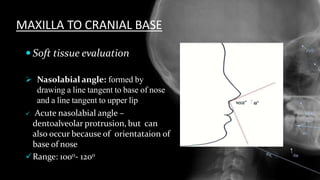
 Soft tissue evaluation
 Nasolabial angle: formed by
drawing a line tangent to base of nose
and a line tangent to upper lip
 Acute nasolabial angle –
dentoalveolar protrusion, but can
also occur because of orientataion of
base of nose
Range: 1000- 1200
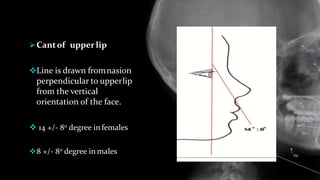
Cantof upperlip
Line is drawn fromnasion
perpendicular to upperlip
from the vertical
orientation of the face.
 14 +/- 8o degree infemales
8 +/- 8o degree in males
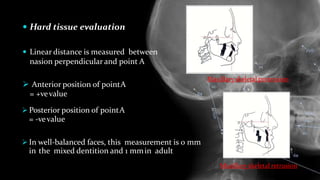
 Hard tissue evaluation
 Linear distance is measured between
nasion perpendicular and point A
 Anterior position of pointA
= +vevalue
 Posterior position of pointA
= -vevalue
 In well-balanced faces, this measurement is 0 mm
in the mixed dentition and 1 mmin adult
Maxillary skeletal protrusion
Maxillary skeletal retrusion
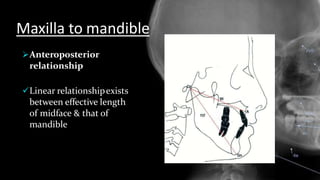
Maxilla to mandible
Anteroposterior
relationship
Linear relationshipexists
between effective length
of midface & that of
mandible
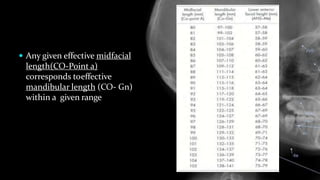
 Any given effective midfacial
length(CO-Point a)
corresponds toeffective
mandibular length (CO- Gn)
within a given range
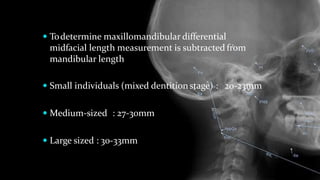
 Todetermine maxillomandibular differential
midfacial length measurement is subtracted from
mandibular length
 Small individuals (mixed dentition stage) : 20-23mm
 Medium-sized : 27-30mm
 Large sized : 30-33mm
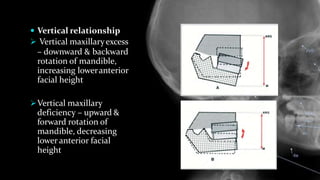
 Vertical relationship
 Vertical maxillaryexcess
– downward & backward
rotation of mandible,
increasing loweranterior
facial height
Vertical maxillary
deficiency – upward &
forward rotation of
mandible, decreasing
lower anterior facial
height
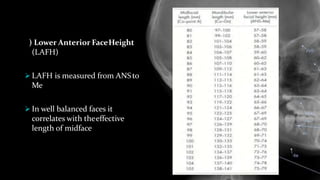
a) Lower Anterior FaceHeight
(LAFH)
 LAFH is measured from ANSto
Me
 In well balanced faces it
correlates with theeffective
length of midface
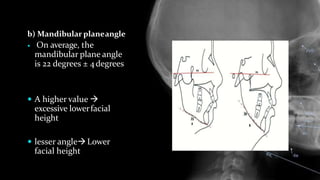
b) Mandibular planeangle
 On average, the
mandibular plane angle
is 22 degrees ± 4degrees
 A higher value 
excessive lowerfacial
height
 lesser angleLower
facial height
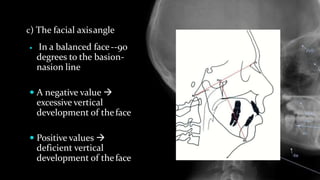
 In a balanced face--90
degrees to the basion-
nasion line
 A negative value 
excessive vertical
development of theface
 Positive values 
deficient vertical
development of theface
c) The facial axisangle
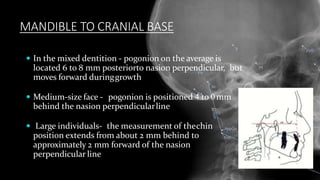
MANDIBLE TO CRANIAL BASE
 In the mixed dentition - pogonion on the average is
located 6 to 8 mm posteriorto nasion perpendicular, but
moves forward duringgrowth
 Medium-size face - pogonion is positioned 4 to 0mm
behind the nasion perpendicularline
 Large individuals- the measurement of thechin
position extends from about 2 mm behind to
approximately 2 mm forward of the nasion
perpendicular line
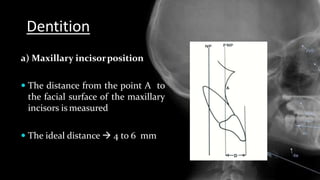
Dentition
a) Maxillary incisorposition
 The distance from the point A to
the facial surface of the maxillary
incisors is measured
 The ideal distance  4 to 6 mm
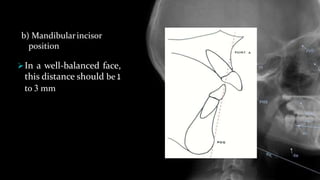
b) Mandibularincisor
position
In a well-balanced face,
this distance should be 1
to 3 mm
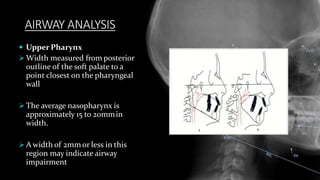
AIRWAY ANALYSIS
 Upper Pharynx
 Width measured from posterior
outline of the soft palate to a
point closest on the pharyngeal
wall
 The average nasopharynx is
approximately 15 to 20mmin
width.
 A width of 2mm or less in this
region may indicate airway
impairment
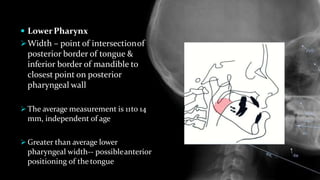
 LowerPharynx
Width – point of intersectionof
posterior border of tongue &
inferior border of mandible to
closest point on posterior
pharyngeal wall
 The average measurement is 11to 14
mm, independent of age
 Greater than average lower
pharyngeal width-- possibleanterior
positioning of the tongue
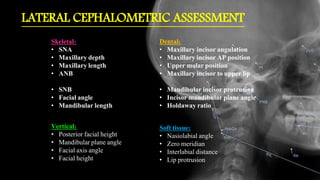
LATERAL CEPHALOMETRIC ASSESSMENT
Skeletal:
• SNA
• Maxillary depth
• Maxillary length
• ANB
• SNB
• Facial angle
• Mandibular length
Dental:
• Maxillary incisor angulation
• Maxillary incisor AP position
• Upper molar position
• Maxillary incisor to upper lip
• Mandibular incisor protrusion
• Incisor mandibular plane angle
• Holdaway ratio
Soft tissue:
• Nasiolabial angle
• Zero meridian
• Interlabial distance
• Lip protrusion
Vertical:
• Posterior facial height
• Mandibular plane angle
• Facial axis angle
• Facial height
Child-to-Adult Changing Proportions
• The infant and young child are characterized by a wide-appearing face
because of the precociously broad basicranial template, but the face
otherwise is vertically short.
• This is because the nasal and oral regions are yet diminutive, matching the
smallish body and pulmonary parts and with masticatory development in a
transitory state.
• The mandibular ramus is vertically yet short because it is linked in
developmental feedback with the shorter, later-maturing nasal and dental
regions.
• Masticatory musculature is proportionately sized and shaped to
progressively match increasing function and to interplay developmentally
with the ramus.
• During later childhood and into adolescence, vertical nasal
enlargement keeps pace with growing body and lung size, and dental
and other oral components have approached adult sizes and
configuration.
• The mandibular arch is lowered by increasing vertical ramus length.
Overall, the early wide face has become altered in proportion by the
later vertical changes.
• The end effect is particularly marked in the dolichocephalic long-
headed and long-face pattern, and less so in the brachycephalic
headform type.
IN BETWEEN AGE 3-6 YEARS
• Treatment of skeletal malocclusions in this age group is ordinarily deferred
until a later age, not because skeletal change cannot be effected but for more
practical reasons.
Three general reasons are offered for delaying treatment:
• First, the diagnosis of skeletal malocclusion is difficult in this age group.
Subtle gradations of skeletal problems and immature soft tissue development
make clinical diagnosis of all but the most obvious cases difficult.
• Second, although the child is growing at this stage, the amount of facial
growth remaining when the child enters the mixed dentition years is
sufficient to aid in the correction of most skeletal malocclusions.
• Third, any skeletal treatment at this age requires prolonged retention because
the initial growth pattern tends to reestablish itself when treatment is
discontinued.
Growth changes in two age groups with different malocclusions in
individuals of Central India. Kumari S, Bapat SM, Gupta K. Growth changes in two age groups with
different malocclusions in individuals of Central India. Arch Med Health Sci 2019;7:53-6
Objective: Comparative evaluation of McNamara's analysis in Class I, Class II, and Class III
individuals of Central India in two different age groups.
Materials and Methods: 240 individuals belonging to Central India were divided into two
main groups: Group I comprised 120 children (10–14 years) and Group II comprised 120
adults (18–22 years). McNamara's analysis was used to assess skeletal, dental, and soft
tissue parameters.
Results: Statistically significant difference was found for facial axis angle, mandibular
length, and maxillary length in children and adults in dental/skeletal Class I individuals. In
Class II division 1 individuals, statistically significant difference was found in children and
adults for maxillary length, mandibular length, and lower anterior facial height. In Class II
division 2 individuals, statistically significant difference was found in children and adults in
maxilla mandibular difference and lower anterior facial height. In Class III individuals, the
difference was in nasolabial angle.
Conclusion: The growth of maxilla is usually completed by 10-14 years of age. The present
study suggests that the growth of maxilla is continuous in adults, and nasolabial angle
decreases with age in Class III individuals. Hence, planning of extractions in earlier age
should be decided with caution.
Bimaxillary Protrusion in Malay Population: Cephalometric
Analysis of Skeletal, Dental and Soft Tissue Components,
Journal of International Dental and Medical Research, Volume ∙ 12 ∙ Number ∙ 1 ∙ 2019 Siti Maisarah Ahmad Razin1 , Sarah
Haniza Abdul Ghani2 , Noraina Hafizan Norman2*
Abstract: This cross-sectional study aimed to analyze skeletal, dental and soft tissue
components of bimaxillary protrusion in a sample of Malay population in Malaysia. 116
lateral cephalometric radiographs were traced and digitized using Dolphin Imaging
software. Thirty radiographs were randomly selected for calibration of two weeks interval
by 2 operators. Eight angular and eight linear parameters were measured to assess the
cephalometric characteristics. Intraclass correlation coefficient (ICC) and descriptive
statistics were used to assess operator’s calibration and cephalometric characteristics
respectively. Inter-rater and intra-rater reliability showed excellent correlation at ICC
0.831 and ICC 0.99 respectively. Significant biskeletal protrusion with SNA of 84.3° (SD
3.9) and SNB of 80.1° (SD 3.9) and bidental protrusion of incisors were also observed
(UIA: 125.48°; LIA: 102.56°) with acute interincisal angle (102.73°). A marked difference
to Caucasian and Chinese standards were observed. They also have evident soft tissue
protrusion. Bimaxillary protrusion is significant in Malay population with varying degree
of protrusion in skeletal, dental and soft tissue. Thus, diagnosis and treatment plan
should be made according to their characteristics.
Determination of downs hard tissue cephalometric norms for
Himachali Mongoloid tribes
Sanjeev Vaid, Santosh Verma, K.S. Negi, J.R Kaundal, Sankalp Sood & Aditi Malhotra (2019) Determination of downs hard
tissue cephalometric norms for Himachali Mongoloid tribes, Orthodontic Waves, 78:1, 11-17,
Objective: The purpose of this study was (a) to establish hard tissue cephalometric norms for the
population of Himachali Mongoloid tribes, (b) to study the sexual dimorphism in hard tissue
cephalometric norms of this population and (c) to compare the Himachali Mongoloid norms with the
norms established by Downs.
Material and method: Sixty Himachali Mongoloid subjects were selected on the basis of Angle’s
Class I molar relationship, well aligned arches, full complement of teeth, having clinically acceptable
facial esthetics, no previous history of Orthodontic treatment, subjects native of the tribal belt of
Himachal Pradesh. Lateral head films were traced and Downs cephalometric parameters were
recorded. Statistical analysis was done to compare the difference between the established norm and
the norm established by Downs for the Caucasian population.
Result: Significant difference was seen in the Angle of convexity, with Himachali Mongoloid tribe
population having a more forwardly positioned middle part of the face. This population had less
steeper cant of occlusal plane, more acute interincisal angle, more inclined lower incisors in relation
to the mandibular and the occlusal plane and more forwardly positioned maxillary incisor in relation
to the A-pog line.
Conclusion: These findings suggested that ethnic differences in the facial traits exist and awareness
of dentofacial pattern of each ethnic group will ensure better success of the treatment in
establishing optimal facial harmony.
RECENT ADVANCES
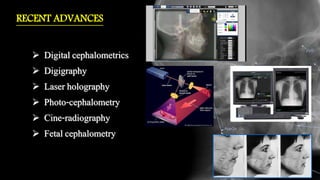
 Digital cephalometrics
 Digigraphy
 Laser holography
 Photo-cephalometry
 Cine-radiography
 Fetal cephalometry
conclusion
References
• Radiographic Cephalometry ( From Basics To Video Imaging).Alexander
Jacobson.
• An Atlas And Manual Of Cephalometric Radiography. Thomas Rakosi.
• Contemporary Orthodontics, William R.Proffit,5th Edition
• Jacobson. A. The Wits apprasial of Jaw Disharmony AJODO 1975; 67: 125- 38.
• Orthodontics :The Art and Science. Bhalaji 3rd Edi
• Internet sources
THANK YOU

CEPHELOMETRICS IN PEDIATRIC DENTISTRY

  • 1.
  • 2.
    CONTENTS Introduction Radiographic cephalograms Errors incephalometry Cephalometric landmarks Classification of cephalometric analysis Hard tissue analysis Conclusion References
  • 3.
  • 4.
    Discovery of xrays • In 1895 ,X-rays were discovered by William Conrad Roentgen when experimenting with cathode rays. • First nobel prize ever in physics -1901 • 5 years after discovery of x rays-W.A.Price in 1900, proclaimed value of radiography as a diagnostic aid in orthodontics. • Van Loon – 1ST introduced cephelometrics to orthodontics
  • 5.
    Broadbent B.H Anew x ray technique and its application to orthodontia Angle ortho.1931;1:45-66 Broadbent –bolton cephalometer • During 1920’s Broadbent refined the craniostat in to craniometer. • That proved to be the first step in the evolution of craniostat in to a radiographic cephalostat. • In 1931 cephalometric radiography came to full function when B. Holly Broadbent in USA published methods to obtain standardized head radiographs in the Angle Orthodontist (A new X ray tech & its application to orthodontia).
  • 6.
    CEPHALOMETRY • “The measurementof the head from the shadows of the bony and soft tissue landmarks on the radiographic image is known as roentgenographic cephalometry.” • “The scientific measurement of the bones of the cranium and face, utilizing a fixed, reproducible position for lateral radiographic exposure of skull and facial bones” • -- Moyers • “ A scientific study of the measurements of the head with relation to specific reference points; used for evaluation of facial growth and development, including soft tissue profile” -- Grabers
  • 7.
    • Primary aimof cephalometric analysis is to localize malocclusion within a tracing of facial bone and soft-tissue structures. • Analysis is performed by using standardized cephalometric landmarks to construct lines, angles and imaginary planes, which permits the linear and angular assessment of dental and facial relationships as seen on radiographic films of head and face.
  • 8.
    TYPES OF CEPHALOGRAMS Posteroanterior(p-a) cephalometric radiograph Lateral cephalogram
  • 9.
    Lateral ceph Uses:  Important in orthodontic growth analysis  Diagnosis & Treatment planning  Monitoring of therapy  Evaluation of final treatment outcome. P-A ceph Uses :  Provides information related to skull width  Skull symmetry  Vertical proportions of skull, craniofacial complex & oral structures  For assessing growth abnormalities & trauma
  • 10.
    Principle of Cephalometricanalysis • To compare the patient with a normal reference group, so that differences between the patient’s actual dentofacial relationships and those expected for his/her racial or ethnic groups are revealed -- Jacobson
  • 11.
    Goals of Cephalometrics Toevaluate the relationships, both horizontally and vertically, of the five major functional components of the face • The cranium and the cranial base • The skeletal maxilla • The skeletal mandible • The maxillary dentition and the alveolar process • The mandibular dentition and the alveolar process -- Jacobson
  • 12.
    Uses of cephalometrics Pre-treatmentcephalogram of a case of malocclusion helps to establish the: • Severity of dental malocclusion • Severity of skeletal malocclusion • Identify the location of dysplasia • Evaluate soft tissue integument of face and its relationship to the dental hard tissues and skeleton of face • Evaluate nasopharyngeal airway, soft palate and position of tongue . • Aids in treatment planning, decision on extraction/growth modifications/surgical orthodontics and the type of mechanotherapy to be employed.
  • 13.
    • Design andplan retention strategy • Stage and post-treatment cephalograms are taken to monitor progress of treatment and treatment outcome. Clinical implication of Cephalogram CVMI (Cervical Vertebrae maturity indicators)
  • 14.
    Cephalometric imaging system •X- ray apparatus • An image receptor • Cephalostat
  • 15.
    Cephalometric Errors Errors maybe caused by • Projection errors • Error in landmark identification • Error in measurements
  • 20.
    Limitations of cephalometrics •It gives two dimensional view of a three dimensional object • It gives a static picture which does not takes time into consideration • The reliability of cephalometrics is not always accurate • Standardization of analytical procedures are difficult. • Image enlargement • Distortion • Exposure to radiation • Chemical hazards (environmental and those due to processing)
  • 21.
    Cephalometric landmarks • Aconspicuous point on a cephalogram that serves as a guide for measurement or construction of planes – Jacobson • Requisites for a landmark  Should be easily seen on the roentgenogram  Be uniform in outline  Easily reproducible  Should permit valid quantitative measurement of lines and angles  Lines and planes should have significant relationship to the vectors of growth
  • 22.
    2 TYPES : 1.Anatomic: represent actual anatomic structure of the skull. Eg: – N, ANS, point A, point B, Pog, Me etc 2. Constructed: constructed or obtained secondarily from anatomic structures in the cephalogram. eg:– Go, Ptm, S
  • 23.
    • Sella(S): Sellais the geometric center of the pituitary fossa (sella turcica-Turkish Saddle) , determined by inspection-a constructed point in the mid-sagittal plane • Nasion: • The most anterior point midway between the frontal and nasal bones in the fronto-nasal suture
  • 24.
    • Orbitale: • Thelowest point in the inferior margin of the orbit, midpoint between right and left images (Arne Bjork1947) • Point A: subspinale(ss) The deepest (most posterior) midline point on the curvature between the ANS and prosthion. • The location of A-point may change somewhat with root movement of the maxillary incisor teeth.
  • 25.
    Point A revisited.Jacobson R.L. ,Jacobson A. Am J Orthod 1980;46:721 • Point A cannot be accurately identified in all cephalometric radiographs. • A point plotted 3.0 mm. labial to a point between the upper third and lower two thirds of the long axis of the root of the maxillary central incisor was found to be a suitable point (estimated point A) through which to draw the NA line and one which most closely approximates the true NA plane
  • 26.
    • Point B:supramentale • It is the deepest point in the midline between the alveolar crest of mandible and mental process. • Anterior Nasal Spine(ANS) : The anterior tip of the sharp bony process of the maxilla at the lower margin of the anterior nasal opening.
  • 27.
    • Posterior NasalSpine(PNS) : The most posterior point on the bony hard palate in the mid- sagittal; the meeting point between the inferior and the superior surfaces of the bony hard palate(nasal floor) at its posterior aspect. • Pogonion(Pog,P,Pg) : The most anterior point on the contour of the bony chin , in the midsagittal plane.
  • 28.
    • Menton(Me) :The most inferior point of the mandibular symphysis , in the midsagittal plane • Gonion(Go) : The most posterior inferior point on the outline of the angle of the mandible.
  • 29.
    • Gnathion(Gn) :The anterior inferior point on the bony chin in the midsagittal plane. • Many authors- most anterior and inferior point on chin • Graig- intersection of facial and mandibular planes • Rakosi- most anterior and inferior point on bony chin • Martin and sellar- median plane - anterior curve in outline of chin merged with body of mandible.
  • 30.
    • Pterygomaxillare(Ptm) : Abilateral , inverted teardrop shaped radiolucency , whose anterior border represents the posterior surfaces of the tuberosities of the maxilla.
  • 31.
    Porion(Po) : Themidpoint of the upper contour of the external auditory meatus (anatomic porion) or The midpoint of the upper contour of the metal ear rod of the cephalometer(machine porion)
  • 32.
    • Condylion(cd): Itis the superior most point of the head of the condyle of the mandible • Basion(Ba) : The most anterior inferior point on the margin of foramen magnum in the midsagittal plane.
  • 33.
    Soft Tissue Landmarks Pronasale (Pn) : most prominent point of the tip of the nose, in the midsagittal plane.  Soft tissue glabella (G’) : most prominent point of soft tissue drape of the fore head in the midsagittal plane.  Soft tissue menton (Me’) : most inferior point of the soft tissue chin in the midsagittal plane.
  • 34.
    • Inferior labialsulcus (Ils) : Point of greatest concavity on the contour of the lower lip between the labrale inferius and menton in the midsagittal plane. • Labrale inferior (Li) : Point denoting the vermillion border of the lower lip in the midsagittal plane. • Labrale superior (Ls) : Point denoting the vermillion border of the upper lip in the midsagittal plane.
  • 35.
    • Soft tissuenasion (N’, Na’) : Deepest point of the concavity between the forehead and the soft tissue contour of the nose in the midsagittal plane. • Soft tissue pogonion (Pg’, Pog’): Most prominent point on the soft tissue contour of the chin in the midsagittal plane.
  • 36.
    CEPHALOMETRIC PLANES  Theseare derived from at least 2 or 3 landmarks  Used for measurements, separation of anatomic divisions, defining of anatomic structures of relating parts of the face to one another  Classified into horizontal & vertical planes
  • 37.
  • 38.
    BASION – NASION PLANE PALATALPLANEOCCLUSAL PLANE MANDIBULAR PLANE Mandibular plane: Different definitions are given in different analysis 1. Tweed- Tangent to lower border of the mandible 2. Downs analysis – extends from Go to Me 3. Steiner’s anlysis – extends from Go to Gn
  • 39.
  • 40.
    Measurement analysis : HARDTISSUE ANALYSIS • Downs analysis • Steiner analysis • Tweed analysis • Wits appraisal • Rakosi’s • Schwarz • Rickets analysis • Mc Namara analysis • Cogs SOFT TISSUE ANALYSIS • Holdaway’s • Arnett
  • 41.
    DOWN’S ANALYSIS • Givenby WB Downs, 1925 • One of the most frequently used cephalometric analysis • Based on findings on 20 caucasian individuals of 12-17 yrs age group belonging to both the sexes • Consists of 10 parameters of which - 5 are skeletal - 5 are dental
  • 42.
    Skeletal parameters : •Facial angle • Average value is 87.8°, Range 82-95° • Gives an indication of anteroposterior positioning of mandible in relation to upper face • Magnitude increases in skeletal class 3 cases, decreases in skeletal class 2 cases
  • 43.
    • Angle ofconvexity • Intersection of line N-point A to point A-pogonion. • Maxillary basal arch at its anterior limit relative to the total facial • Reveals convexity or concavity of skeletal profile • Average value 0°, Range = - 8.5 to 10° • Positive angle or increased angle – prominent maxillary relative to mandible • Decreased angle , negative angle – prognathic mandible
  • 44.
    • A-B planeangle • Formed with the N-pog line • Mean value = -4.6°, Range = -9 to 0° • Indicative of maxillary mandibular relationship in relation to facial plane • Positive angle in class 3 malocclusion
  • 45.
    • Mandibular planeangle • Mean value = 21.9°, Range = 17 to 28° • Increased mandibular plane angle suggestive of vertical grower with hyperdivergent facial pattern
  • 46.
    • Y- axis(growth axis) • By intersection of sella-gnathion with the FH plane. • Mean value = 59° , range = 53 to 66° • Angle is larger in class 2 facial patterns than in class 3 patterns • Indicates growth pattern of an individual • Angle greater than normal – vertical growth of mandible • Angle smaller than normal – horizontal growth of mandible
  • 47.
    Dental parameters • Cantof occlusal plane • Measure of the slope of the occlusal plane to the FH Plane. • Mean value = 9.3° , Range = 1.5 to 14° • Gives a measure of slope of occlusal plane relative to FH plane
  • 48.
    • Inter- incisalangle • established by passing a line through the incisal edge and apex of the root of maxillary and mandibular central incisors. • Average reading = 135.4° , range = 130 to 150.5° • Angle decreased in class 1 bimaxillary protrusion & class 2 div 1 malocculsion • Increased in class 2 div 2 case
  • 49.
    • Incisor occlusalplane angle • Relates lower incisor to their functioning surface at the occlusal plane. • Average value = 14.5°, range = 3.5 to 20° • Increase in the angle is suggestive of increased lower incisor proclination
  • 50.
    • Incisor mandibularplane angle • Intersection of long axis of mandibular central incisor and mandibular plane. • Mean angulation is 1.4, range = -8.5 to 7° • Increase in angle is indicative of lower incisor proclination
  • 51.
    • Upper Incisor-A-pogLine :  Distance - incisal edge of the maxillary central incisor to the A-pog line. • Its positive - incisal edge is ahead of the A-pog line -maxillary dental protrusion. • Negative if the incisal edge lies behind A-pog line. • Minimum : -1.0 mm • Maximum : +5mm • Mean : +2.7 mm
  • 52.
    Disadvantages • Downs selectedonly ten male and ten female caucasian subjects with what were considered ideal occlusions to serve as a sample for the determination of his norms. • Most of the reference planes relate to the mandible and not to the maxilla, because at the time of introduction downs thought that the mandible is at fault in most of the malocclusions.
  • 53.
    STEINER’S ANALYSIS • Developedby Cecil C.Steiner in 1930 with an idea of providing maximal information with the least no. of measurements Divided the analysis into 3 parts • Skeletal(5) • Dental(5) • Soft tissue(1)
  • 54.
    Skeletal analysis • S.N.Aangle • Indicates the relative antero-posterior positioning of maxilla in relation to cranial base • >82° -- prognathic maxilla (Class 2) • < 82°– retrognathic maxilla (class 3)
  • 55.
    • S.N.B angle •Indicates antero-posterior positioning of the mandible in relation to cranial base • > 80°-- prognathic mandible • < 80°-- retrusive mandible
  • 56.
    • A.N.B angle •Denotes relative position of maxilla & mandible to each other • > 2° –- class 2 skeletal tendency • < 2°–- skeletal class 3 tendency
  • 57.
    • Mandibular planeangle • Gives an indication of growth pattern of an individual • < 32° -- horizontal growing face • > 32°– vertical growing individual • Occlusal plane angle • Mean value = 14.5° • Indicates relation of occlusal plane to the cranium & face • Indicates growth pattern of an individual
  • 58.
    Dental analysis • Upperincisor to N-A(angle) • Normal angle = 22° • Angle indicates relative inclination of upper Incisors • Increased angle seen in class 2 div 1 malocclusion • Upper incisor to N-A (linear) • Helps in asssessing the upper incisor inclination • Normal value is 4 mm • Increase in measurement – proclined upper incisors
  • 59.
    • Lower incisorto N-B (angle) • Indicates inclination of lower central incisors • >25 °-- proclination of lower incisors • < 25 °– retroclined Incisors • Lower incisor to N-B (linear) • Helps in assessing lower incisor inclination • Increase in measurement indicates proclined lower incisors • Normal value– 4mm
  • 60.
    • Inter-incisal angle •< 130 to 131° -- class 2 div 1 malocclusion or a class 1 bimax • > 130 to 131° – class 2 div 2 malocclusion
  • 61.
    • Lower incisorto chin • It is measured according to Holdaway • Discrepancy of the distance between the labial surfaces of lower incisor to N-B and the distance between N-B line and Pog is measured. • Should be equal,acceptable till 2mm. • More than 4mm should be considered for correction.
  • 62.
    Soft tissue analysis Steiner’sS-Line : The lips in well balanced faces should touch a line extending from the soft tissue contour of the chin to the middle of an S formed by the lower border of the nose referred to as the S- Line. • Lips located beyond this line tend to be protrusive. • Lips located behind this line patients profile tends to be concave.
  • 63.
    TWEEDS ANALYSIS • CharlesHenry Tweed in 1954 • Easy and quick to perform for students and professionals. • Three planes are used forming a diagnostic triangle: 1)Frankfort horizontal plane (FH PLANE) 2)Mandibular plane(MP) 3)Long axis of mandibular incisor(MIA)
  • 64.
    Tweeds diagnostic facialtriangle • FMPA = 25 °(16-35) • IMPA = 90 °(85-95) • FMIA = 65 °(60-75) FMA= 16-28° Prognosis is good FMA = 28-35° Prognosis is fair FMA = above 35° Prognosis is poor
  • 65.
    Limitation Of Tweed’sTriangle The system was never intended to be a total facial analysis, it was merely an aid to determine the relationships of certain teeth relative to the inclination of the mandibular plane
  • 66.
    Cephalometric Profile ofBangladeshis: Tweed’s Analysis Rizvi HM, Hossain MZ. Cephalometric profile of bangladeshis: Tweed’s analysis. APOS Trends Orthod 2017;7:130-4. INTRODUCTION: Tweed’s diagnostic triangle is simple yet provides a definite guideline in treatment planning. The aim of the present study was to establish the Tweed’s norms for Bangladeshi people. METHODS: The study was conducted for 89 Bangladeshi young adults (45 males and 44 females), aged 19–27 years, having balanced and harmonious facial profiles. Lateral cephalograms taken of these subjects were used for a series of morphometric analyses. RESULTS: All three angular parameters Frankfort-mandibular plane angle (FMA), Frankfort- mandibular incisal angle (FMIA), incise mandibular plane angle (IMPA)were measured and found to be 24.52°, 54.60°, and 100.88°, respectively. The mean FMA has been found to be 24.52° (with a range of 14°–36°) which is quite close to Tweed’s norm and found to be statistically insignificant. However, IMPA and FMIA values of Bangladeshis found to be statistically significantly different from that of the Caucasians. The linear regression equation of IMPA on FMA was fitted, and the estimated value of IMPA was computed for a given FMA. CONCLUSION: The results support the idea that treatment objectives of IMPA should be considered according to the facial pattern, i.e., FMA. Ethnic variations of norms cannot be overlooked while outlining goals and planning the treatment.
  • 67.
    WITS APPRAISAL • Givenin 1975 by ALEXANDER JACOBSON . • To identify situations where the ANB reading does not accurately represent the extent of anteroposterior jaw dysplasia. • Created to be a simple clinical analysis • It is a linear measurement and not an analysis in itself. • It is used to measure the saggital skeletal discrepancy.
  • 68.
    • In malespoint BO is ahead of AO by 1mm • In females point AO & BO coincide • In skeletal class 2 tendency BO is usually behind AO (positive reading) • In skeletal class 3 tendency BO is located ahead of AO (negative reading)
  • 69.
    DRAWBACKS: • Our valuesare dependent mostly on the functional occlusal plane • If there are changes in the functional occlusal plane the analysis can vary Clockwise Anti clockwise
  • 70.
    RAKOSI’S ANALYSIS The Rakosisanalysis is an important diagnostic tool in planning Functional appliance therapy. The Rakosi’s analysis can be divided into 3 divisions: 1) Analysis of facial skeleton 2) Analysis of jaw base. 3) Analysis of Dento-Alveolar relationship.
  • 71.
    1) ANALYSIS OFFACIAL SKELETON • Saddle angle (Mean value is 123±6°) • Articular angle (Mean value is 143±6°) • Gonial angle (Mean value is 128± 7°.) • Facial height • Extent of anterior and posterior cranial Base length
  • 72.
    Saddle angle : Angleformed by joining points N S and Ar. • Saddle angle increases when the condyle and mandible are posteriorly positioned w.r.t cranial base and maxilla. • Unless there is deviation in position of the mandible saddle angle can be compensated by the linear and angular measurements like ramal length and articulare angle. • A non compensated saddle angle caused by posterior positioning of the mandible is very difficult to be influenced by functional appliance therapy. • Mean value is 123±6°
  • 73.
    Articular angle It isformed by joining the points S Ar and Go. • It is the constructed angle between the upper and lower contours of the facial skeleton. • It depends on the position of the mandible . • If the mandible is retrognathic it increases and it decreases in cases of prognathic mandible. • It decreases with anterior positioning of the mandible, deep bite and mesial migration of the posterior segment. • Increases with posterior relocation of the mandible, opening of the bite and distal deviation of posterior segment. • Mean value is 143±6°
  • 74.
    Gonial angle The angleformed by the tangents to the body of the mandible and posterior border of the ramus . • It not only gives the form of the mandible but also gives informtion about the direction of growth of the mandible. • If the angle is small it signifies horizontal growth pattern and is favourable condition for anterior positioning of the mandible using an activator. • If the angle is large it signifies vertical growth pattern. • Mean value is 128± 7°.
  • 75.
    UPPER AND LOWERGONIAL ANGLE OF JARABAK The gonial angle may be divided by a line drawn from nasion to gonion. Which gives an upper and lower gonial angle of jarabak. The upper angle is formed by the ascending ramus and the line joining nasion and gonion. • A larger upper angle indicates horizontal growth. • The mean value is 50-55°. The lower angle is formed by the line joining nasion and gonion and the lower border of the mandible. • A larger lower angle indicates vertical growth pattern. • The mean value is 72-75°.
  • 76.
    SUM OF POSTERIORANGLES Sum of posterior angles is Saddle angle + Articulare angle + Gonial angle. • If the sum is more than 396° then it is clockwise direction of growth. • If the sum is less than 396° then it is anticlockwise direction of growth. • If the sum is less than 396° then it is favourable for functional appliance therapy
  • 77.
    FACIAL HEIGHT: POSTERIOR FACIALHEIGHT is measured from S to Go. • It is more in patients having horizontal growth pattern than patients having vertical growth pattern.(9yrs-horizontal-69.5mm,vertical-64.1mm) ANTERIOR FACIAL HEIGHT is measured from N to Me. • It is more in patients having vertical growth pattern than patients having horizontal growth pattern.(9yrs-horizontal-103mm,vertical-106.6mm)
  • 78.
    JARABACK’S RATIO: It isgiven by the formula : • Posterior facial height x 100 Anterior facial height • A ratio of less than 62% expresses a verticalgrowth pattern whereas more than 65% expresses a horizontal growth pattern.
  • 79.
    EXTENT OF ANTERIORCRANIAL BASE LENGTH: It is taken from N to Se. • It is increased in horizontal growth pattern and reduced in vertical growth pattern. • Mean value is 75mm.
  • 80.
    EXTENT OF POSTERIORCRANIAL BASE LENGTH: It is measured from S to Ar. • Also called as lateral cranial base length. • It is based on posterior facial height and position of the fossa. • Short cranial bases are seen in vertical growth pattern and skeletal open bites. • Mean value is 32-35mm.
  • 81.
    2) ANALYSIS OFJAW BASE.  SNA  SNB  Base plane angle  Inclination angle  Extent of maxillary base  Extent of mandibular base  Length of ascending ramus In cases of very large SNA,like in Class II Div 1, Activator therapy is contraindicated If SNB is small and mandible is retrognathic functional appliance therapy is indicated. LINEAR MEASUREMENTS OF JAW BASES
  • 82.
    BASE PLANE ANGLE: Thebase plane angle is the angle between the palatal plane and the mandibular plane. • It is large in vertical growth pattern and small in horizontal growth patterns. • Mean value is 25° . • The base plane angle is divided into 2: • Upper – between the palatal plane and the occlusal plane. Mean value is 11°. • lower – between the occusal plane and the mandibular plane . Mean value is 14°.
  • 83.
    INCLINATION ANGLE: It isthe angle formed by the perpendicular line dropped from N- Se at N and the palatal plane. • A large angle expresses upward and forward inclination whereas small angle indicates down and back tipping of the anterior end of the palatal plane and maxillary base. • Mean value is 85° .
  • 84.
    EXTENT OF MANDIBULARBASE: The extent of the mandibular base is determined by measuring the distance between Go and Pog. • More in patients having horizontal growth pattern than patients having vertical growth pattern. • Ideally it should be 3mm more than the anterior facial height until 12 yrs and 3.5mm more after 12 yrs.
  • 85.
    EXTENT OF MAXILLARYBASE: It is determined by measuring the distance between the PNS and a perpendicular drawn from point A to the palatal plane. • The difference of the measurement between horizontal and vertical growth pattern is slight. • Mean value is 44mm.
  • 86.
    LENGTH OF THEASCENDING RAMUS : The length of the ascending ramus is done by measuring the distance between the gonion and the condylion. • The length of the ramus is more in patients having horizontal growth pattern than vertical growth pattern. • Mean value is 46mm.
  • 87.
    3) ANALYSIS OFDENTO-ALVEOLAR RELATIONSHIP UPPER INCISORS :Mean value is 102°. • A smaller angle indicates the incisors are lingually tipped which is advantageous for functional appliance treatment. Lower incisors: Mean value is 90° • Smaller angle indicates lingual tipping of the incisors. Position of the incisors: The average position of the maxillary incisors is 2 to 4mm anterior to the N-Pog line. The average position of the mandibular incisors is -2 to 2mm to the N-Pog line.
  • 88.
    RICKETTS ANALYSIS  Alsoknown as Ricketts’ summary descriptive analysis  Given by RM Ricketts in1961  The mean measurements given are those of a normal 9 yearold child  The growth dependentvariables are given a mean change value that is to be expected and adjusted in theanalysis. Dr. RM Ricketts
  • 89.
    LANDMARKS  This isa 11 factorsummaryanalysis thatemploys specific measurementsto Locate the chin inspace Locate the maxilla through theconvexityof the face Locate the denture in theface Evaluate theprofile
  • 90.
    This analysis employssomewhat less traditional measurements & reference points En = nose DT = softtissue Ti = Ti point Po = Cephalometric Gn = Gnathion A6 = upper molar B6 = Lower molar Go = gonion C1 = condyle DC = condyle CC = Center of cranium CF = Points from planes atpterygoid
  • 91.
  • 92.
    PLANES:  Frankfurt horizontal-- Extends from porion to orbitale  Facial plane -- Extendsfrom nasion topogonion  Mandibular plane -- Extends from cephalometric gonionto cephalometricgnathion
  • 93.
     Pterygoid vertical– A vertical line drawn through the distal radiographic outline of the pterygomax fissure & perpendicular to FHP  Ba-Na plane -- Extends from basion to the nasion. Divides the face and cranium.
  • 94.
     Occlusal plane-- Represented by line extending throughthe first molars & the premolars.  A-pog line -- Also known as thedental plane.  E-line -- Extends from soft tissue tip of noseto the soft tissue chin point.
  • 95.
    Condylaraxis Corpusaxis Normal value:260+/-20 A total of 30 increase is seen every 5 year
  • 96.
    Interpretation  This consistsofanalyzing:  Chin in space  Convexity at pointA  Teeth  Profile  Facial axisangle  Facial (depth) angle  Mandibular planeangle Chin in Space is determined by:
  • 97.
    Facial axis angle/X-Y AXIS:  It is a line from PT point through cephalometric gnathion normally intersects Basion-Nasion at a right angle.  It seemed to be more useful in assessing facial height and prognosing the direction of growth of face.  Mean value in a nine year old is 90o +/- 3.5o
  • 98.
     Facial (depth)angle  Changes withgrowth  Mean value is 87˚± 3˚with an increase of 1˚ every 3 years  Indicates the horizontal position of the chin & therefore suggests whether cl.II orcl.III pattern isdue to the position of themandible
  • 99.
     Mandibular planeangle  Mean -- 26˚± 4˚at 9 yrs with 1˚decrease every 3 yrs  High angle -- open bite– vertically growing mandible  Low angle – deep bite– horizontally growing mandible  Also gives anindication about ramus height
  • 100.
    Convexity at pointA  This gives an indicationabout the skeletal profile  Direct linear measurementfrom point A to the facialplane  Normal at 9 yrs of age is 2mm & becomes 1mm at 18 yrs of age, since mandible grows morethan maxilla  High convexity – Cl IIpattern  Negative convexity – Cl III pattern
  • 101.
    Teeth  Lower incisorto A-Pog  Referred to as denture plane Useful reference line tomeasure position of anteriorteeth Ideally lower incisor should be located 1 mm ahead of A-Pog line Used to define protrusionof lowerarch
  • 102.
     Upper molartoPtV Measurement is the distance between pterygoid vertical to the distal ofupper molar Measurement shouldequal the age of thepatient +3.0mm Determines whether the malocclusion is due to position of upper orlower molars Useful in determining whether extractions are necessary
  • 103.
     Lowerincisor inclinations Angle betweenlong axisof lower incisors & the A-Pog plane On average this angle this angle should be 28degrees Measurement provides some idea of lowerincisor procumbency
  • 104.
    Profile  Lower lipto Eplane Distance between lower lip & esthetic plane is an indication of soft tissue balance between lips & profile Average measurement is -2.0mm at 9 yrs ofage Positive values are those ahead of E- line
  • 105.
    Cephalometric comparison ofsouth Indians and North Indians using Ricketts lateral Cephalometric analysis Peter, Elbe & M, Valiathan. (2000). Cephalometric comparison of south Indians and North Indians using Ricketts lateral Cephalometric analysis.
  • 106.
    Mc NAMARA ANALYSIS Given By Mc Namara JA, 1984  In an effort to create a clinically useful analysis, the craniofacial skeletal complex is divided into five majorsections. 1. Maxilla to cranial base 2. Maxilla to mandible 3. Mandible to cranialbase 4. Dentition 5. Airway
  • 107.
    MAXILLA TO CRANIALBASE  Soft tissue evaluation  Nasolabial angle: formed by drawing a line tangent to base of nose and a line tangent to upper lip  Acute nasolabial angle – dentoalveolar protrusion, but can also occur because of orientataion of base of nose Range: 1000- 1200
  • 108.
    Cantof upperlip Line isdrawn fromnasion perpendicular to upperlip from the vertical orientation of the face.  14 +/- 8o degree infemales 8 +/- 8o degree in males
  • 109.
     Hard tissueevaluation  Linear distance is measured between nasion perpendicular and point A  Anterior position of pointA = +vevalue  Posterior position of pointA = -vevalue  In well-balanced faces, this measurement is 0 mm in the mixed dentition and 1 mmin adult Maxillary skeletal protrusion Maxillary skeletal retrusion
  • 110.
    Maxilla to mandible Anteroposterior relationship Linearrelationshipexists between effective length of midface & that of mandible
  • 111.
     Any giveneffective midfacial length(CO-Point a) corresponds toeffective mandibular length (CO- Gn) within a given range
  • 112.
     Todetermine maxillomandibulardifferential midfacial length measurement is subtracted from mandibular length  Small individuals (mixed dentition stage) : 20-23mm  Medium-sized : 27-30mm  Large sized : 30-33mm
  • 113.
     Vertical relationship Vertical maxillaryexcess – downward & backward rotation of mandible, increasing loweranterior facial height Vertical maxillary deficiency – upward & forward rotation of mandible, decreasing lower anterior facial height
  • 114.
    a) Lower AnteriorFaceHeight (LAFH)  LAFH is measured from ANSto Me  In well balanced faces it correlates with theeffective length of midface
  • 115.
    b) Mandibular planeangle On average, the mandibular plane angle is 22 degrees ± 4degrees  A higher value  excessive lowerfacial height  lesser angleLower facial height
  • 116.
     In abalanced face--90 degrees to the basion- nasion line  A negative value  excessive vertical development of theface  Positive values  deficient vertical development of theface c) The facial axisangle
  • 117.
    MANDIBLE TO CRANIALBASE  In the mixed dentition - pogonion on the average is located 6 to 8 mm posteriorto nasion perpendicular, but moves forward duringgrowth  Medium-size face - pogonion is positioned 4 to 0mm behind the nasion perpendicularline  Large individuals- the measurement of thechin position extends from about 2 mm behind to approximately 2 mm forward of the nasion perpendicular line
  • 118.
    Dentition a) Maxillary incisorposition The distance from the point A to the facial surface of the maxillary incisors is measured  The ideal distance  4 to 6 mm
  • 119.
    b) Mandibularincisor position In awell-balanced face, this distance should be 1 to 3 mm
  • 120.
    AIRWAY ANALYSIS  UpperPharynx  Width measured from posterior outline of the soft palate to a point closest on the pharyngeal wall  The average nasopharynx is approximately 15 to 20mmin width.  A width of 2mm or less in this region may indicate airway impairment
  • 121.
     LowerPharynx Width –point of intersectionof posterior border of tongue & inferior border of mandible to closest point on posterior pharyngeal wall  The average measurement is 11to 14 mm, independent of age  Greater than average lower pharyngeal width-- possibleanterior positioning of the tongue
  • 122.
    LATERAL CEPHALOMETRIC ASSESSMENT Skeletal: •SNA • Maxillary depth • Maxillary length • ANB • SNB • Facial angle • Mandibular length Dental: • Maxillary incisor angulation • Maxillary incisor AP position • Upper molar position • Maxillary incisor to upper lip • Mandibular incisor protrusion • Incisor mandibular plane angle • Holdaway ratio Soft tissue: • Nasiolabial angle • Zero meridian • Interlabial distance • Lip protrusion Vertical: • Posterior facial height • Mandibular plane angle • Facial axis angle • Facial height
  • 123.
    Child-to-Adult Changing Proportions •The infant and young child are characterized by a wide-appearing face because of the precociously broad basicranial template, but the face otherwise is vertically short. • This is because the nasal and oral regions are yet diminutive, matching the smallish body and pulmonary parts and with masticatory development in a transitory state. • The mandibular ramus is vertically yet short because it is linked in developmental feedback with the shorter, later-maturing nasal and dental regions. • Masticatory musculature is proportionately sized and shaped to progressively match increasing function and to interplay developmentally with the ramus.
  • 124.
    • During laterchildhood and into adolescence, vertical nasal enlargement keeps pace with growing body and lung size, and dental and other oral components have approached adult sizes and configuration. • The mandibular arch is lowered by increasing vertical ramus length. Overall, the early wide face has become altered in proportion by the later vertical changes. • The end effect is particularly marked in the dolichocephalic long- headed and long-face pattern, and less so in the brachycephalic headform type.
  • 125.
    IN BETWEEN AGE3-6 YEARS • Treatment of skeletal malocclusions in this age group is ordinarily deferred until a later age, not because skeletal change cannot be effected but for more practical reasons. Three general reasons are offered for delaying treatment: • First, the diagnosis of skeletal malocclusion is difficult in this age group. Subtle gradations of skeletal problems and immature soft tissue development make clinical diagnosis of all but the most obvious cases difficult. • Second, although the child is growing at this stage, the amount of facial growth remaining when the child enters the mixed dentition years is sufficient to aid in the correction of most skeletal malocclusions. • Third, any skeletal treatment at this age requires prolonged retention because the initial growth pattern tends to reestablish itself when treatment is discontinued.
  • 126.
    Growth changes intwo age groups with different malocclusions in individuals of Central India. Kumari S, Bapat SM, Gupta K. Growth changes in two age groups with different malocclusions in individuals of Central India. Arch Med Health Sci 2019;7:53-6 Objective: Comparative evaluation of McNamara's analysis in Class I, Class II, and Class III individuals of Central India in two different age groups. Materials and Methods: 240 individuals belonging to Central India were divided into two main groups: Group I comprised 120 children (10–14 years) and Group II comprised 120 adults (18–22 years). McNamara's analysis was used to assess skeletal, dental, and soft tissue parameters. Results: Statistically significant difference was found for facial axis angle, mandibular length, and maxillary length in children and adults in dental/skeletal Class I individuals. In Class II division 1 individuals, statistically significant difference was found in children and adults for maxillary length, mandibular length, and lower anterior facial height. In Class II division 2 individuals, statistically significant difference was found in children and adults in maxilla mandibular difference and lower anterior facial height. In Class III individuals, the difference was in nasolabial angle. Conclusion: The growth of maxilla is usually completed by 10-14 years of age. The present study suggests that the growth of maxilla is continuous in adults, and nasolabial angle decreases with age in Class III individuals. Hence, planning of extractions in earlier age should be decided with caution.
  • 127.
    Bimaxillary Protrusion inMalay Population: Cephalometric Analysis of Skeletal, Dental and Soft Tissue Components, Journal of International Dental and Medical Research, Volume ∙ 12 ∙ Number ∙ 1 ∙ 2019 Siti Maisarah Ahmad Razin1 , Sarah Haniza Abdul Ghani2 , Noraina Hafizan Norman2* Abstract: This cross-sectional study aimed to analyze skeletal, dental and soft tissue components of bimaxillary protrusion in a sample of Malay population in Malaysia. 116 lateral cephalometric radiographs were traced and digitized using Dolphin Imaging software. Thirty radiographs were randomly selected for calibration of two weeks interval by 2 operators. Eight angular and eight linear parameters were measured to assess the cephalometric characteristics. Intraclass correlation coefficient (ICC) and descriptive statistics were used to assess operator’s calibration and cephalometric characteristics respectively. Inter-rater and intra-rater reliability showed excellent correlation at ICC 0.831 and ICC 0.99 respectively. Significant biskeletal protrusion with SNA of 84.3° (SD 3.9) and SNB of 80.1° (SD 3.9) and bidental protrusion of incisors were also observed (UIA: 125.48°; LIA: 102.56°) with acute interincisal angle (102.73°). A marked difference to Caucasian and Chinese standards were observed. They also have evident soft tissue protrusion. Bimaxillary protrusion is significant in Malay population with varying degree of protrusion in skeletal, dental and soft tissue. Thus, diagnosis and treatment plan should be made according to their characteristics.
  • 128.
    Determination of downshard tissue cephalometric norms for Himachali Mongoloid tribes Sanjeev Vaid, Santosh Verma, K.S. Negi, J.R Kaundal, Sankalp Sood & Aditi Malhotra (2019) Determination of downs hard tissue cephalometric norms for Himachali Mongoloid tribes, Orthodontic Waves, 78:1, 11-17, Objective: The purpose of this study was (a) to establish hard tissue cephalometric norms for the population of Himachali Mongoloid tribes, (b) to study the sexual dimorphism in hard tissue cephalometric norms of this population and (c) to compare the Himachali Mongoloid norms with the norms established by Downs. Material and method: Sixty Himachali Mongoloid subjects were selected on the basis of Angle’s Class I molar relationship, well aligned arches, full complement of teeth, having clinically acceptable facial esthetics, no previous history of Orthodontic treatment, subjects native of the tribal belt of Himachal Pradesh. Lateral head films were traced and Downs cephalometric parameters were recorded. Statistical analysis was done to compare the difference between the established norm and the norm established by Downs for the Caucasian population. Result: Significant difference was seen in the Angle of convexity, with Himachali Mongoloid tribe population having a more forwardly positioned middle part of the face. This population had less steeper cant of occlusal plane, more acute interincisal angle, more inclined lower incisors in relation to the mandibular and the occlusal plane and more forwardly positioned maxillary incisor in relation to the A-pog line. Conclusion: These findings suggested that ethnic differences in the facial traits exist and awareness of dentofacial pattern of each ethnic group will ensure better success of the treatment in establishing optimal facial harmony.
  • 129.
    RECENT ADVANCES  Digitalcephalometrics  Digigraphy  Laser holography  Photo-cephalometry  Cine-radiography  Fetal cephalometry
  • 130.
  • 131.
    References • Radiographic Cephalometry( From Basics To Video Imaging).Alexander Jacobson. • An Atlas And Manual Of Cephalometric Radiography. Thomas Rakosi. • Contemporary Orthodontics, William R.Proffit,5th Edition • Jacobson. A. The Wits apprasial of Jaw Disharmony AJODO 1975; 67: 125- 38. • Orthodontics :The Art and Science. Bhalaji 3rd Edi • Internet sources
  • 132.