Odontogenic
 Infections

DR MOHAMMAD AKHEEL
     OMFS PG
Odontogenic Infections
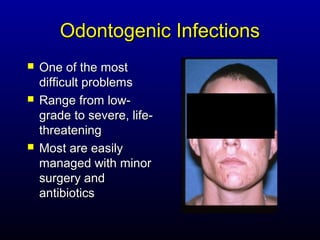
   One of the most
    difficult problems
   Range from low-
    grade to severe, life-
    threatening
   Most are easily
    managed with minor
    surgery and
    antibiotics
Odontogenic Infections
   Systematic
    approach to
    Infection Patient
    – Typical Microbiology
    – Natural history of
      odontogenic
      infections
    – Principles of
      infection
      management
    – Indications for
      referral to OMS
Microbiology

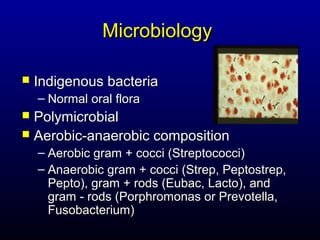
   Indigenous bacteria
    – Normal oral flora
 Polymicrobial
 Aerobic-anaerobic composition
    – Aerobic gram + cocci (Streptococci)
    – Anaerobic gram + cocci (Strep, Peptostrep,
      Pepto), gram + rods (Eubac, Lacto), and
      gram - rods (Porphromonas or Prevotella,
      Fusobacterium)
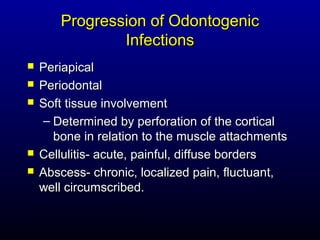
Progression of Odontogenic
               Infections
   Periapical
   Periodontal
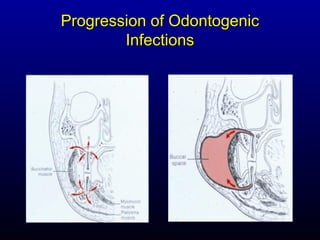
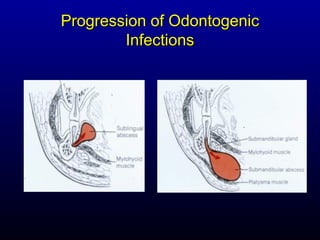
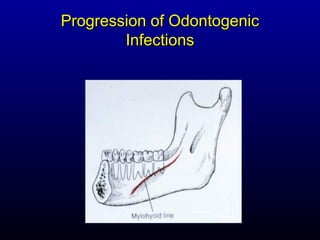
   Soft tissue involvement
    – Determined by perforation of the cortical
      bone in relation to the muscle attachments
   Cellulitis- acute, painful, diffuse borders
   Abscess- chronic, localized pain, fluctuant,
    well circumscribed.
Progression of Odontogenic
        Infections
Progression of Odontogenic
        Infections
Progression of Odontogenic
        Infections
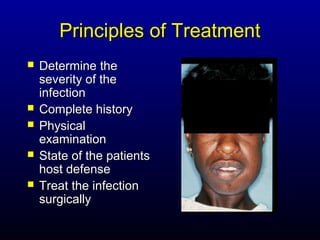
Principles of Treatment
   Determine the
    severity of the
    infection
   Complete history
   Physical
    examination
   State of the patients
    host defense
   Treat the infection
    surgically
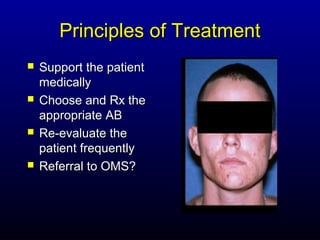
Principles of Treatment
   Support the patient
    medically
   Choose and Rx the
    appropriate AB
   Re-evaluate the
    patient frequently
   Referral to OMS?
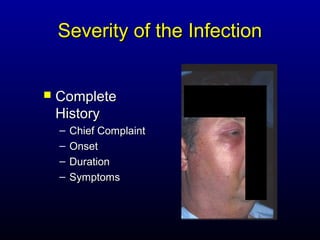
Severity of the Infection


   Complete
    History
    –   Chief Complaint
    –   Onset
    –   Duration
    –   Symptoms
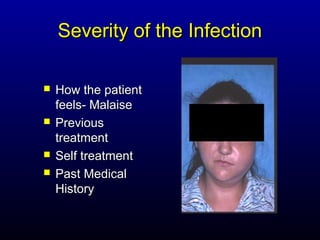
Severity of the Infection

   How the patient
    feels- Malaise
   Previous
    treatment
   Self treatment
   Past Medical
    History
Physical Examination
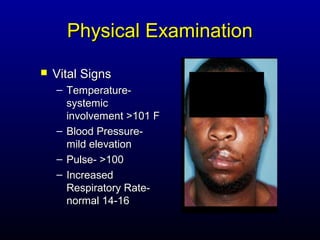
   Vital Signs
    – Temperature-
      systemic
      involvement >101 F
    – Blood Pressure-
      mild elevation
    – Pulse- >100
    – Increased
      Respiratory Rate-
      normal 14-16
Physical Examination
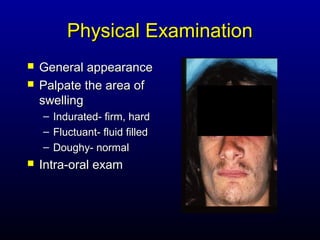
   General appearance
   Palpate the area of
    swelling
    – Indurated- firm, hard
    – Fluctuant- fluid filled
    – Doughy- normal
   Intra-oral exam
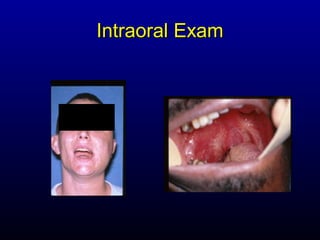
Intraoral Exam
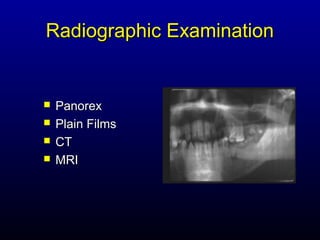
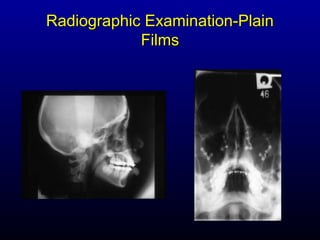
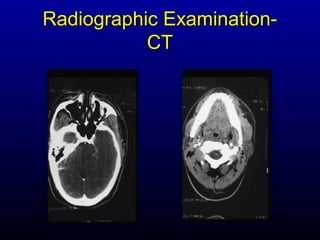
Radiographic Examination


   Panorex
   Plain Films
   CT
   MRI
Radiographic Examination-Plain
            Films
Radiographic Examination-
           CT
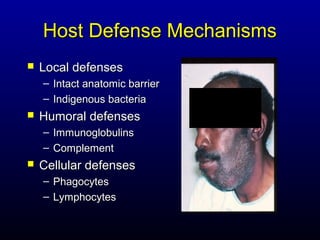
Host Defense Mechanisms
   Local defenses
    – Intact anatomic barrier
    – Indigenous bacteria
   Humoral defenses
    – Immunoglobulins
    – Complement
   Cellular defenses
    – Phagocytes
    – Lymphocytes
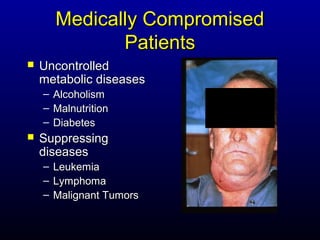
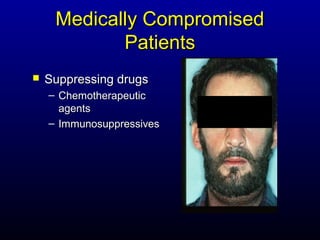
Medically Compromised
               Patients
   Uncontrolled
    metabolic diseases
    – Alcoholism
    – Malnutrition
    – Diabetes
   Suppressing
    diseases
    –   Leukemia
    –   Lymphoma
    –   Malignant Tumors
Medically Compromised
            Patients
   Suppressing drugs
    – Chemotherapeutic
      agents
    – Immunosuppressives
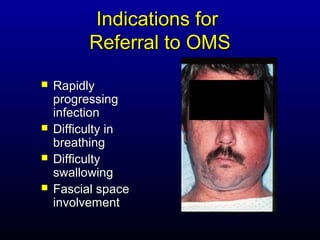
Indications for
          Referral to OMS
   Rapidly
    progressing
    infection
   Difficulty in
    breathing
   Difficulty
    swallowing
   Fascial space
    involvement
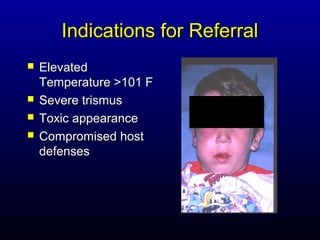
Indications for Referral
   Elevated
    Temperature >101 F
   Severe trismus
   Toxic appearance
   Compromised host
    defenses
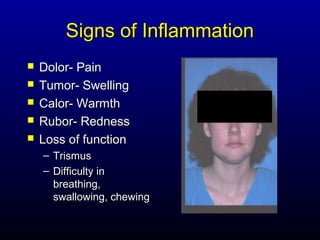
Signs of Inflammation
   Dolor- Pain
   Tumor- Swelling
   Calor- Warmth
   Rubor- Redness
   Loss of function
    – Trismus
    – Difficulty in
      breathing,
      swallowing, chewing
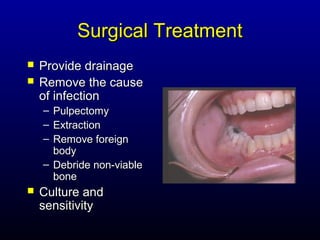
Surgical Treatment
   Provide drainage
   Remove the cause
    of infection
    – Pulpectomy
    – Extraction
    – Remove foreign
      body
    – Debride non-viable
      bone
   Culture and
    sensitivity
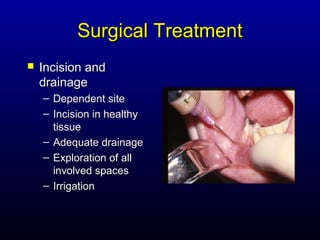
Surgical Treatment
   Incision and
    drainage
    – Dependent site
    – Incision in healthy
      tissue
    – Adequate drainage
    – Exploration of all
      involved spaces
    – Irrigation
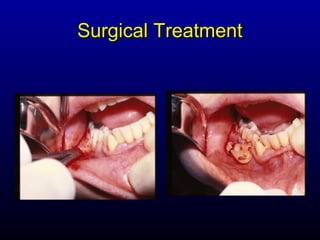
Surgical Treatment
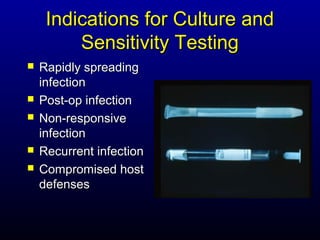
Indications for Culture and
         Sensitivity Testing
   Rapidly spreading
    infection
   Post-op infection
   Non-responsive
    infection
   Recurrent infection
   Compromised host
    defenses
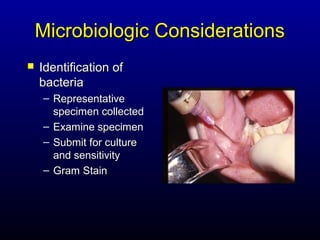
Microbiologic Considerations
   Identification of
    bacteria
    – Representative
      specimen collected
    – Examine specimen
    – Submit for culture
      and sensitivity
    – Gram Stain
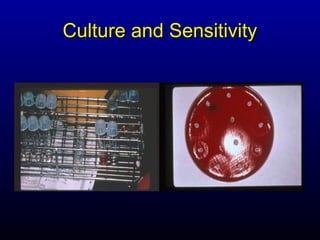
Culture and Sensitivity
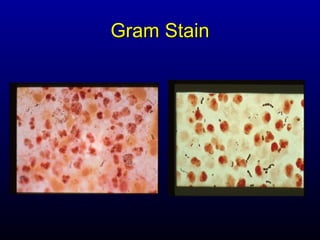
Gram Stain
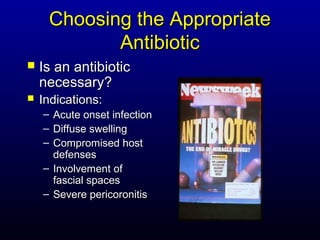
Choosing the Appropriate
            Antibiotic
   Is an antibiotic
    necessary?
   Indications:
    – Acute onset infection
    – Diffuse swelling
    – Compromised host
      defenses
    – Involvement of
      fascial spaces
    – Severe pericoronitis
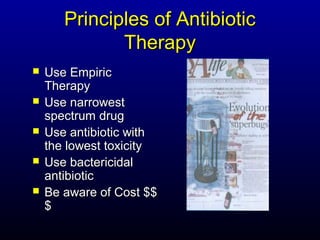
Principles of Antibiotic
              Therapy
   Use Empiric
    Therapy
   Use narrowest
    spectrum drug
   Use antibiotic with
    the lowest toxicity
   Use bactericidal
    antibiotic
   Be aware of Cost $$
    $
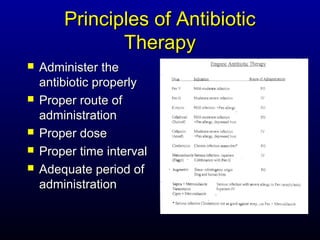
Principles of Antibiotic
               Therapy
   Administer the
    antibiotic properly
   Proper route of
    administration
   Proper dose
   Proper time interval
   Adequate period of
    administration
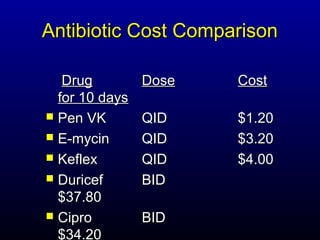
Antibiotic Cost Comparison

   Drug         Dose   Cost
  for 10 days
 Pen VK        QID    $1.20
 E-mycin       QID    $3.20
 Keflex        QID    $4.00
 Duricef       BID
  $37.80
 Cipro         BID
  $34.20
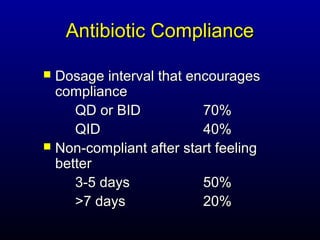
Antibiotic Compliance

 Dosage interval that encourages
  compliance
     QD or BID           70%
     QID                 40%
 Non-compliant after start feeling
  better
     3-5 days            50%
     >7 days             20%
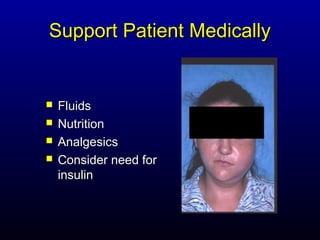
Support Patient Medically


   Fluids
   Nutrition
   Analgesics
   Consider need for
    insulin
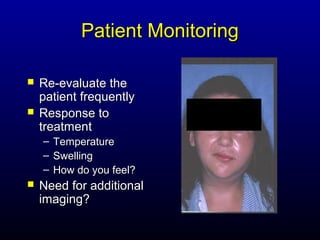
Patient Monitoring

   Re-evaluate the
    patient frequently
   Response to
    treatment
    – Temperature
    – Swelling
    – How do you feel?
   Need for additional
    imaging?
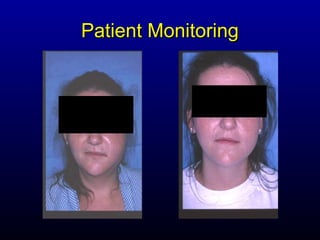
Patient Monitoring
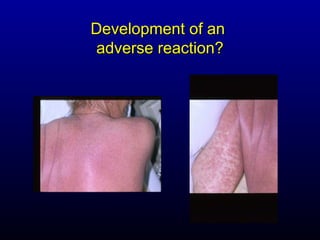
Development of an
adverse reaction?
Antibiotic Associated Colitis
   Diagnosis                      Treatment
    – Profuse watery                –   D/C current AB
      diarrhea >10 per day          –   Fluid management
    – Cramping                      –   Antibiotics
    – Fever                              » Metronidazole
    – C. difficle culture and            » Vancomycin PO
      toxin assay
    – Tissue culture
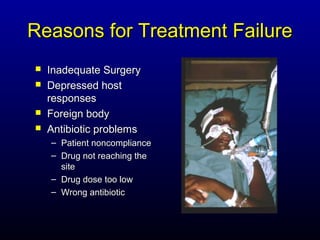
Reasons for Treatment Failure
   Inadequate Surgery
   Depressed host
    responses
   Foreign body
   Antibiotic problems
    – Patient noncompliance
    – Drug not reaching the
      site
    – Drug dose too low
    – Wrong antibiotic
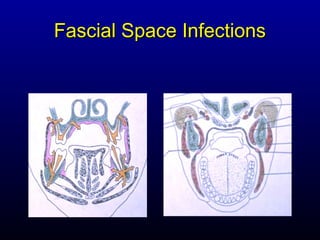
Fascial Space Infections
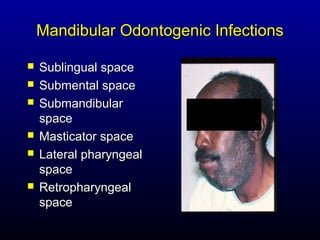
Mandibular Odontogenic Infections

   Sublingual space
   Submental space
   Submandibular
    space
   Masticator space
   Lateral pharyngeal
    space
   Retropharyngeal
    space
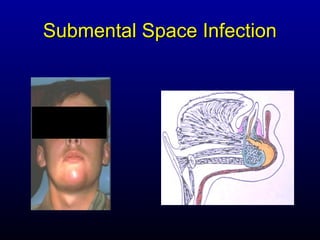
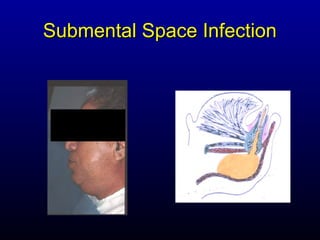
Submental Space Infection
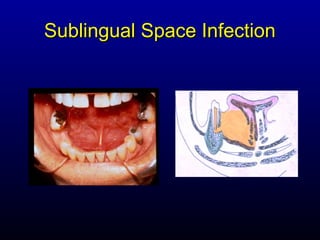
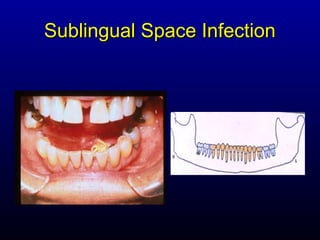
Sublingual Space Infection
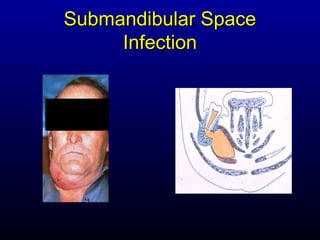
Submandibular Space
     Infection
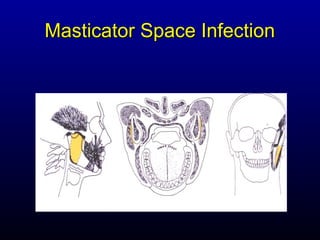
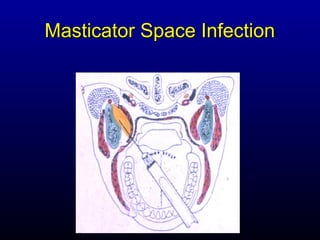
Masticator Space Infection
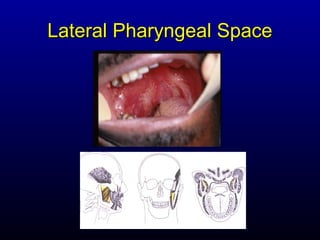
Lateral Pharyngeal Space
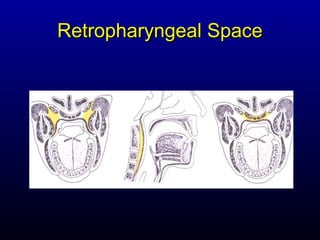
Retropharyngeal Space
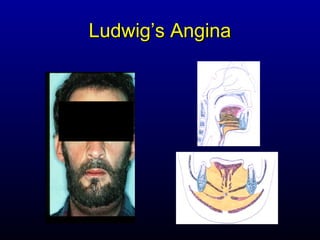
Ludwig’s Angina
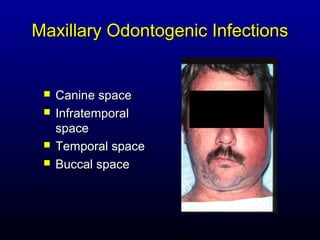
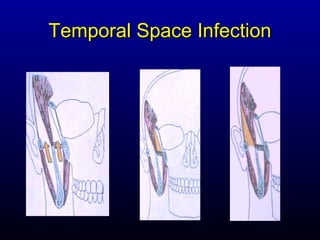
Maxillary Odontogenic Infections


    Canine space
    Infratemporal
     space
    Temporal space
    Buccal space
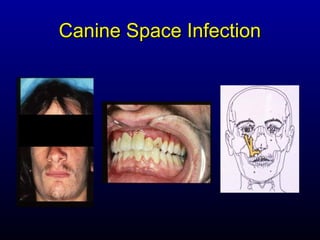
Canine Space Infection
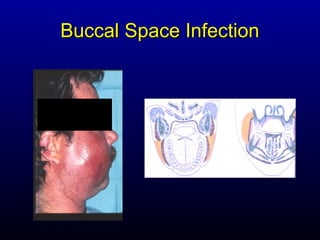
Buccal Space Infection
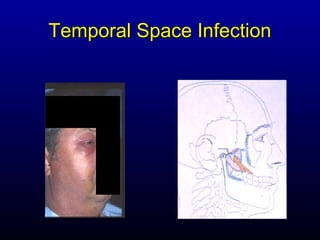
Temporal Space Infection
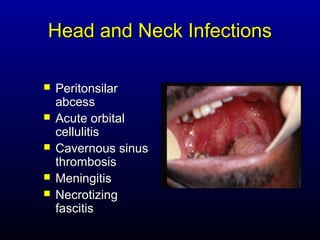
Head and Neck Infections

   Peritonsilar
    abcess
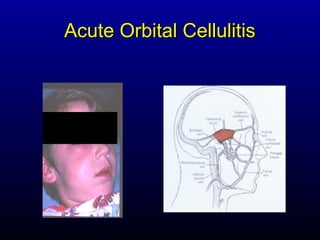
   Acute orbital
    cellulitis
   Cavernous sinus
    thrombosis
   Meningitis
   Necrotizing
    fascitis
Acute Orbital Cellulitis
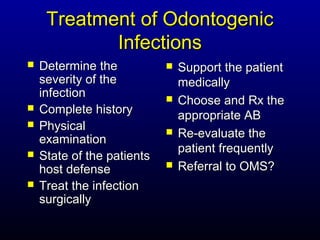
Treatment of Odontogenic
            Infections
   Determine the              Support the patient
    severity of the             medically
    infection                  Choose and Rx the
   Complete history            appropriate AB
   Physical
    examination
                               Re-evaluate the
                                patient frequently
   State of the patients
    host defense               Referral to OMS?
   Treat the infection
    surgically
THANK YOU

Odontogenic infections