Endodontic Cavity Preparation
Careful cavity preparation and canal obturation .
 are the keystones to successful root canal
. therapy
Apical moisture – proof seal, the first essential for .
 success, is not possible unless the space to be
filled is carefully prepared and debrided to
. receive the restoration
Endodontic cavity preparation begins the instant .
 the involved tooth is approached with a cutting
 instrument, and the final obturation of the
canal space will depend on the care and
. accuracy exercised in this initial preparation
                 Ass.Prof.Dr.Mohamed ALsakkaf        1
Divisions of Cavity Preparation

For descriptive convenience, endodontic
  cavity preparation may be separated into
 : two anatomic divisions
.a. Coronal preparation
.b. Radicular preparation
If one thinks of an endodontic preparation   .
 as a continuum from enamel surface to
 apex, Blacks Principle of Cavity
 Preparation –Outline, convenience,
retention, and resistance forms – may be
         .applied                                2
The entire length of the preparation is the .
full outline form. In turn, this outline may
have to be modified for the sake of
convenience to accommodate canal
. anatomy or curvature and/or instruments
Resistance must be developed at the apical .
terminus of the preparation, the So –
Called "apical stop", the barrier against
which virtually every canal filling must be
.compacted

                                            3
Basic Coronal Instruments

.Two handpieces are usually required.
The ideal cutting instrument is the round – end.
  Carbide Fissure bur, with this instrument,
  enamel,resin, ceramic, or metal perforation
 is easily accomplished, and surface
. extensions may be rapidly completed
Precious metal alloys can be cut with tungsten .
  . carbide burs
                                              4
Tapered instruments should never be forced, .
  but should be allowed to cut their own way
  with a light touch by the operator. If a
 tapered instrument is forced it will act as a
 wedge. This causes the enamel to "chech"
 .or "craze" and will weaken the tooth
If a Porcelian Jacket Crown is to be entered, .
 a small diamond bur should be used. Again
  care must be exercised not to split the
 . Jacket by forcing the action
                                              5
penetration and minor surface extensions

 are complete, the high – speed handpiece is

                                    put
  aside, and the slow – speed with a round bur
is
  used. Three sizes of round burs No. 2, 4, 6,

  and two lengths, regular and surgical are
  routinely used.
. The regular – length round bur in a
  conventional latch – type contra – angle
  handpice will "reach" 9.0mm from the nose      6
The surgical – length bur will "reach" 14 or.
    15mm and is necessary in some deep
 .preparations
The round burs are for dentin removal in both .
 anterior and posterior teeth – these burs are
first used to drill through the dentin and
"drop" into the pulp chamber. The same bur
is then used in the removal of the roof of the
. pulp chamber
The size of the round bur is made by estimating .
 the canal width and chamber size and depth
  .apparent in the initial radiograph
                                                    7
The No.2 round bur is generally used in        .
preparing mandibular anterior teeth and
most maxillary premolar teeth with
.narrow chambers and canals
The No.4 round bur is generally used the       .
maxillary anterior teeth and mandibular
premolar teeth, and in "young" maxillary
premolars and "adults" molars in both
 . arches

                                           8
The No.6 round bur is used only in molars .
. with large pulp chamber
A No.1 round bur is used in the floor of the .
pulp chamber to seek additional canal
.orifices
UltraSonic units with specially designed     .
 endodontic tips, allow clinicians to more
precisely remove dentin and expose
.orifices

                                            9
As soon as the bulk of the overhanging dentin is .
 removed from the roof of the chamber, the
Law – speed round bur is put aside, and,
once again the high – speed fissure bur is used
to finish and slope the side walls. Endoz
Carbide fissure bur is recommended. It is safe
– ended and will not scar the pulpal floor.
Moreover it is longer bleded (9mm) for
 .sloping the access cavity
High – Speed burs should not be used to
penetrate into, or initially enlarge, the pulp
chamber unless the operator is skilled in
 .endodontic preparation                        10
Principles of Endodontic Cavity
               Preparation

By slightly modifying G.V. Black Principles .
 of Cavity Preparation, a list of principles
 of endodontic cavity preparation may be
.established
Black G.V dealt with cavity preparation      .
 limited to the crowns of teeth, however his
principles can be applied to radicular
   .preparations as well
                                             11
Endodontic preparations deal with both     .
coronal and radicular cohorts – each
prepared separately but ultimately flowing
.together into a single preparation
For convenience of description, Blacks
principles are therefore divided into the
.following


                                          12
Endodontic Coronal Cavity Preparation

 .I. Outline Form
  .II. Convenience form
 III. Removal of the remaining carious dentin
  ).   ( and defective restoration
 .IV. Toilet of the cavity


                                           13
Endodontic Radicular Cavity
           Preparation

I. and II outline form and convenience form
 ).   (continued
).IV. Toilet of the cavity (continued
 .V. Retention Form
 .VI. Resistance Form


                                          14
Outline Form

The outline form of the endodontic cavity      .
  must be correctly shaped, and positioned
  to establish complete access for
 instrumentation, from cavity margin to
.apical foramen
External outline form evolves from the        .
  internal anatomy of the tooth established
 . by the pulp

                                              15
Because of this internal – external            .
  relationship, endodontic preparations
must of necessity be done in a reverse
manner,      from the inside of the tooth to
the outside. This means, the external
outline form is     established by
mechanically projecting the internal
anatomy of the pulp onto the          external
.surface

                                             16
This may be accomplished only by drilling into .
 the open space of the pulp chamber and then
working with the bur from the inside of the
tooth to the outside, cutting away the dentin
of the pulpal floor and walls overhanging the
 .floor of the chamber
Intracoronal preparation is contrasted to the .
 extracoronal preparation of operative
dentistry, in which outline form is always
 .related to the external anatomy of the tooth

                                              17
Factors that govern Endodontic outline
                  form
:Size of pulp chamber. 1
The outline form affected by the size of the pulp.
   chamber. In young patients, these
  preparations must be more extensive than in
 older patients, in whom the pulp has receded
 .and the pulp chamber is smaller
In youngsters teeth the root canals are larger, so.
 . they require larger instruments

                                                  18
:Shape of pulp chamber. 2

Final outline form should reflect the shape of   .
. the pulp chamber
Example
a. The floor of the pulp chamber in a molar tooth
    is usually triangular in shape, owing to the
   triangular position of the orifices of the
  canals. This triangular shape is extended up
 the walls of the cavity and out onto the
occlusal surface, so the final occlusal cavity
 .outline form is generally triangular
                                                 19
b. The coronal pulp of a maxillary premolar
is    flat mesiodistally, but is elongated
     buccolingually. The outline form is, an
     elongated oval that extends
     buccolingually rather than
mesiodistally,    as does Blacks operative
 .cavity               preparation


                                               20
Number, position and carveture of the . 3
. root canals

To prepare each canal efficiently without     .
 interference, the cavity walls often have to
 be extended to allow unstrained
. instrument approach to apical foramen


                                              21
Self Study

 .Convenience form. 1
III Principle (Removal of remaining. 2
 (.carious dentin
.IV Principle Toilet of the cavity. 3


                                         22
Endodontic Preparation Of Maxillary
            Anterior Teeth
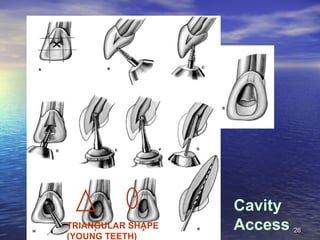
A. Access opening is always gained through the
   lingual surface of all anterior teeth. Initial
  penetration is made in the exact center (X(.
. Avoid intering the cavity too far gingivally
B. Enterance is prepared with a round – point
  tapering fissure bur in high – speed handpice,
 operated at a right angle to the long axis of the
tooth. At this step only enamel is penetrated.
.Don’t apply any pressure

                                                     23
C. Convenience extension toword the incisal
  continues the initial penetrating. Enamel
 and dentin are beveled toward the incial –
  Entrance into the pulp chamber should
 not be made with a high – speed
. handpice
D. The outline is fanned incisally with a
  fissure bur, a "nest" is prepared in the
 dentin to receive the round bur to be
. used in penetration

                                              24
E. A surgical – length No 2 or 4 round bur in
     low – speed is used to penetrate the pulp
     chamber. Take advantage of convenience
    extension toward the incisal to allow for
   the shaft of the bur, operated nearly
 . parallel to the long axis
F. Working from inside the chamber to
     outside, a round bur is used to remove
the lingual and labial walls of the pulp
 .       chamber

                                             25
Cavity
TRIANGULAR SHAPE   Access   26
(YOUNG TEETH)
G. When the outline is completed, the surgical
   – length bur is carefully passed into the
 . canal
Working from inside to outside, the lingual
"shoulder" is removed to provide
continuous, smooth – flowing penetration.
Often a long, tapering diamond point bur to
 .be used for this purpose


                                            27
H. A No 1 or 2 round bur must be used
    laterally and incisally to eliminate pulpal
    horn debris (This will prevent future
 (. discoloration
I. In a "young" tooth with a large pulp, the
   outline form reflects a large triangular
  internal anatomy – an extensive cavity
 that allows cleansing of the chamber as
 well as passage of large instruments.
Extension incisally provides greater
 .access to the midline of the canal
                                                  28
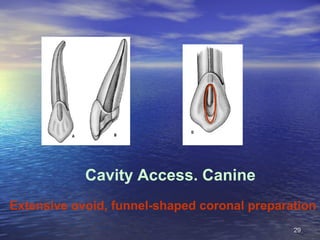
Cavity Access. Canine
Extensive ovoid, funnel-shaped coronal preparation
                                              29
J. In "adult" teeth with the chamber
   obturated with secondary dentin, are
  avoid in shape. The difficalty is to reach
 to this depth with a round bur.
 Therefore, when the X – Ray reveals
advanced pulpal recession, convenience
extension must be advanced further
incisally to allow the bur shaft to operate
 .in the central axis


                                               30
K. Final preparation with the reamer. The
   shaft clears the incisal cavity margin and
    reduced lingual "shoulder", providing
    good approach to the apical third of the
    canal. An optimal, round, tapered cavity
.    may be prepared in the apical third


                                                31

Endodontic cavity preparation

  • 1.
    Endodontic Cavity Preparation Carefulcavity preparation and canal obturation . are the keystones to successful root canal . therapy Apical moisture – proof seal, the first essential for . success, is not possible unless the space to be filled is carefully prepared and debrided to . receive the restoration Endodontic cavity preparation begins the instant . the involved tooth is approached with a cutting instrument, and the final obturation of the canal space will depend on the care and . accuracy exercised in this initial preparation Ass.Prof.Dr.Mohamed ALsakkaf 1
  • 2.
    Divisions of CavityPreparation For descriptive convenience, endodontic cavity preparation may be separated into : two anatomic divisions .a. Coronal preparation .b. Radicular preparation If one thinks of an endodontic preparation . as a continuum from enamel surface to apex, Blacks Principle of Cavity Preparation –Outline, convenience, retention, and resistance forms – may be .applied 2
  • 3.
    The entire lengthof the preparation is the . full outline form. In turn, this outline may have to be modified for the sake of convenience to accommodate canal . anatomy or curvature and/or instruments Resistance must be developed at the apical . terminus of the preparation, the So – Called "apical stop", the barrier against which virtually every canal filling must be .compacted 3
  • 4.
    Basic Coronal Instruments .Twohandpieces are usually required. The ideal cutting instrument is the round – end. Carbide Fissure bur, with this instrument, enamel,resin, ceramic, or metal perforation is easily accomplished, and surface . extensions may be rapidly completed Precious metal alloys can be cut with tungsten . . carbide burs 4
  • 5.
    Tapered instruments shouldnever be forced, . but should be allowed to cut their own way with a light touch by the operator. If a tapered instrument is forced it will act as a wedge. This causes the enamel to "chech" .or "craze" and will weaken the tooth If a Porcelian Jacket Crown is to be entered, . a small diamond bur should be used. Again care must be exercised not to split the . Jacket by forcing the action 5
  • 6.
    penetration and minorsurface extensions are complete, the high – speed handpiece is put aside, and the slow – speed with a round bur is used. Three sizes of round burs No. 2, 4, 6, and two lengths, regular and surgical are routinely used. . The regular – length round bur in a conventional latch – type contra – angle handpice will "reach" 9.0mm from the nose 6
  • 7.
    The surgical –length bur will "reach" 14 or. 15mm and is necessary in some deep .preparations The round burs are for dentin removal in both . anterior and posterior teeth – these burs are first used to drill through the dentin and "drop" into the pulp chamber. The same bur is then used in the removal of the roof of the . pulp chamber The size of the round bur is made by estimating . the canal width and chamber size and depth .apparent in the initial radiograph 7
  • 8.
    The No.2 roundbur is generally used in . preparing mandibular anterior teeth and most maxillary premolar teeth with .narrow chambers and canals The No.4 round bur is generally used the . maxillary anterior teeth and mandibular premolar teeth, and in "young" maxillary premolars and "adults" molars in both . arches 8
  • 9.
    The No.6 roundbur is used only in molars . . with large pulp chamber A No.1 round bur is used in the floor of the . pulp chamber to seek additional canal .orifices UltraSonic units with specially designed . endodontic tips, allow clinicians to more precisely remove dentin and expose .orifices 9
  • 10.
    As soon asthe bulk of the overhanging dentin is . removed from the roof of the chamber, the Law – speed round bur is put aside, and, once again the high – speed fissure bur is used to finish and slope the side walls. Endoz Carbide fissure bur is recommended. It is safe – ended and will not scar the pulpal floor. Moreover it is longer bleded (9mm) for .sloping the access cavity High – Speed burs should not be used to penetrate into, or initially enlarge, the pulp chamber unless the operator is skilled in .endodontic preparation 10
  • 11.
    Principles of EndodonticCavity Preparation By slightly modifying G.V. Black Principles . of Cavity Preparation, a list of principles of endodontic cavity preparation may be .established Black G.V dealt with cavity preparation . limited to the crowns of teeth, however his principles can be applied to radicular .preparations as well 11
  • 12.
    Endodontic preparations dealwith both . coronal and radicular cohorts – each prepared separately but ultimately flowing .together into a single preparation For convenience of description, Blacks principles are therefore divided into the .following 12
  • 13.
    Endodontic Coronal CavityPreparation .I. Outline Form .II. Convenience form III. Removal of the remaining carious dentin ). ( and defective restoration .IV. Toilet of the cavity 13
  • 14.
    Endodontic Radicular Cavity Preparation I. and II outline form and convenience form ). (continued ).IV. Toilet of the cavity (continued .V. Retention Form .VI. Resistance Form 14
  • 15.
    Outline Form The outlineform of the endodontic cavity . must be correctly shaped, and positioned to establish complete access for instrumentation, from cavity margin to .apical foramen External outline form evolves from the . internal anatomy of the tooth established . by the pulp 15
  • 16.
    Because of thisinternal – external . relationship, endodontic preparations must of necessity be done in a reverse manner, from the inside of the tooth to the outside. This means, the external outline form is established by mechanically projecting the internal anatomy of the pulp onto the external .surface 16
  • 17.
    This may beaccomplished only by drilling into . the open space of the pulp chamber and then working with the bur from the inside of the tooth to the outside, cutting away the dentin of the pulpal floor and walls overhanging the .floor of the chamber Intracoronal preparation is contrasted to the . extracoronal preparation of operative dentistry, in which outline form is always .related to the external anatomy of the tooth 17
  • 18.
    Factors that governEndodontic outline form :Size of pulp chamber. 1 The outline form affected by the size of the pulp. chamber. In young patients, these preparations must be more extensive than in older patients, in whom the pulp has receded .and the pulp chamber is smaller In youngsters teeth the root canals are larger, so. . they require larger instruments 18
  • 19.
    :Shape of pulpchamber. 2 Final outline form should reflect the shape of . . the pulp chamber Example a. The floor of the pulp chamber in a molar tooth is usually triangular in shape, owing to the triangular position of the orifices of the canals. This triangular shape is extended up the walls of the cavity and out onto the occlusal surface, so the final occlusal cavity .outline form is generally triangular 19
  • 20.
    b. The coronalpulp of a maxillary premolar is flat mesiodistally, but is elongated buccolingually. The outline form is, an elongated oval that extends buccolingually rather than mesiodistally, as does Blacks operative .cavity preparation 20
  • 21.
    Number, position andcarveture of the . 3 . root canals To prepare each canal efficiently without . interference, the cavity walls often have to be extended to allow unstrained . instrument approach to apical foramen 21
  • 22.
    Self Study .Convenienceform. 1 III Principle (Removal of remaining. 2 (.carious dentin .IV Principle Toilet of the cavity. 3 22
  • 23.
    Endodontic Preparation OfMaxillary Anterior Teeth A. Access opening is always gained through the lingual surface of all anterior teeth. Initial penetration is made in the exact center (X(. . Avoid intering the cavity too far gingivally B. Enterance is prepared with a round – point tapering fissure bur in high – speed handpice, operated at a right angle to the long axis of the tooth. At this step only enamel is penetrated. .Don’t apply any pressure 23
  • 24.
    C. Convenience extensiontoword the incisal continues the initial penetrating. Enamel and dentin are beveled toward the incial – Entrance into the pulp chamber should not be made with a high – speed . handpice D. The outline is fanned incisally with a fissure bur, a "nest" is prepared in the dentin to receive the round bur to be . used in penetration 24
  • 25.
    E. A surgical– length No 2 or 4 round bur in low – speed is used to penetrate the pulp chamber. Take advantage of convenience extension toward the incisal to allow for the shaft of the bur, operated nearly . parallel to the long axis F. Working from inside the chamber to outside, a round bur is used to remove the lingual and labial walls of the pulp . chamber 25
  • 26.
    Cavity TRIANGULAR SHAPE Access 26 (YOUNG TEETH)
  • 27.
    G. When theoutline is completed, the surgical – length bur is carefully passed into the . canal Working from inside to outside, the lingual "shoulder" is removed to provide continuous, smooth – flowing penetration. Often a long, tapering diamond point bur to .be used for this purpose 27
  • 28.
    H. A No1 or 2 round bur must be used laterally and incisally to eliminate pulpal horn debris (This will prevent future (. discoloration I. In a "young" tooth with a large pulp, the outline form reflects a large triangular internal anatomy – an extensive cavity that allows cleansing of the chamber as well as passage of large instruments. Extension incisally provides greater .access to the midline of the canal 28
  • 29.
    Cavity Access. Canine Extensiveovoid, funnel-shaped coronal preparation 29
  • 30.
    J. In "adult"teeth with the chamber obturated with secondary dentin, are avoid in shape. The difficalty is to reach to this depth with a round bur. Therefore, when the X – Ray reveals advanced pulpal recession, convenience extension must be advanced further incisally to allow the bur shaft to operate .in the central axis 30
  • 31.
    K. Final preparationwith the reamer. The shaft clears the incisal cavity margin and reduced lingual "shoulder", providing good approach to the apical third of the canal. An optimal, round, tapered cavity . may be prepared in the apical third 31