

By
DR.FAIZAN ALI
 The Steiner analysis, developed and promoted by
  Cecil Steiner in the 1950s, can be considered the first
  of the modern cephalometric analyses for two reasons:
1. It displayed measurements in a way that emphasized
    not just the individual measurements but their
    interrelationship into a pattern.
2. It offered specific guides for use of cephalometric
    measurements in treatment planning. Elements of it
    remain useful today.
 The Steiner numerical analysis, also suggests a series
 of measurements not only to diagnose the problem
 but it also provides guidelines for treatment planning
 based on the prediction of changes that take place as a
 result of growth and/or orthodontic therapy.
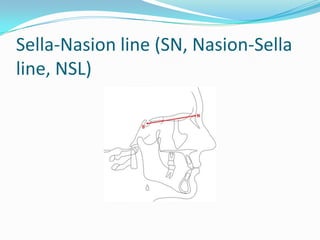
REFRENCE PLANE
 Steiner use SELLA to NASION(anterior cranial base)
  line as a reference plane for his analysis
ADVANTAGE
 According to Steiner S-N plane is a best reference
  plane because
       “If head deviate from true profile position these
two mid line points are minimally moved, even if the
head rotates in a cephalostat”
Sella-Nasion line (SN, Nasion-Sella
line, NSL)
 Steiner analysis consist of


 SKELETAL ANALYSIS
 DENTAL ANALYSIS
 SOFT TISSUE ANALYSIS
SKELETAL ANALYSIS
 Relate upper and lower jaw with skull and each other
  in antero posterior axis
 It consist of
 5 Angular measurements
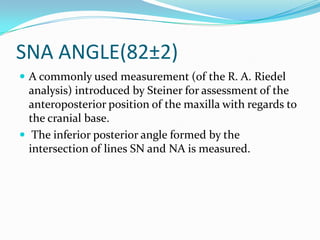
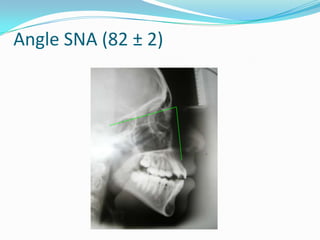
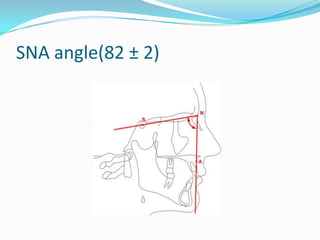
SNA ANGLE(82±2)
 A commonly used measurement (of the R. A. Riedel
  analysis) introduced by Steiner for assessment of the
  anteroposterior position of the maxilla with regards to
  the cranial base.
 The inferior posterior angle formed by the
  intersection of lines SN and NA is measured.
Angle SNA (82 ± 2)
SNA angle(82 ± 2)
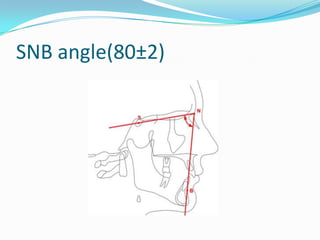
SNB angle(80±2)
 A measurement introduced by Steiner to evaluate the
  anteroposterior position of the mandible in relation to
  the cranial base (also part of the R. A. Riedel analysis).
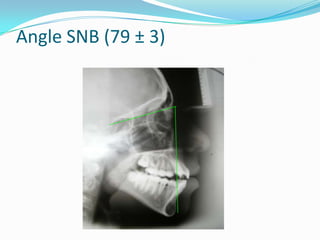
 The inferior posterior angle formed by the intersection
  of lines NA and NB is measured.
Angle SNB (79 ± 3)
SNB angle(80±2)
Angle ANB (3 ± 1)
 The difference between SNA and SNB-the ANB angle-
  indicates the magnitude of the skeletal jaw
  discrepancy.
 This to Steiner was the measurement of real interest.
 The magnitude of the ANB angle, however, is
  influenced by two factors other than the
  anteroposterior difference in jaw position.
1. The vertical height of the face: As the vertical
    distance between nasion and points A and B
    increases, the ANB angle will decreases.
2. If the antero- posterior position of nasion is
    abnormal, the size of the angle will be affected.
 As SNA and SNB become larger and the jaws are more
  protrusive, even if their horizontal relationship is
  unchanged, it will be registered as a larger ANB angle.
 Because of this criticism different indicators of jaw
  discrepancy are now a days used.
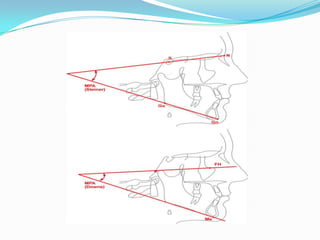
Mandibular plane angle(32±4)
 A measurement introduced by C. C. Steiner for
  assessment of the steepness of the mandibular plane
  in relation to the cranial base.
 The anterior angle formed by the intersection of SN
  and GoGn is measured.
 W. B. Downs defined the mandibular plane angle as
  the anterior angle formed by the intersection of the
  Frankfort horizontal plane and a tangent to the lower
  border of the mandible and symphysis.
SN-OCCLUSAL PLANE ANGLE(17±4)
 According to Steiner occlusal plane is
    “Region of overlapping cusps of first premolar and
   molar”
 Determine the relation of teeth in occlusion with
   cranial base
i. Increased in angle shows HIGH ANGLE
     CASE(SEKELETAL OPEN BITE)
ii. Decreased in angle shows LOW ANGLE
     CASE(SKELETAL DEEP BITE)
DENTAL ANALYSIS
 Relates upper and lower incisors with each other and
  with their respective jaws
 3 Angular measurements
 2 Linear measurements
 1 Ratio
UI-NA angle(22)
 Angle formed between the long axis of upper incisors
  and line drawn from nasion to pogonoin
 Describe axial inclination of upper incisors
 Determine relative angular relationship of upper
  incisor teeth
o Increased: Greater angulation of upper incisor
o Decreased: Lesser angulation of upper incisor
UI-NA DISTANCE(4mm)
 Determine A-P position of upper incisor with relation
  to N-A line
 Distance measured from most anteriorly placed point
  on labial side of crown of upper incisor to N-A line
 Increased: Forwardly placed upper incisor
 Decreased: backwardly placed upper incisor
LI-NB angle(25)
 Angle formed between the long axis of lower incisors
    and line drawn from nasion to pogonoin
   Describe axial inclination of lower incisors
   Determine relative angular relationship of lower
    incisor teeth
   Increased: Greater angulation of lower incisor
   Decreased: Lesser angulation of lower incisor
LI-NB DISTANCE(4mm)
 Determine A-P position of lower incisor with relation
  to N-A line
 Distance measured from most anteriorly placed point
  on labial side of crown of lower incisor to N-A line
 Increased: Forwardly placed lower incisor
 Decreased: backwardly placed lower incisor
 It is important to understand that it is possible for
  both upper and lower incisors to have normal
  angular(axial)relation with N-A line but have
  disturbance in A-P positioning(forward or backward
  placed incisors)
 Reverse relationship of A-P positioning and axial
  inclination or angular relation is also true.
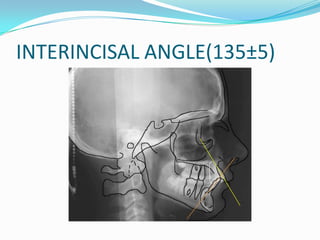
INTERINCISAL ANGLE(135±5)
 Angle between long axes of upper and lower incisors.
 Average value: 135.4’ ( 130 to 150.5’)
 increased in class I bimaxillary protrusion
INTERINCISAL ANGLE(135±5)
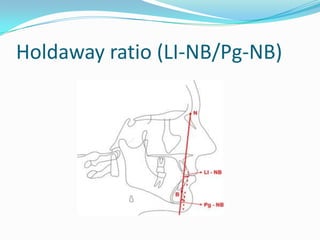
Holdaway ratio (LI-NB/Pg-NB)

 A measurement introduced by R. A. Holdaway to
  evaluate the relative prominence of the mandibular
  incisors, as compared to the size of the bony chin.
 It is calculated as the ratio of the linear distance from
  the labial surface of the mandibular central incisor to
  the NB line, over the linear distance of the chin to the
  same line.
 If ratio is 2:1 it means that lower incisors are more
  proclined as compared to chin prominence.
 If discrepancy is 2mm=acceptable
                    3mm=less desirable
                    4mm=correction indicated
Holdaway ratio (LI-NB/Pg-NB)
SOFT TISSUE ANALYSIS
 To assess balance and harmony of lower facial profile
 2 linear measurements
S-line (Esthetic plane of Steiner)
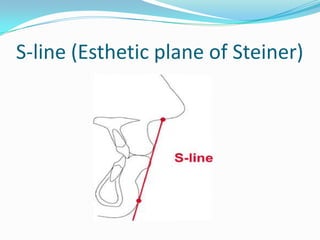
 A line connecting the midpoint of the columella of the
  nose to the soft tissue pogonion.
 According to C. C. Steiner, the lips should fall on this
  line and any deviation shows prominence or flatness of
  the lips.
S-line (Esthetic plane of Steiner)
THANK YOU

Steiners analysis

  • 1.
  • 2.
     The Steineranalysis, developed and promoted by Cecil Steiner in the 1950s, can be considered the first of the modern cephalometric analyses for two reasons: 1. It displayed measurements in a way that emphasized not just the individual measurements but their interrelationship into a pattern. 2. It offered specific guides for use of cephalometric measurements in treatment planning. Elements of it remain useful today.
  • 3.
     The Steinernumerical analysis, also suggests a series of measurements not only to diagnose the problem but it also provides guidelines for treatment planning based on the prediction of changes that take place as a result of growth and/or orthodontic therapy.
  • 4.
    REFRENCE PLANE  Steineruse SELLA to NASION(anterior cranial base) line as a reference plane for his analysis ADVANTAGE  According to Steiner S-N plane is a best reference plane because “If head deviate from true profile position these two mid line points are minimally moved, even if the head rotates in a cephalostat”
  • 5.
    Sella-Nasion line (SN,Nasion-Sella line, NSL)
  • 6.
     Steiner analysisconsist of  SKELETAL ANALYSIS  DENTAL ANALYSIS  SOFT TISSUE ANALYSIS
  • 7.
    SKELETAL ANALYSIS  Relateupper and lower jaw with skull and each other in antero posterior axis  It consist of  5 Angular measurements
  • 8.
    SNA ANGLE(82±2)  Acommonly used measurement (of the R. A. Riedel analysis) introduced by Steiner for assessment of the anteroposterior position of the maxilla with regards to the cranial base.  The inferior posterior angle formed by the intersection of lines SN and NA is measured.
  • 9.
  • 10.
  • 11.
    SNB angle(80±2)  Ameasurement introduced by Steiner to evaluate the anteroposterior position of the mandible in relation to the cranial base (also part of the R. A. Riedel analysis).  The inferior posterior angle formed by the intersection of lines NA and NB is measured.
  • 12.
  • 13.
  • 14.
    Angle ANB (3± 1)  The difference between SNA and SNB-the ANB angle- indicates the magnitude of the skeletal jaw discrepancy.  This to Steiner was the measurement of real interest.
  • 15.
     The magnitudeof the ANB angle, however, is influenced by two factors other than the anteroposterior difference in jaw position. 1. The vertical height of the face: As the vertical distance between nasion and points A and B increases, the ANB angle will decreases. 2. If the antero- posterior position of nasion is abnormal, the size of the angle will be affected.
  • 16.
     As SNAand SNB become larger and the jaws are more protrusive, even if their horizontal relationship is unchanged, it will be registered as a larger ANB angle.  Because of this criticism different indicators of jaw discrepancy are now a days used.
  • 17.
    Mandibular plane angle(32±4) A measurement introduced by C. C. Steiner for assessment of the steepness of the mandibular plane in relation to the cranial base.  The anterior angle formed by the intersection of SN and GoGn is measured.  W. B. Downs defined the mandibular plane angle as the anterior angle formed by the intersection of the Frankfort horizontal plane and a tangent to the lower border of the mandible and symphysis.
  • 19.
    SN-OCCLUSAL PLANE ANGLE(17±4) According to Steiner occlusal plane is  “Region of overlapping cusps of first premolar and molar”  Determine the relation of teeth in occlusion with cranial base i. Increased in angle shows HIGH ANGLE CASE(SEKELETAL OPEN BITE) ii. Decreased in angle shows LOW ANGLE CASE(SKELETAL DEEP BITE)
  • 20.
    DENTAL ANALYSIS  Relatesupper and lower incisors with each other and with their respective jaws  3 Angular measurements  2 Linear measurements  1 Ratio
  • 21.
    UI-NA angle(22)  Angleformed between the long axis of upper incisors and line drawn from nasion to pogonoin  Describe axial inclination of upper incisors  Determine relative angular relationship of upper incisor teeth o Increased: Greater angulation of upper incisor o Decreased: Lesser angulation of upper incisor
  • 22.
    UI-NA DISTANCE(4mm)  DetermineA-P position of upper incisor with relation to N-A line  Distance measured from most anteriorly placed point on labial side of crown of upper incisor to N-A line  Increased: Forwardly placed upper incisor  Decreased: backwardly placed upper incisor
  • 23.
    LI-NB angle(25)  Angleformed between the long axis of lower incisors and line drawn from nasion to pogonoin  Describe axial inclination of lower incisors  Determine relative angular relationship of lower incisor teeth  Increased: Greater angulation of lower incisor  Decreased: Lesser angulation of lower incisor
  • 24.
    LI-NB DISTANCE(4mm)  DetermineA-P position of lower incisor with relation to N-A line  Distance measured from most anteriorly placed point on labial side of crown of lower incisor to N-A line  Increased: Forwardly placed lower incisor  Decreased: backwardly placed lower incisor
  • 25.
     It isimportant to understand that it is possible for both upper and lower incisors to have normal angular(axial)relation with N-A line but have disturbance in A-P positioning(forward or backward placed incisors)  Reverse relationship of A-P positioning and axial inclination or angular relation is also true.
  • 26.
    INTERINCISAL ANGLE(135±5)  Anglebetween long axes of upper and lower incisors.  Average value: 135.4’ ( 130 to 150.5’)  increased in class I bimaxillary protrusion
  • 27.
  • 28.
    Holdaway ratio (LI-NB/Pg-NB) A measurement introduced by R. A. Holdaway to evaluate the relative prominence of the mandibular incisors, as compared to the size of the bony chin.  It is calculated as the ratio of the linear distance from the labial surface of the mandibular central incisor to the NB line, over the linear distance of the chin to the same line.
  • 29.
     If ratiois 2:1 it means that lower incisors are more proclined as compared to chin prominence.  If discrepancy is 2mm=acceptable 3mm=less desirable 4mm=correction indicated
  • 30.
  • 31.
    SOFT TISSUE ANALYSIS To assess balance and harmony of lower facial profile  2 linear measurements
  • 32.
    S-line (Esthetic planeof Steiner)  A line connecting the midpoint of the columella of the nose to the soft tissue pogonion.  According to C. C. Steiner, the lips should fall on this line and any deviation shows prominence or flatness of the lips.
  • 33.
  • 34.