Museo del Prado
The Spanish National Art Gallery
First created 3 Oct 2018. Version 1.0 - 13 Oct 2018. Daperro. London.
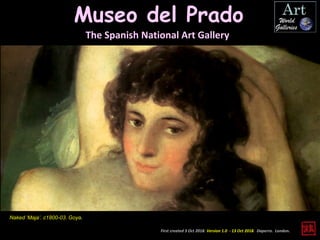
Naked ‘Maja’. c1800-03. Goya.
Medieval 12C Spanish
Painted in Spain, Segovia, during the early
stages of the Reconquista (814-1139). During
this period much of Spain and Portugal were
under the Moors, which was Islamic.
Segovia was in the front line. Neither Spain
nor Portugal existed as a country.
Spain in Reconquista (814-1139).
Spanish
Medieval 13C Spanish
Similar type of altarpieces like this were found all over Europe from Norway, England to the Iberian
Peninsula. During this time master craftsmen were becoming professional artists.
Medieval 14C Spanish
In the 14C Spain was still divided into Christian
kingdoms of Portugal, Aragon, Castile and
Navarre. The Muslim was confined to the
southern half of the peninsula, the Emirate of
Granada, which survived to 1492.
El Greco (c1540-1614)
El Greco’s name was Domenikos
Theotokopoulos. Although often regarded as
a Spanish painter, he was ethically a Greek.
At the age of 26, he travelled to Venice and
later practised in Rome. He enriched his style
with elements of Mannerism and Venetian
Renaissance.
El Greco (c1540-1614)
El Greco early works show his wide ranges:
Titian, Michelangelo, Bassano, Raphael,
Durer etc. In Spain El Greco spent most of his
professional life in Toledo, then the ‘capital’ of
Spain. In his later works, he often painted
people having elongated limbs, small heads
and stylized facial features.
Francisco Zurbaran (1598-1664)
Still Life with Vessels’. c1650. 45x84 cm. F Zurbaran.
Francesco Zurbaran was a contemporary of Diego
Velazquez. His style was somewhat limited, often bleak,
austere, unquestioning piety of Spanish devotional art,
inline with the religious climate of the Counter-
Reformation.
Diego Velazquez (1599-1660)
Velazquez is probably the best known of all the Spanish painter
in history. He became one of the highest decorated court
painter ever lived. Because of his association with the Spanish
monarchy the Prado has the finest collection of Velazquez.
Diego Velazquez (1599-1660)
Diego Velazquez
(1599-1660)
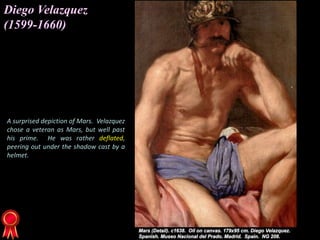
A surprised depiction of Mars. Velazquez
chose a veteran as Mars, but well past
his prime. He was rather deflated,
peering out under the shadow cast by a
helmet.
Diego Velazquez (1599-1660)
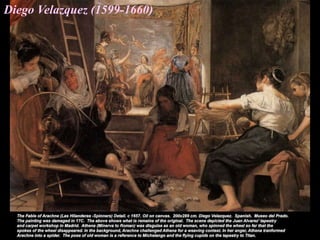
Instead of painting the monarchy. Velazquez painted himself in the company of the royal family.
Diego Velazquez (1599-1660)
Velazquez also painted personality at the court. He
always painted them with dignity.
Diego Velazquez (1599-1660)
Juan Carreno de Miranda (1614-85)
Miranda’s family moved to Madrid in 1623
and trained under Pedro de las Cuevas and
Bartolome Roman. He came to the notice of
Velazquez. In 1658 Carreno was hired as an
assistant on a royal commission to paint
frescoes in the Alcazar of Madrid. He was
hired as the court painter to the queen in
1671.
Bartolome Esteban Murillo (1618-82)
In contrast with Zurbaran, Murillo’s approach in
the 1640s was softer, sweeter and more fused.
Murillo visited Madrid, probably in 1648 being
apparently helped by Velazquez. His change of
style from his earliest works, in his use of colour,
the hard naturalism, like the beggar-boy
paintings. His early religious subjects were cool,
detached, with only a little idealization.
A Boy with a Dog’. 1650s. Hermitage. St Petersburg
Bartolome Esteban Murillo (1618-82)
Murillo idealized devotional forms, with
Baroque flutter to the draperies, a certain
artificiality, always with warmth, charm and
quiet religious feeling.
Luis Egidio Melendez (1716-80)
Francisco Goya (1748-1828)
Prado has a very comprehensive collection on
paintings by Goya. He was the most
important Spanish painter in the 18C and 19C.
He painted the Spanish royal family, the
French occupying rulers and eventually the
British liberator, the Duke of Wellington. His
painting skill was certainty recognised during
his life time.
(An aging) Self Portrait.1815.. Prado. Madrid.
Francisco Goya (1748-1828)
Goya produced a nude portrait of the same woman with identical pose.
Francisco Goya (1748-1828)
The Nude Maja is renowned for the straightforward and unashamed gaze of the model.
Francisco Goya (1748-1828)
Third of May 1808. 1814. Prado. Madrid.
These are the most horrific images painted by Goya. On
the Third of May 1808, Goya painted French savagery on
the Spanish rebellion of 1808. The executioners with their
faces hidden and the horror of the victims moments before
their death.
Saturn Devouring his Son is Goya’s most horrific and
unforgettable image. Saturn was haunted by a prophecy
that he would be overthrown by one of his sons.
Carlos de Haesa (1829-98)
He was a Spanish painter but born in
Belgium. He was noted for the Realism in his
landscape like the painting on Europa. He
became the first professor of landscape
painting.
Bernardo Lopez (1800-74)
Also known as Bernardo Lopez Piquer, he
was a portrait painter noted for his pastels.
Joaquin Sorolla (1618-82)
Foreign
Paintings
Weyden (1400-64)
Weyden (1400-64)
Weyden’s The Descent from the Cross is
one of the prided painting in the Prado’s
collection.
Rogier van der Weyden was an Early
Netherlandish painter. He painted mainly
religious triptychs, altarpieces and
sometimes portraits. He was highly
successful and internationally famous in
his lifetime, his paintings were exported to
Italy and Spain.
Bosch (c1450-1516)
He was a Netherlandish painter.
His work often contains
fantastic illustrations of
religious concepts and
narratives. His pessimistic and
fantastical style cast a wide
influence on northern art of the
16C.
Durer (1471-1528)
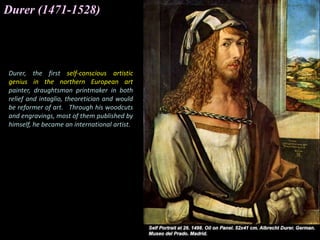
Durer, the first self-conscious artistic
genius in the northern European art
painter, draughtsman printmaker in both
relief and intaglio, theoretician and would
be reformer of art. Through his woodcuts
and engravings, most of them published by
himself, he became an international artist.
Joachin Patinier (1475/80-1524)
Raphael (1483-1520)
Raphael was one of the three High
Renaissance artist. The decade between
1500-1510 saw the emergence of Raphael as a
great master. In his youth he learned from
Leonardo and Michelangelo. In his early years
he was particularly good in painting the
Madonna and Child, portraying the affection
between mother and the child.
Titan (c1490-1575)
Lotto (1480-1557)
Lotto, one of the distinctive portrait painter
of the early 16C. His early works are
strongly influenced by Giovanni Bellini but
afterward his portrait reflected Botticelli,
Fra Bartolommeo, Raphael, Correggio,
Giorgione, Titan and even something of
Durer and Holbein. His portraits were
always with an intensely personal quality.
Little is known of the man.
Tintoretto (1518-1594)
Pieter Bruegel the Elder (1524/30-1660)
Caravaggio (1570-1610)
Caravaggio is of particular importance
in Spain, for he was responsible for the
origin of the realist and ‘tenebrist’
style of painting that later became so
widespread and popular in the works
of such artists as Ribera and Zurbaran.
Rubens (1577-1640)
Rubens painted this picture during his first visit
to Spain using it to show off his talents and to
attract the attention of the court.
Pensionante de Saraceni
La Tour (1593-1652)
Georges de La Tour was a French Caravaggisti.
He worked all his life in Lorraine. In his later
works he adopted a form of indirect lighting
from a candle or other concealed source of
light, which is close to Dutch Caravaggisti like
Honthurst.
Rembrandt (1606-1669)
Rembrandt painted
this this portrait of his
bride, Saskia. It was
painted on the same
year of his marriage.
All rights reserved. Rights belong to their respective owners.
Available free for non-commercial and personal use.
The
End
Music – Ernesto Cortazar. Mascarade
European Art Galleries
Vienna
Hague
Madrid
Copenhagen
With over a thousand of paintings in more than 10 countries.

Museo del Prodo, Madrid

  • 1.
    Museo del Prado TheSpanish National Art Gallery First created 3 Oct 2018. Version 1.0 - 13 Oct 2018. Daperro. London. Naked ‘Maja’. c1800-03. Goya.
  • 2.
    Medieval 12C Spanish Paintedin Spain, Segovia, during the early stages of the Reconquista (814-1139). During this period much of Spain and Portugal were under the Moors, which was Islamic. Segovia was in the front line. Neither Spain nor Portugal existed as a country. Spain in Reconquista (814-1139). Spanish
  • 3.
    Medieval 13C Spanish Similartype of altarpieces like this were found all over Europe from Norway, England to the Iberian Peninsula. During this time master craftsmen were becoming professional artists.
  • 4.
    Medieval 14C Spanish Inthe 14C Spain was still divided into Christian kingdoms of Portugal, Aragon, Castile and Navarre. The Muslim was confined to the southern half of the peninsula, the Emirate of Granada, which survived to 1492.
  • 5.
    El Greco (c1540-1614) ElGreco’s name was Domenikos Theotokopoulos. Although often regarded as a Spanish painter, he was ethically a Greek. At the age of 26, he travelled to Venice and later practised in Rome. He enriched his style with elements of Mannerism and Venetian Renaissance.
  • 6.
  • 7.
    El Greco (c1540-1614) ElGreco early works show his wide ranges: Titian, Michelangelo, Bassano, Raphael, Durer etc. In Spain El Greco spent most of his professional life in Toledo, then the ‘capital’ of Spain. In his later works, he often painted people having elongated limbs, small heads and stylized facial features.
  • 8.
    Francisco Zurbaran (1598-1664) StillLife with Vessels’. c1650. 45x84 cm. F Zurbaran. Francesco Zurbaran was a contemporary of Diego Velazquez. His style was somewhat limited, often bleak, austere, unquestioning piety of Spanish devotional art, inline with the religious climate of the Counter- Reformation.
  • 9.
    Diego Velazquez (1599-1660) Velazquezis probably the best known of all the Spanish painter in history. He became one of the highest decorated court painter ever lived. Because of his association with the Spanish monarchy the Prado has the finest collection of Velazquez.
  • 10.
  • 11.
  • 12.
  • 13.
    Diego Velazquez (1599-1660) A surpriseddepiction of Mars. Velazquez chose a veteran as Mars, but well past his prime. He was rather deflated, peering out under the shadow cast by a helmet.
  • 14.
    Diego Velazquez (1599-1660) Insteadof painting the monarchy. Velazquez painted himself in the company of the royal family.
  • 15.
  • 16.
    Diego Velazquez (1599-1660) Velazquezalso painted personality at the court. He always painted them with dignity.
  • 17.
  • 18.
    Juan Carreno deMiranda (1614-85)
  • 19.
    Juan Carreno deMiranda (1614-85) Miranda’s family moved to Madrid in 1623 and trained under Pedro de las Cuevas and Bartolome Roman. He came to the notice of Velazquez. In 1658 Carreno was hired as an assistant on a royal commission to paint frescoes in the Alcazar of Madrid. He was hired as the court painter to the queen in 1671.
  • 20.
    Bartolome Esteban Murillo(1618-82) In contrast with Zurbaran, Murillo’s approach in the 1640s was softer, sweeter and more fused. Murillo visited Madrid, probably in 1648 being apparently helped by Velazquez. His change of style from his earliest works, in his use of colour, the hard naturalism, like the beggar-boy paintings. His early religious subjects were cool, detached, with only a little idealization. A Boy with a Dog’. 1650s. Hermitage. St Petersburg
  • 21.
  • 22.
    Bartolome Esteban Murillo(1618-82) Murillo idealized devotional forms, with Baroque flutter to the draperies, a certain artificiality, always with warmth, charm and quiet religious feeling.
  • 23.
  • 24.
    Francisco Goya (1748-1828) Pradohas a very comprehensive collection on paintings by Goya. He was the most important Spanish painter in the 18C and 19C. He painted the Spanish royal family, the French occupying rulers and eventually the British liberator, the Duke of Wellington. His painting skill was certainty recognised during his life time. (An aging) Self Portrait.1815.. Prado. Madrid.
  • 25.
  • 26.
    Francisco Goya (1748-1828) Goyaproduced a nude portrait of the same woman with identical pose.
  • 27.
    Francisco Goya (1748-1828) TheNude Maja is renowned for the straightforward and unashamed gaze of the model.
  • 28.
  • 29.
  • 30.
    Francisco Goya (1748-1828) Thirdof May 1808. 1814. Prado. Madrid. These are the most horrific images painted by Goya. On the Third of May 1808, Goya painted French savagery on the Spanish rebellion of 1808. The executioners with their faces hidden and the horror of the victims moments before their death. Saturn Devouring his Son is Goya’s most horrific and unforgettable image. Saturn was haunted by a prophecy that he would be overthrown by one of his sons.
  • 31.
    Carlos de Haesa(1829-98) He was a Spanish painter but born in Belgium. He was noted for the Realism in his landscape like the painting on Europa. He became the first professor of landscape painting.
  • 32.
    Bernardo Lopez (1800-74) Alsoknown as Bernardo Lopez Piquer, he was a portrait painter noted for his pastels.
  • 33.
  • 34.
  • 35.
    Weyden (1400-64) Weyden’s TheDescent from the Cross is one of the prided painting in the Prado’s collection. Rogier van der Weyden was an Early Netherlandish painter. He painted mainly religious triptychs, altarpieces and sometimes portraits. He was highly successful and internationally famous in his lifetime, his paintings were exported to Italy and Spain.
  • 36.
    Bosch (c1450-1516) He wasa Netherlandish painter. His work often contains fantastic illustrations of religious concepts and narratives. His pessimistic and fantastical style cast a wide influence on northern art of the 16C.
  • 37.
    Durer (1471-1528) Durer, thefirst self-conscious artistic genius in the northern European art painter, draughtsman printmaker in both relief and intaglio, theoretician and would be reformer of art. Through his woodcuts and engravings, most of them published by himself, he became an international artist.
  • 38.
  • 39.
    Raphael (1483-1520) Raphael wasone of the three High Renaissance artist. The decade between 1500-1510 saw the emergence of Raphael as a great master. In his youth he learned from Leonardo and Michelangelo. In his early years he was particularly good in painting the Madonna and Child, portraying the affection between mother and the child.
  • 40.
  • 41.
    Lotto (1480-1557) Lotto, oneof the distinctive portrait painter of the early 16C. His early works are strongly influenced by Giovanni Bellini but afterward his portrait reflected Botticelli, Fra Bartolommeo, Raphael, Correggio, Giorgione, Titan and even something of Durer and Holbein. His portraits were always with an intensely personal quality. Little is known of the man.
  • 42.
  • 43.
    Pieter Bruegel theElder (1524/30-1660)
  • 44.
    Caravaggio (1570-1610) Caravaggio isof particular importance in Spain, for he was responsible for the origin of the realist and ‘tenebrist’ style of painting that later became so widespread and popular in the works of such artists as Ribera and Zurbaran.
  • 45.
    Rubens (1577-1640) Rubens paintedthis picture during his first visit to Spain using it to show off his talents and to attract the attention of the court.
  • 46.
  • 47.
    La Tour (1593-1652) Georgesde La Tour was a French Caravaggisti. He worked all his life in Lorraine. In his later works he adopted a form of indirect lighting from a candle or other concealed source of light, which is close to Dutch Caravaggisti like Honthurst.
  • 48.
    Rembrandt (1606-1669) Rembrandt painted thisthis portrait of his bride, Saskia. It was painted on the same year of his marriage.
  • 49.
    All rights reserved.Rights belong to their respective owners. Available free for non-commercial and personal use. The End Music – Ernesto Cortazar. Mascarade
  • 50.
  • 51.
    With over athousand of paintings in more than 10 countries.

Editor's Notes

  • #2 The Prado is unique among the world’s great museums. Its collection is astonishingly rich, with master paintings from the 13C to the 18C. It is one of the more complete wider representation of European schools of paintings. Assembled by the Spanish kings for their palaces, its treasures are now housed in the grandiose Neo-Classical palace designed in 1787. The Prado contains the most important collection of Spanish masters to be found anywhere in the world. It has the finest works included paintings by El Greco, Zurbaran, Velazquez, Murillo, Goya etc. The great strength of the museum is that it has also amassed extensive collections of other European artists. As the Low Countries were once part of the Spanish Empire, its collection included works by Rogier van der Weyden, the unsurpassed works of Hieronymus Bosch, Pieter Bruegel, etc. Rubens’ waorks are well-represented.
  • #50 History of Major Releases Version 2.4 included three PwrPoint slides on Travel, Building & Gallery