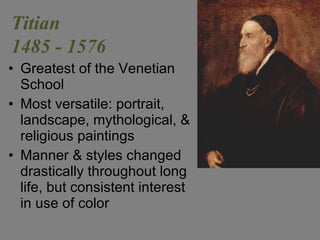
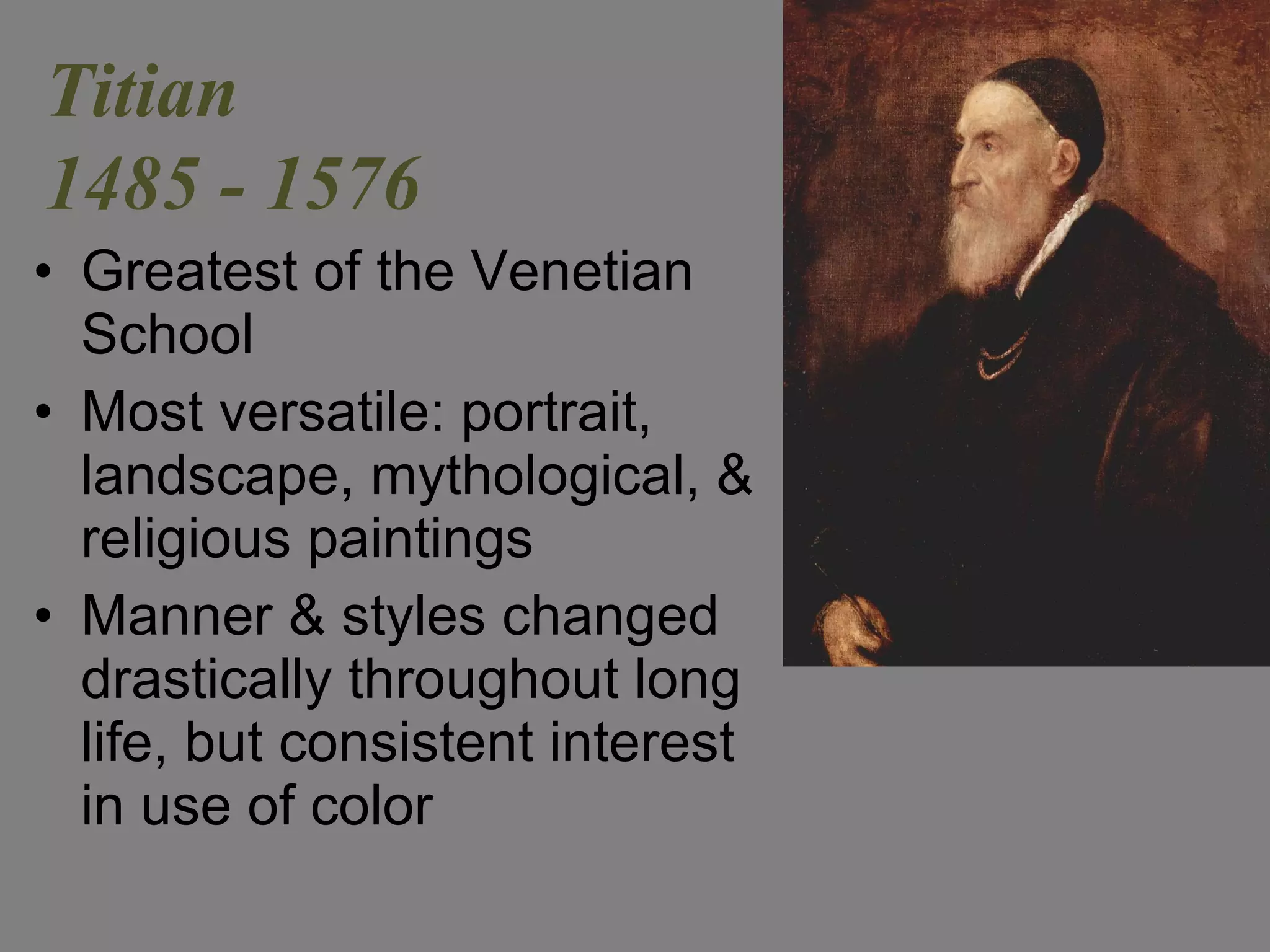
Greatest of the Venetian School Most versatile: portrait, landscape, mythological, & religious paintings Manner & styles changed drastically throughout long life, but consistent interest in use of color Titian 1485 - 1576
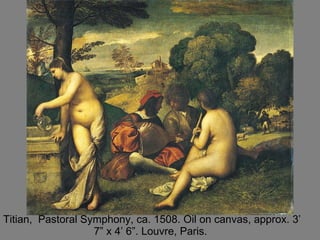
Titian,  Pastoral Symphony, ca. 1508. Oil on canvas, approx. 3’ 7” x 4’ 6”. Louvre, Paris.
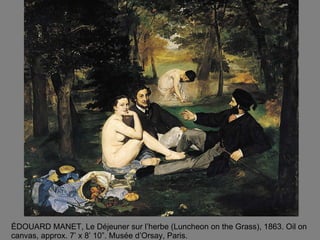
ÉDOUARD MANET, Le Déjeuner sur l’herbe (Luncheon on the Grass), 1863. Oil on canvas, approx. 7’ x 8’ 10”. Musée d’Orsay, Paris.
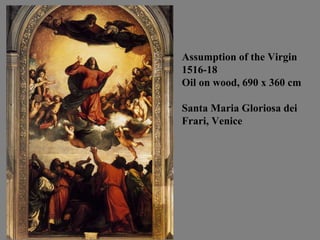
Assumption of the Virgin 1516-18 Oil on wood, 690 x 360 cm Santa Maria Gloriosa dei Frari, Venice
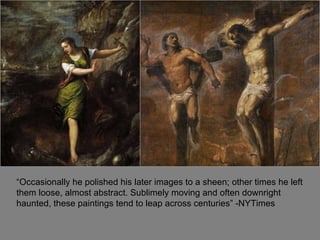
“ Occasionally he polished his later images to a sheen; other times he left them loose, almost abstract. Sublimely moving and often downright haunted, these paintings tend to leap across centuries” -NYTimes
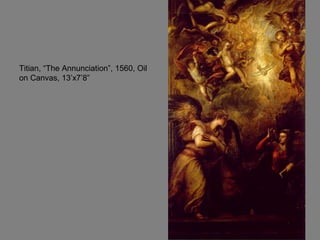
Titian, “The Annunciation”, 1560, Oil on Canvas, 13’x7’8”
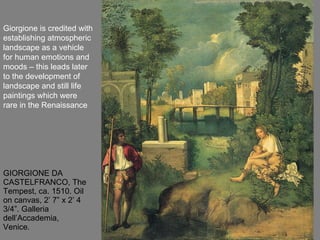
GIORGIONE DA CASTELFRANCO, The Tempest, ca. 1510. Oil on canvas, 2’ 7” x 2’ 4 3/4”. Galleria dell’Accademia, Venice. Giorgione is credited with establishing atmospheric landscape as a vehicle for human emotions and moods – this leads later to the development of landscape and still life paintings which were rare in the Renaissance
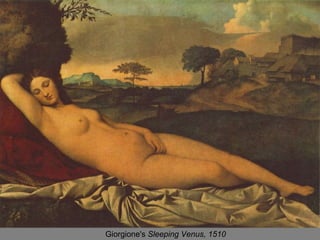
Giorgione's  Sleeping Venus, 1510
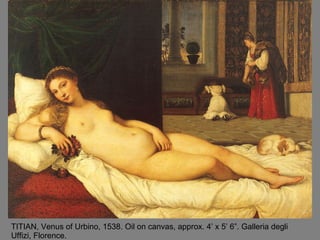
TITIAN, Venus of Urbino, 1538. Oil on canvas, approx. 4’ x 5’ 6”. Galleria degli Uffizi, Florence.
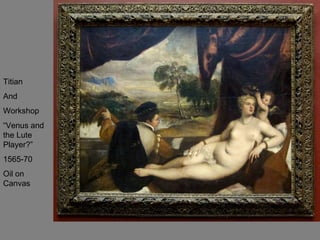
Titian And  Workshop “Venus and the Lute Player?” 1565-70 Oil on Canvas
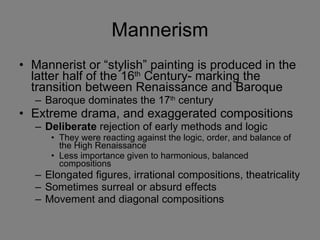
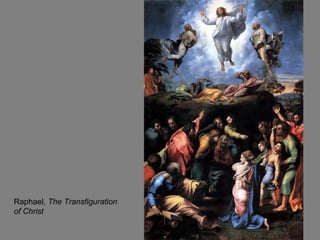
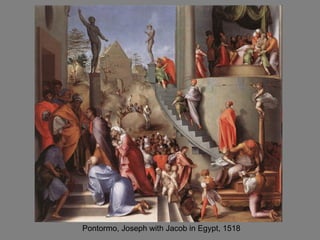
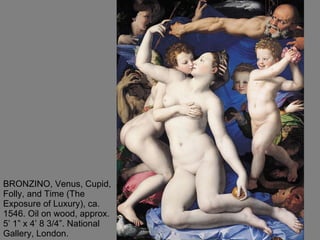
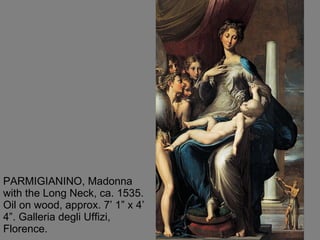
Mannerism Mannerist or “stylish” painting is produced in the latter half of the 16 th  Century- marking the transition between Renaissance and Baroque  Baroque dominates the 17 th  century Extreme drama, and exaggerated compositions  Deliberate  rejection of early methods and logic They were reacting against the logic, order, and balance of the High Renaissance Less importance given to harmonious, balanced compositions  Elongated figures, irrational compositions, theatricality  Sometimes surreal or absurd effects Movement and diagonal compositions
Raphael,  The Transfiguration of Christ
Pontormo, Joseph with Jacob in Egypt, 1518
BRONZINO, Venus, Cupid, Folly, and Time (The Exposure of Luxury), ca. 1546. Oil on wood, approx. 5’ 1” x 4’ 8 3/4”. National Gallery, London.
PARMIGIANINO, Madonna with the Long Neck, ca. 1535. Oil on wood, approx. 7’ 1” x 4’ 4”. Galleria degli Uffizi, Florence.
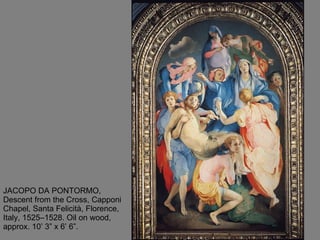
JACOPO DA PONTORMO, Descent from the Cross, Capponi Chapel, Santa Felicità, Florence, Italy, 1525–1528. Oil on wood, approx. 10’ 3” x 6’ 6”.
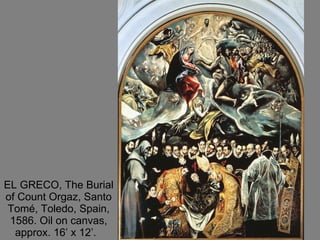
EL GRECO, The Burial of Count Orgaz, Santo Tomé, Toledo, Spain, 1586. Oil on canvas, approx. 16’ x 12’.
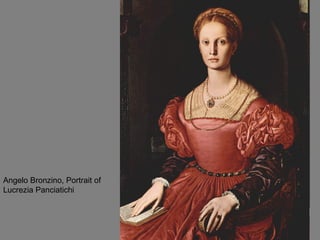
Angelo Bronzino, Portrait of Lucrezia Panciatichi
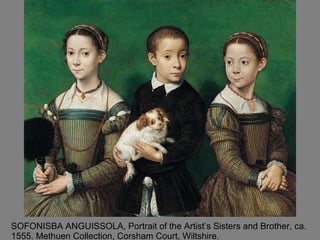
SOFONISBA ANGUISSOLA, Portrait of the Artist’s Sisters and Brother, ca. 1555. Methuen Collection, Corsham Court, Wiltshire.
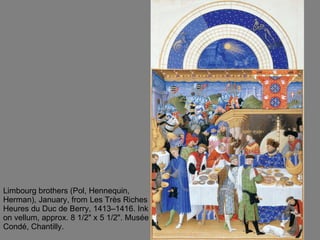
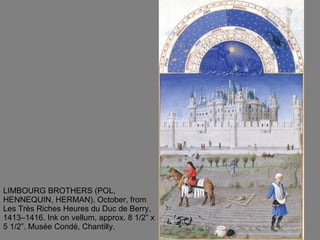
Renaissance in the North Northern Renaissance style evolved gradually out of Middle Ages styles Intuitive perspective  Illuminated Manuscripts Close attention to details of the visible world – jewel-like qualities to the richness of light and texture portrayed Some Northern works much harsher in emotionalism than Italian works
Limbourg brothers (Pol, Hennequin, Herman), January, from Les Très Riches Heures du Duc de Berry, 1413–1416. Ink on vellum, approx. 8 1/2" x 5 1/2". Musée Condé, Chantilly.
LIMBOURG BROTHERS (POL, HENNEQUIN, HERMAN), October, from Les Très Riches Heures du Duc de Berry, 1413–1416. Ink on vellum, approx. 8 1/2” x 5 1/2”. Musée Condé, Chantilly.
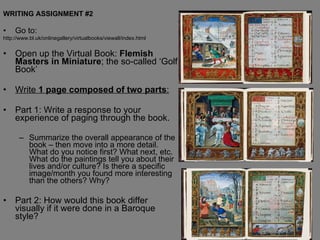
WRITING ASSIGNMENT #2 Go to: http://www.bl.uk/onlinegallery/virtualbooks/viewall/index.html Open up the Virtual Book:  Flemish Masters in Miniature ; the so-called ‘Golf Book’ Write  1 page composed of two parts : Part 1: Write a response to your experience of paging through the book.  Summarize the overall appearance of the book – then move into a more detail. What do you notice first? What next, etc. What do the paintings tell you about their lives and/or culture? Is there a specific image/month you found more interesting than the others? Why?  Part 2: How would this book differ visually if it were done in a Baroque style?
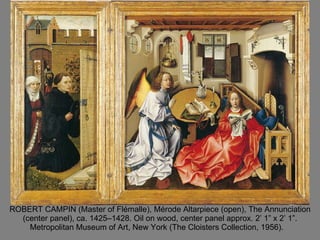
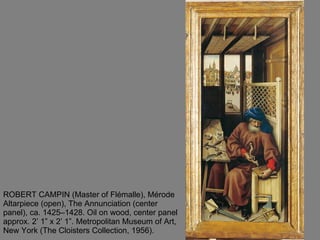
ROBERT CAMPIN (Master of Flémalle), Mérode Altarpiece (open), The Annunciation (center panel), ca. 1425–1428. Oil on wood, center panel approx. 2’ 1” x 2’ 1”. Metropolitan Museum of Art, New York (The Cloisters Collection, 1956).
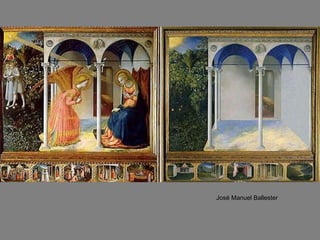
José Manuel Ballester
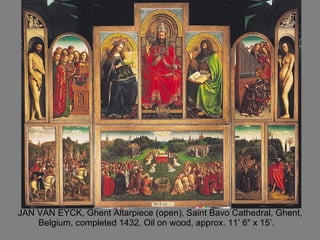
JAN VAN EYCK, Ghent Altarpiece (open), Saint Bavo Cathedral, Ghent, Belgium, completed 1432. Oil on wood, approx. 11’ 6" x 15’.
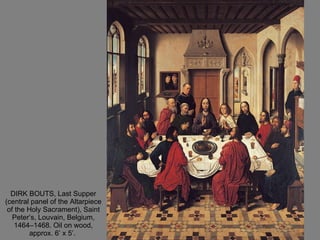
DIRK BOUTS, Last Supper (central panel of the Altarpiece of the Holy Sacrament), Saint Peter’s, Louvain, Belgium, 1464–1468. Oil on wood, approx. 6’ x 5’.
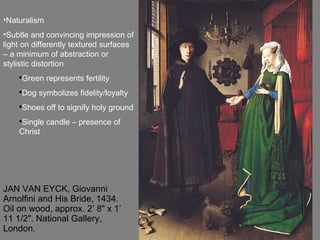
JAN VAN EYCK, Giovanni Arnolfini and His Bride, 1434. Oil on wood, approx. 2’ 8" x 1’ 11 1/2". National Gallery, London.  Naturalism Subtle and convincing impression of light on differently textured surfaces – a minimum of abstraction or stylistic distortion Green represents fertility Dog symbolizes fidelity/loyalty Shoes off to signify holy ground Single candle – presence of Christ
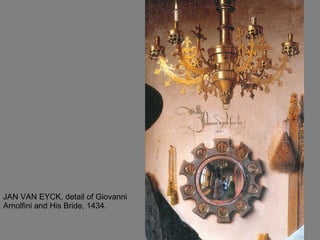
JAN VAN EYCK, detail of Giovanni Arnolfini and His Bride, 1434.
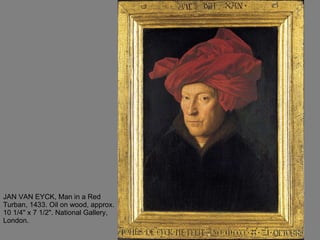
JAN VAN EYCK, Man in a Red Turban, 1433. Oil on wood, approx. 10 1/4" x 7 1/2". National Gallery, London.
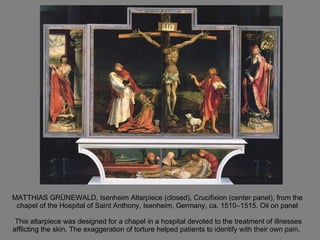
MATTHIAS GRÜNEWALD, Isenheim Altarpiece (closed), Crucifixion (center panel), from the chapel of the Hospital of Saint Anthony, Isenheim, Germany, ca. 1510–1515. Oil on panel  This altarpiece was designed for a chapel in a hospital devoted to the treatment of illnesses afflicting the skin. The exaggeration of torture helped patients to identify with their own pain.
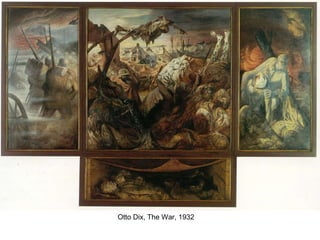
Otto Dix, The War, 1932
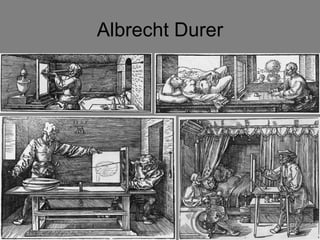
Albrecht Durer
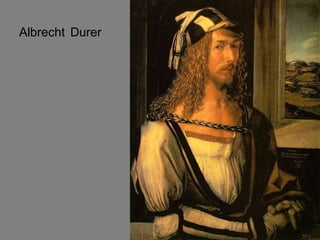
Albrecht   Durer
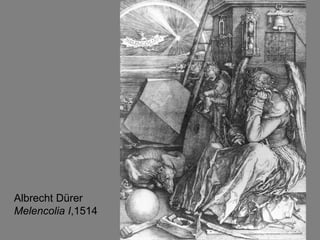
Albrecht Dürer Melencolia I ,1514
 
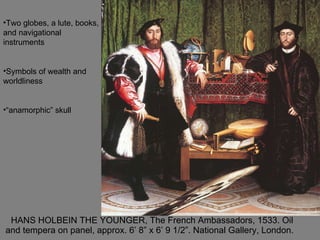
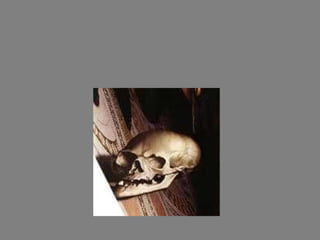
HANS HOLBEIN THE YOUNGER, The French Ambassadors, 1533. Oil and tempera on panel, approx. 6’ 8” x 6’ 9 1/2”. National Gallery, London.  Two globes, a lute, books, and navigational instruments Symbols of wealth and worldliness “anamorphic” skull
 
 
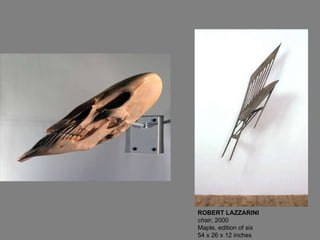
ROBERT LAZZARINI chair , 2000 Maple, edition of six 54 x 26 x 12 inches
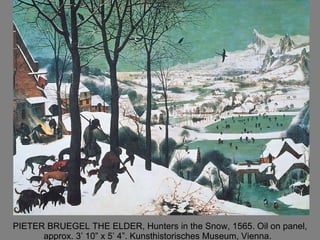
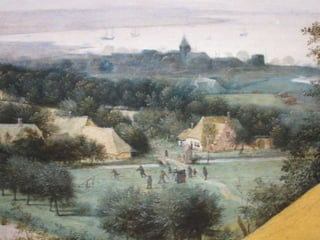
PIETER BRUEGEL THE ELDER, Hunters in the Snow, 1565. Oil on panel, approx. 3’ 10” x 5’ 4”. Kunsthistorisches Museum, Vienna.
 
 
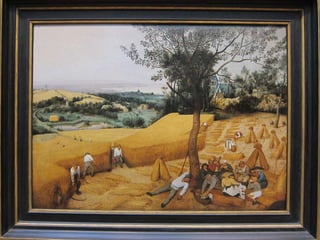
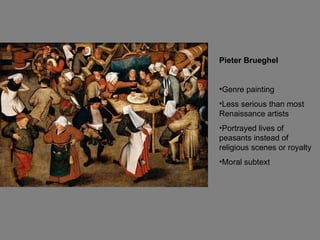
Pieter Brueghel Genre painting Less serious than most Renaissance artists Portrayed lives of peasants instead of religious scenes or royalty Moral subtext
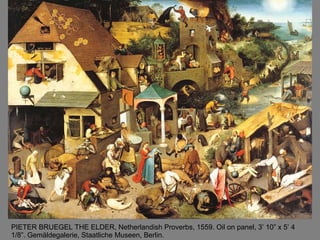
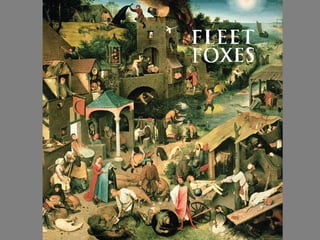
PIETER BRUEGEL THE ELDER, Netherlandish Proverbs, 1559. Oil on panel, 3’ 10” x 5’ 4 1/8”. Gemäldegalerie, Staatliche Museen, Berlin.
 
 
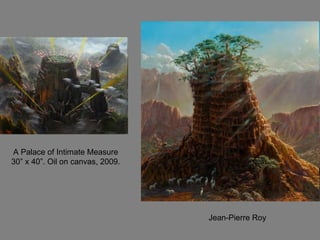
A Palace of Intimate Measure 30” x 40”. Oil on canvas, 2009. Jean-Pierre Roy
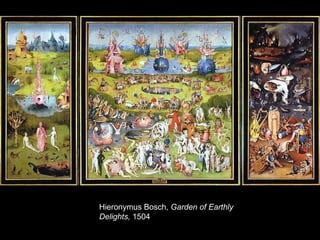
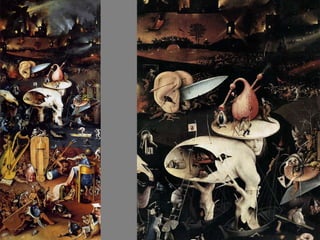
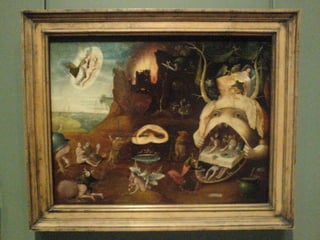
Hieronymus Bosch,  Garden of Earthly Delights,  1504
 
 
Counter-reformation “The kingdom of God is a kingdom of hearing, not seeing” – Martin Luther More depictions of landscape, still-life, and everyday scenes Counter-reformation is the Catholic Church’s approach to preserve the strength of the church  Emotion, light and theatricality to art Baroque
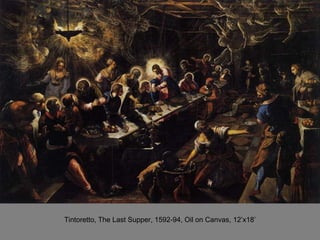
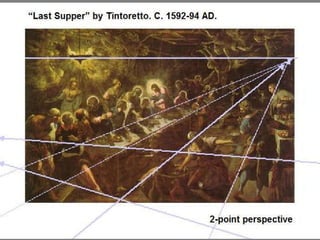
Tintoretto, The Last Supper, 1592-94, Oil on Canvas, 12’x18’


Week8 - Renaissance Part 2

  • 1.
    Greatest of theVenetian School Most versatile: portrait, landscape, mythological, & religious paintings Manner & styles changed drastically throughout long life, but consistent interest in use of color Titian 1485 - 1576
  • 2.
    Titian, PastoralSymphony, ca. 1508. Oil on canvas, approx. 3’ 7” x 4’ 6”. Louvre, Paris.
  • 3.
    ÉDOUARD MANET, LeDéjeuner sur l’herbe (Luncheon on the Grass), 1863. Oil on canvas, approx. 7’ x 8’ 10”. Musée d’Orsay, Paris.
  • 4.
    Assumption of theVirgin 1516-18 Oil on wood, 690 x 360 cm Santa Maria Gloriosa dei Frari, Venice
  • 5.
    “ Occasionally hepolished his later images to a sheen; other times he left them loose, almost abstract. Sublimely moving and often downright haunted, these paintings tend to leap across centuries” -NYTimes
  • 6.
    Titian, “The Annunciation”,1560, Oil on Canvas, 13’x7’8”
  • 7.
    GIORGIONE DA CASTELFRANCO,The Tempest, ca. 1510. Oil on canvas, 2’ 7” x 2’ 4 3/4”. Galleria dell’Accademia, Venice. Giorgione is credited with establishing atmospheric landscape as a vehicle for human emotions and moods – this leads later to the development of landscape and still life paintings which were rare in the Renaissance
  • 8.
  • 9.
    TITIAN, Venus ofUrbino, 1538. Oil on canvas, approx. 4’ x 5’ 6”. Galleria degli Uffizi, Florence.
  • 10.
    Titian And Workshop “Venus and the Lute Player?” 1565-70 Oil on Canvas
  • 11.
    Mannerism Mannerist or“stylish” painting is produced in the latter half of the 16 th Century- marking the transition between Renaissance and Baroque Baroque dominates the 17 th century Extreme drama, and exaggerated compositions Deliberate rejection of early methods and logic They were reacting against the logic, order, and balance of the High Renaissance Less importance given to harmonious, balanced compositions Elongated figures, irrational compositions, theatricality Sometimes surreal or absurd effects Movement and diagonal compositions
  • 12.
    Raphael, TheTransfiguration of Christ
  • 13.
    Pontormo, Joseph withJacob in Egypt, 1518
  • 14.
    BRONZINO, Venus, Cupid,Folly, and Time (The Exposure of Luxury), ca. 1546. Oil on wood, approx. 5’ 1” x 4’ 8 3/4”. National Gallery, London.
  • 15.
    PARMIGIANINO, Madonna withthe Long Neck, ca. 1535. Oil on wood, approx. 7’ 1” x 4’ 4”. Galleria degli Uffizi, Florence.
  • 16.
    JACOPO DA PONTORMO,Descent from the Cross, Capponi Chapel, Santa Felicità, Florence, Italy, 1525–1528. Oil on wood, approx. 10’ 3” x 6’ 6”.
  • 17.
    EL GRECO, TheBurial of Count Orgaz, Santo Tomé, Toledo, Spain, 1586. Oil on canvas, approx. 16’ x 12’.
  • 18.
    Angelo Bronzino, Portraitof Lucrezia Panciatichi
  • 19.
    SOFONISBA ANGUISSOLA, Portraitof the Artist’s Sisters and Brother, ca. 1555. Methuen Collection, Corsham Court, Wiltshire.
  • 20.
    Renaissance in theNorth Northern Renaissance style evolved gradually out of Middle Ages styles Intuitive perspective Illuminated Manuscripts Close attention to details of the visible world – jewel-like qualities to the richness of light and texture portrayed Some Northern works much harsher in emotionalism than Italian works
  • 21.
    Limbourg brothers (Pol,Hennequin, Herman), January, from Les Très Riches Heures du Duc de Berry, 1413–1416. Ink on vellum, approx. 8 1/2" x 5 1/2". Musée Condé, Chantilly.
  • 22.
    LIMBOURG BROTHERS (POL,HENNEQUIN, HERMAN), October, from Les Très Riches Heures du Duc de Berry, 1413–1416. Ink on vellum, approx. 8 1/2” x 5 1/2”. Musée Condé, Chantilly.
  • 23.
    WRITING ASSIGNMENT #2Go to: http://www.bl.uk/onlinegallery/virtualbooks/viewall/index.html Open up the Virtual Book: Flemish Masters in Miniature ; the so-called ‘Golf Book’ Write 1 page composed of two parts : Part 1: Write a response to your experience of paging through the book. Summarize the overall appearance of the book – then move into a more detail. What do you notice first? What next, etc. What do the paintings tell you about their lives and/or culture? Is there a specific image/month you found more interesting than the others? Why? Part 2: How would this book differ visually if it were done in a Baroque style?
  • 24.
    ROBERT CAMPIN (Masterof Flémalle), Mérode Altarpiece (open), The Annunciation (center panel), ca. 1425–1428. Oil on wood, center panel approx. 2’ 1” x 2’ 1”. Metropolitan Museum of Art, New York (The Cloisters Collection, 1956).
  • 25.
    ROBERT CAMPIN (Masterof Flémalle), Mérode Altarpiece (open), The Annunciation (center panel), ca. 1425–1428. Oil on wood, center panel approx. 2’ 1” x 2’ 1”. Metropolitan Museum of Art, New York (The Cloisters Collection, 1956).
  • 26.
  • 27.
    JAN VAN EYCK,Ghent Altarpiece (open), Saint Bavo Cathedral, Ghent, Belgium, completed 1432. Oil on wood, approx. 11’ 6" x 15’.
  • 28.
    DIRK BOUTS, LastSupper (central panel of the Altarpiece of the Holy Sacrament), Saint Peter’s, Louvain, Belgium, 1464–1468. Oil on wood, approx. 6’ x 5’.
  • 29.
    JAN VAN EYCK,Giovanni Arnolfini and His Bride, 1434. Oil on wood, approx. 2’ 8" x 1’ 11 1/2". National Gallery, London. Naturalism Subtle and convincing impression of light on differently textured surfaces – a minimum of abstraction or stylistic distortion Green represents fertility Dog symbolizes fidelity/loyalty Shoes off to signify holy ground Single candle – presence of Christ
  • 30.
    JAN VAN EYCK,detail of Giovanni Arnolfini and His Bride, 1434.
  • 31.
    JAN VAN EYCK,Man in a Red Turban, 1433. Oil on wood, approx. 10 1/4" x 7 1/2". National Gallery, London.
  • 32.
    MATTHIAS GRÜNEWALD, IsenheimAltarpiece (closed), Crucifixion (center panel), from the chapel of the Hospital of Saint Anthony, Isenheim, Germany, ca. 1510–1515. Oil on panel This altarpiece was designed for a chapel in a hospital devoted to the treatment of illnesses afflicting the skin. The exaggeration of torture helped patients to identify with their own pain.
  • 33.
    Otto Dix, TheWar, 1932
  • 34.
  • 35.
    Albrecht Durer
  • 36.
  • 37.
  • 38.
    HANS HOLBEIN THEYOUNGER, The French Ambassadors, 1533. Oil and tempera on panel, approx. 6’ 8” x 6’ 9 1/2”. National Gallery, London. Two globes, a lute, books, and navigational instruments Symbols of wealth and worldliness “anamorphic” skull
  • 39.
  • 40.
  • 41.
    ROBERT LAZZARINI chair, 2000 Maple, edition of six 54 x 26 x 12 inches
  • 42.
    PIETER BRUEGEL THEELDER, Hunters in the Snow, 1565. Oil on panel, approx. 3’ 10” x 5’ 4”. Kunsthistorisches Museum, Vienna.
  • 43.
  • 44.
  • 45.
    Pieter Brueghel Genrepainting Less serious than most Renaissance artists Portrayed lives of peasants instead of religious scenes or royalty Moral subtext
  • 46.
    PIETER BRUEGEL THEELDER, Netherlandish Proverbs, 1559. Oil on panel, 3’ 10” x 5’ 4 1/8”. Gemäldegalerie, Staatliche Museen, Berlin.
  • 47.
  • 48.
  • 49.
    A Palace ofIntimate Measure 30” x 40”. Oil on canvas, 2009. Jean-Pierre Roy
  • 50.
    Hieronymus Bosch, Garden of Earthly Delights, 1504
  • 51.
  • 52.
  • 53.
    Counter-reformation “The kingdomof God is a kingdom of hearing, not seeing” – Martin Luther More depictions of landscape, still-life, and everyday scenes Counter-reformation is the Catholic Church’s approach to preserve the strength of the church Emotion, light and theatricality to art Baroque
  • 54.
    Tintoretto, The LastSupper, 1592-94, Oil on Canvas, 12’x18’
  • 55.
  • 56.