Musee des Beaux-Art
Lyon Museum of Fine Arts
First created 15 Aug 2019. Version 1.0 - 5 Sep 2019. Daperro. London.
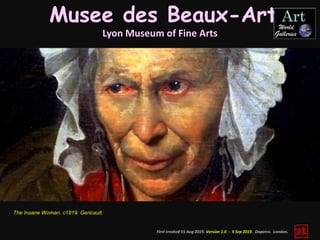
The Insane Woman. c1819. Gericault.
Egyptian Mummy Coffin
Apart from its large collection of
paintings, Musee des Beaux-Arts
Lyon also has a large collection
of objects and artefacts of
antiquity – Egyptian, Middle
Eastern, Italian etc.
Tapestry from Macau
An tapestry made in Macau in the early 17C. Lyon was a centre of the silk industry.
Pesellino c1450/57
The Virgin and Child (detail). 1450/7. Pesellino (1422-57).
Lorenzo Costa. C1490.
Spanish 15C
Perugino c1495
Perugino may have been a pupil of Pierro
della Francisca. Afterward he may have
worked in the workshop of Verrocchio.
Metsys c1509
The leading painter in Antwerp from
c1510 until his death and an
important influence for change in
northern European Art.
Cranach 1534
Cranach was a painter, an etcher and a
woodcut artist. He was in Vienna in 1503.
In 1505 became the Court Painter to the
Electors of Saxony and there he met Luther.
Greco 1579
The elongated people of El Greco (Domenikos Theotocopoulos) a Greek, who found fame and fortune in Spain.
Campi 1579
Campi 1580
Jan Bruegal & Hendrick von Baden 1611.
Bruegel was a satirist and one of the great landscape painter of his time. His paintings were often
packed with detials.
Rubens 1617.
Rubens 1618.
An impressive painting, a typical Rubens
monumental work would undoubtedly have
attracted attentions, with its vigorous expression
and vivid colours.
It was painted in in 1620 for the Dominican church of St
Paul of Antwerp. The painting included two saints – St
Dominic and St Francis, protecting the world from the
lightning bolts thrown down.
Rubens 1618.
Van Dyck 1618.
Van Dyck once worked under Rubens. He became a society painter of the English nobility.
Jordaens 1620.
Jordaens 1644.
Jordaens (1593-78) was born and died in
Antwerp, where he worked as an
assistance to Rubens. He is an example of
the pervasive effect of Rubens’s style, with
lively, active, animated, exuberant
settings. This painting is good example of
the Rubensque influence.
Self Portrait
Vouet 1636/7.
Vouet was a French artist. He was successful. He
spent some 14 years working in Italy.
Honthorst c1623.
Bylert 1625/30.
Snyders c1630.
Snyders was a pupil of Bruegel the Younger. We often worked with Jordaens.
Blanchard c1631.
Rembrandt 1625.
Loo 1635.
Diana with her Nymphs (Detail). 1648. Jacob
van Loo. Gemaldegalerie Staatiche Museen
zu Berlin.
Jacob van Loo was a contemporary of Rembrandt.
Cortona c1637.
Reni 1637.
Guido Cagnacci was part of the Bolognese Schools.
His mature works are characterized by their use of
chiaroscuro and their sensual subjects. His art,
mostly religious in subject, is known for its
unabashed, often unsettling eroticism and his life
was equally and notoriously unconventional.
Cagnacci c1657.
Lucrece c1657. Oil on canvas.
57x66 cm. Guido Cagnacci (1601-
63). Italian. 20 Jul 2019.
According to Roman legend,
Lucrece or Lucretia was a beautiful
noblewoman, wife of an early
Roman commander. She was raped
at knifepoint by the son of the
Roman king. Lucretia made her
husband and father swear to
avenge the deed, before she killed
herself. This caused an outraged by
the people who overthrew the
monarchy and founded the Roman
Republic
Zurbaran 1650.
Zurbaran is one of the greatest Spanish painters, despite his
limited technique. He specialised in Spanish devotional art
which was the prevail tradition of his time.
Le Brun 1674.
Charles LeBrun was and artist politician, a virtual dictator of
arts in France under Louis XIV. He was a pupil of Vouet and
went to Rome. In 1647 he exhibited an altarpiece for Notre
Dame, which began his success. In 1648 he took over the
foundation of the Academy.
Champaigne 1706.
This is a huge painting on two French saints.
Bellotto 1740.
Bellotto is the nephew of Canaletto. He spent sometimes living in Eastern Europe.
Fragonard was known for his Rococo painter for his exuberance and hedonism..
Fragonard 1763.
Romney c1780 (Detail).
George Romney was one of the best British portraitist in the 18C..
Lawrence c1800 (Detail).
Thomas Lawrence was a portraitist and a contemporary of George Romney.
Richard 1816.
Gericault 1819.
An exceptional painting which portrait the
angers and the sufferings of the insane mind.
He was one of the pioneers of the Romantic
movement.
Janmot 1835.
This is one of a collection of 16 paintings of the same theme by Janmot, between 1835 and 1881 at the gallery.
Saint-Jean 1837.
Ingres 1850.
Ingres was a bridge between
Neoclassicism and the rising
Romanticism of the time. He was a
creator of a complex art and at time
dazzling perfection. He also painted
Orientalist subjects.
Manet c1861.
Edouard Manet was destined to defy
tradition and overturn convention. His
paintings were primarily based on
Realism but used some of the
Impressionist style in his finishing, in
particular in his later works.
Courbet 1870.
Dagnan-Bouveret 1879.
Degas c1889.
Gauguin 1896.
Renoir 1897.
Renoir had changed his style
several times in his life, although
most people still regard him as an
Impressionist.
By the time of this painting, Renoir
had all but abandoned
Impressionism, but he was always
a colourist. Note the soft focus of
this painting without any hard
lines mingled with patches of
colours.
Pissarro 1902.
Monet 1903.
All rights reserved. Rights belong to their respective owners.
Available free for non-commercial and personal use.
The
End
Music – I Have a Dream. Guitar Moods
Monumental Staircase Decorations. 1884. Pierre Puvis de Chavannes..
Art Galleries
London
London
With over a thousand of
paintings in more than
10 countries.

Musee Beaux Arts, Lyon

  • 1.
    Musee des Beaux-Art LyonMuseum of Fine Arts First created 15 Aug 2019. Version 1.0 - 5 Sep 2019. Daperro. London. The Insane Woman. c1819. Gericault.
  • 2.
    Egyptian Mummy Coffin Apartfrom its large collection of paintings, Musee des Beaux-Arts Lyon also has a large collection of objects and artefacts of antiquity – Egyptian, Middle Eastern, Italian etc.
  • 3.
    Tapestry from Macau Antapestry made in Macau in the early 17C. Lyon was a centre of the silk industry.
  • 4.
    Pesellino c1450/57 The Virginand Child (detail). 1450/7. Pesellino (1422-57).
  • 5.
  • 6.
  • 7.
    Perugino c1495 Perugino mayhave been a pupil of Pierro della Francisca. Afterward he may have worked in the workshop of Verrocchio.
  • 8.
    Metsys c1509 The leadingpainter in Antwerp from c1510 until his death and an important influence for change in northern European Art.
  • 9.
    Cranach 1534 Cranach wasa painter, an etcher and a woodcut artist. He was in Vienna in 1503. In 1505 became the Court Painter to the Electors of Saxony and there he met Luther.
  • 10.
    Greco 1579 The elongatedpeople of El Greco (Domenikos Theotocopoulos) a Greek, who found fame and fortune in Spain.
  • 11.
  • 12.
  • 13.
    Jan Bruegal &Hendrick von Baden 1611. Bruegel was a satirist and one of the great landscape painter of his time. His paintings were often packed with detials.
  • 14.
  • 15.
    Rubens 1618. An impressivepainting, a typical Rubens monumental work would undoubtedly have attracted attentions, with its vigorous expression and vivid colours. It was painted in in 1620 for the Dominican church of St Paul of Antwerp. The painting included two saints – St Dominic and St Francis, protecting the world from the lightning bolts thrown down.
  • 16.
  • 17.
    Van Dyck 1618. VanDyck once worked under Rubens. He became a society painter of the English nobility.
  • 18.
  • 19.
    Jordaens 1644. Jordaens (1593-78)was born and died in Antwerp, where he worked as an assistance to Rubens. He is an example of the pervasive effect of Rubens’s style, with lively, active, animated, exuberant settings. This painting is good example of the Rubensque influence. Self Portrait
  • 20.
    Vouet 1636/7. Vouet wasa French artist. He was successful. He spent some 14 years working in Italy.
  • 21.
  • 22.
  • 23.
    Snyders c1630. Snyders wasa pupil of Bruegel the Younger. We often worked with Jordaens.
  • 24.
  • 25.
  • 26.
    Loo 1635. Diana withher Nymphs (Detail). 1648. Jacob van Loo. Gemaldegalerie Staatiche Museen zu Berlin. Jacob van Loo was a contemporary of Rembrandt.
  • 27.
  • 28.
    Reni 1637. Guido Cagnacciwas part of the Bolognese Schools. His mature works are characterized by their use of chiaroscuro and their sensual subjects. His art, mostly religious in subject, is known for its unabashed, often unsettling eroticism and his life was equally and notoriously unconventional.
  • 29.
    Cagnacci c1657. Lucrece c1657.Oil on canvas. 57x66 cm. Guido Cagnacci (1601- 63). Italian. 20 Jul 2019. According to Roman legend, Lucrece or Lucretia was a beautiful noblewoman, wife of an early Roman commander. She was raped at knifepoint by the son of the Roman king. Lucretia made her husband and father swear to avenge the deed, before she killed herself. This caused an outraged by the people who overthrew the monarchy and founded the Roman Republic
  • 30.
    Zurbaran 1650. Zurbaran isone of the greatest Spanish painters, despite his limited technique. He specialised in Spanish devotional art which was the prevail tradition of his time.
  • 31.
    Le Brun 1674. CharlesLeBrun was and artist politician, a virtual dictator of arts in France under Louis XIV. He was a pupil of Vouet and went to Rome. In 1647 he exhibited an altarpiece for Notre Dame, which began his success. In 1648 he took over the foundation of the Academy.
  • 32.
    Champaigne 1706. This isa huge painting on two French saints.
  • 33.
    Bellotto 1740. Bellotto isthe nephew of Canaletto. He spent sometimes living in Eastern Europe.
  • 34.
    Fragonard was knownfor his Rococo painter for his exuberance and hedonism.. Fragonard 1763.
  • 35.
    Romney c1780 (Detail). GeorgeRomney was one of the best British portraitist in the 18C..
  • 36.
    Lawrence c1800 (Detail). ThomasLawrence was a portraitist and a contemporary of George Romney.
  • 37.
  • 38.
    Gericault 1819. An exceptionalpainting which portrait the angers and the sufferings of the insane mind. He was one of the pioneers of the Romantic movement.
  • 39.
    Janmot 1835. This isone of a collection of 16 paintings of the same theme by Janmot, between 1835 and 1881 at the gallery.
  • 40.
  • 41.
    Ingres 1850. Ingres wasa bridge between Neoclassicism and the rising Romanticism of the time. He was a creator of a complex art and at time dazzling perfection. He also painted Orientalist subjects.
  • 42.
    Manet c1861. Edouard Manetwas destined to defy tradition and overturn convention. His paintings were primarily based on Realism but used some of the Impressionist style in his finishing, in particular in his later works.
  • 43.
  • 44.
  • 45.
  • 46.
  • 47.
    Renoir 1897. Renoir hadchanged his style several times in his life, although most people still regard him as an Impressionist. By the time of this painting, Renoir had all but abandoned Impressionism, but he was always a colourist. Note the soft focus of this painting without any hard lines mingled with patches of colours.
  • 48.
  • 49.
  • 50.
    All rights reserved.Rights belong to their respective owners. Available free for non-commercial and personal use. The End Music – I Have a Dream. Guitar Moods Monumental Staircase Decorations. 1884. Pierre Puvis de Chavannes..
  • 51.
  • 52.
    With over athousand of paintings in more than 10 countries.

Editor's Notes

  • #2 “Like other regional museums in (France), the Lyon Museum of Fine Art was founded immediately following the French Revolution. In accordance with the ideals being promoted at that time, the works of art confiscated during the Revolution were to be conserved and made accessible to as man as possible. They were also to bolster the Lyon silk industry by providing study models for the factories’ artisans and designers. More than two hundred years later the collections’ encyclopaedic orientations has made the Lyon Museum of Fine Arts one of the foremost museums in France…..”
  • #51 History of Major Releases Version 1.0 Initial release with 46 slides.