Baroque art
3º ESO History
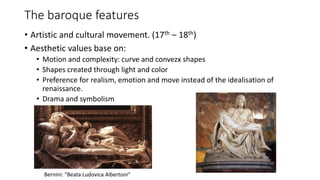
The baroque features
• Artistic and cultural movement. (17th – 18th)
• Aesthetic values base on:
• Motion and complexity: curve and convezx shapes
• Shapes created through light and color
• Preference for realism, emotion and move instead of the idealisation of
renaissance.
• Drama and symbolism
Bernini: “Beata Ludovica Albertoni”
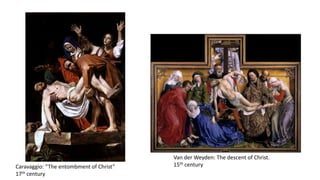
Caravaggio: “The entombment of Christ”
17th century
Van der Weyden: The descent of Christ.
15th century
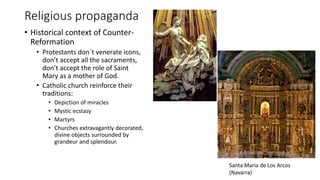
Religious propaganda
• Historical context of Counter-
Reformation
• Protestants don`t venerate icons,
don’t accept all the sacraments,
don’t accept the role of Saint
Mary as a mother of God.
• Catholic church reinforce their
traditions:
• Depiction of miracles
• Mystic ecstasy
• Martyrs
• Churches extravagantly decorated,
divine objects surrounded by
grandeur and splendour.
Santa Maria de Los Arcos
(Navarra)
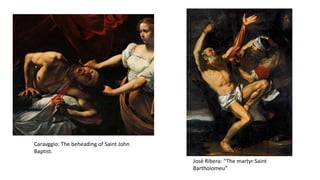
Caravggio: The beheading of Saint John
Baptist.
José Ribera: “The martyr Saint
Bartholomeu”
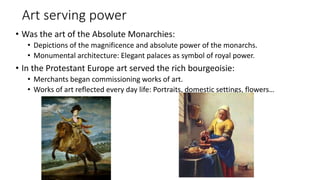
Art serving power
• Was the art of the Absolute Monarchies:
• Depictions of the magnificence and absolute power of the monarchs.
• Monumental architecture: Elegant palaces as symbol of royal power.
• In the Protestant Europe art served the rich bourgeoisie:
• Merchants began commissioning works of art.
• Works of art reflected every day life: Portraits, domestic settings, flowers…
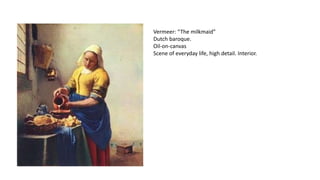
Vermeer: “The milkmaid”
Dutch baroque.
Oil-on-canvas
Scene of everyday life, high detail. Interior.
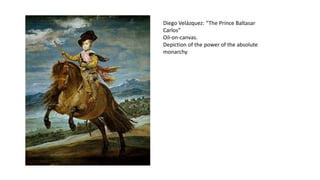
Diego Velázquez: “The Prince Baltasar
Carlos”
Oil-on-canvas.
Depiction of the power of the absolute
monarchy
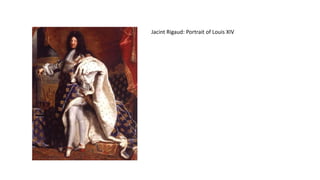
Jacint Rigaud: Portrait of Louis XIV
Architecture and sculpture
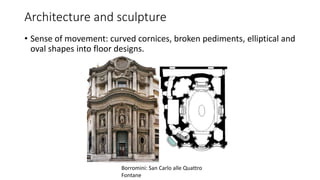
• Sense of movement: curved cornices, broken pediments, elliptical and
oval shapes into floor designs.
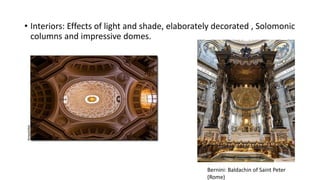
Borromini: San Carlo alle Quattro
Fontane
• Interiors: Effects of light and shade, elaborately decorated , Solomonic
columns and impressive domes.
Bernini: Baldachin of Saint Peter
(Rome)
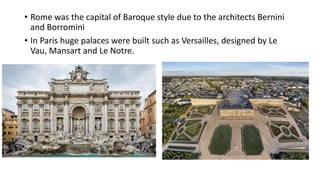
• Rome was the capital of Baroque style due to the architects Bernini
and Borromini
• In Paris huge palaces were built such as Versailles, designed by Le
Vau, Mansart and Le Notre.
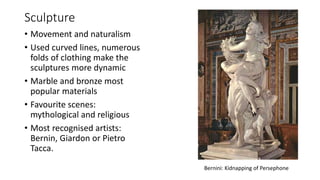
Sculpture
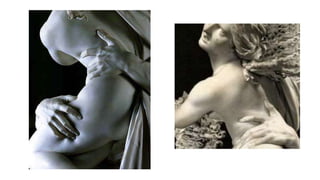
• Movement and naturalism
• Used curved lines, numerous
folds of clothing make the
sculptures more dynamic
• Marble and bronze most
popular materials
• Favourite scenes:
mythological and religious
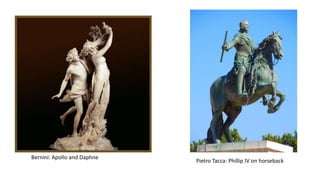
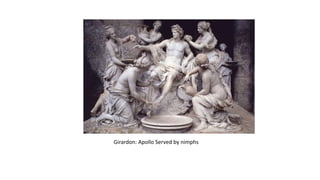
• Most recognised artists:
Bernin, Giardon or Pietro
Tacca.
Bernini: Kidnapping of Persephone
Bernini: Apollo and Daphne
Pietro Tacca: Phillip IV on horseback
Girardon: Apollo Served by nimphs
Architecture and sculpture in Spain
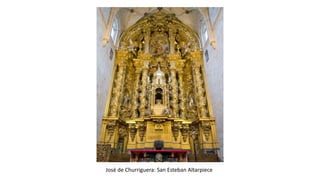
• Art commissioned by church, nobles and general public
• 18th century period of splendour in the Spanish
baroque
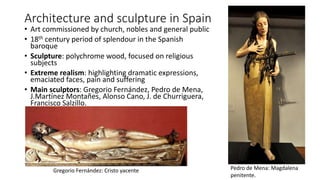
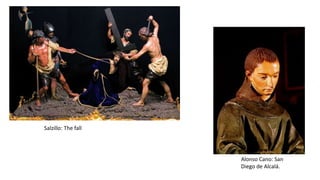
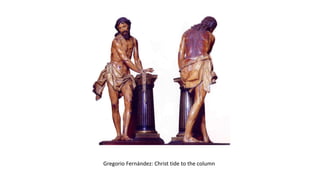
• Sculpture: polychrome wood, focused on religious
subjects
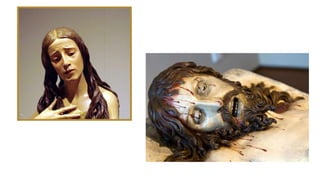
• Extreme realism: highlighting dramatic expressions,
emaciated faces, pain and suffering
• Main sculptors: Gregorio Fernández, Pedro de Mena,
J.Martínez Montañes, Alonso Cano, J. de Churriguera,
Francisco Salzillo.
Pedro de Mena: Magdalena
penitente.
Gregorio Fernández: Cristo yacente
Salzillo: The fall
Alonso Cano: San
Diego de Alcalá.
Gregorio Fernández: Christ tide to the column
José de Churriguera: San Esteban Altarpiece
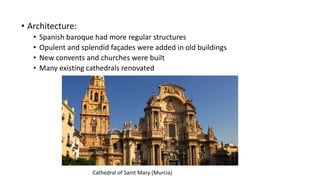
• Architecture:
• Spanish baroque had more regular structures
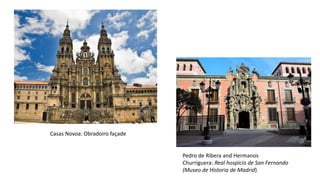
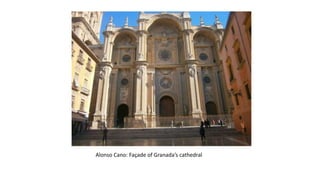
• Opulent and splendid façades were added in old buildings
• New convents and churches were built
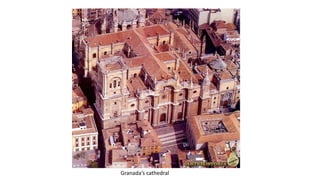
• Many existing cathedrals renovated
Cathedral of Saint Mary (Murcia)
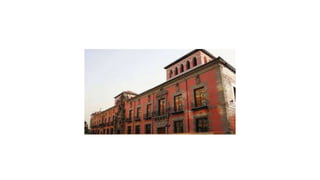
Pedro de Ribera and Hermanos
Churriguera: Real hospicio de San Fernando
(Museo de Historia de Madrid)
Casas Novoa: Obradoiro façade
Alonso Cano: Façade of Granada’s cathedral
Granada’s cathedral
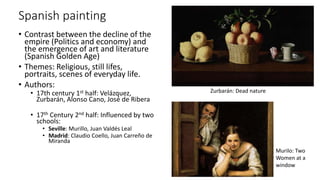
Spanish painting
• Contrast between the decline of the
empire (Politics and economy) and
the emergence of art and literature
(Spanish Golden Age)
• Themes: Religious, still lifes,
portraits, scenes of everyday life.
• Authors:
• 17th century 1st half: Velázquez,
Zurbarán, Alonso Cano, José de Ribera
• 17th Century 2nd half: Influenced by two
schools:
• Seville: Murillo, Juan Valdés Leal
• Madrid: Claudio Coello, Juan Carreño de
Miranda
Zurbarán: Dead nature
Murilo: Two
Women at a
window
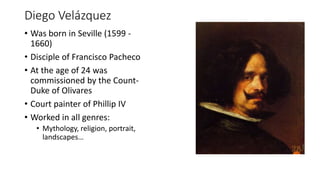
Diego Velázquez
• Was born in Seville (1599 -
1660)
• Disciple of Francisco Pacheco
• At the age of 24 was
commissioned by the Count-
Duke of Olivares
• Court painter of Phillip IV
• Worked in all genres:
• Mythology, religion, portrait,
landscapes…
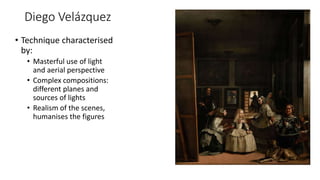
Diego Velázquez
• Technique characterised
by:
• Masterful use of light
and aerial perspective
• Complex compositions:
different planes and
sources of lights
• Realism of the scenes,
humanises the figures
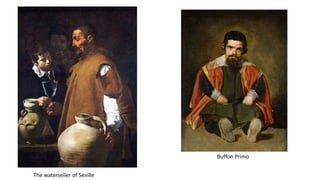
The waterseller of Seville
Buffon Primo
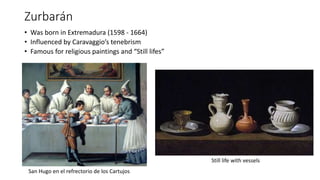
Zurbarán
• Was born in Extremadura (1598 - 1664)
• Influenced by Caravaggio’s tenebrism
• Famous for religious paintings and “Still lifes”
San Hugo en el refrectorio de los Cartujos
Still life with vessels
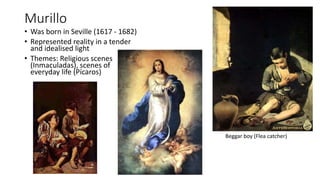
Murillo
• Was born in Seville (1617 - 1682)
• Represented reality in a tender
and idealised light
• Themes: Religious scenes
(Inmaculadas), scenes of
everyday life (Pícaros)
Beggar boy (Flea catcher)
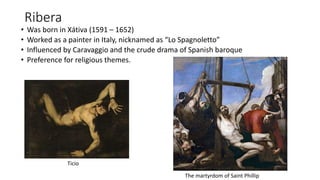
Ribera
• Was born in Xátiva (1591 – 1652)
• Worked as a painter in Italy, nicknamed as “Lo Spagnoletto”
• Influenced by Caravaggio and the crude drama of Spanish baroque
• Preference for religious themes.
Ticio
The martyrdom of Saint Phillip
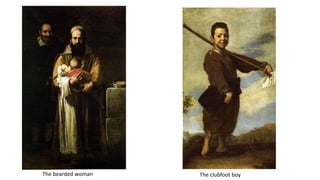
The bearded woman The clubfoot boy

Baroque art

  • 1.
  • 2.
    The baroque features •Artistic and cultural movement. (17th – 18th) • Aesthetic values base on: • Motion and complexity: curve and convezx shapes • Shapes created through light and color • Preference for realism, emotion and move instead of the idealisation of renaissance. • Drama and symbolism Bernini: “Beata Ludovica Albertoni”
  • 3.
    Caravaggio: “The entombmentof Christ” 17th century Van der Weyden: The descent of Christ. 15th century
  • 4.
    Religious propaganda • Historicalcontext of Counter- Reformation • Protestants don`t venerate icons, don’t accept all the sacraments, don’t accept the role of Saint Mary as a mother of God. • Catholic church reinforce their traditions: • Depiction of miracles • Mystic ecstasy • Martyrs • Churches extravagantly decorated, divine objects surrounded by grandeur and splendour. Santa Maria de Los Arcos (Navarra)
  • 5.
    Caravggio: The beheadingof Saint John Baptist. José Ribera: “The martyr Saint Bartholomeu”
  • 6.
    Art serving power •Was the art of the Absolute Monarchies: • Depictions of the magnificence and absolute power of the monarchs. • Monumental architecture: Elegant palaces as symbol of royal power. • In the Protestant Europe art served the rich bourgeoisie: • Merchants began commissioning works of art. • Works of art reflected every day life: Portraits, domestic settings, flowers…
  • 7.
    Vermeer: “The milkmaid” Dutchbaroque. Oil-on-canvas Scene of everyday life, high detail. Interior.
  • 8.
    Diego Velázquez: “ThePrince Baltasar Carlos” Oil-on-canvas. Depiction of the power of the absolute monarchy
  • 9.
  • 12.
    Architecture and sculpture •Sense of movement: curved cornices, broken pediments, elliptical and oval shapes into floor designs. Borromini: San Carlo alle Quattro Fontane
  • 13.
    • Interiors: Effectsof light and shade, elaborately decorated , Solomonic columns and impressive domes. Bernini: Baldachin of Saint Peter (Rome)
  • 14.
    • Rome wasthe capital of Baroque style due to the architects Bernini and Borromini • In Paris huge palaces were built such as Versailles, designed by Le Vau, Mansart and Le Notre.
  • 15.
    Sculpture • Movement andnaturalism • Used curved lines, numerous folds of clothing make the sculptures more dynamic • Marble and bronze most popular materials • Favourite scenes: mythological and religious • Most recognised artists: Bernin, Giardon or Pietro Tacca. Bernini: Kidnapping of Persephone
  • 17.
    Bernini: Apollo andDaphne Pietro Tacca: Phillip IV on horseback
  • 18.
  • 19.
    Architecture and sculpturein Spain • Art commissioned by church, nobles and general public • 18th century period of splendour in the Spanish baroque • Sculpture: polychrome wood, focused on religious subjects • Extreme realism: highlighting dramatic expressions, emaciated faces, pain and suffering • Main sculptors: Gregorio Fernández, Pedro de Mena, J.Martínez Montañes, Alonso Cano, J. de Churriguera, Francisco Salzillo. Pedro de Mena: Magdalena penitente. Gregorio Fernández: Cristo yacente
  • 21.
    Salzillo: The fall AlonsoCano: San Diego de Alcalá.
  • 22.
    Gregorio Fernández: Christtide to the column
  • 23.
    José de Churriguera:San Esteban Altarpiece
  • 24.
    • Architecture: • Spanishbaroque had more regular structures • Opulent and splendid façades were added in old buildings • New convents and churches were built • Many existing cathedrals renovated Cathedral of Saint Mary (Murcia)
  • 25.
    Pedro de Riberaand Hermanos Churriguera: Real hospicio de San Fernando (Museo de Historia de Madrid) Casas Novoa: Obradoiro façade
  • 27.
    Alonso Cano: Façadeof Granada’s cathedral
  • 28.
  • 29.
    Spanish painting • Contrastbetween the decline of the empire (Politics and economy) and the emergence of art and literature (Spanish Golden Age) • Themes: Religious, still lifes, portraits, scenes of everyday life. • Authors: • 17th century 1st half: Velázquez, Zurbarán, Alonso Cano, José de Ribera • 17th Century 2nd half: Influenced by two schools: • Seville: Murillo, Juan Valdés Leal • Madrid: Claudio Coello, Juan Carreño de Miranda Zurbarán: Dead nature Murilo: Two Women at a window
  • 30.
    Diego Velázquez • Wasborn in Seville (1599 - 1660) • Disciple of Francisco Pacheco • At the age of 24 was commissioned by the Count- Duke of Olivares • Court painter of Phillip IV • Worked in all genres: • Mythology, religion, portrait, landscapes…
  • 31.
    Diego Velázquez • Techniquecharacterised by: • Masterful use of light and aerial perspective • Complex compositions: different planes and sources of lights • Realism of the scenes, humanises the figures
  • 32.
    The waterseller ofSeville Buffon Primo
  • 34.
    Zurbarán • Was bornin Extremadura (1598 - 1664) • Influenced by Caravaggio’s tenebrism • Famous for religious paintings and “Still lifes” San Hugo en el refrectorio de los Cartujos Still life with vessels
  • 35.
    Murillo • Was bornin Seville (1617 - 1682) • Represented reality in a tender and idealised light • Themes: Religious scenes (Inmaculadas), scenes of everyday life (Pícaros) Beggar boy (Flea catcher)
  • 36.
    Ribera • Was bornin Xátiva (1591 – 1652) • Worked as a painter in Italy, nicknamed as “Lo Spagnoletto” • Influenced by Caravaggio and the crude drama of Spanish baroque • Preference for religious themes. Ticio The martyrdom of Saint Phillip
  • 37.
    The bearded womanThe clubfoot boy