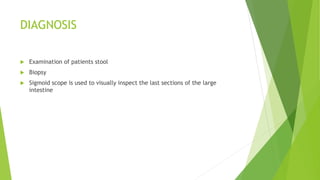
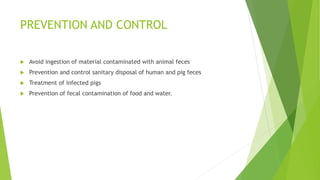
Balantidium coli is a protozoan parasite that causes the disease balantidiasis in humans. It is the largest protozoan known to infect humans and lives in the large intestine. Humans typically acquire the infection through ingesting cysts from the feces of pigs, which are the main reservoir. Symptoms include diarrhea, abdominal pain, and ulceration of the gut wall. Diagnosis is made by examining cysts or trophozoites in stool samples under a microscope. Treatment involves antibiotics like tetracycline, metronidazole, or iodoquinol. Prevention focuses on proper sanitation and disposal of human and pig feces to avoid fecal-oral transmission.


![TAXONOMY
Belongs to the family CILIOPHORA
Class;Litostometea
Order;Vestibuliferida
Family;Balantidiidae
Habitat;Large intestine of man, pig[main reservoir] and other animals](https://image.slidesharecdn.com/balantidiumcoli-230119072903-f1e4000c/85/balantidium-coli-pptx-3-320.jpg)


![SITE OF INFECTION
The following are the site of infection
1. CAECUM[a pouch that forms the first part of the large intestine]
2. LARGE INTESTINE](https://image.slidesharecdn.com/balantidiumcoli-230119072903-f1e4000c/85/balantidium-coli-pptx-7-320.jpg)
![SIGN AND SYMPTOMS
Acute even hemorrhagic
Diarrhea
Ulceration to gut wall
Dysentery
Colitis[An inflammatory reaction in the colon often auto-immune or infection]
Abdominal pain](https://image.slidesharecdn.com/balantidiumcoli-230119072903-f1e4000c/85/balantidium-coli-pptx-14-320.jpg)





![ONFH[AVN HIP] -TRIPLE REGIME -A NOVAL SURGICAL CONCEPT .pptx](https://cdn.slidesharecdn.com/ss_thumbnails/onfhavnhip2026koaconcalicutdrgokuldevdrmashraf-260210064517-213ec005-thumbnail.jpg?width=640&height=640&fit=bounds)


