BACTERIOLOGYBACTERIOLOGY
The Basic ConceptsThe Basic Concepts
BacteriaBacteria
These are the microscopic, rigid walled,These are the microscopic, rigid walled,
unicellular organisms which multiplyunicellular organisms which multiply
asexually by binary fission. These are theasexually by binary fission. These are the
most common pathogens causingmost common pathogens causing
disease.disease.
They are classified according to theThey are classified according to the
following scheme.following scheme.
OrderOrder→→ FamilyFamily→→ GenusGenus→→ Specie.Specie.
NomenclatureNomenclature
The first part of the name is of the genus to which bacteriaThe first part of the name is of the genus to which bacteria
belongs and it always starts with the capital letter e.g.belongs and it always starts with the capital letter e.g.
Staphylococci, Streptococci, etc. It could be abbreviated e.g.Staphylococci, Streptococci, etc. It could be abbreviated e.g.
Staphylococci (Staph. / S.), Mycobacterium (M).Staphylococci (Staph. / S.), Mycobacterium (M).
The second part of the name indicates the specie and it alwaysThe second part of the name indicates the specie and it always
starts with the small letter. It is usually derived from the name ofstarts with the small letter. It is usually derived from the name of
the disease it causes or the organ affected by it.the disease it causes or the organ affected by it.
e.g. Mycobacterium tuberculosis is the complete name of thee.g. Mycobacterium tuberculosis is the complete name of the
microorganism in which;microorganism in which;
MycobacteriumMycobacterium generic namegeneric name
tuberculosistuberculosis indicates the specieindicates the specie
Some bacteria are known by their old name or traditional nameSome bacteria are known by their old name or traditional name
e.g. Mycobacterium tuberculosis is also called tubercle bacilluse.g. Mycobacterium tuberculosis is also called tubercle bacillus
or Koch’s bacillus.or Koch’s bacillus.
Classification of BacteriaClassification of Bacteria
Shape of BacteriaShape of Bacteria
Staining of BacteriaStaining of Bacteria
Oxygen Requirement of BacteriaOxygen Requirement of Bacteria
Shape of BacteriaShape of Bacteria
On the basis of shape bacteria can be:On the basis of shape bacteria can be:
CocciCocci SphericalSpherical
BacilliBacilli Straight rodStraight rod
Spirilum Curved or spiral rodSpirilum Curved or spiral rod
Cocci:Cocci:
These could be of following subtypes:These could be of following subtypes:
Bunches e.g., StaphylococciBunches e.g., Staphylococci
Chains e.g., StreptococciChains e.g., Streptococci
Pairs e.g., Streptococcus pneumoniaePairs e.g., Streptococcus pneumoniae
Pair with flattened side e.g., NeisseriaPair with flattened side e.g., Neisseria
Cubical packets of eight e.g., SarcinaCubical packets of eight e.g., Sarcina
BacilliBacilli ::
They may be of following subtypes:They may be of following subtypes:
Chains e.g., BacillusChains e.g., Bacillus
Short coccobacilli e.g., Brucella & HaemophilusShort coccobacilli e.g., Brucella & Haemophilus
Threads e.g., ProteusThreads e.g., Proteus
Club shaped e.g., CorynebacteriumClub shaped e.g., Corynebacterium
Spindle shaped e.g., FusobacteriumSpindle shaped e.g., Fusobacterium
Branching filaments e.g., ActinomycesBranching filaments e.g., Actinomyces
Spiral:Spiral:
Coma shaped rods e.g., Vibrio, CampylobacterComa shaped rods e.g., Vibrio, Campylobacter
Longer rigid rods & several curves or spirals e.g., SpirillumLonger rigid rods & several curves or spirals e.g., Spirillum
Long flexible with spirals e.g., SpirochaetesLong flexible with spirals e.g., Spirochaetes
Staining of BacteriaStaining of Bacteria
The process by which slides of microorganisms are prepared with the help of special dyes toThe process by which slides of microorganisms are prepared with the help of special dyes to
observe them under microscope is called staining. Following are the main methods ofobserve them under microscope is called staining. Following are the main methods of
staining the bacteria:staining the bacteria:
1. Gram’s Staining:1. Gram’s Staining:
By this method two major classes of microorganisms are distinguished:By this method two major classes of microorganisms are distinguished:
Gram positiveGram positive These stain violetThese stain violet
Gram negativeGram negative These stain pinkThese stain pink
All cocci are G +All cocci are G + except genus Neisseria, Branhamella, Veillonella.except genus Neisseria, Branhamella, Veillonella.
All rods are G -All rods are G - except genus Bacillus, Clostridium, Corynaebacterium,except genus Bacillus, Clostridium, Corynaebacterium,
Mycobacterium, Actinomyces.Mycobacterium, Actinomyces.
Gram PositiveGram Positive Gram NegativeGram Negative
Cell wall resists too much damage. Little mucopeptide in cell wall,Cell wall resists too much damage. Little mucopeptide in cell wall,
more lipoprotein &more lipoprotein &
PolysaccharidesPolysaccharides
Less synthetic abilityLess synthetic ability
Complex nutritional requirementsComplex nutritional requirements
Mainly produce ExotoxinsMainly produce Exotoxins Produce EndotoxinsProduce Endotoxins
2. ZN (Ziehl-Neelsen ) Staining:2. ZN (Ziehl-Neelsen ) Staining:
Usually used for staining mycobacteria e.g. M. tuberculosis.Usually used for staining mycobacteria e.g. M. tuberculosis.
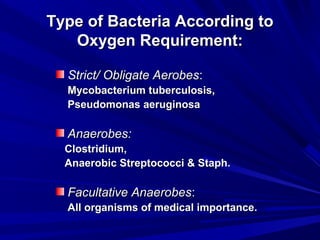
Type of Bacteria According toType of Bacteria According to
Oxygen Requirement:Oxygen Requirement:
Strict/ Obligate AerobesStrict/ Obligate Aerobes::
Mycobacterium tuberculosis,Mycobacterium tuberculosis,
Pseudomonas aeruginosaPseudomonas aeruginosa
Anaerobes:Anaerobes:
Clostridium,Clostridium,
Anaerobic Streptococci & Staph.Anaerobic Streptococci & Staph.
Facultative AnaerobesFacultative Anaerobes::
All organisms of medical importance.All organisms of medical importance.
Structure of BacteriaStructure of Bacteria
1.1. Cell Wall:Cell Wall:
Presence of cell wall makes it different from other animal cells.Presence of cell wall makes it different from other animal cells.
Rigid structure and is responsible for its strength and integrity.Rigid structure and is responsible for its strength and integrity.
Contains mucopeptides (glycopeptides or peptidoglycansContains mucopeptides (glycopeptides or peptidoglycans
2. Protoplast:2. Protoplast:
There is no differentiation b/w cytoplasm & nucleus.There is no differentiation b/w cytoplasm & nucleus.
Cytoplasm contains ribosomes containing RNA.Cytoplasm contains ribosomes containing RNA.
Nuclear structure contains DNA.Nuclear structure contains DNA.
May contain cytoplasmic inclusions.May contain cytoplasmic inclusions.
Cytoplasmic membrane is a fine lipoprotien sheet.Cytoplasmic membrane is a fine lipoprotien sheet.
3. Capsule:3. Capsule:
Outermost cover that provides strength, protection & resistance. It may be;Outermost cover that provides strength, protection & resistance. It may be;
ThickThick Streptococcus pneumoniae, klebsiella pneumoniae,Streptococcus pneumoniae, klebsiella pneumoniae,
ThinThin Neisseria meningitidis, Streptococcus pyogenes,Neisseria meningitidis, Streptococcus pyogenes,
4. Flagella:4. Flagella:
These are special organs of motility. On the presence of these, the bacteria are divided into:These are special organs of motility. On the presence of these, the bacteria are divided into:
1. Motile1. Motile E. coli, Salmonella, Proteus, Pseudomonas,E. coli, Salmonella, Proteus, Pseudomonas,
2. Non motile2. Non motile Shigella,Haemophilus, Mycobacterium, Corynebacterium,Shigella,Haemophilus, Mycobacterium, Corynebacterium,
5. Spores5. Spores::
““Resistant resting stage of the organisms.”Resistant resting stage of the organisms.”
Bacillus (aerobes) e.g., Bacillus anthracis, Clostridium (anaerobes) e.g., Clostridium perfringensBacillus (aerobes) e.g., Bacillus anthracis, Clostridium (anaerobes) e.g., Clostridium perfringens
CommensalsCommensals
““Those microorganisms which constitute the normal flora ofThose microorganisms which constitute the normal flora of
that organ but doesn’t produce disease under normalthat organ but doesn’t produce disease under normal
circumstances.”(Opportunistics)circumstances.”(Opportunistics)
Different organs have different commensals e.g.;Different organs have different commensals e.g.;
Skin commensals:Skin commensals: Staphylococcus epidermidis.Staphylococcus epidermidis.
Bowel Commensals:Bowel Commensals: Bacteroides, Escherichia Coli.Bacteroides, Escherichia Coli.
Upper Respiratory Tract commensalsUpper Respiratory Tract commensals: Haemophilus: Haemophilus
influenzae, Strep.pneumoniae, Strep. viridansinfluenzae, Strep.pneumoniae, Strep. viridans
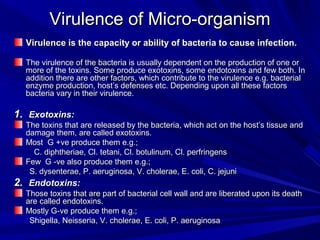
Virulence of Micro-organismVirulence of Micro-organism
Virulence is the capacity or ability of bacteria to cause infection.Virulence is the capacity or ability of bacteria to cause infection.
The virulence of the bacteria is usually dependent on the production of one orThe virulence of the bacteria is usually dependent on the production of one or
more of the toxins. Some produce exotoxins, some endotoxins and few both. Inmore of the toxins. Some produce exotoxins, some endotoxins and few both. In
addition there are other factors, which contribute to the virulence e.g. bacterialaddition there are other factors, which contribute to the virulence e.g. bacterial
enzyme production, host’s defenses etc. Depending upon all these factorsenzyme production, host’s defenses etc. Depending upon all these factors
bacteria vary in their virulence.bacteria vary in their virulence.
1.1. Exotoxins:Exotoxins:
The toxins that are released by the bacteria, which act on the host’s tissue andThe toxins that are released by the bacteria, which act on the host’s tissue and
damage them, are called exotoxins.damage them, are called exotoxins.
Most G +ve produce them e.g.;Most G +ve produce them e.g.;
C. diphtheriae, Cl. tetani, Cl. botulinum, Cl. perfringensC. diphtheriae, Cl. tetani, Cl. botulinum, Cl. perfringens
Few G -ve also produce them e.g.;Few G -ve also produce them e.g.;
S. dysenterae, P. aeruginosa, V. cholerae, E. coli, C. jejuniS. dysenterae, P. aeruginosa, V. cholerae, E. coli, C. jejuni
2.2. Endotoxins:Endotoxins:
Those toxins that are part of bacterial cell wall and are liberated upon its deathThose toxins that are part of bacterial cell wall and are liberated upon its death
are called endotoxins.are called endotoxins.
Mostly G-ve produce them e.g.;Mostly G-ve produce them e.g.;
Shigella, Neisseria, V. cholerae, E. coli, P. aeruginosaShigella, Neisseria, V. cholerae, E. coli, P. aeruginosa
Atypical BacteriaAtypical Bacteria
Spirochaetes:Spirochaetes:
These are thin, spiral, motile, flexible and more complex than the ordinaryThese are thin, spiral, motile, flexible and more complex than the ordinary
bacteria (probably G-ve).bacteria (probably G-ve).
Borrelia: B. vincenti.Borrelia: B. vincenti.
Leptospira: L. biflexa, L. interrogans.Leptospira: L. biflexa, L. interrogans.
Treponema:Treponema: T. pallidum.T. pallidum.
Rickettsiae:Rickettsiae:
These are small obligate, intracellular bacteria transmitted by insect vector.These are small obligate, intracellular bacteria transmitted by insect vector.
R. prowazeki, R. typhi, R. rickettsi.R. prowazeki, R. typhi, R. rickettsi.
Coxiella burnetiCoxiella burneti
Chlamydia:Chlamydia:
These are intracellular bacteria larger than viruses, contain both DNA & RNA,These are intracellular bacteria larger than viruses, contain both DNA & RNA,
and causes disease in man and animal.and causes disease in man and animal.
C. trachomatis.C. trachomatis.
Mycoplasma:Mycoplasma:
These are the smallest free-living organisms & can grow on cell-free media.These are the smallest free-living organisms & can grow on cell-free media.
M. pneumoniae.M. pneumoniae.

Bacteriology

  • 1.
  • 2.
    BacteriaBacteria These are themicroscopic, rigid walled,These are the microscopic, rigid walled, unicellular organisms which multiplyunicellular organisms which multiply asexually by binary fission. These are theasexually by binary fission. These are the most common pathogens causingmost common pathogens causing disease.disease. They are classified according to theThey are classified according to the following scheme.following scheme. OrderOrder→→ FamilyFamily→→ GenusGenus→→ Specie.Specie.
  • 3.
    NomenclatureNomenclature The first partof the name is of the genus to which bacteriaThe first part of the name is of the genus to which bacteria belongs and it always starts with the capital letter e.g.belongs and it always starts with the capital letter e.g. Staphylococci, Streptococci, etc. It could be abbreviated e.g.Staphylococci, Streptococci, etc. It could be abbreviated e.g. Staphylococci (Staph. / S.), Mycobacterium (M).Staphylococci (Staph. / S.), Mycobacterium (M). The second part of the name indicates the specie and it alwaysThe second part of the name indicates the specie and it always starts with the small letter. It is usually derived from the name ofstarts with the small letter. It is usually derived from the name of the disease it causes or the organ affected by it.the disease it causes or the organ affected by it. e.g. Mycobacterium tuberculosis is the complete name of thee.g. Mycobacterium tuberculosis is the complete name of the microorganism in which;microorganism in which; MycobacteriumMycobacterium generic namegeneric name tuberculosistuberculosis indicates the specieindicates the specie Some bacteria are known by their old name or traditional nameSome bacteria are known by their old name or traditional name e.g. Mycobacterium tuberculosis is also called tubercle bacilluse.g. Mycobacterium tuberculosis is also called tubercle bacillus or Koch’s bacillus.or Koch’s bacillus.
  • 4.
    Classification of BacteriaClassificationof Bacteria Shape of BacteriaShape of Bacteria Staining of BacteriaStaining of Bacteria Oxygen Requirement of BacteriaOxygen Requirement of Bacteria
  • 5.
    Shape of BacteriaShapeof Bacteria On the basis of shape bacteria can be:On the basis of shape bacteria can be: CocciCocci SphericalSpherical BacilliBacilli Straight rodStraight rod Spirilum Curved or spiral rodSpirilum Curved or spiral rod Cocci:Cocci: These could be of following subtypes:These could be of following subtypes: Bunches e.g., StaphylococciBunches e.g., Staphylococci Chains e.g., StreptococciChains e.g., Streptococci Pairs e.g., Streptococcus pneumoniaePairs e.g., Streptococcus pneumoniae Pair with flattened side e.g., NeisseriaPair with flattened side e.g., Neisseria Cubical packets of eight e.g., SarcinaCubical packets of eight e.g., Sarcina BacilliBacilli :: They may be of following subtypes:They may be of following subtypes: Chains e.g., BacillusChains e.g., Bacillus Short coccobacilli e.g., Brucella & HaemophilusShort coccobacilli e.g., Brucella & Haemophilus Threads e.g., ProteusThreads e.g., Proteus Club shaped e.g., CorynebacteriumClub shaped e.g., Corynebacterium Spindle shaped e.g., FusobacteriumSpindle shaped e.g., Fusobacterium Branching filaments e.g., ActinomycesBranching filaments e.g., Actinomyces Spiral:Spiral: Coma shaped rods e.g., Vibrio, CampylobacterComa shaped rods e.g., Vibrio, Campylobacter Longer rigid rods & several curves or spirals e.g., SpirillumLonger rigid rods & several curves or spirals e.g., Spirillum Long flexible with spirals e.g., SpirochaetesLong flexible with spirals e.g., Spirochaetes
  • 7.
    Staining of BacteriaStainingof Bacteria The process by which slides of microorganisms are prepared with the help of special dyes toThe process by which slides of microorganisms are prepared with the help of special dyes to observe them under microscope is called staining. Following are the main methods ofobserve them under microscope is called staining. Following are the main methods of staining the bacteria:staining the bacteria: 1. Gram’s Staining:1. Gram’s Staining: By this method two major classes of microorganisms are distinguished:By this method two major classes of microorganisms are distinguished: Gram positiveGram positive These stain violetThese stain violet Gram negativeGram negative These stain pinkThese stain pink All cocci are G +All cocci are G + except genus Neisseria, Branhamella, Veillonella.except genus Neisseria, Branhamella, Veillonella. All rods are G -All rods are G - except genus Bacillus, Clostridium, Corynaebacterium,except genus Bacillus, Clostridium, Corynaebacterium, Mycobacterium, Actinomyces.Mycobacterium, Actinomyces. Gram PositiveGram Positive Gram NegativeGram Negative Cell wall resists too much damage. Little mucopeptide in cell wall,Cell wall resists too much damage. Little mucopeptide in cell wall, more lipoprotein &more lipoprotein & PolysaccharidesPolysaccharides Less synthetic abilityLess synthetic ability Complex nutritional requirementsComplex nutritional requirements Mainly produce ExotoxinsMainly produce Exotoxins Produce EndotoxinsProduce Endotoxins 2. ZN (Ziehl-Neelsen ) Staining:2. ZN (Ziehl-Neelsen ) Staining: Usually used for staining mycobacteria e.g. M. tuberculosis.Usually used for staining mycobacteria e.g. M. tuberculosis.
  • 8.
    Type of BacteriaAccording toType of Bacteria According to Oxygen Requirement:Oxygen Requirement: Strict/ Obligate AerobesStrict/ Obligate Aerobes:: Mycobacterium tuberculosis,Mycobacterium tuberculosis, Pseudomonas aeruginosaPseudomonas aeruginosa Anaerobes:Anaerobes: Clostridium,Clostridium, Anaerobic Streptococci & Staph.Anaerobic Streptococci & Staph. Facultative AnaerobesFacultative Anaerobes:: All organisms of medical importance.All organisms of medical importance.
  • 9.
    Structure of BacteriaStructureof Bacteria 1.1. Cell Wall:Cell Wall: Presence of cell wall makes it different from other animal cells.Presence of cell wall makes it different from other animal cells. Rigid structure and is responsible for its strength and integrity.Rigid structure and is responsible for its strength and integrity. Contains mucopeptides (glycopeptides or peptidoglycansContains mucopeptides (glycopeptides or peptidoglycans 2. Protoplast:2. Protoplast: There is no differentiation b/w cytoplasm & nucleus.There is no differentiation b/w cytoplasm & nucleus. Cytoplasm contains ribosomes containing RNA.Cytoplasm contains ribosomes containing RNA. Nuclear structure contains DNA.Nuclear structure contains DNA. May contain cytoplasmic inclusions.May contain cytoplasmic inclusions. Cytoplasmic membrane is a fine lipoprotien sheet.Cytoplasmic membrane is a fine lipoprotien sheet. 3. Capsule:3. Capsule: Outermost cover that provides strength, protection & resistance. It may be;Outermost cover that provides strength, protection & resistance. It may be; ThickThick Streptococcus pneumoniae, klebsiella pneumoniae,Streptococcus pneumoniae, klebsiella pneumoniae, ThinThin Neisseria meningitidis, Streptococcus pyogenes,Neisseria meningitidis, Streptococcus pyogenes, 4. Flagella:4. Flagella: These are special organs of motility. On the presence of these, the bacteria are divided into:These are special organs of motility. On the presence of these, the bacteria are divided into: 1. Motile1. Motile E. coli, Salmonella, Proteus, Pseudomonas,E. coli, Salmonella, Proteus, Pseudomonas, 2. Non motile2. Non motile Shigella,Haemophilus, Mycobacterium, Corynebacterium,Shigella,Haemophilus, Mycobacterium, Corynebacterium, 5. Spores5. Spores:: ““Resistant resting stage of the organisms.”Resistant resting stage of the organisms.” Bacillus (aerobes) e.g., Bacillus anthracis, Clostridium (anaerobes) e.g., Clostridium perfringensBacillus (aerobes) e.g., Bacillus anthracis, Clostridium (anaerobes) e.g., Clostridium perfringens
  • 11.
    CommensalsCommensals ““Those microorganisms whichconstitute the normal flora ofThose microorganisms which constitute the normal flora of that organ but doesn’t produce disease under normalthat organ but doesn’t produce disease under normal circumstances.”(Opportunistics)circumstances.”(Opportunistics) Different organs have different commensals e.g.;Different organs have different commensals e.g.; Skin commensals:Skin commensals: Staphylococcus epidermidis.Staphylococcus epidermidis. Bowel Commensals:Bowel Commensals: Bacteroides, Escherichia Coli.Bacteroides, Escherichia Coli. Upper Respiratory Tract commensalsUpper Respiratory Tract commensals: Haemophilus: Haemophilus influenzae, Strep.pneumoniae, Strep. viridansinfluenzae, Strep.pneumoniae, Strep. viridans
  • 12.
    Virulence of Micro-organismVirulenceof Micro-organism Virulence is the capacity or ability of bacteria to cause infection.Virulence is the capacity or ability of bacteria to cause infection. The virulence of the bacteria is usually dependent on the production of one orThe virulence of the bacteria is usually dependent on the production of one or more of the toxins. Some produce exotoxins, some endotoxins and few both. Inmore of the toxins. Some produce exotoxins, some endotoxins and few both. In addition there are other factors, which contribute to the virulence e.g. bacterialaddition there are other factors, which contribute to the virulence e.g. bacterial enzyme production, host’s defenses etc. Depending upon all these factorsenzyme production, host’s defenses etc. Depending upon all these factors bacteria vary in their virulence.bacteria vary in their virulence. 1.1. Exotoxins:Exotoxins: The toxins that are released by the bacteria, which act on the host’s tissue andThe toxins that are released by the bacteria, which act on the host’s tissue and damage them, are called exotoxins.damage them, are called exotoxins. Most G +ve produce them e.g.;Most G +ve produce them e.g.; C. diphtheriae, Cl. tetani, Cl. botulinum, Cl. perfringensC. diphtheriae, Cl. tetani, Cl. botulinum, Cl. perfringens Few G -ve also produce them e.g.;Few G -ve also produce them e.g.; S. dysenterae, P. aeruginosa, V. cholerae, E. coli, C. jejuniS. dysenterae, P. aeruginosa, V. cholerae, E. coli, C. jejuni 2.2. Endotoxins:Endotoxins: Those toxins that are part of bacterial cell wall and are liberated upon its deathThose toxins that are part of bacterial cell wall and are liberated upon its death are called endotoxins.are called endotoxins. Mostly G-ve produce them e.g.;Mostly G-ve produce them e.g.; Shigella, Neisseria, V. cholerae, E. coli, P. aeruginosaShigella, Neisseria, V. cholerae, E. coli, P. aeruginosa
  • 15.
    Atypical BacteriaAtypical Bacteria Spirochaetes:Spirochaetes: Theseare thin, spiral, motile, flexible and more complex than the ordinaryThese are thin, spiral, motile, flexible and more complex than the ordinary bacteria (probably G-ve).bacteria (probably G-ve). Borrelia: B. vincenti.Borrelia: B. vincenti. Leptospira: L. biflexa, L. interrogans.Leptospira: L. biflexa, L. interrogans. Treponema:Treponema: T. pallidum.T. pallidum. Rickettsiae:Rickettsiae: These are small obligate, intracellular bacteria transmitted by insect vector.These are small obligate, intracellular bacteria transmitted by insect vector. R. prowazeki, R. typhi, R. rickettsi.R. prowazeki, R. typhi, R. rickettsi. Coxiella burnetiCoxiella burneti Chlamydia:Chlamydia: These are intracellular bacteria larger than viruses, contain both DNA & RNA,These are intracellular bacteria larger than viruses, contain both DNA & RNA, and causes disease in man and animal.and causes disease in man and animal. C. trachomatis.C. trachomatis. Mycoplasma:Mycoplasma: These are the smallest free-living organisms & can grow on cell-free media.These are the smallest free-living organisms & can grow on cell-free media. M. pneumoniae.M. pneumoniae.