Copyright © 2009 Pearson Education Inc., publishing as Pearson Benjamin Cummings
PROTEOBACTERIA
By Rikta Vekaria
Copyright © 2009 Pearson Education Inc., publishing as Pearson Benjamin Cummings
The Phylogeny of Bacteria
I. Phylum Proteobacteria
•Carl Woese proposed this group in 1987
•“Purple bacteria” and their relatives
•Due to red purple pigment
•With Various Shapes (spherical, rod-like,ringed,
spiral, filamentous or curved)
•Gram-negative
Copyright © 2009 Pearson Education Inc., publishing as Pearson Benjamin Cummings
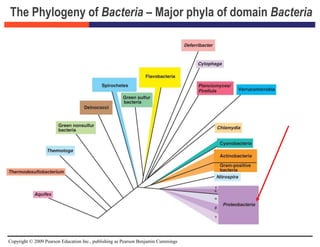
The Phylogeny of Bacteria – Major phyla of domain Bacteria
Phylogenetic Overview of Bacteria
Copyright © 2009 Pearson Education Inc., publishing as Pearson Benjamin Cummings
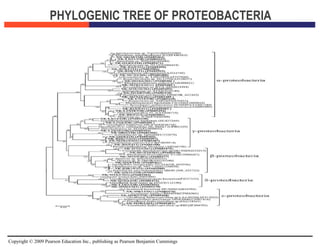
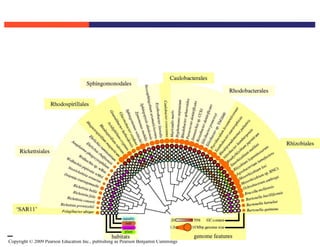
PHYLOGENIC TREE OF PROTEOBACTERIA
Copyright © 2009 Pearson Education Inc., publishing as Pearson Benjamin Cummings
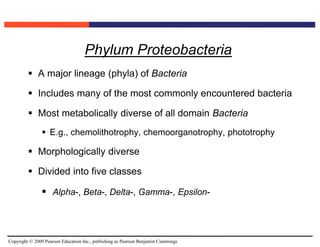
Phylum Proteobacteria
 A major lineage (phyla) of Bacteria
 Includes many of the most commonly encountered bacteria
 Most metabolically diverse of all domain Bacteria
 E.g., chemolithotrophy, chemoorganotrophy, phototrophy
 Morphologically diverse
 Divided into five classes
 Alpha-, Beta-, Delta-, Gamma-, Epsilon-
Copyright © 2009 Pearson Education Inc., publishing as Pearson Benjamin Cummings
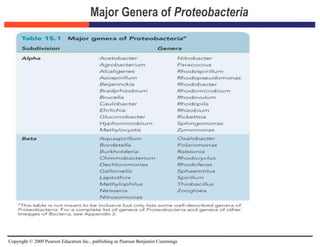
Major Genera of Proteobacteria
Copyright © 2009 Pearson Education Inc., publishing as Pearson Benjamin Cummings
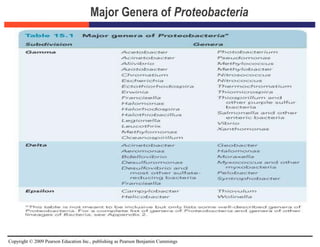
Major Genera of Proteobacteria
Copyright © 2009 Pearson Education Inc., publishing as Pearson Benjamin Cummings
DISTRIBUTION OF PROTEOBACTERIA
Copyright © 2009 Pearson Education Inc., publishing as Pearson Benjamin Cummings
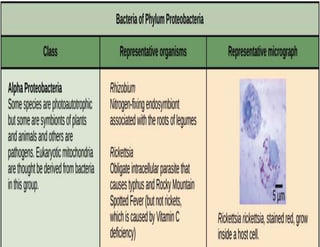
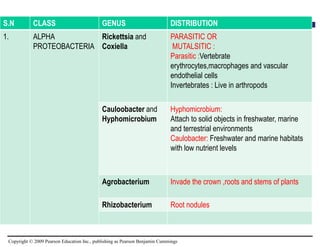
S.N CLASS GENUS DISTRIBUTION
1. ALPHA
PROTEOBACTERIA
Rickettsia and
Coxiella
PARASITIC OR
MUTALSITIC :
Parasitic :Vertebrate
erythrocytes,macrophages and vascular
endothelial cells
Invertebrates : Live in arthropods
Cauloobacter and
Hyphomicrobium
Hyphomicrobium:
Attach to solid objects in freshwater, marine
and terrestrial environments
Caulobacter: Freshwater and marine habitats
with low nutrient levels
Agrobacterium Invade the crown ,roots and stems of plants
Rhizobacterium Root nodules
Copyright © 2009 Pearson Education Inc., publishing as Pearson Benjamin Cummings
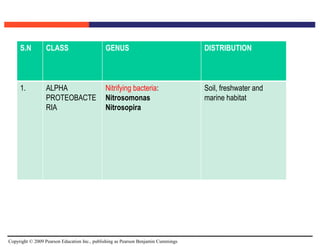
S.N CLASS GENUS DISTRIBUTION
1. ALPHA
PROTEOBACTE
RIA
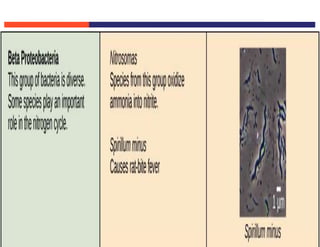
Nitrifying bacteria:
Nitrosomonas
Nitrosopira
Soil, freshwater and
marine habitat
Copyright © 2009 Pearson Education Inc., publishing as Pearson Benjamin Cummings
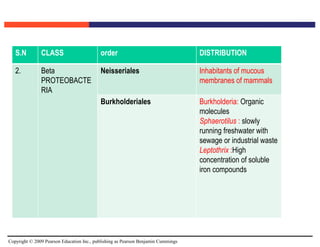
S.N CLASS order DISTRIBUTION
2. Beta
PROTEOBACTE
RIA
Neisseriales Inhabitants of mucous
membranes of mammals
Burkholderiales Burkholderia: Organic
molecules
Sphaerotilus : slowly
running freshwater with
sewage or industrial waste
Leptothrix :High
concentration of soluble
iron compounds
Copyright © 2009 Pearson Education Inc., publishing as Pearson Benjamin Cummings
S.N CLASS order DISTRIBUTION
2. Beta
PROTEOBACTE
RIA
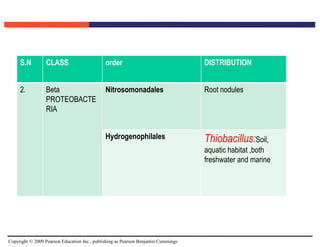
Nitrosomonadales Root nodules
Hydrogenophilales Thiobacillus:Soil,
aquatic habitat ,both
freshwater and marine
Copyright © 2009 Pearson Education Inc., publishing as Pearson Benjamin Cummings
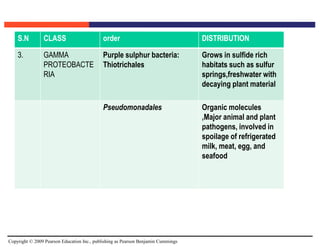
S.N CLASS order DISTRIBUTION
3. GAMMA
PROTEOBACTE
RIA
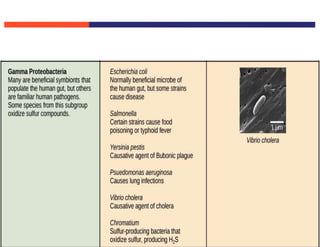
Purple sulphur bacteria:
Thiotrichales
Grows in sulfide rich
habitats such as sulfur
springs,freshwater with
decaying plant material
Pseudomonadales Organic molecules
,Major animal and plant
pathogens, involved in
spoilage of refrigerated
milk, meat, egg, and
seafood
Copyright © 2009 Pearson Education Inc., publishing as Pearson Benjamin Cummings
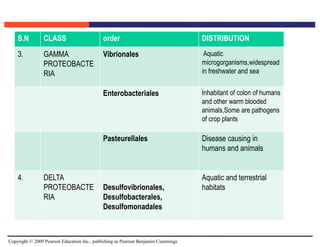
S.N CLASS order DISTRIBUTION
3. GAMMA
PROTEOBACTE
RIA
Vibrionales Aquatic
microgorganisms,widespread
in freshwater and sea
Enterobacteriales Inhabitant of colon of humans
and other warm blooded
animals,Some are pathogens
of crop plants
Pasteurellales Disease causing in
humans and animals
4. DELTA
PROTEOBACTE
RIA
Desulfovibrionales,
Desulfobacterales,
Desulfomonadales
Aquatic and terrestrial
habitats
Copyright © 2009 Pearson Education Inc., publishing as Pearson Benjamin Cummings
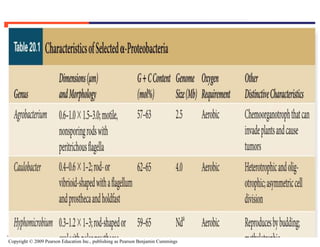
CHARACTERISTICS OF PROTEOBACTERIA
Copyright © 2009 Pearson Education Inc., publishing as Pearson Benjamin Cummings
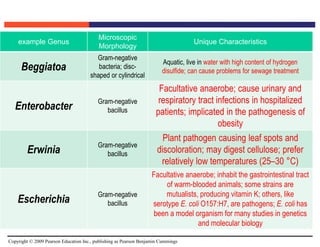
The characteristics of important genera of
Gammaproteobacteria.
Copyright © 2009 Pearson Education Inc., publishing as Pearson Benjamin Cummings
example Genus
Microscopic
Morphology
Unique Characteristics
Beggiatoa
Gram-negative
bacteria; disc-
shaped or cylindrical
Aquatic, live in water with high content of hydrogen
disulfide; can cause problems for sewage treatment
Enterobacter
Gram-negative
bacillus
Facultative anaerobe; cause urinary and
respiratory tract infections in hospitalized
patients; implicated in the pathogenesis of
obesity
Erwinia
Gram-negative
bacillus
Plant pathogen causing leaf spots and
discoloration; may digest cellulose; prefer
relatively low temperatures (25–30 °C)
Escherichia
Gram-negative
bacillus
Facultative anaerobe; inhabit the gastrointestinal tract
of warm-blooded animals; some strains are
mutualists, producing vitamin K; others, like
serotype E. coli O157:H7, are pathogens; E. coli has
been a model organism for many studies in genetics
and molecular biology
Copyright © 2009 Pearson Education Inc., publishing as Pearson Benjamin Cummings
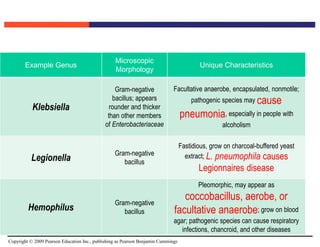
Example Genus
Microscopic
Morphology
Unique Characteristics
Klebsiella
Gram-negative
bacillus; appears
rounder and thicker
than other members
of Enterobacteriaceae
Facultative anaerobe, encapsulated, nonmotile;
pathogenic species may cause
pneumonia, especially in people with
alcoholism
Legionella
Gram-negative
bacillus
Fastidious, grow on charcoal-buffered yeast
extract; L. pneumophila causes
Legionnaires disease
Hemophilus
Gram-negative
bacillus
Pleomorphic, may appear as
coccobacillus, aerobe, or
facultative anaerobe; grow on blood
agar; pathogenic species can cause respiratory
infections, chancroid, and other diseases
Copyright © 2009 Pearson Education Inc., publishing as Pearson Benjamin Cummings
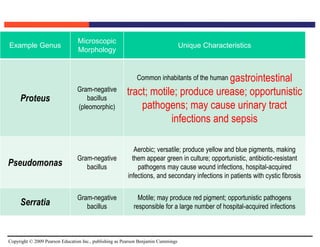
Example Genus
Microscopic
Morphology
Unique Characteristics
Proteus
Gram-negative
bacillus
(pleomorphic)
Common inhabitants of the human gastrointestinal
tract; motile; produce urease; opportunistic
pathogens; may cause urinary tract
infections and sepsis
Pseudomonas
Gram-negative
bacillus
Aerobic; versatile; produce yellow and blue pigments, making
them appear green in culture; opportunistic, antibiotic-resistant
pathogens may cause wound infections, hospital-acquired
infections, and secondary infections in patients with cystic fibrosis
Serratia
Gram-negative
bacillus
Motile; may produce red pigment; opportunistic pathogens
responsible for a large number of hospital-acquired infections
Copyright © 2009 Pearson Education Inc., publishing as Pearson Benjamin Cummings
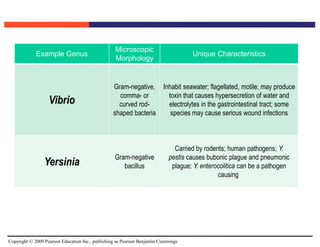
Example Genus
Microscopic
Morphology
Unique Characteristics
Vibrio
Gram-negative,
comma- or
curved rod-
shaped bacteria
Inhabit seawater; flagellated, motile; may produce
toxin that causes hypersecretion of water and
electrolytes in the gastrointestinal tract; some
species may cause serious wound infections
Yersinia
Gram-negative
bacillus
Carried by rodents; human pathogens; Y.
pestis causes bubonic plague and pneumonic
plague; Y. enterocolitica can be a pathogen
causing
Copyright © 2009 Pearson Education Inc., publishing as Pearson Benjamin Cummings
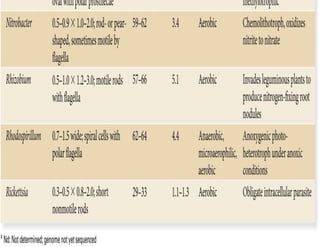
The characteristics of important genera of
Alpha proteobacteria.
Copyright © 2009 Pearson Education Inc., publishing as Pearson Benjamin Cummings
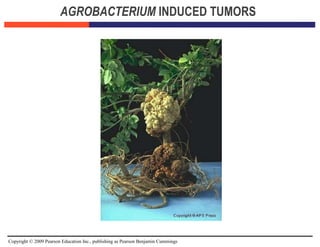
AGROBACTERIUM INDUCED TUMORS
Copyright © 2009 Pearson Education Inc., publishing as Pearson Benjamin Cummings
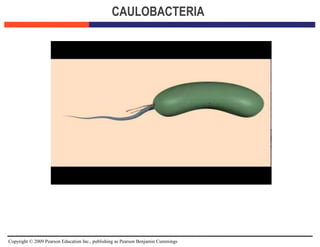
CAULOBACTERIA
Copyright © 2009 Pearson Education Inc., publishing as Pearson Benjamin Cummings
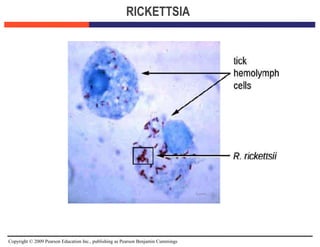
RICKETTSIA
Copyright © 2009 Pearson Education Inc., publishing as Pearson Benjamin Cummings
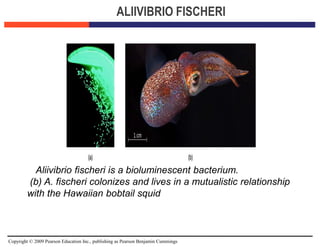
ALIIVIBRIO FISCHERI
a) Aliivibrio fischeri is a bioluminescent bacterium.
(b) A. fischeri colonizes and lives in a mutualistic relationship
with the Hawaiian bobtail squid
Copyright © 2009 Pearson Education Inc., publishing as Pearson Benjamin Cummings
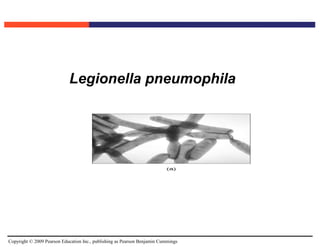
a) Legionella pneumophila
Copyright © 2009 Pearson Education Inc., publishing as Pearson Benjamin Cummings
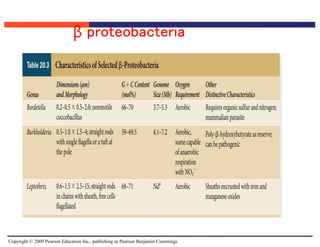
β-
proteobacteria
Copyright © 2009 Pearson Education Inc., publishing as Pearson Benjamin Cummings
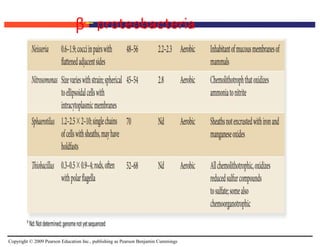
β- proteobacteria
Copyright © 2009 Pearson Education Inc., publishing as Pearson Benjamin Cummings
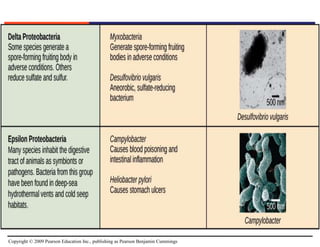
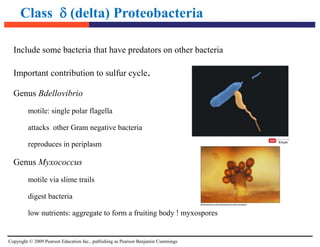
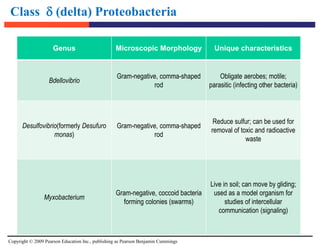
Class  (delta) Proteobacteria
Genus Microscopic Morphology Unique characteristics
Bdellovibrio
Gram-negative, comma-shaped
rod
Obligate aerobes; motile;
parasitic (infecting other bacteria)
Desulfovibrio(formerly Desufuro
monas)
Gram-negative, comma-shaped
rod
Reduce sulfur; can be used for
removal of toxic and radioactive
waste
Myxobacterium
Gram-negative, coccoid bacteria
forming colonies (swarms)
Live in soil; can move by gliding;
used as a model organism for
studies of intercellular
communication (signaling)
Copyright © 2009 Pearson Education Inc., publishing as Pearson Benjamin Cummings
Class  (delta) Proteobacteria
Include some bacteria that have predators on other bacteria
Important contribution to sulfur cycle.
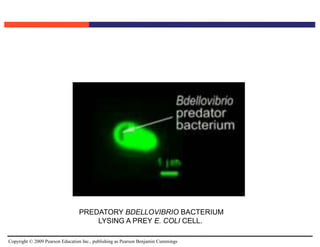
Genus Bdellovibrio
motile: single polar flagella
attacks other Gram negative bacteria
reproduces in periplasm
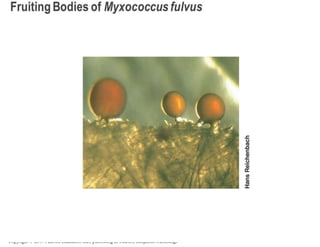
Genus Myxococcus
motile via slime trails
digest bacteria
low nutrients: aggregate to form a fruiting body ! myxospores
Copyright © 2009 Pearson Education Inc., publishing as Pearson Benjamin Cummings
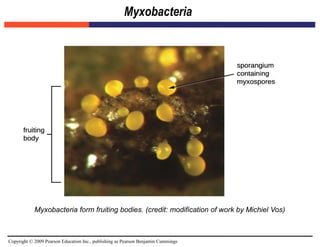
Myxobacteria
Myxobacteria form fruiting bodies. (credit: modification of work by Michiel Vos)
Copyright © 2009 Pearson Education Inc., publishing as Pearson Benjamin Cummings
PREDATORY BDELLOVIBRIO BACTERIUM
LYSING A PREY E. COLI CELL.
Copyright © 2009 Pearson Education Inc., publishing as Pearson Benjamin Cummings
Click to add Text
Copyright © 2009 Pearson Education Inc., publishing as Pearson Benjamin Cummings
Brock Biology of Microorganisms, Twelfth Edition
– Madigan / Martinko / Dunlap / Clark
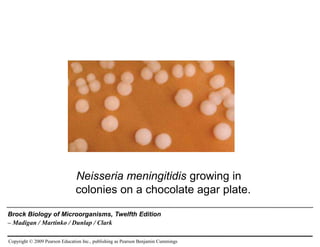
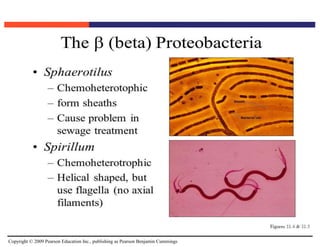
Neisseria meningitidis growing in
colonies on a chocolate agar plate.
Click to add Text
Copyright © 2009 Pearson Education Inc., publishing as Pearson Benjamin Cummings
Brock Biology of Microorganisms, Twelfth Edition
– Madigan / Martinko / Dunlap / Clark
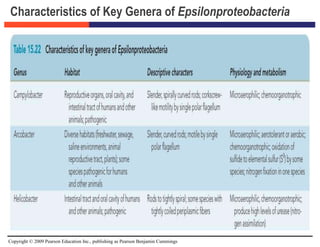
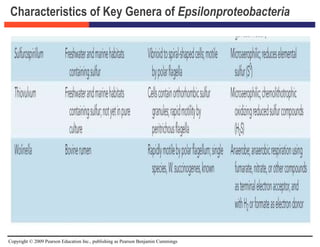
The Epsilonproteobacteria
 Epsilonproteobacteria
 Abundant in oxic–anoxic interfaces in sulfur-rich
environments
 e.g., hydrothermal vents
 Many are autotrophs
 Using H2, formate, sulfide, or thiosulphate as electron
donor
 Pathogenic and non-pathogenic representatives
Copyright © 2009 Pearson Education Inc., publishing as Pearson Benjamin Cummings
Characteristics of Key Genera of Epsilonproteobacteria
Copyright © 2009 Pearson Education Inc., publishing as Pearson Benjamin Cummings
Characteristics of Key Genera of Epsilonproteobacteria
Copyright © 2009 Pearson Education Inc., publishing as Pearson Benjamin Cummings
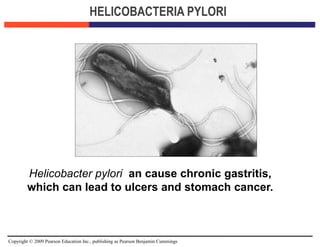
HELICOBACTERIA PYLORI
Helicobacter pylori an cause chronic gastritis,
which can lead to ulcers and stomach cancer.
Copyright © 2009 Pearson Education Inc., publishing as Pearson Benjamin Cummings
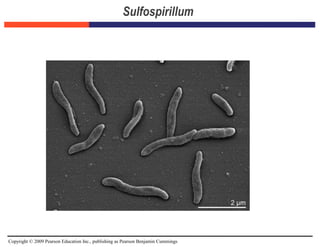
Sulfospirillum
Copyright © 2009 Pearson Education Inc., publishing as Pearson Benjamin Cummings
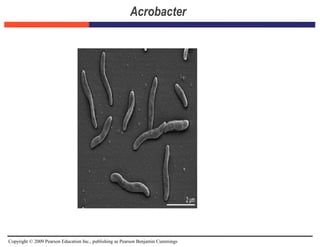
Acrobacter
Copyright © 2009 Pearson Education Inc., publishing as Pearson Benjamin Cummings
Zeta proteobacteria
• The class Zetaproteobacteria is the sixth and most recently
described class of the Proteobacteria. Zetaproteobacteria can also
refer to the group of organisms assigned to this class.
• The Zetaproteobacteria are represented by a single described
species, Mariprofundus ferroxidans , which is an iron oxidizing
neutrophilic chemolithoautotroph originally isolated from Loihi
seamount in 1996 (post-eruption).
Copyright © 2009 Pearson Education Inc., publishing as Pearson Benjamin Cummings
Zeta proteobacteria
• Molecular cloning techniques focusing on the small subunit
ribosomal RNA gene have also been used to identify a more
diverse majority of the Zetaproteobacteria that have as yet been
unculturable.
Copyright © 2009 Pearson Education Inc., publishing as Pearson Benjamin Cummings
GENERAL FEATURES OF
PROTEOBACTERIA:Grouping based on
common phenotype themes and metabolic
themes
Copyright © 2009 Pearson Education Inc., publishing as Pearson Benjamin Cummings
phenotype themes and metabolic themes
I .Phototrophic, Chemolithotrophic & Methanotrophic
Proteobacteria
II. Aerobic & Facultatively Aerobic Chemoorganotrophic
Proteobacteria
III. Morphologically Unusual Proteobacteria
Copyright © 2009 Pearson Education Inc., publishing as Pearson Benjamin Cummings
1. Purple Phototrophic Bacteria
2. The Nitrifying Bacteria
3. Sulfur- and Iron-Oxidizing Bacteria
4. Hydrogen-Oxidizing Bacteria
5. Methanotrophs and Methylotrophs
I Phototrophic, Chemolithotrophic & Methanotrophic
Proteobacteria
Copyright © 2009 Pearson Education Inc., publishing as Pearson Benjamin Cummings
1. Pseudomonads including Pseudomonas
2. Acetic Acid Bacteria
3. Free-Living Aerobic Nitrogen-Fixing Bacteria
4. Neisseria, Chromobacterium, & Relatives
5. Enteric Bacteria
6. Vibrio, Alivibrio, and Photobacterium
7. Rickettsias
II Aerobic & Facultatively Aerobic Chemoorganotrophic
Proteobacteria
Copyright © 2009 Pearson Education Inc., publishing as Pearson Benjamin Cummings
III Morphologically Unusual Proteobacteria
1. Spirilla
2. Sheathed Proteobacteria: Sphaerotilus & Leptothrix
3. Budding and Prosthecate/Stalked Bacteria
Copyright © 2009 Pearson Education Inc., publishing as Pearson Benjamin Cummings
1.Phototrophic,
Chemolithotrophic
& Methanotrophic
Proteobacteria
Copyright © 2009 Pearson Education Inc., publishing as Pearson Benjamin Cummings
1. Purple Phototrophic Bacteria
2. The Nitrifying Bacteria
3. Sulfur- and Iron-Oxidizing Bacteria
4. Hydrogen-Oxidizing Bacteria
5. Methanotrophs and Methylotrophs
I Phototrophic, Chemolithotrophic & Methanotrophic
Proteobacteria
Copyright © 2009 Pearson Education Inc., publishing as Pearson Benjamin Cummings
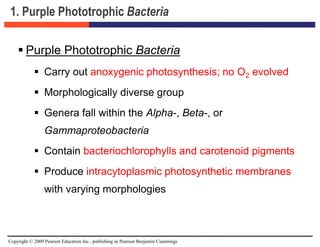
1. Purple Phototrophic Bacteria
 Purple Phototrophic Bacteria
 Carry out anoxygenic photosynthesis; no O2 evolved
 Morphologically diverse group
 Genera fall within the Alpha-, Beta-, or
Gammaproteobacteria
 Contain bacteriochlorophylls and carotenoid pigments
 Produce intracytoplasmic photosynthetic membranes
with varying morphologies
Copyright © 2009 Pearson Education Inc., publishing as Pearson Benjamin Cummings
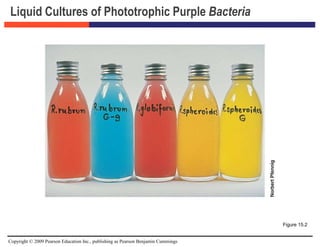
Liquid Cultures of Phototrophic Purple Bacteria
Figure 15.2
Copyright © 2009 Pearson Education Inc., publishing as Pearson Benjamin Cummings
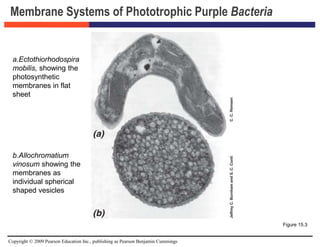
Membrane Systems of Phototrophic Purple Bacteria
Figure 15.3
a.Ectothiorhodospira
mobilis, showing the
photosynthetic
membranes in flat
sheet
b.Allochromatium
vinosum showing the
membranes as
individual spherical
shaped vesicles
Copyright © 2009 Pearson Education Inc., publishing as Pearson Benjamin Cummings
Purple Phototrophic Bacteria
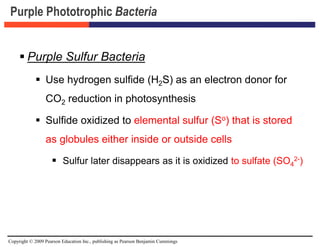
 Purple Sulfur Bacteria
 Use hydrogen sulfide (H2S) as an electron donor for
CO2 reduction in photosynthesis
 Sulfide oxidized to elemental sulfur (So) that is stored
as globules either inside or outside cells
 Sulfur later disappears as it is oxidized to sulfate (SO4
2-)
Copyright © 2009 Pearson Education Inc., publishing as Pearson Benjamin Cummings
Purple Phototrophic Bacteria
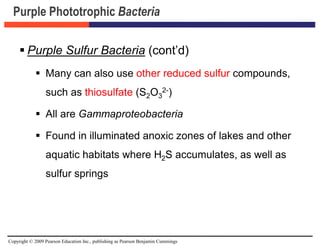
 Purple Sulfur Bacteria (cont’d)
 Many can also use other reduced sulfur compounds,
such as thiosulfate (S2O3
2-)
 All are Gammaproteobacteria
 Found in illuminated anoxic zones of lakes and other
aquatic habitats where H2S accumulates, as well as
sulfur springs
Copyright © 2009 Pearson Education Inc., publishing as Pearson Benjamin Cummings
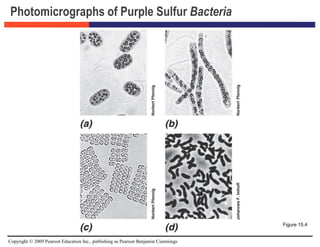
Photomicrographs of Purple Sulfur Bacteria
Figure 15.4
Copyright © 2009 Pearson Education Inc., publishing as Pearson Benjamin Cummings
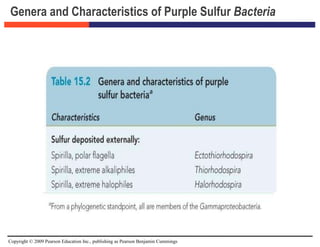
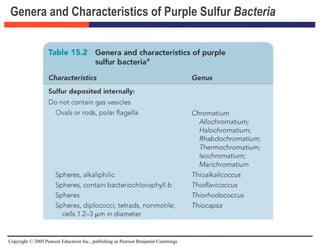
Genera and Characteristics of Purple Sulfur Bacteria
Copyright © 2009 Pearson Education Inc., publishing as Pearson Benjamin Cummings
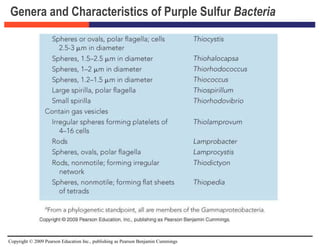
Genera and Characteristics of Purple Sulfur Bacteria
Copyright © 2009 Pearson Education Inc., publishing as Pearson Benjamin Cummings
Genera and Characteristics of Purple Sulfur Bacteria
Copyright © 2009 Pearson Education Inc., publishing as Pearson Benjamin Cummings
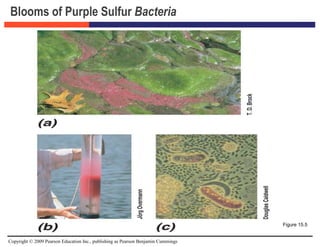
Blooms of Purple Sulfur Bacteria
Figure 15.5
Copyright © 2009 Pearson Education Inc., publishing as Pearson Benjamin Cummings
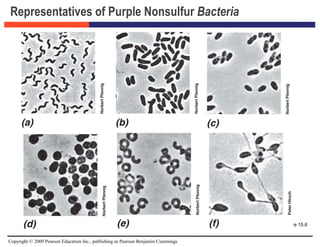
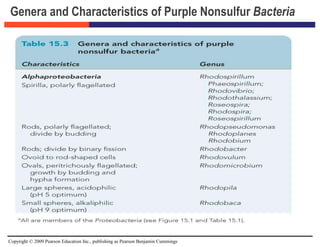
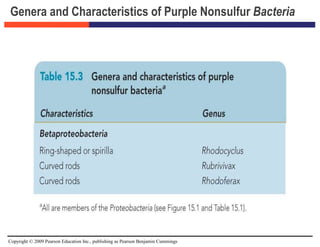
Purple Non-sulfur Bacteria
 Purple Nonsulfur Bacteria
 Originally thought organisms were unable to use sulfide as
an electron donor for CO2 reduction, now know most can
 Most can grow aerobically in the dark as
chemoorganotrophs
 Some can also grow anaerobically in the dark using
fermentative or anaerobic respiration
 Most can grow photoheterotrophically using light as an
energy source and organic compounds as a carbon source
 All in Alpha- and Betaproteobacteria
Copyright © 2009 Pearson Education Inc., publishing as Pearson Benjamin Cummings
Representatives of Purple Nonsulfur Bacteria
Figure 15.6
Copyright © 2009 Pearson Education Inc., publishing as Pearson Benjamin Cummings
Genera and Characteristics of Purple Nonsulfur Bacteria
Copyright © 2009 Pearson Education Inc., publishing as Pearson Benjamin Cummings
Genera and Characteristics of Purple Nonsulfur Bacteria
Copyright © 2009 Pearson Education Inc., publishing as Pearson Benjamin Cummings
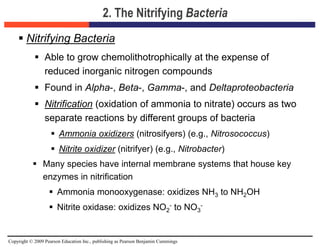
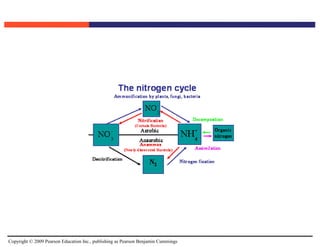
2. The Nitrifying Bacteria
 Nitrifying Bacteria
 Able to grow chemolithotrophically at the expense of
reduced inorganic nitrogen compounds
 Found in Alpha-, Beta-, Gamma-, and Deltaproteobacteria
 Nitrification (oxidation of ammonia to nitrate) occurs as two
separate reactions by different groups of bacteria
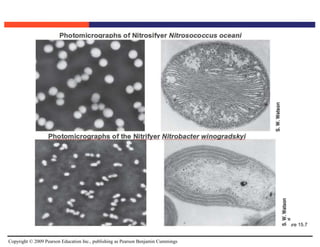
 Ammonia oxidizers (nitrosifyers) (e.g., Nitrosococcus)
 Nitrite oxidizer (nitrifyer) (e.g., Nitrobacter)
 Many species have internal membrane systems that house key
enzymes in nitrification
 Ammonia monooxygenase: oxidizes NH3 to NH2OH
 Nitrite oxidase: oxidizes NO2
- to NO3
-
Copyright © 2009 Pearson Education Inc., publishing as Pearson Benjamin Cummings
 Nitrifying Bacteria (cont’d)
 Widespread in soil and water
 Highest numbers in habitats with large amounts of
ammonia
 i.e., sites with extensive protein decomposition and sewage
treatment facilities
 Most are obligate chemolithotrophs and aerobes
 One exception is annamox organisms, which oxidize ammonia
anaerobically
Copyright © 2009 Pearson Education Inc., publishing as Pearson Benjamin Cummings
Figure 15.7
Copyright © 2009 Pearson Education Inc., publishing as Pearson Benjamin Cummings
3. Sulfur- and Iron-Oxidizing Bacteria
 Sulfur-Oxidizing Bacteria
 Grow chemolithotrophically on reduced sulfur
compounds
 Two broad classes
 Neutrophiles
 Acidophiles (some also use ferrous iron (Fe2+)
 Thiobacillus (rods)
 Sulfur compounds most commonly used as electron
donors are H2S, So, S2O3
2-; generates sulfuric acid
 Achromatium (spherical cells)
Common in freshwater sediments
 Some obligate chemolithotrophs possess special
structures that house Calvin cycle enyzmes
(carboxysomes)
Copyright © 2009 Pearson Education Inc., publishing as Pearson Benjamin Cummings
 Beggiatoa
 Filamentous, gliding bacteria
 Found in habitats rich in H2S
 e.g., sulfur springs, decaying seaweed beds, mud layers
of lakes, sewage polluted waters, and hydrothermal vents
 Most grow mixotrophically
 with reduced sulfur compounds as electron donors
 and organic compounds as carbon sources
 Thioploca
 Large, filamentous sulfur-oxidizing bacteria that form cell
bundles surrounded by a common sheath
 Thick mats found on ocean floor off Chile and Peru
 Couple anoxic oxidation of H2S with reduction of NO3
- to NH4
+
Copyright © 2009 Pearson Education Inc., publishing as Pearson Benjamin Cummings
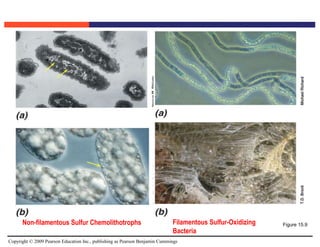
Non-filamentous Sulfur Chemolithotrophs Figure 15.9
Filamentous Sulfur-Oxidizing
Bacteria
Copyright © 2009 Pearson Education Inc., publishing as Pearson Benjamin Cummings
3.Sulfur- and Iron-Oxidizing Bacteria
Sulfur-Oxidizing Bacteria (cont’d)
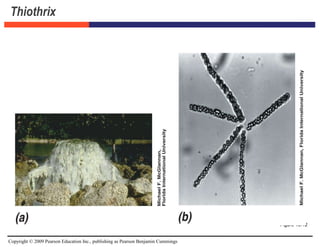
 Thiothrix
 Filamentous sulfur-oxidizing bacteria in
which filaments group together at their
ends by a holdfast to form cellular
arrangements called rosettes
 Obligate aerobic mixotrophs
Copyright © 2009 Pearson Education Inc., publishing as Pearson Benjamin Cummings
Thiothrix
Figure 15.12
Copyright © 2009 Pearson Education Inc., publishing as Pearson Benjamin Cummings
4. Hydrogen-Oxidizing Bacteria
 Hydrogen-Oxidizing Bacteria:
 Most can grow autotrophically with H2 as sole electron
donor and O2 as electron acceptor (“knallgas” reaction)
 Both gram-negative and gram-positive representatives
known
 Contain one or more hydrogenase enzymes that
function to bind H2 and use it to either produce ATP or
for reducing power for autotrophic growth
 Most are facultative chemolithotrophs and can grow
chemoorganotrophically
 Some can grow on carbon monoxide (CO) as electron
donor (carboxydotrophs)
Copyright © 2009 Pearson Education Inc., publishing as Pearson Benjamin Cummings
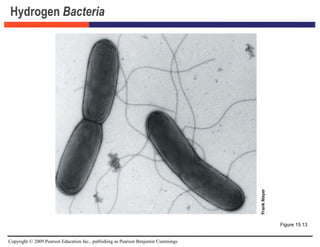
Hydrogen Bacteria
Figure 15.13
Copyright © 2009 Pearson Education Inc., publishing as Pearson Benjamin Cummings
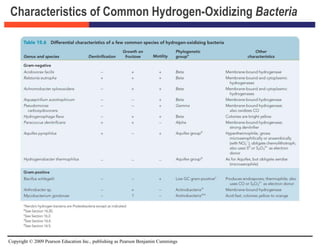
Characteristics of Common Hydrogen-Oxidizing Bacteria
Copyright © 2009 Pearson Education Inc., publishing as Pearson Benjamin Cummings
5. Methanotrophs and Methylotrophs
 Methanotrophs
 Use CH4and a few other one-carbon (C1) compounds
as electron donors and source of carbon
 Widespread in soil and water
 Obligate aerobes
 Morphologically diverse
 Methylotrophs
 Organisms that can grow using carbon compounds
that lack C-C bonds [(CH3)2N (trimethylamine)HCOO-
(formate), CH3OCOO CH3 (Dimethyl carbonate),
(CH3)2SO (dimethyl sulfoxide), CH3OH (methanol),
CH3NH2 (methylamine), CH3)2NH (dimethylamine)]
 Most are also methanotrophs – use CH4
Copyright © 2009 Pearson Education Inc., publishing as Pearson Benjamin Cummings
5. Methanotrophs and Methylotrophs
Methanotrophs (cont'd)
 Methanotrophs methane monooxygenase
 Which incorporates an atom of oxygen from O2 into methane
to produce methanol
 Methanotrophs contain large amounts of sterols
Classification of Methanotrophs
 Two major groups:
 Type I
 Type II
 Contain extensive internal membrane systems for methane
oxidation
Copyright © 2009 Pearson Education Inc., publishing as Pearson Benjamin Cummings
5. Methanotrophs and Methylotrophs
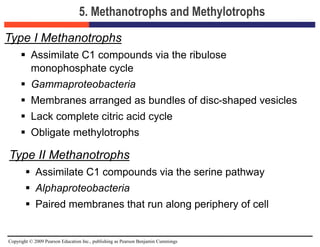
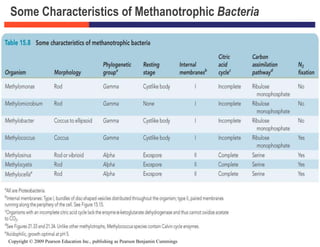
Type I Methanotrophs
 Assimilate C1 compounds via the ribulose
monophosphate cycle
 Gammaproteobacteria
 Membranes arranged as bundles of disc-shaped vesicles
 Lack complete citric acid cycle
 Obligate methylotrophs
Type II Methanotrophs
 Assimilate C1 compounds via the serine pathway
 Alphaproteobacteria
 Paired membranes that run along periphery of cell
Copyright © 2009 Pearson Education Inc., publishing as Pearson Benjamin Cummings
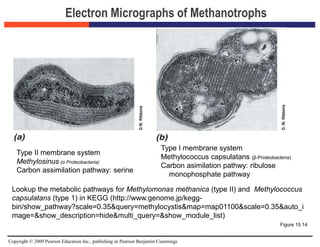
Electron Micrographs of Methanotrophs
Figure 15.14
Type II membrane system
Methylosinus (α Proteobacteria)
Carbon assimilation pathway: serine
Type I membrane system
Methylococcus capsulatans (β-Proteobacteria)
Carbon asimilation pathwy: ribulose
monophosphate pathway
Lookup the metabolic pathways for Methylomonas methanica (type II) and Methylococcus
capsulatans (type 1) in KEGG (http://www.genome.jp/kegg-
bin/show_pathway?scale=0.35&query=methylocystis&map=map01100&scale=0.35&auto_i
mage=&show_description=hide&multi_query=&show_module_list)
Copyright © 2009 Pearson Education Inc., publishing as Pearson Benjamin Cummings
Some Characteristics of Methanotrophic Bacteria
Copyright © 2009 Pearson Education Inc., publishing as Pearson Benjamin Cummings
5. Methanotrophs and Methylotrophs
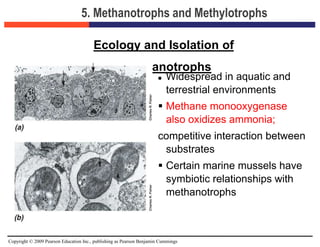
 Widespread in aquatic and
terrestrial environments
 Methane monooxygenase
also oxidizes ammonia;
competitive interaction between
substrates
 Certain marine mussels have
symbiotic relationships with
methanotrophs
Ecology and Isolation of
Methanotrophs
Copyright © 2009 Pearson Education Inc., publishing as Pearson Benjamin Cummings
1. Pseudomonads including Pseudomonas
2. Acetic Acid Bacteria
3. Free-Living Aerobic Nitrogen-Fixing Bacteria
4. Neisseria, Chromobacterium, & Relatives
5. Enteric Bacteria
6. Vibrio, Alivibrio, and Photobacterium
7. Rickettsias
II Aerobic & Facultatively Aerobic Chemoorganotrophic
Proteobacteria
Copyright © 2009 Pearson Education Inc., publishing as Pearson Benjamin Cummings
• .
• Pseudomonads including Pseudomonas
Copyright © 2009 Pearson Education Inc., publishing as Pearson Benjamin Cummings
1. Pseudomonads including Pseudomonas
 Members of the genus Pseudomonas and related
genera can be defined on the basis of phylogeny and
physiological characteristics
 Nutritionally versatile
 Ecologically important organisms in water and
soil
 Some species are pathogenic
 Includes human opportunistic pathogens
and plant pathogens
Copyright © 2009 Pearson Education Inc., publishing as Pearson Benjamin Cummings
1. Pseudomonads including Pseudomonas
 Key Genera:
 Pseudomonas
 Burkholderia
 Zymomonas
 Xanthomonas
 All genera are:
 Straight or curved rods with polar flagella
 Stain gram negative Chemoorganotrophs
 Obligate aerobes
 Posses polar flagella
 Phylogenetically, the group is scattered within the
Proteobacteria
Copyright © 2009 Pearson Education Inc., publishing as Pearson Benjamin Cummings
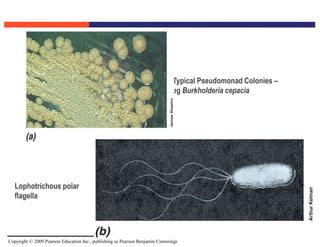
Typical Pseudomonad Colonies –
eg Burkholderia cepacia
Figure 15.16a
Lophotrichous polar
flagella
Copyright © 2009 Pearson Education Inc., publishing as Pearson Benjamin Cummings
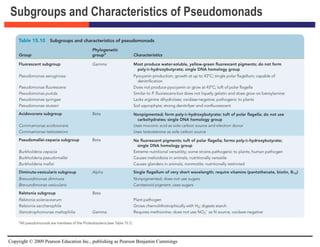
Subgroups and Characteristics of Pseudomonads
Copyright © 2009 Pearson Education Inc., publishing as Pearson Benjamin Cummings
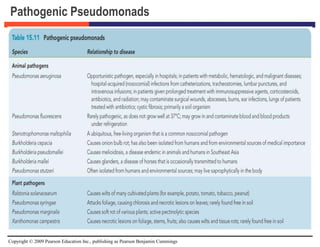
Pathogenic Pseudomonads
Copyright © 2009 Pearson Education Inc., publishing as Pearson Benjamin Cummings
Genus Zymomonas
 Genus of large, gram-negative rods that
carry out vigorous fermentation of
sugars to ethanol
 Used in production of fermented
beverages
Copyright © 2009 Pearson Education Inc., publishing as Pearson Benjamin Cummings
• 2. Acetic Acid Bacteria
Copyright © 2009 Pearson Education Inc., publishing as Pearson Benjamin Cummings
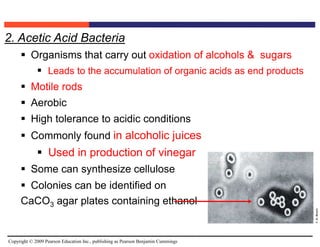
2. Acetic Acid Bacteria
 Organisms that carry out oxidation of alcohols & sugars
 Leads to the accumulation of organic acids as end products
 Motile rods
 Aerobic
 High tolerance to acidic conditions
 Commonly found in alcoholic juices
 Used in production of vinegar
 Some can synthesize cellulose
 Colonies can be identified on
CaCO3 agar plates containing ethanol
Copyright © 2009 Pearson Education Inc., publishing as Pearson Benjamin Cummings
• 3. Free-Living Aerobic Nitrogen-Fixing Bacteria
Copyright © 2009 Pearson Education Inc., publishing as Pearson Benjamin Cummings
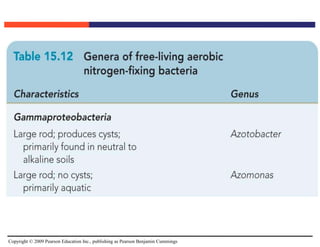
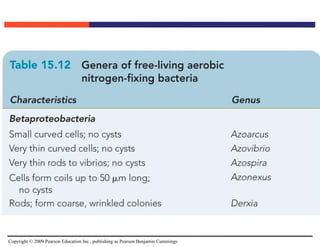
 A variety of soil microbes are capable of fixing N2
aerobically
 Distributed in alpha, beta and gamma Proteobacteria
3. Free-Living Aerobic Nitrogen-Fixing Bacteria
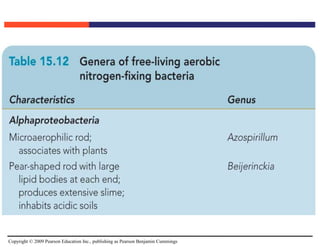
 The major genera of bacteria capable of fixing N2
nonsymbiotically are Azotobacter, Azospirillium, and
Beijerinckia
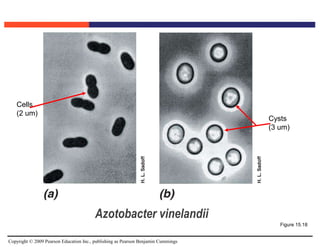
 Azotobacter are large, obligately aerobic rods; can form
resting structures (cysts)
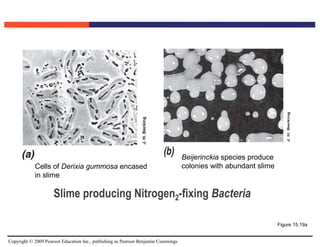
 All genera produce extensive capsules or slime layers;
believed to be important in protecting nitrogenase from
O2 (nitrogenase is oxygen-sensitive)
Copyright © 2009 Pearson Education Inc., publishing as Pearson Benjamin Cummings
Azotobacter vinelandii
Figure 15.18
Cysts
(3 um)
Cells
(2 um)
Copyright © 2009 Pearson Education Inc., publishing as Pearson Benjamin Cummings
Figure 15.19a
Slime producing Nitrogen2-fixing Bacteria
Cells of Derixia gummosa encased
in slime
Beijerinckia species produce
colonies with abundant slime
Copyright © 2009 Pearson Education Inc., publishing as Pearson Benjamin Cummings
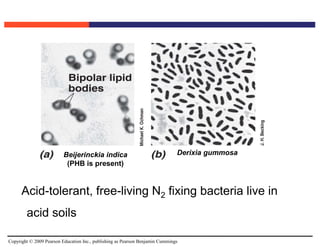
Acid-tolerant, free-living N2 fixing bacteria live in
acid soils
Derixia gummosa
Beijerinckia indica
(PHB is present)
Copyright © 2009 Pearson Education Inc., publishing as Pearson Benjamin Cummings
• 4.Neisseria, Chromobacterium, and their relatives
Copyright © 2009 Pearson Education Inc., publishing as Pearson Benjamin Cummings
4. Neisseria, Chromobacterium, and Relatives
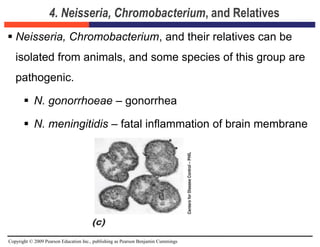
 Neisseria, Chromobacterium, and their relatives can be
isolated from animals, and some species of this group are
pathogenic.
 N. gonorrhoeae – gonorrhea
 N. meningitidis – fatal inflammation of brain membrane
Copyright © 2009 Pearson Education Inc., publishing as Pearson Benjamin Cummings
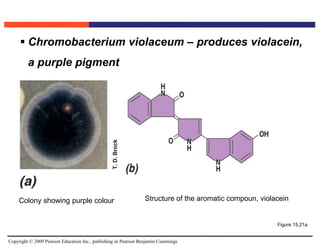
Figure 15.21a
 Chromobacterium violaceum – produces violacein,
a purple pigment
Colony showing purple colour Structure of the aromatic compoun, violacein
Copyright © 2009 Pearson Education Inc., publishing as Pearson Benjamin Cummings
•
• 5. Enteric Bacteria (Fam. Enterobacteriaceae)
Copyright © 2009 Pearson Education Inc., publishing as Pearson Benjamin Cummings
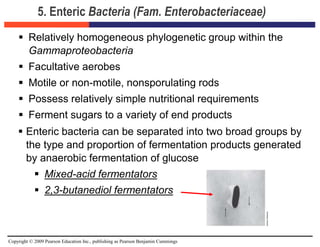
5. Enteric Bacteria (Fam. Enterobacteriaceae)
 Relatively homogeneous phylogenetic group within the
Gammaproteobacteria
 Facultative aerobes
 Motile or non-motile, nonsporulating rods
 Possess relatively simple nutritional requirements
 Ferment sugars to a variety of end products
 Enteric bacteria can be separated into two broad groups by
the type and proportion of fermentation products generated
by anaerobic fermentation of glucose
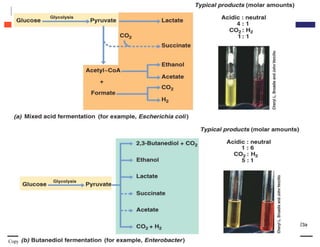
 Mixed-acid fermentators
 2,3-butanediol fermentators
Copyright © 2009 Pearson Education Inc., publishing as Pearson Benjamin Cummings
Enteric Fermentations
Figure 15.23a
Copyright © 2009 Pearson Education Inc., publishing as Pearson Benjamin Cummings
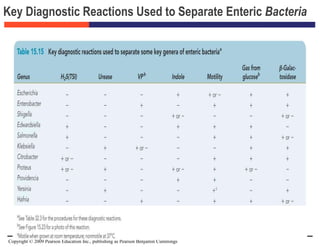
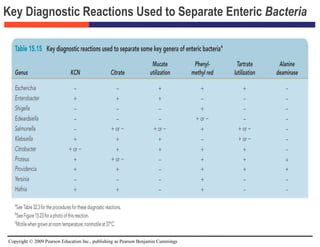
 Diagnostic tests and differential media are often
used to identify various genera of enteric bacteria
Copyright © 2009 Pearson Education Inc., publishing as Pearson Benjamin Cummings
Key Diagnostic Reactions Used to Separate Enteric Bacteria
Copyright © 2009 Pearson Education Inc., publishing as Pearson Benjamin Cummings
Key Diagnostic Reactions Used to Separate Enteric Bacteria
Copyright © 2009 Pearson Education Inc., publishing as Pearson Benjamin Cummings
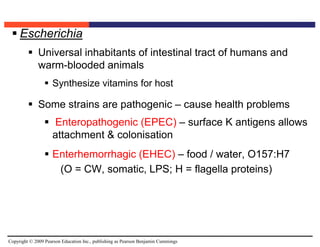
 Escherichia
 Universal inhabitants of intestinal tract of humans and
warm-blooded animals
 Synthesize vitamins for host
 Some strains are pathogenic – cause health problems
 Enteropathogenic (EPEC) – surface K antigens allows
attachment & colonisation
 Enterhemorrhagic (EHEC) – food / water, O157:H7
(O = CW, somatic, LPS; H = flagella proteins)
Copyright © 2009 Pearson Education Inc., publishing as Pearson Benjamin Cummings
 Salmonella and Shigella
 Closely related to Escherichia (DDH > 50 & 70%
respectively)
 Usually pathogenic
 S. typhi - typhoid
 Salmonella is characterized immunologically by 3
surface antigens: (used for tracking epidemics)
 O antigens
 H antigens
 Vi antigens, outer polysaccharide layer; typing S.
typhi
Copyright © 2009 Pearson Education Inc., publishing as Pearson Benjamin Cummings
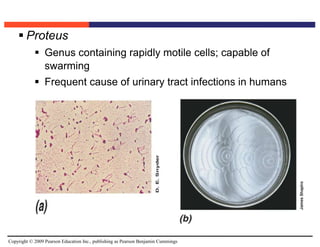
 Proteus
 Genus containing rapidly motile cells; capable of
swarming
 Frequent cause of urinary tract infections in humans
Copyright © 2009 Pearson Education Inc., publishing as Pearson Benjamin Cummings
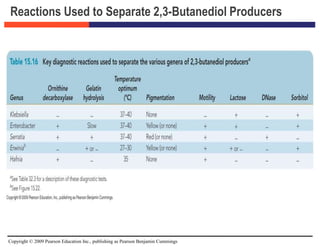
 Butanediol fermentators – Enterobacter, Klebsiella &
Serratia are a closely related group of organisms
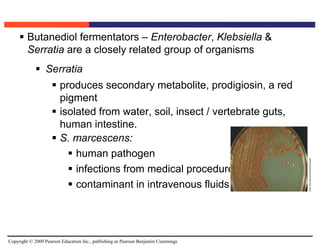
 Serratia
 produces secondary metabolite, prodigiosin, a red
pigment
 isolated from water, soil, insect / vertebrate guts,
human intestine.
 S. marcescens:
 human pathogen
 infections from medical procedures
 contaminant in intravenous fluids
Copyright © 2009 Pearson Education Inc., publishing as Pearson Benjamin Cummings
Reactions Used to Separate 2,3-Butanediol Producers
Copyright © 2009 Pearson Education Inc., publishing as Pearson Benjamin Cummings
•
•
• 6. Vibrio, Alivibrio, and Photobacterium
Copyright © 2009 Pearson Education Inc., publishing as Pearson Benjamin Cummings
6. Vibrio, Alivibrio, and Photobacterium
 The Vibrio Group
 Cells are motile, straight or curved rods
 Facultative aerobes
 Possess a fermentative metabolism
 Best known genera are Vibrio, Alivibrio & Photobacterium
 Most inhabit aquatic environments
 Some are pathogenic
 Some are capable of light production (bioluminescence)
 Catalyzed by luciferase, an O2-dependent enzyme
 Regulation is mediated by population density (quorum
sensing)
Copyright © 2009 Pearson Education Inc., publishing as Pearson Benjamin Cummings
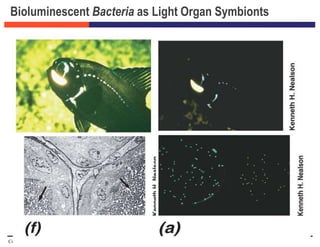
 Bacterial Bioluminescence
 Light emission
 Most are marine isolates (Vibrio, Alivibrio, Photobacterium)
but some terrestrial
 May colonise specialized light organs of some maring fish
& squids or on dead skin of crustacean / fish
 V. cholera & V. vulnificus are pathogens; care when
handling luminous bacteria
 Bioluminescence only when oxygen is present
 LuxCDABE gene products, luciferase, oxygen and a
population density response (acyl homoserine [AHL],
quorum sensing) is required
Copyright © 2009 Pearson Education Inc., publishing as Pearson Benjamin Cummings
Bioluminescent Bacteria as Light Organ Symbionts
Figure 15.27c
Copyright © 2009 Pearson Education Inc., publishing as Pearson Benjamin Cummings
7.Rickettsias
Copyright © 2009 Pearson Education Inc., publishing as Pearson Benjamin Cummings
7. Rickettsias
 Rickettsias
 Small, coccoid or rod-shaped cells
 Mostly obligate intracellular parasites; small genome
size
 Cannot grow outside a host cell; do not survive long
outside the host
 Causative agent of several human diseases
 Typical procaryotic cell structure
Copyright © 2009 Pearson Education Inc., publishing as Pearson Benjamin Cummings
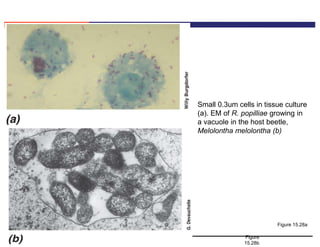
Figure 15.28a
Figure
15.28b
Small 0.3um cells in tissue culture
(a). EM of R. popilliae growing in
a vacuole in the host beetle,
Melolontha melolontha (b)
Copyright © 2009 Pearson Education Inc., publishing as Pearson Benjamin Cummings
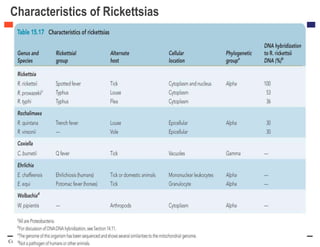
Characteristics of Rickettsias
Copyright © 2009 Pearson Education Inc., publishing as Pearson Benjamin Cummings
 Wolbachia
 Genus of rod-shaped Alphaproteobacteria
 Intracellular parasites of arthropod insects
 Affect the reproductive fitness of hosts
Copyright © 2009 Pearson Education Inc., publishing as Pearson Benjamin Cummings
• III Morphologically Unusual Proteobacteria
Copyright © 2009 Pearson Education Inc., publishing as Pearson Benjamin Cummings
III Morphologically Unusual Proteobacteria
1. Spirilla
2. Sheathed Proteobacteria: Sphaerotilus & Leptothrix
3. Budding and Prosthecate/Stalked Bacteria
Copyright © 2009 Pearson Education Inc., publishing as Pearson Benjamin Cummings
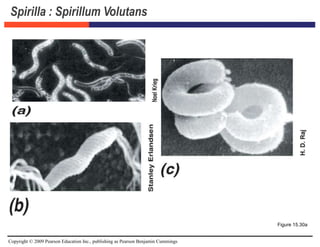
1. Spirilla
 Group of motile, spiral-shaped Proteobacteria:
 Spirillum & relatives
 Magentospirillum
 Bdellovibrio
 Key taxonomic features include
 Cell shape and size
 Number of polar flagella
 Metabolism
 Physiology
 Ecology
Copyright © 2009 Pearson Education Inc., publishing as Pearson Benjamin Cummings
Spirilla : Spirillum Volutans
Figure 15.30a
Copyright © 2009 Pearson Education Inc., publishing as Pearson Benjamin Cummings
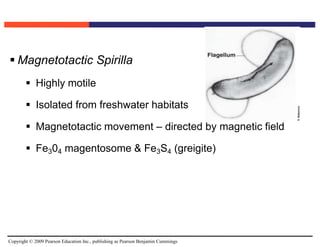
 Magnetotactic Spirilla
 Highly motile
 Isolated from freshwater habitats
 Magnetotactic movement – directed by magnetic field
 Fe304 magentosome & Fe3S4 (greigite)
Copyright © 2009 Pearson Education Inc., publishing as Pearson Benjamin Cummings
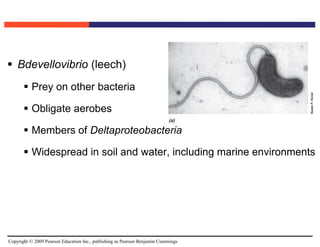
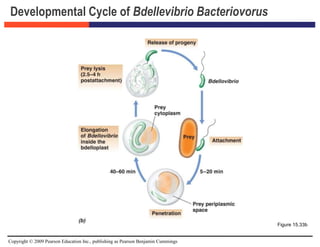
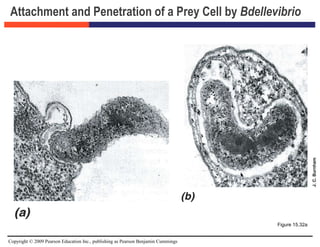
 Bdevellovibrio (leech)
 Prey on other bacteria
 Obligate aerobes
 Members of Deltaproteobacteria
 Widespread in soil and water, including marine environments
Copyright © 2009 Pearson Education Inc., publishing as Pearson Benjamin Cummings
Developmental Cycle of Bdellevibrio Bacteriovorus
Figure 15.33b
Copyright © 2009 Pearson Education Inc., publishing as Pearson Benjamin Cummings
Attachment and Penetration of a Prey Cell by Bdellevibrio
Figure 15.32a
Copyright © 2009 Pearson Education Inc., publishing as Pearson Benjamin Cummings
2. Sheathed Proteobacteria: Sphaerotilus & Leptothrix
 Sheathed Bacteria
 Filamentous Betaproteobacteria
 Unique life cycle in which flagellated swarmer cells
form within a long tube or sheath
 Under unfavorable conditions, swarmer cells move out
to explore new environments
 Common in freshwater habitats rich in organic matter
Copyright © 2009 Pearson Education Inc., publishing as Pearson Benjamin Cummings
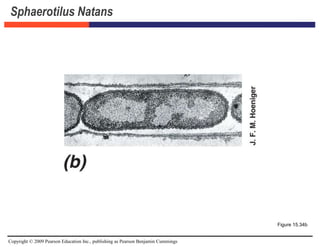
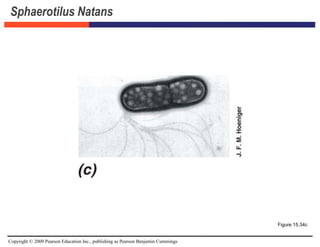
Sheathed Proteobacteria: Sphaerotilus & Leptothrix
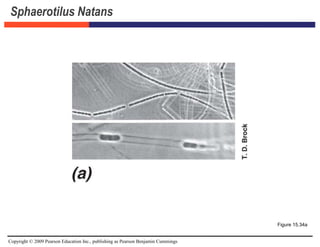
 Sphaerotilus
 Nutritionally versatile
 Able to use simple organic compounds
 Obligate aerobes
 Cells within the sheath divide by binary fission
 Eventually swarmer cells are liberated from sheaths
Copyright © 2009 Pearson Education Inc., publishing as Pearson Benjamin Cummings
Sphaerotilus Natans
Figure 15.34a
Copyright © 2009 Pearson Education Inc., publishing as Pearson Benjamin Cummings
Sphaerotilus Natans
Figure 15.34b
Copyright © 2009 Pearson Education Inc., publishing as Pearson Benjamin Cummings
Sphaerotilus Natans
Figure 15.34c
Copyright © 2009 Pearson Education Inc., publishing as Pearson Benjamin Cummings
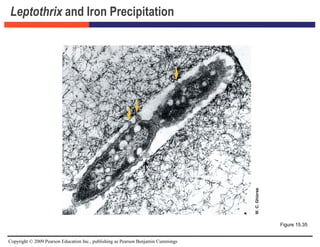
Sheathed Proteobacteria: Sphaerotilus & Leptothrix
 Sphaerotilus and Leptothrix are able to precipitate
iron oxides
Copyright © 2009 Pearson Education Inc., publishing as Pearson Benjamin Cummings
Leptothrix and Iron Precipitation
Figure 15.35
Copyright © 2009 Pearson Education Inc., publishing as Pearson Benjamin Cummings
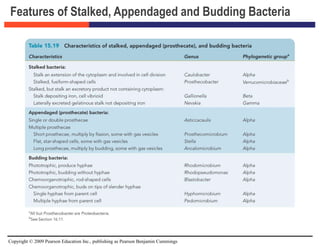
Budding and Prosthecate/Stalked Bacteria
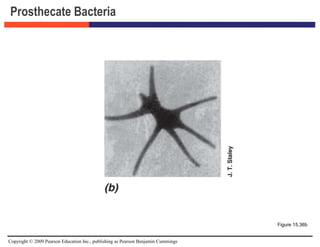
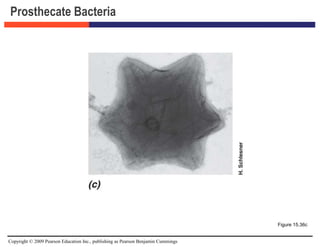
3. Budding and Prosthecate/Stalked Bacteria
 Large and heterogeneous group
 Primarily Alphaproteobacteria
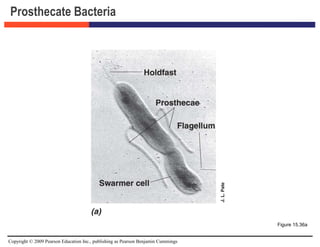
 Form various kinds of cytoplasmic extrusions bounded
by a cell wall (collectively called prosthecae)
Copyright © 2009 Pearson Education Inc., publishing as Pearson Benjamin Cummings
Budding and Prosthecate/Stalked Bacteria
 Prosthecate and Stalked Bacteria
 Appendaged bacteria that attach to particulate matter,
plant material, and other microbes in aquatic
environments
 Appendages increase surface-to-volume ratio of the
cells
Copyright © 2009 Pearson Education Inc., publishing as Pearson Benjamin Cummings
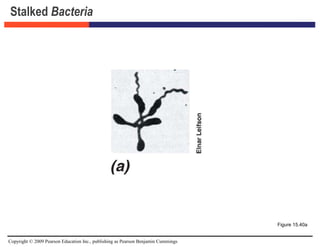
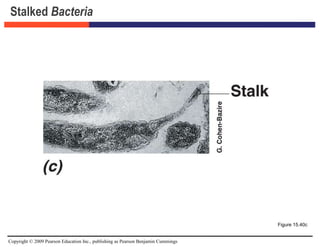
Stalked Bacteria
Figure 15.40a
Copyright © 2009 Pearson Education Inc., publishing as Pearson Benjamin Cummings
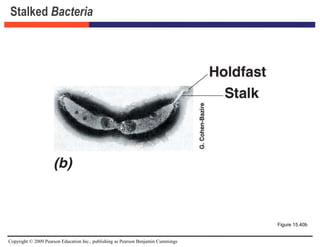
Stalked Bacteria
Figure 15.40b
Copyright © 2009 Pearson Education Inc., publishing as Pearson Benjamin Cummings
Stalked Bacteria
Figure 15.40c
Copyright © 2009 Pearson Education Inc., publishing as Pearson Benjamin Cummings
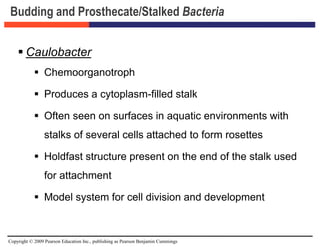
Budding and Prosthecate/Stalked Bacteria
 Caulobacter
 Chemoorganotroph
 Produces a cytoplasm-filled stalk
 Often seen on surfaces in aquatic environments with
stalks of several cells attached to form rosettes
 Holdfast structure present on the end of the stalk used
for attachment
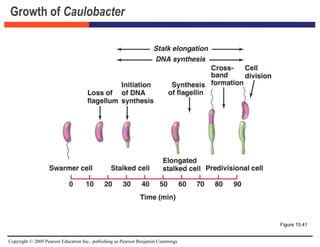
 Model system for cell division and development
Copyright © 2009 Pearson Education Inc., publishing as Pearson Benjamin Cummings
Growth of Caulobacter
Figure 15.41
Copyright © 2009 Pearson Education Inc., publishing as Pearson Benjamin Cummings
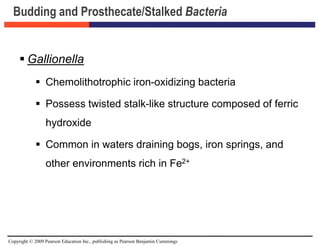
Budding and Prosthecate/Stalked Bacteria
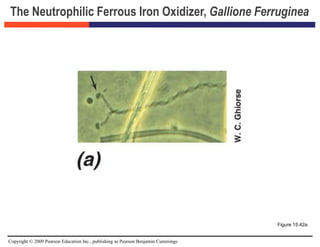
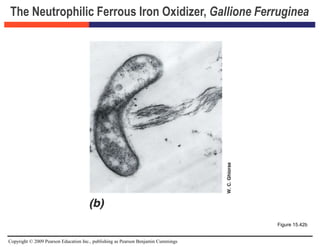
 Gallionella
 Chemolithotrophic iron-oxidizing bacteria
 Possess twisted stalk-like structure composed of ferric
hydroxide
 Common in waters draining bogs, iron springs, and
other environments rich in Fe2+
Copyright © 2009 Pearson Education Inc., publishing as Pearson Benjamin Cummings
The Neutrophilic Ferrous Iron Oxidizer, Gallione Ferruginea
Figure 15.42a
Copyright © 2009 Pearson Education Inc., publishing as Pearson Benjamin Cummings
The Neutrophilic Ferrous Iron Oxidizer, Gallione Ferruginea
Figure 15.42b
Copyright © 2009 Pearson Education Inc., publishing as Pearson Benjamin Cummings
Features of Stalked, Appendaged and Budding Bacteria
Copyright © 2009 Pearson Education Inc., publishing as Pearson Benjamin Cummings
Prosthecate Bacteria
Figure 15.36a
Copyright © 2009 Pearson Education Inc., publishing as Pearson Benjamin Cummings
Prosthecate Bacteria
Figure 15.36b
Copyright © 2009 Pearson Education Inc., publishing as Pearson Benjamin Cummings
Prosthecate Bacteria
Figure 15.36c
Copyright © 2009 Pearson Education Inc., publishing as Pearson Benjamin Cummings
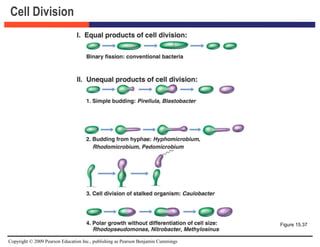
Cell Division
Figure 15.37
Copyright © 2009 Pearson Education Inc., publishing as Pearson Benjamin Cummings
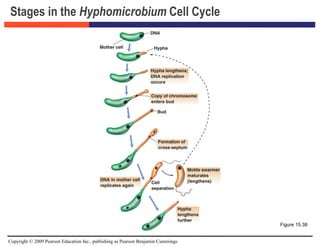
Budding and Prosthecate/Stalked Bacteria
 Budding Bacteria
 Divide as a result of unequal cell growth
 Two well-studied genera
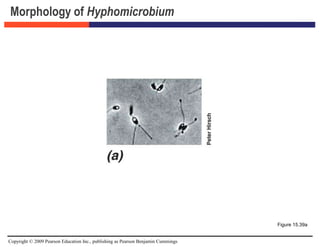
 Hyphomicrobium (chemoorganotrophic)
 Rhodomicrobium (phototrophic)
Copyright © 2009 Pearson Education Inc., publishing as Pearson Benjamin Cummings
Stages in the Hyphomicrobium Cell Cycle
Figure 15.38
Copyright © 2009 Pearson Education Inc., publishing as Pearson Benjamin Cummings
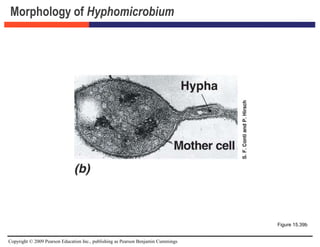
Morphology of Hyphomicrobium
Figure 15.39a
Copyright © 2009 Pearson Education Inc., publishing as Pearson Benjamin Cummings
Morphology of Hyphomicrobium
Figure 15.39b

Edited_Proteobacteria_powerpoint - Copy.ppt

  • 1.
    Copyright © 2009Pearson Education Inc., publishing as Pearson Benjamin Cummings PROTEOBACTERIA By Rikta Vekaria
  • 2.
    Copyright © 2009Pearson Education Inc., publishing as Pearson Benjamin Cummings The Phylogeny of Bacteria I. Phylum Proteobacteria •Carl Woese proposed this group in 1987 •“Purple bacteria” and their relatives •Due to red purple pigment •With Various Shapes (spherical, rod-like,ringed, spiral, filamentous or curved) •Gram-negative
  • 3.
    Copyright © 2009Pearson Education Inc., publishing as Pearson Benjamin Cummings The Phylogeny of Bacteria – Major phyla of domain Bacteria Phylogenetic Overview of Bacteria
  • 4.
    Copyright © 2009Pearson Education Inc., publishing as Pearson Benjamin Cummings PHYLOGENIC TREE OF PROTEOBACTERIA
  • 5.
    Copyright © 2009Pearson Education Inc., publishing as Pearson Benjamin Cummings Phylum Proteobacteria  A major lineage (phyla) of Bacteria  Includes many of the most commonly encountered bacteria  Most metabolically diverse of all domain Bacteria  E.g., chemolithotrophy, chemoorganotrophy, phototrophy  Morphologically diverse  Divided into five classes  Alpha-, Beta-, Delta-, Gamma-, Epsilon-
  • 6.
    Copyright © 2009Pearson Education Inc., publishing as Pearson Benjamin Cummings Major Genera of Proteobacteria
  • 7.
    Copyright © 2009Pearson Education Inc., publishing as Pearson Benjamin Cummings Major Genera of Proteobacteria
  • 8.
    Copyright © 2009Pearson Education Inc., publishing as Pearson Benjamin Cummings
  • 9.
    Copyright © 2009Pearson Education Inc., publishing as Pearson Benjamin Cummings
  • 10.
    Copyright © 2009Pearson Education Inc., publishing as Pearson Benjamin Cummings
  • 11.
    Copyright © 2009Pearson Education Inc., publishing as Pearson Benjamin Cummings
  • 12.
    Copyright © 2009Pearson Education Inc., publishing as Pearson Benjamin Cummings DISTRIBUTION OF PROTEOBACTERIA
  • 13.
    Copyright © 2009Pearson Education Inc., publishing as Pearson Benjamin Cummings S.N CLASS GENUS DISTRIBUTION 1. ALPHA PROTEOBACTERIA Rickettsia and Coxiella PARASITIC OR MUTALSITIC : Parasitic :Vertebrate erythrocytes,macrophages and vascular endothelial cells Invertebrates : Live in arthropods Cauloobacter and Hyphomicrobium Hyphomicrobium: Attach to solid objects in freshwater, marine and terrestrial environments Caulobacter: Freshwater and marine habitats with low nutrient levels Agrobacterium Invade the crown ,roots and stems of plants Rhizobacterium Root nodules
  • 14.
    Copyright © 2009Pearson Education Inc., publishing as Pearson Benjamin Cummings S.N CLASS GENUS DISTRIBUTION 1. ALPHA PROTEOBACTE RIA Nitrifying bacteria: Nitrosomonas Nitrosopira Soil, freshwater and marine habitat
  • 15.
    Copyright © 2009Pearson Education Inc., publishing as Pearson Benjamin Cummings S.N CLASS order DISTRIBUTION 2. Beta PROTEOBACTE RIA Neisseriales Inhabitants of mucous membranes of mammals Burkholderiales Burkholderia: Organic molecules Sphaerotilus : slowly running freshwater with sewage or industrial waste Leptothrix :High concentration of soluble iron compounds
  • 16.
    Copyright © 2009Pearson Education Inc., publishing as Pearson Benjamin Cummings S.N CLASS order DISTRIBUTION 2. Beta PROTEOBACTE RIA Nitrosomonadales Root nodules Hydrogenophilales Thiobacillus:Soil, aquatic habitat ,both freshwater and marine
  • 17.
    Copyright © 2009Pearson Education Inc., publishing as Pearson Benjamin Cummings S.N CLASS order DISTRIBUTION 3. GAMMA PROTEOBACTE RIA Purple sulphur bacteria: Thiotrichales Grows in sulfide rich habitats such as sulfur springs,freshwater with decaying plant material Pseudomonadales Organic molecules ,Major animal and plant pathogens, involved in spoilage of refrigerated milk, meat, egg, and seafood
  • 18.
    Copyright © 2009Pearson Education Inc., publishing as Pearson Benjamin Cummings S.N CLASS order DISTRIBUTION 3. GAMMA PROTEOBACTE RIA Vibrionales Aquatic microgorganisms,widespread in freshwater and sea Enterobacteriales Inhabitant of colon of humans and other warm blooded animals,Some are pathogens of crop plants Pasteurellales Disease causing in humans and animals 4. DELTA PROTEOBACTE RIA Desulfovibrionales, Desulfobacterales, Desulfomonadales Aquatic and terrestrial habitats
  • 19.
    Copyright © 2009Pearson Education Inc., publishing as Pearson Benjamin Cummings CHARACTERISTICS OF PROTEOBACTERIA
  • 20.
    Copyright © 2009Pearson Education Inc., publishing as Pearson Benjamin Cummings The characteristics of important genera of Gammaproteobacteria.
  • 21.
    Copyright © 2009Pearson Education Inc., publishing as Pearson Benjamin Cummings example Genus Microscopic Morphology Unique Characteristics Beggiatoa Gram-negative bacteria; disc- shaped or cylindrical Aquatic, live in water with high content of hydrogen disulfide; can cause problems for sewage treatment Enterobacter Gram-negative bacillus Facultative anaerobe; cause urinary and respiratory tract infections in hospitalized patients; implicated in the pathogenesis of obesity Erwinia Gram-negative bacillus Plant pathogen causing leaf spots and discoloration; may digest cellulose; prefer relatively low temperatures (25–30 °C) Escherichia Gram-negative bacillus Facultative anaerobe; inhabit the gastrointestinal tract of warm-blooded animals; some strains are mutualists, producing vitamin K; others, like serotype E. coli O157:H7, are pathogens; E. coli has been a model organism for many studies in genetics and molecular biology
  • 22.
    Copyright © 2009Pearson Education Inc., publishing as Pearson Benjamin Cummings Example Genus Microscopic Morphology Unique Characteristics Klebsiella Gram-negative bacillus; appears rounder and thicker than other members of Enterobacteriaceae Facultative anaerobe, encapsulated, nonmotile; pathogenic species may cause pneumonia, especially in people with alcoholism Legionella Gram-negative bacillus Fastidious, grow on charcoal-buffered yeast extract; L. pneumophila causes Legionnaires disease Hemophilus Gram-negative bacillus Pleomorphic, may appear as coccobacillus, aerobe, or facultative anaerobe; grow on blood agar; pathogenic species can cause respiratory infections, chancroid, and other diseases
  • 23.
    Copyright © 2009Pearson Education Inc., publishing as Pearson Benjamin Cummings Example Genus Microscopic Morphology Unique Characteristics Proteus Gram-negative bacillus (pleomorphic) Common inhabitants of the human gastrointestinal tract; motile; produce urease; opportunistic pathogens; may cause urinary tract infections and sepsis Pseudomonas Gram-negative bacillus Aerobic; versatile; produce yellow and blue pigments, making them appear green in culture; opportunistic, antibiotic-resistant pathogens may cause wound infections, hospital-acquired infections, and secondary infections in patients with cystic fibrosis Serratia Gram-negative bacillus Motile; may produce red pigment; opportunistic pathogens responsible for a large number of hospital-acquired infections
  • 24.
    Copyright © 2009Pearson Education Inc., publishing as Pearson Benjamin Cummings Example Genus Microscopic Morphology Unique Characteristics Vibrio Gram-negative, comma- or curved rod- shaped bacteria Inhabit seawater; flagellated, motile; may produce toxin that causes hypersecretion of water and electrolytes in the gastrointestinal tract; some species may cause serious wound infections Yersinia Gram-negative bacillus Carried by rodents; human pathogens; Y. pestis causes bubonic plague and pneumonic plague; Y. enterocolitica can be a pathogen causing
  • 25.
    Copyright © 2009Pearson Education Inc., publishing as Pearson Benjamin Cummings
  • 26.
    Copyright © 2009Pearson Education Inc., publishing as Pearson Benjamin Cummings The characteristics of important genera of Alpha proteobacteria.
  • 27.
    Copyright © 2009Pearson Education Inc., publishing as Pearson Benjamin Cummings
  • 28.
    Copyright © 2009Pearson Education Inc., publishing as Pearson Benjamin Cummings
  • 29.
    Copyright © 2009Pearson Education Inc., publishing as Pearson Benjamin Cummings
  • 30.
    Copyright © 2009Pearson Education Inc., publishing as Pearson Benjamin Cummings AGROBACTERIUM INDUCED TUMORS
  • 31.
    Copyright © 2009Pearson Education Inc., publishing as Pearson Benjamin Cummings CAULOBACTERIA
  • 32.
    Copyright © 2009Pearson Education Inc., publishing as Pearson Benjamin Cummings RICKETTSIA
  • 33.
    Copyright © 2009Pearson Education Inc., publishing as Pearson Benjamin Cummings ALIIVIBRIO FISCHERI a) Aliivibrio fischeri is a bioluminescent bacterium. (b) A. fischeri colonizes and lives in a mutualistic relationship with the Hawaiian bobtail squid
  • 34.
    Copyright © 2009Pearson Education Inc., publishing as Pearson Benjamin Cummings a) Legionella pneumophila
  • 35.
    Copyright © 2009Pearson Education Inc., publishing as Pearson Benjamin Cummings β- proteobacteria
  • 36.
    Copyright © 2009Pearson Education Inc., publishing as Pearson Benjamin Cummings β- proteobacteria
  • 37.
    Copyright © 2009Pearson Education Inc., publishing as Pearson Benjamin Cummings
  • 38.
    Copyright © 2009Pearson Education Inc., publishing as Pearson Benjamin Cummings Class  (delta) Proteobacteria Genus Microscopic Morphology Unique characteristics Bdellovibrio Gram-negative, comma-shaped rod Obligate aerobes; motile; parasitic (infecting other bacteria) Desulfovibrio(formerly Desufuro monas) Gram-negative, comma-shaped rod Reduce sulfur; can be used for removal of toxic and radioactive waste Myxobacterium Gram-negative, coccoid bacteria forming colonies (swarms) Live in soil; can move by gliding; used as a model organism for studies of intercellular communication (signaling)
  • 39.
    Copyright © 2009Pearson Education Inc., publishing as Pearson Benjamin Cummings Class  (delta) Proteobacteria Include some bacteria that have predators on other bacteria Important contribution to sulfur cycle. Genus Bdellovibrio motile: single polar flagella attacks other Gram negative bacteria reproduces in periplasm Genus Myxococcus motile via slime trails digest bacteria low nutrients: aggregate to form a fruiting body ! myxospores
  • 40.
    Copyright © 2009Pearson Education Inc., publishing as Pearson Benjamin Cummings Myxobacteria Myxobacteria form fruiting bodies. (credit: modification of work by Michiel Vos)
  • 41.
    Copyright © 2009Pearson Education Inc., publishing as Pearson Benjamin Cummings PREDATORY BDELLOVIBRIO BACTERIUM LYSING A PREY E. COLI CELL.
  • 42.
    Copyright © 2009Pearson Education Inc., publishing as Pearson Benjamin Cummings
  • 43.
    Click to addText Copyright © 2009 Pearson Education Inc., publishing as Pearson Benjamin Cummings Brock Biology of Microorganisms, Twelfth Edition – Madigan / Martinko / Dunlap / Clark Neisseria meningitidis growing in colonies on a chocolate agar plate.
  • 44.
    Click to addText Copyright © 2009 Pearson Education Inc., publishing as Pearson Benjamin Cummings Brock Biology of Microorganisms, Twelfth Edition – Madigan / Martinko / Dunlap / Clark The Epsilonproteobacteria  Epsilonproteobacteria  Abundant in oxic–anoxic interfaces in sulfur-rich environments  e.g., hydrothermal vents  Many are autotrophs  Using H2, formate, sulfide, or thiosulphate as electron donor  Pathogenic and non-pathogenic representatives
  • 45.
    Copyright © 2009Pearson Education Inc., publishing as Pearson Benjamin Cummings Characteristics of Key Genera of Epsilonproteobacteria
  • 46.
    Copyright © 2009Pearson Education Inc., publishing as Pearson Benjamin Cummings Characteristics of Key Genera of Epsilonproteobacteria
  • 47.
    Copyright © 2009Pearson Education Inc., publishing as Pearson Benjamin Cummings HELICOBACTERIA PYLORI Helicobacter pylori an cause chronic gastritis, which can lead to ulcers and stomach cancer.
  • 48.
    Copyright © 2009Pearson Education Inc., publishing as Pearson Benjamin Cummings Sulfospirillum
  • 49.
    Copyright © 2009Pearson Education Inc., publishing as Pearson Benjamin Cummings Acrobacter
  • 50.
    Copyright © 2009Pearson Education Inc., publishing as Pearson Benjamin Cummings Zeta proteobacteria • The class Zetaproteobacteria is the sixth and most recently described class of the Proteobacteria. Zetaproteobacteria can also refer to the group of organisms assigned to this class. • The Zetaproteobacteria are represented by a single described species, Mariprofundus ferroxidans , which is an iron oxidizing neutrophilic chemolithoautotroph originally isolated from Loihi seamount in 1996 (post-eruption).
  • 51.
    Copyright © 2009Pearson Education Inc., publishing as Pearson Benjamin Cummings Zeta proteobacteria • Molecular cloning techniques focusing on the small subunit ribosomal RNA gene have also been used to identify a more diverse majority of the Zetaproteobacteria that have as yet been unculturable.
  • 52.
    Copyright © 2009Pearson Education Inc., publishing as Pearson Benjamin Cummings GENERAL FEATURES OF PROTEOBACTERIA:Grouping based on common phenotype themes and metabolic themes
  • 53.
    Copyright © 2009Pearson Education Inc., publishing as Pearson Benjamin Cummings phenotype themes and metabolic themes I .Phototrophic, Chemolithotrophic & Methanotrophic Proteobacteria II. Aerobic & Facultatively Aerobic Chemoorganotrophic Proteobacteria III. Morphologically Unusual Proteobacteria
  • 54.
    Copyright © 2009Pearson Education Inc., publishing as Pearson Benjamin Cummings 1. Purple Phototrophic Bacteria 2. The Nitrifying Bacteria 3. Sulfur- and Iron-Oxidizing Bacteria 4. Hydrogen-Oxidizing Bacteria 5. Methanotrophs and Methylotrophs I Phototrophic, Chemolithotrophic & Methanotrophic Proteobacteria
  • 55.
    Copyright © 2009Pearson Education Inc., publishing as Pearson Benjamin Cummings 1. Pseudomonads including Pseudomonas 2. Acetic Acid Bacteria 3. Free-Living Aerobic Nitrogen-Fixing Bacteria 4. Neisseria, Chromobacterium, & Relatives 5. Enteric Bacteria 6. Vibrio, Alivibrio, and Photobacterium 7. Rickettsias II Aerobic & Facultatively Aerobic Chemoorganotrophic Proteobacteria
  • 56.
    Copyright © 2009Pearson Education Inc., publishing as Pearson Benjamin Cummings III Morphologically Unusual Proteobacteria 1. Spirilla 2. Sheathed Proteobacteria: Sphaerotilus & Leptothrix 3. Budding and Prosthecate/Stalked Bacteria
  • 57.
    Copyright © 2009Pearson Education Inc., publishing as Pearson Benjamin Cummings 1.Phototrophic, Chemolithotrophic & Methanotrophic Proteobacteria
  • 58.
    Copyright © 2009Pearson Education Inc., publishing as Pearson Benjamin Cummings 1. Purple Phototrophic Bacteria 2. The Nitrifying Bacteria 3. Sulfur- and Iron-Oxidizing Bacteria 4. Hydrogen-Oxidizing Bacteria 5. Methanotrophs and Methylotrophs I Phototrophic, Chemolithotrophic & Methanotrophic Proteobacteria
  • 59.
    Copyright © 2009Pearson Education Inc., publishing as Pearson Benjamin Cummings 1. Purple Phototrophic Bacteria  Purple Phototrophic Bacteria  Carry out anoxygenic photosynthesis; no O2 evolved  Morphologically diverse group  Genera fall within the Alpha-, Beta-, or Gammaproteobacteria  Contain bacteriochlorophylls and carotenoid pigments  Produce intracytoplasmic photosynthetic membranes with varying morphologies
  • 60.
    Copyright © 2009Pearson Education Inc., publishing as Pearson Benjamin Cummings Liquid Cultures of Phototrophic Purple Bacteria Figure 15.2
  • 61.
    Copyright © 2009Pearson Education Inc., publishing as Pearson Benjamin Cummings Membrane Systems of Phototrophic Purple Bacteria Figure 15.3 a.Ectothiorhodospira mobilis, showing the photosynthetic membranes in flat sheet b.Allochromatium vinosum showing the membranes as individual spherical shaped vesicles
  • 62.
    Copyright © 2009Pearson Education Inc., publishing as Pearson Benjamin Cummings Purple Phototrophic Bacteria  Purple Sulfur Bacteria  Use hydrogen sulfide (H2S) as an electron donor for CO2 reduction in photosynthesis  Sulfide oxidized to elemental sulfur (So) that is stored as globules either inside or outside cells  Sulfur later disappears as it is oxidized to sulfate (SO4 2-)
  • 63.
    Copyright © 2009Pearson Education Inc., publishing as Pearson Benjamin Cummings Purple Phototrophic Bacteria  Purple Sulfur Bacteria (cont’d)  Many can also use other reduced sulfur compounds, such as thiosulfate (S2O3 2-)  All are Gammaproteobacteria  Found in illuminated anoxic zones of lakes and other aquatic habitats where H2S accumulates, as well as sulfur springs
  • 64.
    Copyright © 2009Pearson Education Inc., publishing as Pearson Benjamin Cummings Photomicrographs of Purple Sulfur Bacteria Figure 15.4
  • 65.
    Copyright © 2009Pearson Education Inc., publishing as Pearson Benjamin Cummings Genera and Characteristics of Purple Sulfur Bacteria
  • 66.
    Copyright © 2009Pearson Education Inc., publishing as Pearson Benjamin Cummings Genera and Characteristics of Purple Sulfur Bacteria
  • 67.
    Copyright © 2009Pearson Education Inc., publishing as Pearson Benjamin Cummings Genera and Characteristics of Purple Sulfur Bacteria
  • 68.
    Copyright © 2009Pearson Education Inc., publishing as Pearson Benjamin Cummings Blooms of Purple Sulfur Bacteria Figure 15.5
  • 69.
    Copyright © 2009Pearson Education Inc., publishing as Pearson Benjamin Cummings Purple Non-sulfur Bacteria  Purple Nonsulfur Bacteria  Originally thought organisms were unable to use sulfide as an electron donor for CO2 reduction, now know most can  Most can grow aerobically in the dark as chemoorganotrophs  Some can also grow anaerobically in the dark using fermentative or anaerobic respiration  Most can grow photoheterotrophically using light as an energy source and organic compounds as a carbon source  All in Alpha- and Betaproteobacteria
  • 70.
    Copyright © 2009Pearson Education Inc., publishing as Pearson Benjamin Cummings Representatives of Purple Nonsulfur Bacteria Figure 15.6
  • 71.
    Copyright © 2009Pearson Education Inc., publishing as Pearson Benjamin Cummings Genera and Characteristics of Purple Nonsulfur Bacteria
  • 72.
    Copyright © 2009Pearson Education Inc., publishing as Pearson Benjamin Cummings Genera and Characteristics of Purple Nonsulfur Bacteria
  • 73.
    Copyright © 2009Pearson Education Inc., publishing as Pearson Benjamin Cummings 2. The Nitrifying Bacteria  Nitrifying Bacteria  Able to grow chemolithotrophically at the expense of reduced inorganic nitrogen compounds  Found in Alpha-, Beta-, Gamma-, and Deltaproteobacteria  Nitrification (oxidation of ammonia to nitrate) occurs as two separate reactions by different groups of bacteria  Ammonia oxidizers (nitrosifyers) (e.g., Nitrosococcus)  Nitrite oxidizer (nitrifyer) (e.g., Nitrobacter)  Many species have internal membrane systems that house key enzymes in nitrification  Ammonia monooxygenase: oxidizes NH3 to NH2OH  Nitrite oxidase: oxidizes NO2 - to NO3 -
  • 74.
    Copyright © 2009Pearson Education Inc., publishing as Pearson Benjamin Cummings
  • 75.
    Copyright © 2009Pearson Education Inc., publishing as Pearson Benjamin Cummings  Nitrifying Bacteria (cont’d)  Widespread in soil and water  Highest numbers in habitats with large amounts of ammonia  i.e., sites with extensive protein decomposition and sewage treatment facilities  Most are obligate chemolithotrophs and aerobes  One exception is annamox organisms, which oxidize ammonia anaerobically
  • 76.
    Copyright © 2009Pearson Education Inc., publishing as Pearson Benjamin Cummings Figure 15.7
  • 77.
    Copyright © 2009Pearson Education Inc., publishing as Pearson Benjamin Cummings 3. Sulfur- and Iron-Oxidizing Bacteria  Sulfur-Oxidizing Bacteria  Grow chemolithotrophically on reduced sulfur compounds  Two broad classes  Neutrophiles  Acidophiles (some also use ferrous iron (Fe2+)  Thiobacillus (rods)  Sulfur compounds most commonly used as electron donors are H2S, So, S2O3 2-; generates sulfuric acid  Achromatium (spherical cells) Common in freshwater sediments  Some obligate chemolithotrophs possess special structures that house Calvin cycle enyzmes (carboxysomes)
  • 78.
    Copyright © 2009Pearson Education Inc., publishing as Pearson Benjamin Cummings  Beggiatoa  Filamentous, gliding bacteria  Found in habitats rich in H2S  e.g., sulfur springs, decaying seaweed beds, mud layers of lakes, sewage polluted waters, and hydrothermal vents  Most grow mixotrophically  with reduced sulfur compounds as electron donors  and organic compounds as carbon sources  Thioploca  Large, filamentous sulfur-oxidizing bacteria that form cell bundles surrounded by a common sheath  Thick mats found on ocean floor off Chile and Peru  Couple anoxic oxidation of H2S with reduction of NO3 - to NH4 +
  • 79.
    Copyright © 2009Pearson Education Inc., publishing as Pearson Benjamin Cummings Non-filamentous Sulfur Chemolithotrophs Figure 15.9 Filamentous Sulfur-Oxidizing Bacteria
  • 80.
    Copyright © 2009Pearson Education Inc., publishing as Pearson Benjamin Cummings 3.Sulfur- and Iron-Oxidizing Bacteria Sulfur-Oxidizing Bacteria (cont’d)  Thiothrix  Filamentous sulfur-oxidizing bacteria in which filaments group together at their ends by a holdfast to form cellular arrangements called rosettes  Obligate aerobic mixotrophs
  • 81.
    Copyright © 2009Pearson Education Inc., publishing as Pearson Benjamin Cummings Thiothrix Figure 15.12
  • 82.
    Copyright © 2009Pearson Education Inc., publishing as Pearson Benjamin Cummings 4. Hydrogen-Oxidizing Bacteria  Hydrogen-Oxidizing Bacteria:  Most can grow autotrophically with H2 as sole electron donor and O2 as electron acceptor (“knallgas” reaction)  Both gram-negative and gram-positive representatives known  Contain one or more hydrogenase enzymes that function to bind H2 and use it to either produce ATP or for reducing power for autotrophic growth  Most are facultative chemolithotrophs and can grow chemoorganotrophically  Some can grow on carbon monoxide (CO) as electron donor (carboxydotrophs)
  • 83.
    Copyright © 2009Pearson Education Inc., publishing as Pearson Benjamin Cummings Hydrogen Bacteria Figure 15.13
  • 84.
    Copyright © 2009Pearson Education Inc., publishing as Pearson Benjamin Cummings Characteristics of Common Hydrogen-Oxidizing Bacteria
  • 85.
    Copyright © 2009Pearson Education Inc., publishing as Pearson Benjamin Cummings 5. Methanotrophs and Methylotrophs  Methanotrophs  Use CH4and a few other one-carbon (C1) compounds as electron donors and source of carbon  Widespread in soil and water  Obligate aerobes  Morphologically diverse  Methylotrophs  Organisms that can grow using carbon compounds that lack C-C bonds [(CH3)2N (trimethylamine)HCOO- (formate), CH3OCOO CH3 (Dimethyl carbonate), (CH3)2SO (dimethyl sulfoxide), CH3OH (methanol), CH3NH2 (methylamine), CH3)2NH (dimethylamine)]  Most are also methanotrophs – use CH4
  • 86.
    Copyright © 2009Pearson Education Inc., publishing as Pearson Benjamin Cummings 5. Methanotrophs and Methylotrophs Methanotrophs (cont'd)  Methanotrophs methane monooxygenase  Which incorporates an atom of oxygen from O2 into methane to produce methanol  Methanotrophs contain large amounts of sterols Classification of Methanotrophs  Two major groups:  Type I  Type II  Contain extensive internal membrane systems for methane oxidation
  • 87.
    Copyright © 2009Pearson Education Inc., publishing as Pearson Benjamin Cummings 5. Methanotrophs and Methylotrophs Type I Methanotrophs  Assimilate C1 compounds via the ribulose monophosphate cycle  Gammaproteobacteria  Membranes arranged as bundles of disc-shaped vesicles  Lack complete citric acid cycle  Obligate methylotrophs Type II Methanotrophs  Assimilate C1 compounds via the serine pathway  Alphaproteobacteria  Paired membranes that run along periphery of cell
  • 88.
    Copyright © 2009Pearson Education Inc., publishing as Pearson Benjamin Cummings Electron Micrographs of Methanotrophs Figure 15.14 Type II membrane system Methylosinus (α Proteobacteria) Carbon assimilation pathway: serine Type I membrane system Methylococcus capsulatans (β-Proteobacteria) Carbon asimilation pathwy: ribulose monophosphate pathway Lookup the metabolic pathways for Methylomonas methanica (type II) and Methylococcus capsulatans (type 1) in KEGG (http://www.genome.jp/kegg- bin/show_pathway?scale=0.35&query=methylocystis&map=map01100&scale=0.35&auto_i mage=&show_description=hide&multi_query=&show_module_list)
  • 89.
    Copyright © 2009Pearson Education Inc., publishing as Pearson Benjamin Cummings Some Characteristics of Methanotrophic Bacteria
  • 90.
    Copyright © 2009Pearson Education Inc., publishing as Pearson Benjamin Cummings 5. Methanotrophs and Methylotrophs  Widespread in aquatic and terrestrial environments  Methane monooxygenase also oxidizes ammonia; competitive interaction between substrates  Certain marine mussels have symbiotic relationships with methanotrophs Ecology and Isolation of Methanotrophs
  • 91.
    Copyright © 2009Pearson Education Inc., publishing as Pearson Benjamin Cummings 1. Pseudomonads including Pseudomonas 2. Acetic Acid Bacteria 3. Free-Living Aerobic Nitrogen-Fixing Bacteria 4. Neisseria, Chromobacterium, & Relatives 5. Enteric Bacteria 6. Vibrio, Alivibrio, and Photobacterium 7. Rickettsias II Aerobic & Facultatively Aerobic Chemoorganotrophic Proteobacteria
  • 92.
    Copyright © 2009Pearson Education Inc., publishing as Pearson Benjamin Cummings • . • Pseudomonads including Pseudomonas
  • 93.
    Copyright © 2009Pearson Education Inc., publishing as Pearson Benjamin Cummings 1. Pseudomonads including Pseudomonas  Members of the genus Pseudomonas and related genera can be defined on the basis of phylogeny and physiological characteristics  Nutritionally versatile  Ecologically important organisms in water and soil  Some species are pathogenic  Includes human opportunistic pathogens and plant pathogens
  • 94.
    Copyright © 2009Pearson Education Inc., publishing as Pearson Benjamin Cummings 1. Pseudomonads including Pseudomonas  Key Genera:  Pseudomonas  Burkholderia  Zymomonas  Xanthomonas  All genera are:  Straight or curved rods with polar flagella  Stain gram negative Chemoorganotrophs  Obligate aerobes  Posses polar flagella  Phylogenetically, the group is scattered within the Proteobacteria
  • 95.
    Copyright © 2009Pearson Education Inc., publishing as Pearson Benjamin Cummings Typical Pseudomonad Colonies – eg Burkholderia cepacia Figure 15.16a Lophotrichous polar flagella
  • 96.
    Copyright © 2009Pearson Education Inc., publishing as Pearson Benjamin Cummings Subgroups and Characteristics of Pseudomonads
  • 97.
    Copyright © 2009Pearson Education Inc., publishing as Pearson Benjamin Cummings Pathogenic Pseudomonads
  • 98.
    Copyright © 2009Pearson Education Inc., publishing as Pearson Benjamin Cummings Genus Zymomonas  Genus of large, gram-negative rods that carry out vigorous fermentation of sugars to ethanol  Used in production of fermented beverages
  • 99.
    Copyright © 2009Pearson Education Inc., publishing as Pearson Benjamin Cummings
  • 100.
    Copyright © 2009Pearson Education Inc., publishing as Pearson Benjamin Cummings • 2. Acetic Acid Bacteria
  • 101.
    Copyright © 2009Pearson Education Inc., publishing as Pearson Benjamin Cummings 2. Acetic Acid Bacteria  Organisms that carry out oxidation of alcohols & sugars  Leads to the accumulation of organic acids as end products  Motile rods  Aerobic  High tolerance to acidic conditions  Commonly found in alcoholic juices  Used in production of vinegar  Some can synthesize cellulose  Colonies can be identified on CaCO3 agar plates containing ethanol
  • 102.
    Copyright © 2009Pearson Education Inc., publishing as Pearson Benjamin Cummings • 3. Free-Living Aerobic Nitrogen-Fixing Bacteria
  • 103.
    Copyright © 2009Pearson Education Inc., publishing as Pearson Benjamin Cummings  A variety of soil microbes are capable of fixing N2 aerobically  Distributed in alpha, beta and gamma Proteobacteria 3. Free-Living Aerobic Nitrogen-Fixing Bacteria  The major genera of bacteria capable of fixing N2 nonsymbiotically are Azotobacter, Azospirillium, and Beijerinckia  Azotobacter are large, obligately aerobic rods; can form resting structures (cysts)  All genera produce extensive capsules or slime layers; believed to be important in protecting nitrogenase from O2 (nitrogenase is oxygen-sensitive)
  • 104.
    Copyright © 2009Pearson Education Inc., publishing as Pearson Benjamin Cummings Azotobacter vinelandii Figure 15.18 Cysts (3 um) Cells (2 um)
  • 105.
    Copyright © 2009Pearson Education Inc., publishing as Pearson Benjamin Cummings Figure 15.19a Slime producing Nitrogen2-fixing Bacteria Cells of Derixia gummosa encased in slime Beijerinckia species produce colonies with abundant slime
  • 106.
    Copyright © 2009Pearson Education Inc., publishing as Pearson Benjamin Cummings Acid-tolerant, free-living N2 fixing bacteria live in acid soils Derixia gummosa Beijerinckia indica (PHB is present)
  • 107.
    Copyright © 2009Pearson Education Inc., publishing as Pearson Benjamin Cummings
  • 108.
    Copyright © 2009Pearson Education Inc., publishing as Pearson Benjamin Cummings
  • 109.
    Copyright © 2009Pearson Education Inc., publishing as Pearson Benjamin Cummings
  • 110.
    Copyright © 2009Pearson Education Inc., publishing as Pearson Benjamin Cummings • 4.Neisseria, Chromobacterium, and their relatives
  • 111.
    Copyright © 2009Pearson Education Inc., publishing as Pearson Benjamin Cummings 4. Neisseria, Chromobacterium, and Relatives  Neisseria, Chromobacterium, and their relatives can be isolated from animals, and some species of this group are pathogenic.  N. gonorrhoeae – gonorrhea  N. meningitidis – fatal inflammation of brain membrane
  • 112.
    Copyright © 2009Pearson Education Inc., publishing as Pearson Benjamin Cummings Figure 15.21a  Chromobacterium violaceum – produces violacein, a purple pigment Colony showing purple colour Structure of the aromatic compoun, violacein
  • 113.
    Copyright © 2009Pearson Education Inc., publishing as Pearson Benjamin Cummings • • 5. Enteric Bacteria (Fam. Enterobacteriaceae)
  • 114.
    Copyright © 2009Pearson Education Inc., publishing as Pearson Benjamin Cummings 5. Enteric Bacteria (Fam. Enterobacteriaceae)  Relatively homogeneous phylogenetic group within the Gammaproteobacteria  Facultative aerobes  Motile or non-motile, nonsporulating rods  Possess relatively simple nutritional requirements  Ferment sugars to a variety of end products  Enteric bacteria can be separated into two broad groups by the type and proportion of fermentation products generated by anaerobic fermentation of glucose  Mixed-acid fermentators  2,3-butanediol fermentators
  • 115.
    Copyright © 2009Pearson Education Inc., publishing as Pearson Benjamin Cummings Enteric Fermentations Figure 15.23a
  • 116.
    Copyright © 2009Pearson Education Inc., publishing as Pearson Benjamin Cummings  Diagnostic tests and differential media are often used to identify various genera of enteric bacteria
  • 117.
    Copyright © 2009Pearson Education Inc., publishing as Pearson Benjamin Cummings Key Diagnostic Reactions Used to Separate Enteric Bacteria
  • 118.
    Copyright © 2009Pearson Education Inc., publishing as Pearson Benjamin Cummings Key Diagnostic Reactions Used to Separate Enteric Bacteria
  • 119.
    Copyright © 2009Pearson Education Inc., publishing as Pearson Benjamin Cummings  Escherichia  Universal inhabitants of intestinal tract of humans and warm-blooded animals  Synthesize vitamins for host  Some strains are pathogenic – cause health problems  Enteropathogenic (EPEC) – surface K antigens allows attachment & colonisation  Enterhemorrhagic (EHEC) – food / water, O157:H7 (O = CW, somatic, LPS; H = flagella proteins)
  • 120.
    Copyright © 2009Pearson Education Inc., publishing as Pearson Benjamin Cummings  Salmonella and Shigella  Closely related to Escherichia (DDH > 50 & 70% respectively)  Usually pathogenic  S. typhi - typhoid  Salmonella is characterized immunologically by 3 surface antigens: (used for tracking epidemics)  O antigens  H antigens  Vi antigens, outer polysaccharide layer; typing S. typhi
  • 121.
    Copyright © 2009Pearson Education Inc., publishing as Pearson Benjamin Cummings  Proteus  Genus containing rapidly motile cells; capable of swarming  Frequent cause of urinary tract infections in humans
  • 122.
    Copyright © 2009Pearson Education Inc., publishing as Pearson Benjamin Cummings  Butanediol fermentators – Enterobacter, Klebsiella & Serratia are a closely related group of organisms  Serratia  produces secondary metabolite, prodigiosin, a red pigment  isolated from water, soil, insect / vertebrate guts, human intestine.  S. marcescens:  human pathogen  infections from medical procedures  contaminant in intravenous fluids
  • 123.
    Copyright © 2009Pearson Education Inc., publishing as Pearson Benjamin Cummings Reactions Used to Separate 2,3-Butanediol Producers
  • 124.
    Copyright © 2009Pearson Education Inc., publishing as Pearson Benjamin Cummings • • • 6. Vibrio, Alivibrio, and Photobacterium
  • 125.
    Copyright © 2009Pearson Education Inc., publishing as Pearson Benjamin Cummings 6. Vibrio, Alivibrio, and Photobacterium  The Vibrio Group  Cells are motile, straight or curved rods  Facultative aerobes  Possess a fermentative metabolism  Best known genera are Vibrio, Alivibrio & Photobacterium  Most inhabit aquatic environments  Some are pathogenic  Some are capable of light production (bioluminescence)  Catalyzed by luciferase, an O2-dependent enzyme  Regulation is mediated by population density (quorum sensing)
  • 126.
    Copyright © 2009Pearson Education Inc., publishing as Pearson Benjamin Cummings  Bacterial Bioluminescence  Light emission  Most are marine isolates (Vibrio, Alivibrio, Photobacterium) but some terrestrial  May colonise specialized light organs of some maring fish & squids or on dead skin of crustacean / fish  V. cholera & V. vulnificus are pathogens; care when handling luminous bacteria  Bioluminescence only when oxygen is present  LuxCDABE gene products, luciferase, oxygen and a population density response (acyl homoserine [AHL], quorum sensing) is required
  • 127.
    Copyright © 2009Pearson Education Inc., publishing as Pearson Benjamin Cummings Bioluminescent Bacteria as Light Organ Symbionts Figure 15.27c
  • 128.
    Copyright © 2009Pearson Education Inc., publishing as Pearson Benjamin Cummings 7.Rickettsias
  • 129.
    Copyright © 2009Pearson Education Inc., publishing as Pearson Benjamin Cummings 7. Rickettsias  Rickettsias  Small, coccoid or rod-shaped cells  Mostly obligate intracellular parasites; small genome size  Cannot grow outside a host cell; do not survive long outside the host  Causative agent of several human diseases  Typical procaryotic cell structure
  • 130.
    Copyright © 2009Pearson Education Inc., publishing as Pearson Benjamin Cummings Figure 15.28a Figure 15.28b Small 0.3um cells in tissue culture (a). EM of R. popilliae growing in a vacuole in the host beetle, Melolontha melolontha (b)
  • 131.
    Copyright © 2009Pearson Education Inc., publishing as Pearson Benjamin Cummings Characteristics of Rickettsias
  • 132.
    Copyright © 2009Pearson Education Inc., publishing as Pearson Benjamin Cummings  Wolbachia  Genus of rod-shaped Alphaproteobacteria  Intracellular parasites of arthropod insects  Affect the reproductive fitness of hosts
  • 133.
    Copyright © 2009Pearson Education Inc., publishing as Pearson Benjamin Cummings • III Morphologically Unusual Proteobacteria
  • 134.
    Copyright © 2009Pearson Education Inc., publishing as Pearson Benjamin Cummings III Morphologically Unusual Proteobacteria 1. Spirilla 2. Sheathed Proteobacteria: Sphaerotilus & Leptothrix 3. Budding and Prosthecate/Stalked Bacteria
  • 135.
    Copyright © 2009Pearson Education Inc., publishing as Pearson Benjamin Cummings 1. Spirilla  Group of motile, spiral-shaped Proteobacteria:  Spirillum & relatives  Magentospirillum  Bdellovibrio  Key taxonomic features include  Cell shape and size  Number of polar flagella  Metabolism  Physiology  Ecology
  • 136.
    Copyright © 2009Pearson Education Inc., publishing as Pearson Benjamin Cummings Spirilla : Spirillum Volutans Figure 15.30a
  • 137.
    Copyright © 2009Pearson Education Inc., publishing as Pearson Benjamin Cummings  Magnetotactic Spirilla  Highly motile  Isolated from freshwater habitats  Magnetotactic movement – directed by magnetic field  Fe304 magentosome & Fe3S4 (greigite)
  • 138.
    Copyright © 2009Pearson Education Inc., publishing as Pearson Benjamin Cummings  Bdevellovibrio (leech)  Prey on other bacteria  Obligate aerobes  Members of Deltaproteobacteria  Widespread in soil and water, including marine environments
  • 139.
    Copyright © 2009Pearson Education Inc., publishing as Pearson Benjamin Cummings Developmental Cycle of Bdellevibrio Bacteriovorus Figure 15.33b
  • 140.
    Copyright © 2009Pearson Education Inc., publishing as Pearson Benjamin Cummings Attachment and Penetration of a Prey Cell by Bdellevibrio Figure 15.32a
  • 141.
    Copyright © 2009Pearson Education Inc., publishing as Pearson Benjamin Cummings 2. Sheathed Proteobacteria: Sphaerotilus & Leptothrix  Sheathed Bacteria  Filamentous Betaproteobacteria  Unique life cycle in which flagellated swarmer cells form within a long tube or sheath  Under unfavorable conditions, swarmer cells move out to explore new environments  Common in freshwater habitats rich in organic matter
  • 142.
    Copyright © 2009Pearson Education Inc., publishing as Pearson Benjamin Cummings Sheathed Proteobacteria: Sphaerotilus & Leptothrix  Sphaerotilus  Nutritionally versatile  Able to use simple organic compounds  Obligate aerobes  Cells within the sheath divide by binary fission  Eventually swarmer cells are liberated from sheaths
  • 143.
    Copyright © 2009Pearson Education Inc., publishing as Pearson Benjamin Cummings Sphaerotilus Natans Figure 15.34a
  • 144.
    Copyright © 2009Pearson Education Inc., publishing as Pearson Benjamin Cummings Sphaerotilus Natans Figure 15.34b
  • 145.
    Copyright © 2009Pearson Education Inc., publishing as Pearson Benjamin Cummings Sphaerotilus Natans Figure 15.34c
  • 146.
    Copyright © 2009Pearson Education Inc., publishing as Pearson Benjamin Cummings Sheathed Proteobacteria: Sphaerotilus & Leptothrix  Sphaerotilus and Leptothrix are able to precipitate iron oxides
  • 147.
    Copyright © 2009Pearson Education Inc., publishing as Pearson Benjamin Cummings Leptothrix and Iron Precipitation Figure 15.35
  • 148.
    Copyright © 2009Pearson Education Inc., publishing as Pearson Benjamin Cummings Budding and Prosthecate/Stalked Bacteria 3. Budding and Prosthecate/Stalked Bacteria  Large and heterogeneous group  Primarily Alphaproteobacteria  Form various kinds of cytoplasmic extrusions bounded by a cell wall (collectively called prosthecae)
  • 149.
    Copyright © 2009Pearson Education Inc., publishing as Pearson Benjamin Cummings Budding and Prosthecate/Stalked Bacteria  Prosthecate and Stalked Bacteria  Appendaged bacteria that attach to particulate matter, plant material, and other microbes in aquatic environments  Appendages increase surface-to-volume ratio of the cells
  • 150.
    Copyright © 2009Pearson Education Inc., publishing as Pearson Benjamin Cummings Stalked Bacteria Figure 15.40a
  • 151.
    Copyright © 2009Pearson Education Inc., publishing as Pearson Benjamin Cummings Stalked Bacteria Figure 15.40b
  • 152.
    Copyright © 2009Pearson Education Inc., publishing as Pearson Benjamin Cummings Stalked Bacteria Figure 15.40c
  • 153.
    Copyright © 2009Pearson Education Inc., publishing as Pearson Benjamin Cummings Budding and Prosthecate/Stalked Bacteria  Caulobacter  Chemoorganotroph  Produces a cytoplasm-filled stalk  Often seen on surfaces in aquatic environments with stalks of several cells attached to form rosettes  Holdfast structure present on the end of the stalk used for attachment  Model system for cell division and development
  • 154.
    Copyright © 2009Pearson Education Inc., publishing as Pearson Benjamin Cummings Growth of Caulobacter Figure 15.41
  • 155.
    Copyright © 2009Pearson Education Inc., publishing as Pearson Benjamin Cummings Budding and Prosthecate/Stalked Bacteria  Gallionella  Chemolithotrophic iron-oxidizing bacteria  Possess twisted stalk-like structure composed of ferric hydroxide  Common in waters draining bogs, iron springs, and other environments rich in Fe2+
  • 156.
    Copyright © 2009Pearson Education Inc., publishing as Pearson Benjamin Cummings The Neutrophilic Ferrous Iron Oxidizer, Gallione Ferruginea Figure 15.42a
  • 157.
    Copyright © 2009Pearson Education Inc., publishing as Pearson Benjamin Cummings The Neutrophilic Ferrous Iron Oxidizer, Gallione Ferruginea Figure 15.42b
  • 158.
    Copyright © 2009Pearson Education Inc., publishing as Pearson Benjamin Cummings Features of Stalked, Appendaged and Budding Bacteria
  • 159.
    Copyright © 2009Pearson Education Inc., publishing as Pearson Benjamin Cummings Prosthecate Bacteria Figure 15.36a
  • 160.
    Copyright © 2009Pearson Education Inc., publishing as Pearson Benjamin Cummings Prosthecate Bacteria Figure 15.36b
  • 161.
    Copyright © 2009Pearson Education Inc., publishing as Pearson Benjamin Cummings Prosthecate Bacteria Figure 15.36c
  • 162.
    Copyright © 2009Pearson Education Inc., publishing as Pearson Benjamin Cummings Cell Division Figure 15.37
  • 163.
    Copyright © 2009Pearson Education Inc., publishing as Pearson Benjamin Cummings Budding and Prosthecate/Stalked Bacteria  Budding Bacteria  Divide as a result of unequal cell growth  Two well-studied genera  Hyphomicrobium (chemoorganotrophic)  Rhodomicrobium (phototrophic)
  • 164.
    Copyright © 2009Pearson Education Inc., publishing as Pearson Benjamin Cummings Stages in the Hyphomicrobium Cell Cycle Figure 15.38
  • 165.
    Copyright © 2009Pearson Education Inc., publishing as Pearson Benjamin Cummings Morphology of Hyphomicrobium Figure 15.39a
  • 166.
    Copyright © 2009Pearson Education Inc., publishing as Pearson Benjamin Cummings Morphology of Hyphomicrobium Figure 15.39b