communicable diseases
Lecture 9
Nino Buadze
National Centre Disease Control and Public Health
Epidemiologist
Lecture 9
communicable disease
A communicable disease is a disease that spreads from one
person or animal to another. Pathogens such as viruses,
bacteria, and fungi cause these diseases.
Communicable Disease: Definition
An infectious disease transmissible (as from person to person) by
direct contact with an affected individual or the individual's
discharges
or by indirect means (as by a vector)
Examples:
โ€’ Measles
โ€’ Dengue
โ€’ Typhoid
Communicable Disease: Definition
Diseases due to infection form a large part of the history of
public health, and are again a central part of its present and
its future. Infections of public health importance are primarily
those that are communicable; that is, they can be transmitted
from person to person or from animals or the physical
environment to humans. Communicable diseasemay be
caused by a wide variety of organisms, ranging from bacteria,
to viruses, to a spectrum of parasites, including malaria and
hookworm.
Let us examine the burden of disease due to communicable
diseases.
What Is the Burden of Disease
Caused by Communicable Diseases?
For many centuries, communicable diseases were the leading
cause of death and disability among all ages, but especially
among the young and the old. Communicable diseases are
not only the causes of widespread epidemics of disease, but
they can also become endemic or be regularly present and
become routine causes of death. Communicable and
noncommunicable infectious diseases play a key role in
maternal deaths associated with childbirth, infant, and early
childhood deaths, as well as deaths of malnourished infants
and children.
Aspects of communicable disease
A communicable disease is any disease that passes between people or animals. People
sometimes refer to communicable diseases as โ€œinfectiousโ€ or โ€œtransmissibleโ€ diseases.
Pathogens, including bacteria, viruses, fungi, and protists, cause communicable diseases.
A person may develop a communicable disease after becoming infected by the pathogen. This
may happen through:
o direct contact with a person carrying the pathogen
o contact with contaminated fluids, such as blood, mucus, or saliva
o inhaling contaminated droplets from another personโ€™s cough or sneeze
o receiving a bite from an animal or insect carrying the pathogen
o consuming contaminated water or foods
Once a pathogen has entered a personโ€™s body, it will begin replicating. The individual may
then begin to experience symptoms.
Some symptoms are a direct result of the pathogen damaging the bodyโ€™s cells. Others are due
to the bodyโ€™s immune response to the infection.
Communicable diseases are usually mild, and symptoms pass after a few days. However, some
can be serious and potentially life threatening.
How do these communicable diseases spread?
How these diseases spread depends on the specific disease or infectious agent.
Some ways in which communicable diseases spread are by:
1. physical contact with an infected person, such as through touch
(staphylococcus), sexual intercourse (gonorrhea, HIV), fecal/oral transmission
(hepatitis A), or droplets (influenza, TB)
2. contact with a contaminated surface or object (Norwalk virus), food
(salmonella, E. coli), blood (HIV, hepatitis B), or water (cholera);
3. bites from insects or animals capable of transmitting the disease (mosquito:
malaria and yellow fever; flea: plague); and
4. travel through the air, such as tuberculosis or measles.
Factors involved in the transmission of communicable
diseases
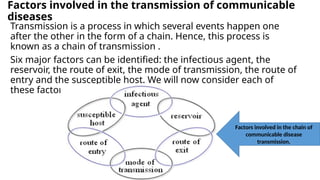
Transmission is a process in which several events happen one
after the other in the form of a chain. Hence, this process is
known as a chain of transmission .
Six major factors can be identified: the infectious agent, the
reservoir, the route of exit, the mode of transmission, the route of
entry and the susceptible host. We will now consider each of
these factors in turn.
Factors involved in the chain of
communicable disease
transmission.
Infectious agents
The agents of infection can be divided into different groups on the
basis of their size, biochemical characteristics, or manner in which
they interact with the human host. The groups of organisms that
cause infectious diseases are categorized as bacteria, viruses,
fungi, and parasites.
Reservoirs of infectious agents
Many infectious agents can survive in different organisms, or on non-
living objects, or in the environment. Some can only persist and multiply
inside human beings, whereas others can survive in other animals, or
for example in soil or water. The place where the infectious agent is
normally present before infecting a new human is called a reservoir.
Without reservoirs, infectious agents could not survive and hence could
not be transmitted to other people. Humans and animals which serve as
reservoirs for infectious agents are known as infected hosts. Two
examples are people infected with HIV and with the bacteria that cause
tuberculosis; these infectious agents persist and multiply in the infected
hosts and can be directly transmitted to new hosts.
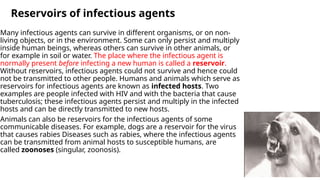
Animals can also be reservoirs for the infectious agents of some
communicable diseases. For example, dogs are a reservoir for the virus
that causes rabies Diseases such as rabies, where the infectious agents
can be transmitted from animal hosts to susceptible humans, are
called zoonoses (singular, zoonosis).
Route of exit
Before an infectious agent can be transmitted to other
people, it must first get out of the infected host. The site on
the infected host through which the infectious agent gets out
is called the route of exit.
Respiratory tract
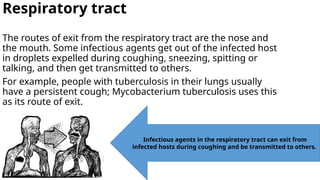
The routes of exit from the respiratory tract are the nose and
the mouth. Some infectious agents get out of the infected host
in droplets expelled during coughing, sneezing, spitting or
talking, and then get transmitted to others.
For example, people with tuberculosis in their lungs usually
have a persistent cough; Mycobacterium tuberculosis uses this
as its route of exit.
Infectious agents in the respiratory tract can exit from
infected hosts during coughing and be transmitted to others.
Gastrointestinal tract
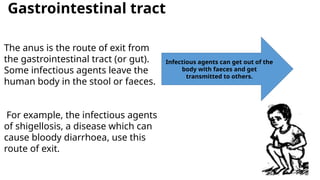
Infectious agents can get out of the
body with faeces and get
transmitted to others.
The anus is the route of exit from
the gastrointestinal tract (or gut).
Some infectious agents leave the
human body in the stool or faeces.
For example, the infectious agents
of shigellosis, a disease which can
cause bloody diarrhoea, use this
route of exit.
Skin
Some types of infectious agents can exit the body through breaks
in the skin.
For example, this route of exit is used by Plasmodium protozoa,
which are present in the blood and get out of the human body
when a mosquito bites through the skin to suck blood.
Modes of transmission
Once an infectious agent leaves a reservoir, it must get
transmitted to a new host if it is to multiply and cause
disease.
Remember !!! - The route by which an infectious agent is
transmitted from a reservoir to another host is called the
mode of transmission.
It is important for you to identify different modes of
transmission, because prevention and control measures differ
depending on the type.
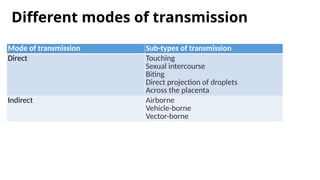
Different modes of transmission
Mode of transmission Sub-types of transmission
Direct Touching
Sexual intercourse
Biting
Direct projection of droplets
Across the placenta
Indirect Airborne
Vehicle-borne
Vector-borne
Direct modes of transmission
Direct transmission refers to the transfer of an infectious agent from an
infected host to a new host, without the need for intermediates such as air,
food, water or other animals.
Direct modes of transmission can occur in two main ways:
1. Person to person: The infectious agent is spread by direct contact between
people through touching, biting, kissing, sexual intercourse or direct
projection of respiratory droplets into another personโ€™s nose or mouth
during coughing, sneezing or talking. A familiar example is the transmission
of HIV from an infected person to others through sexual intercourse.
2. Transplacental transmission: This refers to the transmission of an
infectious agent from a pregnant woman to her fetus through the placenta.
An example is mother-to-child transmission (MTCT) of HIV.
Indirect transmission
Indirect transmission is when infectious agents are transmitted to new hosts through
intermediates such as air, food, water, objects or substances in the environment, or other
animals.
Indirect transmission has three subtypes:
1. Airborne transmission: The infectious agent may be transmitted in dried secretions from the
respiratory tract, which can remain suspended in the air for some time.
For example, the infectious agent causing tuberculosis can enter a new host through airborne
transmission.
2. Vehicle-borne transmission: A vehicle is any non-living substance or object that can be
contaminated by an infectious agent, which then transmits it to a new host. Contamination
refers to the presence of an infectious agent in or on the vehicle.
3. Vector-borne transmission: A vector is an organism, usually an arthropod, which transmits
an infectious agent to a new host. Arthropods which act as vectors include houseflies,
mosquitoes, lice and ticks.
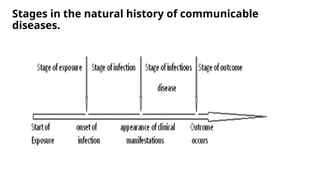
Natural history of a communicable disease
The natural history of a communicable disease refers to the
sequence of events that happen one after another, over a
period of time, in a person who is not receiving treatment.
Recognising these events helps you understand how
particular interventions at different stages could prevent or
control the disease.
Events that occur in the natural history of a communicable
disease are grouped into four stages: exposure, infection,
infectious disease, and outcome . We will briefly discuss each
of them in turn.
Stages in the natural history of communicable
diseases.
Stage of exposure
Here a contact refers to an association between a susceptible
host and a reservoir of infection, which creates an
opportunity for the infectious agents to enter the host.
In the stage of exposure, the susceptible host has come into
close contact with the infectious agent, but it has not yet
entered the hostโ€™s body cells.
Examples of an exposed host include:
oa person who shakes hands with someone suffering from a
common cold
oa child living in the same room as an adult with tuberculosis
oa person eating contaminated food or drinking contaminated
water.
Stage of infection
At this stage the infectious agent has entered the hostโ€™s body and has
begun multiplying. The entry and multiplication of an infectious agent
inside the host is known as the stage of infection. For instance, a person
who has eaten food contaminated with Salmonella typhii (the bacteria that
cause typhoid fever) is said to be exposed; if the bacteria enter the cells
lining the intestines and start multiplying, the person is said to be infected.
At this stage there are no clinical manifestations of the disease, a term
referring to the typical symptoms and signs of that illness. Symptoms are
the complaints the patient can tell you about (e.g. headache, vomiting,
dizziness). Signs are the features that would only be detected by a trained
health worker (e.g. high temperature, fast pulse rate, enlargement of
organs in the abdomen).
Stage of infectious disease
At this stage the clinical manifestations of the disease are present in the
infected host. For example, a person infected with Plasmodium falciparum,
who has fever, vomiting and headache, is in the stage of infectious disease โ€“
in this case, malaria. The time interval between the onset (start) of infection
and the first appearance of clinical manifestations of a disease is called the
incubation period. For malaria caused by Plasmodium falciparum the
incubation period ranges from 7 to 14 days.
Remember that not all infected hosts may develop the disease, and among
those who do, the severity of the illness may differ, depending on the level of
immunity of the host and the type of infectious agent. Infected hosts who
have clinical manifestations of the disease are called active cases. Individuals
who are infected, but who do not have clinical manifestations, are called
carriers. Carriers and active cases can both transmit the infection to others.
Susceptible hosts and risk factors
After an infectious agent gets inside the body it has to multiply in order to cause the disease. In some hosts,
infection leads to the disease developing, but in others it does not. Individuals who are likely to develop a
communicable disease after exposure to the infectious agents are called susceptible hosts. Different
individuals are not equally susceptible to infection, for a variety of reasons.
Factors that increase the susceptibility of a host to the development of a communicable disease are
called risk factors. Some risk factors arise from outside the individual โ€“ for example, poor personal hygiene,
or poor control of reservoirs of infection in the environment. Factors such as these increase the exposure of
susceptible hosts to infectious agents, which makes the disease more likely to develop.
Additionally, some people in a community are more likely to develop the disease than others, even though
they all have the same exposure to infectious agents. This is due to a low level of immunity within the more
susceptible individuals. Immunity refers to the resistance of an individual to communicable diseases,
because their white blood cells and antibodies (defensive proteins) are able to fight the infectious agents
successfully. Low levels of immunity could be due to:
diseases like HIV/AIDS which suppress immunity
poorly developed or immature immunity, as in very young children
not being vaccinated
poor nutritional status (e.g. malnourished children)
pregnancy.
In general terms, in what two ways could the risk of developing a communicable disease be reduced?
Summary of Study Session
In Study Session you have learned that:
Communicable diseases are caused by infectious agents that can be transmitted to susceptible
individuals from an infected person, or from other animals, objects or the environment.
Infectious agents include helminths, protozoa, bacteria, viruses and fungi.
Six factors are involved in the transmission of communicable diseases: the infectious agent,
the reservoir, route of exit, mode of transmission, route of entry, and the susceptible host.
A reservoir is a human, another animal, or a non-living thing (such as soil), where the
infectious agent normally lives.
Modes of transmission of an infectious agent can be directly through person-to-person
contact, or across the placenta from mother to fetus. Indirect transmission can occur through
air, vehicles such as water, food and contaminated objects, or via a vector such as a mosquito.
A susceptible host is a person or animal who can develop infection if exposed to the infectious
agent. Susceptibility is increased if exposure is high, or the hostโ€™s immunity is low.
The natural history of an untreated communicable disease has four stages: stage of exposure,
stage of infection, stage of infectious disease, and stage of outcome.
How Do We Establish That an Organism Is a Contributory
Cause of a Communicable Disease?
Establishing that an organism is a contributory cause of a disease
traditionally relied on Kochโ€™s postulates. Kochโ€™s postulates hold
that in order to definitively establish a cause-and-effect
relationship, all of the following four conditions must be met:
1. The organism must be shown to be present in every case of
the disease by isolation of the organism.
2. The organism must not be found in cases of other disease.
3. Once isolated, the organism must be capable of replicating the
disease in an experimental anima
4. The organism must be recoverable from the animal
Public policy is driven in part by public attitudes, which,
in turn, affect policy makersโ€™ readiness to take action.
Public acceptance of approaches to prevent and control infectious diseases is
generally high, in spite of the fact that the laws and regulations that underpin
these approaches generally involve some invasion of privacy and personal rights.
Control and prevention of infectious diseases can involve mandatory reporting of
cases (with identification of individuals) to public authorities, tracing of contacts
(with attendant loss of privacy and occasional embarrassment and/or public
disclosure), compulsory quarantine, mandatory treatment, mandatory vaccination,
and in some extreme cases even incarceration. Pets or other animals that are
regarded as potential sources of human infection can be seized, quarantined, and
even destroyed. Businesses, such as restaurants, can be closed.
Prevention, Policy, and Public Health
Identifying the Problem: Infectious Diseases and Consequences
Historically, prevention of infectious diseases provided one of the cornerstones of
public health. Many of the approaches that the public health community uses to
tackle ongoing problems stem from the policies used to deal with major infectious-
disease challenges in the late 19th and early 20th century. These include careful
epidemiology, interventions grounded in scientific understanding of causality, sound
public policy, and strong public support based on clear messaging and a public
understanding of the benefit of prevention.
It is important to note, however, that in spite of many significant advances, infectious
diseases still account for about one quarter of annual deaths worldwide.The burden
of these diseases varies greatly by geography, with the greatest impact being seen in
low-income countries. Although the Western world, including the United States is
much less affected by the infectious diseases of childhood (such as pneumonia,
diarrhea, and malaria), it remains vulnerable to and affected by emerging infections
and other infectious-disease problems, and these continue to present significant
challenges to the developed world.
Conclusion
๏ƒ˜Prevention of infectious diseases has been one of the great public health success stories of the last
150 years. Policies based on sound scientific principles, including understanding of pathogenesis
and transmission of infection have been developed and implemented. Most jurisdictions have a
public health infrastructure that monitors important infections and has policies to control and/or to
prevent many of the important risks to the population.
๏ƒ˜Vaccination policies have led to the virtual elimination of many important infections (especially those
of early childhood) in the developed world. However, the risk of infection has not been eliminated.
๏ƒ˜There has been a decrease in funding for public health over the last 30 years, with consequent
inadequate responses to emerging or new infections.
๏ƒ˜Trends in globalization and travel have increased the risk of many infections, including vector-borne,
food-borne, and zoonotic infections. Antimicrobial resistance and hospital-associated infections are
now global problems that will require a multinational and multidisciplinary response.
๏ƒ˜The policy implications for prevention of infectious diseases are many.
wish you health
thank you for your
attention ๏Š

comunicable deseaseffffffffffffffffff.pptx

  • 1.
    communicable diseases Lecture 9 NinoBuadze National Centre Disease Control and Public Health Epidemiologist Lecture 9
  • 2.
    communicable disease A communicabledisease is a disease that spreads from one person or animal to another. Pathogens such as viruses, bacteria, and fungi cause these diseases.
  • 3.
    Communicable Disease: Definition Aninfectious disease transmissible (as from person to person) by direct contact with an affected individual or the individual's discharges or by indirect means (as by a vector) Examples: โ€’ Measles โ€’ Dengue โ€’ Typhoid
  • 4.
    Communicable Disease: Definition Diseasesdue to infection form a large part of the history of public health, and are again a central part of its present and its future. Infections of public health importance are primarily those that are communicable; that is, they can be transmitted from person to person or from animals or the physical environment to humans. Communicable diseasemay be caused by a wide variety of organisms, ranging from bacteria, to viruses, to a spectrum of parasites, including malaria and hookworm. Let us examine the burden of disease due to communicable diseases.
  • 5.
    What Is theBurden of Disease Caused by Communicable Diseases? For many centuries, communicable diseases were the leading cause of death and disability among all ages, but especially among the young and the old. Communicable diseases are not only the causes of widespread epidemics of disease, but they can also become endemic or be regularly present and become routine causes of death. Communicable and noncommunicable infectious diseases play a key role in maternal deaths associated with childbirth, infant, and early childhood deaths, as well as deaths of malnourished infants and children.
  • 6.
    Aspects of communicabledisease A communicable disease is any disease that passes between people or animals. People sometimes refer to communicable diseases as โ€œinfectiousโ€ or โ€œtransmissibleโ€ diseases. Pathogens, including bacteria, viruses, fungi, and protists, cause communicable diseases. A person may develop a communicable disease after becoming infected by the pathogen. This may happen through: o direct contact with a person carrying the pathogen o contact with contaminated fluids, such as blood, mucus, or saliva o inhaling contaminated droplets from another personโ€™s cough or sneeze o receiving a bite from an animal or insect carrying the pathogen o consuming contaminated water or foods Once a pathogen has entered a personโ€™s body, it will begin replicating. The individual may then begin to experience symptoms. Some symptoms are a direct result of the pathogen damaging the bodyโ€™s cells. Others are due to the bodyโ€™s immune response to the infection. Communicable diseases are usually mild, and symptoms pass after a few days. However, some can be serious and potentially life threatening.
  • 7.
    How do thesecommunicable diseases spread? How these diseases spread depends on the specific disease or infectious agent. Some ways in which communicable diseases spread are by: 1. physical contact with an infected person, such as through touch (staphylococcus), sexual intercourse (gonorrhea, HIV), fecal/oral transmission (hepatitis A), or droplets (influenza, TB) 2. contact with a contaminated surface or object (Norwalk virus), food (salmonella, E. coli), blood (HIV, hepatitis B), or water (cholera); 3. bites from insects or animals capable of transmitting the disease (mosquito: malaria and yellow fever; flea: plague); and 4. travel through the air, such as tuberculosis or measles.
  • 8.
    Factors involved inthe transmission of communicable diseases Transmission is a process in which several events happen one after the other in the form of a chain. Hence, this process is known as a chain of transmission . Six major factors can be identified: the infectious agent, the reservoir, the route of exit, the mode of transmission, the route of entry and the susceptible host. We will now consider each of these factors in turn. Factors involved in the chain of communicable disease transmission.
  • 9.
    Infectious agents The agentsof infection can be divided into different groups on the basis of their size, biochemical characteristics, or manner in which they interact with the human host. The groups of organisms that cause infectious diseases are categorized as bacteria, viruses, fungi, and parasites.
  • 10.
    Reservoirs of infectiousagents Many infectious agents can survive in different organisms, or on non- living objects, or in the environment. Some can only persist and multiply inside human beings, whereas others can survive in other animals, or for example in soil or water. The place where the infectious agent is normally present before infecting a new human is called a reservoir. Without reservoirs, infectious agents could not survive and hence could not be transmitted to other people. Humans and animals which serve as reservoirs for infectious agents are known as infected hosts. Two examples are people infected with HIV and with the bacteria that cause tuberculosis; these infectious agents persist and multiply in the infected hosts and can be directly transmitted to new hosts. Animals can also be reservoirs for the infectious agents of some communicable diseases. For example, dogs are a reservoir for the virus that causes rabies Diseases such as rabies, where the infectious agents can be transmitted from animal hosts to susceptible humans, are called zoonoses (singular, zoonosis).
  • 11.
    Route of exit Beforean infectious agent can be transmitted to other people, it must first get out of the infected host. The site on the infected host through which the infectious agent gets out is called the route of exit.
  • 12.
    Respiratory tract The routesof exit from the respiratory tract are the nose and the mouth. Some infectious agents get out of the infected host in droplets expelled during coughing, sneezing, spitting or talking, and then get transmitted to others. For example, people with tuberculosis in their lungs usually have a persistent cough; Mycobacterium tuberculosis uses this as its route of exit. Infectious agents in the respiratory tract can exit from infected hosts during coughing and be transmitted to others.
  • 13.
    Gastrointestinal tract Infectious agentscan get out of the body with faeces and get transmitted to others. The anus is the route of exit from the gastrointestinal tract (or gut). Some infectious agents leave the human body in the stool or faeces. For example, the infectious agents of shigellosis, a disease which can cause bloody diarrhoea, use this route of exit.
  • 14.
    Skin Some types ofinfectious agents can exit the body through breaks in the skin. For example, this route of exit is used by Plasmodium protozoa, which are present in the blood and get out of the human body when a mosquito bites through the skin to suck blood.
  • 15.
    Modes of transmission Oncean infectious agent leaves a reservoir, it must get transmitted to a new host if it is to multiply and cause disease. Remember !!! - The route by which an infectious agent is transmitted from a reservoir to another host is called the mode of transmission. It is important for you to identify different modes of transmission, because prevention and control measures differ depending on the type.
  • 16.
    Different modes oftransmission Mode of transmission Sub-types of transmission Direct Touching Sexual intercourse Biting Direct projection of droplets Across the placenta Indirect Airborne Vehicle-borne Vector-borne
  • 17.
    Direct modes oftransmission Direct transmission refers to the transfer of an infectious agent from an infected host to a new host, without the need for intermediates such as air, food, water or other animals. Direct modes of transmission can occur in two main ways: 1. Person to person: The infectious agent is spread by direct contact between people through touching, biting, kissing, sexual intercourse or direct projection of respiratory droplets into another personโ€™s nose or mouth during coughing, sneezing or talking. A familiar example is the transmission of HIV from an infected person to others through sexual intercourse. 2. Transplacental transmission: This refers to the transmission of an infectious agent from a pregnant woman to her fetus through the placenta. An example is mother-to-child transmission (MTCT) of HIV.
  • 18.
    Indirect transmission Indirect transmissionis when infectious agents are transmitted to new hosts through intermediates such as air, food, water, objects or substances in the environment, or other animals. Indirect transmission has three subtypes: 1. Airborne transmission: The infectious agent may be transmitted in dried secretions from the respiratory tract, which can remain suspended in the air for some time. For example, the infectious agent causing tuberculosis can enter a new host through airborne transmission. 2. Vehicle-borne transmission: A vehicle is any non-living substance or object that can be contaminated by an infectious agent, which then transmits it to a new host. Contamination refers to the presence of an infectious agent in or on the vehicle. 3. Vector-borne transmission: A vector is an organism, usually an arthropod, which transmits an infectious agent to a new host. Arthropods which act as vectors include houseflies, mosquitoes, lice and ticks.
  • 19.
    Natural history ofa communicable disease The natural history of a communicable disease refers to the sequence of events that happen one after another, over a period of time, in a person who is not receiving treatment. Recognising these events helps you understand how particular interventions at different stages could prevent or control the disease. Events that occur in the natural history of a communicable disease are grouped into four stages: exposure, infection, infectious disease, and outcome . We will briefly discuss each of them in turn.
  • 20.
    Stages in thenatural history of communicable diseases.
  • 21.
    Stage of exposure Herea contact refers to an association between a susceptible host and a reservoir of infection, which creates an opportunity for the infectious agents to enter the host. In the stage of exposure, the susceptible host has come into close contact with the infectious agent, but it has not yet entered the hostโ€™s body cells. Examples of an exposed host include: oa person who shakes hands with someone suffering from a common cold oa child living in the same room as an adult with tuberculosis oa person eating contaminated food or drinking contaminated water.
  • 22.
    Stage of infection Atthis stage the infectious agent has entered the hostโ€™s body and has begun multiplying. The entry and multiplication of an infectious agent inside the host is known as the stage of infection. For instance, a person who has eaten food contaminated with Salmonella typhii (the bacteria that cause typhoid fever) is said to be exposed; if the bacteria enter the cells lining the intestines and start multiplying, the person is said to be infected. At this stage there are no clinical manifestations of the disease, a term referring to the typical symptoms and signs of that illness. Symptoms are the complaints the patient can tell you about (e.g. headache, vomiting, dizziness). Signs are the features that would only be detected by a trained health worker (e.g. high temperature, fast pulse rate, enlargement of organs in the abdomen).
  • 23.
    Stage of infectiousdisease At this stage the clinical manifestations of the disease are present in the infected host. For example, a person infected with Plasmodium falciparum, who has fever, vomiting and headache, is in the stage of infectious disease โ€“ in this case, malaria. The time interval between the onset (start) of infection and the first appearance of clinical manifestations of a disease is called the incubation period. For malaria caused by Plasmodium falciparum the incubation period ranges from 7 to 14 days. Remember that not all infected hosts may develop the disease, and among those who do, the severity of the illness may differ, depending on the level of immunity of the host and the type of infectious agent. Infected hosts who have clinical manifestations of the disease are called active cases. Individuals who are infected, but who do not have clinical manifestations, are called carriers. Carriers and active cases can both transmit the infection to others.
  • 24.
    Susceptible hosts andrisk factors After an infectious agent gets inside the body it has to multiply in order to cause the disease. In some hosts, infection leads to the disease developing, but in others it does not. Individuals who are likely to develop a communicable disease after exposure to the infectious agents are called susceptible hosts. Different individuals are not equally susceptible to infection, for a variety of reasons. Factors that increase the susceptibility of a host to the development of a communicable disease are called risk factors. Some risk factors arise from outside the individual โ€“ for example, poor personal hygiene, or poor control of reservoirs of infection in the environment. Factors such as these increase the exposure of susceptible hosts to infectious agents, which makes the disease more likely to develop. Additionally, some people in a community are more likely to develop the disease than others, even though they all have the same exposure to infectious agents. This is due to a low level of immunity within the more susceptible individuals. Immunity refers to the resistance of an individual to communicable diseases, because their white blood cells and antibodies (defensive proteins) are able to fight the infectious agents successfully. Low levels of immunity could be due to: diseases like HIV/AIDS which suppress immunity poorly developed or immature immunity, as in very young children not being vaccinated poor nutritional status (e.g. malnourished children) pregnancy. In general terms, in what two ways could the risk of developing a communicable disease be reduced?
  • 25.
    Summary of StudySession In Study Session you have learned that: Communicable diseases are caused by infectious agents that can be transmitted to susceptible individuals from an infected person, or from other animals, objects or the environment. Infectious agents include helminths, protozoa, bacteria, viruses and fungi. Six factors are involved in the transmission of communicable diseases: the infectious agent, the reservoir, route of exit, mode of transmission, route of entry, and the susceptible host. A reservoir is a human, another animal, or a non-living thing (such as soil), where the infectious agent normally lives. Modes of transmission of an infectious agent can be directly through person-to-person contact, or across the placenta from mother to fetus. Indirect transmission can occur through air, vehicles such as water, food and contaminated objects, or via a vector such as a mosquito. A susceptible host is a person or animal who can develop infection if exposed to the infectious agent. Susceptibility is increased if exposure is high, or the hostโ€™s immunity is low. The natural history of an untreated communicable disease has four stages: stage of exposure, stage of infection, stage of infectious disease, and stage of outcome.
  • 26.
    How Do WeEstablish That an Organism Is a Contributory Cause of a Communicable Disease? Establishing that an organism is a contributory cause of a disease traditionally relied on Kochโ€™s postulates. Kochโ€™s postulates hold that in order to definitively establish a cause-and-effect relationship, all of the following four conditions must be met: 1. The organism must be shown to be present in every case of the disease by isolation of the organism. 2. The organism must not be found in cases of other disease. 3. Once isolated, the organism must be capable of replicating the disease in an experimental anima 4. The organism must be recoverable from the animal
  • 27.
    Public policy isdriven in part by public attitudes, which, in turn, affect policy makersโ€™ readiness to take action. Public acceptance of approaches to prevent and control infectious diseases is generally high, in spite of the fact that the laws and regulations that underpin these approaches generally involve some invasion of privacy and personal rights. Control and prevention of infectious diseases can involve mandatory reporting of cases (with identification of individuals) to public authorities, tracing of contacts (with attendant loss of privacy and occasional embarrassment and/or public disclosure), compulsory quarantine, mandatory treatment, mandatory vaccination, and in some extreme cases even incarceration. Pets or other animals that are regarded as potential sources of human infection can be seized, quarantined, and even destroyed. Businesses, such as restaurants, can be closed.
  • 28.
    Prevention, Policy, andPublic Health Identifying the Problem: Infectious Diseases and Consequences Historically, prevention of infectious diseases provided one of the cornerstones of public health. Many of the approaches that the public health community uses to tackle ongoing problems stem from the policies used to deal with major infectious- disease challenges in the late 19th and early 20th century. These include careful epidemiology, interventions grounded in scientific understanding of causality, sound public policy, and strong public support based on clear messaging and a public understanding of the benefit of prevention. It is important to note, however, that in spite of many significant advances, infectious diseases still account for about one quarter of annual deaths worldwide.The burden of these diseases varies greatly by geography, with the greatest impact being seen in low-income countries. Although the Western world, including the United States is much less affected by the infectious diseases of childhood (such as pneumonia, diarrhea, and malaria), it remains vulnerable to and affected by emerging infections and other infectious-disease problems, and these continue to present significant challenges to the developed world.
  • 29.
    Conclusion ๏ƒ˜Prevention of infectiousdiseases has been one of the great public health success stories of the last 150 years. Policies based on sound scientific principles, including understanding of pathogenesis and transmission of infection have been developed and implemented. Most jurisdictions have a public health infrastructure that monitors important infections and has policies to control and/or to prevent many of the important risks to the population. ๏ƒ˜Vaccination policies have led to the virtual elimination of many important infections (especially those of early childhood) in the developed world. However, the risk of infection has not been eliminated. ๏ƒ˜There has been a decrease in funding for public health over the last 30 years, with consequent inadequate responses to emerging or new infections. ๏ƒ˜Trends in globalization and travel have increased the risk of many infections, including vector-borne, food-borne, and zoonotic infections. Antimicrobial resistance and hospital-associated infections are now global problems that will require a multinational and multidisciplinary response. ๏ƒ˜The policy implications for prevention of infectious diseases are many.
  • 30.
    wish you health thankyou for your attention ๏Š