Lesson Overview

Specialized Tissues in Plants

Lesson Overview
23.1 Specialized Tissues
in Plants
Lesson Overview

Specialized Tissues in Plants

THINK ABOUT IT
Have you ever wondered if plants were really alive? Indeed they are—if you
look deep inside a living plant, you will find a busy and complex organism.
Plants move materials, grow, repair themselves, and constantly respond to
the environment. Their cells and tissues work together in very effective
ways.
The leaves of this sundew plant are adapted to capture and digest live prey.
Lesson Overview

Specialized Tissues in Plants

Seed Plant Structure
What are the three principal organs of seed plants?
Lesson Overview

Specialized Tissues in Plants

Seed Plant Structure
What are the three principal organs of seed plants?
The three principal organs of seed plants are roots, stems, and leaves.
Lesson Overview

Specialized Tissues in Plants

Seed Plant Structure
The three principal organs of seed
plants are roots, stems, and leaves,
as shown in the figure. The organs
are linked together by tissue
systems that produce, store, and
transport nutrients, and provide
physical support and protection.
Lesson Overview

Specialized Tissues in Plants

Roots
Roots anchor plants in the ground,
holding soil in place and preventing
erosion.
Root systems absorb water and
dissolved nutrients.
Roots transport these materials to
the rest of the plant, store food,
and hold plants upright against
forces such as wind and rain.
Lesson Overview

Specialized Tissues in Plants

Stems
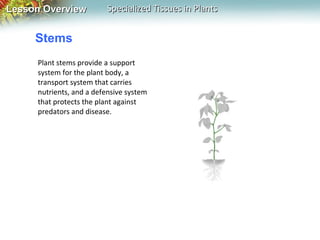
Plant stems provide a support
system for the plant body, a
transport system that carries
nutrients, and a defensive system
that protects the plant against
predators and disease.
Lesson Overview

Specialized Tissues in Plants

Stems
Stems also produce leaves and
reproductive organs such as
flowers.
The stem’s transport system lifts
water from the roots up to the
leaves and carries the products of
photosynthesis from the leaves
back down to the roots.
Lesson Overview

Specialized Tissues in Plants

Leaves
Leaves are the plant’s main
photosynthetic organs.
Leaves also expose tissue to the
dryness of the air and, therefore,
have adjustable pores that help
conserve water while letting
oxygen and carbon dioxide enter
and exit the leaf.
Lesson Overview

Specialized Tissues in Plants

Plant Tissue Systems
What are the primary functions of the main tissue systems of seed plants?
Lesson Overview

Specialized Tissues in Plants

Plant Tissue Systems
What are the primary functions of the main tissue systems of seed plants?
Dermal tissue is the protective outer covering of a plant.
Vascular tissue supports the plant body and transports water and nutrients
throughout the plant.
Ground tissue produces and stores sugars, and contributes to physical support of
the plant.
Lesson Overview

Specialized Tissues in Plants

Plant Tissue Systems
Plants have three main tissue systems:
dermal, vascular, and ground.
These cross sections of the principal organs
of seed plants show that all three organs
contain dermal tissue, vascular tissue, and
ground tissue.
Lesson Overview

Specialized Tissues in Plants

Dermal Tissue
Dermal tissue is the protective outer covering of a plant.
Dermal tissue in young plants consists of a single layer of cells, called the
epidermis. The outer surfaces of epidermal cells are often covered with a thick
waxy layer called the cuticle, which protects against water loss. In older plants,
dermal tissue may be many cell layers deep and may be covered with bark.
Lesson Overview

Specialized Tissues in Plants

Dermal Tissue
Some epidermal cells have tiny projections known as trichomes that help protect
the leaf and may give the leaf a fuzzy appearance.
In roots, dermal tissue includes root hair cells that help absorb water.
Lesson Overview

Specialized Tissues in Plants

Vascular Tissue
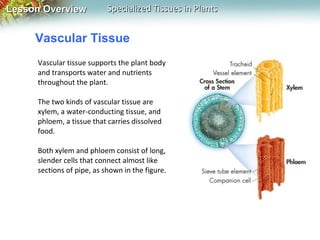
Vascular tissue supports the plant body
and transports water and nutrients
throughout the plant.
The two kinds of vascular tissue are
xylem, a water-conducting tissue, and
phloem, a tissue that carries dissolved
food.
Both xylem and phloem consist of long,
slender cells that connect almost like
sections of pipe, as shown in the figure.
Lesson Overview

Specialized Tissues in Plants

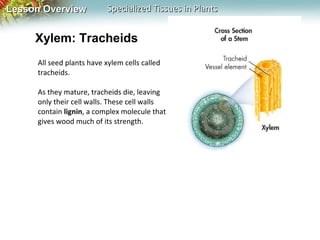
Xylem: Tracheids
All seed plants have xylem cells called
tracheids.
As they mature, tracheids die, leaving
only their cell walls. These cell walls
contain lignin, a complex molecule that
gives wood much of its strength.
Lesson Overview

Specialized Tissues in Plants

Xylem: Tracheids
Openings in the walls connect
neighboring cells and allow water to
flow from cell to cell.
Thinner regions of the wall, known as
pits, allow water to diffuse from
tracheids into surrounding ground
tissue.
Lesson Overview

Specialized Tissues in Plants

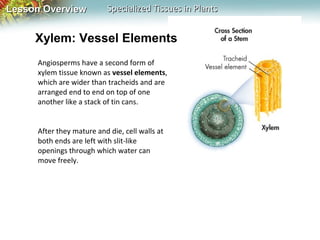
Xylem: Vessel Elements
Angiosperms have a second form of
xylem tissue known as vessel elements,
which are wider than tracheids and are
arranged end to end on top of one
another like a stack of tin cans.
After they mature and die, cell walls at
both ends are left with slit-like
openings through which water can
move freely.
Lesson Overview

Specialized Tissues in Plants

Xylem: Sieve Tube
Elements
Unlike xylem cells, phloem cells are
alive at maturity. The main phloem
cells are sieve tube elements, which
are arranged end to end, forming sieve
tubes. The end walls have many small
holes through which nutrients move
from cell to cell.
Lesson Overview

Specialized Tissues in Plants

Xylem: Sieve Tube
Elements
As sieve tube elements mature, they
lose their nuclei and most other
organelles. The remaining organelles
hug the inside of the cell wall and are
kept alive by companion cells.
Lesson Overview

Specialized Tissues in Plants

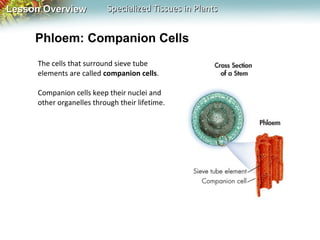
Phloem: Companion Cells
The cells that surround sieve tube
elements are called companion cells.
Companion cells keep their nuclei and
other organelles through their lifetime.
Lesson Overview

Specialized Tissues in Plants

Ground Tissue
Ground tissue produces and stores sugars, and contributes to physical support of
the plant. It is neither dermal nor vascular.
Three types of ground tissue, which vary in cell wall thickness, are found in plants:
parenchyma (thin cell walls), collenchyma (thicker cell walls), and sclerenchyma
(thickest cell walls).
Lesson Overview

Specialized Tissues in Plants

Ground Tissue
Parenchyma cells, the main type of ground tissue, have thin cell walls and
a large central vacuole surrounded by a thin layer of cytoplasm. In leaves,
these cells contain many chloroplasts and are the site of most of a plant’s
photosynthesis.
Lesson Overview

Specialized Tissues in Plants

Ground Tissue
Collenchyma cells have strong, flexible cell walls that help support plant
organs.
Lesson Overview

Specialized Tissues in Plants

Ground Tissue
Sclerenchyma cells have extremely thick, rigid cell walls that make ground
tissue such as seed coats tough and strong.
Lesson Overview

Specialized Tissues in Plants

Plant Growth and Meristems
How do meristems differ from other plant tissues?
Lesson Overview

Specialized Tissues in Plants

Plant Growth and Meristems
How do meristems differ from other plant tissues?
Meristems are regions of unspecialized cells in which mitosis produces new cells
that are ready for differentiation.
Lesson Overview

Specialized Tissues in Plants

Plant Growth and Meristems
Even the oldest trees produce new leaves and new reproductive organs every
year, almost as if they remained “forever young.”
The secrets of plant growth are found in meristems. Meristems are regions of
unspecialized cells in which mitosis produces new cells that are ready for
differentiation.
Meristems are found in places where plants grow rapidly, such as the tips of
stems and roots.
Lesson Overview

Specialized Tissues in Plants

Apical Meristems
Because the tip of a stem or root is known
as its apex, meristems in these regions are
called apical meristems. Unspecialized
cells produced in apical meristems divide
rapidly as stems and roots increase in
length.
The micrographs in the figure show
examples of stem and root apical
meristems.
Lesson Overview

Specialized Tissues in Plants

Apical Meristems
At first, the new cells that are pushed out of meristems look very much
alike: They are unspecialized and have thin cell walls.
Gradually, they develop into mature cells with specialized structures
and functions. As the cells differentiate, they produce each of the tissue
systems of the plant, including dermal, vascular, and ground tissue.
Lesson Overview

Specialized Tissues in Plants

Meristems and Flower Development
The highly specialized cells found in cones and flowers are also
produced in meristems.
Flower or cone development begins when the pattern of gene
expression changes in a stem’s apical meristem. These changes
transform the apical meristem of a flowering plant into a floral
meristem. Floral meristems produce the tissues of flowers, which
include the plant’s reproductive organs as well as the colorful petals
that surround them.

B10vrv6231

  • 1.
    Lesson Overview Specialized Tissuesin Plants Lesson Overview 23.1 Specialized Tissues in Plants
  • 2.
    Lesson Overview Specialized Tissuesin Plants THINK ABOUT IT Have you ever wondered if plants were really alive? Indeed they are—if you look deep inside a living plant, you will find a busy and complex organism. Plants move materials, grow, repair themselves, and constantly respond to the environment. Their cells and tissues work together in very effective ways. The leaves of this sundew plant are adapted to capture and digest live prey.
  • 3.
    Lesson Overview Specialized Tissuesin Plants Seed Plant Structure What are the three principal organs of seed plants?
  • 4.
    Lesson Overview Specialized Tissuesin Plants Seed Plant Structure What are the three principal organs of seed plants? The three principal organs of seed plants are roots, stems, and leaves.
  • 5.
    Lesson Overview Specialized Tissuesin Plants Seed Plant Structure The three principal organs of seed plants are roots, stems, and leaves, as shown in the figure. The organs are linked together by tissue systems that produce, store, and transport nutrients, and provide physical support and protection.
  • 6.
    Lesson Overview Specialized Tissuesin Plants Roots Roots anchor plants in the ground, holding soil in place and preventing erosion. Root systems absorb water and dissolved nutrients. Roots transport these materials to the rest of the plant, store food, and hold plants upright against forces such as wind and rain.
  • 7.
    Lesson Overview Specialized Tissuesin Plants Stems Plant stems provide a support system for the plant body, a transport system that carries nutrients, and a defensive system that protects the plant against predators and disease.
  • 8.
    Lesson Overview Specialized Tissuesin Plants Stems Stems also produce leaves and reproductive organs such as flowers. The stem’s transport system lifts water from the roots up to the leaves and carries the products of photosynthesis from the leaves back down to the roots.
  • 9.
    Lesson Overview Specialized Tissuesin Plants Leaves Leaves are the plant’s main photosynthetic organs. Leaves also expose tissue to the dryness of the air and, therefore, have adjustable pores that help conserve water while letting oxygen and carbon dioxide enter and exit the leaf.
  • 10.
    Lesson Overview Specialized Tissuesin Plants Plant Tissue Systems What are the primary functions of the main tissue systems of seed plants?
  • 11.
    Lesson Overview Specialized Tissuesin Plants Plant Tissue Systems What are the primary functions of the main tissue systems of seed plants? Dermal tissue is the protective outer covering of a plant. Vascular tissue supports the plant body and transports water and nutrients throughout the plant. Ground tissue produces and stores sugars, and contributes to physical support of the plant.
  • 12.
    Lesson Overview Specialized Tissuesin Plants Plant Tissue Systems Plants have three main tissue systems: dermal, vascular, and ground. These cross sections of the principal organs of seed plants show that all three organs contain dermal tissue, vascular tissue, and ground tissue.
  • 13.
    Lesson Overview Specialized Tissuesin Plants Dermal Tissue Dermal tissue is the protective outer covering of a plant. Dermal tissue in young plants consists of a single layer of cells, called the epidermis. The outer surfaces of epidermal cells are often covered with a thick waxy layer called the cuticle, which protects against water loss. In older plants, dermal tissue may be many cell layers deep and may be covered with bark.
  • 14.
    Lesson Overview Specialized Tissuesin Plants Dermal Tissue Some epidermal cells have tiny projections known as trichomes that help protect the leaf and may give the leaf a fuzzy appearance. In roots, dermal tissue includes root hair cells that help absorb water.
  • 15.
    Lesson Overview Specialized Tissuesin Plants Vascular Tissue Vascular tissue supports the plant body and transports water and nutrients throughout the plant. The two kinds of vascular tissue are xylem, a water-conducting tissue, and phloem, a tissue that carries dissolved food. Both xylem and phloem consist of long, slender cells that connect almost like sections of pipe, as shown in the figure.
  • 16.
    Lesson Overview Specialized Tissuesin Plants Xylem: Tracheids All seed plants have xylem cells called tracheids. As they mature, tracheids die, leaving only their cell walls. These cell walls contain lignin, a complex molecule that gives wood much of its strength.
  • 17.
    Lesson Overview Specialized Tissuesin Plants Xylem: Tracheids Openings in the walls connect neighboring cells and allow water to flow from cell to cell. Thinner regions of the wall, known as pits, allow water to diffuse from tracheids into surrounding ground tissue.
  • 18.
    Lesson Overview Specialized Tissuesin Plants Xylem: Vessel Elements Angiosperms have a second form of xylem tissue known as vessel elements, which are wider than tracheids and are arranged end to end on top of one another like a stack of tin cans. After they mature and die, cell walls at both ends are left with slit-like openings through which water can move freely.
  • 19.
    Lesson Overview Specialized Tissuesin Plants Xylem: Sieve Tube Elements Unlike xylem cells, phloem cells are alive at maturity. The main phloem cells are sieve tube elements, which are arranged end to end, forming sieve tubes. The end walls have many small holes through which nutrients move from cell to cell.
  • 20.
    Lesson Overview Specialized Tissuesin Plants Xylem: Sieve Tube Elements As sieve tube elements mature, they lose their nuclei and most other organelles. The remaining organelles hug the inside of the cell wall and are kept alive by companion cells.
  • 21.
    Lesson Overview Specialized Tissuesin Plants Phloem: Companion Cells The cells that surround sieve tube elements are called companion cells. Companion cells keep their nuclei and other organelles through their lifetime.
  • 22.
    Lesson Overview Specialized Tissuesin Plants Ground Tissue Ground tissue produces and stores sugars, and contributes to physical support of the plant. It is neither dermal nor vascular. Three types of ground tissue, which vary in cell wall thickness, are found in plants: parenchyma (thin cell walls), collenchyma (thicker cell walls), and sclerenchyma (thickest cell walls).
  • 23.
    Lesson Overview Specialized Tissuesin Plants Ground Tissue Parenchyma cells, the main type of ground tissue, have thin cell walls and a large central vacuole surrounded by a thin layer of cytoplasm. In leaves, these cells contain many chloroplasts and are the site of most of a plant’s photosynthesis.
  • 24.
    Lesson Overview Specialized Tissuesin Plants Ground Tissue Collenchyma cells have strong, flexible cell walls that help support plant organs.
  • 25.
    Lesson Overview Specialized Tissuesin Plants Ground Tissue Sclerenchyma cells have extremely thick, rigid cell walls that make ground tissue such as seed coats tough and strong.
  • 26.
    Lesson Overview Specialized Tissuesin Plants Plant Growth and Meristems How do meristems differ from other plant tissues?
  • 27.
    Lesson Overview Specialized Tissuesin Plants Plant Growth and Meristems How do meristems differ from other plant tissues? Meristems are regions of unspecialized cells in which mitosis produces new cells that are ready for differentiation.
  • 28.
    Lesson Overview Specialized Tissuesin Plants Plant Growth and Meristems Even the oldest trees produce new leaves and new reproductive organs every year, almost as if they remained “forever young.” The secrets of plant growth are found in meristems. Meristems are regions of unspecialized cells in which mitosis produces new cells that are ready for differentiation. Meristems are found in places where plants grow rapidly, such as the tips of stems and roots.
  • 29.
    Lesson Overview Specialized Tissuesin Plants Apical Meristems Because the tip of a stem or root is known as its apex, meristems in these regions are called apical meristems. Unspecialized cells produced in apical meristems divide rapidly as stems and roots increase in length. The micrographs in the figure show examples of stem and root apical meristems.
  • 30.
    Lesson Overview Specialized Tissuesin Plants Apical Meristems At first, the new cells that are pushed out of meristems look very much alike: They are unspecialized and have thin cell walls. Gradually, they develop into mature cells with specialized structures and functions. As the cells differentiate, they produce each of the tissue systems of the plant, including dermal, vascular, and ground tissue.
  • 31.
    Lesson Overview Specialized Tissuesin Plants Meristems and Flower Development The highly specialized cells found in cones and flowers are also produced in meristems. Flower or cone development begins when the pattern of gene expression changes in a stem’s apical meristem. These changes transform the apical meristem of a flowering plant into a floral meristem. Floral meristems produce the tissues of flowers, which include the plant’s reproductive organs as well as the colorful petals that surround them.