12te62@student.muet.edu.pk 
Danish_raja1@hotmail.com
 Auto cone can be defined as “ It is a type of winding machine 
in which ring bobbins are converted into large cones with 
removing of spinning faults. 
 In order to form packages of the right weight for subsequent 
processing stages, the winding machine can be fed by ring-spun 
yarn bobbins. 
 Packages can thus be subdivided according to their shape: 
a. Cylindrical 
b . Conical, with tapers ranging from 5° 57° to 9° 15° 
c . Cones with tapers of up to 4° 20° 
 The yarn unwound from the package passes through yarn 
tensioning and control systems. 
 with the help of a grooved cylinder, yarn is wound evenly 
around the large package. 
12te62@student.muet.edu.pk
 The yarn enters the recess in the cylinder, thus the rotary 
movement of the cylinder corresponds to the translation of the 
yarn. 
 Winding machines currently have independent heads with 
individually adjustable motors. 
 A modern winding machine can process yarns ranging from a 
count of Ne 2 to finer ones, at a winding speed of 400 to 
2000 m/min. 
 Further functions of winding are to check the yarn and to 
eliminate any faults found. This is done by a process called 
“clearing” i.e., by passing the yarn through an electronic device, 
known as a yarn clearer which assesses it according to set 
parameters (fault section and length). 
 If these set values are exceeded the yarn is cut and spliced - a 
splice being deemed preferable to a fault. 
 Splicing is done using the air-splicing system or the Twin splicer 
system. 
12te62@student.muet.edu.pk
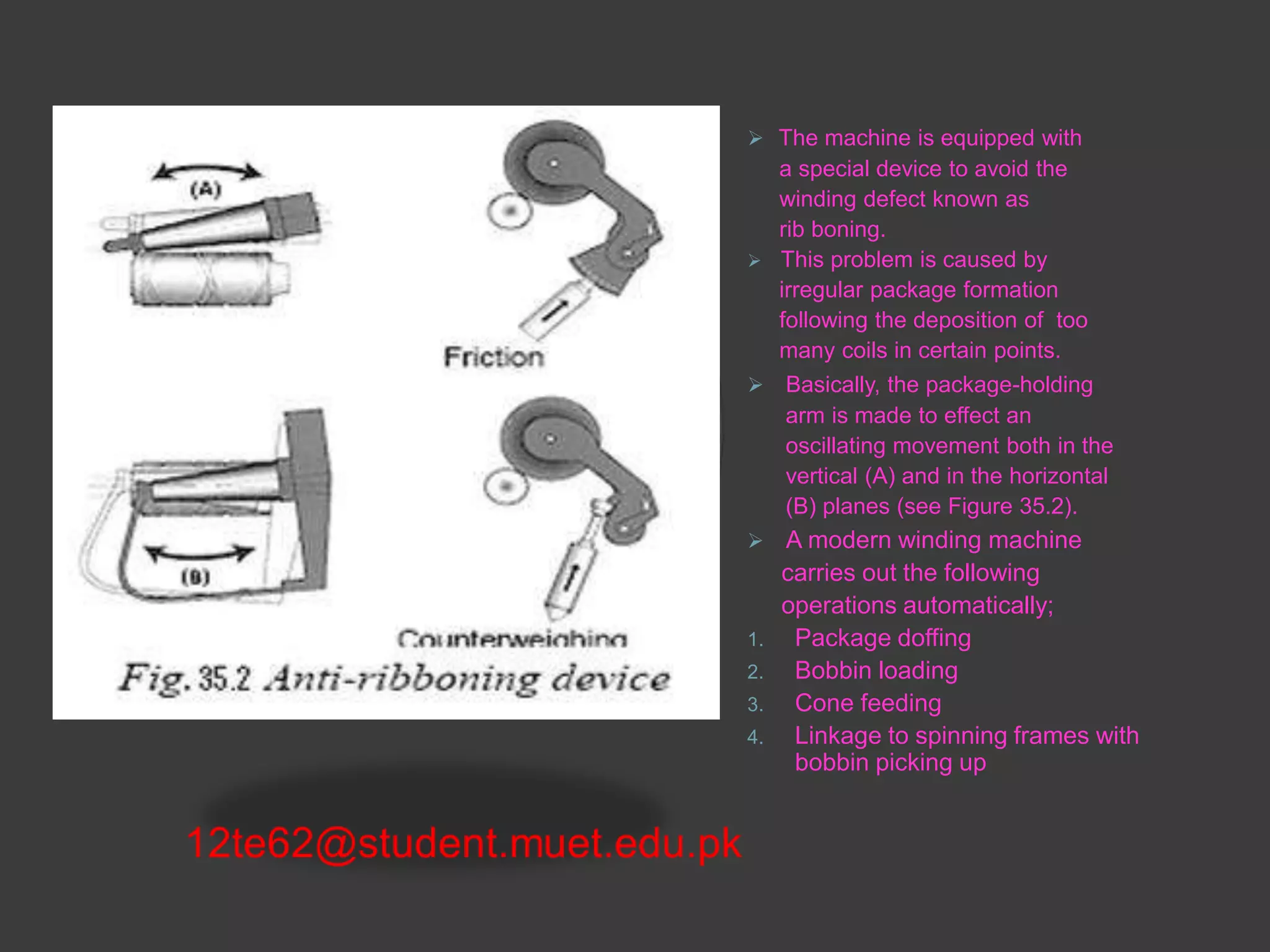
 The machine is equipped with 
a special device to avoid the 
winding defect known as 
rib boning. 
 This problem is caused by 
irregular package formation 
following the deposition of too 
many coils in certain points. 
 Basically, the package-holding 
arm is made to effect an 
oscillating movement both in the 
vertical (A) and in the horizontal 
(B) planes (see Figure 35.2). 
 A modern winding machine 
carries out the following 
operations automatically; 
1. Package doffing 
2. Bobbin loading 
3. Cone feeding 
4. Linkage to spinning frames with 
bobbin picking up
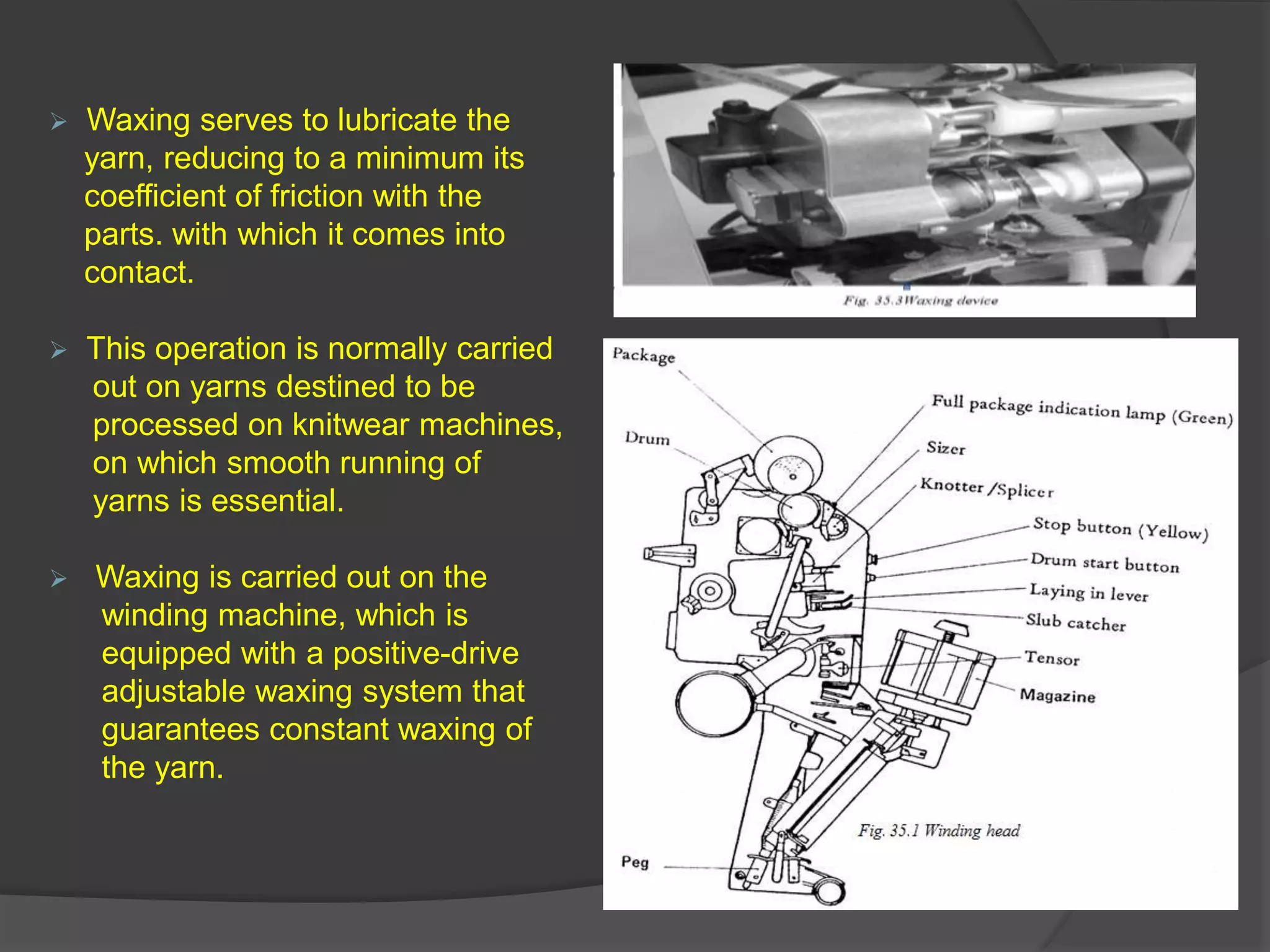
 Waxing serves to lubricate the 
yarn, reducing to a minimum its 
coefficient of friction with the 
parts. with which it comes into 
contact. 
 This operation is normally carried 
out on yarns destined to be 
processed on knitwear machines, 
on which smooth running of 
yarns is essential. 
 Waxing is carried out on the 
winding machine, which is 
equipped with a positive-drive 
adjustable waxing system that 
guarantees constant waxing of 
the yarn.
OBJECTIVES OFWINDING Requirement of atmospheric 
conditions of auto cone department 
 To prepare a bigger 
package (cone) from ring 
bobbin with specific length 
and weight. 
 To remove spinning faults. 
 To wax or condition the 
material. 
 To improve the quality of 
yarn. 
 In auto cone department 
the humidity and 
temperature are 
maintained according to 
the requirement 
throughout the year. 
Normally ranges are:- 
 Humidity% 
55~80% 
 Temperature 
22~39.5°C
Parts of Auto cone 
Cradle: Its function is to provide setting to cones/packages having 
package holders; it lies on the upper part of the machine on drum. 
Drum: It is a polished surface metallic drum slightly cone type, having 
different diameter at both sides i.e 90 mm on one side and 100 mm on 
other side. It has cut marks or grooves cut in to it at its surface to help 
the cross winding of packages. Its speed lies in range from 1000 to 
2000 rpm. 
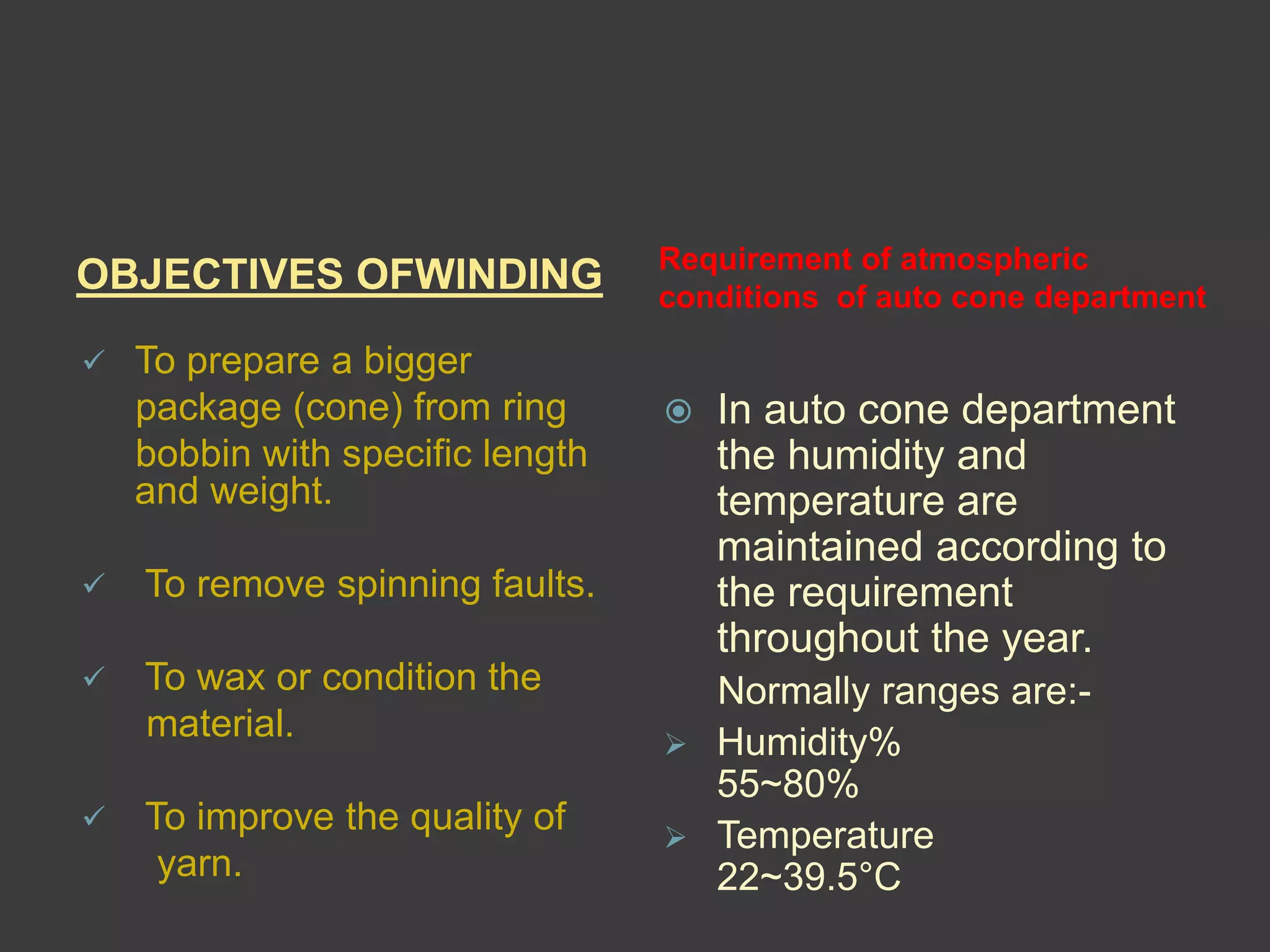
Magazine: Magazine is the main component of auto cone machine, its 
function is to hold/feed the cops for winding, its capacity lies up to 9 
bobbins/cops per magazine. Bobbins are fed to bobbin peg one by one 
automatically, when one becomes empty and ejected from peg. 
Tension assembly: Tension assembly provides sufficient tension to the 
yarn during unwinding from cop to winding on to cones. Due to this 
sufficient tension is developed on cones and hence dense packages 
can be formed.
Yarn clearer: As the spun yarn have various faults i.e thin and thick 
places, neps, hairiness, embedded particles of dust & leaves colouring 
matters and short and long defects etc .Its function is to remove these 
faults according to the given set values on electron touch screen panel to 
produce fault free yarn to meet the quality requirements. 
Tensor cutter: The purpose of cutter is to cut the yarn whenever required 
during winding process. 
Balloon breaker: Its function is to break the balloon/control the length of 
yarn balloon during yarn unwinding from the cop, because yarn is passes 
at high speed during winding operation and hence high tension developed. 
Therefore that tension becomes equalized by balloon breaker. 
Waste suction pipe: During yarn cutting and splicing it sucks the waste 
yarn. 
Bobbin plate: The function of bobbin plate is to rotate the bobbins one-by- 
one. 
Bobbin peg/holder: It is a disk type wheel; its function is to hold the filled 
bobbins for unwinding process. 
Lower scissor: When bobbin is completed it cut the yarn. 
Upper scissor: Its function is to take out yarn from lower scissor toward it 
self.
Tension dip: Tension dip is employed to give tension at yarn. 
Wax bush: To provide smooth surface to yarn wax is applied especially to the yarn 
intended for knitting, the function of wax bush is to apply wax to yarn to make its 
hairs sticky. 
Wax motor: Its function is to run wax bush continuously. 
Pre-cleaner: Its function is to gauge the yarn according to the requirements of 
count for instance; Ne. 16’s gauge =1.2 mm, Ne. 20’s = 1.0 mm & Ne. 30’s = 0.8mm 
Center flip: Its function is to provide path during bobbin change when one bobbin is 
completed. 
Mobile pipe: It sucks the yarn when it is break at the center. 
Suction mouth: Whenever yarn breaks during winding the package move in 
opposite direction with slow speed during that time it sucks the broken yarn end 
from the package and take it for splicing. 
Retie pipe: It take the yarn end from bobbin to ward splicing mechanism. 
Splicer: The splicing mechanism performs the knot free joining of the two yarn 
ends after yarn breakage or during any cutting operation for removal of faults. 
Hairiness nozzles: Hairiness nozzles are used to reduce yarn hairiness. 
Dust removal unit: It collects the dust and fiber fly.
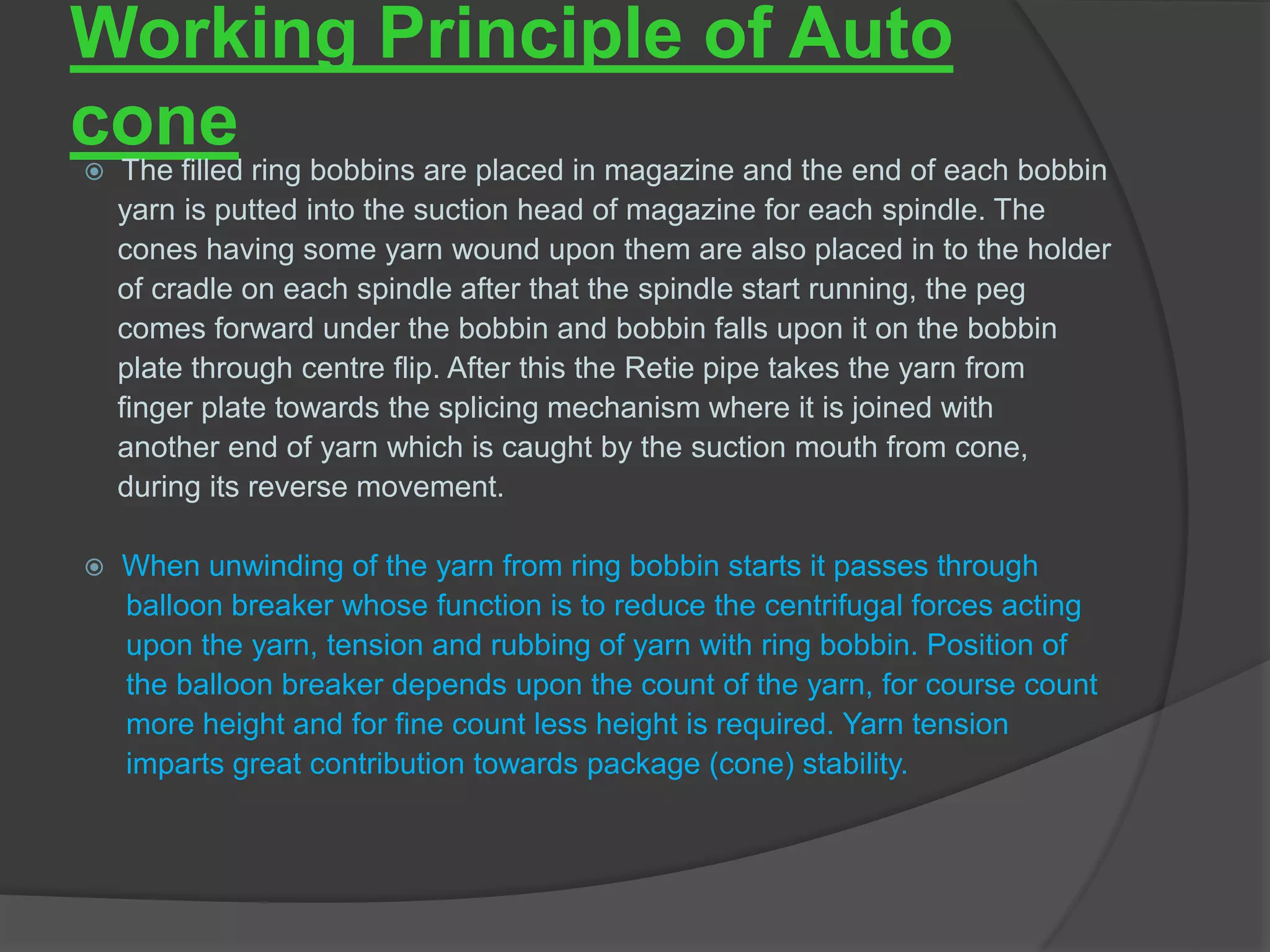
Working Principle of Auto 
cone 
 The filled ring bobbins are placed in magazine and the end of each bobbin 
yarn is putted into the suction head of magazine for each spindle. The 
cones having some yarn wound upon them are also placed in to the holder 
of cradle on each spindle after that the spindle start running, the peg 
comes forward under the bobbin and bobbin falls upon it on the bobbin 
plate through centre flip. After this the Retie pipe takes the yarn from 
finger plate towards the splicing mechanism where it is joined with 
another end of yarn which is caught by the suction mouth from cone, 
during its reverse movement. 
 When unwinding of the yarn from ring bobbin starts it passes through 
balloon breaker whose function is to reduce the centrifugal forces acting 
upon the yarn, tension and rubbing of yarn with ring bobbin. Position of 
the balloon breaker depends upon the count of the yarn, for course count 
more height and for fine count less height is required. Yarn tension 
imparts great contribution towards package (cone) stability.
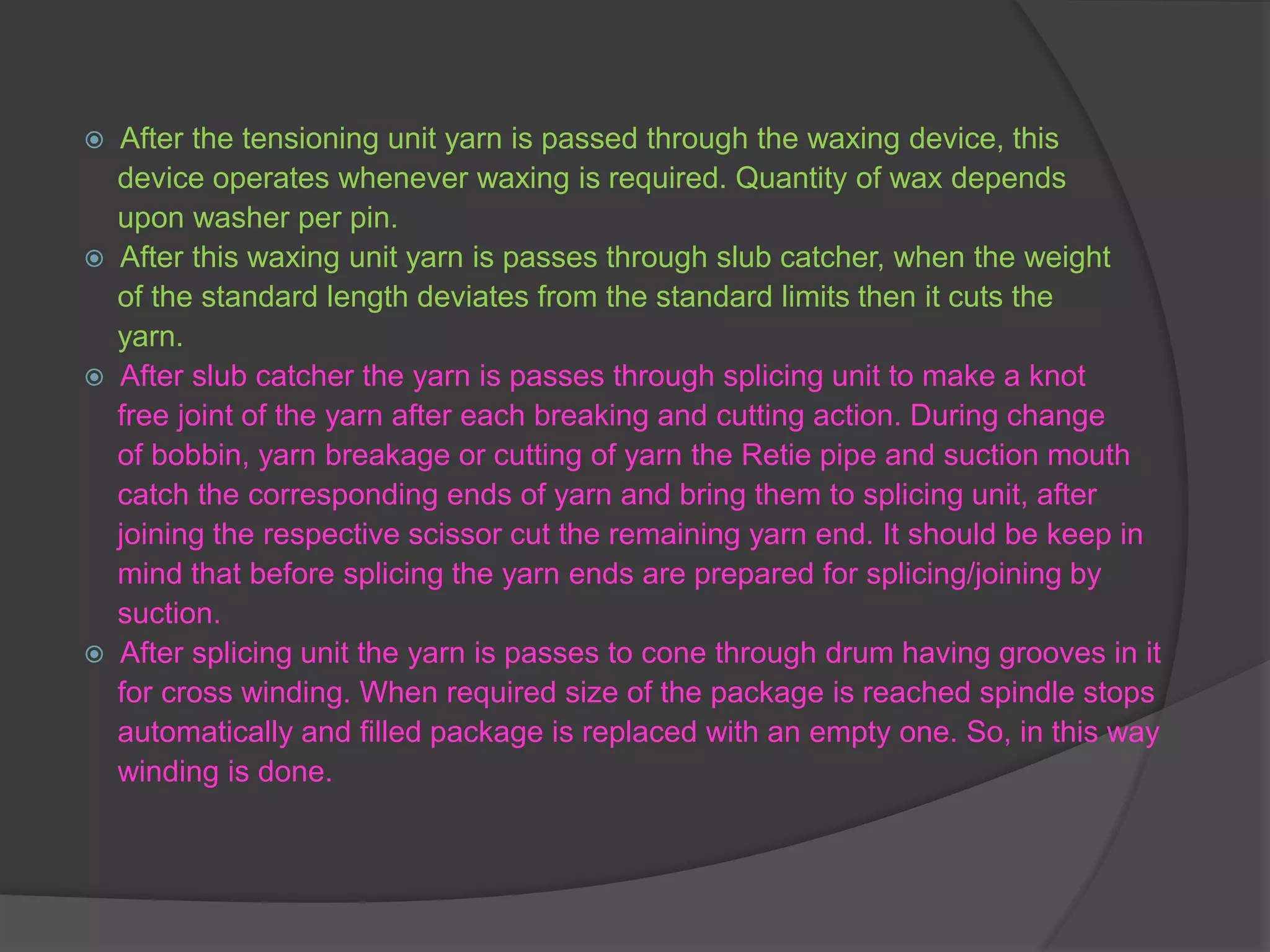
 After the tensioning unit yarn is passed through the waxing device, this 
device operates whenever waxing is required. Quantity of wax depends 
upon washer per pin. 
 After this waxing unit yarn is passes through slub catcher, when the weight 
of the standard length deviates from the standard limits then it cuts the 
yarn. 
 After slub catcher the yarn is passes through splicing unit to make a knot 
free joint of the yarn after each breaking and cutting action. During change 
of bobbin, yarn breakage or cutting of yarn the Retie pipe and suction mouth 
catch the corresponding ends of yarn and bring them to splicing unit, after 
joining the respective scissor cut the remaining yarn end. It should be keep in 
mind that before splicing the yarn ends are prepared for splicing/joining by 
suction. 
 After splicing unit the yarn is passes to cone through drum having grooves in it 
for cross winding. When required size of the package is reached spindle stops 
automatically and filled package is replaced with an empty one. So, in this way 
winding is done.
Auto cone winding

Auto cone winding

  • 2.
  • 3.
     Auto conecan be defined as “ It is a type of winding machine in which ring bobbins are converted into large cones with removing of spinning faults.  In order to form packages of the right weight for subsequent processing stages, the winding machine can be fed by ring-spun yarn bobbins.  Packages can thus be subdivided according to their shape: a. Cylindrical b . Conical, with tapers ranging from 5° 57° to 9° 15° c . Cones with tapers of up to 4° 20°  The yarn unwound from the package passes through yarn tensioning and control systems.  with the help of a grooved cylinder, yarn is wound evenly around the large package. 12te62@student.muet.edu.pk
  • 4.
     The yarnenters the recess in the cylinder, thus the rotary movement of the cylinder corresponds to the translation of the yarn.  Winding machines currently have independent heads with individually adjustable motors.  A modern winding machine can process yarns ranging from a count of Ne 2 to finer ones, at a winding speed of 400 to 2000 m/min.  Further functions of winding are to check the yarn and to eliminate any faults found. This is done by a process called “clearing” i.e., by passing the yarn through an electronic device, known as a yarn clearer which assesses it according to set parameters (fault section and length).  If these set values are exceeded the yarn is cut and spliced - a splice being deemed preferable to a fault.  Splicing is done using the air-splicing system or the Twin splicer system. 12te62@student.muet.edu.pk
  • 5.
     The machineis equipped with a special device to avoid the winding defect known as rib boning.  This problem is caused by irregular package formation following the deposition of too many coils in certain points.  Basically, the package-holding arm is made to effect an oscillating movement both in the vertical (A) and in the horizontal (B) planes (see Figure 35.2).  A modern winding machine carries out the following operations automatically; 1. Package doffing 2. Bobbin loading 3. Cone feeding 4. Linkage to spinning frames with bobbin picking up
  • 6.
     Waxing servesto lubricate the yarn, reducing to a minimum its coefficient of friction with the parts. with which it comes into contact.  This operation is normally carried out on yarns destined to be processed on knitwear machines, on which smooth running of yarns is essential.  Waxing is carried out on the winding machine, which is equipped with a positive-drive adjustable waxing system that guarantees constant waxing of the yarn.
  • 7.
    OBJECTIVES OFWINDING Requirementof atmospheric conditions of auto cone department  To prepare a bigger package (cone) from ring bobbin with specific length and weight.  To remove spinning faults.  To wax or condition the material.  To improve the quality of yarn.  In auto cone department the humidity and temperature are maintained according to the requirement throughout the year. Normally ranges are:-  Humidity% 55~80%  Temperature 22~39.5°C
  • 8.
    Parts of Autocone Cradle: Its function is to provide setting to cones/packages having package holders; it lies on the upper part of the machine on drum. Drum: It is a polished surface metallic drum slightly cone type, having different diameter at both sides i.e 90 mm on one side and 100 mm on other side. It has cut marks or grooves cut in to it at its surface to help the cross winding of packages. Its speed lies in range from 1000 to 2000 rpm. Magazine: Magazine is the main component of auto cone machine, its function is to hold/feed the cops for winding, its capacity lies up to 9 bobbins/cops per magazine. Bobbins are fed to bobbin peg one by one automatically, when one becomes empty and ejected from peg. Tension assembly: Tension assembly provides sufficient tension to the yarn during unwinding from cop to winding on to cones. Due to this sufficient tension is developed on cones and hence dense packages can be formed.
  • 9.
    Yarn clearer: Asthe spun yarn have various faults i.e thin and thick places, neps, hairiness, embedded particles of dust & leaves colouring matters and short and long defects etc .Its function is to remove these faults according to the given set values on electron touch screen panel to produce fault free yarn to meet the quality requirements. Tensor cutter: The purpose of cutter is to cut the yarn whenever required during winding process. Balloon breaker: Its function is to break the balloon/control the length of yarn balloon during yarn unwinding from the cop, because yarn is passes at high speed during winding operation and hence high tension developed. Therefore that tension becomes equalized by balloon breaker. Waste suction pipe: During yarn cutting and splicing it sucks the waste yarn. Bobbin plate: The function of bobbin plate is to rotate the bobbins one-by- one. Bobbin peg/holder: It is a disk type wheel; its function is to hold the filled bobbins for unwinding process. Lower scissor: When bobbin is completed it cut the yarn. Upper scissor: Its function is to take out yarn from lower scissor toward it self.
  • 10.
    Tension dip: Tensiondip is employed to give tension at yarn. Wax bush: To provide smooth surface to yarn wax is applied especially to the yarn intended for knitting, the function of wax bush is to apply wax to yarn to make its hairs sticky. Wax motor: Its function is to run wax bush continuously. Pre-cleaner: Its function is to gauge the yarn according to the requirements of count for instance; Ne. 16’s gauge =1.2 mm, Ne. 20’s = 1.0 mm & Ne. 30’s = 0.8mm Center flip: Its function is to provide path during bobbin change when one bobbin is completed. Mobile pipe: It sucks the yarn when it is break at the center. Suction mouth: Whenever yarn breaks during winding the package move in opposite direction with slow speed during that time it sucks the broken yarn end from the package and take it for splicing. Retie pipe: It take the yarn end from bobbin to ward splicing mechanism. Splicer: The splicing mechanism performs the knot free joining of the two yarn ends after yarn breakage or during any cutting operation for removal of faults. Hairiness nozzles: Hairiness nozzles are used to reduce yarn hairiness. Dust removal unit: It collects the dust and fiber fly.
  • 11.
    Working Principle ofAuto cone  The filled ring bobbins are placed in magazine and the end of each bobbin yarn is putted into the suction head of magazine for each spindle. The cones having some yarn wound upon them are also placed in to the holder of cradle on each spindle after that the spindle start running, the peg comes forward under the bobbin and bobbin falls upon it on the bobbin plate through centre flip. After this the Retie pipe takes the yarn from finger plate towards the splicing mechanism where it is joined with another end of yarn which is caught by the suction mouth from cone, during its reverse movement.  When unwinding of the yarn from ring bobbin starts it passes through balloon breaker whose function is to reduce the centrifugal forces acting upon the yarn, tension and rubbing of yarn with ring bobbin. Position of the balloon breaker depends upon the count of the yarn, for course count more height and for fine count less height is required. Yarn tension imparts great contribution towards package (cone) stability.
  • 12.
     After thetensioning unit yarn is passed through the waxing device, this device operates whenever waxing is required. Quantity of wax depends upon washer per pin.  After this waxing unit yarn is passes through slub catcher, when the weight of the standard length deviates from the standard limits then it cuts the yarn.  After slub catcher the yarn is passes through splicing unit to make a knot free joint of the yarn after each breaking and cutting action. During change of bobbin, yarn breakage or cutting of yarn the Retie pipe and suction mouth catch the corresponding ends of yarn and bring them to splicing unit, after joining the respective scissor cut the remaining yarn end. It should be keep in mind that before splicing the yarn ends are prepared for splicing/joining by suction.  After splicing unit the yarn is passes to cone through drum having grooves in it for cross winding. When required size of the package is reached spindle stops automatically and filled package is replaced with an empty one. So, in this way winding is done.