



Methods to determine the dye
chemistry.
DANISH RAJA
Danish_raja1@hotmail.com
CONTENTS:
• Introduction
• Methods to determine
dye structure.
• FTIR
• DSC
• IR spectroscopy.
• Examples
• Conclussion.
Methods to determine dye structure:
• There are main three methods to determine dye
chemistry
• 1) FTIR
• 2) DSC
• 3)IR SPECTROSCOPY
Introduction:
• A dye is a colored substance that has an affinity to the
substrate to which it is being applied. The dye is
generally applied in an aqueous solution and requires a
mordant to improve the fastness of the dye on the
fiber. Dyes have complex structures which are different
for each dye, making it different in application
,property , and substantivity to fibers. To understand
the chemical structure and functional groups ,there are
different methods to determine the dye chemistry.
FTIR
FT-IR stands for Fourier Transform Infra Red, the
preferred method of infrared spectroscopy. In infrared
spectroscopy, IR radiation is passed through a sample.
Some of the infrared radiation is absorbed by the sample
and some of it is passed through(transmitted). The
resulting spectrum represents the molecular absorption
and transmission, creating a molecular finger print of the
sample. Like a finger print of two unique molecular
structures produce the same infrared spectrum. This
makes infrared spectroscopy useful for several types of
analysis.
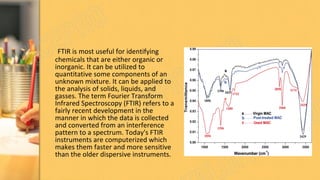
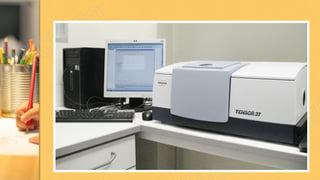
FTIR is most useful for identifying
chemicals that are either organic or
inorganic. It can be utilized to
quantitative some components of an
unknown mixture. It can be applied to
the analysis of solids, liquids, and
gasses. The term Fourier Transform
Infrared Spectroscopy (FTIR) refers to a
fairly recent development in the
manner in which the data is collected
and converted from an interference
pattern to a spectrum. Today's FTIR
instruments are computerized which
makes them faster and more sensitive
than the older dispersive instruments.
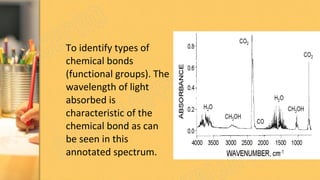
To identify types of
chemical bonds
(functional groups). The
wavelength of light
absorbed is
characteristic of the
chemical bond as can
be seen in this
annotated spectrum.
DSC:
DSC stands for differential scanning calorimeter .
calorimeter: It measures the heat into or out of a sample.
Differential calorimeter : It measures the heat into or out of a
sample relative to reference .it has two reactions endothermic and
exothermic reactions ,
• Endothermic heat flows into the sample
• Exothermic heat flows out of the sample.
DSC measures the temperature and heat flow associated with
transitions in materials as a function of time and temperature in a
controlled atmosphere .
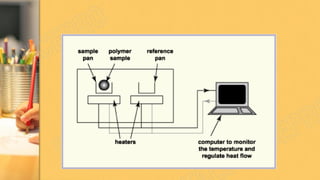
Metal
1
Metal
2
Metal
1
Metal
2
Sample Empty
Sample
Temperature
Reference
Temperature
Temperature
Difference =
Heat Flow
A “linear” heating profile even for isothermal methods
What can DSC measure?
• Glass transitions
• Melting and boiling points
• Crystallisation time and temperature
• Percent crystallinity
• Heats of fusion and reactions
• Specific heat capacity
• Oxidative/thermal stability
• Rate and degree of cure
• Reaction kinetics
• Purity
• chemicals
Infra Red Spectroscopy:
• Infrared (IR) spectroscopy is a technique used to identify the
structure of chemicals based on the interaction of atoms with infrared
radiation. Molecular vibration and rotation can be excited by the
absorption of radiation in an infra red region. Such molecular vibrations
and rotation scan be directly measured as absorbance in the infrared
spectrum. When infrared radiation interacts with an organic compound,
certain frequencies of energy are absorbed while others are
transmitted or reflected. The frequencies absorbed or transmitted are
determined by the functional groups present in the substance. The
molecular vibrations are localized with in the functional groups and do
not extend over the rest of the molecules. Such functional groups can
be identified by their absorption bands Hence, IR can be used as a
means for identifying the chemical composition of the material.
Example:
Determining Functional Groups of Commercially Available Ink-
Jet Printing Reactive Dye Using Infrared Spectroscopy:
In textile ink-jet printing, the chemical structures of the reactive
dyes present in the ink were not disclosed due to commercial
reasons. As a result, it was not easy for researchers to study the
actual chemical reaction between the dye molecules and the
fibers to determine the printing mechanism Therefore, the aim
of this study was to determine the chemical structure of the
functional groups available in one primary color Cyan of the
commercially available reactive dye used for ink-jet printing.
• Separating and Purifying Ink.
• Preparing a Sample for IR Analysis.
• Interpreting an IR Spectrum:
An IR spectrum consists of two main regions: (i) above
1500cm-1 there are absorption bands that can be assigned
to individual functional groups, whereas (ii) the region
below 1500cm-1 (the fingerprint region) contains many
bands and characterizes the molecule as a whole. The
bands within the fingerprint region, which arise from
functional groups, can be used for identification,
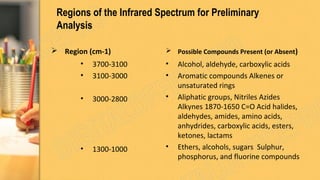
• Table 1. Regions of the Infrared Spectrum for
Preliminary Analysis (Lambert et al. 1998)
• Region (cm-1) Group Possible Compounds
Present (or Absent)
• 3700-3100 -OH Alcohol, aldehyde, carboxylic acids
• -NH Amides, amines
• ≡C-H Alkynes
• 3100-3000 =C-H Aromatic compounds
• -CH2 or –CH=CH- Alkenes or unsaturated rings
• 3000-2800 -CH, -CH2-, -CH3 Aliphatic groups
• 2800-2600 -CHO Aldehydes (Fermi doublet)
• 2700-2400 -POH Phosphorus compounds
• -SH Mercaptans and thiols
• -PH Phosphine
• 2400-2000 -C N Nitriles -N=N+=N- Azides -C C- Alkynes≡ ≡
Regions of the Infrared Spectrum for Preliminary
Analysis
 Region (cm-1)
• 3700-3100
• 3100-3000
• 3000-2800
• 1300-1000
• Alcohol, aldehyde, carboxylic acids
• Aromatic compounds Alkenes or
unsaturated rings
• Aliphatic groups, Nitriles Azides
Alkynes 1870-1650 C=O Acid halides,
aldehydes, amides, amino acids,
anhydrides, carboxylic acids, esters,
ketones, lactams
• Ethers, alcohols, sugars Sulphur,
phosphorus, and fluorine compounds
 Possible Compounds Present (or Absent)
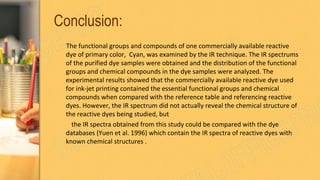
Conclusion:
The functional groups and compounds of one commercially available reactive
dye of primary color, Cyan, was examined by the IR technique. The IR spectrums
of the purified dye samples were obtained and the distribution of the functional
groups and chemical compounds in the dye samples were analyzed. The
experimental results showed that the commercially available reactive dye used
for ink-jet printing contained the essential functional groups and chemical
compounds when compared with the reference table and referencing reactive
dyes. However, the IR spectrum did not actually reveal the chemical structure of
the reactive dyes being studied, but
the IR spectra obtained from this study could be compared with the dye
databases (Yuen et al. 1996) which contain the IR spectra of reactive dyes with
known chemical structures .
Methods to determine the dye chemistry

Methods to determine the dye chemistry

  • 1.
    Methods to determinethe dye chemistry. DANISH RAJA Danish_raja1@hotmail.com
  • 2.
    CONTENTS: • Introduction • Methodsto determine dye structure. • FTIR • DSC • IR spectroscopy. • Examples • Conclussion.
  • 3.
    Methods to determinedye structure: • There are main three methods to determine dye chemistry • 1) FTIR • 2) DSC • 3)IR SPECTROSCOPY
  • 4.
    Introduction: • A dyeis a colored substance that has an affinity to the substrate to which it is being applied. The dye is generally applied in an aqueous solution and requires a mordant to improve the fastness of the dye on the fiber. Dyes have complex structures which are different for each dye, making it different in application ,property , and substantivity to fibers. To understand the chemical structure and functional groups ,there are different methods to determine the dye chemistry.
  • 5.
    FTIR FT-IR stands forFourier Transform Infra Red, the preferred method of infrared spectroscopy. In infrared spectroscopy, IR radiation is passed through a sample. Some of the infrared radiation is absorbed by the sample and some of it is passed through(transmitted). The resulting spectrum represents the molecular absorption and transmission, creating a molecular finger print of the sample. Like a finger print of two unique molecular structures produce the same infrared spectrum. This makes infrared spectroscopy useful for several types of analysis.
  • 6.
    FTIR is mostuseful for identifying chemicals that are either organic or inorganic. It can be utilized to quantitative some components of an unknown mixture. It can be applied to the analysis of solids, liquids, and gasses. The term Fourier Transform Infrared Spectroscopy (FTIR) refers to a fairly recent development in the manner in which the data is collected and converted from an interference pattern to a spectrum. Today's FTIR instruments are computerized which makes them faster and more sensitive than the older dispersive instruments.
  • 7.
    To identify typesof chemical bonds (functional groups). The wavelength of light absorbed is characteristic of the chemical bond as can be seen in this annotated spectrum.
  • 9.
    DSC: DSC stands fordifferential scanning calorimeter . calorimeter: It measures the heat into or out of a sample. Differential calorimeter : It measures the heat into or out of a sample relative to reference .it has two reactions endothermic and exothermic reactions , • Endothermic heat flows into the sample • Exothermic heat flows out of the sample. DSC measures the temperature and heat flow associated with transitions in materials as a function of time and temperature in a controlled atmosphere .
  • 10.
  • 11.
    What can DSCmeasure? • Glass transitions • Melting and boiling points • Crystallisation time and temperature • Percent crystallinity • Heats of fusion and reactions • Specific heat capacity • Oxidative/thermal stability • Rate and degree of cure • Reaction kinetics • Purity • chemicals
  • 13.
    Infra Red Spectroscopy: •Infrared (IR) spectroscopy is a technique used to identify the structure of chemicals based on the interaction of atoms with infrared radiation. Molecular vibration and rotation can be excited by the absorption of radiation in an infra red region. Such molecular vibrations and rotation scan be directly measured as absorbance in the infrared spectrum. When infrared radiation interacts with an organic compound, certain frequencies of energy are absorbed while others are transmitted or reflected. The frequencies absorbed or transmitted are determined by the functional groups present in the substance. The molecular vibrations are localized with in the functional groups and do not extend over the rest of the molecules. Such functional groups can be identified by their absorption bands Hence, IR can be used as a means for identifying the chemical composition of the material.
  • 14.
    Example: Determining Functional Groupsof Commercially Available Ink- Jet Printing Reactive Dye Using Infrared Spectroscopy: In textile ink-jet printing, the chemical structures of the reactive dyes present in the ink were not disclosed due to commercial reasons. As a result, it was not easy for researchers to study the actual chemical reaction between the dye molecules and the fibers to determine the printing mechanism Therefore, the aim of this study was to determine the chemical structure of the functional groups available in one primary color Cyan of the commercially available reactive dye used for ink-jet printing.
  • 15.
    • Separating andPurifying Ink. • Preparing a Sample for IR Analysis. • Interpreting an IR Spectrum: An IR spectrum consists of two main regions: (i) above 1500cm-1 there are absorption bands that can be assigned to individual functional groups, whereas (ii) the region below 1500cm-1 (the fingerprint region) contains many bands and characterizes the molecule as a whole. The bands within the fingerprint region, which arise from functional groups, can be used for identification,
  • 16.
    • Table 1.Regions of the Infrared Spectrum for Preliminary Analysis (Lambert et al. 1998) • Region (cm-1) Group Possible Compounds Present (or Absent) • 3700-3100 -OH Alcohol, aldehyde, carboxylic acids • -NH Amides, amines • ≡C-H Alkynes • 3100-3000 =C-H Aromatic compounds • -CH2 or –CH=CH- Alkenes or unsaturated rings • 3000-2800 -CH, -CH2-, -CH3 Aliphatic groups • 2800-2600 -CHO Aldehydes (Fermi doublet) • 2700-2400 -POH Phosphorus compounds • -SH Mercaptans and thiols • -PH Phosphine • 2400-2000 -C N Nitriles -N=N+=N- Azides -C C- Alkynes≡ ≡
  • 17.
    Regions of theInfrared Spectrum for Preliminary Analysis  Region (cm-1) • 3700-3100 • 3100-3000 • 3000-2800 • 1300-1000 • Alcohol, aldehyde, carboxylic acids • Aromatic compounds Alkenes or unsaturated rings • Aliphatic groups, Nitriles Azides Alkynes 1870-1650 C=O Acid halides, aldehydes, amides, amino acids, anhydrides, carboxylic acids, esters, ketones, lactams • Ethers, alcohols, sugars Sulphur, phosphorus, and fluorine compounds  Possible Compounds Present (or Absent)
  • 18.
    Conclusion: The functional groupsand compounds of one commercially available reactive dye of primary color, Cyan, was examined by the IR technique. The IR spectrums of the purified dye samples were obtained and the distribution of the functional groups and chemical compounds in the dye samples were analyzed. The experimental results showed that the commercially available reactive dye used for ink-jet printing contained the essential functional groups and chemical compounds when compared with the reference table and referencing reactive dyes. However, the IR spectrum did not actually reveal the chemical structure of the reactive dyes being studied, but the IR spectra obtained from this study could be compared with the dye databases (Yuen et al. 1996) which contain the IR spectra of reactive dyes with known chemical structures .