TPM Club India Jishu Hozen Pillar
Autonomous Maintenance – Step 4
jISu hojn ipØlr
Winding Machine (Process coner 21 C)
TPM Club India Jishu Hozen Pillar
What is Link Coner?
It is a winding machine that wounds yarn of Ring frame bobbin
to cones.Link coner is acting as the last member in the process
of spinning. It takes bobbin from Ring frame machines with the
link of CBF.
Main Features of Link coner
• High-quality packaging is provided by using the Perla-A hairiness-reducing
system and Muratec's winding control, Pac21. When combined with the PLC21
optical yarn length sensing device, this ensures high-productivity of packaged
yarn with properly wound lengths.
• It produces packages that improve quality and efficiency in subsequent
processes.
• link coner is a tray-to-tray system that eliminates the need to replace spinning
bobbins, allowing the spinning machine to directly supply the winder. Within the
field of directly-linked spinning frames and winders, Muratec's link coner is
particularly noted for its ability to improve product quality and productivity.
• Muratec's unique tray-to-tray system eliminates the danger of damaging the
yarn supplied during transportation or handling. It also reduces the risk of mixed
yarn counts
TPM Club India Jishu Hozen Pillar
What is Link Coner?
Main specifications
Machine type-Link Coner(L/C type),Bobbin tray(B/T) type,Magazine(M/G) type
Maximum winding speed- 2,000 m/min
Balloon control-Bal-Con(brush type kink preventor integrated type)
Drum drive-DBL motor(direct drive)
Drum-Pac21
Winding angle : 3 degree 30 minutes.
Splicer : Cassette type,VOS communication type
Cradle : It is designed to support P winding,Q winding and parallel winding
TPM Club India Jishu Hozen Pillar
Electrical Components
 Residual yarn feeler
Photoelectric feeler compatible with colored yarn
 Blower system
Equipped with power -saving inverter
 Winding Unit
Each winding unit has error/problem
indicating function
TPM Club India Jishu Hozen Pillar
Cradle
Drum
Yarn Clearer
Suction Mouth
Splicer Unit
Pre clearer
Retie pipe
Bal con
Photo electric yarn feeler
Unit Indicator
Yarn Tensioner
TPM Club India Jishu Hozen Pillar
List of Components
Nature of
Spare
S.No Item Description
Mechanical
1 Cradle
2 Drum
3 Suction Mouth
4 Splicer Unit
5 Yarn Tensioner
6 Retie pipe
7 Bal con
TPM Club India Jishu Hozen Pillar
Inspection Item List
Category Inspecti
on
Parts
N
o.
Inspection Item Inspection Methods Criterion
Mechanical
Cradle 1 Cradle pressure Visually on dial 0.2 bar
2 Cradle lifting Visually by stopping drum Drum should lift
3 Adapter jam Visually No jamming
Drum
1 Lapping Visually Lapping should not be
there
2 Scaling Visually No scaling on drum
grooves
Suction
Mouth
1 Mouth Visually No hard waste jam
2 Micro dust Visually No micro dust on
mouth
3 Setting with cone Visually It should be 2.5 to
3mm with 150 mm dia
cone
TPM Club India Jishu Hozen Pillar
Inspection Item List
Category Inspection
Parts
No. Inspection Item Inspection Methods Criterion
Mechanical Splicer
Unit
1 Knotter Visually No fly should be
there
2 Knot Visually Visual appearance
should be OK
3 Air pipe Visually No jamming in pipe
Yarn
tensor
1 Piston Visually Piston should work
smoothly
2 Tension opener Visually Tension opener
should open properly
Retie Pipe
1 Mouth Visually No hard waste jam
and micro dust
2 Spring By hand Spring should work
properly
Bal con
1 Bal con movement Visually No jerky movement
2 Bal con centering Visually Should be exactly on
centre of bobbin
TPM Club India Jishu Hozen Pillar
List of Components
Nature of Spare S.No Item Description
Electrical
1 VOS and quality assuring system
2 Fan Motor
3 Main control panel
4 Uster gauge
5 Bal con sensor
6 Auto doffer
7 CBF unit
8 CBF control Unit
9 Cop Robo
TPM Club India Jishu Hozen Pillar
Inspection Item List
TPM Club India Jishu Hozen Pillar
Inspection Item List
TPM Club India Jishu Hozen Pillar
Cradle
Cradle
Function-
Function of cradle is to hold the
empty cone and hold it till
desired amount of yarn is
wound on it.The aim is to grip
cone properly so as to facilitate
proper cone shape.It holds the
cone by means of P3 air
pipe.Whenever end break
occur the cradle lifts the cone
so as to facilitate splicing
process.
TPM Club India Jishu Hozen Pillar
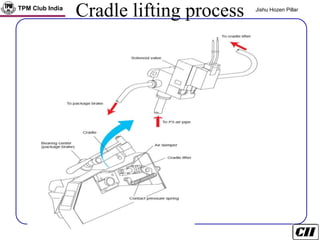
Cradle lifting process
• When the solenoid valve opens and air gets inside of the
cylinder, the piston rises and lifts up.At this time, steel
balls around the rod are clumped by wedge effect, and the
rod.
• Piston rising
When yarn breakage occurs during winding, air comes in
the cylinder and the cradle is listed up. Accordingly, the
package rises from the drum surface. keeps going up till
the piston hits the stopper.
TPM Club India Jishu Hozen Pillar
Cradle lifting process
TPM Club India Jishu Hozen Pillar
Cradle lifting process
TPM Club India Jishu Hozen Pillar
[1] The contact pressure is kept at a constant level by the balance between the air cylinder
and the spring.The P3 pressure is normally fixed at 0.45 MPa. This pressure presses the
cradle against the drum.
[2] The gradual contact pressure reduction spring generates reaction to the air cylinder. The
contact pressure curve and the contact pressure during pressure application are
determined by this spring and the eccentric pin.
Contact pressure during pressure application = P3 air pressure - gradual contact pressure
reduction spring force
[3] Contact pressure during winding-The contact pressure during winding can be set with the
P4 air pressure.
Contact pressure during winding = Contact pressure during pressure application - P4 air
pressure = P3 air pressure - Gradual contact pressure reduction spring - P4 air pressure.
[4] The contact pressure valve is a normally open (NO) type. Air flows under normal
conditions; however, it is stopped when the valve is energized, discharging the air from
the air cylinder.Use of this valve makes it possible to apply contact pressure at the start
of winding, after splicing, etc. The contact pressure application time can be set on the
VOS screen
Cradle lifting process
TPM Club India Jishu Hozen Pillar
DRUM
Function-
Function of drum is to guide yarn to cone with the help of
grooves on drum surface.Drum is driven by separate
motor.It can run upto speed of 2000 MPM,but generally it
runs at 1500-1600 MPM.There is possibility of making
different package shapes by using different grooved
drums.
TPM Club India Jishu Hozen Pillar
Drum parts
Drum
cover (L)
Drum
cover (R)
Drum Covers
Drum cover is fixed on drum.It facilitate
suction arm suction from cone at the time
of splicing process.The standard clearance
between the drum and the drum cover is
1.5 mm.
The drum feeler is intended to detect drum
entanglement due to yarn breakage near
the drum
at the initial stage.
Drum Feeler
Pac 21 Wind
Switch the drum wind by turn on or off the
wind switching solenoid
- Winding with 2.5 winds occurs when the
wind switching solenoid is normally off.
- Winding with 2 winds occurs when the
wind switching solenoid is normally on.
TPM Club India Jishu Hozen Pillar
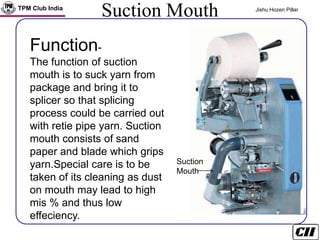
Suction Mouth
Suction
Mouth
Function-
The function of suction
mouth is to suck yarn from
package and bring it to
splicer so that splicing
process could be carried out
with retie pipe yarn. Suction
mouth consists of sand
paper and blade which grips
yarn.Special care is to be
taken of its cleaning as dust
on mouth may lead to high
mis % and thus low
effeciency.
TPM Club India Jishu Hozen Pillar
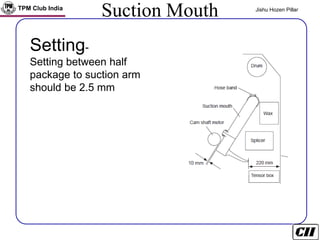
Suction Mouth
Setting-
Setting between half
package to suction arm
should be 2.5 mm
TPM Club India Jishu Hozen Pillar
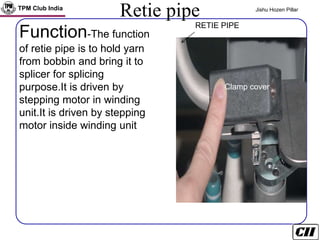
Retie pipe
RETIE PIPE
Clamp cover
Function-The function
of retie pipe is to hold yarn
from bobbin and bring it to
splicer for splicing
purpose.It is driven by
stepping motor in winding
unit.It is driven by stepping
motor inside winding unit
TPM Club India Jishu Hozen Pillar
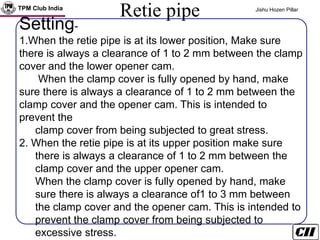
Retie pipe
Clamp cover
Setting-
1.When the retie pipe is at its lower position, Make sure
there is always a clearance of 1 to 2 mm between the clamp
cover and the lower opener cam.
When the clamp cover is fully opened by hand, make
sure there is always a clearance of 1 to 2 mm between the
clamp cover and the opener cam. This is intended to
prevent the
clamp cover from being subjected to great stress.
2. When the retie pipe is at its upper position make sure
there is always a clearance of 1 to 2 mm between the
clamp cover and the upper opener cam.
When the clamp cover is fully opened by hand, make
sure there is always a clearance of1 to 3 mm between
the clamp cover and the opener cam. This is intended to
prevent the clamp cover from being subjected to
excessive stress.
TPM Club India Jishu Hozen Pillar
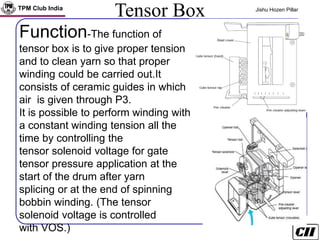
Tensor Box
Function-The function of
tensor box is to give proper tension
and to clean yarn so that proper
winding could be carried out.It
consists of ceramic guides in which
air is given through P3.
It is possible to perform winding with
a constant winding tension all the
time by controlling the
tensor solenoid voltage for gate
tensor pressure application at the
start of the drum after yarn
splicing or at the end of spinning
bobbin winding. (The tensor
solenoid voltage is controlled
with VOS.)
TPM Club India Jishu Hozen Pillar
Bal Con
Kink Preventer
Bal-Con PCB
Bal-Con Sensor
Function-
Bal-Con is intended to keep
the winding tension at a
constant level throughout
the operation of winding
yarn from the spinning
bobbin to a full package.
Bobbin tray type Bal-Con is
integrated with a kink
preventer. It includes a fixed
Bal-Con part, movable Bal-
Con part, sensor, air
cylinder, and brush.
TPM Club India Jishu Hozen Pillar
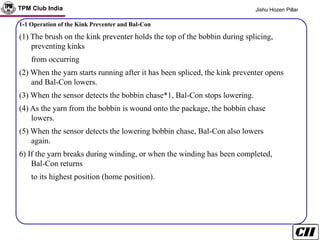
1-1 Operation of the Kink Preventer and Bal-Con
(1) The brush on the kink preventer holds the top of the bobbin during splicing,
preventing kinks
from occurring
(2) When the yarn starts running after it has been spliced, the kink preventer opens
and Bal-Con lowers.
(3) When the sensor detects the bobbin chase*1, Bal-Con stops lowering.
(4) As the yarn from the bobbin is wound onto the package, the bobbin chase
lowers.
(5) When the sensor detects the lowering bobbin chase, Bal-Con also lowers
again.
6) If the yarn breaks during winding, or when the winding has been completed,
Bal-Con returns
to its highest position (home position).
TPM Club India Jishu Hozen Pillar
Splicer
Function-
The Mach Splicer overlaps
the yarn ends from the
package and bobbin sides,
twists them together using
compressed air, and splices
them together without a
knot.The Mach Splicer can
join a broad range
of natural and synthetic
fibers of fine to coarse count
in the same time that it
takes a mechanical knotter
TPM Club India Jishu Hozen Pillar
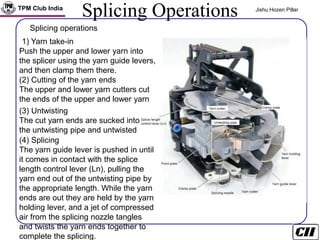
Splicing Operations
Splicing operations
(1) Yarn take-in
Push the upper and lower yarn into
the splicer using the yarn guide levers,
and then clamp them there.
(2) Cutting of the yarn ends
The upper and lower yarn cutters cut
the ends of the upper and lower yarn.
(3) Untwisting
The cut yarn ends are sucked into
the untwisting pipe and untwisted
(4) Splicing
The yarn guide lever is pushed in until
it comes in contact with the splice
length control lever (Ln), pulling the
yarn end out of the untwisting pipe by
the appropriate length. While the yarn
ends are out they are held by the yarn
holding lever, and a jet of compressed
air from the splicing nozzle tangles
and twists the yarn ends together to
complete the splicing.
TPM Club India Jishu Hozen Pillar
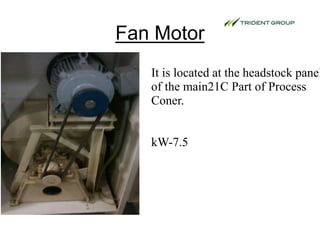
Fan Motor
It is located at the headstock panel
of the main21C Part of Process
Coner.
kW-7.5
Main Control Panel.
 Start button
 Bobbin conveyor switch
 Blow cleaner switch
 Cleaning mode button
 MAIN TEX MPC
 CM(CONTROL MASTER
 MAIN I/F PCB
 POWER FAIL PCB
 T1 TRANSFORMER
 Provides 100VAC for control circuits.
 T2 TRANSFORMER
 Power supply transformer,provides
 200VAC for converter power supply,con
 Motor and CBF.
 Stop button
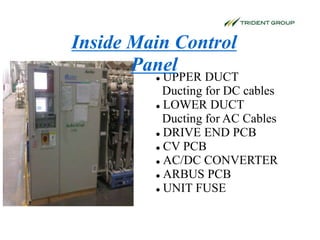
Inside Main Control Panel
 CB11-17
 PACKAGE CONVEYOR SWITCH
PANEL
 HUB PCB
 L4 PCB
 L1 TERMINAL
 L4 TERMINAL
 CONNECTOR PANEL
 L3 TERMINAL
 CB,MC,TH
 COOLING FAN
 PU1(power supply)
 PU2
 PU3
 Blower Inverter
For 7.5kW,11kW and 15kW blower
 UPPER DUCT
Ducting for DC cables
 LOWER DUCT
Ducting for AC Cables
 DRIVE END PCB
 CV PCB
 AC/DC CONVERTER
 ARBUS PCB
 UNIT FUSE
Inside Bus Duct
Inside Main Control
Panel
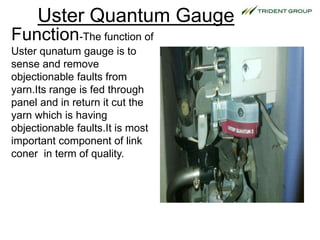
Uster Quantum Gauge
Function-The function of
Uster qunatum gauge is to
sense and remove
objectionable faults from
yarn.Its range is fed through
panel and in return it cut the
yarn which is having
objectionable faults.It is most
important component of link
coner in term of quality.
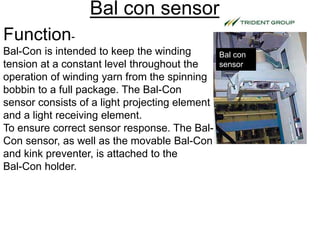
Bal con sensor
Bal con
sensor
Function-
Bal-Con is intended to keep the winding
tension at a constant level throughout the
operation of winding yarn from the spinning
bobbin to a full package. The Bal-Con
sensor consists of a light projecting element
and a light receiving element.
To ensure correct sensor response. The Bal-
Con sensor, as well as the movable Bal-Con
and kink preventer, is attached to the
Bal-Con holder.
Auto-Doffer
The Auto-Doffer(AD) device is attached to a
winder,No 21C Process Coner.This device
performs automatically (1) doffing package
that were would up to a preset Diameter or
yarn length by the winder and (2) supplying
new take-up tubes to enable the winder to
resume winding.
CBF Unit
CBF Unit acts as a connecting link
between Ring frame and Winding
machine.
It supply spinning-bobbins to the
Winding Units. The supply method
differs according to Machine type.
In Link Coner type,Spinning bobbins
are Automatically Supplied from CB
CBF Control Box
The following four PCB’s are set in the CBF
1) Remote I/O Master(MES-N2070-5**)
Controls the CBF and Parts Feeder(PF)
2) Remote I/O Slave (MES-N502A-40)
Receives instructions from the remote I/O
master and controls the input and output.
3) CBF I/F Printed Circuit Board(21G-N120A-
5**/6**)
*Sorts the input and output from the remote
I/O master.
*Supplies power to each PCB.
*Controls the emergency stop.
* Used as I/F relay with the spinning frame
4) Stepper Driver Printed Circuit Board(21G-
N1220-5**) Drives the stepping motor
Cop-Robo
This is a yarn end finder which
finds yarn end on a spinning
bobbin and inserts it into the top
hole of the bobbin. The bobbin
which has thus been readied is
automatically fed into the
winding unit.
Know Why
OVERALL INSPECTION JISHU HOZEN STEP-4
EQUIPMENT KNOW WHY SHEET
Machine System Assembly
Name
Component
name
Part Name Confirmed
By
Prepared
By
Date of
Preparation
Revision
Winding Maintena
nce
Balcon
assembly
Balcon Balcon Kshitij
Anand
Ashwani
Tripathi
08/03/2014
Basic function of this part:- To control the yarn balloon
Part Problem Specific Phenomenon
& Occurrences
Frequency of Occurrences
Balcon movement and
centering.
Improper movement
of balcon and
centering out.
No Inspection
Item
Inspection
Method
Criterion/ Standard Action in case of Problem Who OPL No KNOW-WHY: Why is Inspection
Necessary
1 Balcon By eyes Should be clean and it
should move
properly.Ring frame
bobbin should be in
center of balcon.
Check the Balcon
movement and centering
by inspection
↓
Operator Why to check the balcon
↓
If any problem observed,
Check the balcon assembly.
↓
Will lead to disturb movement and
centering
↓
If balcon is Jammed or
jerking motion observed
then stop the winding unit.
↓
Will lead to increase quality
defects.
↓
Check the Balcon
sensor,filter, and cable .
Will Cause the Unplanned Stoppage
of winding unit.
OVERALL INSPECTION JISHU HOZEN STEP-4
EQUIPMENT KNOW WHY SHEET
Machine System Assembly
Name
Component
name
Part Name Confirmed
By
Prepared
By
Date of
Preparation
Revision
Winding Maintena
nce
Cradle
assembly
Cradle Adopter Kshitij
Anand
Ashwani
Tripathi
08/03/14
Basic function of this part:- To hold the cone by adopter.
Part Problem Specific Phenomenon
& Occurrences
Frequency of Occurrences
To accumulate fly/hard
waste in adopter
During yarn
breakage,there is
chances of yarn
lapping on adopter.
Once in a shift.
No Inspection
Item
Inspection
Method
Criterion/ Standard Action in case of Problem Who OPL No KNOW-WHY: Why is Inspection
Necessary
1 Adopter By eyes Should be clean and it
should not be jam.
Check the adopter jam by
inspection
↓
Operator Why to check the Adopter
↓
If any problem observed,
Check the adopter.
↓
Will lead to fly/hard waste
accumulation in adopter.
↓
If Adopter is Jammed,
Remove the Fly/hard waste
from adopter and Recheck
↓
Will lead to increase quality
defects.
↓
Check the Cradle assembly
again and Recheck the
Adopter movement if the
Problem Still Exist then
stop the Winding unit &
Clean with cloth and hands.
Will Cauase the Unplanned
Stoppage of winding unit.
OVERALL INSPECTION JISHU HOZEN STEP-4
EQUIPMENT KNOW WHY SHEET
Machine System Assembly
Name
Component
name
Part Name Confirmed
By
Prepared
By
Date of
Preparation
Revision
Winding Maintena
nce
Drum Drum Drum Ashutosh
Kumar
Ashwani
Tripathi
08/03/14
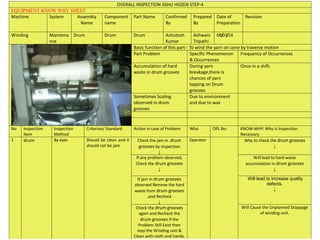
Basic function of this part:- To wind the yarn on cone by traverse motion
Part Problem Specific Phenomenon
& Occurrences
Frequency of Occurrences
Accumulation of hard
waste in drum grooves
During yarn
breakage,there is
chances of yarn
lapping on Drum
grooves
Once in a shift.
Sometimes Scaling
observed in drum
grooves
Due to environment
and due to wax
No Inspection
Item
Inspection
Method
Criterion/ Standard Action in case of Problem Who OPL No KNOW-WHY: Why is Inspection
Necessary
1 drum By eyes Should be clean and it
should not be jam.
Check the jam in drum
grooves by inspection
↓
Operator Why to check the drum grooves
↓
If any problem observed,
Check the drum grooves
↓
Will lead to hard waste
accumulation in drum grooves
↓
If jam in drum grooves
observed Remove the hard
waste from drum grooves
,and Recheck
↓
Will lead to increase quality
defects.
↓
Check the drum grooves
again and Recheck the
drum grooves if the
Problem Still Exist then
stop the Winding unit &
Clean with cloth and hands.
Will Cause the Unplanned Stoppage
of winding unit.
OVERALL INSPECTION JISHU HOZEN STEP-4
EQUIPMENT KNOW WHY SHEET
Machine System Assembly
Name
Component
name
Part Name Confirmed
By
Prepared
By
Date of
Preparation
Revision
Winding Maintena
nce
Gripper arm Gripper arm Gripper arm Ashutosh
Kumar
Pradeep
srivastav
08/03/14
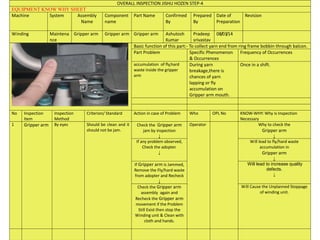
Basic function of this part:- To collect yarn end from ring frame bobbin through balcon.
Part Problem Specific Phenomenon
& Occurrences
Frequency of Occurrences
accumulation of fly,hard
waste inside the gripper
arm
During yarn
breakage,there is
chances of yarn
lapping or fly
accumulation on
Gripper arm mouth.
Once in a shift.
No Inspection
Item
Inspection
Method
Criterion/ Standard Action in case of Problem Who OPL No KNOW-WHY: Why is Inspection
Necessary
1 Gripper arm By eyes Should be clean and it
should not be jam.
Check the Gripper arm
jam by inspection
↓
Operator Why to check the
Gripper arm
↓
If any problem observed,
Check the adopter.
↓
Will lead to fly/hard waste
accumulation in
Gripper arm
↓
If Gripper arm is Jammed,
Remove the Fly/hard waste
from adopter and Recheck
↓
Will lead to increase quality
defects.
↓
Check the Gripper arm
assembly again and
Recheck the Gripper arm
movement if the Problem
Still Exist then stop the
Winding unit & Clean with
cloth and hands.
Will Cause the Unplanned Stoppage
of winding unit.
OVERALL INSPECTION JISHU HOZEN STEP-4
EQUIPMENT KNOW WHY SHEET
Machine System Assembly
Name
Component
name
Part Name Confirmed
By
Prepared
By
Date of
Preparation
Revision
Winding Maintena
nce
Splicer
assembly
Splicer Splicer Kshitij
Anand
Sudip
Khamrui
08/03/14
Basic function of this part:- To splice the yarn after breakage.
Part Problem Specific Phenomenon
& Occurrences
Frequency of Occurrences
To accumulate fly in splicer
unit.
During yarn
breakage,there is
chances of fly
accumulation on
splicer.
Once in a shift.
No Inspection
Item
Inspection
Method
Criterion/ Standard Action in case of Problem Who OPL No KNOW-WHY: Why is Inspection
Necessary
1 Splicer
assembly
By eyes Should be clean and it
should not be jam.
Check the splicing unit
jam by inspection
↓
Operator Why to check the Splicer unit.
↓
If any problem observed,
Check the splicing unit.
↓
Will lead to fly accumulation in
Splicing zone.
↓
If splicing unit is Jammed,
Remove the Fly .
↓
Will lead to increase quality
defects(as week splice and poor
appearance).
↓
Check the splicing unit
again and stop the winding
unit. check the setting of
nozzles ,LN lever and prism
.
Will Cause the Unplanned Stoppage
of winding unit.
OVERALL INSPECTION JISHU HOZEN STEP-4
EQUIPMENT KNOW WHY SHEET
Machine System Assembly
Name
Component
name
Part Name Confirmed
By
Prepared
By
Date of
Preparation
Revision
Winding Maintena
nce
suction arm suction arm suction arm Kshitij
Anand
Sudip
Khamrui
08/03/14
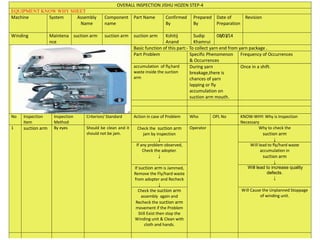
Basic function of this part:- To collect yarn end from yarn package .
Part Problem Specific Phenomenon
& Occurrences
Frequency of Occurrences
accumulation of fly,hard
waste inside the suction
arm
During yarn
breakage,there is
chances of yarn
lapping or fly
accumulation on
suction arm mouth.
Once in a shift.
No Inspection
Item
Inspection
Method
Criterion/ Standard Action in case of Problem Who OPL No KNOW-WHY: Why is Inspection
Necessary
1 suction arm By eyes Should be clean and it
should not be jam.
Check the suction arm
jam by inspection
↓
Operator Why to check the
suction arm
↓
If any problem observed,
Check the adopter.
↓
Will lead to fly/hard waste
accumulation in
suction arm
↓
If suction arm is Jammed,
Remove the Fly/hard waste
from adopter and Recheck
↓
Will lead to increase quality
defects.
↓
Check the suction arm
assembly again and
Recheck the suction arm
movement if the Problem
Still Exist then stop the
Winding unit & Clean with
cloth and hands.
Will Cause the Unplanned Stoppage
of winding unit.
OVERALL INSPECTION JISHU HOZEN STEP-4
EQUIPMENT KNOW WHY SHEET
Machine System Assembly
Name
Component
name
Part Name Confirmed
By
Prepared
By
Date of
Preparation
Revision
Winding Maintena
nce
Tension
assembly
Tension
finger .
Tension
finger.
Ashutosh
Kumar
Pradeep
Srivastav
08/03/14
Basic function of this part:- To maintain package hardness.
Part Problem Specific Phenomenon
& Occurrences
Frequency of Occurrences
To accumulate fly/hard
waste in Tension finger.
During yarn
breakage,there is
chances of yarn
lapping in tension
finger.
Once in a shift.
Jam in Tension piston. Improper
greasing(352p)
No Inspection
Item
Inspection
Method
Criterion/ Standard Action in case of Problem Who OPL No KNOW-WHY: Why is Inspection
Necessary
1 Tension
assembly
By eyes,hand
and hardness
tester.
Should be clean and it
should not be
jam.there should be
proper movement of
finger.
Check the Tension
assembly jam and
movement by inspection
↓
Operator Why to check the Tension assembly
↓
If any problem observed,
Check the
Tension assembly
↓
Will lead to fly/hard waste
accumulation in
Tension assembly
↓
If Tension assembly is
Jammed, Remove the
Fly/hard waste from
Tension assembly and
Recheck
↓
Will lead to increase quality
defects.(loose cone,bunch cone
etc)
↓
Check the Tension
assembly again Recheck
the Tension assembly
movement if the Problem
Still Exist then stop the
Winding unit & Clean with
cloth and hands.
Will Cause the Unplanned Stoppage
of winding unit.

Winding step-4.ppt

  • 1.
    TPM Club IndiaJishu Hozen Pillar Autonomous Maintenance – Step 4 jISu hojn ipØlr Winding Machine (Process coner 21 C)
  • 2.
    TPM Club IndiaJishu Hozen Pillar What is Link Coner? It is a winding machine that wounds yarn of Ring frame bobbin to cones.Link coner is acting as the last member in the process of spinning. It takes bobbin from Ring frame machines with the link of CBF. Main Features of Link coner • High-quality packaging is provided by using the Perla-A hairiness-reducing system and Muratec's winding control, Pac21. When combined with the PLC21 optical yarn length sensing device, this ensures high-productivity of packaged yarn with properly wound lengths. • It produces packages that improve quality and efficiency in subsequent processes. • link coner is a tray-to-tray system that eliminates the need to replace spinning bobbins, allowing the spinning machine to directly supply the winder. Within the field of directly-linked spinning frames and winders, Muratec's link coner is particularly noted for its ability to improve product quality and productivity. • Muratec's unique tray-to-tray system eliminates the danger of damaging the yarn supplied during transportation or handling. It also reduces the risk of mixed yarn counts
  • 3.
    TPM Club IndiaJishu Hozen Pillar What is Link Coner? Main specifications Machine type-Link Coner(L/C type),Bobbin tray(B/T) type,Magazine(M/G) type Maximum winding speed- 2,000 m/min Balloon control-Bal-Con(brush type kink preventor integrated type) Drum drive-DBL motor(direct drive) Drum-Pac21 Winding angle : 3 degree 30 minutes. Splicer : Cassette type,VOS communication type Cradle : It is designed to support P winding,Q winding and parallel winding
  • 4.
    TPM Club IndiaJishu Hozen Pillar Electrical Components  Residual yarn feeler Photoelectric feeler compatible with colored yarn  Blower system Equipped with power -saving inverter  Winding Unit Each winding unit has error/problem indicating function
  • 5.
    TPM Club IndiaJishu Hozen Pillar Cradle Drum Yarn Clearer Suction Mouth Splicer Unit Pre clearer Retie pipe Bal con Photo electric yarn feeler Unit Indicator Yarn Tensioner
  • 6.
    TPM Club IndiaJishu Hozen Pillar List of Components Nature of Spare S.No Item Description Mechanical 1 Cradle 2 Drum 3 Suction Mouth 4 Splicer Unit 5 Yarn Tensioner 6 Retie pipe 7 Bal con
  • 7.
    TPM Club IndiaJishu Hozen Pillar Inspection Item List Category Inspecti on Parts N o. Inspection Item Inspection Methods Criterion Mechanical Cradle 1 Cradle pressure Visually on dial 0.2 bar 2 Cradle lifting Visually by stopping drum Drum should lift 3 Adapter jam Visually No jamming Drum 1 Lapping Visually Lapping should not be there 2 Scaling Visually No scaling on drum grooves Suction Mouth 1 Mouth Visually No hard waste jam 2 Micro dust Visually No micro dust on mouth 3 Setting with cone Visually It should be 2.5 to 3mm with 150 mm dia cone
  • 8.
    TPM Club IndiaJishu Hozen Pillar Inspection Item List Category Inspection Parts No. Inspection Item Inspection Methods Criterion Mechanical Splicer Unit 1 Knotter Visually No fly should be there 2 Knot Visually Visual appearance should be OK 3 Air pipe Visually No jamming in pipe Yarn tensor 1 Piston Visually Piston should work smoothly 2 Tension opener Visually Tension opener should open properly Retie Pipe 1 Mouth Visually No hard waste jam and micro dust 2 Spring By hand Spring should work properly Bal con 1 Bal con movement Visually No jerky movement 2 Bal con centering Visually Should be exactly on centre of bobbin
  • 9.
    TPM Club IndiaJishu Hozen Pillar List of Components Nature of Spare S.No Item Description Electrical 1 VOS and quality assuring system 2 Fan Motor 3 Main control panel 4 Uster gauge 5 Bal con sensor 6 Auto doffer 7 CBF unit 8 CBF control Unit 9 Cop Robo
  • 10.
    TPM Club IndiaJishu Hozen Pillar Inspection Item List
  • 11.
    TPM Club IndiaJishu Hozen Pillar Inspection Item List
  • 12.
    TPM Club IndiaJishu Hozen Pillar
  • 13.
    TPM Club IndiaJishu Hozen Pillar Cradle Cradle Function- Function of cradle is to hold the empty cone and hold it till desired amount of yarn is wound on it.The aim is to grip cone properly so as to facilitate proper cone shape.It holds the cone by means of P3 air pipe.Whenever end break occur the cradle lifts the cone so as to facilitate splicing process.
  • 14.
    TPM Club IndiaJishu Hozen Pillar Cradle lifting process • When the solenoid valve opens and air gets inside of the cylinder, the piston rises and lifts up.At this time, steel balls around the rod are clumped by wedge effect, and the rod. • Piston rising When yarn breakage occurs during winding, air comes in the cylinder and the cradle is listed up. Accordingly, the package rises from the drum surface. keeps going up till the piston hits the stopper.
  • 15.
    TPM Club IndiaJishu Hozen Pillar Cradle lifting process
  • 16.
    TPM Club IndiaJishu Hozen Pillar Cradle lifting process
  • 17.
    TPM Club IndiaJishu Hozen Pillar [1] The contact pressure is kept at a constant level by the balance between the air cylinder and the spring.The P3 pressure is normally fixed at 0.45 MPa. This pressure presses the cradle against the drum. [2] The gradual contact pressure reduction spring generates reaction to the air cylinder. The contact pressure curve and the contact pressure during pressure application are determined by this spring and the eccentric pin. Contact pressure during pressure application = P3 air pressure - gradual contact pressure reduction spring force [3] Contact pressure during winding-The contact pressure during winding can be set with the P4 air pressure. Contact pressure during winding = Contact pressure during pressure application - P4 air pressure = P3 air pressure - Gradual contact pressure reduction spring - P4 air pressure. [4] The contact pressure valve is a normally open (NO) type. Air flows under normal conditions; however, it is stopped when the valve is energized, discharging the air from the air cylinder.Use of this valve makes it possible to apply contact pressure at the start of winding, after splicing, etc. The contact pressure application time can be set on the VOS screen Cradle lifting process
  • 18.
    TPM Club IndiaJishu Hozen Pillar DRUM Function- Function of drum is to guide yarn to cone with the help of grooves on drum surface.Drum is driven by separate motor.It can run upto speed of 2000 MPM,but generally it runs at 1500-1600 MPM.There is possibility of making different package shapes by using different grooved drums.
  • 19.
    TPM Club IndiaJishu Hozen Pillar Drum parts Drum cover (L) Drum cover (R) Drum Covers Drum cover is fixed on drum.It facilitate suction arm suction from cone at the time of splicing process.The standard clearance between the drum and the drum cover is 1.5 mm. The drum feeler is intended to detect drum entanglement due to yarn breakage near the drum at the initial stage. Drum Feeler Pac 21 Wind Switch the drum wind by turn on or off the wind switching solenoid - Winding with 2.5 winds occurs when the wind switching solenoid is normally off. - Winding with 2 winds occurs when the wind switching solenoid is normally on.
  • 20.
    TPM Club IndiaJishu Hozen Pillar Suction Mouth Suction Mouth Function- The function of suction mouth is to suck yarn from package and bring it to splicer so that splicing process could be carried out with retie pipe yarn. Suction mouth consists of sand paper and blade which grips yarn.Special care is to be taken of its cleaning as dust on mouth may lead to high mis % and thus low effeciency.
  • 21.
    TPM Club IndiaJishu Hozen Pillar Suction Mouth Setting- Setting between half package to suction arm should be 2.5 mm
  • 22.
    TPM Club IndiaJishu Hozen Pillar Retie pipe RETIE PIPE Clamp cover Function-The function of retie pipe is to hold yarn from bobbin and bring it to splicer for splicing purpose.It is driven by stepping motor in winding unit.It is driven by stepping motor inside winding unit
  • 23.
    TPM Club IndiaJishu Hozen Pillar Retie pipe Clamp cover Setting- 1.When the retie pipe is at its lower position, Make sure there is always a clearance of 1 to 2 mm between the clamp cover and the lower opener cam. When the clamp cover is fully opened by hand, make sure there is always a clearance of 1 to 2 mm between the clamp cover and the opener cam. This is intended to prevent the clamp cover from being subjected to great stress. 2. When the retie pipe is at its upper position make sure there is always a clearance of 1 to 2 mm between the clamp cover and the upper opener cam. When the clamp cover is fully opened by hand, make sure there is always a clearance of1 to 3 mm between the clamp cover and the opener cam. This is intended to prevent the clamp cover from being subjected to excessive stress.
  • 24.
    TPM Club IndiaJishu Hozen Pillar Tensor Box Function-The function of tensor box is to give proper tension and to clean yarn so that proper winding could be carried out.It consists of ceramic guides in which air is given through P3. It is possible to perform winding with a constant winding tension all the time by controlling the tensor solenoid voltage for gate tensor pressure application at the start of the drum after yarn splicing or at the end of spinning bobbin winding. (The tensor solenoid voltage is controlled with VOS.)
  • 25.
    TPM Club IndiaJishu Hozen Pillar Bal Con Kink Preventer Bal-Con PCB Bal-Con Sensor Function- Bal-Con is intended to keep the winding tension at a constant level throughout the operation of winding yarn from the spinning bobbin to a full package. Bobbin tray type Bal-Con is integrated with a kink preventer. It includes a fixed Bal-Con part, movable Bal- Con part, sensor, air cylinder, and brush.
  • 26.
    TPM Club IndiaJishu Hozen Pillar 1-1 Operation of the Kink Preventer and Bal-Con (1) The brush on the kink preventer holds the top of the bobbin during splicing, preventing kinks from occurring (2) When the yarn starts running after it has been spliced, the kink preventer opens and Bal-Con lowers. (3) When the sensor detects the bobbin chase*1, Bal-Con stops lowering. (4) As the yarn from the bobbin is wound onto the package, the bobbin chase lowers. (5) When the sensor detects the lowering bobbin chase, Bal-Con also lowers again. 6) If the yarn breaks during winding, or when the winding has been completed, Bal-Con returns to its highest position (home position).
  • 27.
    TPM Club IndiaJishu Hozen Pillar Splicer Function- The Mach Splicer overlaps the yarn ends from the package and bobbin sides, twists them together using compressed air, and splices them together without a knot.The Mach Splicer can join a broad range of natural and synthetic fibers of fine to coarse count in the same time that it takes a mechanical knotter
  • 28.
    TPM Club IndiaJishu Hozen Pillar Splicing Operations Splicing operations (1) Yarn take-in Push the upper and lower yarn into the splicer using the yarn guide levers, and then clamp them there. (2) Cutting of the yarn ends The upper and lower yarn cutters cut the ends of the upper and lower yarn. (3) Untwisting The cut yarn ends are sucked into the untwisting pipe and untwisted (4) Splicing The yarn guide lever is pushed in until it comes in contact with the splice length control lever (Ln), pulling the yarn end out of the untwisting pipe by the appropriate length. While the yarn ends are out they are held by the yarn holding lever, and a jet of compressed air from the splicing nozzle tangles and twists the yarn ends together to complete the splicing.
  • 29.
    TPM Club IndiaJishu Hozen Pillar
  • 30.
    Fan Motor It islocated at the headstock panel of the main21C Part of Process Coner. kW-7.5
  • 31.
    Main Control Panel. Start button  Bobbin conveyor switch  Blow cleaner switch  Cleaning mode button  MAIN TEX MPC  CM(CONTROL MASTER  MAIN I/F PCB  POWER FAIL PCB  T1 TRANSFORMER  Provides 100VAC for control circuits.  T2 TRANSFORMER  Power supply transformer,provides  200VAC for converter power supply,con  Motor and CBF.  Stop button
  • 32.
    Inside Main ControlPanel  CB11-17  PACKAGE CONVEYOR SWITCH PANEL  HUB PCB  L4 PCB  L1 TERMINAL  L4 TERMINAL  CONNECTOR PANEL  L3 TERMINAL  CB,MC,TH  COOLING FAN  PU1(power supply)  PU2  PU3  Blower Inverter For 7.5kW,11kW and 15kW blower
  • 33.
     UPPER DUCT Ductingfor DC cables  LOWER DUCT Ducting for AC Cables  DRIVE END PCB  CV PCB  AC/DC CONVERTER  ARBUS PCB  UNIT FUSE Inside Bus Duct Inside Main Control Panel
  • 34.
    Uster Quantum Gauge Function-Thefunction of Uster qunatum gauge is to sense and remove objectionable faults from yarn.Its range is fed through panel and in return it cut the yarn which is having objectionable faults.It is most important component of link coner in term of quality.
  • 35.
    Bal con sensor Balcon sensor Function- Bal-Con is intended to keep the winding tension at a constant level throughout the operation of winding yarn from the spinning bobbin to a full package. The Bal-Con sensor consists of a light projecting element and a light receiving element. To ensure correct sensor response. The Bal- Con sensor, as well as the movable Bal-Con and kink preventer, is attached to the Bal-Con holder.
  • 36.
    Auto-Doffer The Auto-Doffer(AD) deviceis attached to a winder,No 21C Process Coner.This device performs automatically (1) doffing package that were would up to a preset Diameter or yarn length by the winder and (2) supplying new take-up tubes to enable the winder to resume winding.
  • 37.
    CBF Unit CBF Unitacts as a connecting link between Ring frame and Winding machine. It supply spinning-bobbins to the Winding Units. The supply method differs according to Machine type. In Link Coner type,Spinning bobbins are Automatically Supplied from CB
  • 38.
    CBF Control Box Thefollowing four PCB’s are set in the CBF 1) Remote I/O Master(MES-N2070-5**) Controls the CBF and Parts Feeder(PF) 2) Remote I/O Slave (MES-N502A-40) Receives instructions from the remote I/O master and controls the input and output. 3) CBF I/F Printed Circuit Board(21G-N120A- 5**/6**) *Sorts the input and output from the remote I/O master. *Supplies power to each PCB. *Controls the emergency stop. * Used as I/F relay with the spinning frame 4) Stepper Driver Printed Circuit Board(21G- N1220-5**) Drives the stepping motor
  • 39.
    Cop-Robo This is ayarn end finder which finds yarn end on a spinning bobbin and inserts it into the top hole of the bobbin. The bobbin which has thus been readied is automatically fed into the winding unit.
  • 41.
    Know Why OVERALL INSPECTIONJISHU HOZEN STEP-4 EQUIPMENT KNOW WHY SHEET Machine System Assembly Name Component name Part Name Confirmed By Prepared By Date of Preparation Revision Winding Maintena nce Balcon assembly Balcon Balcon Kshitij Anand Ashwani Tripathi 08/03/2014 Basic function of this part:- To control the yarn balloon Part Problem Specific Phenomenon & Occurrences Frequency of Occurrences Balcon movement and centering. Improper movement of balcon and centering out. No Inspection Item Inspection Method Criterion/ Standard Action in case of Problem Who OPL No KNOW-WHY: Why is Inspection Necessary 1 Balcon By eyes Should be clean and it should move properly.Ring frame bobbin should be in center of balcon. Check the Balcon movement and centering by inspection ↓ Operator Why to check the balcon ↓ If any problem observed, Check the balcon assembly. ↓ Will lead to disturb movement and centering ↓ If balcon is Jammed or jerking motion observed then stop the winding unit. ↓ Will lead to increase quality defects. ↓ Check the Balcon sensor,filter, and cable . Will Cause the Unplanned Stoppage of winding unit.
  • 42.
    OVERALL INSPECTION JISHUHOZEN STEP-4 EQUIPMENT KNOW WHY SHEET Machine System Assembly Name Component name Part Name Confirmed By Prepared By Date of Preparation Revision Winding Maintena nce Cradle assembly Cradle Adopter Kshitij Anand Ashwani Tripathi 08/03/14 Basic function of this part:- To hold the cone by adopter. Part Problem Specific Phenomenon & Occurrences Frequency of Occurrences To accumulate fly/hard waste in adopter During yarn breakage,there is chances of yarn lapping on adopter. Once in a shift. No Inspection Item Inspection Method Criterion/ Standard Action in case of Problem Who OPL No KNOW-WHY: Why is Inspection Necessary 1 Adopter By eyes Should be clean and it should not be jam. Check the adopter jam by inspection ↓ Operator Why to check the Adopter ↓ If any problem observed, Check the adopter. ↓ Will lead to fly/hard waste accumulation in adopter. ↓ If Adopter is Jammed, Remove the Fly/hard waste from adopter and Recheck ↓ Will lead to increase quality defects. ↓ Check the Cradle assembly again and Recheck the Adopter movement if the Problem Still Exist then stop the Winding unit & Clean with cloth and hands. Will Cauase the Unplanned Stoppage of winding unit.
  • 43.
    OVERALL INSPECTION JISHUHOZEN STEP-4 EQUIPMENT KNOW WHY SHEET Machine System Assembly Name Component name Part Name Confirmed By Prepared By Date of Preparation Revision Winding Maintena nce Drum Drum Drum Ashutosh Kumar Ashwani Tripathi 08/03/14 Basic function of this part:- To wind the yarn on cone by traverse motion Part Problem Specific Phenomenon & Occurrences Frequency of Occurrences Accumulation of hard waste in drum grooves During yarn breakage,there is chances of yarn lapping on Drum grooves Once in a shift. Sometimes Scaling observed in drum grooves Due to environment and due to wax No Inspection Item Inspection Method Criterion/ Standard Action in case of Problem Who OPL No KNOW-WHY: Why is Inspection Necessary 1 drum By eyes Should be clean and it should not be jam. Check the jam in drum grooves by inspection ↓ Operator Why to check the drum grooves ↓ If any problem observed, Check the drum grooves ↓ Will lead to hard waste accumulation in drum grooves ↓ If jam in drum grooves observed Remove the hard waste from drum grooves ,and Recheck ↓ Will lead to increase quality defects. ↓ Check the drum grooves again and Recheck the drum grooves if the Problem Still Exist then stop the Winding unit & Clean with cloth and hands. Will Cause the Unplanned Stoppage of winding unit.
  • 44.
    OVERALL INSPECTION JISHUHOZEN STEP-4 EQUIPMENT KNOW WHY SHEET Machine System Assembly Name Component name Part Name Confirmed By Prepared By Date of Preparation Revision Winding Maintena nce Gripper arm Gripper arm Gripper arm Ashutosh Kumar Pradeep srivastav 08/03/14 Basic function of this part:- To collect yarn end from ring frame bobbin through balcon. Part Problem Specific Phenomenon & Occurrences Frequency of Occurrences accumulation of fly,hard waste inside the gripper arm During yarn breakage,there is chances of yarn lapping or fly accumulation on Gripper arm mouth. Once in a shift. No Inspection Item Inspection Method Criterion/ Standard Action in case of Problem Who OPL No KNOW-WHY: Why is Inspection Necessary 1 Gripper arm By eyes Should be clean and it should not be jam. Check the Gripper arm jam by inspection ↓ Operator Why to check the Gripper arm ↓ If any problem observed, Check the adopter. ↓ Will lead to fly/hard waste accumulation in Gripper arm ↓ If Gripper arm is Jammed, Remove the Fly/hard waste from adopter and Recheck ↓ Will lead to increase quality defects. ↓ Check the Gripper arm assembly again and Recheck the Gripper arm movement if the Problem Still Exist then stop the Winding unit & Clean with cloth and hands. Will Cause the Unplanned Stoppage of winding unit.
  • 45.
    OVERALL INSPECTION JISHUHOZEN STEP-4 EQUIPMENT KNOW WHY SHEET Machine System Assembly Name Component name Part Name Confirmed By Prepared By Date of Preparation Revision Winding Maintena nce Splicer assembly Splicer Splicer Kshitij Anand Sudip Khamrui 08/03/14 Basic function of this part:- To splice the yarn after breakage. Part Problem Specific Phenomenon & Occurrences Frequency of Occurrences To accumulate fly in splicer unit. During yarn breakage,there is chances of fly accumulation on splicer. Once in a shift. No Inspection Item Inspection Method Criterion/ Standard Action in case of Problem Who OPL No KNOW-WHY: Why is Inspection Necessary 1 Splicer assembly By eyes Should be clean and it should not be jam. Check the splicing unit jam by inspection ↓ Operator Why to check the Splicer unit. ↓ If any problem observed, Check the splicing unit. ↓ Will lead to fly accumulation in Splicing zone. ↓ If splicing unit is Jammed, Remove the Fly . ↓ Will lead to increase quality defects(as week splice and poor appearance). ↓ Check the splicing unit again and stop the winding unit. check the setting of nozzles ,LN lever and prism . Will Cause the Unplanned Stoppage of winding unit.
  • 46.
    OVERALL INSPECTION JISHUHOZEN STEP-4 EQUIPMENT KNOW WHY SHEET Machine System Assembly Name Component name Part Name Confirmed By Prepared By Date of Preparation Revision Winding Maintena nce suction arm suction arm suction arm Kshitij Anand Sudip Khamrui 08/03/14 Basic function of this part:- To collect yarn end from yarn package . Part Problem Specific Phenomenon & Occurrences Frequency of Occurrences accumulation of fly,hard waste inside the suction arm During yarn breakage,there is chances of yarn lapping or fly accumulation on suction arm mouth. Once in a shift. No Inspection Item Inspection Method Criterion/ Standard Action in case of Problem Who OPL No KNOW-WHY: Why is Inspection Necessary 1 suction arm By eyes Should be clean and it should not be jam. Check the suction arm jam by inspection ↓ Operator Why to check the suction arm ↓ If any problem observed, Check the adopter. ↓ Will lead to fly/hard waste accumulation in suction arm ↓ If suction arm is Jammed, Remove the Fly/hard waste from adopter and Recheck ↓ Will lead to increase quality defects. ↓ Check the suction arm assembly again and Recheck the suction arm movement if the Problem Still Exist then stop the Winding unit & Clean with cloth and hands. Will Cause the Unplanned Stoppage of winding unit.
  • 47.
    OVERALL INSPECTION JISHUHOZEN STEP-4 EQUIPMENT KNOW WHY SHEET Machine System Assembly Name Component name Part Name Confirmed By Prepared By Date of Preparation Revision Winding Maintena nce Tension assembly Tension finger . Tension finger. Ashutosh Kumar Pradeep Srivastav 08/03/14 Basic function of this part:- To maintain package hardness. Part Problem Specific Phenomenon & Occurrences Frequency of Occurrences To accumulate fly/hard waste in Tension finger. During yarn breakage,there is chances of yarn lapping in tension finger. Once in a shift. Jam in Tension piston. Improper greasing(352p) No Inspection Item Inspection Method Criterion/ Standard Action in case of Problem Who OPL No KNOW-WHY: Why is Inspection Necessary 1 Tension assembly By eyes,hand and hardness tester. Should be clean and it should not be jam.there should be proper movement of finger. Check the Tension assembly jam and movement by inspection ↓ Operator Why to check the Tension assembly ↓ If any problem observed, Check the Tension assembly ↓ Will lead to fly/hard waste accumulation in Tension assembly ↓ If Tension assembly is Jammed, Remove the Fly/hard waste from Tension assembly and Recheck ↓ Will lead to increase quality defects.(loose cone,bunch cone etc) ↓ Check the Tension assembly again Recheck the Tension assembly movement if the Problem Still Exist then stop the Winding unit & Clean with cloth and hands. Will Cause the Unplanned Stoppage of winding unit.