PRESENTATION ON
Supervised By 
DR. SHAIKH MD. MOMINUL ALAM 
ASSOCIATE PROFESSOR & HEAD 
Department of Fabric Manufacturing Engineering 
Bangladesh University of Textiles
ACKNOWLEDGEMENT 
First of all, we would like to express our gratitude to the almighty Allah for enabling us to 
complete the project work successfully. 
Bangladesh University of Textiles has given us the opportunity to perform the project work. 
We are grateful to Prof. Mashud Ahmed, Dean, Faculty of Textile Manufacturing 
Engineering and Prof. Dr. Nitai Chandra Sutradhar, the Vice-Chancellor of the 
University for giving us the opportunity to accomplish the project. 
Special thanks to our supervising teacher Dr. Shaikh Md. Mominul Alam, Head of 
department of Fabric Manufacturing Engineering. 
We would like to express our cordial thanks to all the teachers of our university especially 
to Md. Emdad Sarker, Lecturer of Fabric Manufacturing Engineering. 
We also like to give our heartiest thanks to MD. Habibur Rahman, AGM, Tosrifa 
industries Ltd.; without whose help it would not be possible to complete the project 
successfully. 
Heartiest thanks goes to Textile Engineers of GMS Composite knitting industries ltd.; 
FAKIR Knitwears ltd.; Tosrifa industries ltd.; DIRD Composite Textiles ltd.& 
Cotton group .
INTRODUCTION 
The ever increasing demand of knitted apparels has attracted attention 
in global niche market. In comparison to woven garment, around 
50% of the clothing needs are met by the knitted goods. 
Needles, sinkers, cams, lubrication systems being the most important 
work elements for knitting machines, suffer permanent 
improvements to better satisfy the work conditions and the 
functions they must answer, resulting in a higher quality of the 
knitted fabrics, the reduce of the production costs, the increase of 
the machine productivity, by higher speeds and less downtimes. 
The project concerns the detailed about needles specification, relative 
cost, lifetime, different types of sinkers, different types of cams, 
different types of lubrication systems used in knitting machines in 
our country.
OBJECTIVES 
• To find out different types of machine brands used in factory 
• Why needles varies during production 
• Why sinker varies during production 
• Different types of cams used in factory 
• Lubrication system of knitting machines 
• Effect of elements on fabric 
• Different types of relation between needles, sinkers, cams, m/c gauge, no. of feeder 
etc
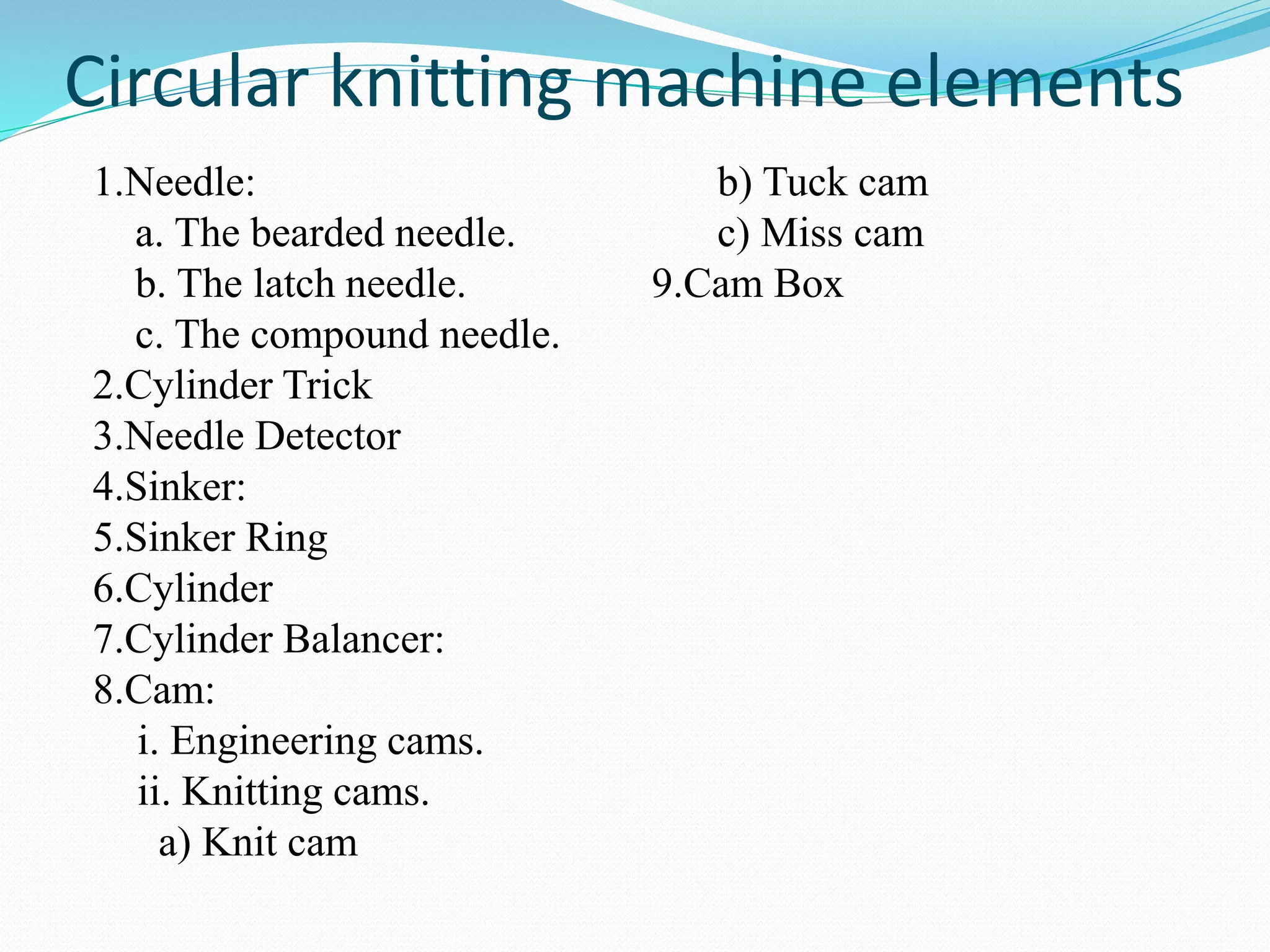
Circular knitting machine elements 
1.Needle: 
a. The bearded needle. 
b. The latch needle. 
c. The compound needle. 
2.Cylinder Trick 
3.Needle Detector 
4.Sinker: 
5.Sinker Ring 
6.Cylinder 
7.Cylinder Balancer: 
8.Cam: 
i. Engineering cams. 
ii. Knitting cams. 
a) Knit cam 
b) Tuck cam 
c) Miss cam 
9.Cam Box
Circular knitting machine elements 
10. Creel 
11. VDQ Pulley 
12. Pulley Belt 
13. Brush 
14. Tension Disk 
15. Inlet and Outlet Stop Motion 
16. Yarn Guide 
17. MNF Wheel 
18. Feeder Ring 
19. Positive Feeder 
20. Lycra Attachment Device 
21. Lycra Stop Motion 
22. Uniwave Lubrication 
23. Adjustable Fan 
24. Spreader 
25. Air Gun Nozzle
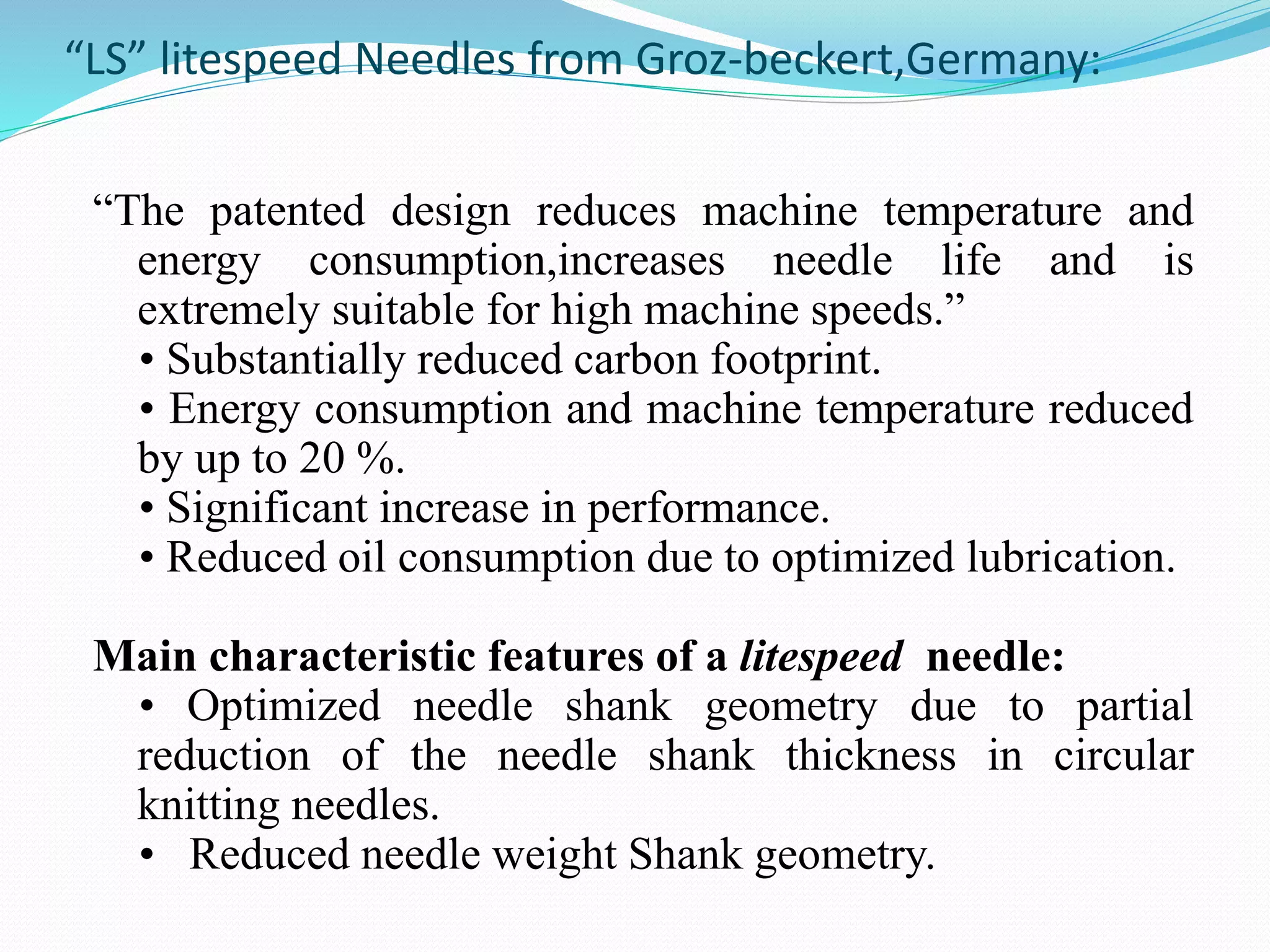
Needles 
“G00” and “G0” Needles from Groz-beckert, Germany 
The standard version G0 is designed to withstand 
the normal hook stress levels and is recommended in 
cases where excessive stress occurs only rarely. 
The special version G00 is a more favourite 
alternative in case where frequent needle overloading is 
anticipated or when a slightly open needle leads to 
unacceptable striping in the fabric.
“LS” litespeed Needles from Groz-beckert,Germany: 
“The patented design reduces machine temperature and 
energy consumption,increases needle life and is 
extremely suitable for high machine speeds.” 
• Substantially reduced carbon footprint. 
• Energy consumption and machine temperature reduced 
by up to 20 %. 
• Significant increase in performance. 
• Reduced oil consumption due to optimized lubrication. 
Main characteristic features of a litespeed needle: 
• Optimized needle shank geometry due to partial 
reduction of the needle shank thickness in circular 
knitting needles. 
• Reduced needle weight Shank geometry.
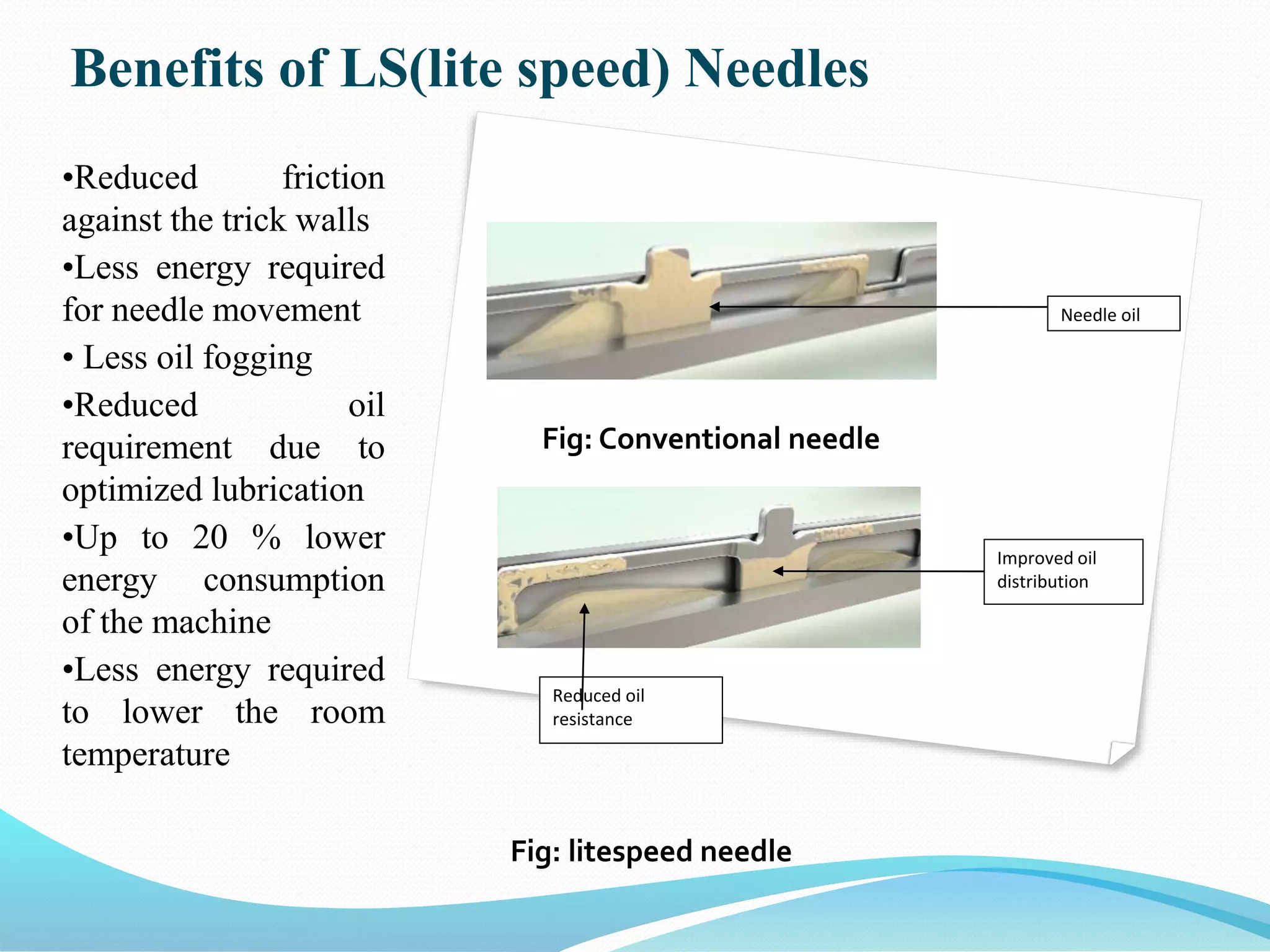
Benefits of LS(lite speed) Needles 
•Reduced friction 
against the trick walls 
•Less energy required 
for needle movement 
• Less oil fogging 
•Reduced oil 
requirement due to 
optimized lubrication 
•Up to 20 % lower 
energy consumption 
of the machine 
•Less energy required 
to lower the room 
temperature 
Needle oil 
Fig: Conventional needle 
Improved oil 
distribution 
Reduced oil 
resistance 
Fig: litespeed needle
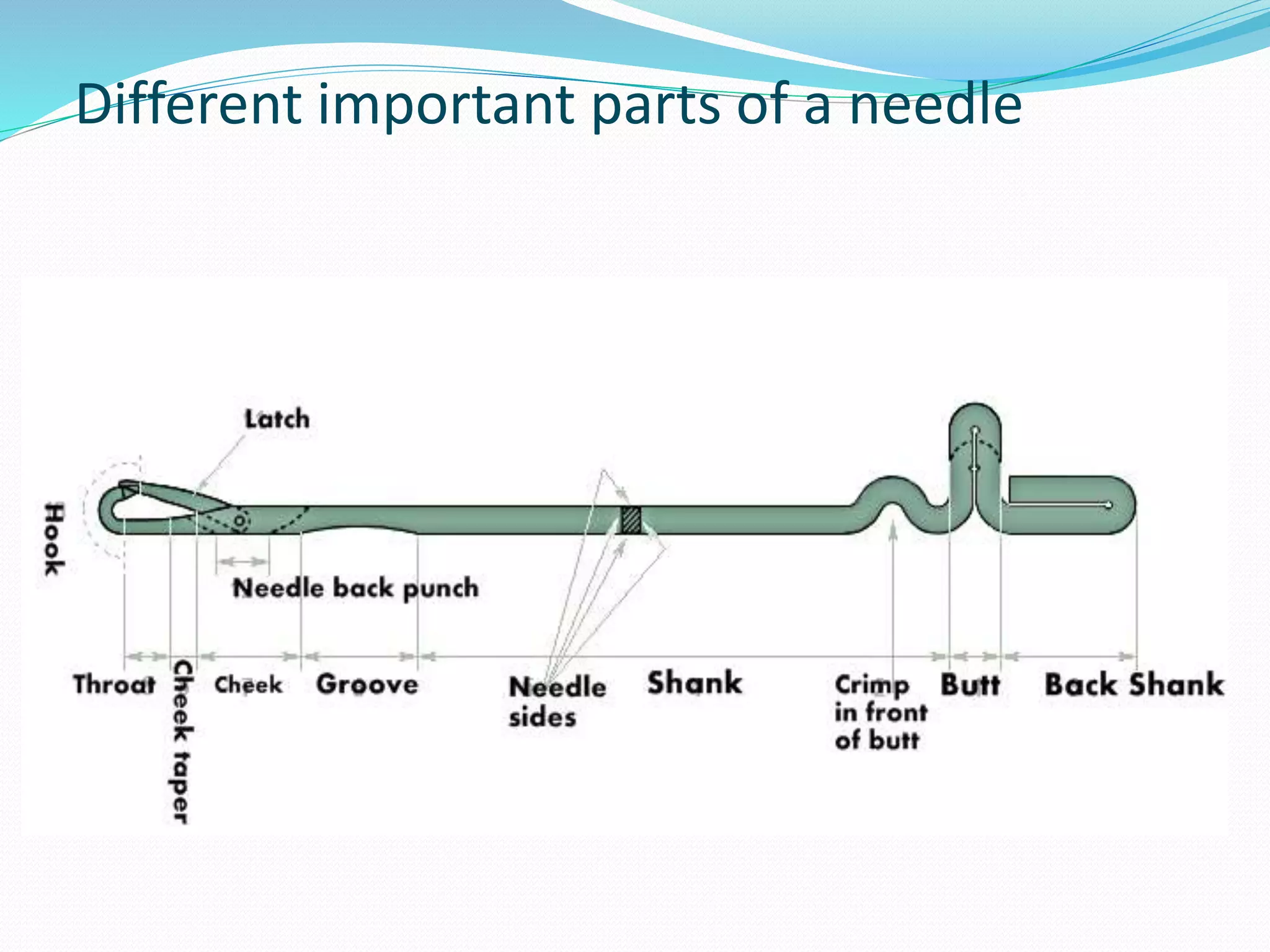
Different important parts of a needle
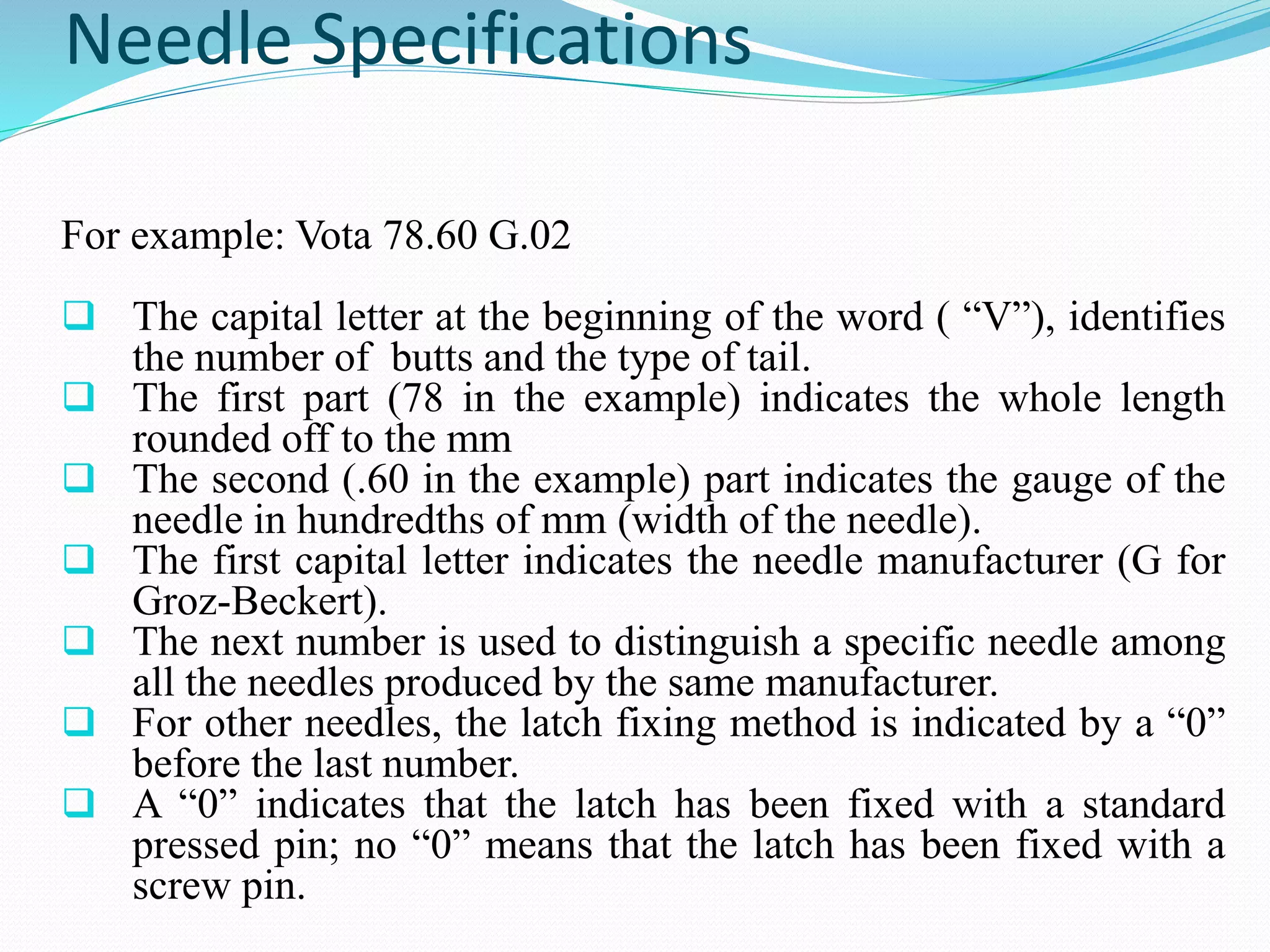
Needle Specifications 
For example: Vota 78.60 G.02 
 The capital letter at the beginning of the word ( “V”), identifies 
the number of butts and the type of tail. 
 The first part (78 in the example) indicates the whole length 
rounded off to the mm 
 The second (.60 in the example) part indicates the gauge of the 
needle in hundredths of mm (width of the needle). 
 The first capital letter indicates the needle manufacturer (G for 
Groz-Beckert). 
 The next number is used to distinguish a specific needle among 
all the needles produced by the same manufacturer. 
 For other needles, the latch fixing method is indicated by a “0” 
before the last number. 
 A “0” indicates that the latch has been fixed with a standard 
pressed pin; no “0” means that the latch has been fixed with a 
screw pin.
The sinker 
The sinker is the second primary knitting element (the needle 
being the first). It is a thin metal plate with an individual or a 
collective action operating approximately at right angles from 
the hook side of the needle bed, between adjacent needles. 
Functions: 
It may perform one or more of the following functions, 
dependent upon the machine’s knitting action and consequent 
sinker shape and movement: 
 Loop formation 
 Holding-down 
 Knocking-over
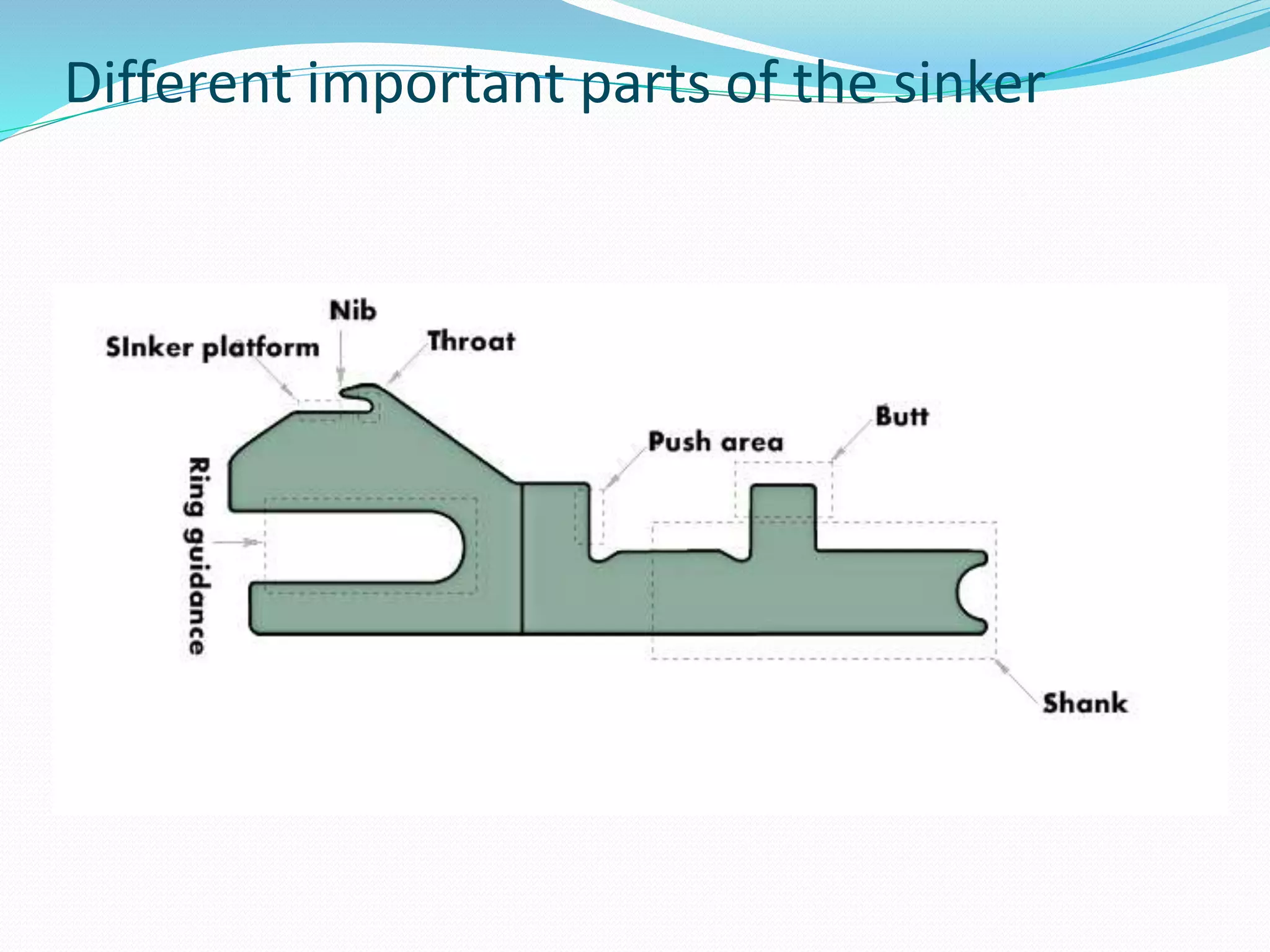
Different important parts of the sinker
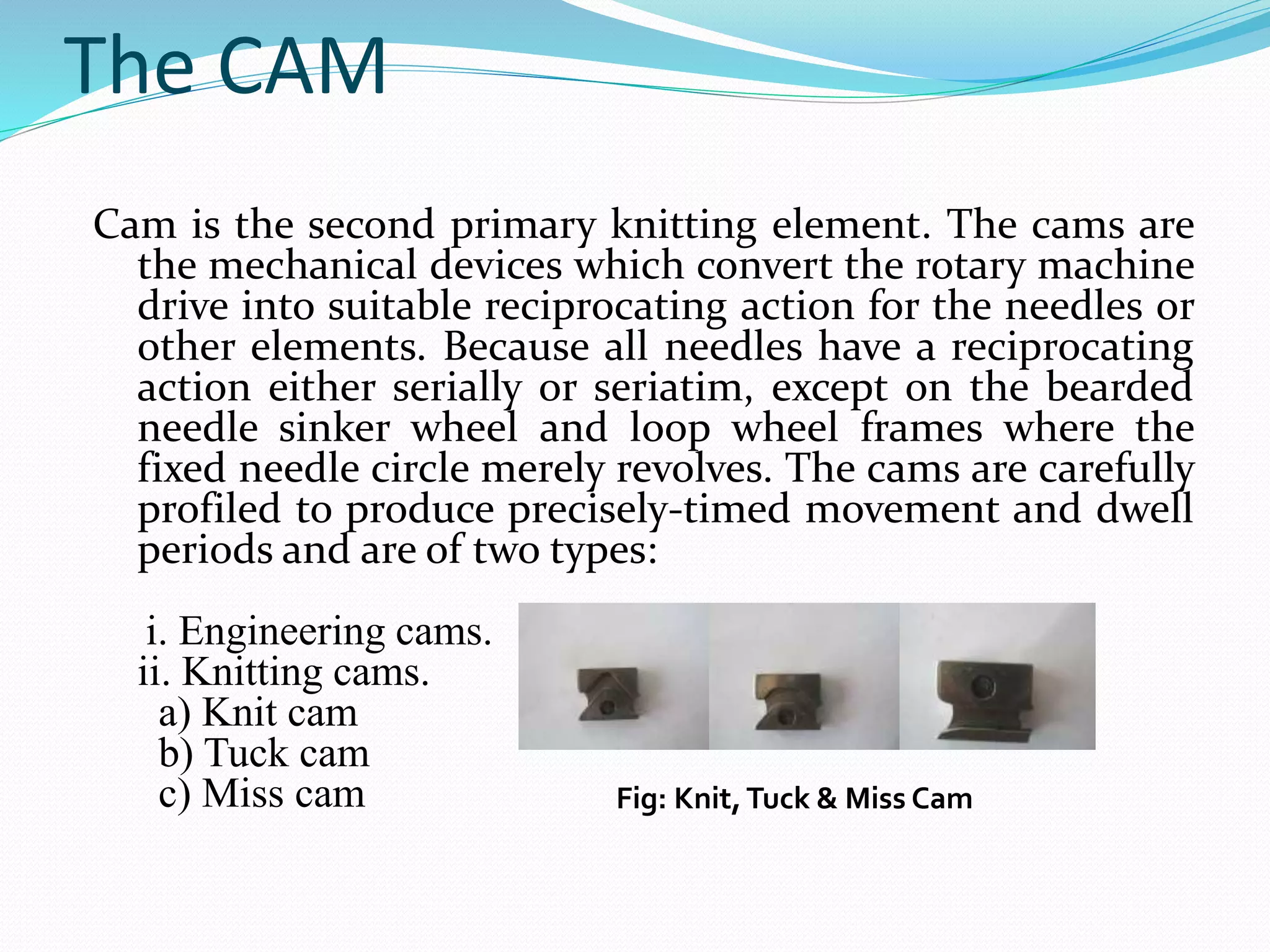
The CAM 
Cam is the second primary knitting element. The cams are 
the mechanical devices which convert the rotary machine 
drive into suitable reciprocating action for the needles or 
other elements. Because all needles have a reciprocating 
action either serially or seriatim, except on the bearded 
needle sinker wheel and loop wheel frames where the 
fixed needle circle merely revolves. The cams are carefully 
profiled to produce precisely-timed movement and dwell 
periods and are of two types: 
i. Engineering cams. 
ii. Knitting cams. 
a) Knit cam 
b) Tuck cam 
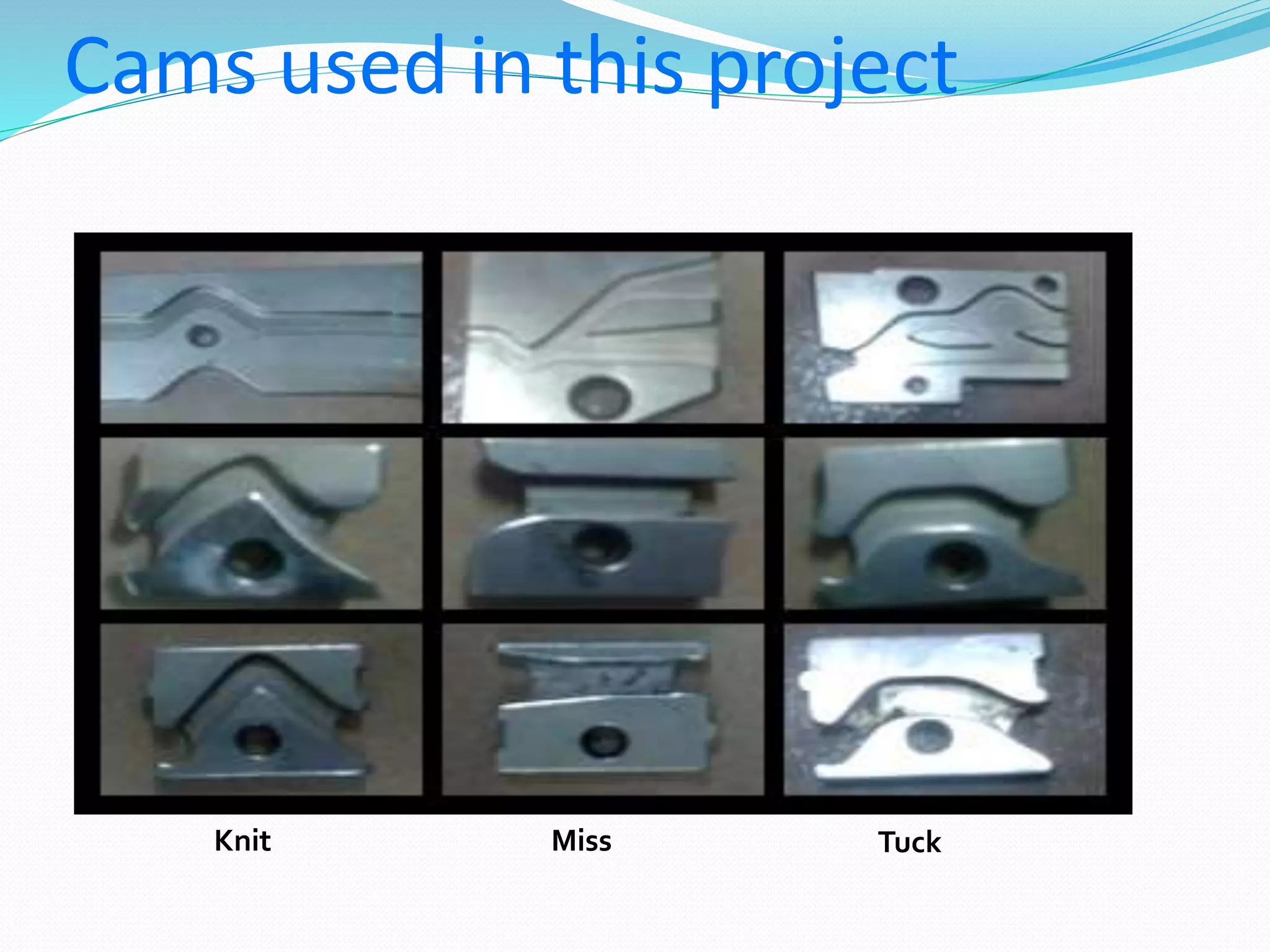
c) Miss cam Fig: Knit, Tuck & Miss Cam
Lubrication System 
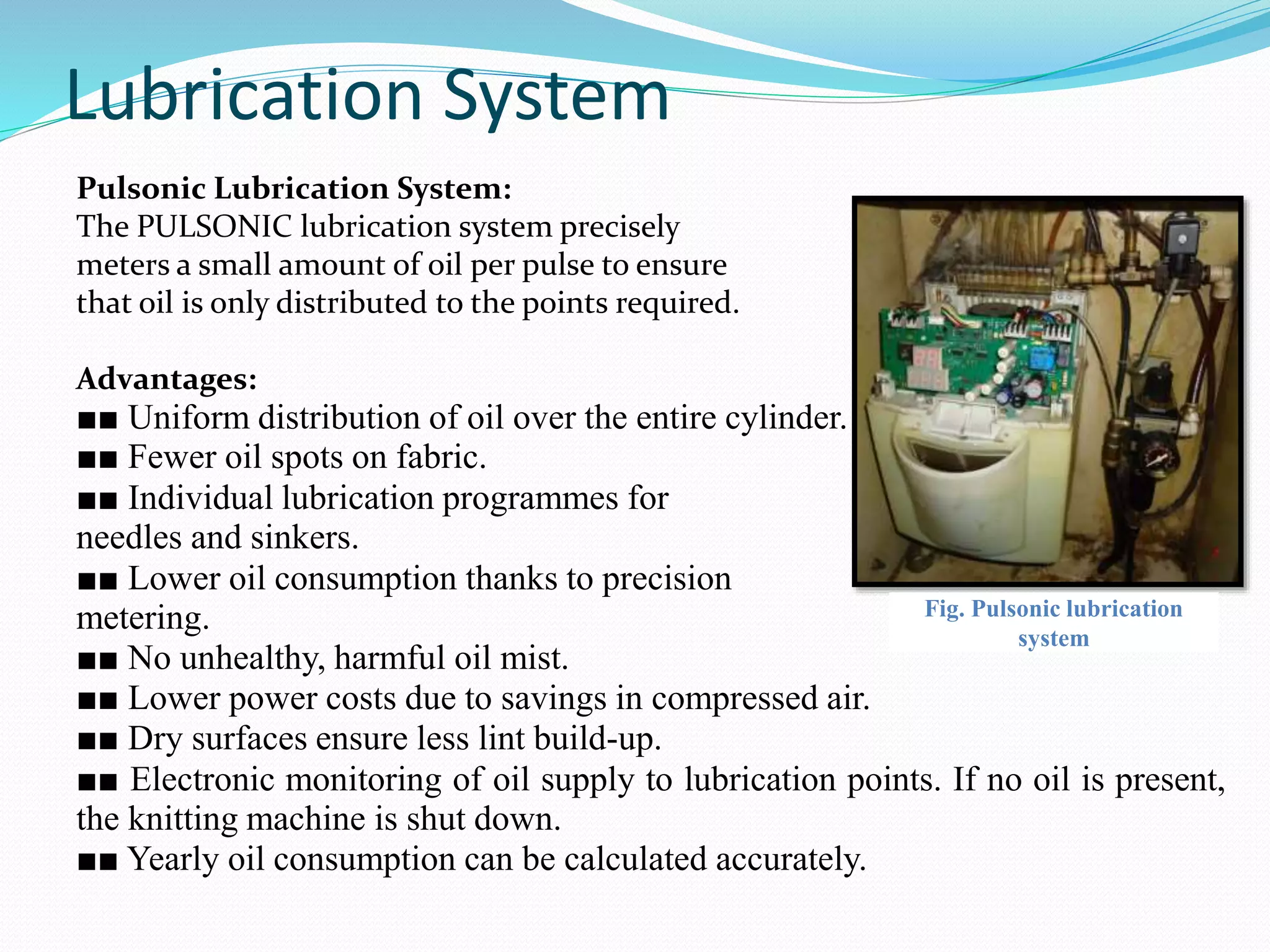
Pulsonic Lubrication System: 
The PULSONIC lubrication system precisely 
meters a small amount of oil per pulse to ensure 
that oil is only distributed to the points required. 
Advantages: 
■■ Uniform distribution of oil over the entire cylinder. 
■■ Fewer oil spots on fabric. 
■■ Individual lubrication programmes for 
needles and sinkers. 
■■ Lower oil consumption thanks to precision 
metering. 
Fig. Pulsonic lubrication 
system 
■■ No unhealthy, harmful oil mist. 
■■ Lower power costs due to savings in compressed air. 
■■ Dry surfaces ensure less lint build-up. 
■■ Electronic monitoring of oil supply to lubrication points. If no oil is present, 
the knitting machine is shut down. 
■■ Yearly oil consumption can be calculated accurately.
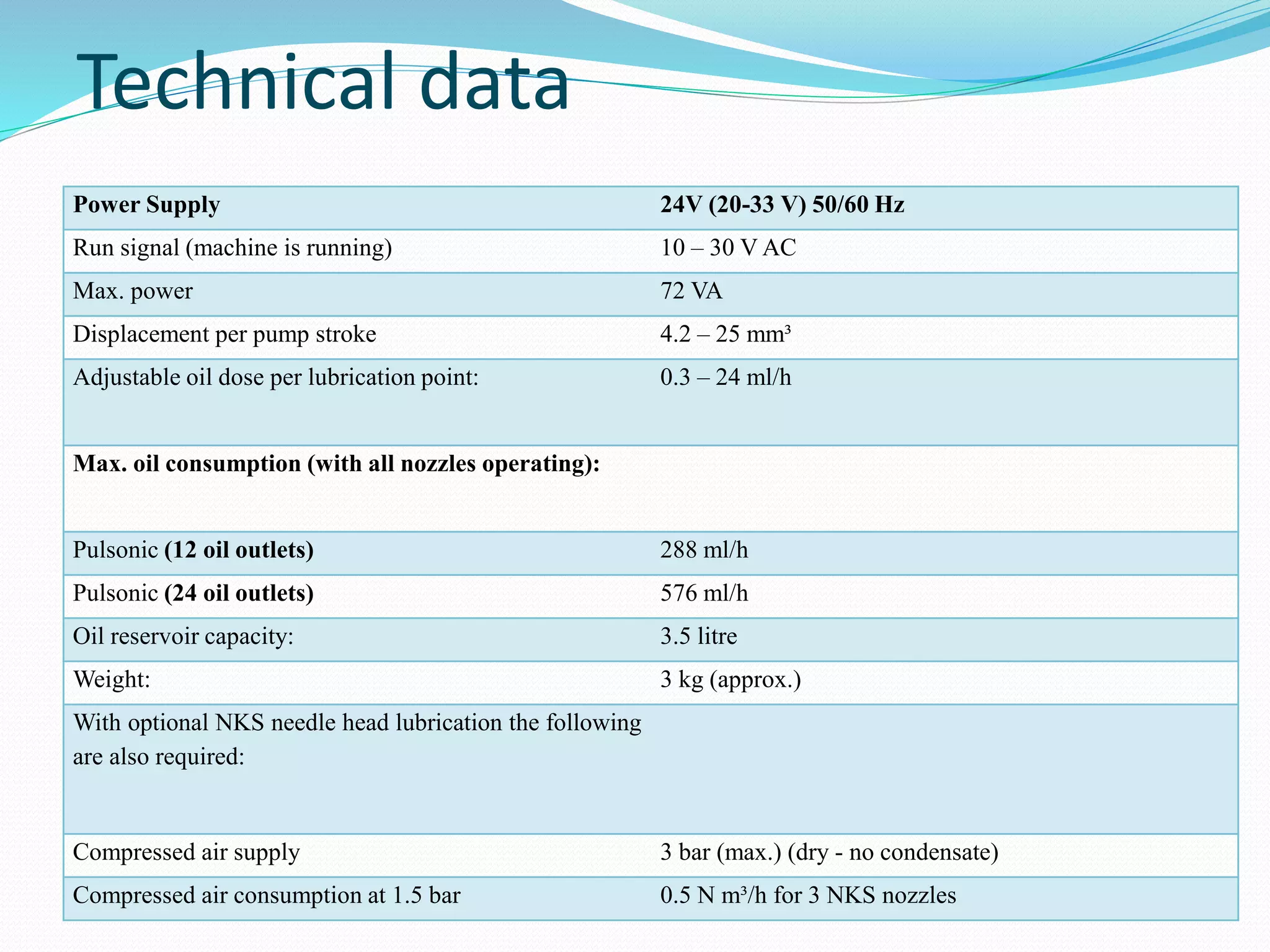
Technical data 
Power Supply 24V (20-33 V) 50/60 Hz 
Run signal (machine is running) 10 – 30 V AC 
Max. power 72 VA 
Displacement per pump stroke 4.2 – 25 mm³ 
Adjustable oil dose per lubrication point: 0.3 – 24 ml/h 
Max. oil consumption (with all nozzles operating): 
Pulsonic (12 oil outlets) 288 ml/h 
Pulsonic (24 oil outlets) 576 ml/h 
Oil reservoir capacity: 3.5 litre 
Weight: 3 kg (approx.) 
With optional NKS needle head lubrication the following 
are also required: 
Compressed air supply 3 bar (max.) (dry - no condensate) 
Compressed air consumption at 1.5 bar 0.5 N m³/h for 3 NKS nozzles
Lubrication System 
Uniwave Lubrication System: 
The PROJECTILE lubricator provides uniform lubrication to 
needles, cam tracks, sinkers and other knitting machine 
components. The patented nozzle construction separates the 
air-oil mixture into air and droplets of oil. 
Advantages: 
■■ The patented atomizing and nozzle system enables a major 
reduction in compressed air consumption. This enables 
considerable savings in power and operating costs. 
■■ The PROJECTILE 419 supplies each of the 20 lubrication 
points with the exactly the same amount of oil 
■■ The knitting machine gearbox can be lubricated from the 
two low-flow connections on the PROJECTILE unit. 
■■ Strong construction. 
■■ No oil mist health hazard in production areas. 
Technical data: 
1. 20 lubrication points. 
2. Two, low-flow connections. 
3. Compact oil reservoir. 
4. Long, reliable service life guaranteed. 
Fig. Uniwave 
Lubrication System
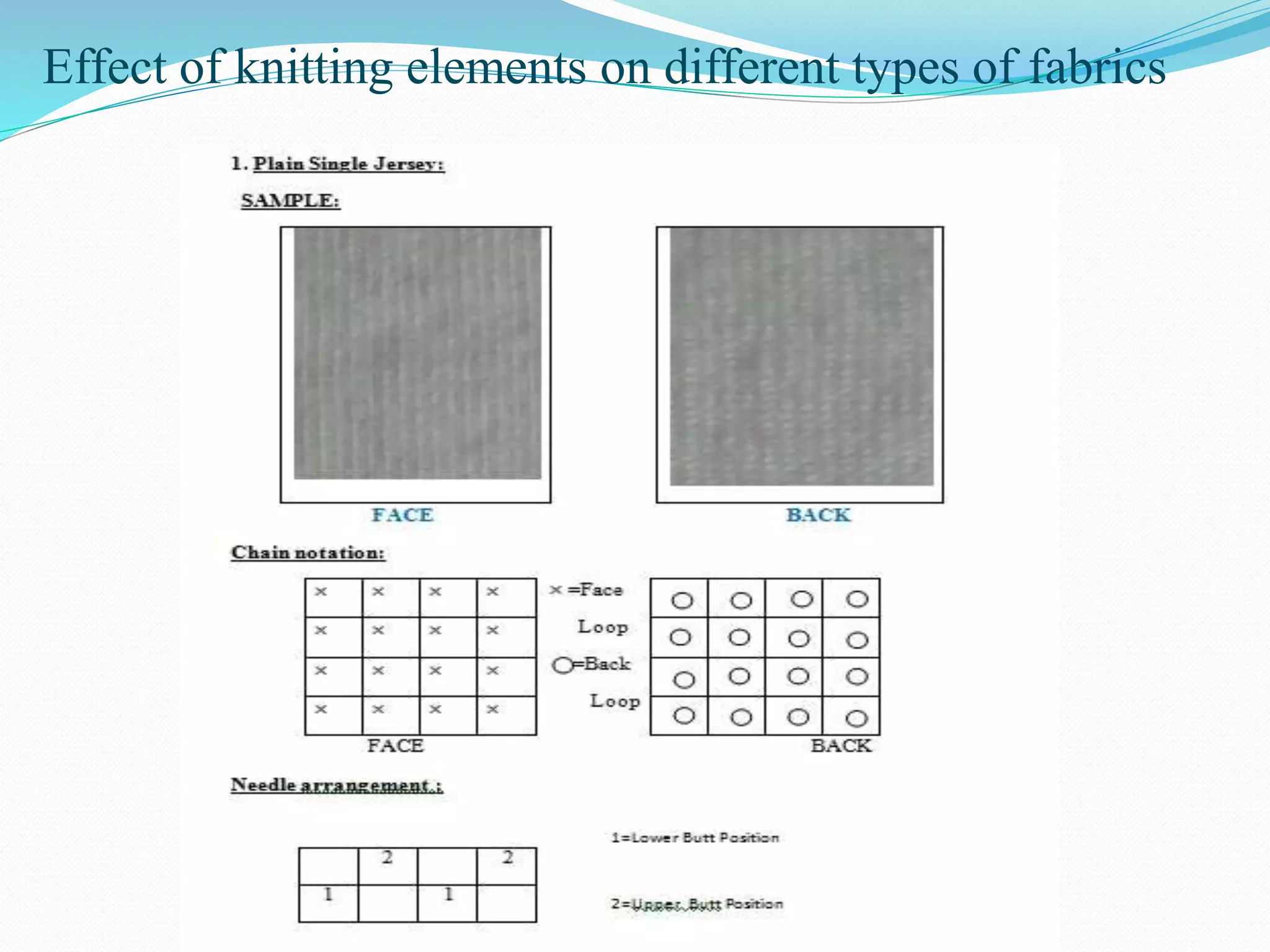
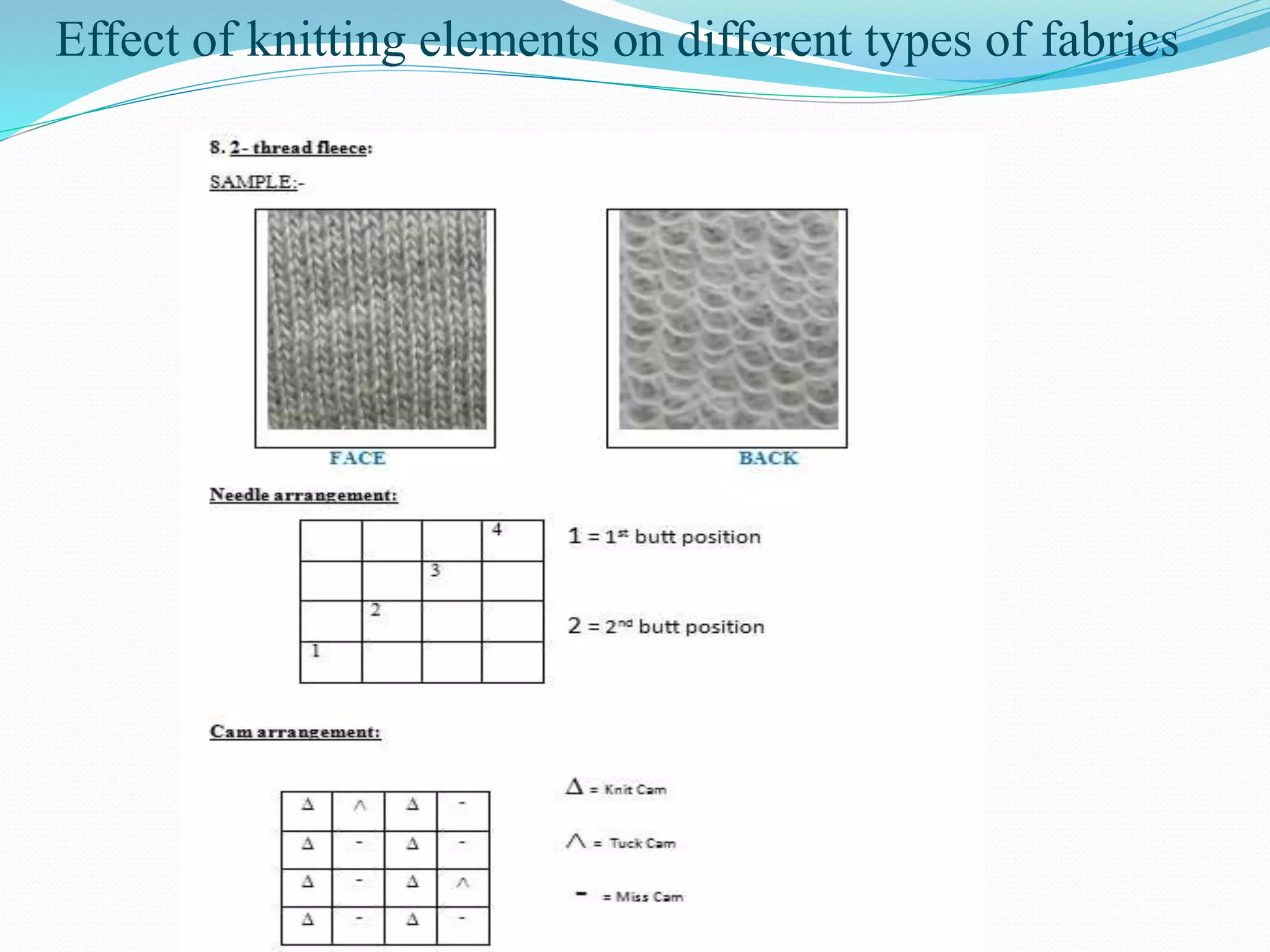
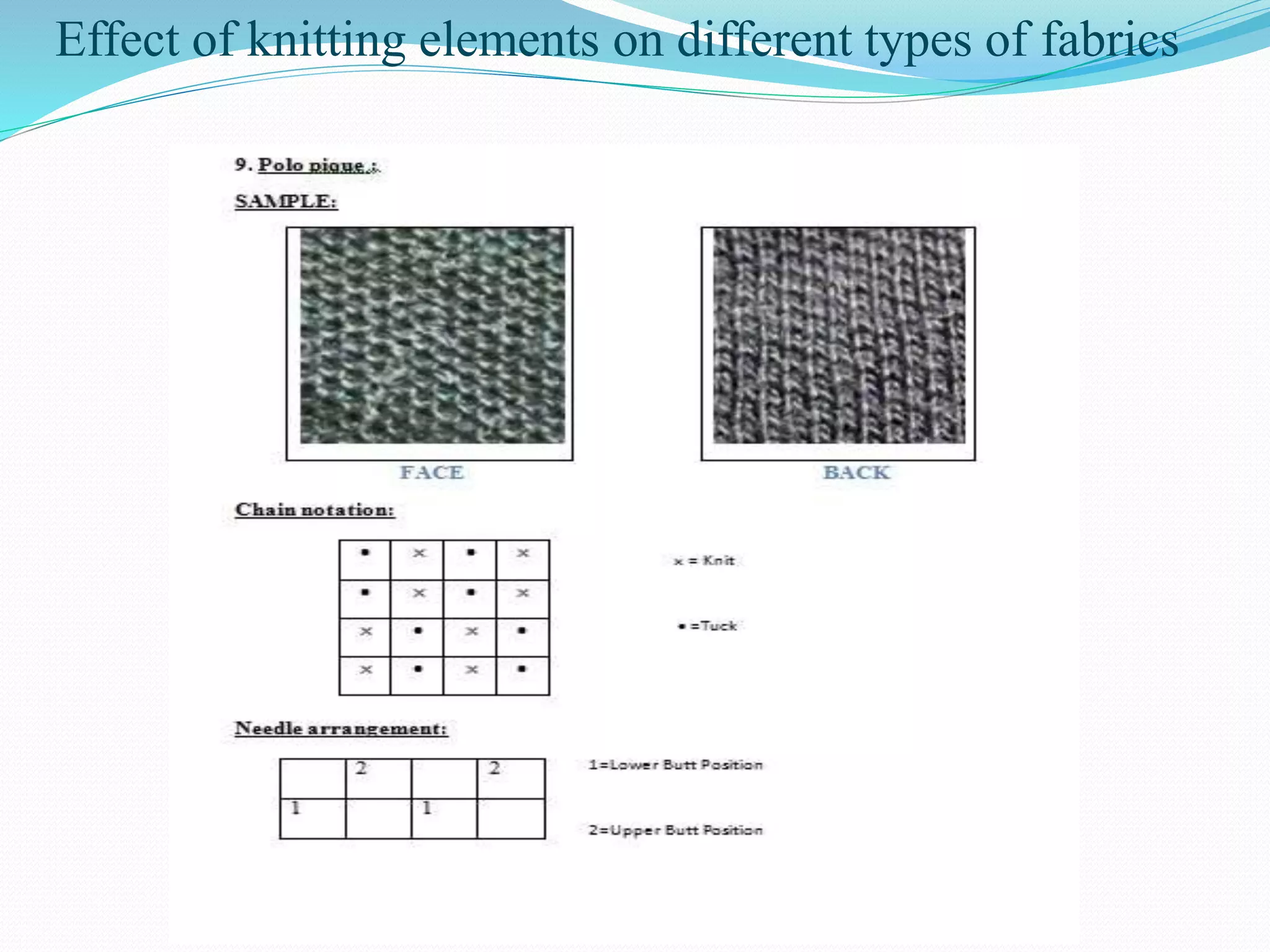
Effect of knitting elements on different types of fabrics
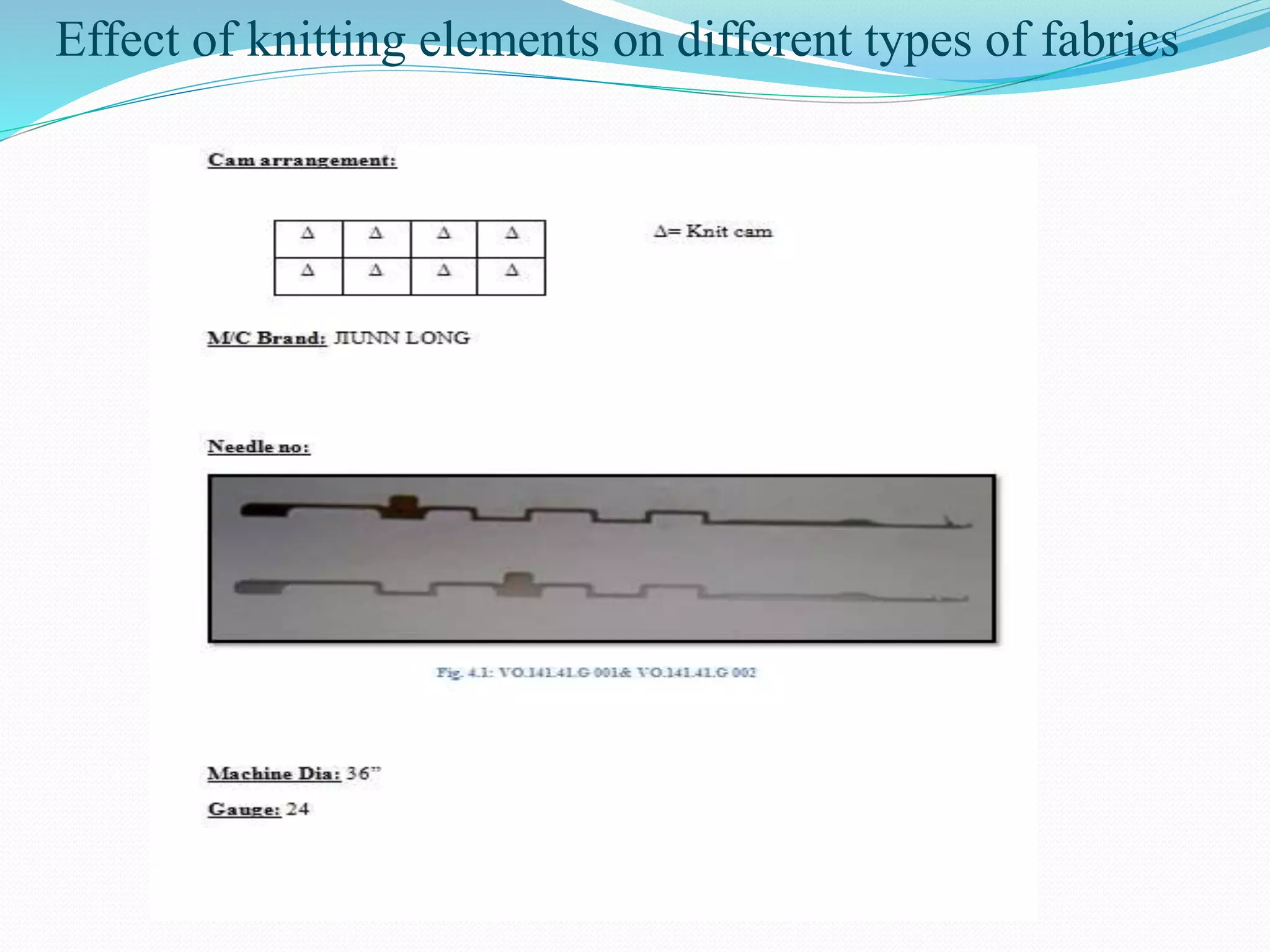
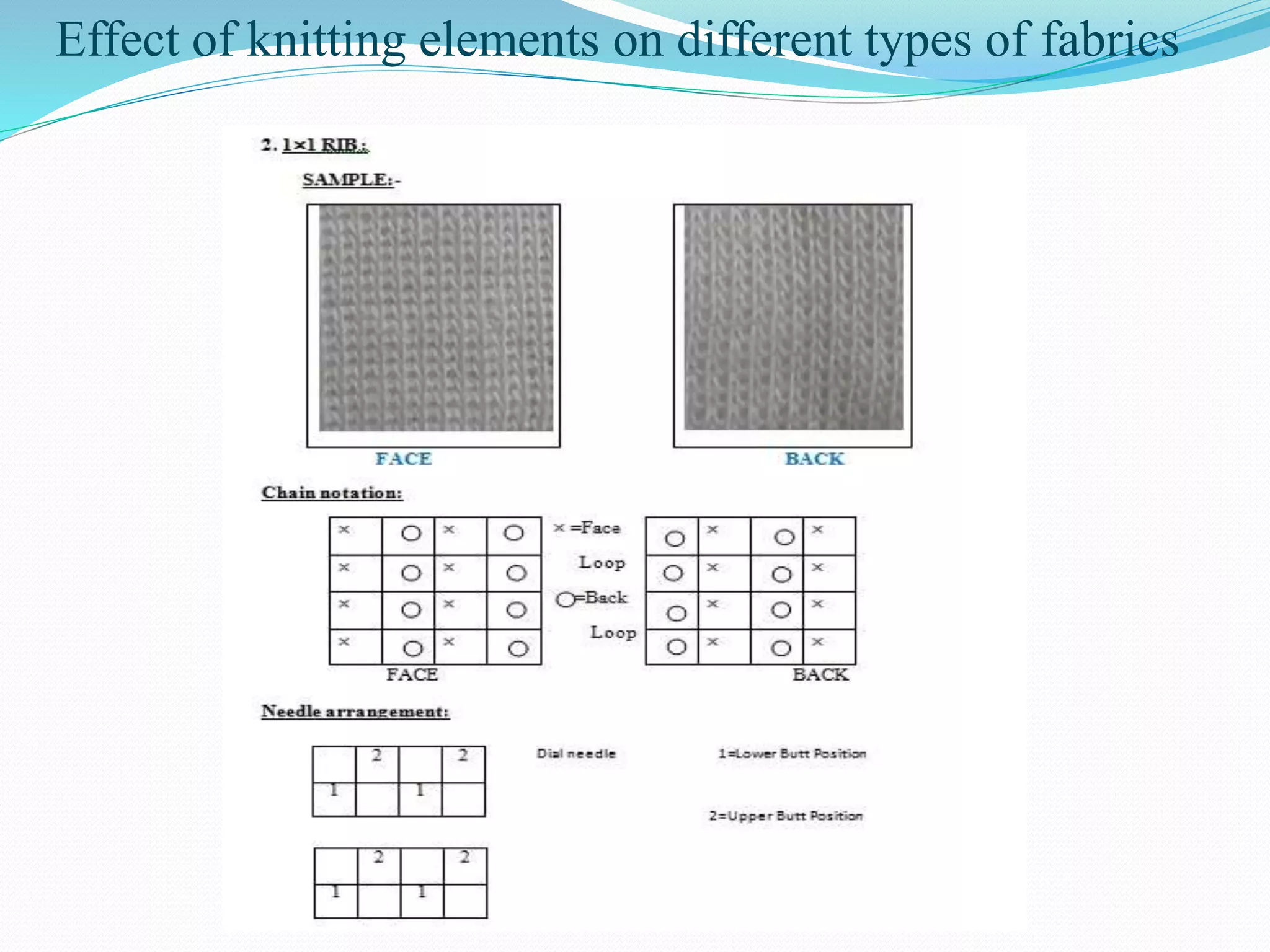
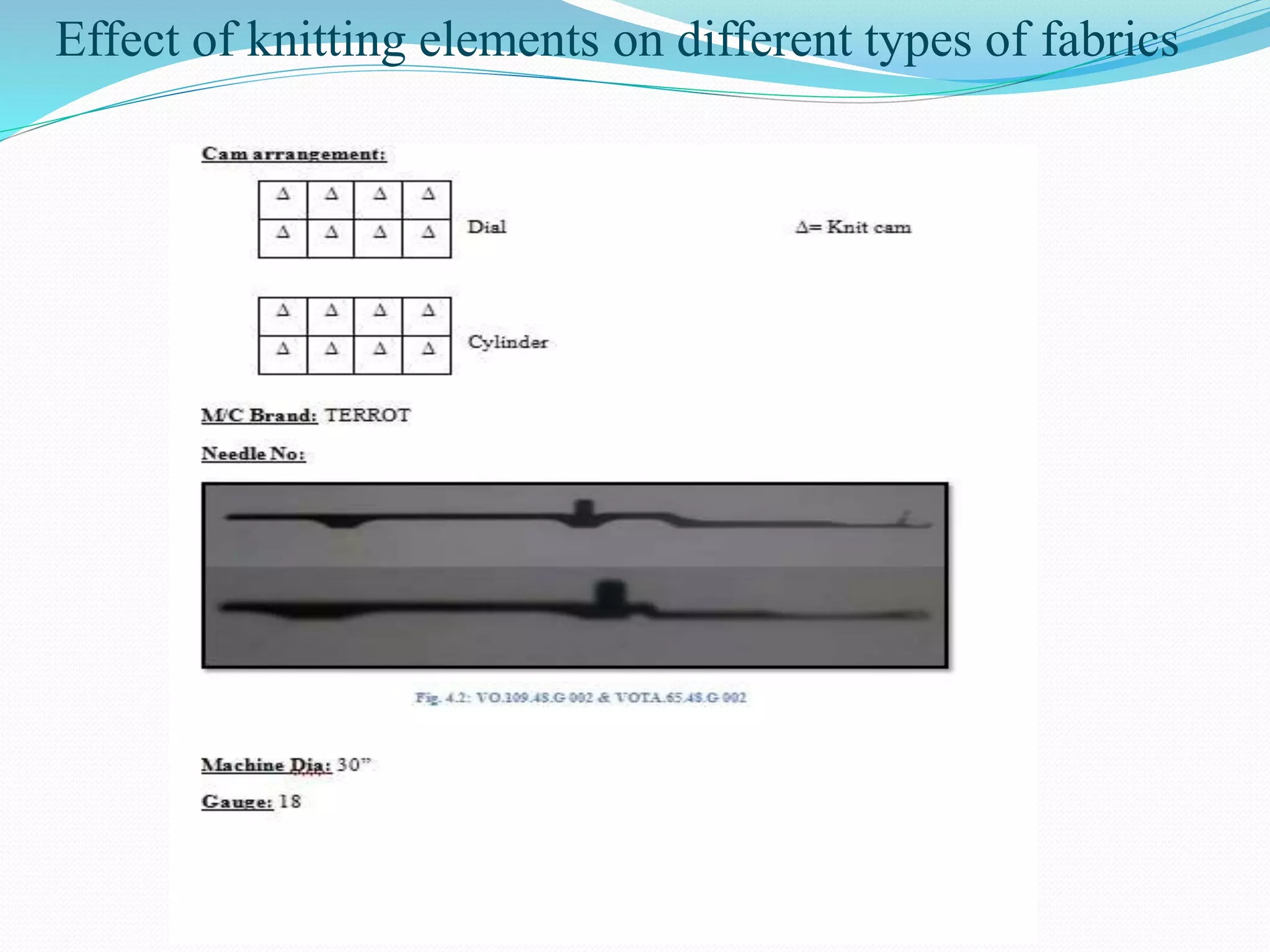
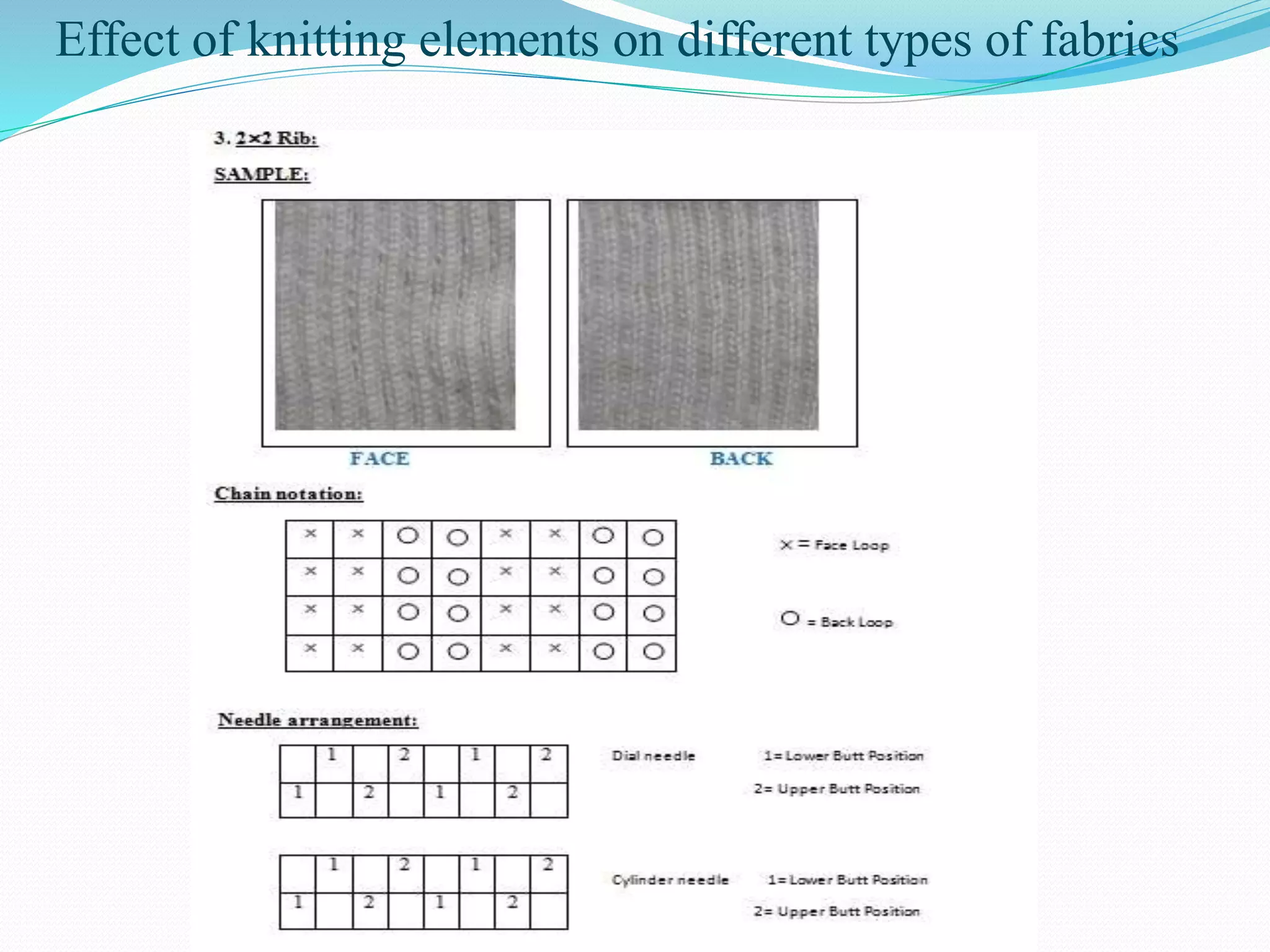
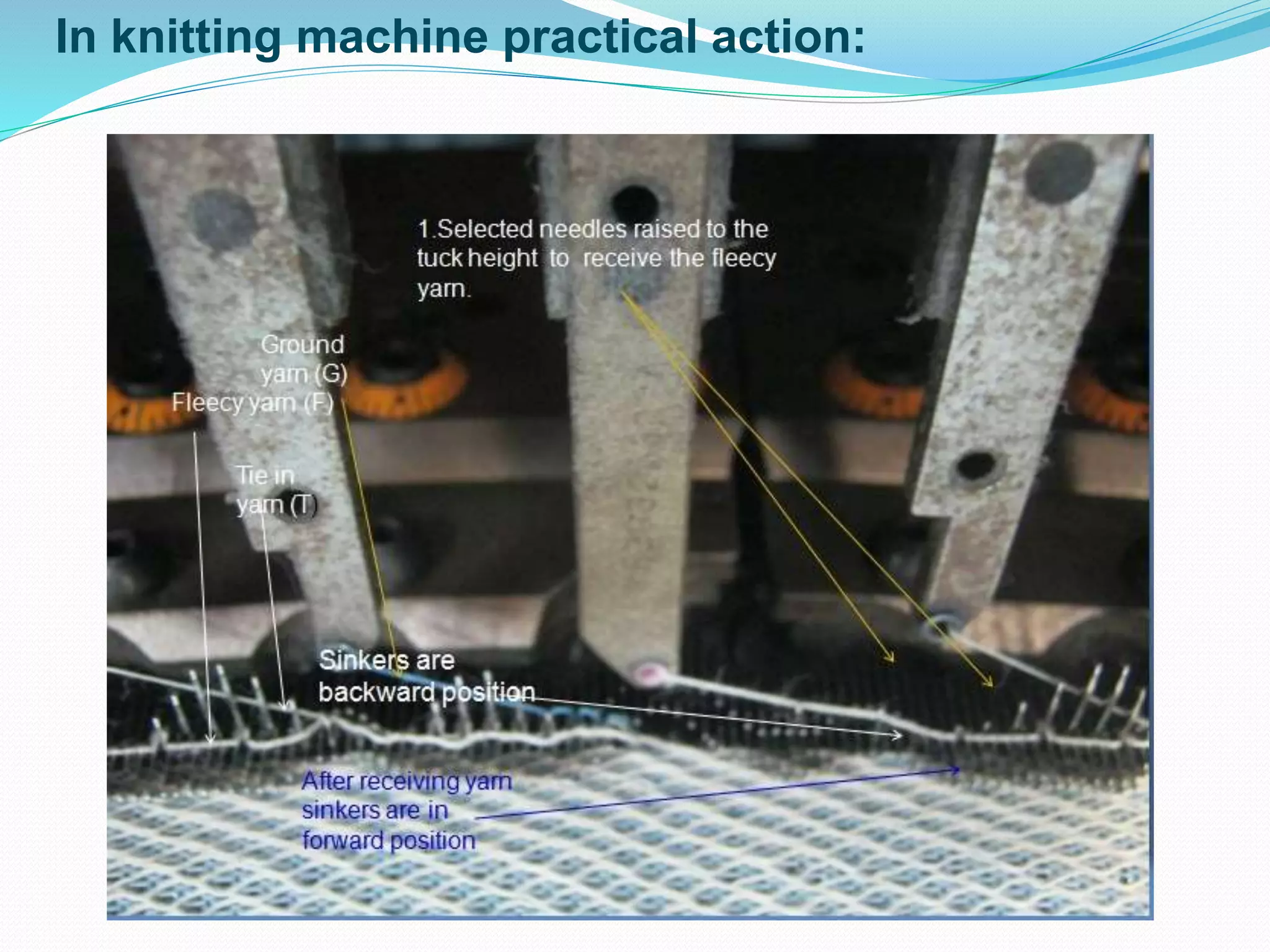
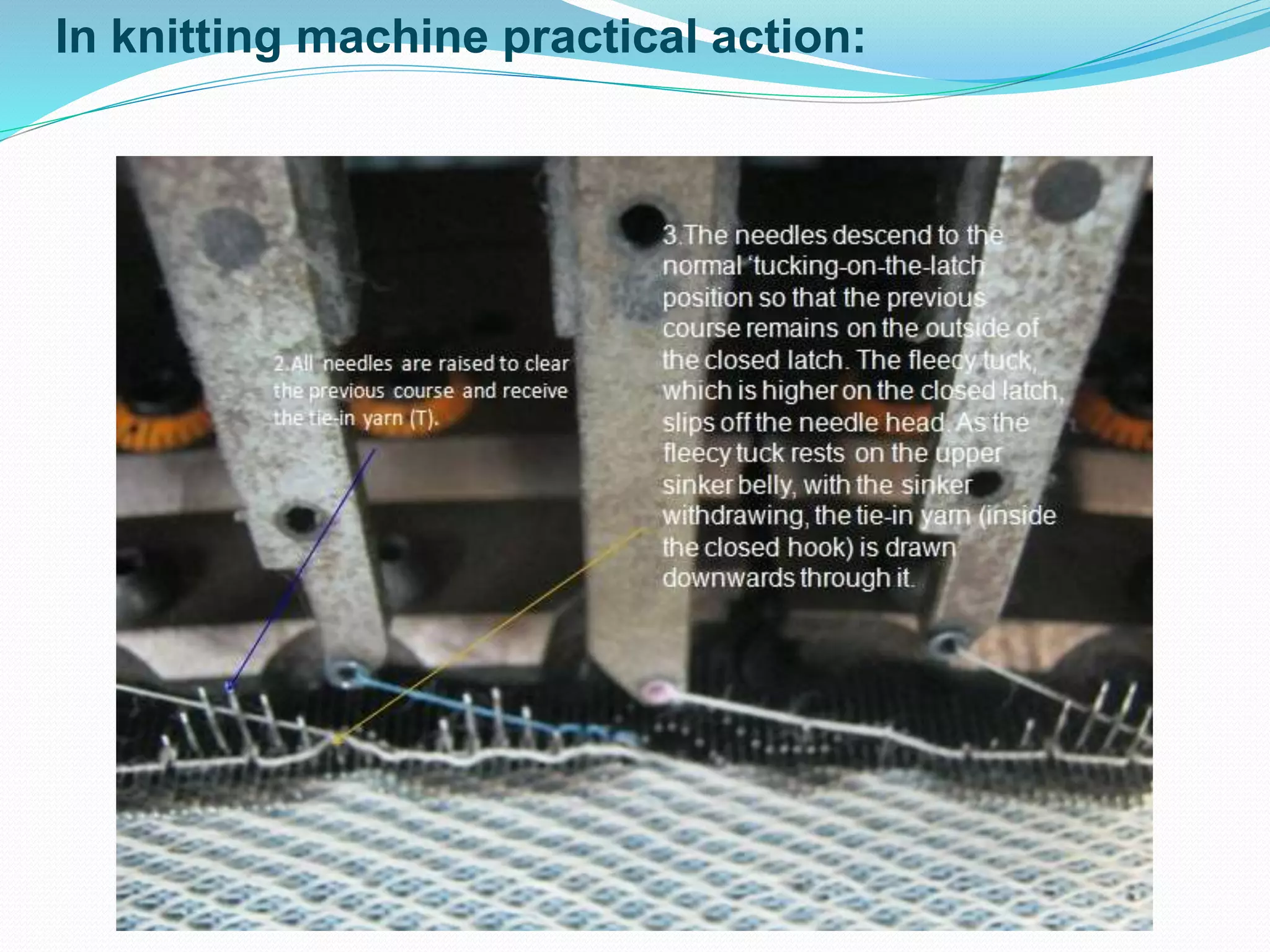
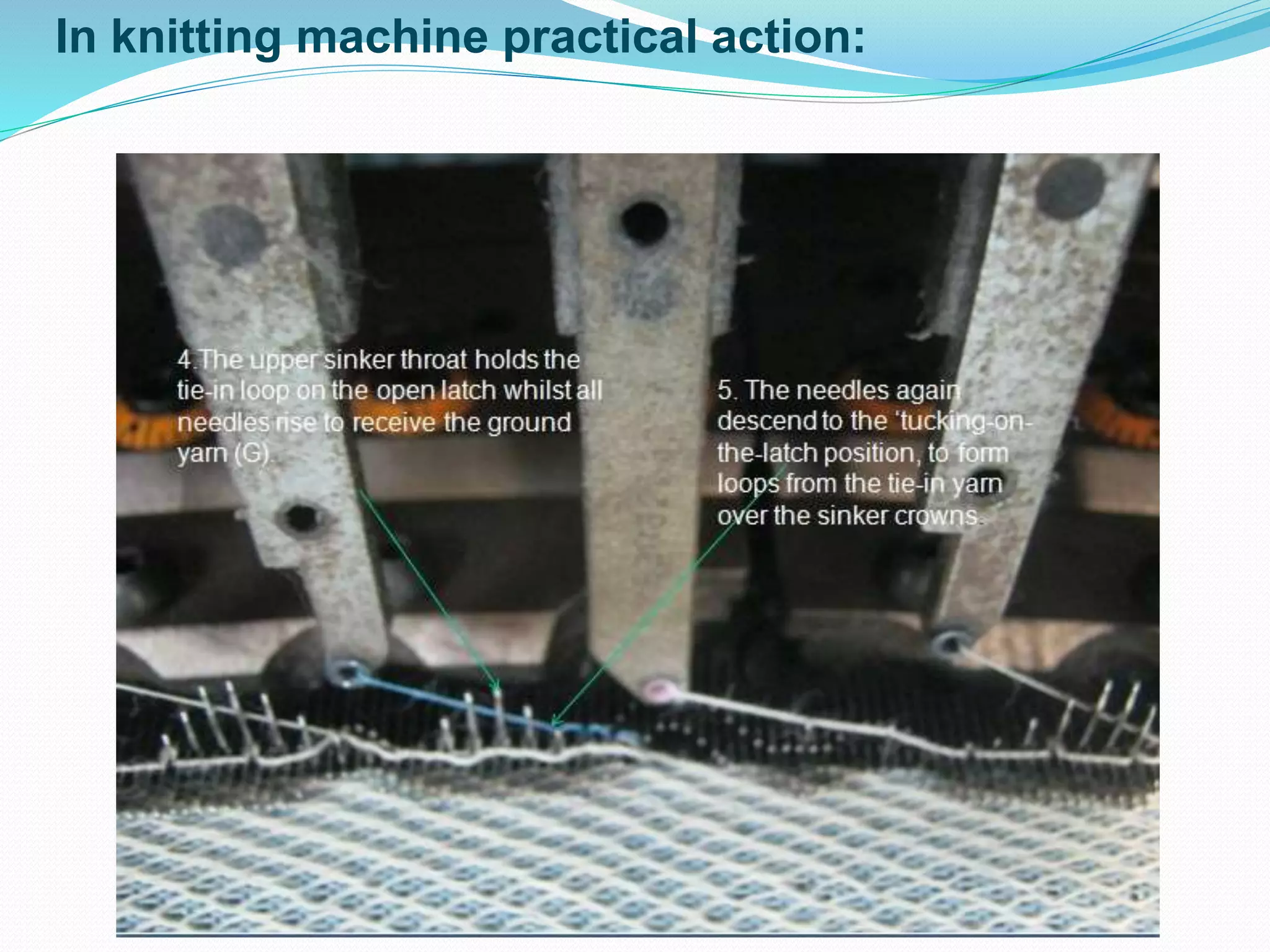
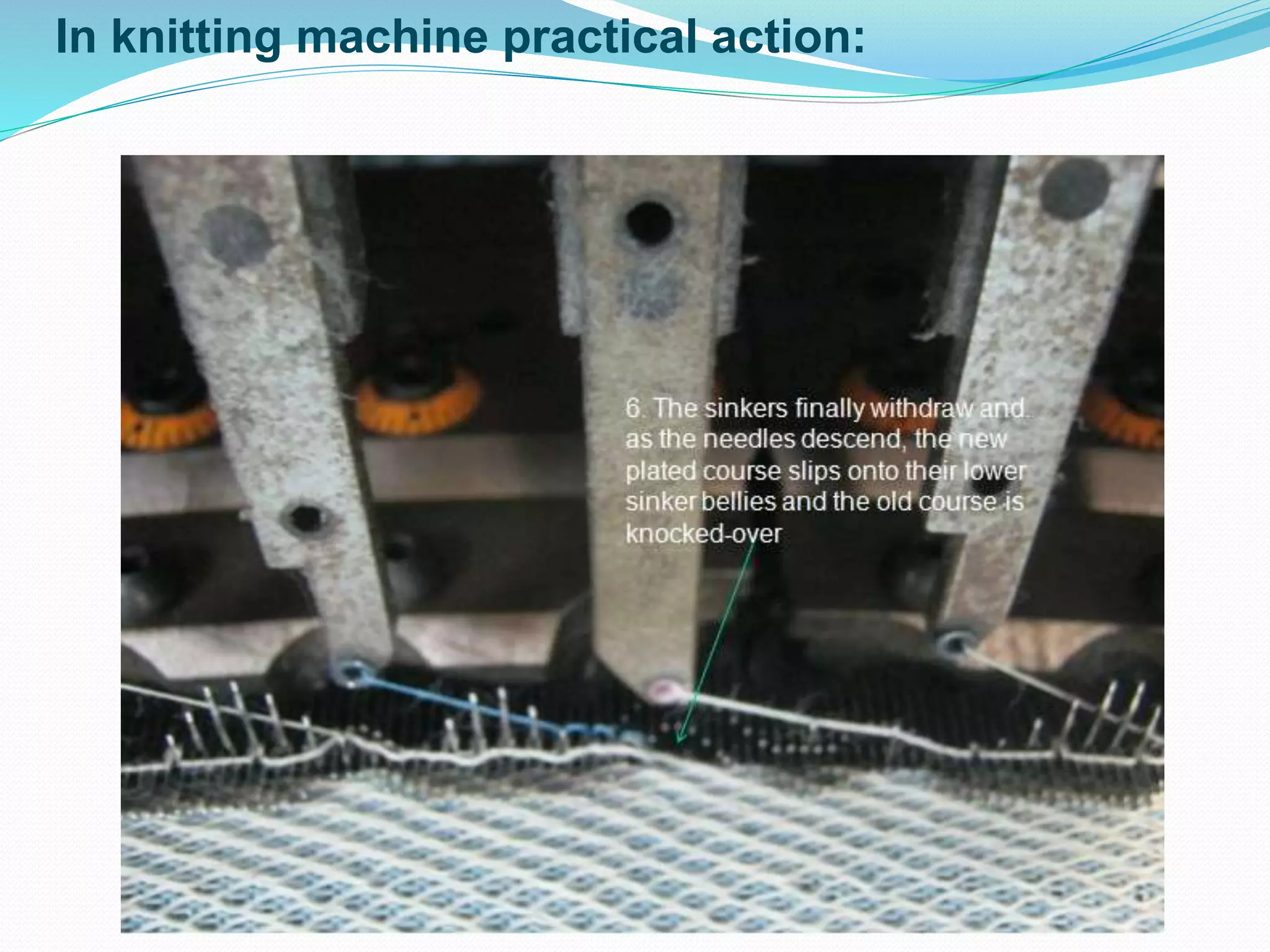
In knitting machine practical action:
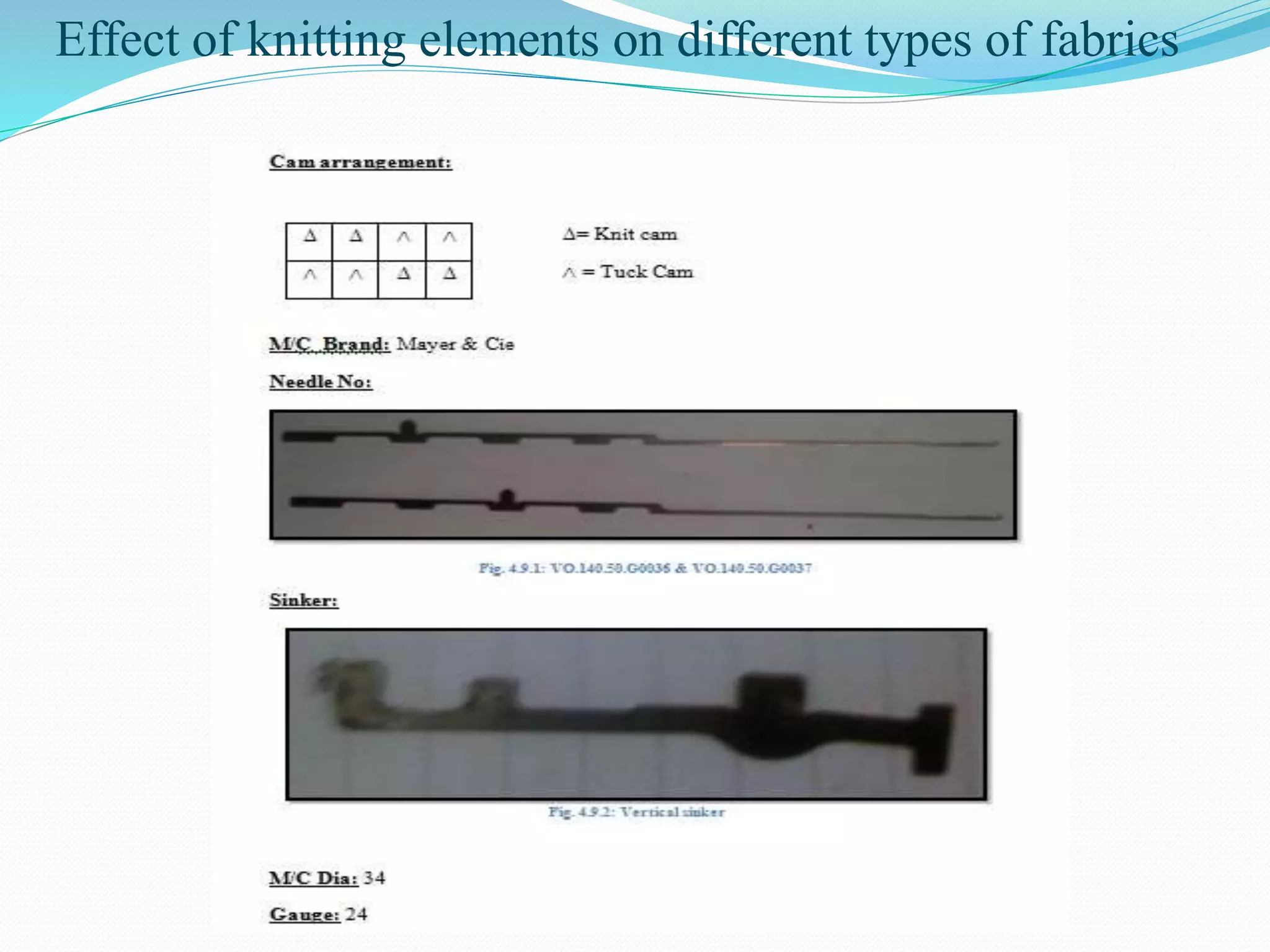
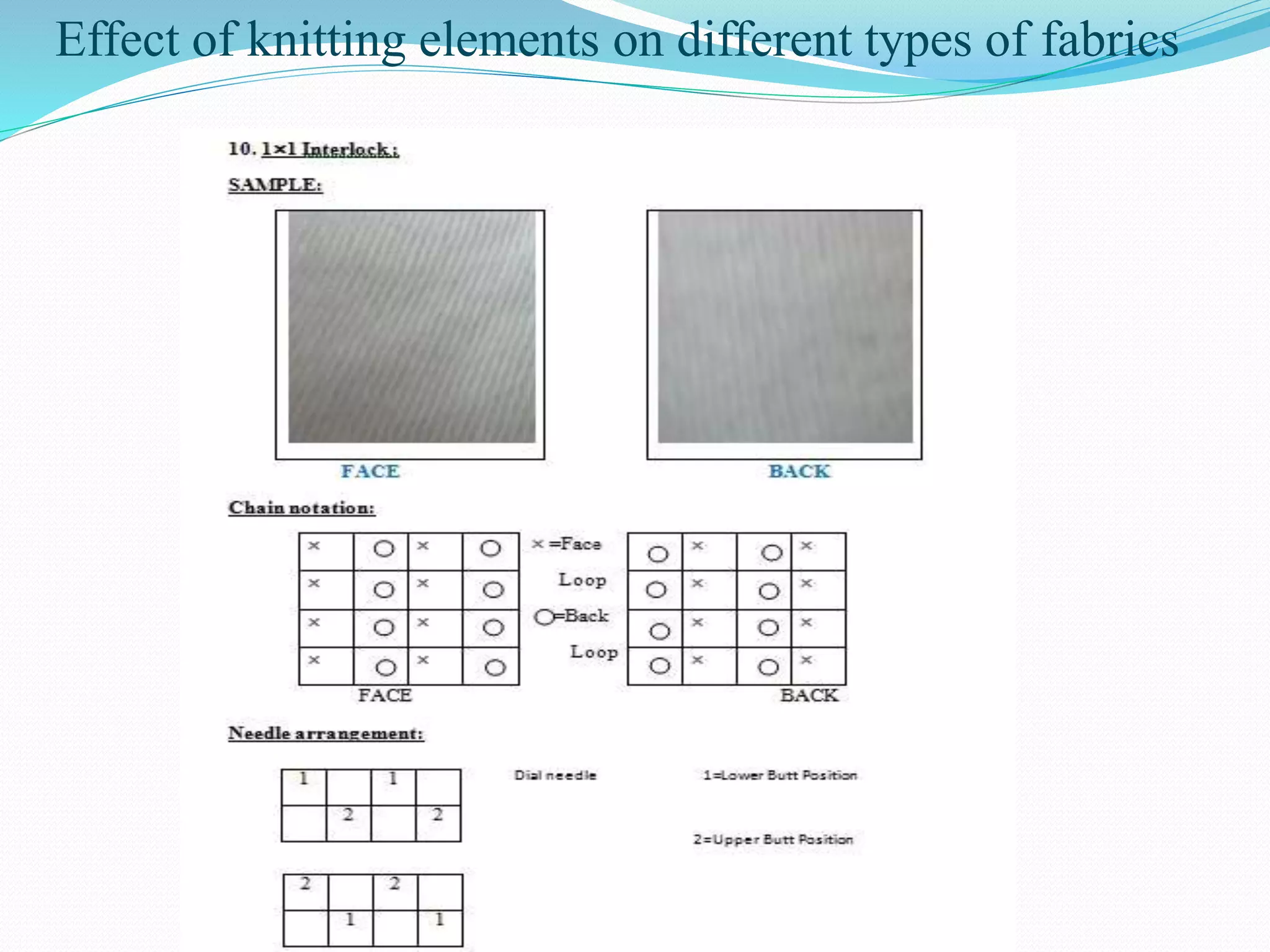
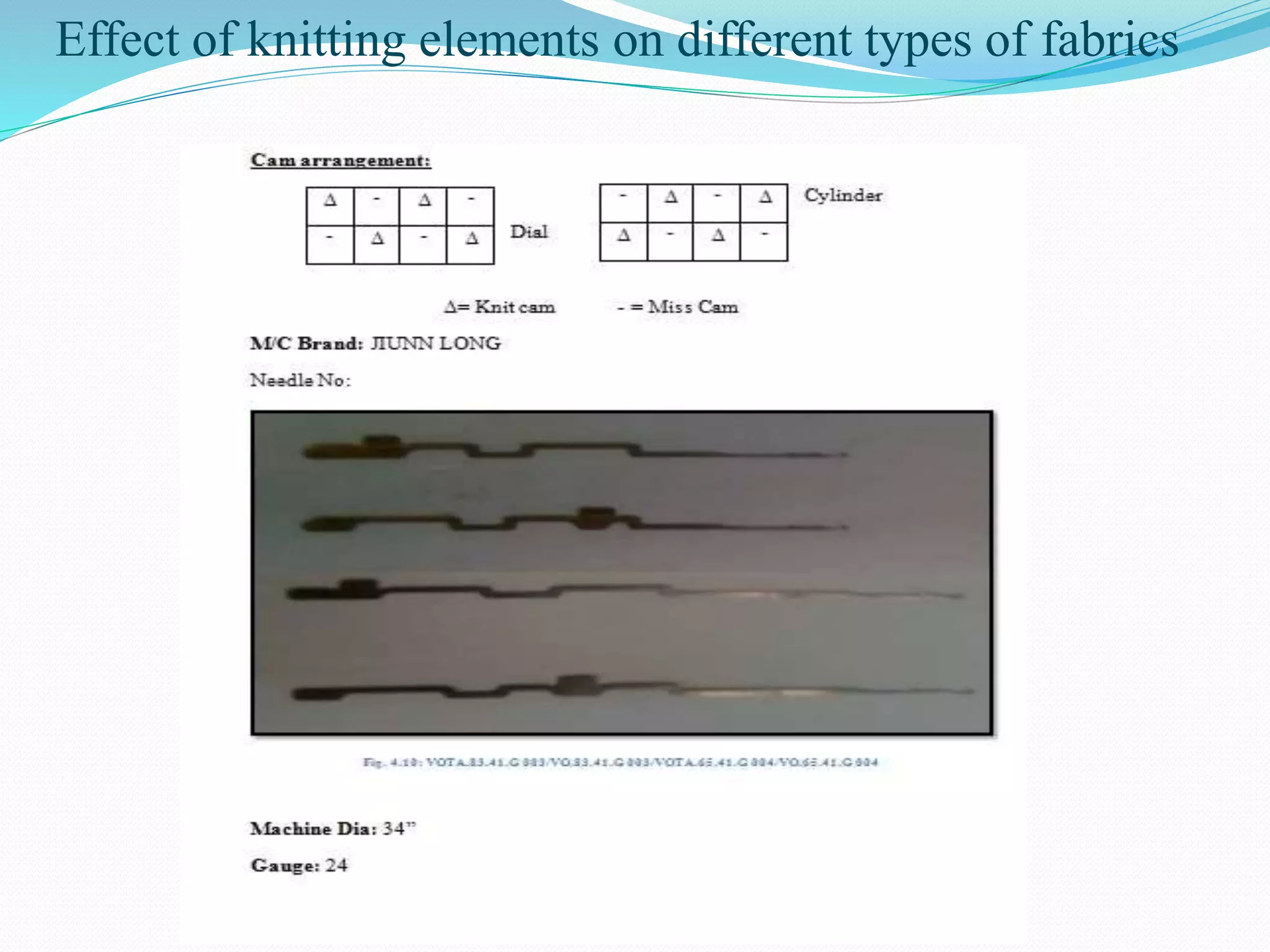
Effect of knitting elements on different types of fabrics
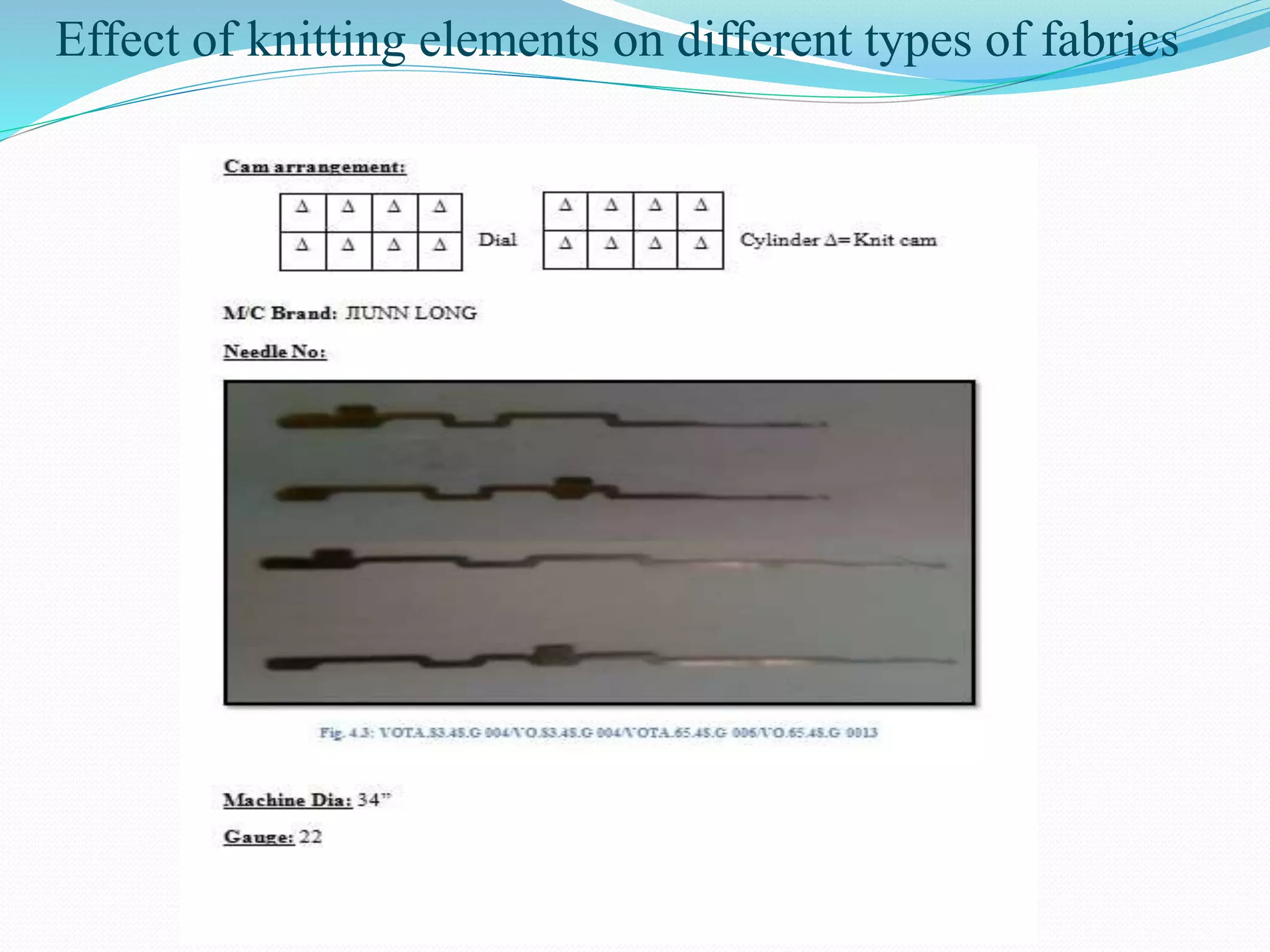
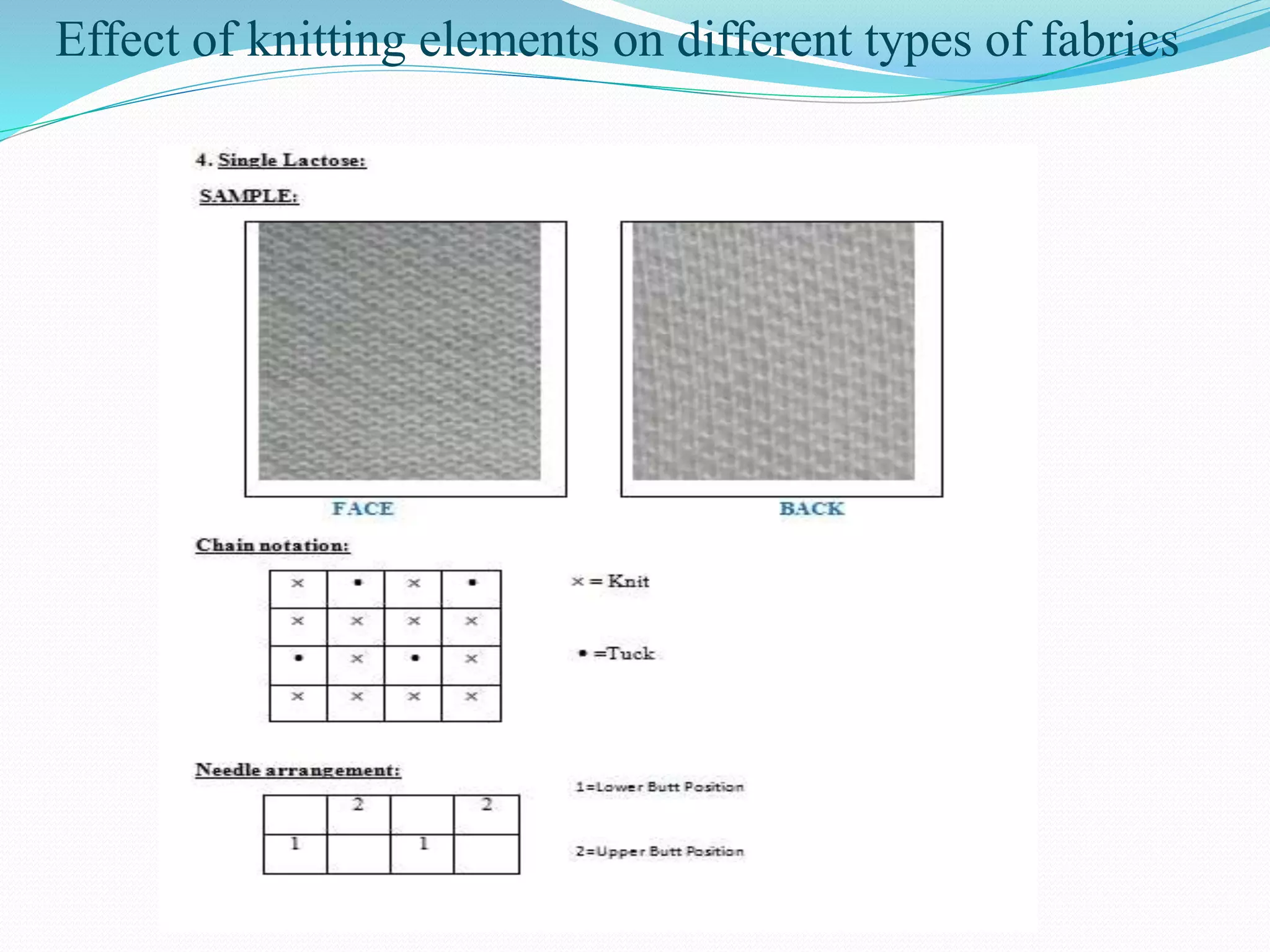
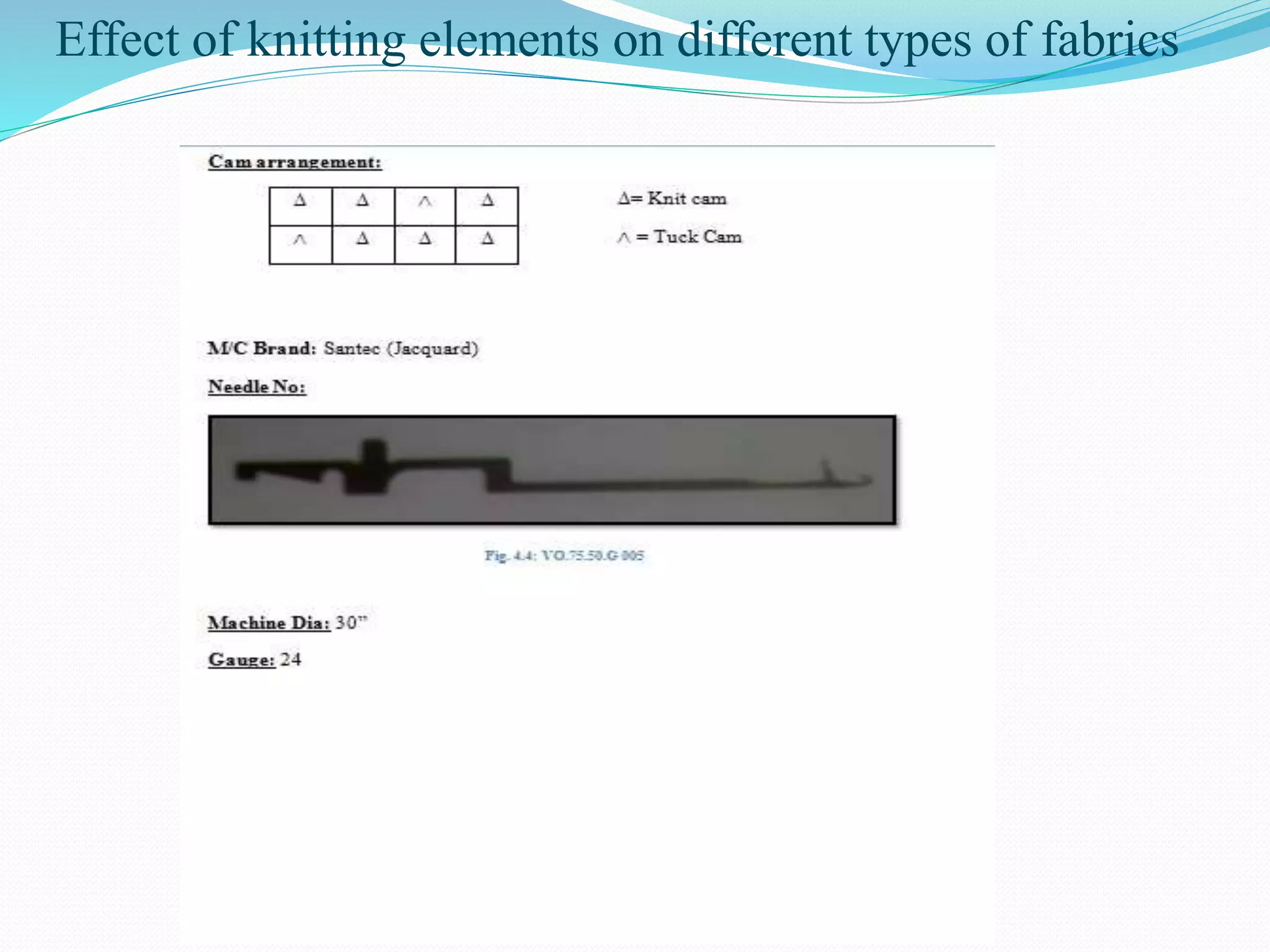
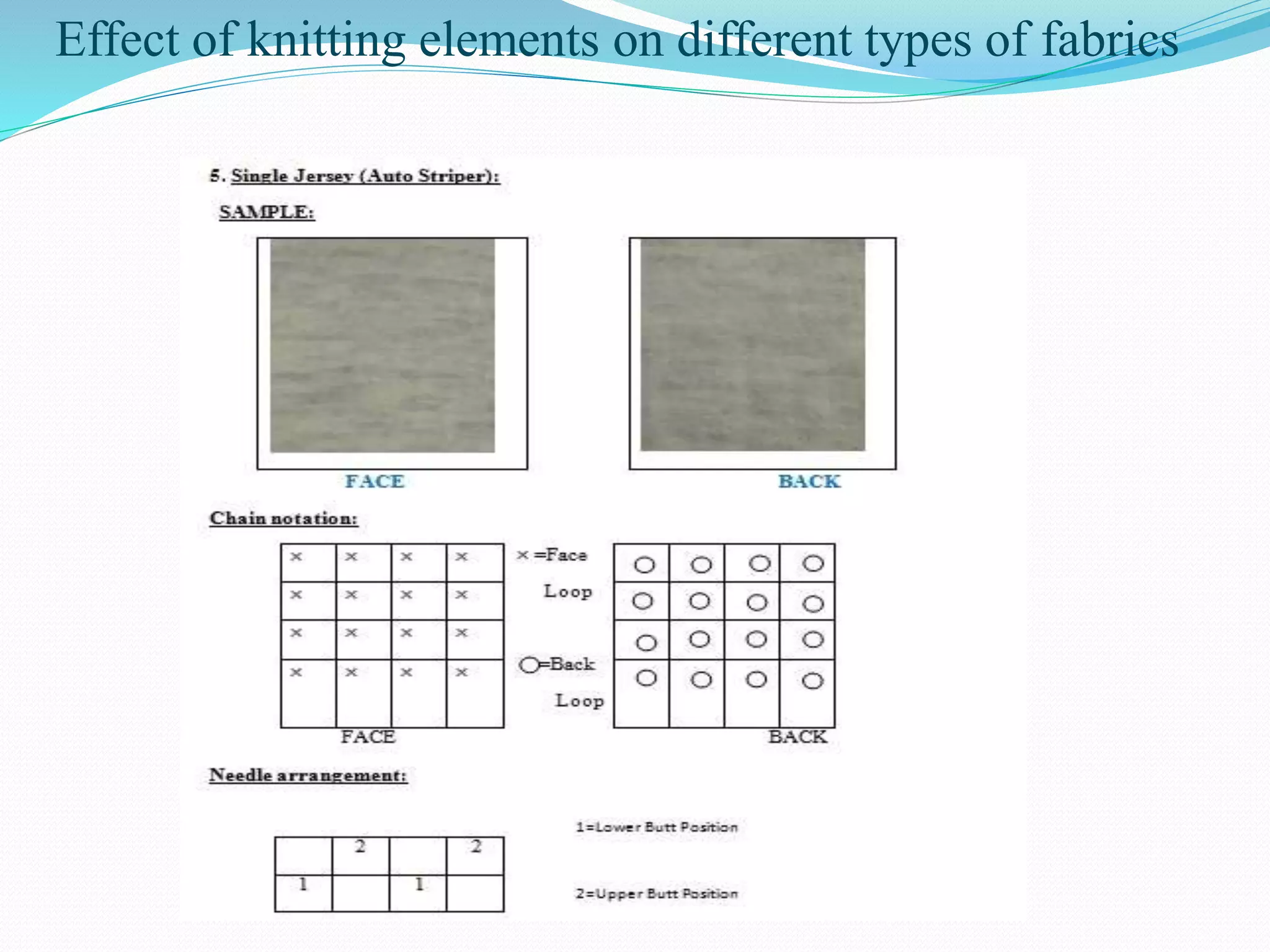
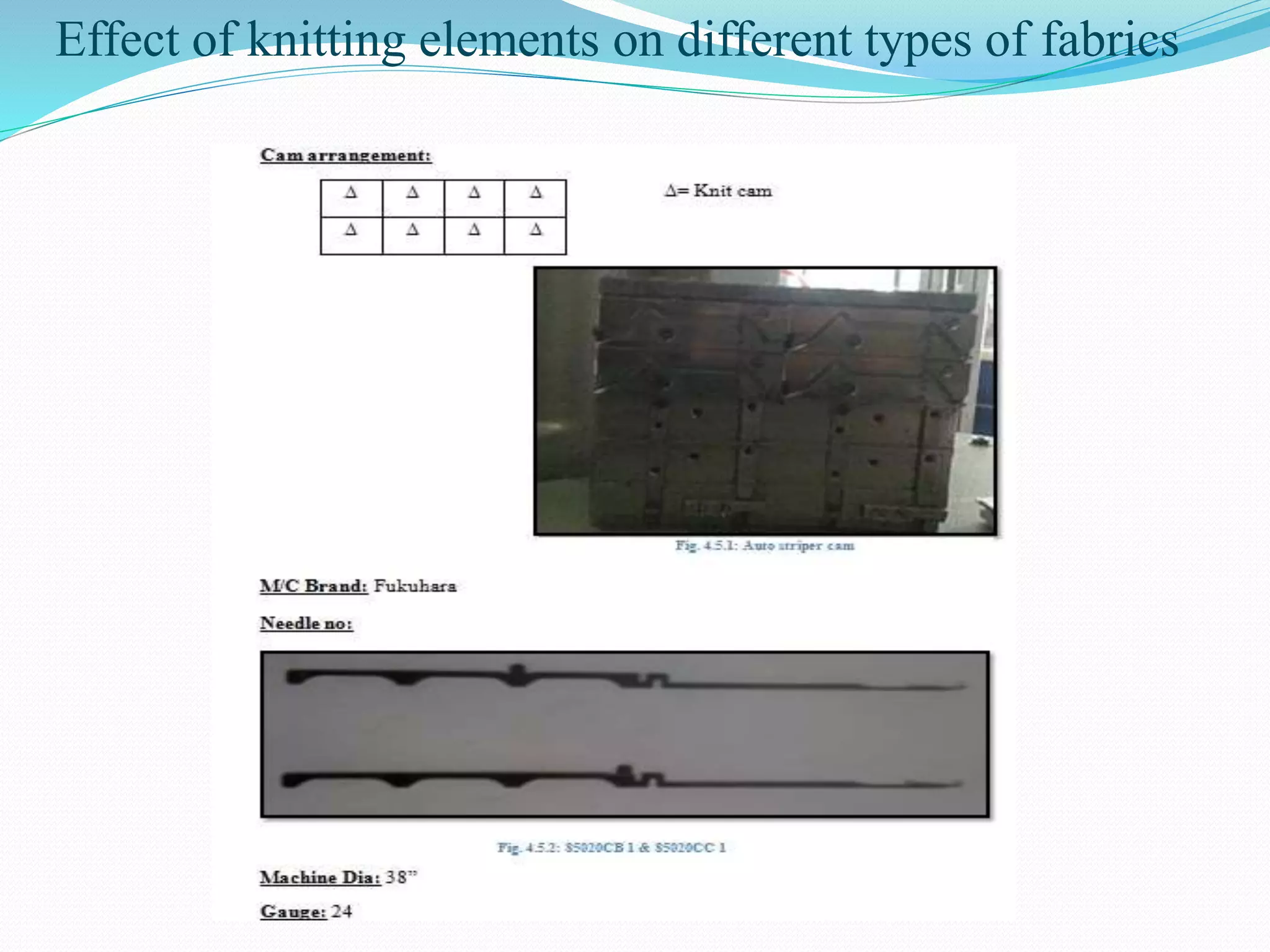
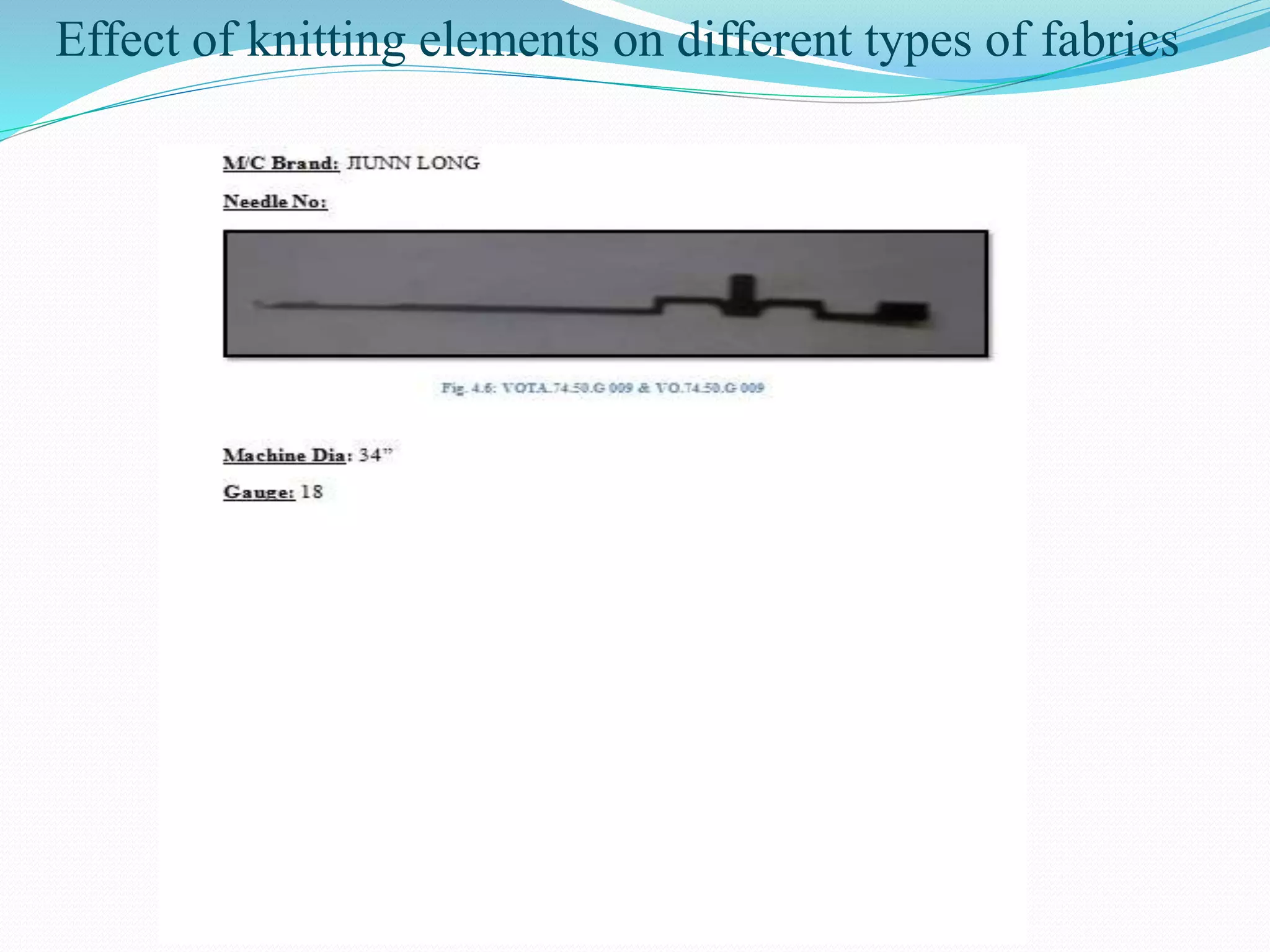
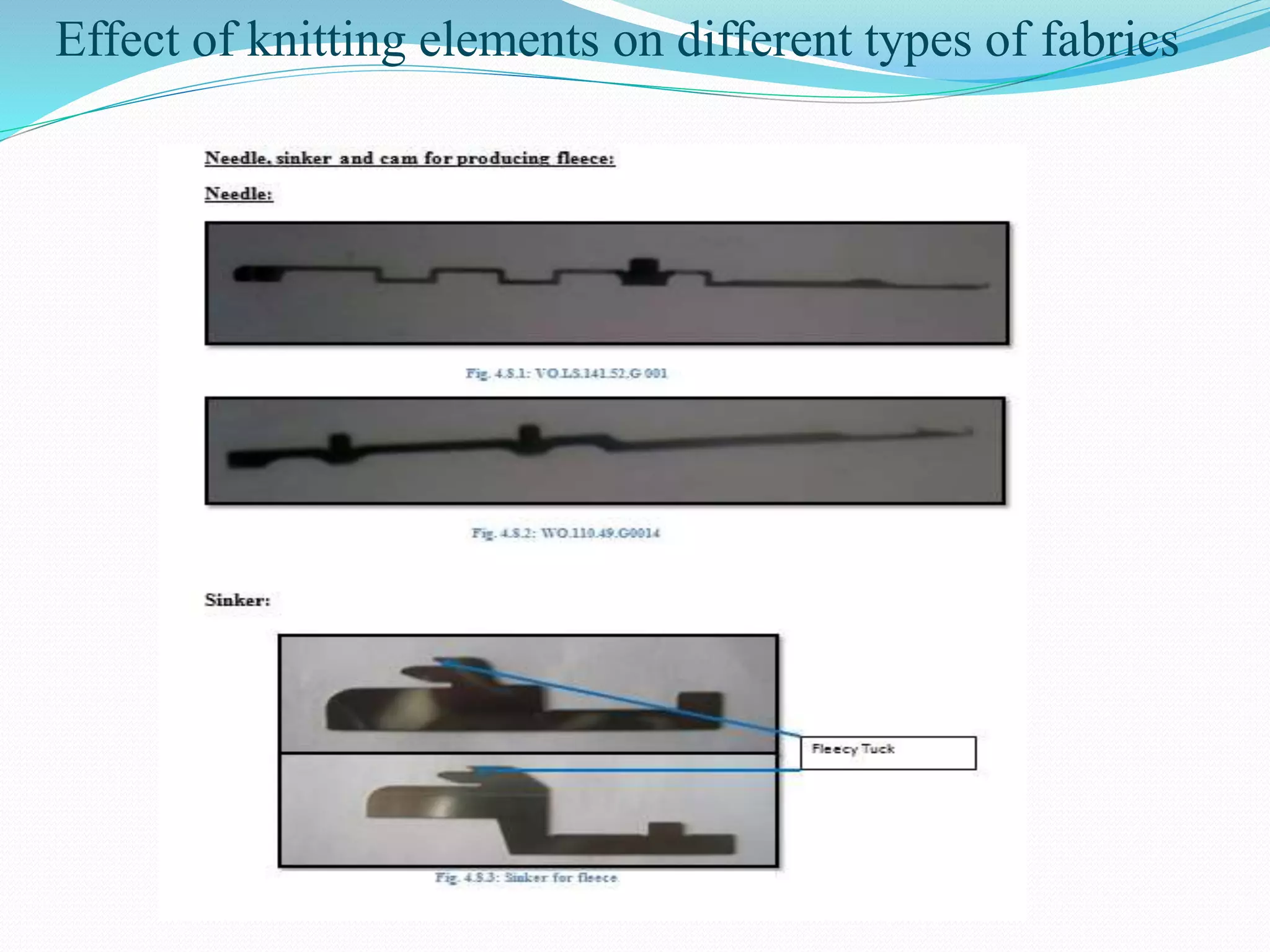
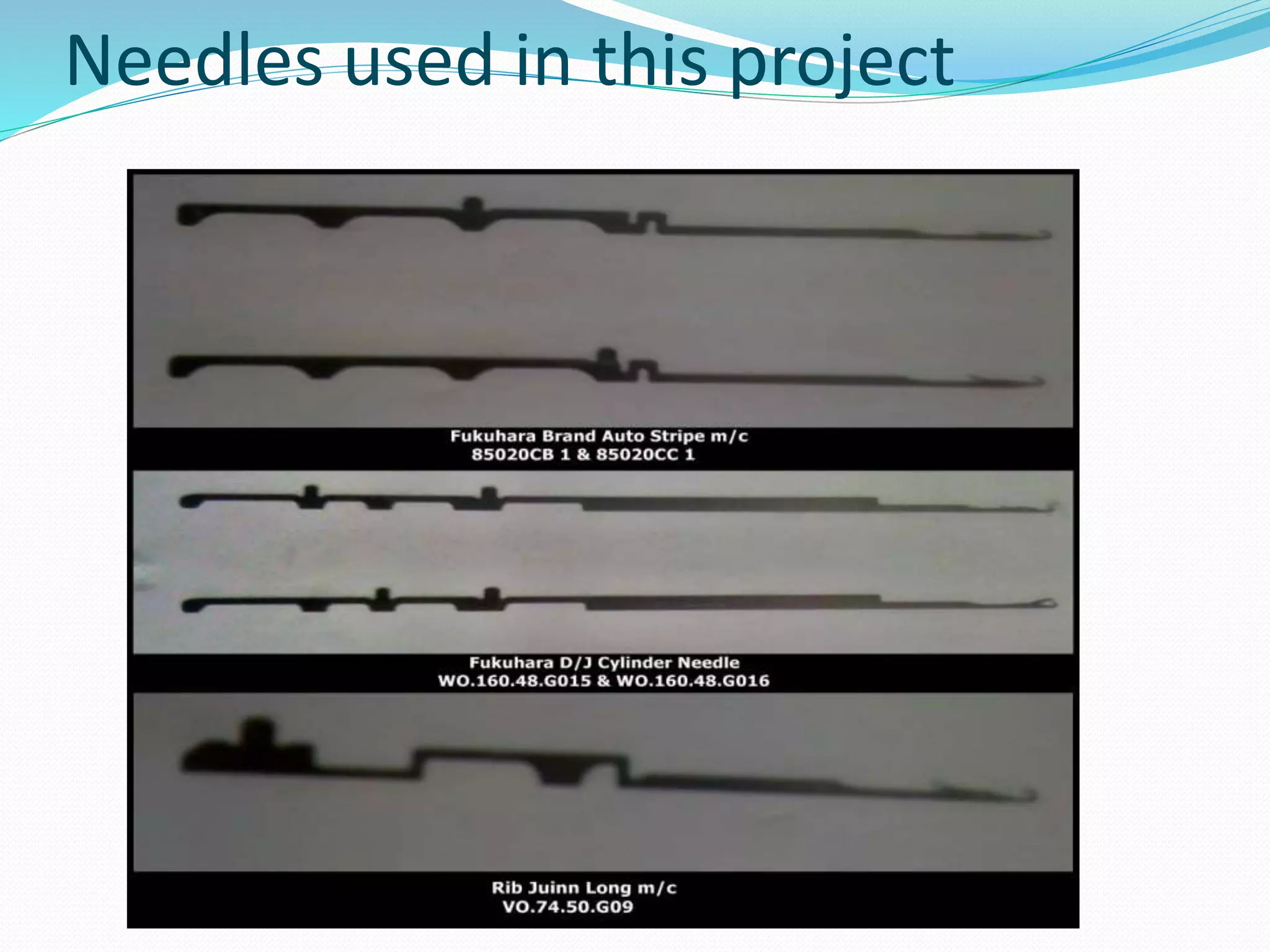
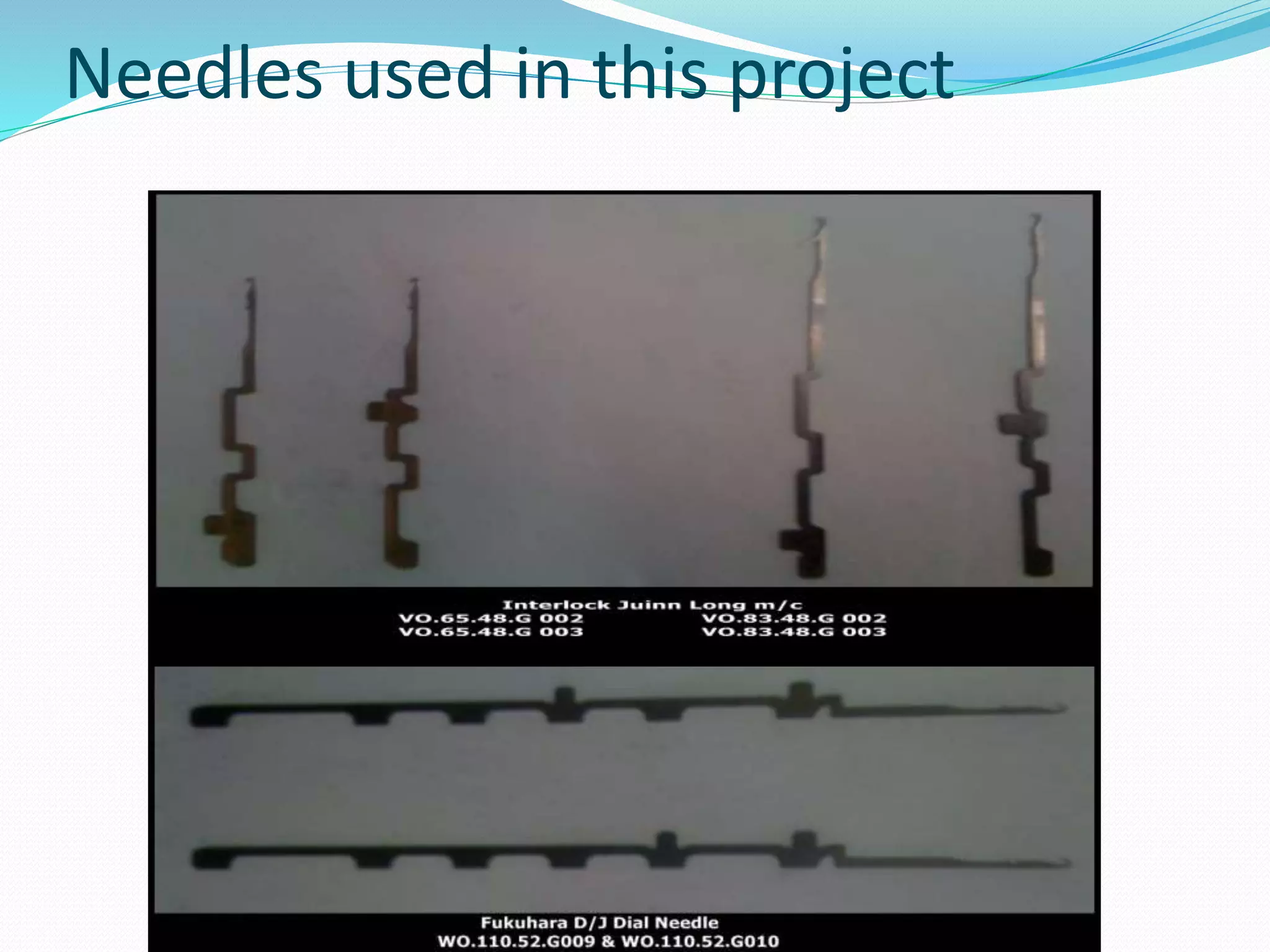
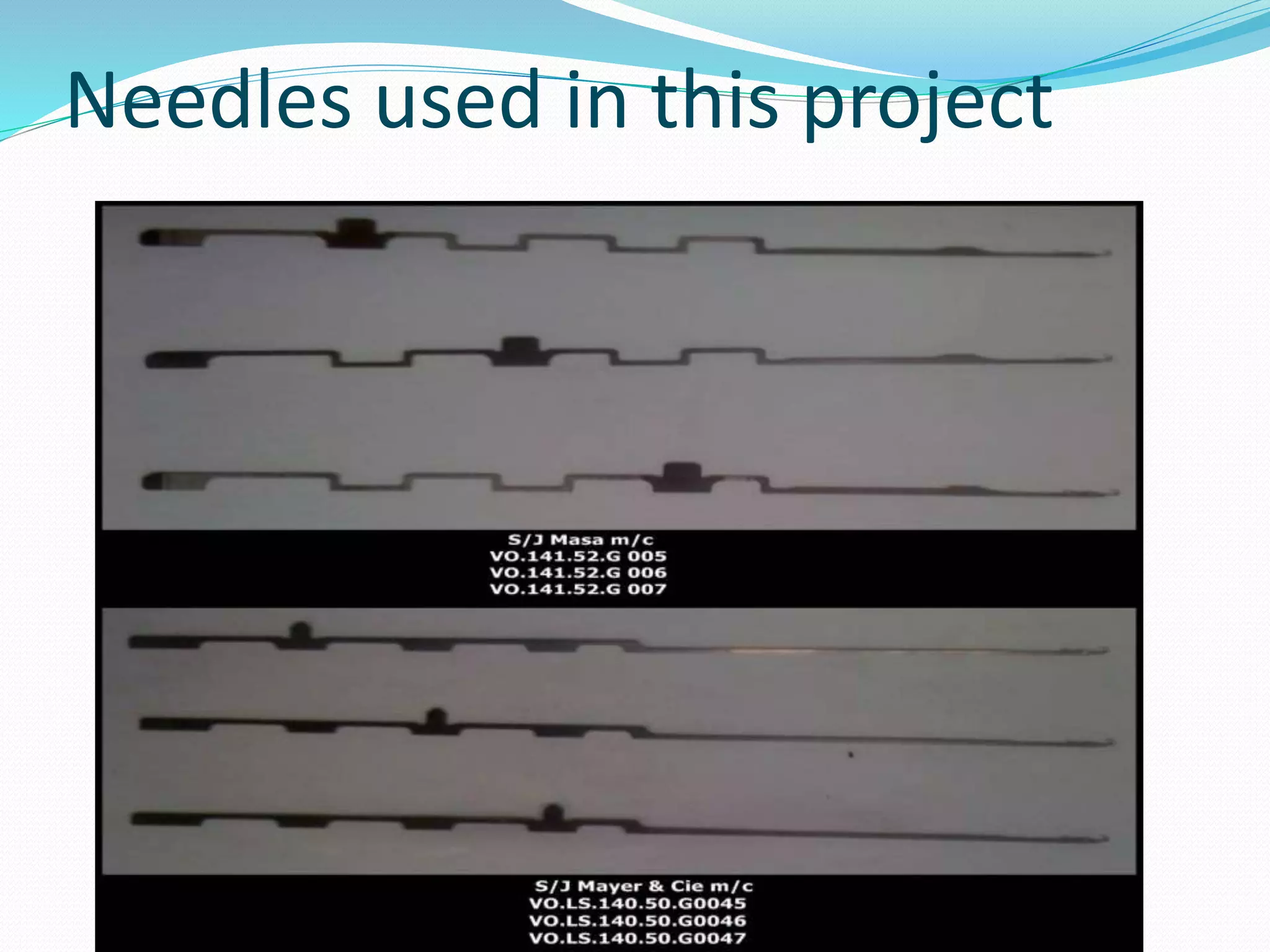
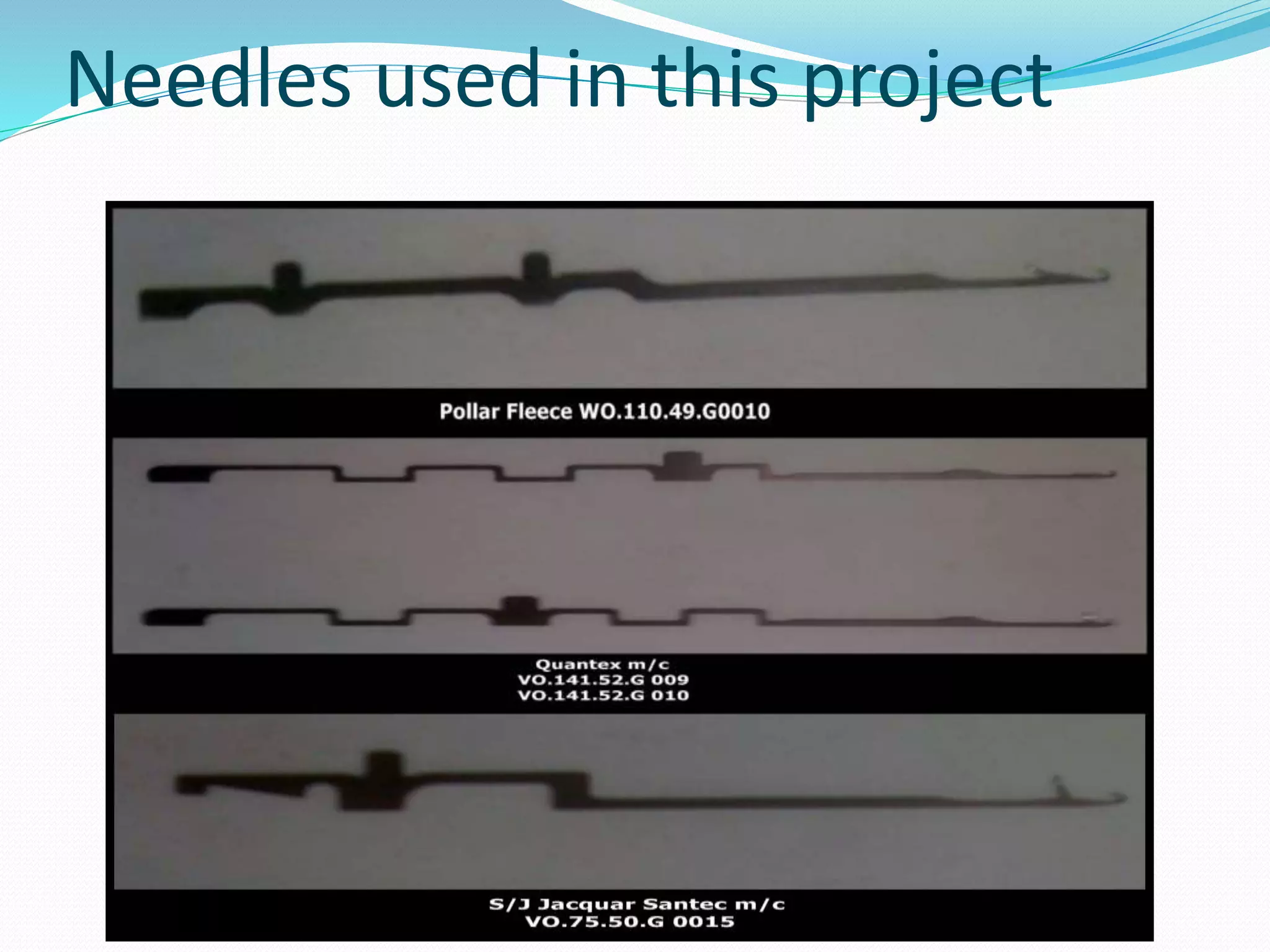
Needles used in this project
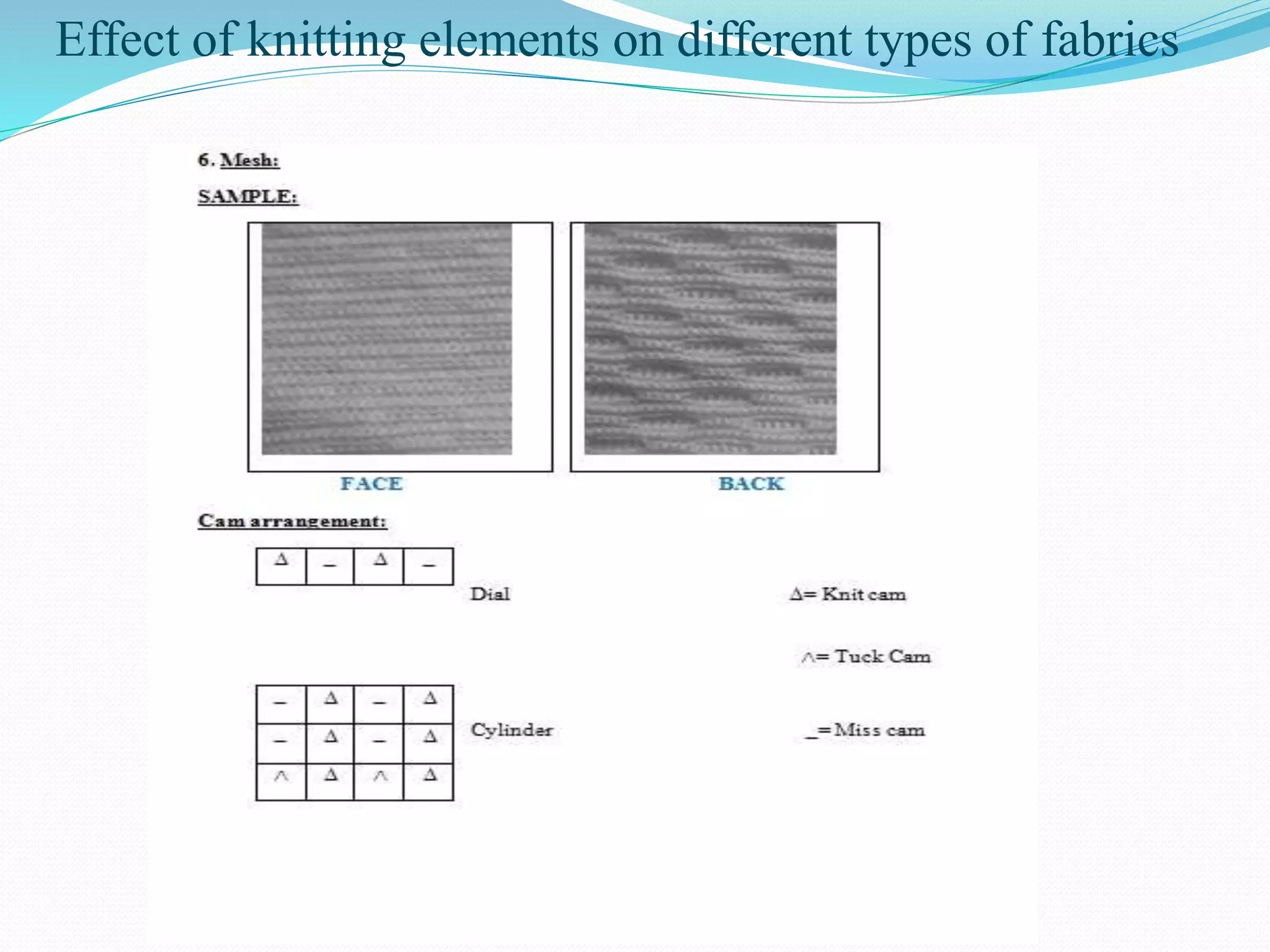
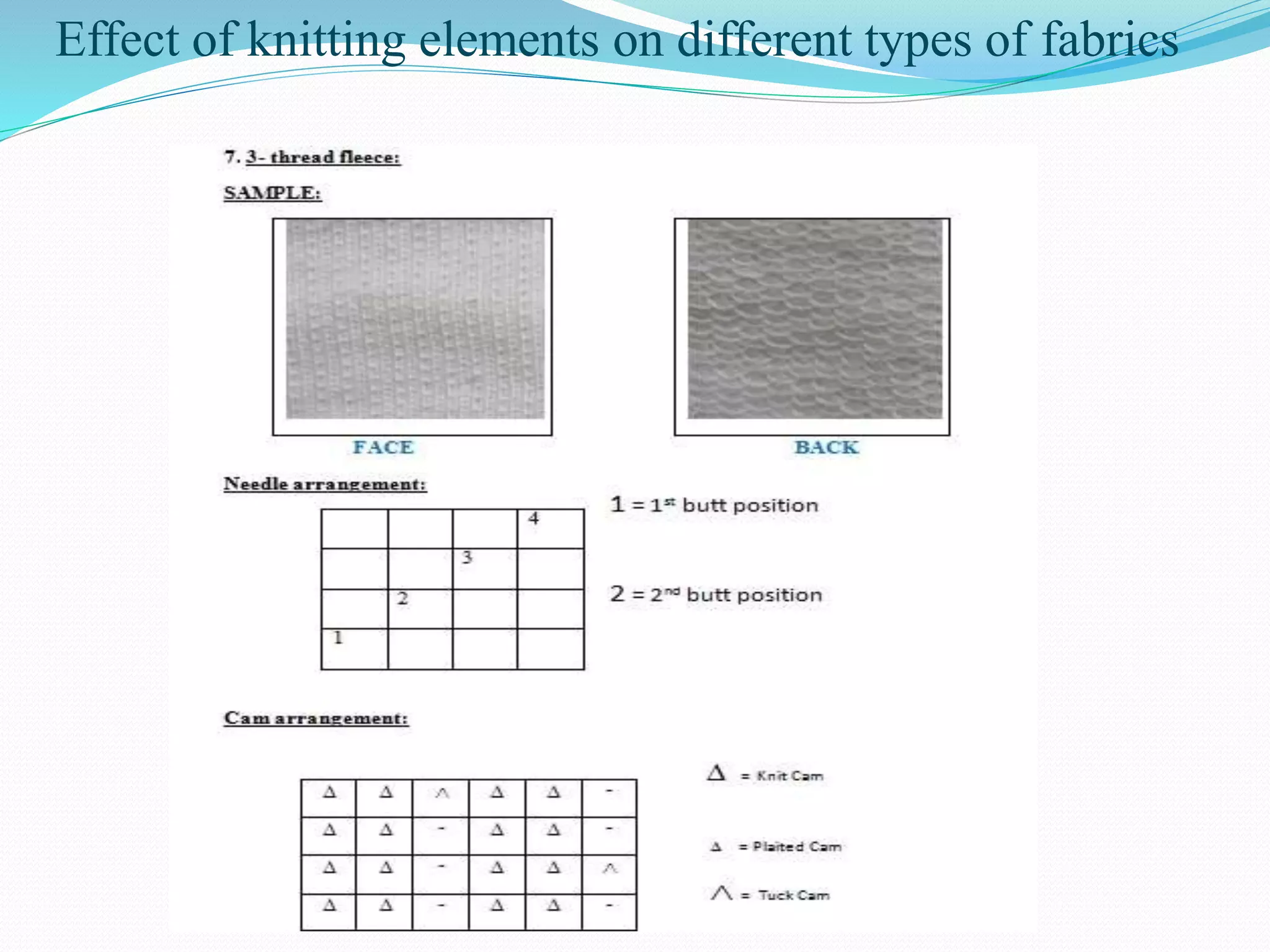
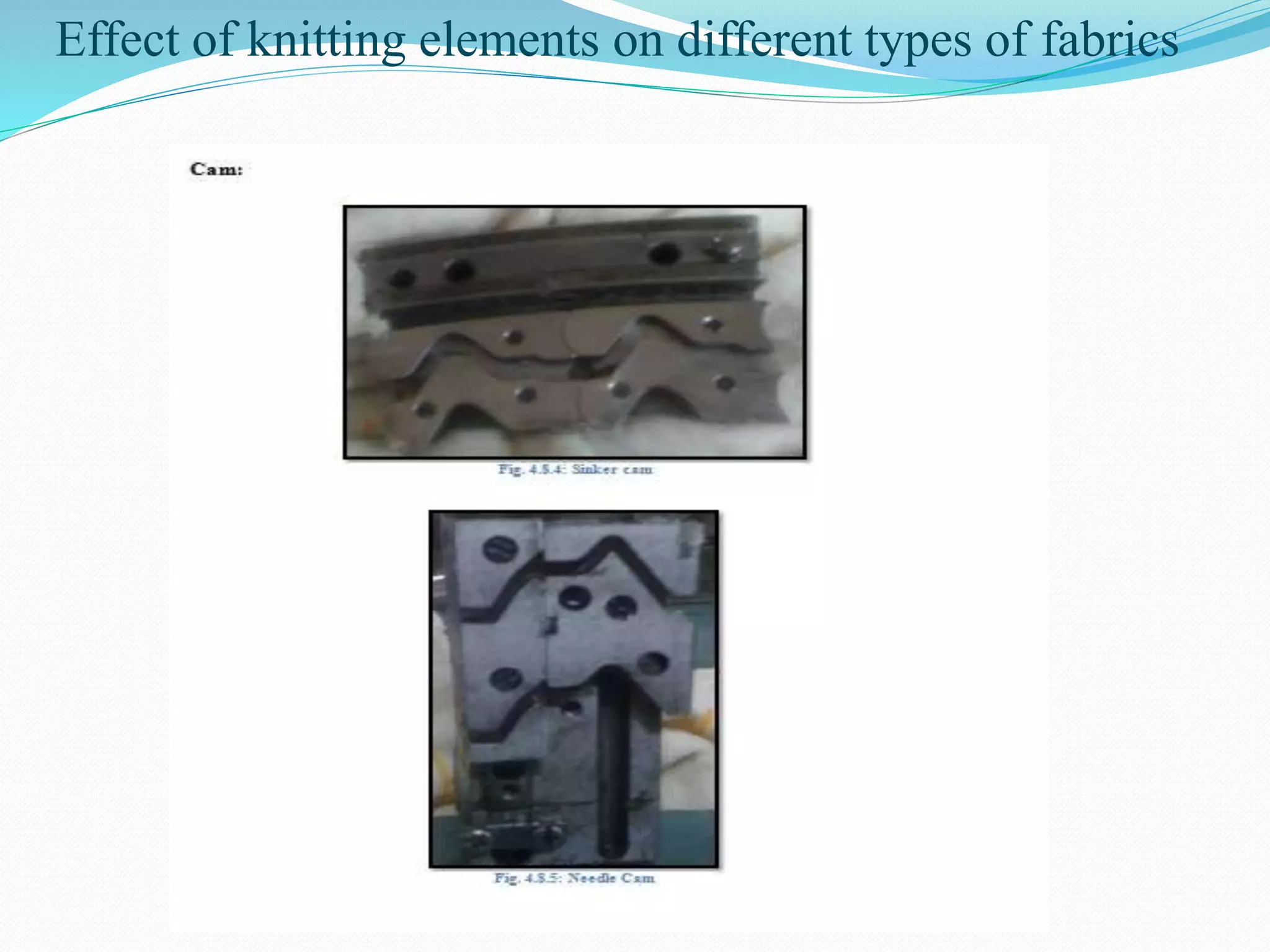
Cams used in this project 
Knit Miss Tuck
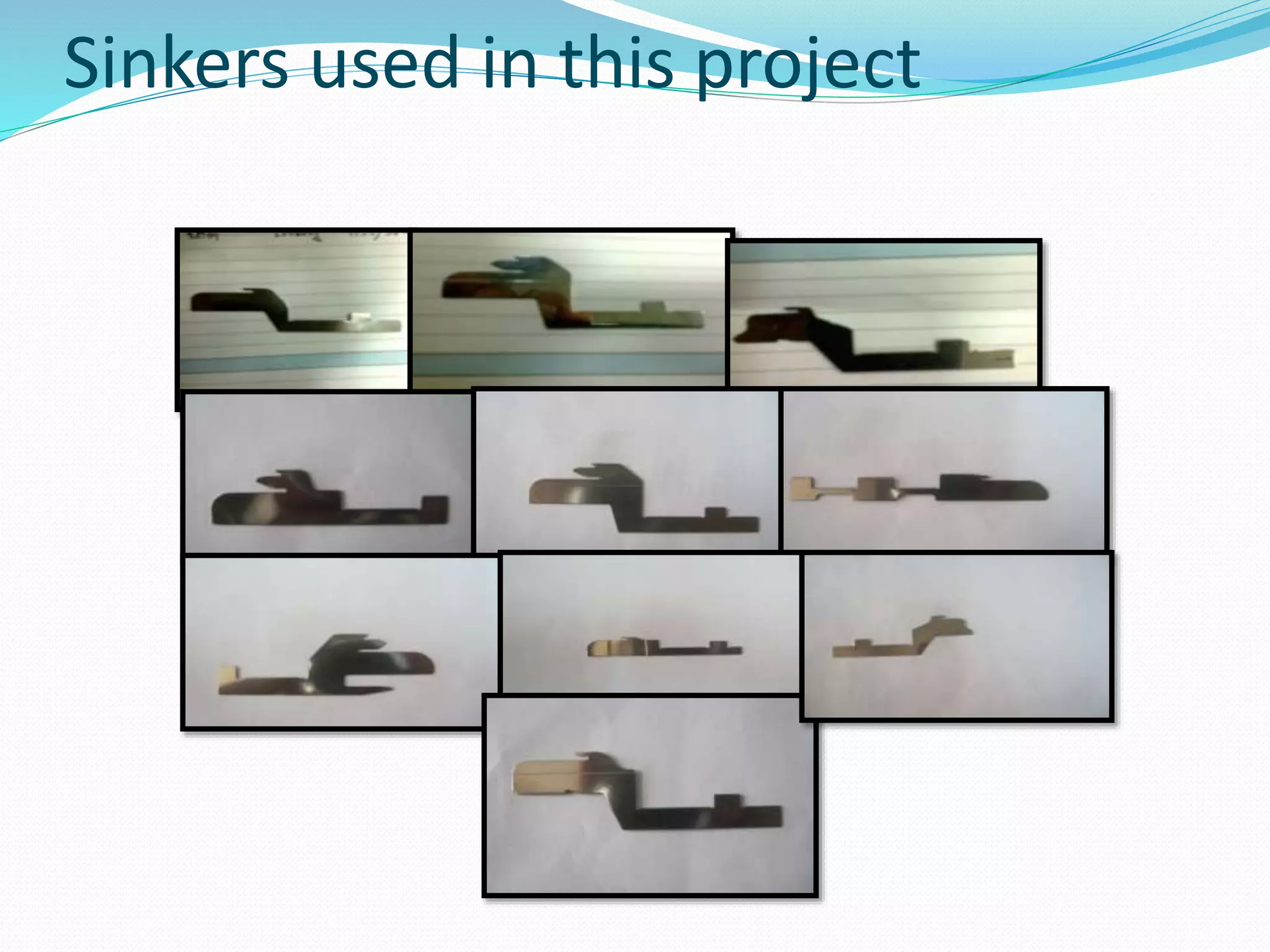
Sinkers used in this project
Details Investigation 
26G 
18G 
42G 
34G 
6000 
4000 
3000 
2000 
1000 
0 
5000 
16" 18" 20" 22" 24" 26" 28" 32" 36" 40" 
n 
e 
e 
d 
l 
e 
s 
n 
u 
m 
b 
e 
r 
DIA 
18G 
20G 
22G 
24G 
26G 
28G 
30G 
32G 
34G 
36G 
38G 
40G 
42G 
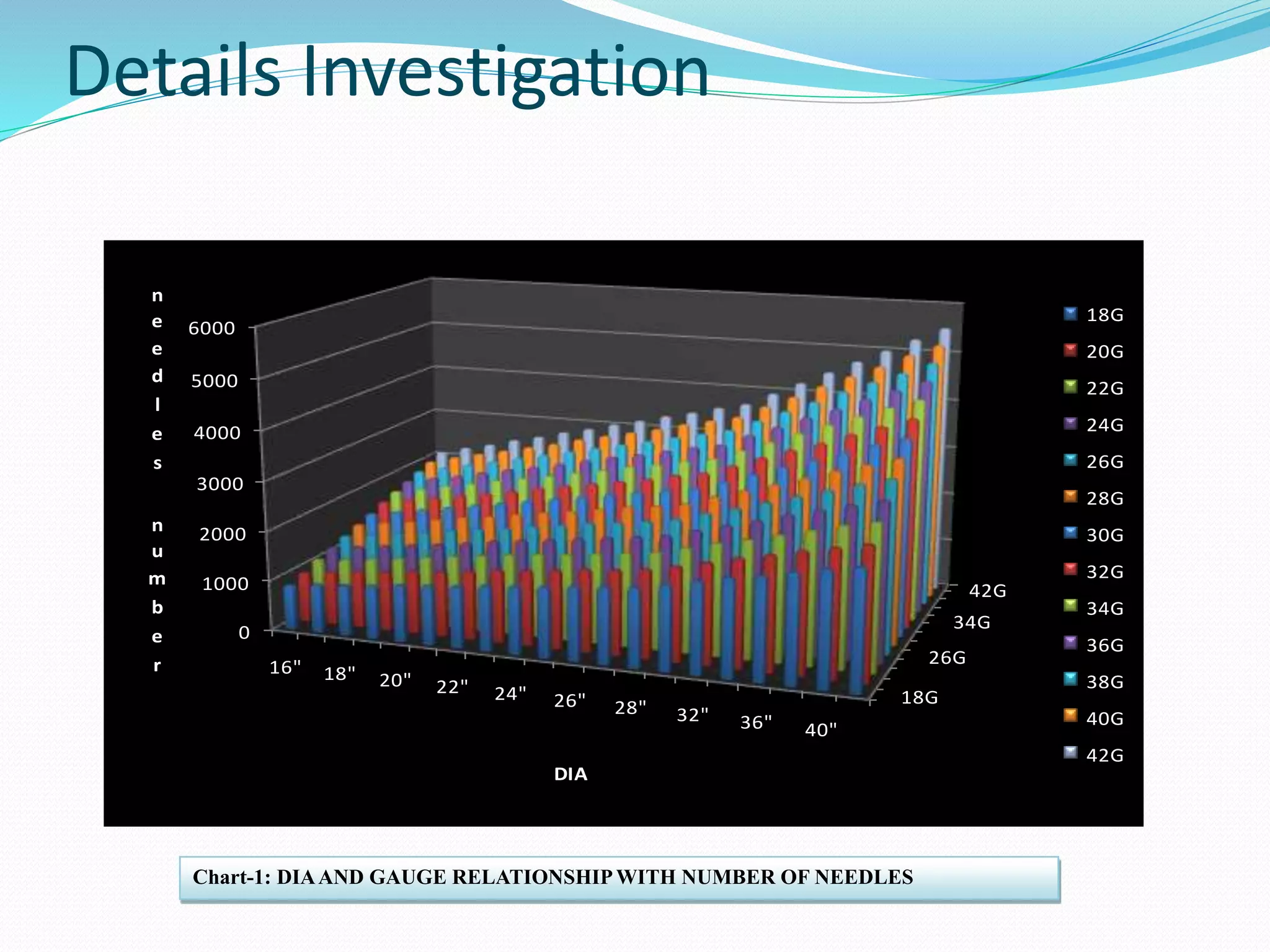
Chart-1: DIA AND GAUGE RELATIONSHIP WITH NUMBER OF NEEDLES
Details Investigation 
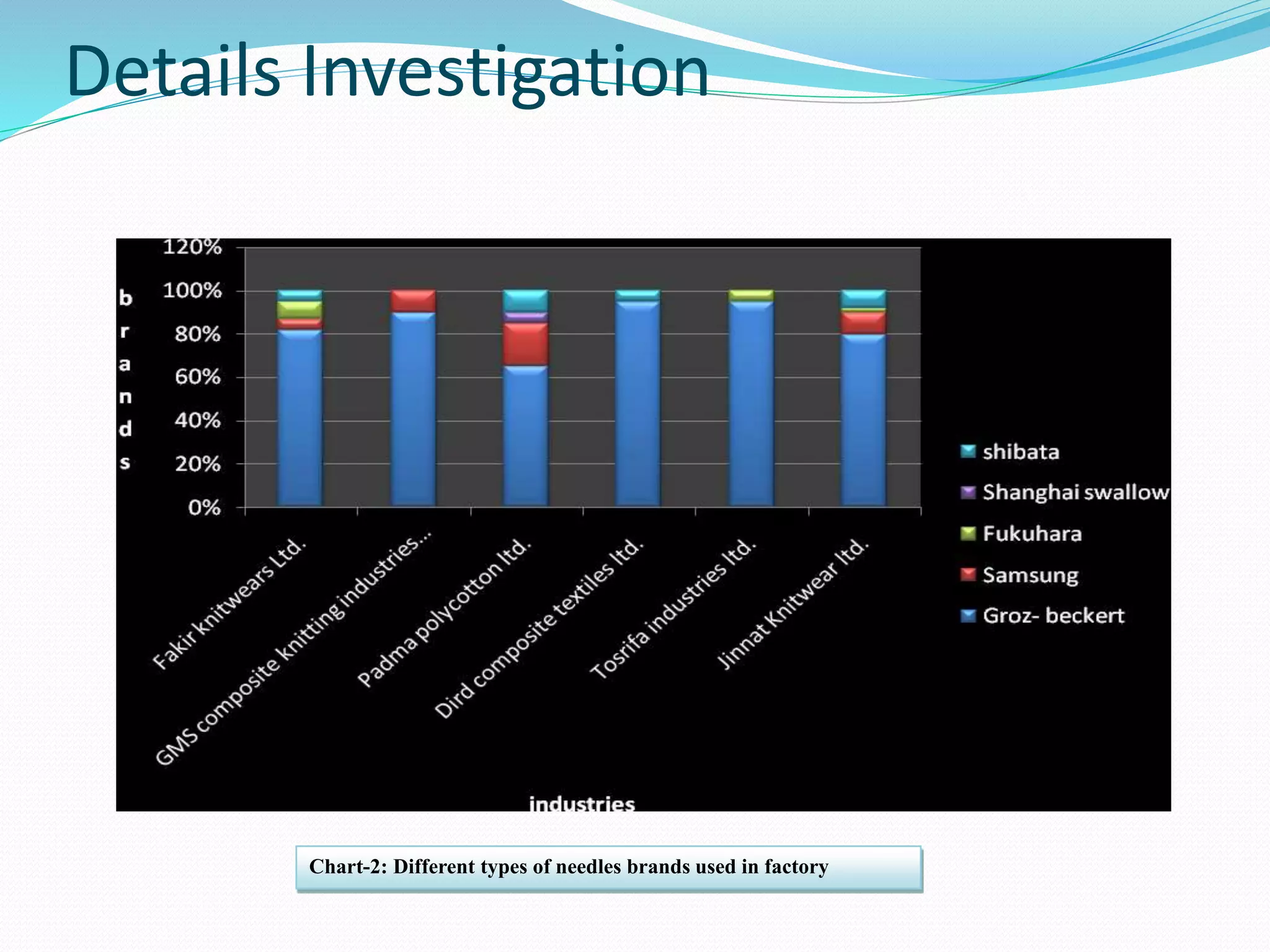
Chart-2: Different types of needles brands used in factory
Details Investigation 
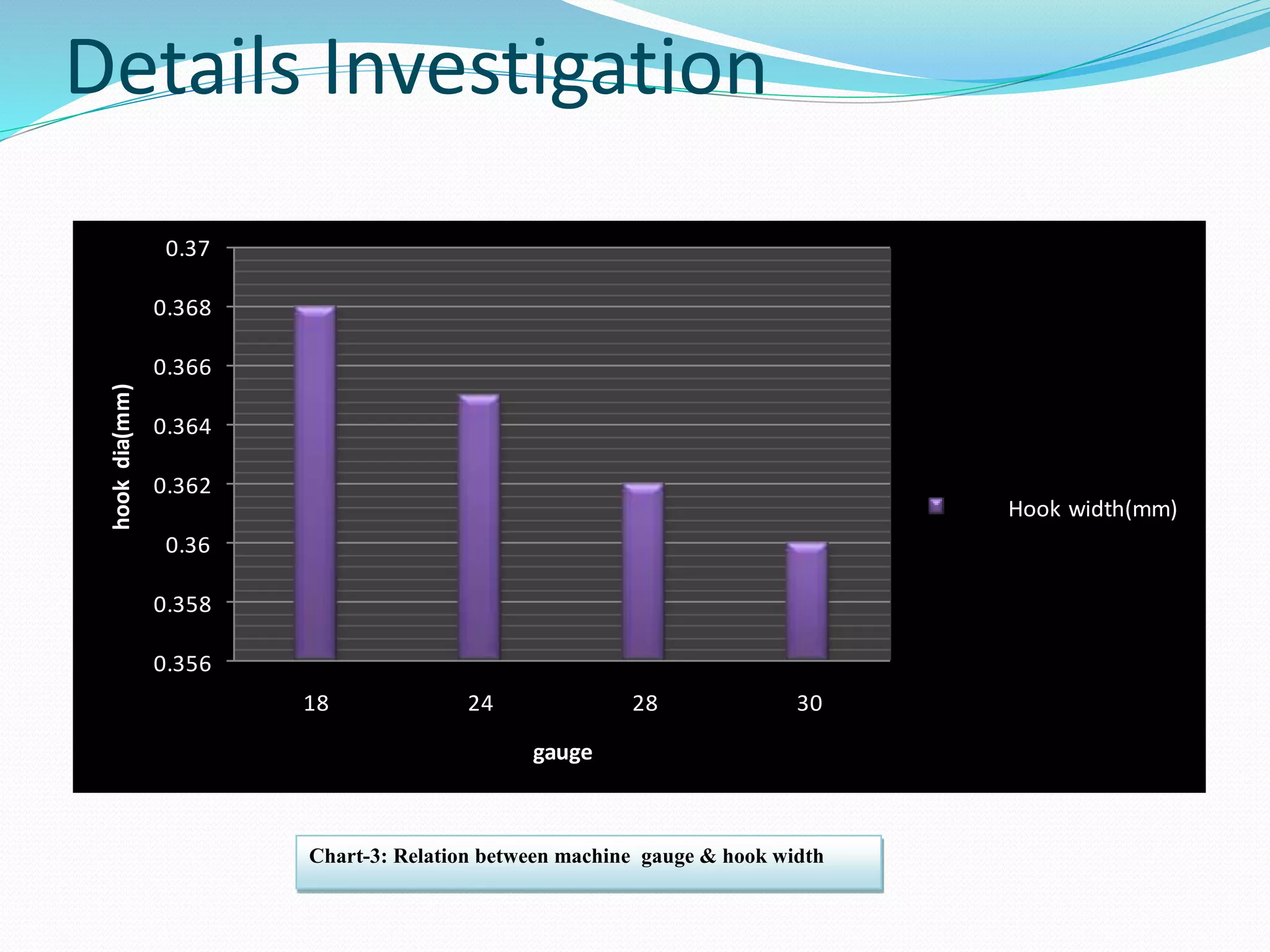
0.37 
0.368 
0.366 
0.364 
0.362 
0.36 
0.358 
0.356 
18 24 28 30 
hook dia(mm) 
gauge 
Hook width(mm) 
Chart-3: Relation between machine gauge & hook width
Details Investigation 
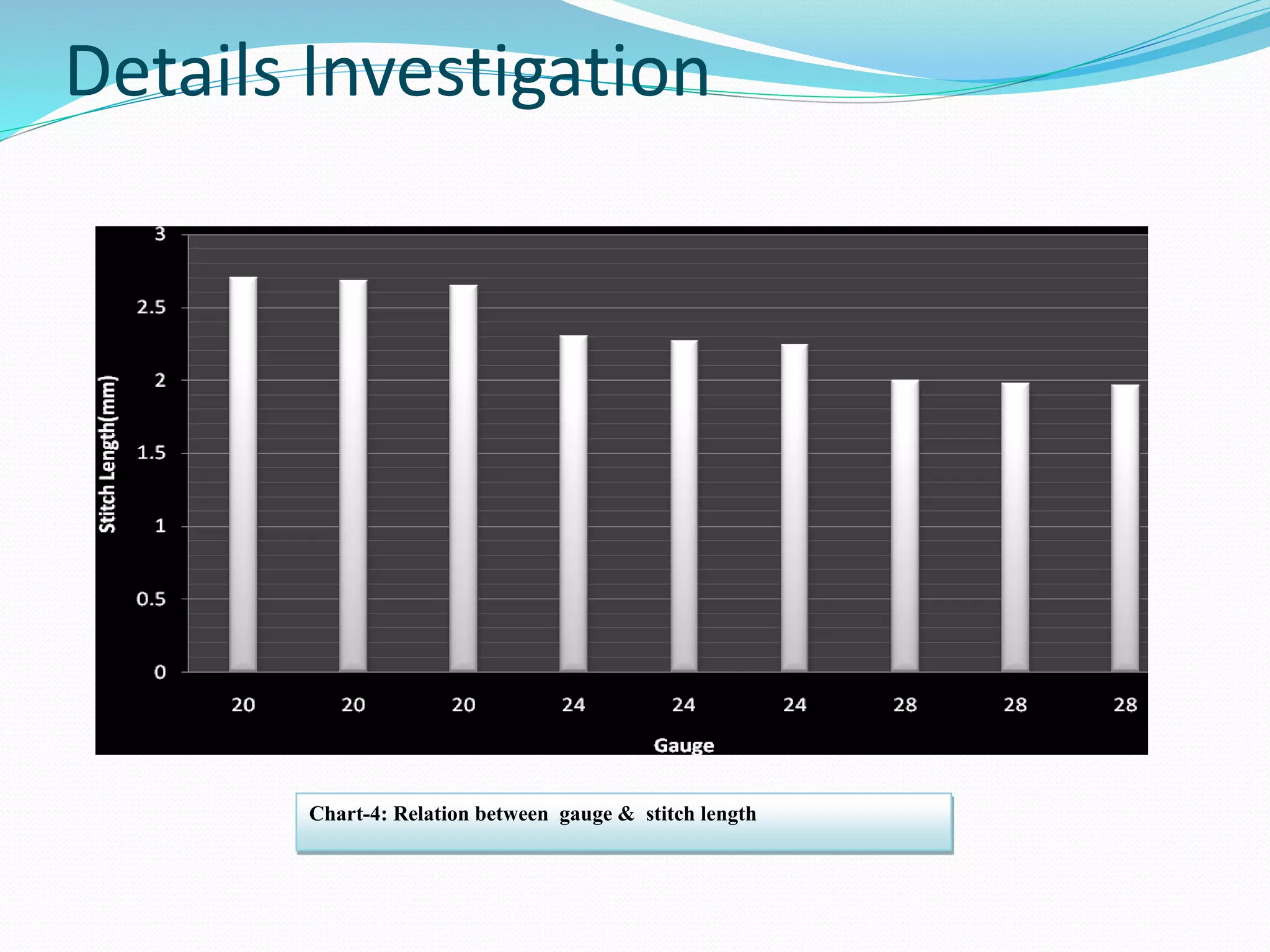
Chart-4: Relation between gauge & stitch length
Details Investigation 
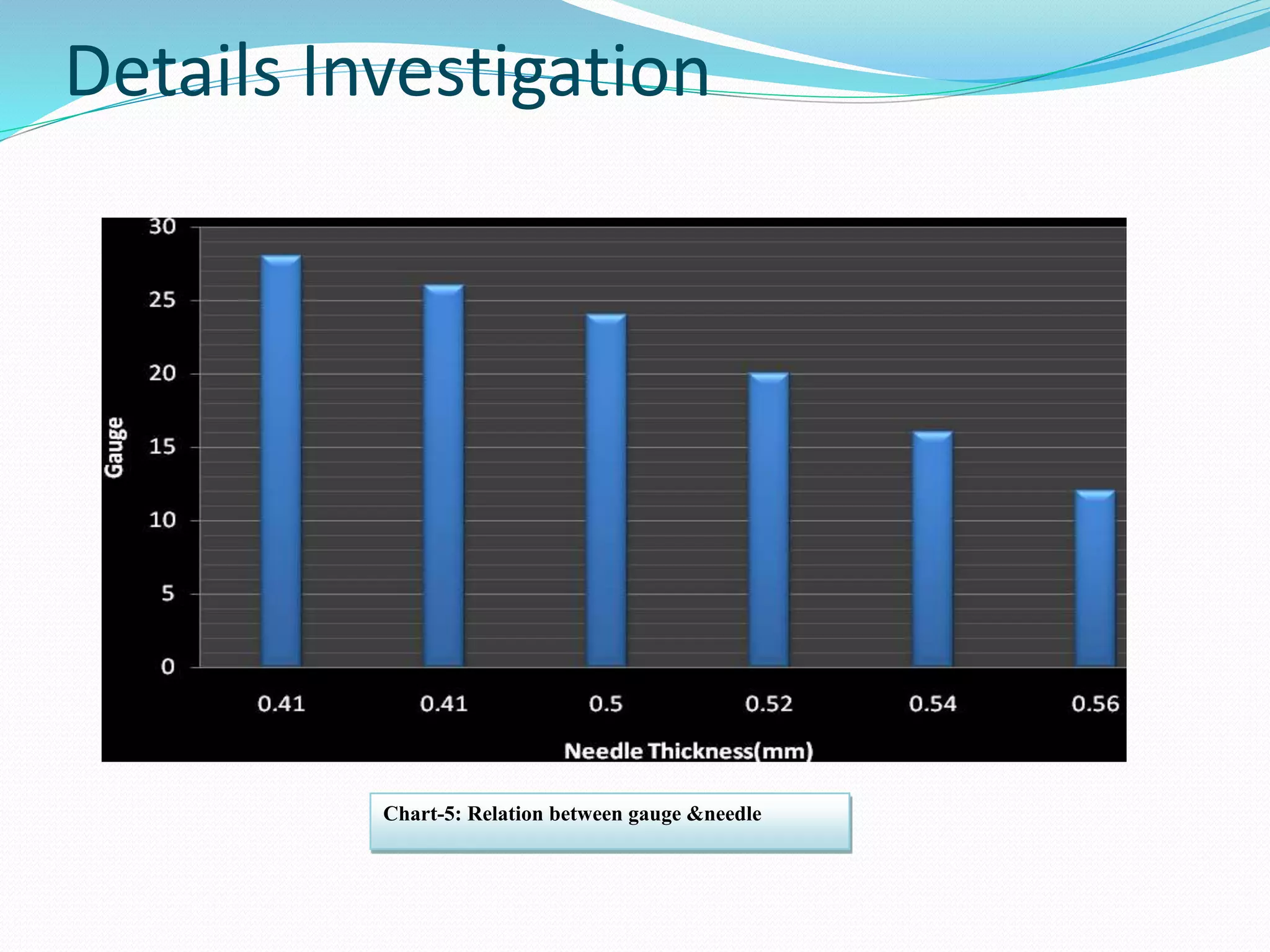
Chart-5: Relation between gauge &needle
Details Investigation 
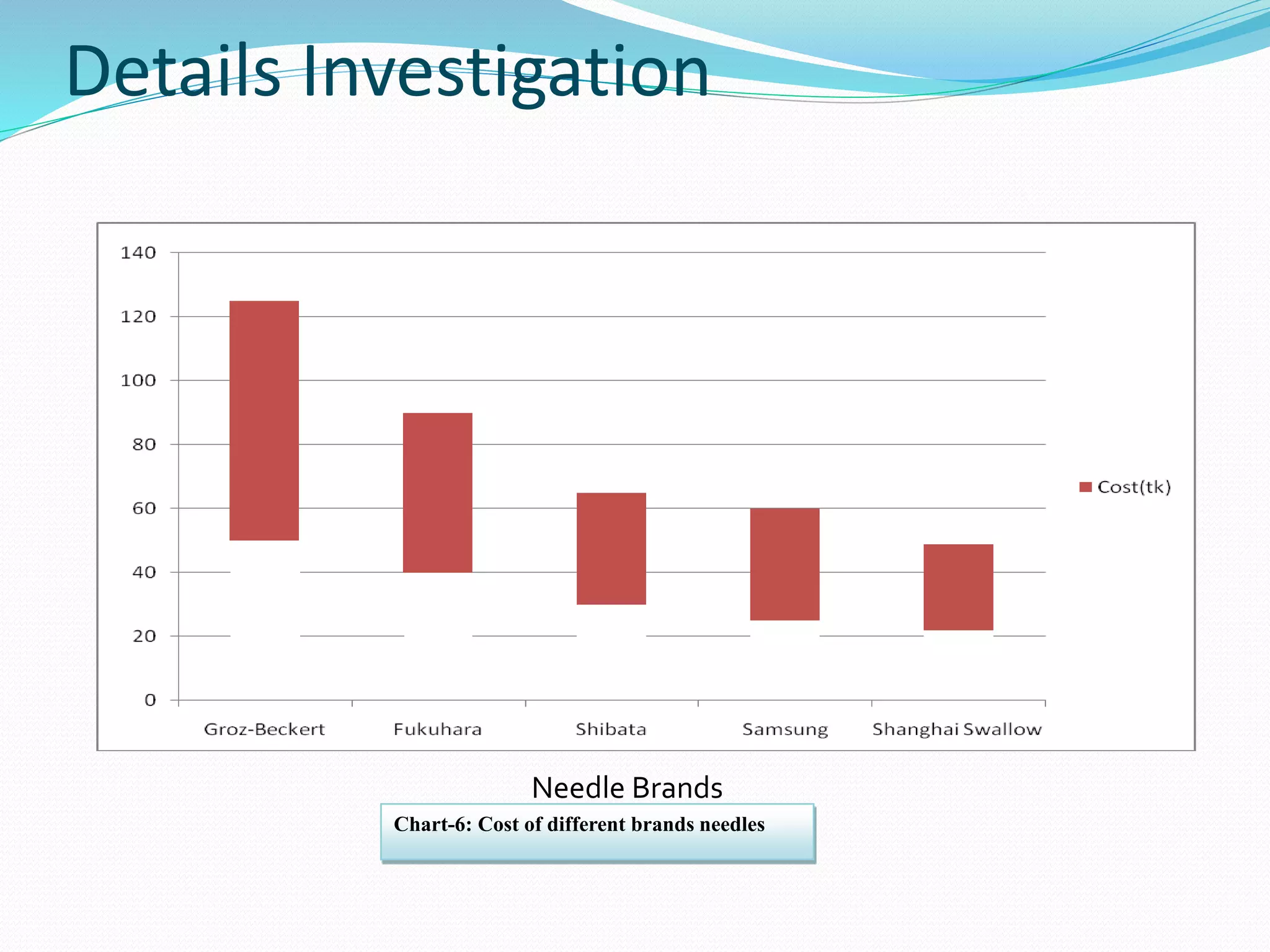
Needle Brands 
Chart-6: Cost of different brands needles
Details Investigation 
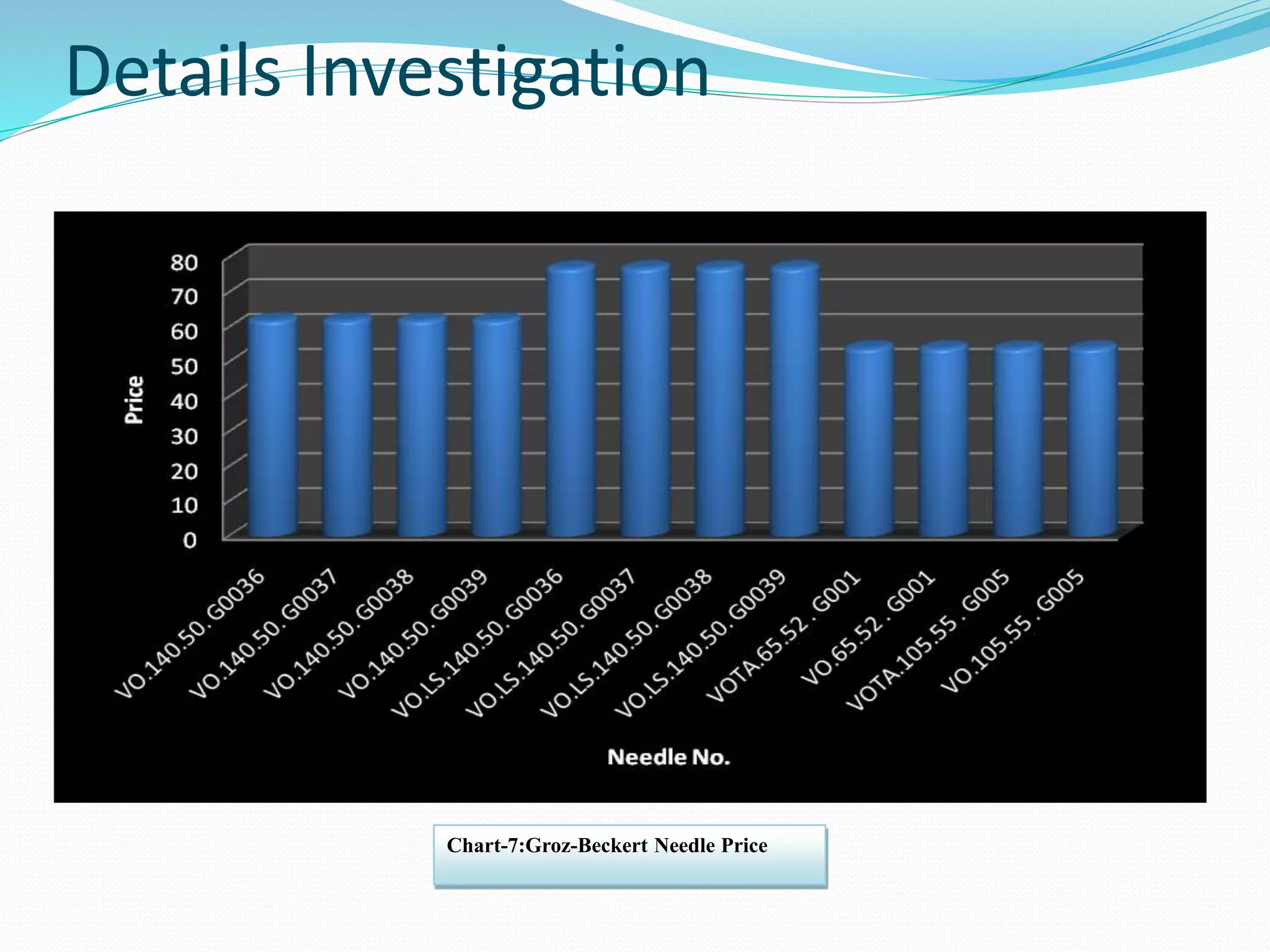
Chart-7:Groz-Beckert Needle Price
Details Investigation 
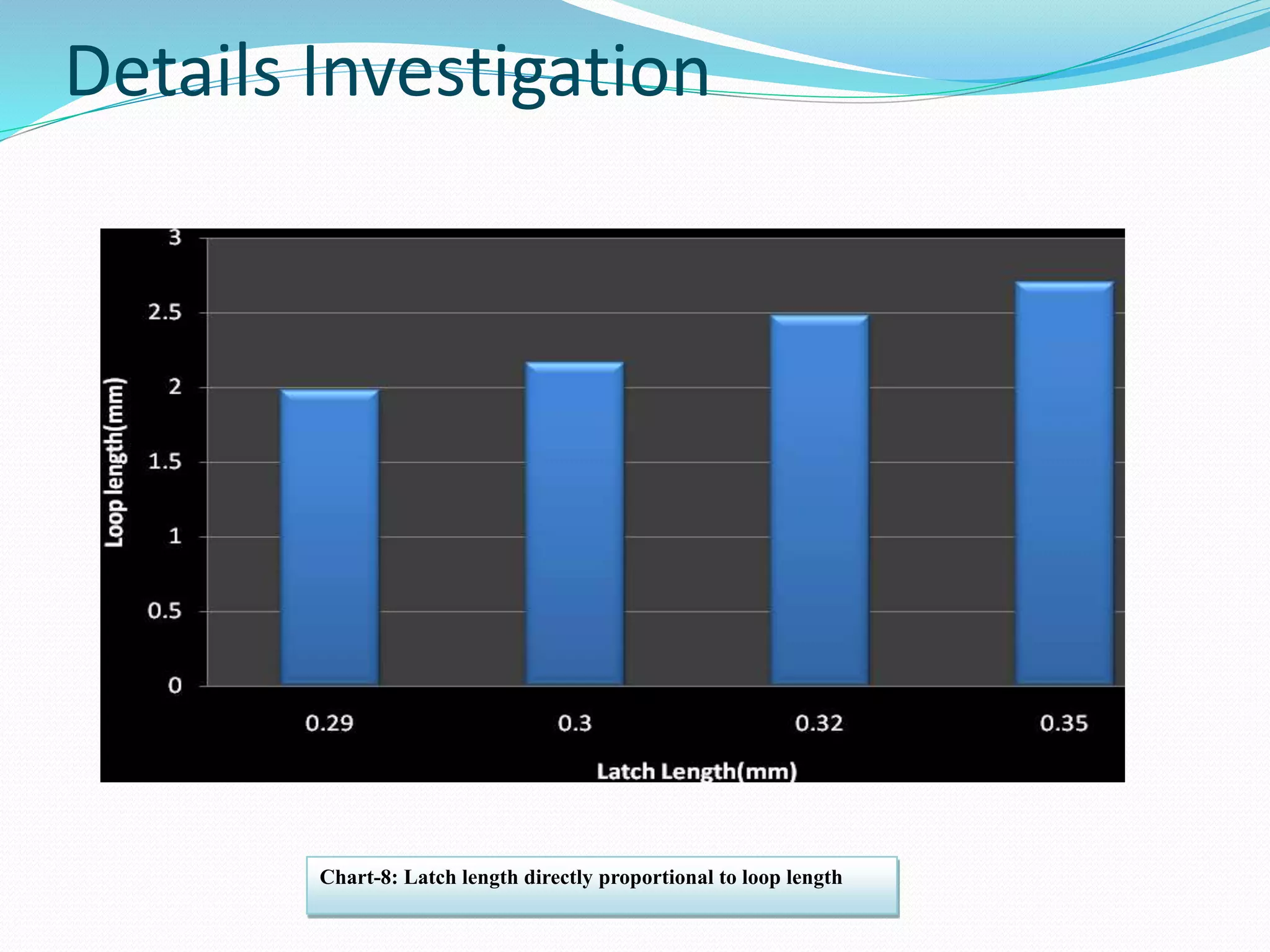
Chart-8: Latch length directly proportional to loop length
Details Investigation 
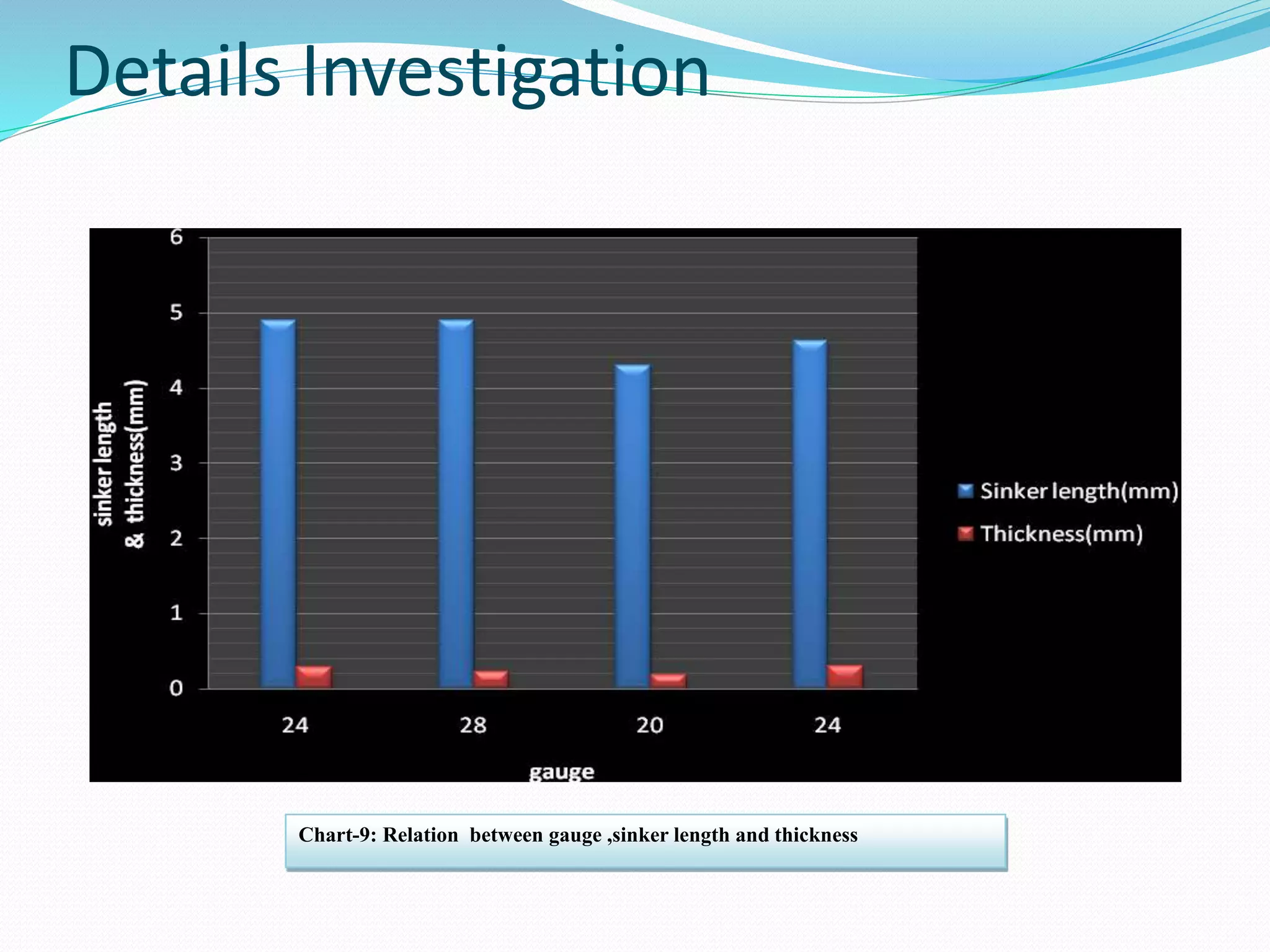
Chart-9: Relation between gauge ,sinker length and thickness
Details Investigation 
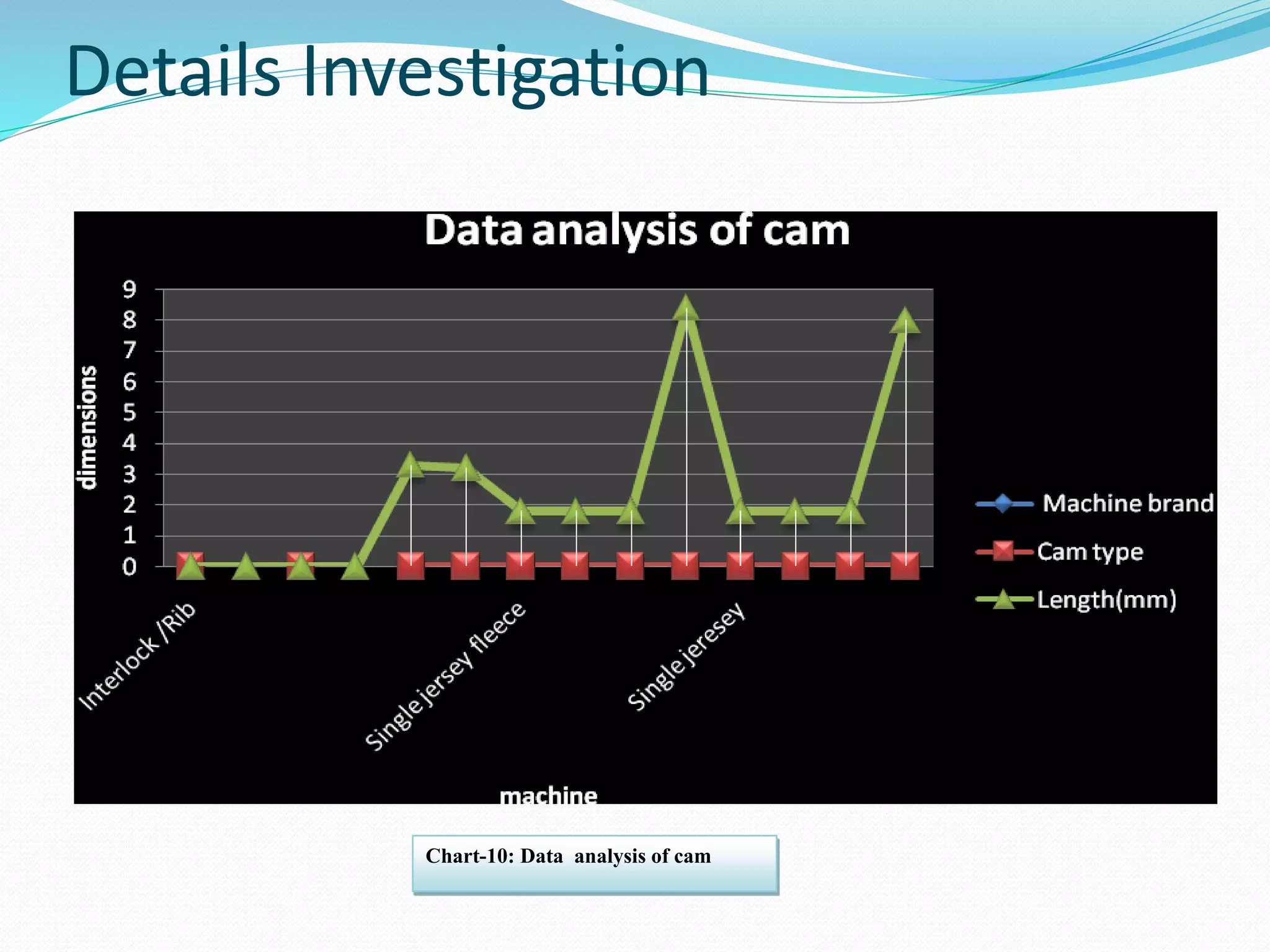
Chart-10: Data analysis of cam
45 
40 
35 
30 
25 
20 
15 
10 
5 
0 
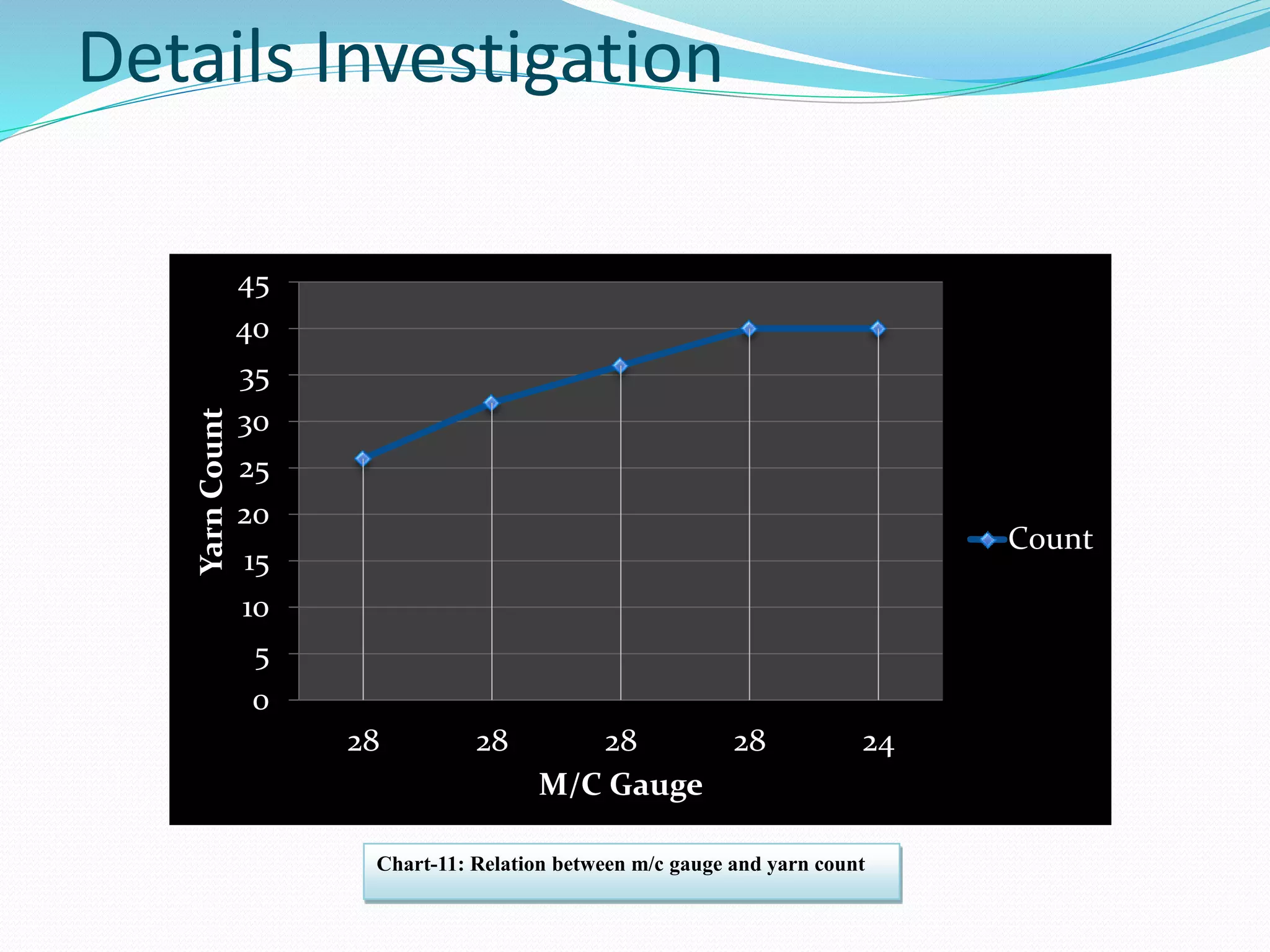
28 28 28 28 24 
Yarn Count 
M/C Gauge 
Count 
Details Investigation 
Chart-11: Relation between m/c gauge and yarn count
Result & Discusions 
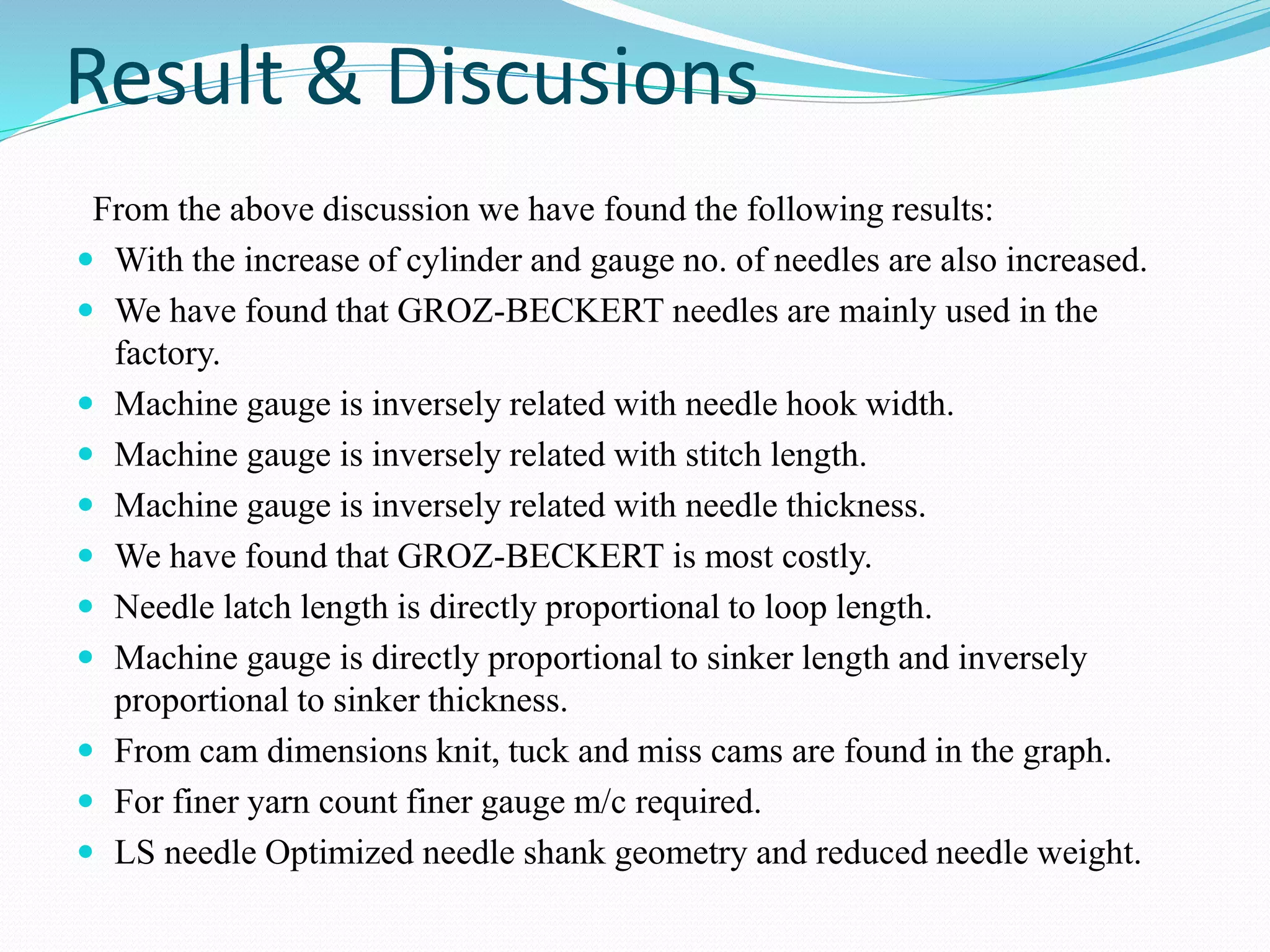
From the above discussion we have found the following results: 
 With the increase of cylinder and gauge no. of needles are also increased. 
 We have found that GROZ-BECKERT needles are mainly used in the 
factory. 
 Machine gauge is inversely related with needle hook width. 
 Machine gauge is inversely related with stitch length. 
 Machine gauge is inversely related with needle thickness. 
 We have found that GROZ-BECKERT is most costly. 
 Needle latch length is directly proportional to loop length. 
 Machine gauge is directly proportional to sinker length and inversely 
proportional to sinker thickness. 
 From cam dimensions knit, tuck and miss cams are found in the graph. 
 For finer yarn count finer gauge m/c required. 
 LS needle Optimized needle shank geometry and reduced needle weight.
Conclusion 
The main purpose of this project is to determine what type of 
needles are used in different brand of machines, relation 
between the cylinder dia and the number of needles, also 
relation between the hook width and the machine gauge, also 
the relation between the latch length and the loop length. 
The investigation is conducted a snap study to analyze the 
relation between the machine gauge to sinker length and to 
sinker thickness. 
The investigation also review the dimensions of knit, tuck and 
miss cams, also details about needle shank geometry and 
needle weight. 
And finally, the lubrication system of knitting machines.

Study on knitting elements of circular knitting machine (butex)

  • 1.
  • 2.
    Supervised By DR.SHAIKH MD. MOMINUL ALAM ASSOCIATE PROFESSOR & HEAD Department of Fabric Manufacturing Engineering Bangladesh University of Textiles
  • 3.
    ACKNOWLEDGEMENT First ofall, we would like to express our gratitude to the almighty Allah for enabling us to complete the project work successfully. Bangladesh University of Textiles has given us the opportunity to perform the project work. We are grateful to Prof. Mashud Ahmed, Dean, Faculty of Textile Manufacturing Engineering and Prof. Dr. Nitai Chandra Sutradhar, the Vice-Chancellor of the University for giving us the opportunity to accomplish the project. Special thanks to our supervising teacher Dr. Shaikh Md. Mominul Alam, Head of department of Fabric Manufacturing Engineering. We would like to express our cordial thanks to all the teachers of our university especially to Md. Emdad Sarker, Lecturer of Fabric Manufacturing Engineering. We also like to give our heartiest thanks to MD. Habibur Rahman, AGM, Tosrifa industries Ltd.; without whose help it would not be possible to complete the project successfully. Heartiest thanks goes to Textile Engineers of GMS Composite knitting industries ltd.; FAKIR Knitwears ltd.; Tosrifa industries ltd.; DIRD Composite Textiles ltd.& Cotton group .
  • 4.
    INTRODUCTION The everincreasing demand of knitted apparels has attracted attention in global niche market. In comparison to woven garment, around 50% of the clothing needs are met by the knitted goods. Needles, sinkers, cams, lubrication systems being the most important work elements for knitting machines, suffer permanent improvements to better satisfy the work conditions and the functions they must answer, resulting in a higher quality of the knitted fabrics, the reduce of the production costs, the increase of the machine productivity, by higher speeds and less downtimes. The project concerns the detailed about needles specification, relative cost, lifetime, different types of sinkers, different types of cams, different types of lubrication systems used in knitting machines in our country.
  • 5.
    OBJECTIVES • Tofind out different types of machine brands used in factory • Why needles varies during production • Why sinker varies during production • Different types of cams used in factory • Lubrication system of knitting machines • Effect of elements on fabric • Different types of relation between needles, sinkers, cams, m/c gauge, no. of feeder etc
  • 6.
    Circular knitting machineelements 1.Needle: a. The bearded needle. b. The latch needle. c. The compound needle. 2.Cylinder Trick 3.Needle Detector 4.Sinker: 5.Sinker Ring 6.Cylinder 7.Cylinder Balancer: 8.Cam: i. Engineering cams. ii. Knitting cams. a) Knit cam b) Tuck cam c) Miss cam 9.Cam Box
  • 7.
    Circular knitting machineelements 10. Creel 11. VDQ Pulley 12. Pulley Belt 13. Brush 14. Tension Disk 15. Inlet and Outlet Stop Motion 16. Yarn Guide 17. MNF Wheel 18. Feeder Ring 19. Positive Feeder 20. Lycra Attachment Device 21. Lycra Stop Motion 22. Uniwave Lubrication 23. Adjustable Fan 24. Spreader 25. Air Gun Nozzle
  • 8.
    Needles “G00” and“G0” Needles from Groz-beckert, Germany The standard version G0 is designed to withstand the normal hook stress levels and is recommended in cases where excessive stress occurs only rarely. The special version G00 is a more favourite alternative in case where frequent needle overloading is anticipated or when a slightly open needle leads to unacceptable striping in the fabric.
  • 9.
    “LS” litespeed Needlesfrom Groz-beckert,Germany: “The patented design reduces machine temperature and energy consumption,increases needle life and is extremely suitable for high machine speeds.” • Substantially reduced carbon footprint. • Energy consumption and machine temperature reduced by up to 20 %. • Significant increase in performance. • Reduced oil consumption due to optimized lubrication. Main characteristic features of a litespeed needle: • Optimized needle shank geometry due to partial reduction of the needle shank thickness in circular knitting needles. • Reduced needle weight Shank geometry.
  • 10.
    Benefits of LS(litespeed) Needles •Reduced friction against the trick walls •Less energy required for needle movement • Less oil fogging •Reduced oil requirement due to optimized lubrication •Up to 20 % lower energy consumption of the machine •Less energy required to lower the room temperature Needle oil Fig: Conventional needle Improved oil distribution Reduced oil resistance Fig: litespeed needle
  • 11.
  • 12.
    Needle Specifications Forexample: Vota 78.60 G.02  The capital letter at the beginning of the word ( “V”), identifies the number of butts and the type of tail.  The first part (78 in the example) indicates the whole length rounded off to the mm  The second (.60 in the example) part indicates the gauge of the needle in hundredths of mm (width of the needle).  The first capital letter indicates the needle manufacturer (G for Groz-Beckert).  The next number is used to distinguish a specific needle among all the needles produced by the same manufacturer.  For other needles, the latch fixing method is indicated by a “0” before the last number.  A “0” indicates that the latch has been fixed with a standard pressed pin; no “0” means that the latch has been fixed with a screw pin.
  • 13.
    The sinker Thesinker is the second primary knitting element (the needle being the first). It is a thin metal plate with an individual or a collective action operating approximately at right angles from the hook side of the needle bed, between adjacent needles. Functions: It may perform one or more of the following functions, dependent upon the machine’s knitting action and consequent sinker shape and movement:  Loop formation  Holding-down  Knocking-over
  • 14.
  • 15.
    The CAM Camis the second primary knitting element. The cams are the mechanical devices which convert the rotary machine drive into suitable reciprocating action for the needles or other elements. Because all needles have a reciprocating action either serially or seriatim, except on the bearded needle sinker wheel and loop wheel frames where the fixed needle circle merely revolves. The cams are carefully profiled to produce precisely-timed movement and dwell periods and are of two types: i. Engineering cams. ii. Knitting cams. a) Knit cam b) Tuck cam c) Miss cam Fig: Knit, Tuck & Miss Cam
  • 16.
    Lubrication System PulsonicLubrication System: The PULSONIC lubrication system precisely meters a small amount of oil per pulse to ensure that oil is only distributed to the points required. Advantages: ■■ Uniform distribution of oil over the entire cylinder. ■■ Fewer oil spots on fabric. ■■ Individual lubrication programmes for needles and sinkers. ■■ Lower oil consumption thanks to precision metering. Fig. Pulsonic lubrication system ■■ No unhealthy, harmful oil mist. ■■ Lower power costs due to savings in compressed air. ■■ Dry surfaces ensure less lint build-up. ■■ Electronic monitoring of oil supply to lubrication points. If no oil is present, the knitting machine is shut down. ■■ Yearly oil consumption can be calculated accurately.
  • 17.
    Technical data PowerSupply 24V (20-33 V) 50/60 Hz Run signal (machine is running) 10 – 30 V AC Max. power 72 VA Displacement per pump stroke 4.2 – 25 mm³ Adjustable oil dose per lubrication point: 0.3 – 24 ml/h Max. oil consumption (with all nozzles operating): Pulsonic (12 oil outlets) 288 ml/h Pulsonic (24 oil outlets) 576 ml/h Oil reservoir capacity: 3.5 litre Weight: 3 kg (approx.) With optional NKS needle head lubrication the following are also required: Compressed air supply 3 bar (max.) (dry - no condensate) Compressed air consumption at 1.5 bar 0.5 N m³/h for 3 NKS nozzles
  • 18.
    Lubrication System UniwaveLubrication System: The PROJECTILE lubricator provides uniform lubrication to needles, cam tracks, sinkers and other knitting machine components. The patented nozzle construction separates the air-oil mixture into air and droplets of oil. Advantages: ■■ The patented atomizing and nozzle system enables a major reduction in compressed air consumption. This enables considerable savings in power and operating costs. ■■ The PROJECTILE 419 supplies each of the 20 lubrication points with the exactly the same amount of oil ■■ The knitting machine gearbox can be lubricated from the two low-flow connections on the PROJECTILE unit. ■■ Strong construction. ■■ No oil mist health hazard in production areas. Technical data: 1. 20 lubrication points. 2. Two, low-flow connections. 3. Compact oil reservoir. 4. Long, reliable service life guaranteed. Fig. Uniwave Lubrication System
  • 19.
    Effect of knittingelements on different types of fabrics
  • 20.
    Effect of knittingelements on different types of fabrics
  • 21.
    Effect of knittingelements on different types of fabrics
  • 22.
    Effect of knittingelements on different types of fabrics
  • 23.
    Effect of knittingelements on different types of fabrics
  • 24.
    Effect of knittingelements on different types of fabrics
  • 25.
    Effect of knittingelements on different types of fabrics
  • 26.
    Effect of knittingelements on different types of fabrics
  • 27.
    Effect of knittingelements on different types of fabrics
  • 28.
    Effect of knittingelements on different types of fabrics
  • 29.
    Effect of knittingelements on different types of fabrics
  • 30.
    Effect of knittingelements on different types of fabrics
  • 31.
    Effect of knittingelements on different types of fabrics
  • 32.
    Effect of knittingelements on different types of fabrics
  • 33.
    Effect of knittingelements on different types of fabrics
  • 34.
    Effect of knittingelements on different types of fabrics
  • 35.
    In knitting machinepractical action:
  • 36.
    In knitting machinepractical action:
  • 37.
    In knitting machinepractical action:
  • 38.
    In knitting machinepractical action:
  • 39.
    Effect of knittingelements on different types of fabrics
  • 40.
    Effect of knittingelements on different types of fabrics
  • 41.
    Effect of knittingelements on different types of fabrics
  • 42.
    Effect of knittingelements on different types of fabrics
  • 43.
    Needles used inthis project
  • 44.
    Needles used inthis project
  • 45.
    Needles used inthis project
  • 46.
    Needles used inthis project
  • 47.
    Cams used inthis project Knit Miss Tuck
  • 48.
    Sinkers used inthis project
  • 49.
    Details Investigation 26G 18G 42G 34G 6000 4000 3000 2000 1000 0 5000 16" 18" 20" 22" 24" 26" 28" 32" 36" 40" n e e d l e s n u m b e r DIA 18G 20G 22G 24G 26G 28G 30G 32G 34G 36G 38G 40G 42G Chart-1: DIA AND GAUGE RELATIONSHIP WITH NUMBER OF NEEDLES
  • 50.
    Details Investigation Chart-2:Different types of needles brands used in factory
  • 51.
    Details Investigation 0.37 0.368 0.366 0.364 0.362 0.36 0.358 0.356 18 24 28 30 hook dia(mm) gauge Hook width(mm) Chart-3: Relation between machine gauge & hook width
  • 52.
    Details Investigation Chart-4:Relation between gauge & stitch length
  • 53.
    Details Investigation Chart-5:Relation between gauge &needle
  • 54.
    Details Investigation NeedleBrands Chart-6: Cost of different brands needles
  • 55.
  • 56.
    Details Investigation Chart-8:Latch length directly proportional to loop length
  • 57.
    Details Investigation Chart-9:Relation between gauge ,sinker length and thickness
  • 58.
    Details Investigation Chart-10:Data analysis of cam
  • 59.
    45 40 35 30 25 20 15 10 5 0 28 28 28 28 24 Yarn Count M/C Gauge Count Details Investigation Chart-11: Relation between m/c gauge and yarn count
  • 60.
    Result & Discusions From the above discussion we have found the following results:  With the increase of cylinder and gauge no. of needles are also increased.  We have found that GROZ-BECKERT needles are mainly used in the factory.  Machine gauge is inversely related with needle hook width.  Machine gauge is inversely related with stitch length.  Machine gauge is inversely related with needle thickness.  We have found that GROZ-BECKERT is most costly.  Needle latch length is directly proportional to loop length.  Machine gauge is directly proportional to sinker length and inversely proportional to sinker thickness.  From cam dimensions knit, tuck and miss cams are found in the graph.  For finer yarn count finer gauge m/c required.  LS needle Optimized needle shank geometry and reduced needle weight.
  • 61.
    Conclusion The mainpurpose of this project is to determine what type of needles are used in different brand of machines, relation between the cylinder dia and the number of needles, also relation between the hook width and the machine gauge, also the relation between the latch length and the loop length. The investigation is conducted a snap study to analyze the relation between the machine gauge to sinker length and to sinker thickness. The investigation also review the dimensions of knit, tuck and miss cams, also details about needle shank geometry and needle weight. And finally, the lubrication system of knitting machines.