Presentation On Single lift single
cylinder(SLSC) jacquard
Prepared by
MD.MEHEDI HASAN
RIMAN
ID : 12132107012
Intake :08
Section :01
Department of Textile
Engineering.
BUBT-Bangladesh
University of Business &
Technology
Introduction
Jacquard shedding system was developed by
William Jacquard. In case of cam and dobby
shedding systems, large number of yarns passing
through a heald is controlled.
Thus it precludes the possibility of controlling
individual ends independently. Therefore,
complicated woven designs cannot be made using
cam or dobby shedding systems. With the jacquard
shedding system individual ends can be controlled
independently and thus large woven figures can
be produced in fabrics.
What is JACQUARD Shedding
The jacquard is a shedding device attached to
the top of the hand loom or power loom and
controls a large number of warp threads with a
view to produce the maximum variety of
sheds(without any heald shaft)for beautiful and
intricate ornamental large design fabrics .
Scope of Jacquard Shedding
I. It can be used for a large design which
cannot be positive on tappet or dobby.(It can
produce most complex or any design).
II. It can produce any shape of design.
III. One warp thread for each harness.
IV. Most costly fabric is produced.
V. No heald shaft is used.
VI. Every thread is controlled individually
VII.It is possible to lift 2000-3000 yarns at any
instant.
Classification of jacquard
Mechanical jacquard systems can be classified
under three categories:
Single lift and single cylinder (SLSC)
Double lift and single cylinder (DLSC)
Double lift and double cylinder (DLDC)
Single lift & single cylinder (SLSC)
jacquard
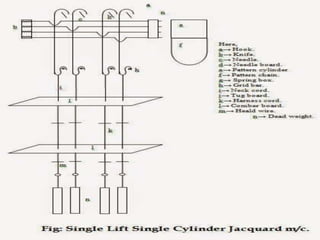
Figure shows the simplified side view of SLSC jacquard.
If the machine has the capacity to handle 300 ends
independently, then it requires 300 hooks (one per end)
which are vertically arranged and 300 needles (one per
hook) which are horizontally arranged. For example, the
needles can be arranged six rows and each row will have
50 needles. In the side view, only six needles (one per
horizontal row) are visible. Hooks, which are connected
to individual ends through nylon cord, are also arranged
in six rows and each row is having 50 hooks. One knife
is responsible for controlling the movement ((lifting and
lowering) of one row of hooks.
However, whether a hook will be lifted or not will be ascertained
by the selection mechanism which is basically a punched card
and mounted on a revolving cylinder. The needles are connected
with springs at the opposite of the cylinder. Therefore, the
needle always exert a pressure in the right hand side direction
(Figure). So, if there is a hole in the punch card corresponding to
the position of a needle, then the needle will be able to pass
through the hole and thus the needle will remain in upright
position thus making it accessible to the knife when the latter
has started its upward movement after descending to the lowest
height. On the other hand, if there is no hole, then the needle
will be pressed towards the left side against the spring pressure.
Thus the kink (which partially circumscribes the stem of a hook)
present in the needle presses the hook towards the left side
making the latter tilted enough from the vertical plane so that
the knife will miss it while moving upward. Therefore, presence
of a hole implies selection (ends up) and vice versa. A hole in this
case is tantamount with a peg used on the lag of dobby shedding
system.
If the loom speed is 300 picks per minute then in
case of SLSC jacquard, the cylinder will turn 300
times per minute (5 times per second) and the
knives should also reciprocate (up and down) 300
times per minute. Thus it hinders the high picks per
minute. When a particular hook (and the
corresponding end) has to be in up position in two
consecutive picks, in between the two peaks, in
descends to its lowest possible height (determined
by the grate) and then moves up again. Thus it
produces bottom closed shed. This happens as one
end is controlled by a single hook.
Features of SLSC jacquard
500 end machine will have 500 needles and
500 hooks
Cylinder should turn in every pick
Knives must rise and fall in every pick
Bottom closed shed is produced
Conclusion
By this mechanism we learn how jacquard
mechanism work and how it produce decorate
design by using yarn individually. Moreover it is
a very helpful and important practical for our
textile life.

Single lift single cylinder(SLSC) jacquard

  • 1.
    Presentation On Singlelift single cylinder(SLSC) jacquard Prepared by MD.MEHEDI HASAN RIMAN ID : 12132107012 Intake :08 Section :01 Department of Textile Engineering. BUBT-Bangladesh University of Business & Technology
  • 2.
    Introduction Jacquard shedding systemwas developed by William Jacquard. In case of cam and dobby shedding systems, large number of yarns passing through a heald is controlled. Thus it precludes the possibility of controlling individual ends independently. Therefore, complicated woven designs cannot be made using cam or dobby shedding systems. With the jacquard shedding system individual ends can be controlled independently and thus large woven figures can be produced in fabrics.
  • 3.
    What is JACQUARDShedding The jacquard is a shedding device attached to the top of the hand loom or power loom and controls a large number of warp threads with a view to produce the maximum variety of sheds(without any heald shaft)for beautiful and intricate ornamental large design fabrics .
  • 4.
    Scope of JacquardShedding I. It can be used for a large design which cannot be positive on tappet or dobby.(It can produce most complex or any design). II. It can produce any shape of design. III. One warp thread for each harness. IV. Most costly fabric is produced. V. No heald shaft is used. VI. Every thread is controlled individually VII.It is possible to lift 2000-3000 yarns at any instant.
  • 5.
    Classification of jacquard Mechanicaljacquard systems can be classified under three categories: Single lift and single cylinder (SLSC) Double lift and single cylinder (DLSC) Double lift and double cylinder (DLDC)
  • 6.
    Single lift &single cylinder (SLSC) jacquard
  • 8.
    Figure shows thesimplified side view of SLSC jacquard. If the machine has the capacity to handle 300 ends independently, then it requires 300 hooks (one per end) which are vertically arranged and 300 needles (one per hook) which are horizontally arranged. For example, the needles can be arranged six rows and each row will have 50 needles. In the side view, only six needles (one per horizontal row) are visible. Hooks, which are connected to individual ends through nylon cord, are also arranged in six rows and each row is having 50 hooks. One knife is responsible for controlling the movement ((lifting and lowering) of one row of hooks.
  • 9.
    However, whether ahook will be lifted or not will be ascertained by the selection mechanism which is basically a punched card and mounted on a revolving cylinder. The needles are connected with springs at the opposite of the cylinder. Therefore, the needle always exert a pressure in the right hand side direction (Figure). So, if there is a hole in the punch card corresponding to the position of a needle, then the needle will be able to pass through the hole and thus the needle will remain in upright position thus making it accessible to the knife when the latter has started its upward movement after descending to the lowest height. On the other hand, if there is no hole, then the needle will be pressed towards the left side against the spring pressure. Thus the kink (which partially circumscribes the stem of a hook) present in the needle presses the hook towards the left side making the latter tilted enough from the vertical plane so that the knife will miss it while moving upward. Therefore, presence of a hole implies selection (ends up) and vice versa. A hole in this case is tantamount with a peg used on the lag of dobby shedding system.
  • 10.
    If the loomspeed is 300 picks per minute then in case of SLSC jacquard, the cylinder will turn 300 times per minute (5 times per second) and the knives should also reciprocate (up and down) 300 times per minute. Thus it hinders the high picks per minute. When a particular hook (and the corresponding end) has to be in up position in two consecutive picks, in between the two peaks, in descends to its lowest possible height (determined by the grate) and then moves up again. Thus it produces bottom closed shed. This happens as one end is controlled by a single hook.
  • 11.
    Features of SLSCjacquard 500 end machine will have 500 needles and 500 hooks Cylinder should turn in every pick Knives must rise and fall in every pick Bottom closed shed is produced
  • 12.
    Conclusion By this mechanismwe learn how jacquard mechanism work and how it produce decorate design by using yarn individually. Moreover it is a very helpful and important practical for our textile life.