By Zinabie D.
Woven Fabric Manufacturing Practical I
Target group 3rd year Textile Engineering
CHAPTER ONE
Survey of the Preparatory Machines
of Weaving
• What is Weaving ??
• Weaving is the interlacing of two sets of yarns,
namely warp and weft at right angle in order to
product fabric.
• In woven construction the yarns that are placed
lengthwise or parallel to the selvedge (edges
of the cloth) are called warp yarns. Each thread
or yarn in the warp is called an end.
• The yarns that run crosswise are called weft
(filling) yarns and each thread in the weft is
called a pick.
Introduction
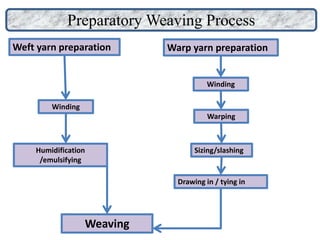
warp yarn preparation
The stages involved in warp preparation are:
(a) Winding from spinner‘s package to
cones.
(b) Winding from cones to warp (i.e.
warping).
(c) Application of size and lubricant to warp
(1.e. slashing).
(d) Drawing-in or tying-in.
Weft yarn preparation
(a) Winding from spinner‘s package
to cones.
(b) emulsifying (humidification)
Weft yarn preparation
Sizing/slashing
Warping
Winding
Warp yarn preparation
Weaving
Drawing in / tying in
Winding
Preparatory Weaving Process
Humidification
/emulsifying
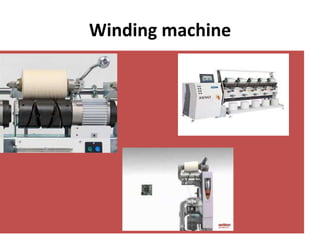
Winding machine
• .
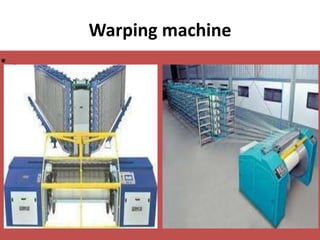
Warping machine
• .
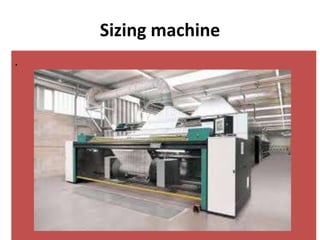
Sizing machine
.
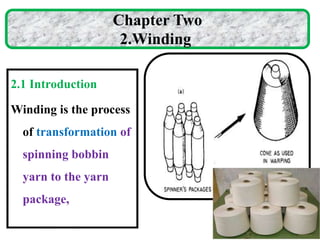
2.1 Introduction
Winding is the process
of transformation of
spinning bobbin
yarn to the yarn
package,
Chapter Two
2.Winding
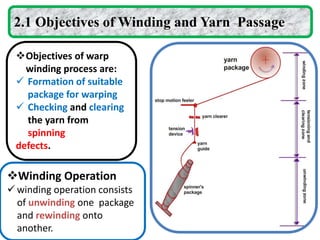
2.1 Objectives of Winding and Yarn Passage
Winding Operation
 winding operation consists
of unwinding one package
and rewinding onto
another.
Objectives of warp
winding process are:
 Formation of suitable
package for warping
 Checking and clearing
the yarn from
spinning
defects.
2.2 Technical Requirements of Winding
Process
1. The physical and mechanical properties
of the yarn should not be impaired.
2. Package should be built to ensure easy
running off during warping at high speed.
3. The package should contain maximum
length of yarn.
Cont’d
4. The yarn ends should be tied with strong
knots of correct structure easily passing at
subsequent processing
5. The process should remove the
objectionable fault.
6. Yarn wastes must be as small as possible.
7. The yarn tension should be regular and
ensure constant winding condition
1. Cope holder
2. Thread guide
3. balloon breaker
4. Tensioner
5. Clearer or slub
catcher
6. Winding drum
7. Bobbin cradle
8. Automatic thread
stop motion
9. Full bobbin stop
motion
10.Ribbon breaker or
anti-ribboning
device
11.Driving arrangement
2.3 Winding machine elements
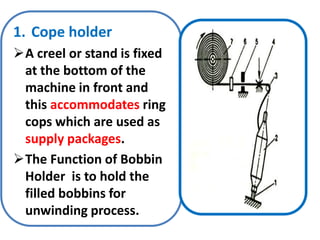
1. Cope holder
A creel or stand is fixed
at the bottom of the
machine in front and
this accommodates ring
cops which are used as
supply packages.
The Function of Bobbin
Holder is to hold the
filled bobbins for
unwinding process.
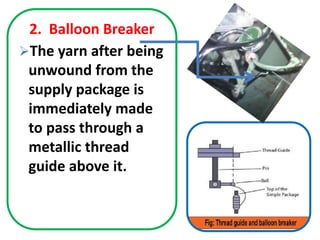
2. Balloon Breaker
The yarn after being
unwound from the
supply package is
immediately made
to pass through a
metallic thread
guide above it.
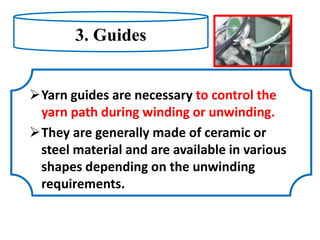
3. Guides
Yarn guides are necessary to control the
yarn path during winding or unwinding.
They are generally made of ceramic or
steel material and are available in various
shapes depending on the unwinding
requirements.
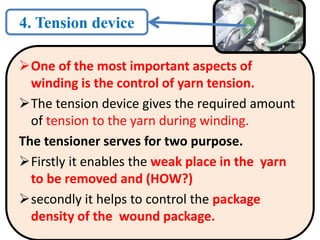
4. Tension device
One of the most important aspects of
winding is the control of yarn tension.
The tension device gives the required amount
of tension to the yarn during winding.
The tensioner serves for two purpose.
Firstly it enables the weak place in the yarn
to be removed and (HOW?)
secondly it helps to control the package
density of the wound package.
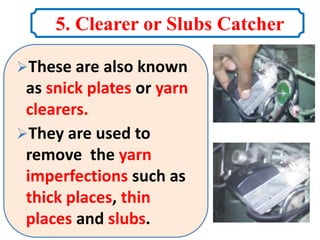
5. Clearer or Slubs Catcher
These are also known
as snick plates or yarn
clearers.
They are used to
remove the yarn
imperfections such as
thick places, thin
places and slubs.
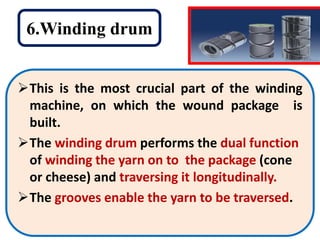
6.Winding drum
This is the most crucial part of the winding
machine, on which the wound package is
built.
The winding drum performs the dual function
of winding the yarn on to the package (cone
or cheese) and traversing it longitudinally.
The grooves enable the yarn to be traversed.
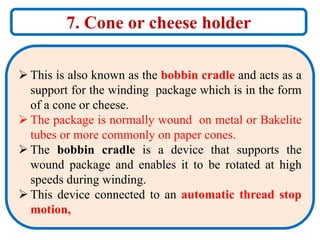
7. Cone or cheese holder
 This is also known as the bobbin cradle and acts as a
support for the winding package which is in the form
of a cone or cheese.
 The package is normally wound on metal or Bakelite
tubes or more commonly on paper cones.
 The bobbin cradle is a device that supports the
wound package and enables it to be rotated at high
speeds during winding.
 This device connected to an automatic thread stop
motion,
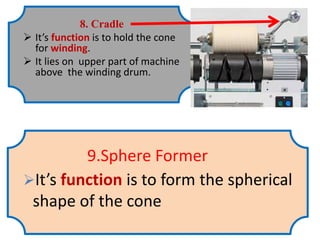
8. Cradle
 It’s function is to hold the cone
for winding.
 It lies on upper part of machine
above the winding drum.
9.Sphere Former
It’s function is to form the spherical
shape of the cone
10. Automatic broken thread stops motion(filer)
Since the wound packages rotate at high
speeds, it is necessary that stop devices be
provided to stop winding in the event of thread
breakage or exhaustion of supply package
during winding.
The stop motion should be able to immediately
lift the particular cheese or cone out of contact
with the winding drum in such an event.
If the cone or cheese is allowed to run what will
happen?
Further, the yarn on the cone will be damaged
due to being constantly rubbed .
11. Full package stop motion
 As soon as the wound package has reached the
preset or predetermined size, the full package
stop motion automatically lifts it out of contact
with the winding drum or shaft.
 This is necessary to obtain equal length of yarn
on all the cones or cheeses of the particular set or
lot as otherwise it causes problems in warping
due to different cones in the warping creel
exhausting at different times.
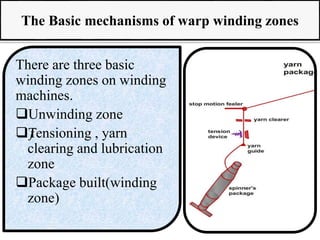
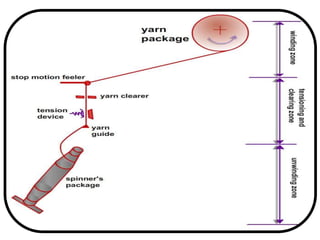
The Basic mechanisms of warp winding zones
There are three basic
winding zones on winding
machines.
Unwinding zone
ƒTensioning , yarn
clearing and lubrication
zone
Package built(winding
zone)
1. Unwinding mechanism
2. Yarn tension mechanism
3. Yarn clearing mechanism
4. Package build mechanism
5. Yarn lubrication
2.4 Mechanisms of warp winding
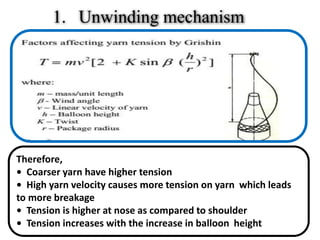
1. Unwinding mechanism
Therefore,
• Coarser yarn have higher tension
• High yarn velocity causes more tension on yarn which leads
to more breakage
• Tension is higher at nose as compared to shoulder
• Tension increases with the increase in balloon height
2.Yarn tension mechanism
The needs for tensioning are:
 It gives required winding density
 It gives suitable tension to the yarn
 It facilitates winding
 It aids to remove weak yarns
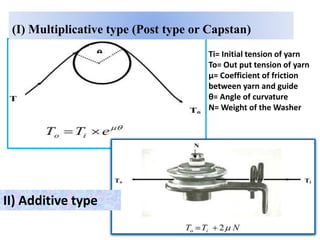
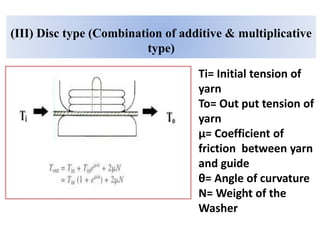
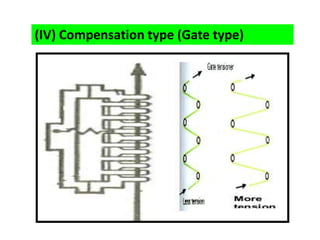
Tension devises can be classified in to four
groups
(I) Multiplicative type (Post type or Capstan)
II) Additive type
Ti= Initial tension of yarn
To= Out put tension of yarn
μ= Coefficient of friction
between yarn and guide
θ= Angle of curvature
N= Weight of the Washer
(III) Disc type (Combination of additive & multiplicative
type)
Ti= Initial tension of
yarn
To= Out put tension of
yarn
μ= Coefficient of
friction between yarn
and guide
θ= Angle of curvature
N= Weight of the
Washer
(IV) Compensation type (Gate type)
Winding machine 1

Winding machine 1

  • 1.
    By Zinabie D. WovenFabric Manufacturing Practical I Target group 3rd year Textile Engineering
  • 2.
    CHAPTER ONE Survey ofthe Preparatory Machines of Weaving
  • 3.
    • What isWeaving ?? • Weaving is the interlacing of two sets of yarns, namely warp and weft at right angle in order to product fabric. • In woven construction the yarns that are placed lengthwise or parallel to the selvedge (edges of the cloth) are called warp yarns. Each thread or yarn in the warp is called an end. • The yarns that run crosswise are called weft (filling) yarns and each thread in the weft is called a pick. Introduction
  • 4.
    warp yarn preparation Thestages involved in warp preparation are: (a) Winding from spinner‘s package to cones. (b) Winding from cones to warp (i.e. warping). (c) Application of size and lubricant to warp (1.e. slashing). (d) Drawing-in or tying-in.
  • 5.
    Weft yarn preparation (a)Winding from spinner‘s package to cones. (b) emulsifying (humidification)
  • 6.
    Weft yarn preparation Sizing/slashing Warping Winding Warpyarn preparation Weaving Drawing in / tying in Winding Preparatory Weaving Process Humidification /emulsifying
  • 7.
  • 8.
  • 9.
  • 10.
    2.1 Introduction Winding isthe process of transformation of spinning bobbin yarn to the yarn package, Chapter Two 2.Winding
  • 11.
    2.1 Objectives ofWinding and Yarn Passage Winding Operation  winding operation consists of unwinding one package and rewinding onto another. Objectives of warp winding process are:  Formation of suitable package for warping  Checking and clearing the yarn from spinning defects.
  • 12.
    2.2 Technical Requirementsof Winding Process 1. The physical and mechanical properties of the yarn should not be impaired. 2. Package should be built to ensure easy running off during warping at high speed. 3. The package should contain maximum length of yarn.
  • 13.
    Cont’d 4. The yarnends should be tied with strong knots of correct structure easily passing at subsequent processing 5. The process should remove the objectionable fault. 6. Yarn wastes must be as small as possible. 7. The yarn tension should be regular and ensure constant winding condition
  • 14.
    1. Cope holder 2.Thread guide 3. balloon breaker 4. Tensioner 5. Clearer or slub catcher 6. Winding drum 7. Bobbin cradle 8. Automatic thread stop motion 9. Full bobbin stop motion 10.Ribbon breaker or anti-ribboning device 11.Driving arrangement 2.3 Winding machine elements
  • 15.
    1. Cope holder Acreel or stand is fixed at the bottom of the machine in front and this accommodates ring cops which are used as supply packages. The Function of Bobbin Holder is to hold the filled bobbins for unwinding process.
  • 16.
    2. Balloon Breaker Theyarn after being unwound from the supply package is immediately made to pass through a metallic thread guide above it.
  • 17.
    3. Guides Yarn guidesare necessary to control the yarn path during winding or unwinding. They are generally made of ceramic or steel material and are available in various shapes depending on the unwinding requirements.
  • 18.
    4. Tension device Oneof the most important aspects of winding is the control of yarn tension. The tension device gives the required amount of tension to the yarn during winding. The tensioner serves for two purpose. Firstly it enables the weak place in the yarn to be removed and (HOW?) secondly it helps to control the package density of the wound package.
  • 19.
    5. Clearer orSlubs Catcher These are also known as snick plates or yarn clearers. They are used to remove the yarn imperfections such as thick places, thin places and slubs.
  • 20.
    6.Winding drum This isthe most crucial part of the winding machine, on which the wound package is built. The winding drum performs the dual function of winding the yarn on to the package (cone or cheese) and traversing it longitudinally. The grooves enable the yarn to be traversed.
  • 21.
    7. Cone orcheese holder  This is also known as the bobbin cradle and acts as a support for the winding package which is in the form of a cone or cheese.  The package is normally wound on metal or Bakelite tubes or more commonly on paper cones.  The bobbin cradle is a device that supports the wound package and enables it to be rotated at high speeds during winding.  This device connected to an automatic thread stop motion,
  • 22.
    8. Cradle  It’sfunction is to hold the cone for winding.  It lies on upper part of machine above the winding drum. 9.Sphere Former It’s function is to form the spherical shape of the cone
  • 23.
    10. Automatic brokenthread stops motion(filer) Since the wound packages rotate at high speeds, it is necessary that stop devices be provided to stop winding in the event of thread breakage or exhaustion of supply package during winding. The stop motion should be able to immediately lift the particular cheese or cone out of contact with the winding drum in such an event. If the cone or cheese is allowed to run what will happen? Further, the yarn on the cone will be damaged due to being constantly rubbed .
  • 24.
    11. Full packagestop motion  As soon as the wound package has reached the preset or predetermined size, the full package stop motion automatically lifts it out of contact with the winding drum or shaft.  This is necessary to obtain equal length of yarn on all the cones or cheeses of the particular set or lot as otherwise it causes problems in warping due to different cones in the warping creel exhausting at different times.
  • 25.
    The Basic mechanismsof warp winding zones There are three basic winding zones on winding machines. Unwinding zone ƒTensioning , yarn clearing and lubrication zone Package built(winding zone)
  • 27.
    1. Unwinding mechanism 2.Yarn tension mechanism 3. Yarn clearing mechanism 4. Package build mechanism 5. Yarn lubrication 2.4 Mechanisms of warp winding
  • 28.
    1. Unwinding mechanism Therefore, •Coarser yarn have higher tension • High yarn velocity causes more tension on yarn which leads to more breakage • Tension is higher at nose as compared to shoulder • Tension increases with the increase in balloon height
  • 29.
    2.Yarn tension mechanism Theneeds for tensioning are:  It gives required winding density  It gives suitable tension to the yarn  It facilitates winding  It aids to remove weak yarns Tension devises can be classified in to four groups
  • 30.
    (I) Multiplicative type(Post type or Capstan) II) Additive type Ti= Initial tension of yarn To= Out put tension of yarn μ= Coefficient of friction between yarn and guide θ= Angle of curvature N= Weight of the Washer
  • 31.
    (III) Disc type(Combination of additive & multiplicative type) Ti= Initial tension of yarn To= Out put tension of yarn μ= Coefficient of friction between yarn and guide θ= Angle of curvature N= Weight of the Washer
  • 32.