By Robel L.
Department of Textile Technology
Warping Process
Warping
• Warping is the process of combining yarns
from different cones together to form a sheet
Objective
 The main objective of warping process is to produce a
product known as warped beam from a certain numbers
of cones or Bobbins.
Technical requirement of the process
The tension of all wound ends must be uniform
Warping should not impair the physical &
mechanical properties of the yarn
The density of the yarn through out the package
must be uniform as possible & its shape should
be cylindrical
 All ends should be of the same length
 While the yarn end break or slough-off occurs,
the beam must stop before 5 meter displacement
 The production rate of warping should be as
high as possible
Contd..
Warping creel
Creel is the structure which holds many individual yarn
packages from which the yarn sheet is formed or it is
simply a metallic frames on which the feeding yarn
packages are loaded.
Components of Creel and Their Functions
Yarn cleaner - it is used to remove different yarn faults like
slubs, neps and etc.
Stop device - it is used to stop the machine when yarns are
broken.
Creel Stops Motion by Faller Wires
 The stop motion is activated by faller wires
which are kept pulled back ward when the end is
intact.
 When the end breaks, the faller wire drops
forward and makes contact to complete the
electrical circuit to stop the warper
 Indicator - is used to indicate yarn breakage in
the package.
 Tensioner - is used to keep the yarn in a uniform
tension.
 Yarn guide - it is used pass the yarn in specific
way.
 Flanged bobbin or cone or cheese - it is used to
hold the yarn on the package.
 Blower or suction fan - it is used to remove dirt
or dust from the yarn.
Types of Warping Creels
 There are six general purpose types of creels in common
use.
1. V-shaped/continuous chain/reversible creel
2. Truck or Mobile Creel
3. Magazine Creel
4. Duplicative creel
5. Swiveling creel
6. Automatic creel
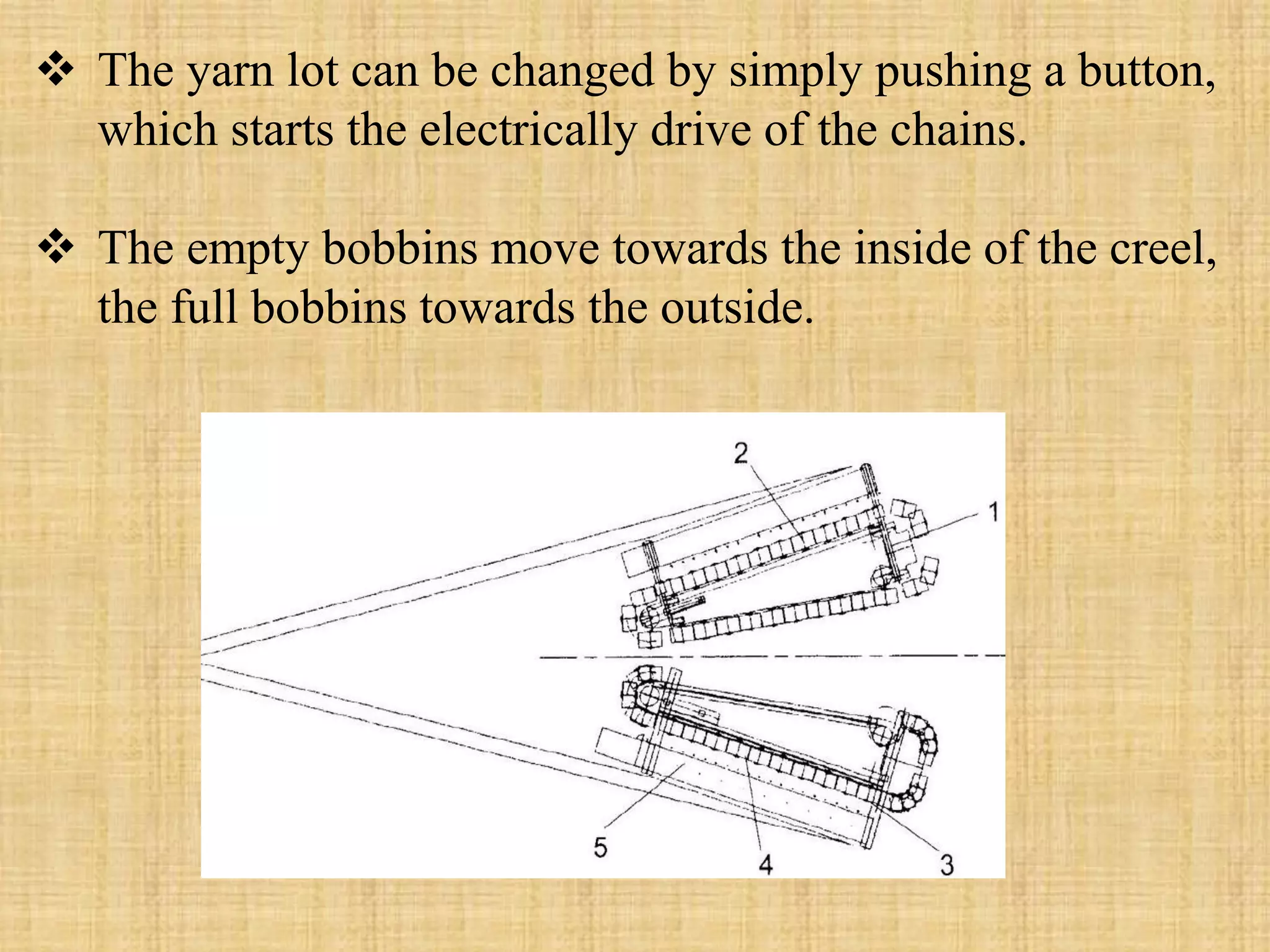
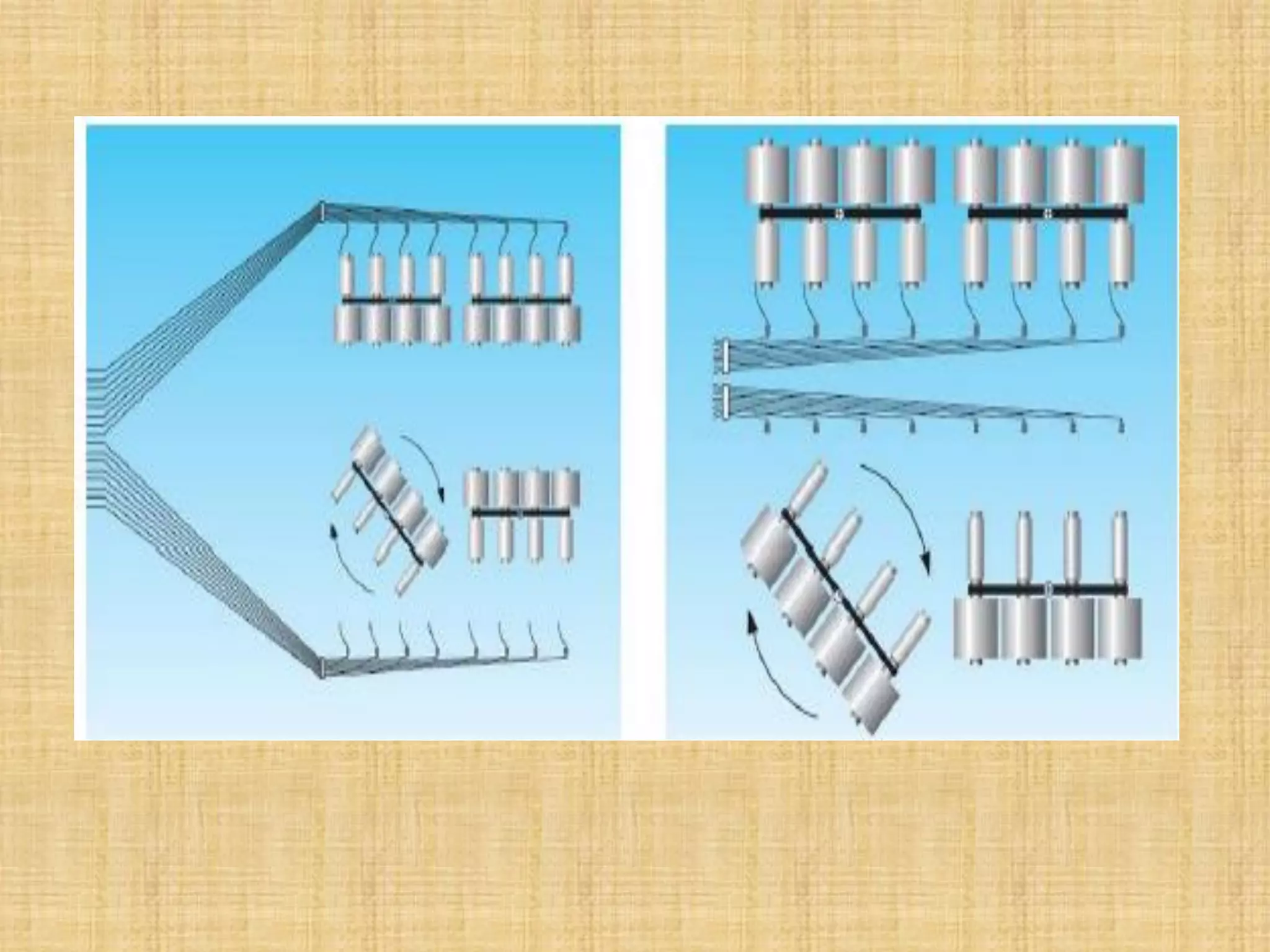
1. V-shaped/continuous chain/reversible creel
 In this creel type, the creel boards are assembled in
form of endless chains.
 While warping is carried out from the outer sides using
the already creeled up bobbins, the subsequent yarn lot
can be creeled up on the empty spindles positioned
inside the creel.
 This interior room serves at the same time as storage
and bobbin exchange station.
 The yarn lot can be changed by simply pushing a button,
which starts the electrically drive of the chains.
 The empty bobbins move towards the inside of the creel,
the full bobbins towards the outside.
2. Truck or Mobile Creel
 It uses trucks or mobile package carrier units.
 Frames loaded with full packages are changed
with empty package frames at run out.
 The truck sections can be rolled out to remove
depleted supply packages so full packages can be
rolled into position replacing depleted packages.
Cont.
 The truck sections can be creeled with a bobbins
or cones in advance and be ready when needed
outside of creel zone.
 This reduces considerably the waiting time. The
mobile creel comes in handy especially when
there is insufficient room to permit the use of two
standard creels
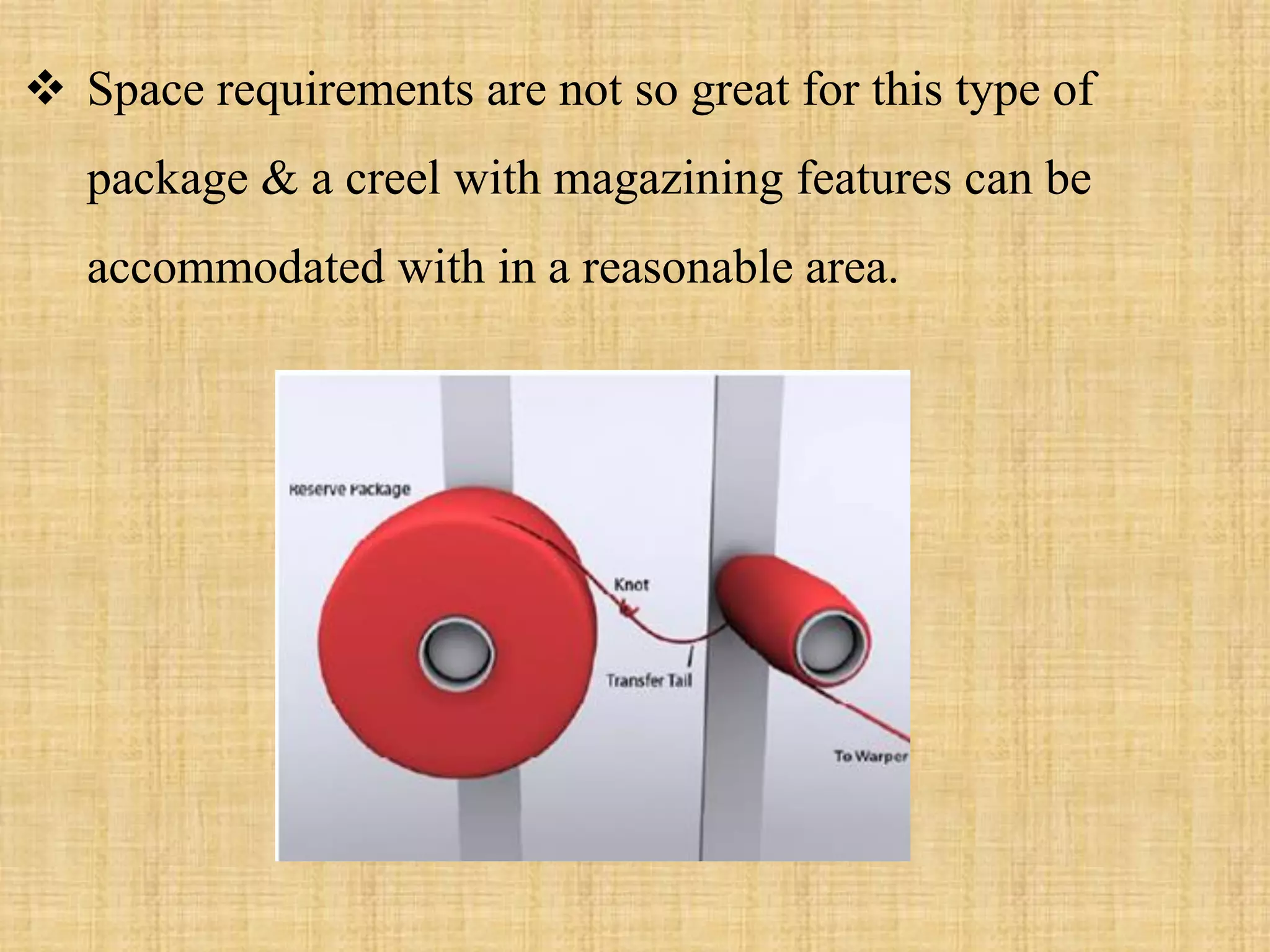
3. Magazine Creel
 The magazine creel holds two packages side by
side which feed one end going to the beam & the
other in the reserve position tied nose to tail.
 The package holders swivel/rotate to enable the
empty cones to be removed & new cones tied in
nose to tail to the running package whilst the
machine is in operation.
 Space requirements are not so great for this type of
package & a creel with magazining features can be
accommodated with in a reasonable area.
4. Duplicative creel
 One duplicate spare creel is kept ready with creeled
packages.
 After exhaustion of the first creel, the headstock or creel
can be moved relative to each other to bring in front of
the new creel.
 This system is versatile & saves a lot of time but it will
be necessary to re-thread the warp at the beaming
headstock before commencing the new run.
Creel A Creel B Creel A Creel B
Headstock Headstock
i. Mobile creel
ii. Fixed creel
5. Swiveling creel
 The swivel creel is two sided. One side holds
the packages that are being run and the other side
is equipped with holders for full packages.
 The sections can be swiveled or rotated 1800
to
bring the reserve packages into a running
position when the running packages are depleted.
 This creel allows mounting of reserve packages
without increasing floor space requirements.
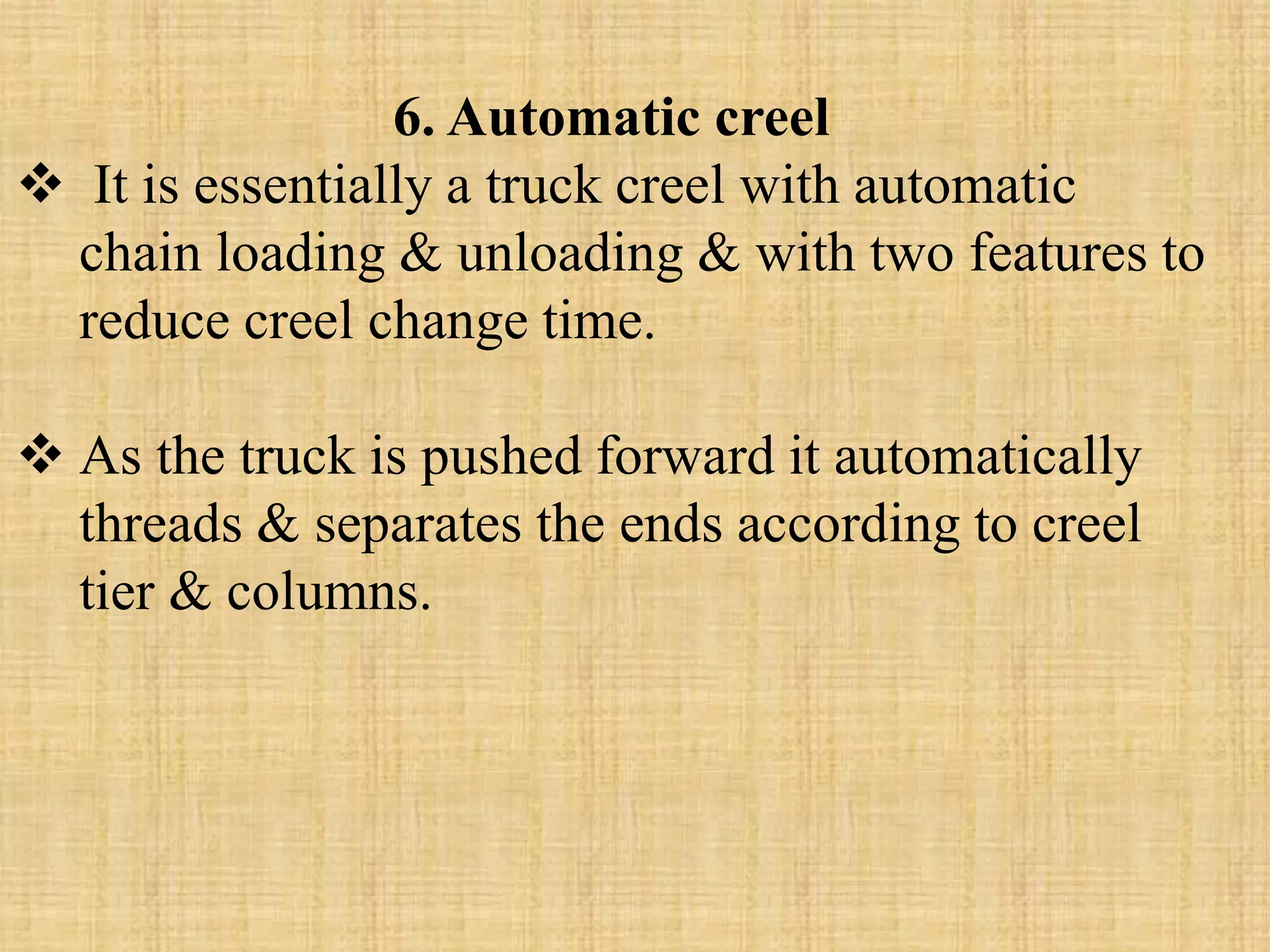
6. Automatic creel
 It is essentially a truck creel with automatic
chain loading & unloading & with two features to
reduce creel change time.
 As the truck is pushed forward it automatically
threads & separates the ends according to creel
tier & columns.
Calculation of warping machines productivity
The productivity of warping machines can be
expressed by the amount of yarn wound on a
warpers beam or a weavers beam per given time.
The productivity of a beam warping machine can
be:
P =V × t × T × m × Ԑ × 10−6 [Kg/hr]
Where:
V= Average speed of warping machine (m/min)
T= Rated time(min)
T= Linear density of yarn (tex)
M= number of ends wound simultaneously on to beam
Ԑ= machine efficiency
Time required to produce a full beam (tb) or each
section
Tb = L/V L = piece length of warp in a beam.
The running efficiency of the warping machine
Ԑ = tb/tb+ts X100 ts= idle time of the machine
the yarn breakage is usually assumed per million
meters of single yarn. Hence the number of
operations for eliminating breakage per warping or
weavers beam (no) is
no = n1XmXL/1X1000000
Where:
n1 = number of breakages per million meters of single yarn
m = number of ends
L= length of warp in a beam
Number of warping beam(nb) or sections(ns)
nb= l/L or ns = m/C
Where:
l= length of yarn on the supply package including warping waste
C = creel capacity
Example: 1
On beam warping machine the following parameters are observed
Linear density of yarn (Nm) = 40
Length of yarn on the supply package(l) =100,000m
Average speed of warping machine(V) = 600m/min
Piece length of warp on a beam (L) = 20, 000m
Working time(t) = 8 hours
Number of ends in a beam (m) = 500
Idle time of the machine (ts) = 2 hours
Calculate
a. The actual productivity of the machine
b. Time required to produce a full beam
c. Number of warpers beam obtained per supply package
solution
a. P =V(m/min) × t(min) × T(tex) × m × Ԑ × 10−6
[Kg/shift]
Tex = 1000/Nm = 1000/40 = 25
t = 8 X60min = 480min
Ԑ = t-ts/t X100= 8-2/8X100 = 6/8X100 = 75%
So, P =600m/min× 480min × 25 × 500 × 75%× 10−6 [Kg/shift]
P= 2700 Kg/shift
b. Time required for a full beam
tb = L/V = 20,000m/600m/min = 33.3min
c. Number of beams produced per supply package
nb = l/L = 100000/20000 = 5 beams
Example: 2
In the sectional warping machines the following data
are collected
Drum barrel diameter (d) = 2m
Piece length of yarn in beam (l) = 5000m
Inclination angle (θ) = 45
Linear density of yarn (T) = 20 tex
Total ends (m) = 10000
Width between flanges (L) = 2.5m
Density of warp in a beam(ρ) = 0.5 cm
g
3
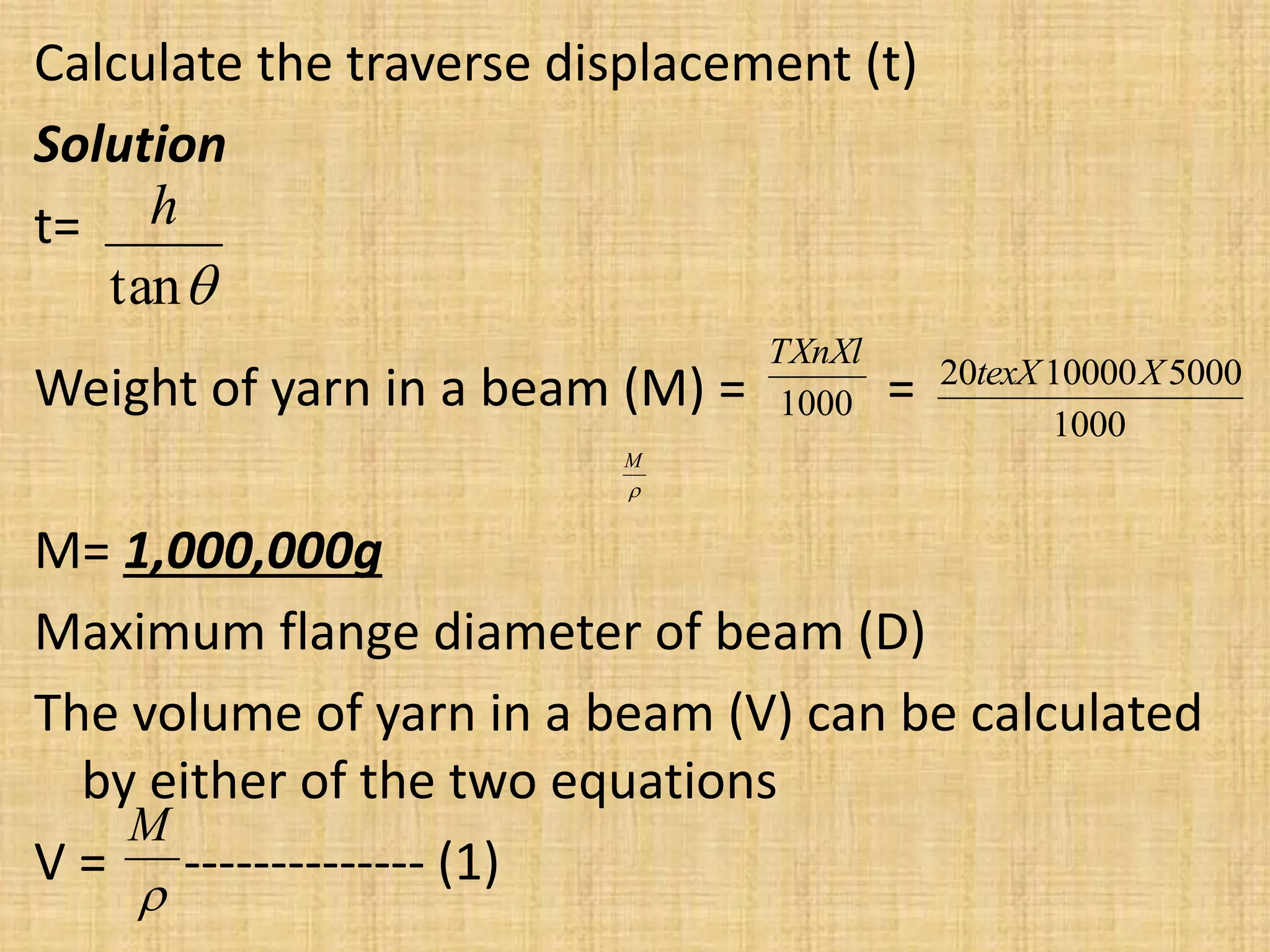
Calculate the traverse displacement (t)
Solution
t=
Weight of yarn in a beam (M) = =
M= 1,000,000g
Maximum flange diameter of beam (D)
The volume of yarn in a beam (V) can be calculated
by either of the two equations
V = -------------- (1)

tan
h
1000
5000
10000
20 X
texX

M

M
1000
TXnXl
V = ------------(2)
Equating equation 1 & equation 2
=
D = = = 215cm
Depth of the yarn on the beam (h)
h = = = 7.5cm
XL
d
D )
(
4
2
2



M
XL
d
D )
(
4
2
2


d
xL
M
x
2
)
(
4


 )
/
2
3
200
(
250
5
.
0
1000000
4
cm
cm
g cm
x
g
x 
 2
200
215 
2
d
D 
2
200
215 
So, the traverse displacement per section (t) can be
calculated from depth of yarn on the beam &
cone angle.
t= = = 7.5cm

tan
h
45
0
tan
5
.
7 cm
Warping defects
• Overlapping/Excessive Distance
• Excessive or insufficient number of yarn ends in
the warp
• Incorrect Laying of lease cords, or their absence
in some sections
• Snarling and Overlapping
THANK YOU!
31

Warping process

  • 1.
    By Robel L. Departmentof Textile Technology Warping Process
  • 2.
    Warping • Warping isthe process of combining yarns from different cones together to form a sheet
  • 3.
    Objective  The mainobjective of warping process is to produce a product known as warped beam from a certain numbers of cones or Bobbins.
  • 4.
    Technical requirement ofthe process The tension of all wound ends must be uniform Warping should not impair the physical & mechanical properties of the yarn The density of the yarn through out the package must be uniform as possible & its shape should be cylindrical
  • 5.
     All endsshould be of the same length  While the yarn end break or slough-off occurs, the beam must stop before 5 meter displacement  The production rate of warping should be as high as possible Contd..
  • 6.
    Warping creel Creel isthe structure which holds many individual yarn packages from which the yarn sheet is formed or it is simply a metallic frames on which the feeding yarn packages are loaded. Components of Creel and Their Functions Yarn cleaner - it is used to remove different yarn faults like slubs, neps and etc. Stop device - it is used to stop the machine when yarns are broken.
  • 7.
    Creel Stops Motionby Faller Wires  The stop motion is activated by faller wires which are kept pulled back ward when the end is intact.  When the end breaks, the faller wire drops forward and makes contact to complete the electrical circuit to stop the warper
  • 8.
     Indicator -is used to indicate yarn breakage in the package.  Tensioner - is used to keep the yarn in a uniform tension.  Yarn guide - it is used pass the yarn in specific way.  Flanged bobbin or cone or cheese - it is used to hold the yarn on the package.  Blower or suction fan - it is used to remove dirt or dust from the yarn.
  • 9.
    Types of WarpingCreels  There are six general purpose types of creels in common use. 1. V-shaped/continuous chain/reversible creel 2. Truck or Mobile Creel 3. Magazine Creel 4. Duplicative creel 5. Swiveling creel 6. Automatic creel
  • 10.
    1. V-shaped/continuous chain/reversiblecreel  In this creel type, the creel boards are assembled in form of endless chains.  While warping is carried out from the outer sides using the already creeled up bobbins, the subsequent yarn lot can be creeled up on the empty spindles positioned inside the creel.  This interior room serves at the same time as storage and bobbin exchange station.
  • 11.
     The yarnlot can be changed by simply pushing a button, which starts the electrically drive of the chains.  The empty bobbins move towards the inside of the creel, the full bobbins towards the outside.
  • 12.
    2. Truck orMobile Creel  It uses trucks or mobile package carrier units.  Frames loaded with full packages are changed with empty package frames at run out.  The truck sections can be rolled out to remove depleted supply packages so full packages can be rolled into position replacing depleted packages.
  • 13.
    Cont.  The trucksections can be creeled with a bobbins or cones in advance and be ready when needed outside of creel zone.  This reduces considerably the waiting time. The mobile creel comes in handy especially when there is insufficient room to permit the use of two standard creels
  • 14.
    3. Magazine Creel The magazine creel holds two packages side by side which feed one end going to the beam & the other in the reserve position tied nose to tail.  The package holders swivel/rotate to enable the empty cones to be removed & new cones tied in nose to tail to the running package whilst the machine is in operation.
  • 15.
     Space requirementsare not so great for this type of package & a creel with magazining features can be accommodated with in a reasonable area.
  • 16.
    4. Duplicative creel One duplicate spare creel is kept ready with creeled packages.  After exhaustion of the first creel, the headstock or creel can be moved relative to each other to bring in front of the new creel.  This system is versatile & saves a lot of time but it will be necessary to re-thread the warp at the beaming headstock before commencing the new run.
  • 17.
    Creel A CreelB Creel A Creel B Headstock Headstock i. Mobile creel ii. Fixed creel
  • 18.
    5. Swiveling creel The swivel creel is two sided. One side holds the packages that are being run and the other side is equipped with holders for full packages.  The sections can be swiveled or rotated 1800 to bring the reserve packages into a running position when the running packages are depleted.  This creel allows mounting of reserve packages without increasing floor space requirements.
  • 20.
    6. Automatic creel It is essentially a truck creel with automatic chain loading & unloading & with two features to reduce creel change time.  As the truck is pushed forward it automatically threads & separates the ends according to creel tier & columns.
  • 21.
    Calculation of warpingmachines productivity The productivity of warping machines can be expressed by the amount of yarn wound on a warpers beam or a weavers beam per given time. The productivity of a beam warping machine can be: P =V × t × T × m × Ԑ × 10−6 [Kg/hr] Where: V= Average speed of warping machine (m/min) T= Rated time(min) T= Linear density of yarn (tex) M= number of ends wound simultaneously on to beam Ԑ= machine efficiency
  • 22.
    Time required toproduce a full beam (tb) or each section Tb = L/V L = piece length of warp in a beam. The running efficiency of the warping machine Ԑ = tb/tb+ts X100 ts= idle time of the machine the yarn breakage is usually assumed per million meters of single yarn. Hence the number of operations for eliminating breakage per warping or weavers beam (no) is no = n1XmXL/1X1000000
  • 23.
    Where: n1 = numberof breakages per million meters of single yarn m = number of ends L= length of warp in a beam Number of warping beam(nb) or sections(ns) nb= l/L or ns = m/C Where: l= length of yarn on the supply package including warping waste C = creel capacity
  • 24.
    Example: 1 On beamwarping machine the following parameters are observed Linear density of yarn (Nm) = 40 Length of yarn on the supply package(l) =100,000m Average speed of warping machine(V) = 600m/min Piece length of warp on a beam (L) = 20, 000m Working time(t) = 8 hours Number of ends in a beam (m) = 500 Idle time of the machine (ts) = 2 hours Calculate a. The actual productivity of the machine b. Time required to produce a full beam c. Number of warpers beam obtained per supply package
  • 25.
    solution a. P =V(m/min)× t(min) × T(tex) × m × Ԑ × 10−6 [Kg/shift] Tex = 1000/Nm = 1000/40 = 25 t = 8 X60min = 480min Ԑ = t-ts/t X100= 8-2/8X100 = 6/8X100 = 75% So, P =600m/min× 480min × 25 × 500 × 75%× 10−6 [Kg/shift] P= 2700 Kg/shift b. Time required for a full beam tb = L/V = 20,000m/600m/min = 33.3min
  • 26.
    c. Number ofbeams produced per supply package nb = l/L = 100000/20000 = 5 beams Example: 2 In the sectional warping machines the following data are collected Drum barrel diameter (d) = 2m Piece length of yarn in beam (l) = 5000m Inclination angle (θ) = 45 Linear density of yarn (T) = 20 tex Total ends (m) = 10000 Width between flanges (L) = 2.5m Density of warp in a beam(ρ) = 0.5 cm g 3
  • 27.
    Calculate the traversedisplacement (t) Solution t= Weight of yarn in a beam (M) = = M= 1,000,000g Maximum flange diameter of beam (D) The volume of yarn in a beam (V) can be calculated by either of the two equations V = -------------- (1)  tan h 1000 5000 10000 20 X texX  M  M 1000 TXnXl
  • 28.
    V = ------------(2) Equatingequation 1 & equation 2 = D = = = 215cm Depth of the yarn on the beam (h) h = = = 7.5cm XL d D ) ( 4 2 2    M XL d D ) ( 4 2 2   d xL M x 2 ) ( 4    ) / 2 3 200 ( 250 5 . 0 1000000 4 cm cm g cm x g x   2 200 215  2 d D  2 200 215 
  • 29.
    So, the traversedisplacement per section (t) can be calculated from depth of yarn on the beam & cone angle. t= = = 7.5cm  tan h 45 0 tan 5 . 7 cm
  • 30.
    Warping defects • Overlapping/ExcessiveDistance • Excessive or insufficient number of yarn ends in the warp • Incorrect Laying of lease cords, or their absence in some sections • Snarling and Overlapping
  • 31.