
 AR is usually considered to be a live view
of the real world, onto which extra data
– usually pulled from the internet - is
layered or superimposed.
 It is similar to the view of the world that
Arnold Schwarzenegger had in the
Terminator movies.
 The technology is already well established
elsewhere.
 For example, there are numerous Smartphone apps
that allow users to overlay the view from their
camera with everything from directions and transport
options to restaurant reviews and house prices.
 Point your phone at something of interest, power up
your app and you are away.
 Companies like Google are taking it one step
further. The search giant unveiled its Google
Glass project, a pair of minimal glasses that
overlay a person’s vision with everything from
weather data, location and diary appointments.
 It is an idea that has been seized upon by other
firms, such as Microsoft
 Surface – The most understandable form of ‘reality that is augmented’
would be screens, floors, walls etc that respond to the touch of people
in them providing them with virtual real time information or
collaboration
 Pattern – The AR system performs simple pattern recognition on a
shape, marker (usually on a framed card in the real world scene) or
face and replaces it with a static or moving element e.g: a 3D model,
info, audio, video stream or loop etc: You view the ‘items’ in the scene
with you
 Outline – This is where your hand, eye or body outline is picked up
and seamlessly ‘merged’ with the virtual elements. Simple example
where you can pick up a 3D object that doesn’t exist because the
system is tracking your hand outline. Eg- Iron Man Movies
 Location – Based on detailed GPS or triangulation
location & position/view of the camera/device the
AR system can overlay information precisely over
buildings or people as you move through real space.
 Hologram – Using ‘smoke & spinning mirrors’
literally in some cases, virtual or real items are
‘projected’ into the physical space you are in and can
be interactive with based on cameras tracking real
world impulses e.g.: hand gestures or audio signals
in Mission Impossible.
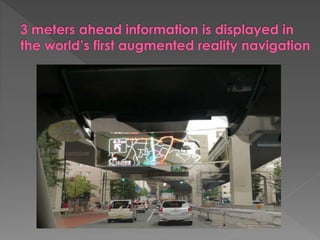
 And now AR is making its way into cars.
 It builds on so-called “heads up display” (HUD)
technology that is commonly used in fighter planes and
began to make its way into high-end cars in the late
1990s.
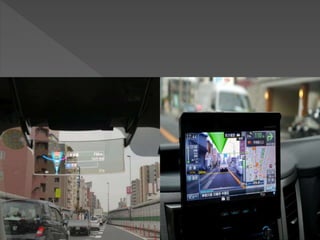
 These HUDs are frequently used to project directions or
speed onto the windscreen in the driver’s line of sight to
minimize the amount of time the driver takes their eyes
off the road.
 But augmented reality could allow these displays to go
much further than that.
 Car manufacturers such as BMW, Toyota, Mercedes
and GM have shown off various prototypes in recent
years.
 For example, a Mercedes concept unveiled earlier
this year and known as Dice allowed drivers to
conjure up information about passing places of
interest by merely pointing at them while friends
driving past the car show up as an icon on the
windscreen, alongside their social network status.
 Another concept from GM, known as the enhanced vision
system, uses an array of sensors and cameras mounted inside
and outside the vehicle to monitor the environment around the
car and the driver’s eye and head movements.
 This information is then used to overlay the view from the
windscreen with relevant information about driving
conditions – such as the location of the building you are
trying to find or dangers that you may not be aware of, such
as an animal or child at the side of the road.
 Another mode marks the edges of the road when fog obscures
the drivers view.
 Other concepts take AR even further. Japanese car maker
Toyota has shown off a prototype of “enhanced car
windows” that would allow passengers to zoom in on
places and objects of interest that they are passing.
 However, the most extreme concept comes from
designers at Keio University in Japan, who are working
on technology that will make the back seat of a car
appear transparent, so that when drivers are reversing
they can see everything around them.
 In the race auto brands carry out to take competitive advantage over the
rest, several of them are taking into consideration the fact to add
Augmented Reality technology not only in their advertising campaigns, but
also in the physic car.
 We already know that the advancement of technology has birthed many
innovative creations, in several fields and among them especially in the
automotive industry.
 Thus, a large digital display would be created in order to show all of this
information. But the use of Augmented Reality in cars is not restricted to a
simply using as a GPS.
 The computer vision technology behind Augmented Reality can be also
integrated in such applications in functionalities like image recognition for
traffic signals, keeping the safe distance between cars, or even warning to
the driver in danger situations, such as in lane changes or in those moments
when drivers could fall asleep.
 The technology has proven to be popular in the
automotive industry adding another dimension to vehicles
that will likely change the driving experience. Furthermore
it also has the potential- or tries to have it- to make driving
safer, as digital displays on the windshield can highlight
risks in the environment and also warn of potential
distractions or unsafe driving habits.
 The idea of adding additional information into the
windshield of a vehicle must be carefully thought for
several reasons. The main constraint should be that
showing that Augmented Reality information must
synergize well with user´s driving. This means that the digital
information displayed shouldn´t be intrusive to a driver’s
vision of the road in order to avoid any kind of distraction.
Augmented reality in future cars

Augmented reality in future cars

  • 2.
     AR isusually considered to be a live view of the real world, onto which extra data – usually pulled from the internet - is layered or superimposed.  It is similar to the view of the world that Arnold Schwarzenegger had in the Terminator movies.
  • 3.
     The technologyis already well established elsewhere.  For example, there are numerous Smartphone apps that allow users to overlay the view from their camera with everything from directions and transport options to restaurant reviews and house prices.  Point your phone at something of interest, power up your app and you are away.
  • 4.
     Companies likeGoogle are taking it one step further. The search giant unveiled its Google Glass project, a pair of minimal glasses that overlay a person’s vision with everything from weather data, location and diary appointments.  It is an idea that has been seized upon by other firms, such as Microsoft
  • 5.
     Surface –The most understandable form of ‘reality that is augmented’ would be screens, floors, walls etc that respond to the touch of people in them providing them with virtual real time information or collaboration  Pattern – The AR system performs simple pattern recognition on a shape, marker (usually on a framed card in the real world scene) or face and replaces it with a static or moving element e.g: a 3D model, info, audio, video stream or loop etc: You view the ‘items’ in the scene with you  Outline – This is where your hand, eye or body outline is picked up and seamlessly ‘merged’ with the virtual elements. Simple example where you can pick up a 3D object that doesn’t exist because the system is tracking your hand outline. Eg- Iron Man Movies
  • 6.
     Location –Based on detailed GPS or triangulation location & position/view of the camera/device the AR system can overlay information precisely over buildings or people as you move through real space.  Hologram – Using ‘smoke & spinning mirrors’ literally in some cases, virtual or real items are ‘projected’ into the physical space you are in and can be interactive with based on cameras tracking real world impulses e.g.: hand gestures or audio signals in Mission Impossible.
  • 7.
     And nowAR is making its way into cars.  It builds on so-called “heads up display” (HUD) technology that is commonly used in fighter planes and began to make its way into high-end cars in the late 1990s.  These HUDs are frequently used to project directions or speed onto the windscreen in the driver’s line of sight to minimize the amount of time the driver takes their eyes off the road.  But augmented reality could allow these displays to go much further than that.
  • 9.
     Car manufacturerssuch as BMW, Toyota, Mercedes and GM have shown off various prototypes in recent years.  For example, a Mercedes concept unveiled earlier this year and known as Dice allowed drivers to conjure up information about passing places of interest by merely pointing at them while friends driving past the car show up as an icon on the windscreen, alongside their social network status.
  • 11.
     Another conceptfrom GM, known as the enhanced vision system, uses an array of sensors and cameras mounted inside and outside the vehicle to monitor the environment around the car and the driver’s eye and head movements.  This information is then used to overlay the view from the windscreen with relevant information about driving conditions – such as the location of the building you are trying to find or dangers that you may not be aware of, such as an animal or child at the side of the road.  Another mode marks the edges of the road when fog obscures the drivers view.
  • 12.
     Other conceptstake AR even further. Japanese car maker Toyota has shown off a prototype of “enhanced car windows” that would allow passengers to zoom in on places and objects of interest that they are passing.  However, the most extreme concept comes from designers at Keio University in Japan, who are working on technology that will make the back seat of a car appear transparent, so that when drivers are reversing they can see everything around them.
  • 13.
     In therace auto brands carry out to take competitive advantage over the rest, several of them are taking into consideration the fact to add Augmented Reality technology not only in their advertising campaigns, but also in the physic car.  We already know that the advancement of technology has birthed many innovative creations, in several fields and among them especially in the automotive industry.  Thus, a large digital display would be created in order to show all of this information. But the use of Augmented Reality in cars is not restricted to a simply using as a GPS.  The computer vision technology behind Augmented Reality can be also integrated in such applications in functionalities like image recognition for traffic signals, keeping the safe distance between cars, or even warning to the driver in danger situations, such as in lane changes or in those moments when drivers could fall asleep.
  • 14.
     The technologyhas proven to be popular in the automotive industry adding another dimension to vehicles that will likely change the driving experience. Furthermore it also has the potential- or tries to have it- to make driving safer, as digital displays on the windshield can highlight risks in the environment and also warn of potential distractions or unsafe driving habits.  The idea of adding additional information into the windshield of a vehicle must be carefully thought for several reasons. The main constraint should be that showing that Augmented Reality information must synergize well with user´s driving. This means that the digital information displayed shouldn´t be intrusive to a driver’s vision of the road in order to avoid any kind of distraction.