Augmented Reality
 Augmented Reality is still in its early
days. The next technology that is truly
going to bring about changes in the lives
of people is Augmented Reality (AR).
 As per International Data Corporation
(IDC), worldwide spending on Augmented
Reality (AR) and Virtual Reality (VR) will
reach $ 160 Billion in 2023.
 What is Augmented Reality?
 Augmented Reality (AR) is the
technology that superimposes an image
onto a user’s view of the real world and
enhances it with sound, touch, and even
smell.
 It is a combination of the real scene
viewed by the user and a virtual scene
generated by the computer. AR is a
technology that is going to blur the lines
of reality.
 Augmented Reality has moved beyond
headsets and gaming and permeated
into numerous industries.
 In general terms, Augmented Reality is
increasingly being adopted for a variety
of uses like assembly, maintenance,
repair, education, training, retail
showcasing, and diagnostics.
 AR makes workers more efficient by
providing them with an additional layer
of knowledge and insights.
 The workforce is already being
enhanced in industries such as
Pharmaceuticals, Oil and Gas, military,
aerospace, automotive, and
manufacturing.
 Augmented Reality remote assistance
can improve training in situations where
new hires need assistance. This tech
enables real-time collaboration between
field personnel and remote experts.
Industries adopting AR Technology
 Manufacturing
 Utilities
 Telecommunications
 Retail
 Healthcare
 Logistics
What are the real-world applications
of Augmented Reality?
Defense
 It helps in improving the situational
awareness of the soldiers using AR
technology. The tech is named as
Tactical Augmented Reality (TAR).
 This tech has an eyepiece that assists
soldiers on the battlefield to precisely
locate their positions in addition to the
location of others (friends and enemy
soldiers).
Impact of this technology
 TAR will one day replace night vision
goggles, as this technology can help
soldiers in the dark.It will replace the
handheld GPS that soldiers carry today
to locate their positions.
 The eyepiece is wirelessly connected to
a thermal site on the soldiers’ rifle or
carbine. When the soldier is pointing the
weapon, the image of the target, plus
other details, such as the distance to the
target can be seen through the
eyepiece.
Advertising
 For example, Jaguar Land Rover put
prospective car buyers in the virtual
driver’s seat of its latest models without
visiting the dealership. Consumers could
launch the AR capability directly from a
banner ad without any need to install an
app. Customers can see the outside
view seated at the driving seat through
transparent windows.
Healthcare
 Traditionally handheld ultrasound
scanners are used in reconstruction
surgery for locating blood vessels, and
bones. However, AR technology has the
potential to replace ultrasound scanners
as it will help in locating the blood
vessels very accurately and in a shorter
period.
Pharmaceuticals
 Augmented Reality tools can help
scientists to picture the structure of
complex molecules. Drug developers
usually work with static models. The AR
will help the developers to step inside
the molecule and see how it moves and
responds to different stimuli and
situations. This will reduce errors and
reduce the years-long drug development
cycle.
Logistics
 AR will benefit logistics industries at
multiple levels of their operations.
 Optimizing warehouse operations
 Optimizing transportation
 Last-mile delivery
 Enhanced value-added services
Other miscellaneous applications of
Augmented Reality
 Various filters on Snapchat and
Instagram are an example of Augmented
Reality.
 Scanning your QR code using your
phone’s camera provides additional
information on the screen.
 Google Glass and other Head-up Displays
(HUD) put Augmented Reality directly
into the glasses. These glasses could be
used as reminders for patients
undergoing medication.
 AR is used in the field of language
translation
 Law enforcement agencies can use AR
tech to recognize criminals in huge
crowds.
 If a car breaks down people can fix their
cars using AR tech, repair and
maintenance can be carried out without
the help of mechanics. requirements.
 This tech will recognize the vehicle parts
via object recognition, describe and
pictures all required repair and
maintenance steps in detail, and real-
time, along with information about any
equipment.
 Retail companies use it to help
customers envisage aesthetics when
new furniture is placed to redesign the
interiors of their homes.
 Gaming – Pokemon is one of the most
famous games to hit a big chord with
the public.
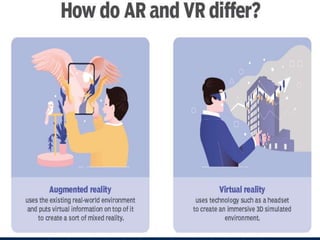
 How is Virtual Reality (VR) different
from Augmented Reality (AR)?
Ans.
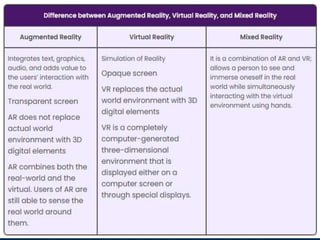
 Images created by a computer that
appear to surround the person looking
at them and seem almost real is said to
be virtual reality. On the other hand
Augmented reality is the real-time use
of information in the form of text,
graphics, audio, and other virtual
enhancements integrated with real-
world objects.
 Augmented reality (AR) is the integration of
digital information with the user's
environment in real time. Unlike virtual reality
(VR), which creates a totally artificial
environment, AR users experience a real-
world environment with generated perceptual
information overlaid on top of it.
 Augmented reality is used to either visually
change natural environments in some way or
to provide additional information to users.
The primary benefit of AR is that it manages
to blend digital and three-dimensional (3D)
components with an individual's perception of
the real world. AR has a variety of uses, from
helping in decision-making to entertainment.
 AR delivers visual elements, sound and
other sensory information to the user
through a device like a smartphone or
glasses. This information is overlaid onto the
device to create an interwoven experience
where digital information alters the user's
perception of the real world. The overlaid
information can be added to an environment
or mask part of the natural environment.
 Boeing Computer Services Research
employee Thomas Caudell coined the
term augmented reality in 1990 to describe
how the head-mounted displays that
electricians use when assembling
complicated wiring harnesses worked.
 One of the first commercial applications
of augmented reality technology was the
yellow first down marker that began
appearing in televised football games
sometime in 1998.
 Today, Google Glass, smartphone
games and heads-up displays (HUDs) in
car windshields are the most well-known
consumer AR products. But the
technology is also used in many
industries, including healthcare, public
safety, gas and oil, tourism and
marketing.
What is Augmented Reality?
 Augmented reality (AR) is a field of
computer research which deals with the
combination of real-world and computer-
generated data.
 Most of the AR research is currently
concerned with the use of video imagery
which is digitally processed and
augmented by adding computer-generated
graphics.
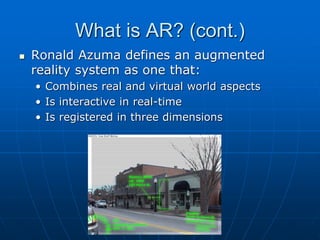
What is AR? (cont.)
 Ronald Azuma defines an augmented
reality system as one that:
• Combines real and virtual world aspects
• Is interactive in real-time
• Is registered in three dimensions
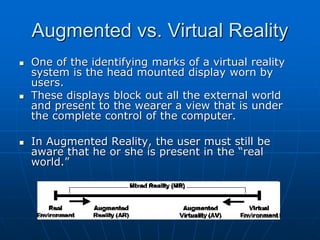
Augmented vs. Virtual Reality
 One of the identifying marks of a virtual reality
system is the head mounted display worn by
users.
 These displays block out all the external world
and present to the wearer a view that is under
the complete control of the computer.
 In Augmented Reality, the user must still be
aware that he or she is present in the “real
world.”
How does AR Work?
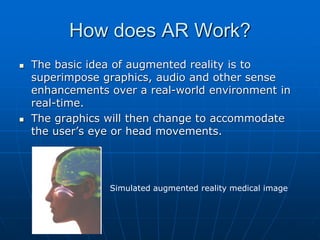
 The basic idea of augmented reality is to
superimpose graphics, audio and other sense
enhancements over a real-world environment in
real-time.
 The graphics will then change to accommodate
the user’s eye or head movements.
Simulated augmented reality medical image
What is needed?
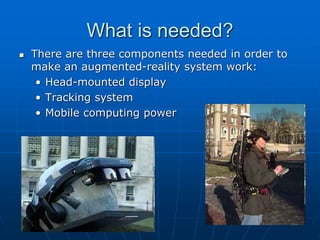
 There are three components needed in order to
make an augmented-reality system work:
• Head-mounted display
• Tracking system
• Mobile computing power
Current Uses of AR
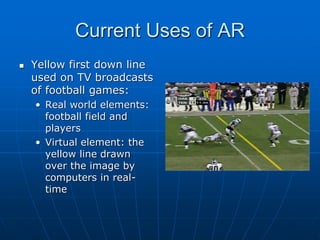
 Yellow first down line
used on TV broadcasts
of football games:
• Real world elements:
football field and
players
• Virtual element: the
yellow line drawn
over the image by
computers in real-
time
Current Uses of AR
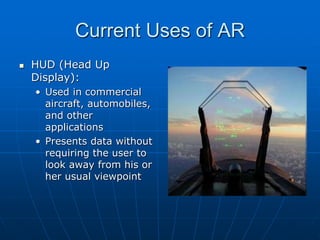
 HUD (Head Up
Display):
• Used in commercial
aircraft, automobiles,
and other
applications
• Presents data without
requiring the user to
look away from his or
her usual viewpoint
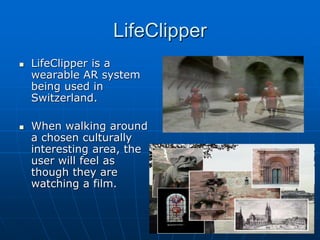
LifeClipper
 LifeClipper is a
wearable AR system
being used in
Switzerland.
 When walking around
a chosen culturally
interesting area, the
user will feel as
though they are
watching a film.
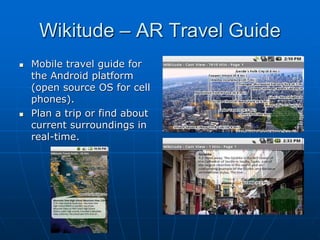
Wikitude – AR Travel Guide
 Mobile travel guide for
the Android platform
(open source OS for cell
phones).
 Plan a trip or find about
current surroundings in
real-time.
Future of AR
 Military:
• The Office of Naval Research has sponsored AR research
• AR system could provide troops with vital information
about their surroundings.
 Medical:
• Superimpose an image from an MRI onto a patient’s
body.
• This might allow surgeons to pinpoint a tumor to
remove.
 Education:
• Used in labs where students can learn more about the
experiments they are participating in.
Future of AR
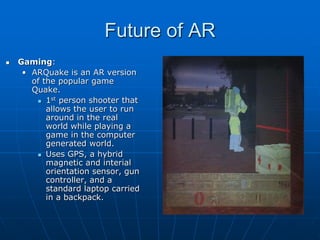
 Gaming:
• ARQuake is an AR version
of the popular game
Quake.
 1st person shooter that
allows the user to run
around in the real
world while playing a
game in the computer
generated world.
 Uses GPS, a hybrid
magnetic and interial
orientation sensor, gun
controller, and a
standard laptop carried
in a backpack.
Why continue research in AR?
 AR systems will instantly recognize what
someone is looking at, and retrieve and display
the data related to that view.
 There are hundreds of potential applications for
such a technology, gaming and entertainment
being the most obvious ones.
 Any system that gives people instant information,
requiring no research on their part, is bound to
be a valuable to anyone in any field.

Notes for AR.ppt

  • 1.
  • 2.
     Augmented Realityis still in its early days. The next technology that is truly going to bring about changes in the lives of people is Augmented Reality (AR).  As per International Data Corporation (IDC), worldwide spending on Augmented Reality (AR) and Virtual Reality (VR) will reach $ 160 Billion in 2023.
  • 3.
     What isAugmented Reality?  Augmented Reality (AR) is the technology that superimposes an image onto a user’s view of the real world and enhances it with sound, touch, and even smell.  It is a combination of the real scene viewed by the user and a virtual scene generated by the computer. AR is a technology that is going to blur the lines of reality.
  • 4.
     Augmented Realityhas moved beyond headsets and gaming and permeated into numerous industries.  In general terms, Augmented Reality is increasingly being adopted for a variety of uses like assembly, maintenance, repair, education, training, retail showcasing, and diagnostics.  AR makes workers more efficient by providing them with an additional layer of knowledge and insights.
  • 5.
     The workforceis already being enhanced in industries such as Pharmaceuticals, Oil and Gas, military, aerospace, automotive, and manufacturing.  Augmented Reality remote assistance can improve training in situations where new hires need assistance. This tech enables real-time collaboration between field personnel and remote experts.
  • 6.
    Industries adopting ARTechnology  Manufacturing  Utilities  Telecommunications  Retail  Healthcare  Logistics
  • 7.
    What are thereal-world applications of Augmented Reality? Defense  It helps in improving the situational awareness of the soldiers using AR technology. The tech is named as Tactical Augmented Reality (TAR).  This tech has an eyepiece that assists soldiers on the battlefield to precisely locate their positions in addition to the location of others (friends and enemy soldiers).
  • 8.
    Impact of thistechnology  TAR will one day replace night vision goggles, as this technology can help soldiers in the dark.It will replace the handheld GPS that soldiers carry today to locate their positions.  The eyepiece is wirelessly connected to a thermal site on the soldiers’ rifle or carbine. When the soldier is pointing the weapon, the image of the target, plus other details, such as the distance to the target can be seen through the eyepiece.
  • 9.
    Advertising  For example,Jaguar Land Rover put prospective car buyers in the virtual driver’s seat of its latest models without visiting the dealership. Consumers could launch the AR capability directly from a banner ad without any need to install an app. Customers can see the outside view seated at the driving seat through transparent windows.
  • 10.
    Healthcare  Traditionally handheldultrasound scanners are used in reconstruction surgery for locating blood vessels, and bones. However, AR technology has the potential to replace ultrasound scanners as it will help in locating the blood vessels very accurately and in a shorter period.
  • 11.
    Pharmaceuticals  Augmented Realitytools can help scientists to picture the structure of complex molecules. Drug developers usually work with static models. The AR will help the developers to step inside the molecule and see how it moves and responds to different stimuli and situations. This will reduce errors and reduce the years-long drug development cycle.
  • 12.
    Logistics  AR willbenefit logistics industries at multiple levels of their operations.  Optimizing warehouse operations  Optimizing transportation  Last-mile delivery  Enhanced value-added services
  • 13.
    Other miscellaneous applicationsof Augmented Reality  Various filters on Snapchat and Instagram are an example of Augmented Reality.  Scanning your QR code using your phone’s camera provides additional information on the screen.  Google Glass and other Head-up Displays (HUD) put Augmented Reality directly into the glasses. These glasses could be used as reminders for patients undergoing medication.
  • 14.
     AR isused in the field of language translation  Law enforcement agencies can use AR tech to recognize criminals in huge crowds.  If a car breaks down people can fix their cars using AR tech, repair and maintenance can be carried out without the help of mechanics. requirements.
  • 15.
     This techwill recognize the vehicle parts via object recognition, describe and pictures all required repair and maintenance steps in detail, and real- time, along with information about any equipment.  Retail companies use it to help customers envisage aesthetics when new furniture is placed to redesign the interiors of their homes.  Gaming – Pokemon is one of the most famous games to hit a big chord with the public.
  • 16.
     How isVirtual Reality (VR) different from Augmented Reality (AR)? Ans.  Images created by a computer that appear to surround the person looking at them and seem almost real is said to be virtual reality. On the other hand Augmented reality is the real-time use of information in the form of text, graphics, audio, and other virtual enhancements integrated with real- world objects.
  • 18.
     Augmented reality(AR) is the integration of digital information with the user's environment in real time. Unlike virtual reality (VR), which creates a totally artificial environment, AR users experience a real- world environment with generated perceptual information overlaid on top of it.  Augmented reality is used to either visually change natural environments in some way or to provide additional information to users. The primary benefit of AR is that it manages to blend digital and three-dimensional (3D) components with an individual's perception of the real world. AR has a variety of uses, from helping in decision-making to entertainment.
  • 19.
     AR deliversvisual elements, sound and other sensory information to the user through a device like a smartphone or glasses. This information is overlaid onto the device to create an interwoven experience where digital information alters the user's perception of the real world. The overlaid information can be added to an environment or mask part of the natural environment.  Boeing Computer Services Research employee Thomas Caudell coined the term augmented reality in 1990 to describe how the head-mounted displays that electricians use when assembling complicated wiring harnesses worked.
  • 20.
     One ofthe first commercial applications of augmented reality technology was the yellow first down marker that began appearing in televised football games sometime in 1998.  Today, Google Glass, smartphone games and heads-up displays (HUDs) in car windshields are the most well-known consumer AR products. But the technology is also used in many industries, including healthcare, public safety, gas and oil, tourism and marketing.
  • 24.
    What is AugmentedReality?  Augmented reality (AR) is a field of computer research which deals with the combination of real-world and computer- generated data.  Most of the AR research is currently concerned with the use of video imagery which is digitally processed and augmented by adding computer-generated graphics.
  • 25.
    What is AR?(cont.)  Ronald Azuma defines an augmented reality system as one that: • Combines real and virtual world aspects • Is interactive in real-time • Is registered in three dimensions
  • 26.
    Augmented vs. VirtualReality  One of the identifying marks of a virtual reality system is the head mounted display worn by users.  These displays block out all the external world and present to the wearer a view that is under the complete control of the computer.  In Augmented Reality, the user must still be aware that he or she is present in the “real world.”
  • 27.
    How does ARWork?  The basic idea of augmented reality is to superimpose graphics, audio and other sense enhancements over a real-world environment in real-time.  The graphics will then change to accommodate the user’s eye or head movements. Simulated augmented reality medical image
  • 28.
    What is needed? There are three components needed in order to make an augmented-reality system work: • Head-mounted display • Tracking system • Mobile computing power
  • 29.
    Current Uses ofAR  Yellow first down line used on TV broadcasts of football games: • Real world elements: football field and players • Virtual element: the yellow line drawn over the image by computers in real- time
  • 30.
    Current Uses ofAR  HUD (Head Up Display): • Used in commercial aircraft, automobiles, and other applications • Presents data without requiring the user to look away from his or her usual viewpoint
  • 31.
    LifeClipper  LifeClipper isa wearable AR system being used in Switzerland.  When walking around a chosen culturally interesting area, the user will feel as though they are watching a film.
  • 32.
    Wikitude – ARTravel Guide  Mobile travel guide for the Android platform (open source OS for cell phones).  Plan a trip or find about current surroundings in real-time.
  • 33.
    Future of AR Military: • The Office of Naval Research has sponsored AR research • AR system could provide troops with vital information about their surroundings.  Medical: • Superimpose an image from an MRI onto a patient’s body. • This might allow surgeons to pinpoint a tumor to remove.  Education: • Used in labs where students can learn more about the experiments they are participating in.
  • 34.
    Future of AR Gaming: • ARQuake is an AR version of the popular game Quake.  1st person shooter that allows the user to run around in the real world while playing a game in the computer generated world.  Uses GPS, a hybrid magnetic and interial orientation sensor, gun controller, and a standard laptop carried in a backpack.
  • 35.
    Why continue researchin AR?  AR systems will instantly recognize what someone is looking at, and retrieve and display the data related to that view.  There are hundreds of potential applications for such a technology, gaming and entertainment being the most obvious ones.  Any system that gives people instant information, requiring no research on their part, is bound to be a valuable to anyone in any field.