 is an enhanced version of
reality where live direct or indirect views of physical
real-world environments are augmented with
superimposed computer generated images over a
user’s view of the real world, thus enhancing one’s
current perception of reality.
 is known as the “Father
of virtual reality” for his research and
invention in the ‘50s and ‘60s. He patented the
Sensorama Stimulator ,which is called as
“experience theater”, on August 28, 1962.
1. 1990s - Tom Caudell, attributed the
term“Augmented reality”.
2. 1997 - Ronald T. Azuma’s “A
Survey of Augmented Reality”, examined
the uses of augmented reality in medical,
manufacture, research, mechanical
operation and entertainment.
 Technology
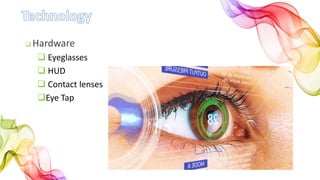
 Hardware
 Possible Application
 Hardware
 Eyeglasses
 HUD
 Contact lenses
Eye Tap
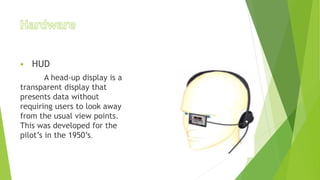
 HUD
A head-up display is a
transparent display that
presents data without
requiring users to look away
from the usual view points.
This was developed for the
pilot’s in the 1950’s.
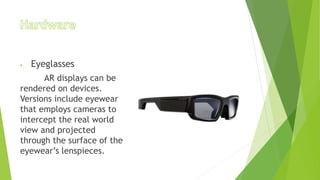
 Eyeglasses
AR displays can be
rendered on devices.
Versions include eyewear
that employs cameras to
intercept the real world
view and projected
through the surface of the
eyewear’s lenspieces.
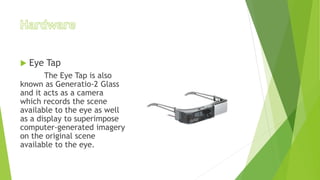
 Eye Tap
The Eye Tap is also
known as Generatio-2 Glass
and it acts as a camera
which records the scene
available to the eye as well
as a display to superimpose
computer-generated imagery
on the original scene
available to the eye.
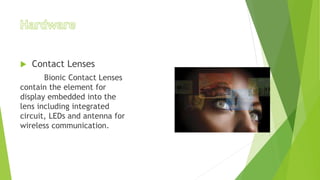
 Contact Lenses
Bionic Contact Lenses
contain the element for
display embedded into the
lens including integrated
circuit, LEDs and antenna for
wireless communication.
 Archaeology
 Architecture
 Visual Art
 Commerce
 Education
 Video games

AR has allow archaeologist to formulate possible site
configuration from external structure. Computer generates models of
ruins, building, landscape or even ancient people have been recycled
into early archaeological AR applications.

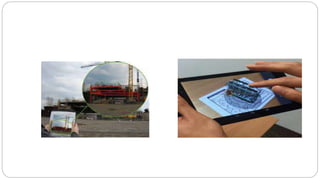
AR can visualize the building project using a computer
generated image of a structure can be superimposed into a real life
local view of the property before physical building, these was
demonstrated by Trimble Navigation in 2004.

AR applied in the visual arts allows the objects or places
to trigger artistic multidimensional experience of reality. AR
technology aid the development of eye tracking technology to
translate a disabled person’s eye movement for drawing on the
screen.
•
AR allows the customer to know what is inside a
product’s package without opening it. AR is also been used to select
products from catalog. Scammed images of products can activate
views of additional content such as customized options and
additional images of the product.

AR has complement a standard curriculum. Text, Video,
and audio may be superimposed into a student’s real-time
environment. Textbooks and other study material may contains
“markers” that, when scanned by AR device additional information
rendered in a multimedia format.

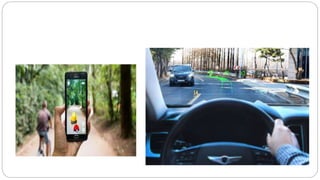
AR allows the player to experience digital game play in a
real world environment. Niantic and Proxy42 emerged as major
creators. PokemonGo was a record breaking game created by
Niantic.
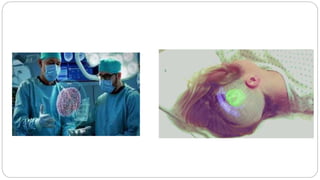
Robert implemented the first medical augmented reality
systems. Anothers application for augmented reality in the medical
domain is in ultrasound imaging. Ultrasound technique volumetric
can view the image of the fetus overlaid on the abdomen of the
pregnant woman. AR visual guidance information is for surgeon’s
experience and accuracy of assisted surgery.
AR can be used to display the real battlefield scene and
augment it with annotation information. Liteye company built HMD’s
for military. Hybrid optical and inertial trackers that used miniature
MEMS (Micro Electro-Mechanical Systems) sensors was developed
for cockpit tracking.
 AR is also used for planning for training in urban terrain and display
an animated terrain, used for the intervention planning was
developed by Arcane Company. The helicopter night vision system
was developed by Canada’s Institute for Aerospace Research
(NRC-IAR) Battlefield Augmented Reality System (BARS) by Julier.
The BARS system also provides tools to author the environment
with new 3D information that other system users.

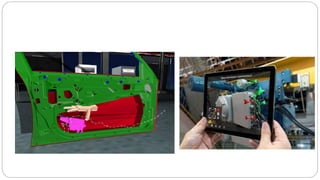
AR in industrial design is a growing area and strong. AR
manufacturing systems that could enhance manufacturing processes,
as well as product and process development, leading to shorter lead-
time, reduced cost and improved quality.

AR is an ideal platform for human-robot collaboration.
Robots can present complex informations by using AR technique for
communicating information to humans. AR technique robot was most
used for head surgery. 3D AR display during robot assisted
Laparoscopic Partial Nephrectomy(LPM) can also been done
Augmented reality was first used for advertising in the
automotive Some companies printed special flyers that were
automatically recognized by webcams, causing a three dimensional
model of the advertised car to be shown on the screen industry.
 Despite the growing interest in AR and the large body of advances and
research, several challenges and issue still exist and need to be addressed.
 In this section , we classify the limits that characterize the current state of
the art of AR based on the following aspects: technology, social acceptance,
usability. Considerable advances made in each of the areas described in this
paper. However, there are still limitations with the technology that needs to
be overcome.
 AR system has to deal with vast amount of information in reality. Therefore
the hardware used should be small, light, and easily portable and fast enough
to display graphics. Also the battery life used by these complicated AR devices
is another limitation for AR’s uses.
 AR tracking needs some system hardware such as GPS to provide accurate
marker, ask them to be both accurate and reliable enough. These hardware
obstacles need to be resolved for practical AR use. AR systems usually obtain
a lot of information, and need software to filter the information, retain
useful information, discard useless data and display it in a convenient way.
• Several possible future directions are speculated for further research. Many HMDs
created specifically with AR in mind need to be developed. HMDs are still too
clumsy and have limited field of vision, contrast and resolution. HMDs and other
wearable equipment, such as data-gloves and data suits, is a limitation for the
user. All wearable equipment need be developed to be lighter, smaller and easier
to work with the user. Also the AR system researchers need consider other
challenges such as response time delays, hardware or software failures from AR
systems. One limitation of AR systems is registration error. Occlusion detection is
an active area of study of AR systems. Analyzing various tracking methods, possible
tracking research directions are identified that allow researchers to effectively
capitalize on knowledge in video frames, or integrate vision-based methods with
other sensors in a novel way. The challenge is to construct a pervasive
middleware to support the AR system.
Augumented Reality

Augumented Reality

  • 2.
     is anenhanced version of reality where live direct or indirect views of physical real-world environments are augmented with superimposed computer generated images over a user’s view of the real world, thus enhancing one’s current perception of reality.
  • 3.
     is knownas the “Father of virtual reality” for his research and invention in the ‘50s and ‘60s. He patented the Sensorama Stimulator ,which is called as “experience theater”, on August 28, 1962.
  • 5.
    1. 1990s -Tom Caudell, attributed the term“Augmented reality”. 2. 1997 - Ronald T. Azuma’s “A Survey of Augmented Reality”, examined the uses of augmented reality in medical, manufacture, research, mechanical operation and entertainment.
  • 6.
     Technology  Hardware Possible Application
  • 7.
     Hardware  Eyeglasses HUD  Contact lenses Eye Tap
  • 8.
     HUD A head-updisplay is a transparent display that presents data without requiring users to look away from the usual view points. This was developed for the pilot’s in the 1950’s.
  • 9.
     Eyeglasses AR displayscan be rendered on devices. Versions include eyewear that employs cameras to intercept the real world view and projected through the surface of the eyewear’s lenspieces.
  • 10.
     Eye Tap TheEye Tap is also known as Generatio-2 Glass and it acts as a camera which records the scene available to the eye as well as a display to superimpose computer-generated imagery on the original scene available to the eye.
  • 11.
     Contact Lenses BionicContact Lenses contain the element for display embedded into the lens including integrated circuit, LEDs and antenna for wireless communication.
  • 12.
     Archaeology  Architecture Visual Art  Commerce  Education  Video games
  • 13.
     AR has allowarchaeologist to formulate possible site configuration from external structure. Computer generates models of ruins, building, landscape or even ancient people have been recycled into early archaeological AR applications.  AR can visualize the building project using a computer generated image of a structure can be superimposed into a real life local view of the property before physical building, these was demonstrated by Trimble Navigation in 2004.
  • 15.
     AR applied inthe visual arts allows the objects or places to trigger artistic multidimensional experience of reality. AR technology aid the development of eye tracking technology to translate a disabled person’s eye movement for drawing on the screen. • AR allows the customer to know what is inside a product’s package without opening it. AR is also been used to select products from catalog. Scammed images of products can activate views of additional content such as customized options and additional images of the product.
  • 16.
     AR has complementa standard curriculum. Text, Video, and audio may be superimposed into a student’s real-time environment. Textbooks and other study material may contains “markers” that, when scanned by AR device additional information rendered in a multimedia format.  AR allows the player to experience digital game play in a real world environment. Niantic and Proxy42 emerged as major creators. PokemonGo was a record breaking game created by Niantic.
  • 18.
    Robert implemented thefirst medical augmented reality systems. Anothers application for augmented reality in the medical domain is in ultrasound imaging. Ultrasound technique volumetric can view the image of the fetus overlaid on the abdomen of the pregnant woman. AR visual guidance information is for surgeon’s experience and accuracy of assisted surgery. AR can be used to display the real battlefield scene and augment it with annotation information. Liteye company built HMD’s for military. Hybrid optical and inertial trackers that used miniature MEMS (Micro Electro-Mechanical Systems) sensors was developed for cockpit tracking.
  • 20.
     AR isalso used for planning for training in urban terrain and display an animated terrain, used for the intervention planning was developed by Arcane Company. The helicopter night vision system was developed by Canada’s Institute for Aerospace Research (NRC-IAR) Battlefield Augmented Reality System (BARS) by Julier. The BARS system also provides tools to author the environment with new 3D information that other system users.  AR in industrial design is a growing area and strong. AR manufacturing systems that could enhance manufacturing processes, as well as product and process development, leading to shorter lead- time, reduced cost and improved quality.
  • 22.
     AR is anideal platform for human-robot collaboration. Robots can present complex informations by using AR technique for communicating information to humans. AR technique robot was most used for head surgery. 3D AR display during robot assisted Laparoscopic Partial Nephrectomy(LPM) can also been done Augmented reality was first used for advertising in the automotive Some companies printed special flyers that were automatically recognized by webcams, causing a three dimensional model of the advertised car to be shown on the screen industry.
  • 23.
     Despite thegrowing interest in AR and the large body of advances and research, several challenges and issue still exist and need to be addressed.  In this section , we classify the limits that characterize the current state of the art of AR based on the following aspects: technology, social acceptance, usability. Considerable advances made in each of the areas described in this paper. However, there are still limitations with the technology that needs to be overcome.  AR system has to deal with vast amount of information in reality. Therefore the hardware used should be small, light, and easily portable and fast enough to display graphics. Also the battery life used by these complicated AR devices is another limitation for AR’s uses.  AR tracking needs some system hardware such as GPS to provide accurate marker, ask them to be both accurate and reliable enough. These hardware obstacles need to be resolved for practical AR use. AR systems usually obtain a lot of information, and need software to filter the information, retain useful information, discard useless data and display it in a convenient way.
  • 24.
    • Several possiblefuture directions are speculated for further research. Many HMDs created specifically with AR in mind need to be developed. HMDs are still too clumsy and have limited field of vision, contrast and resolution. HMDs and other wearable equipment, such as data-gloves and data suits, is a limitation for the user. All wearable equipment need be developed to be lighter, smaller and easier to work with the user. Also the AR system researchers need consider other challenges such as response time delays, hardware or software failures from AR systems. One limitation of AR systems is registration error. Occlusion detection is an active area of study of AR systems. Analyzing various tracking methods, possible tracking research directions are identified that allow researchers to effectively capitalize on knowledge in video frames, or integrate vision-based methods with other sensors in a novel way. The challenge is to construct a pervasive middleware to support the AR system.