Introduction to Machine
Learning
ThePhilosophy
Advantages
Applications
Algorithms
Venkat Reddy
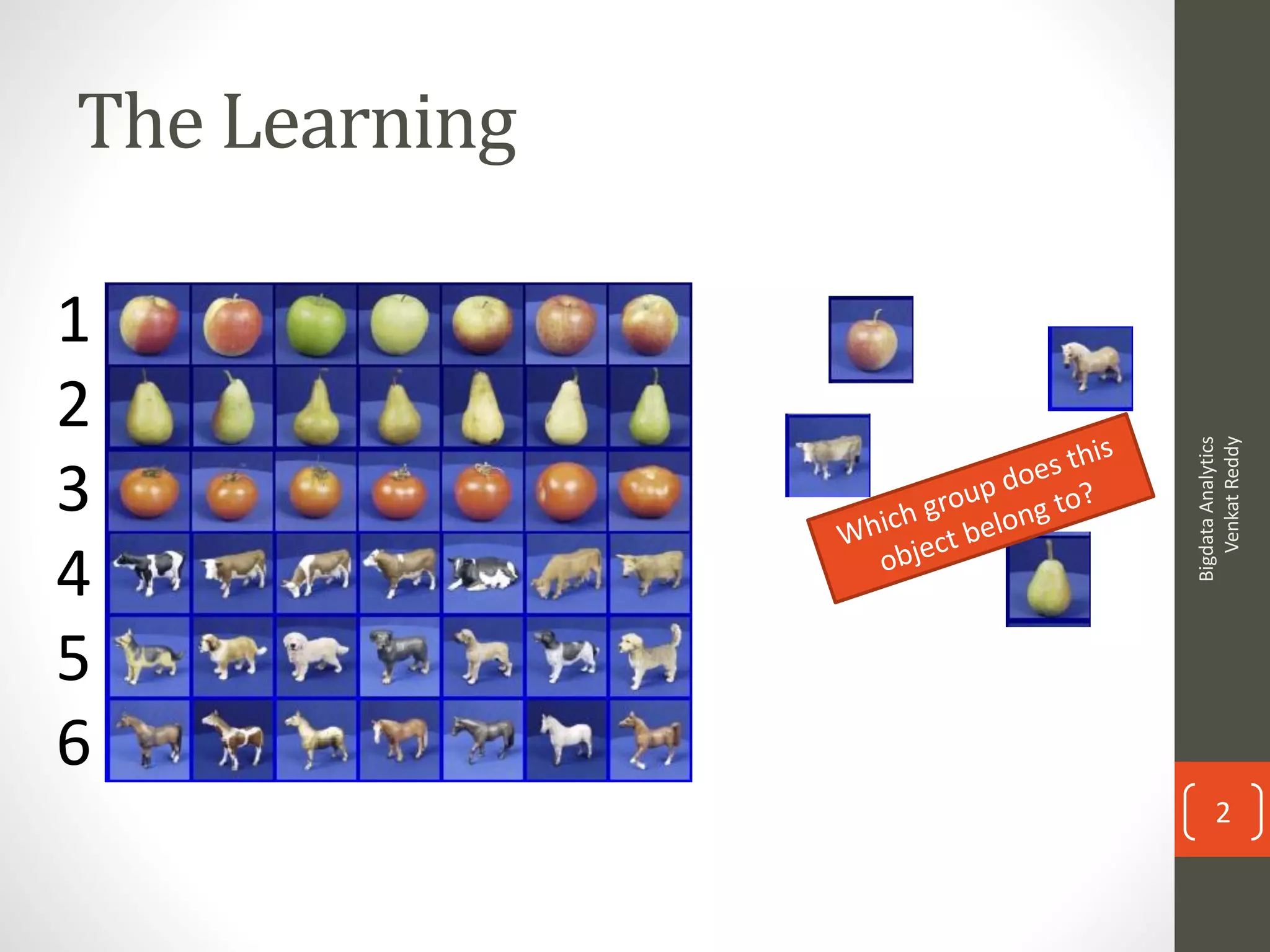
The Learning
1
2
3
4
5
6
BigdataAnalytics
VenkatReddy
2
Machine Learning
• How did our brain process the images?
• How did the grouping happen?
• Human brain processed the given images - learning
• After learning the brain simply looked at the new image and
compared with the groups classified the image to the closest
group - Classification
• If a machine has to perform the same operation we use
Machine Learning
• We write programs for learning and then classification, this is
nothing but machine learning
BigdataAnalytics
VenkatReddy
3
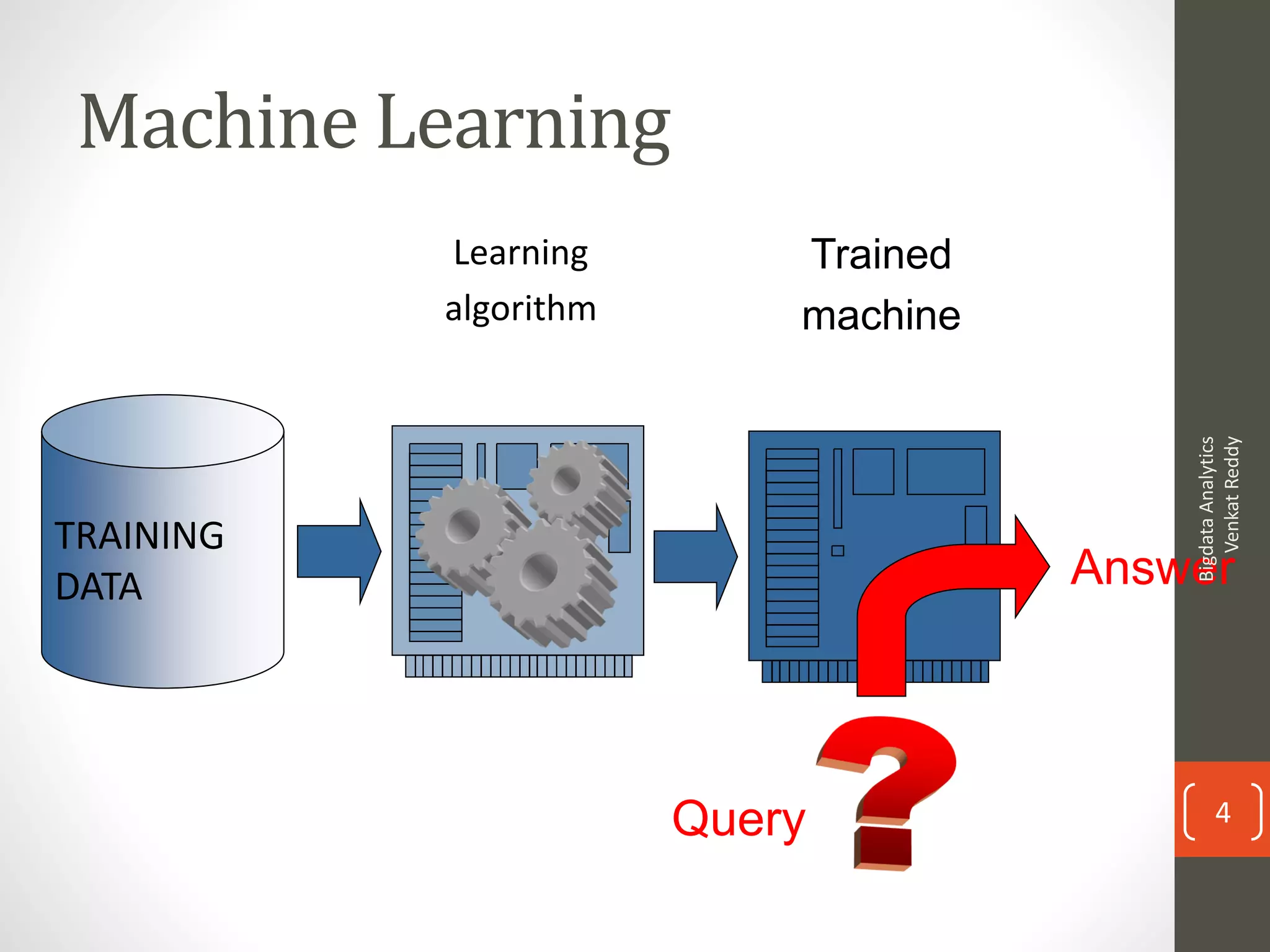
Machine Learning
Learning
algorithm
TRAINING
DATA Answer
Trained
machine
Query
BigdataAnalytics
VenkatReddy
4
Example: Classification using ML
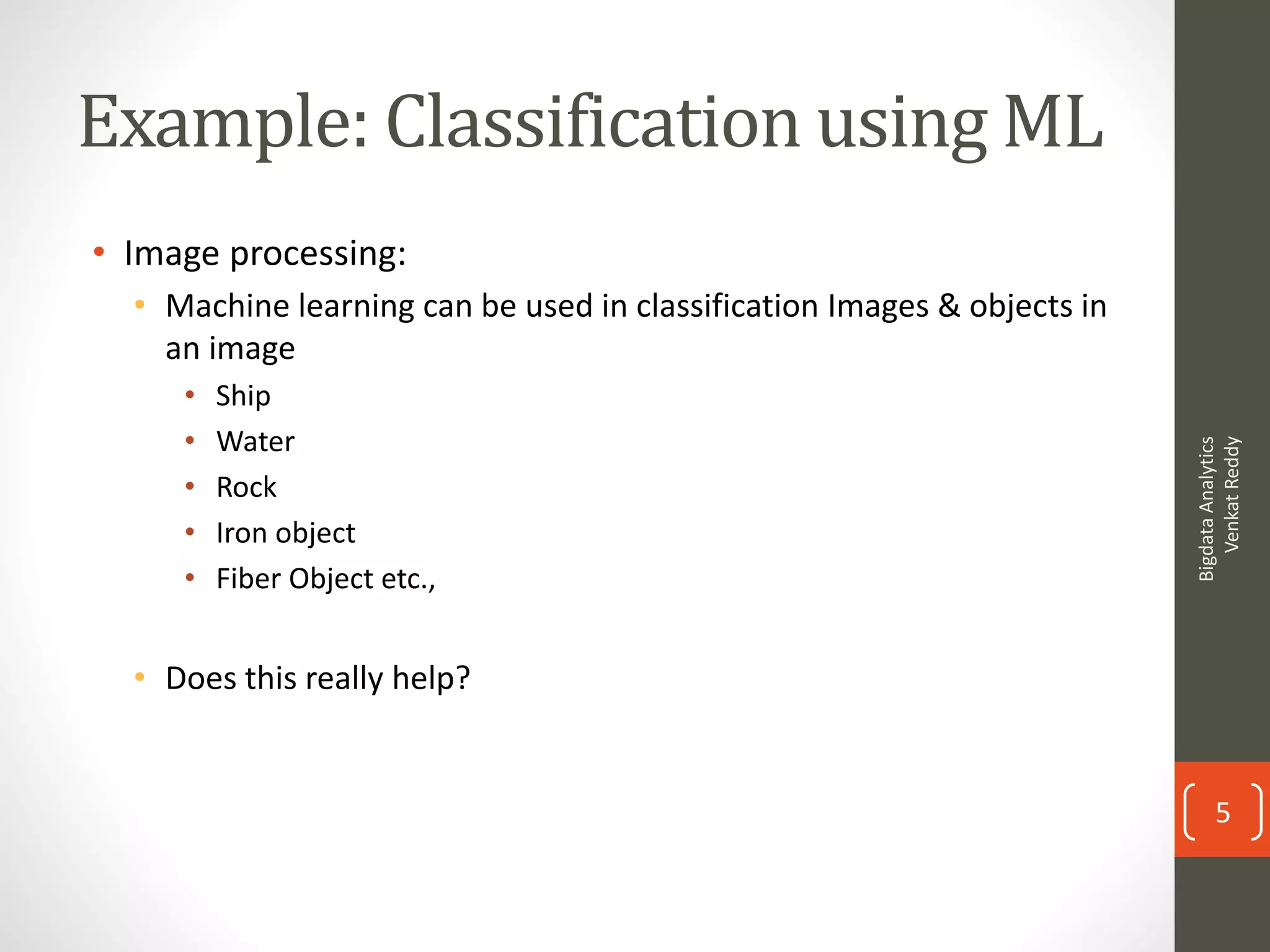
• Image processing:
• Machine learning can be used in classification Images & objects in
an image
• Ship
• Water
• Rock
• Iron object
• Fiber Object etc.,
• Does this really help?
BigdataAnalytics
VenkatReddy
5
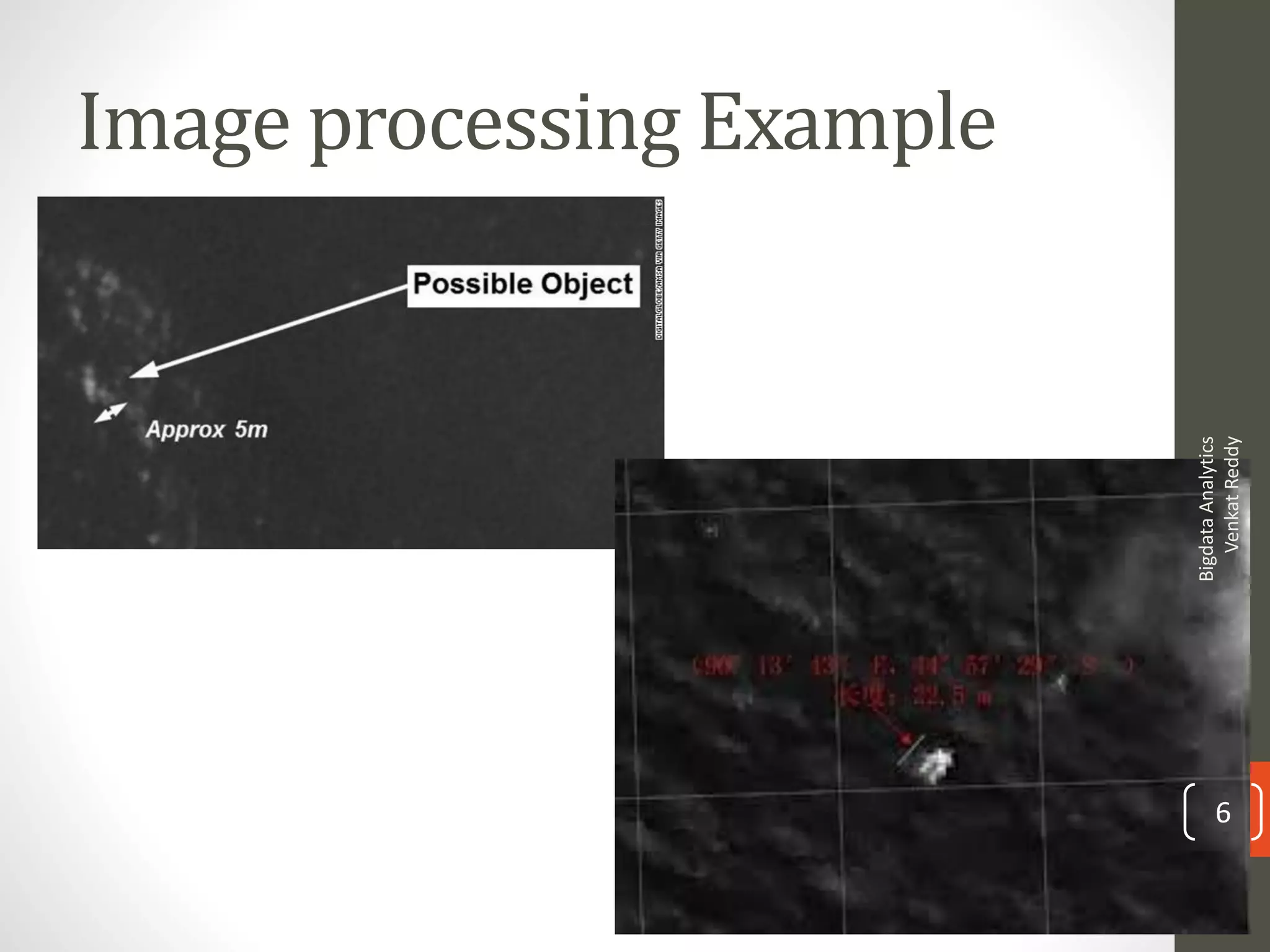
Image processing Example
BigdataAnalytics
VenkatReddy
6
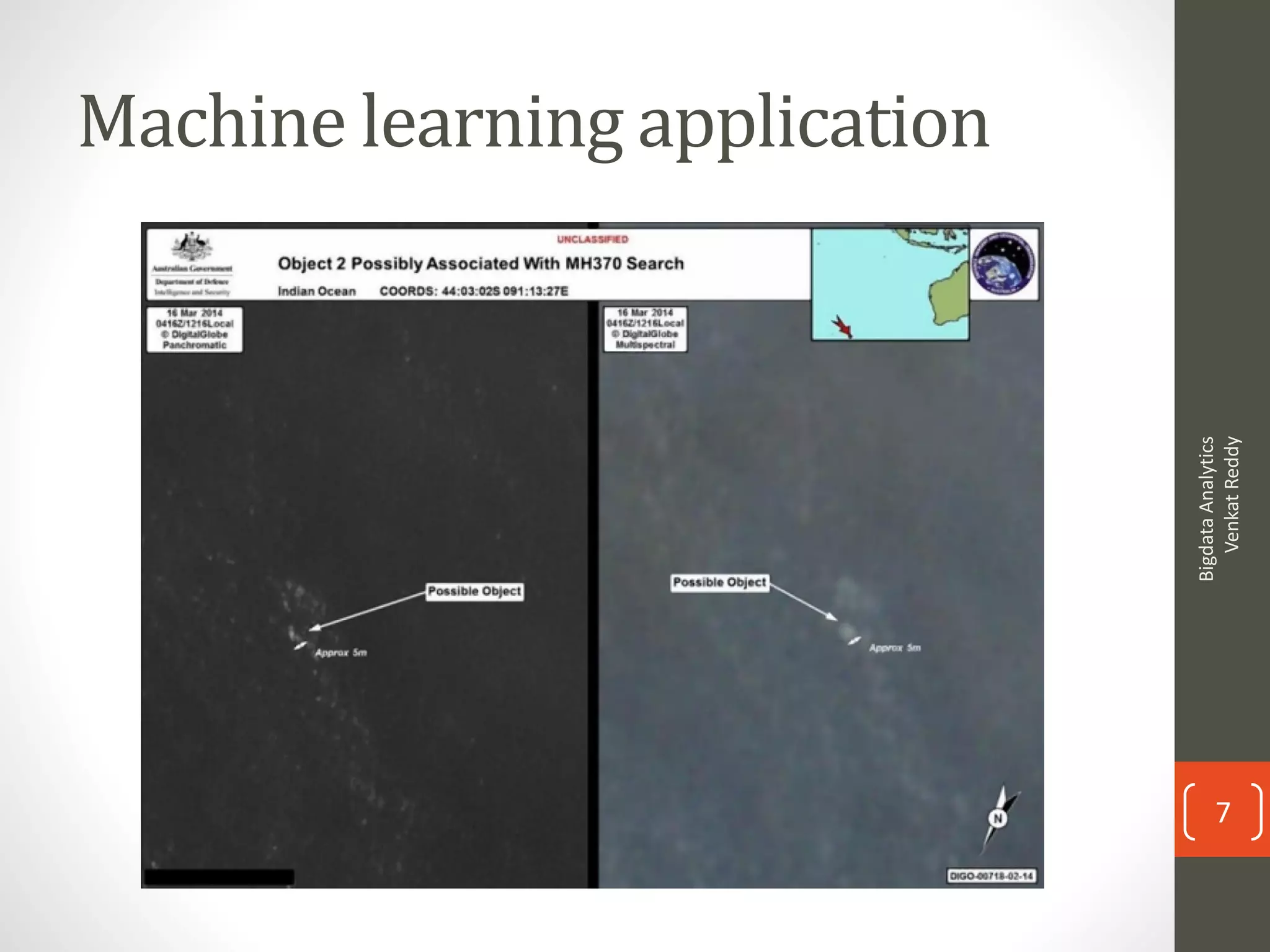
Machine learning application
BigdataAnalytics
VenkatReddy
7
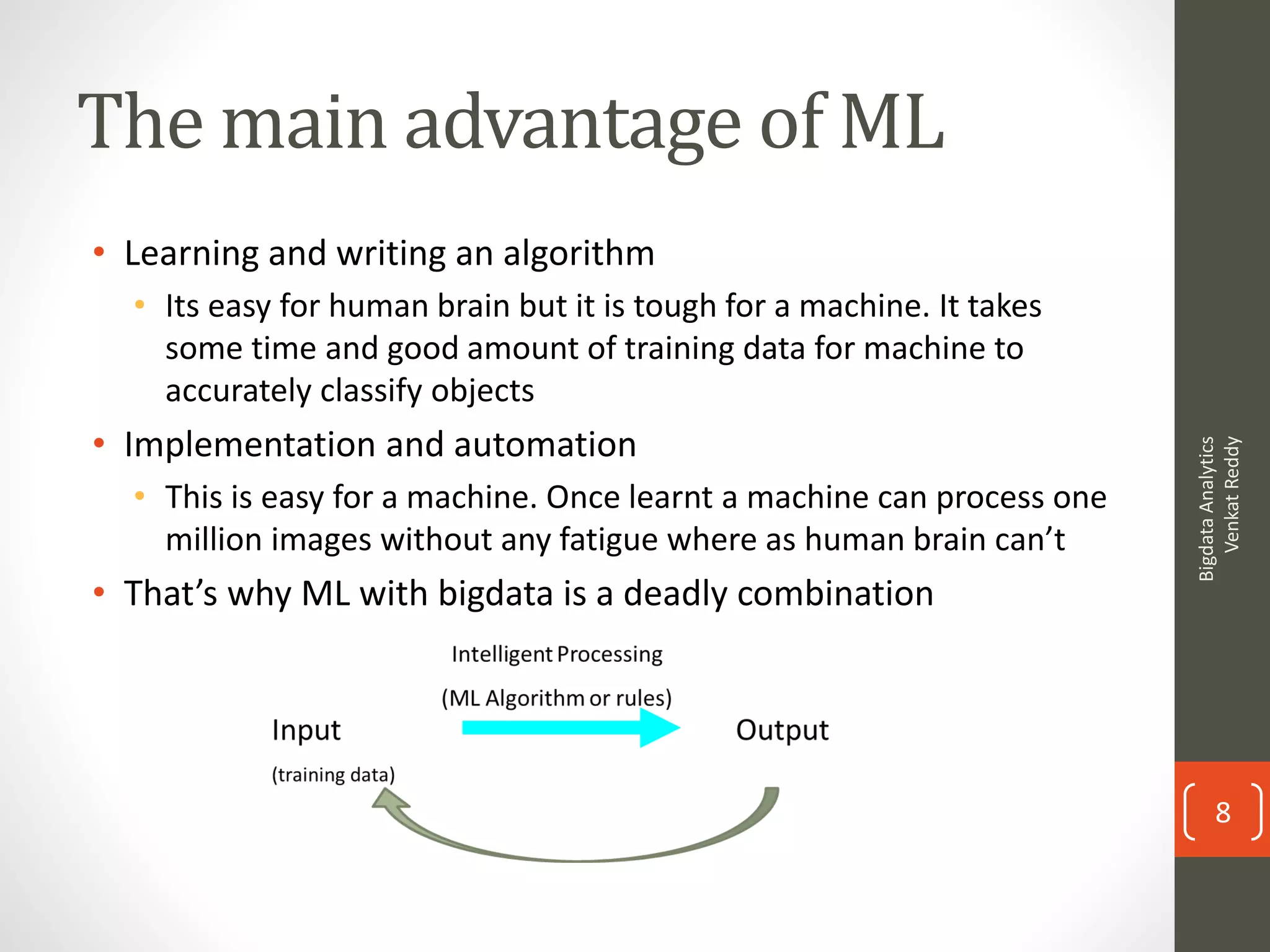
The main advantage of ML
• Learning and writing an algorithm
• Its easy for human brain but it is tough for a machine. It takes
some time and good amount of training data for machine to
accurately classify objects
• Implementation and automation
• This is easy for a machine. Once learnt a machine can process one
million images without any fatigue where as human brain can’t
• That’s why ML with bigdata is a deadly combination
BigdataAnalytics
VenkatReddy
8
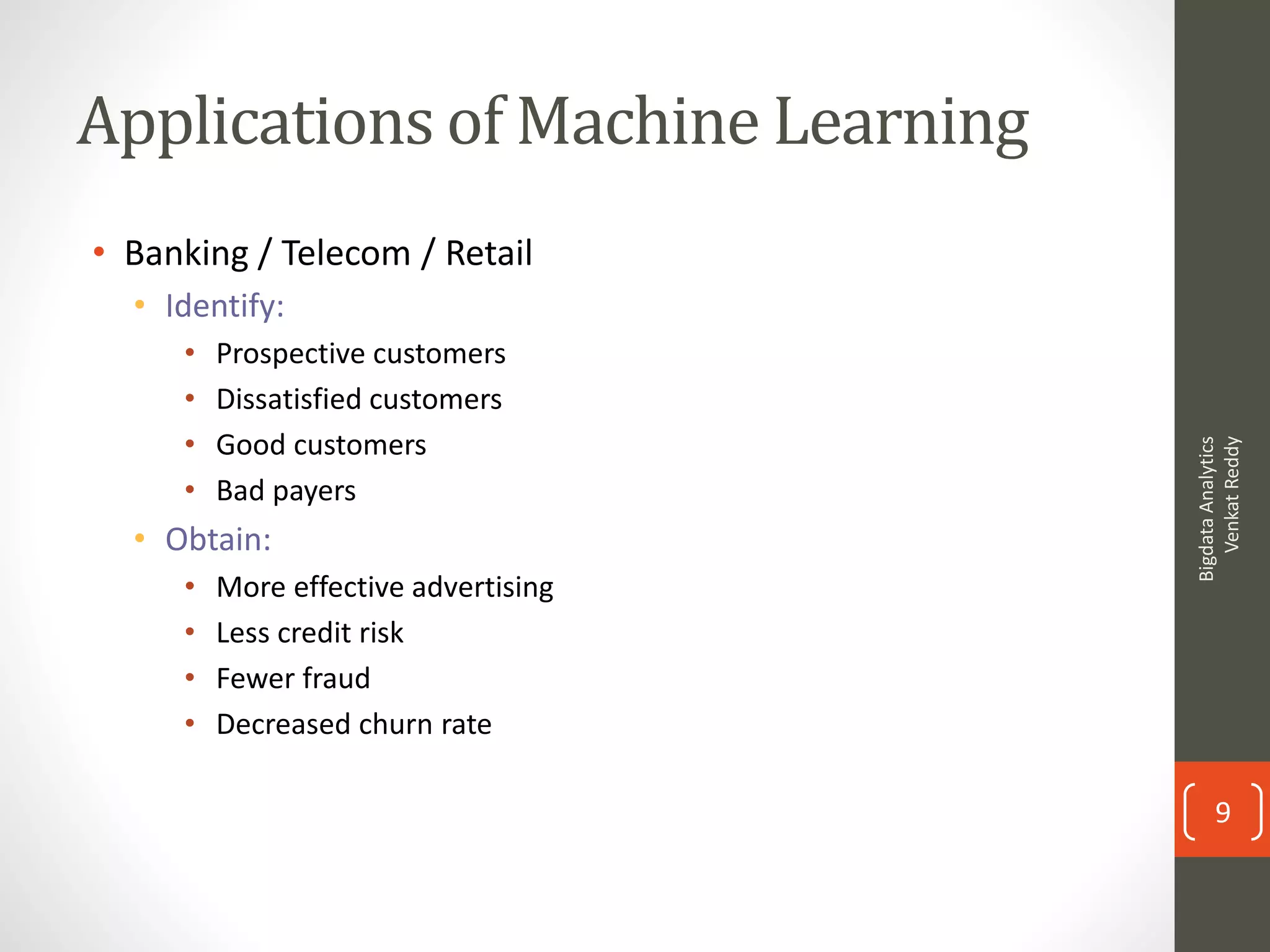
Applications of Machine Learning
• Banking / Telecom / Retail
• Identify:
• Prospective customers
• Dissatisfied customers
• Good customers
• Bad payers
• Obtain:
• More effective advertising
• Less credit risk
• Fewer fraud
• Decreased churn rate
BigdataAnalytics
VenkatReddy
9
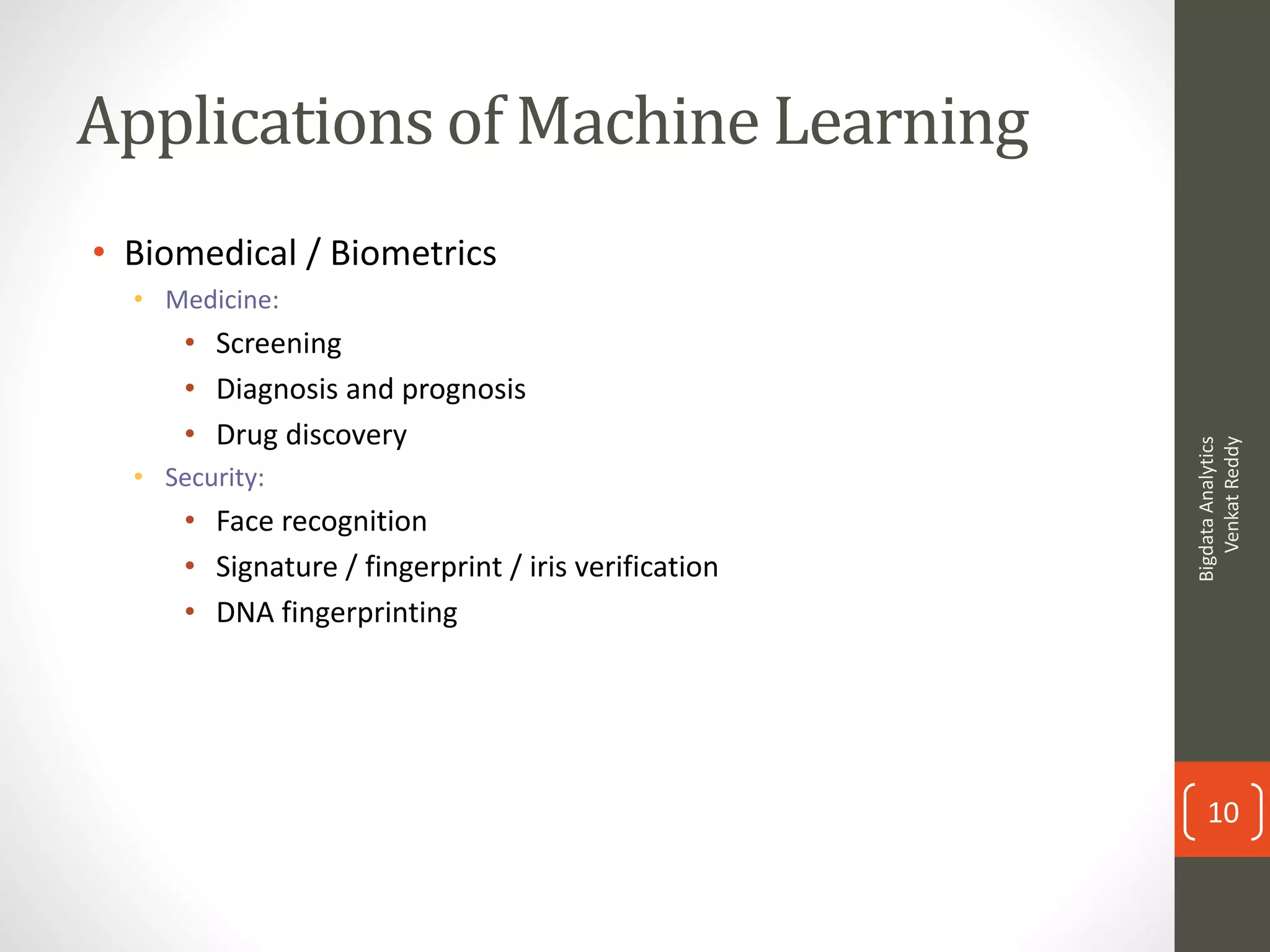
Applications of Machine Learning
• Biomedical / Biometrics
• Medicine:
• Screening
• Diagnosis and prognosis
• Drug discovery
• Security:
• Face recognition
• Signature / fingerprint / iris verification
• DNA fingerprinting
BigdataAnalytics
VenkatReddy
10
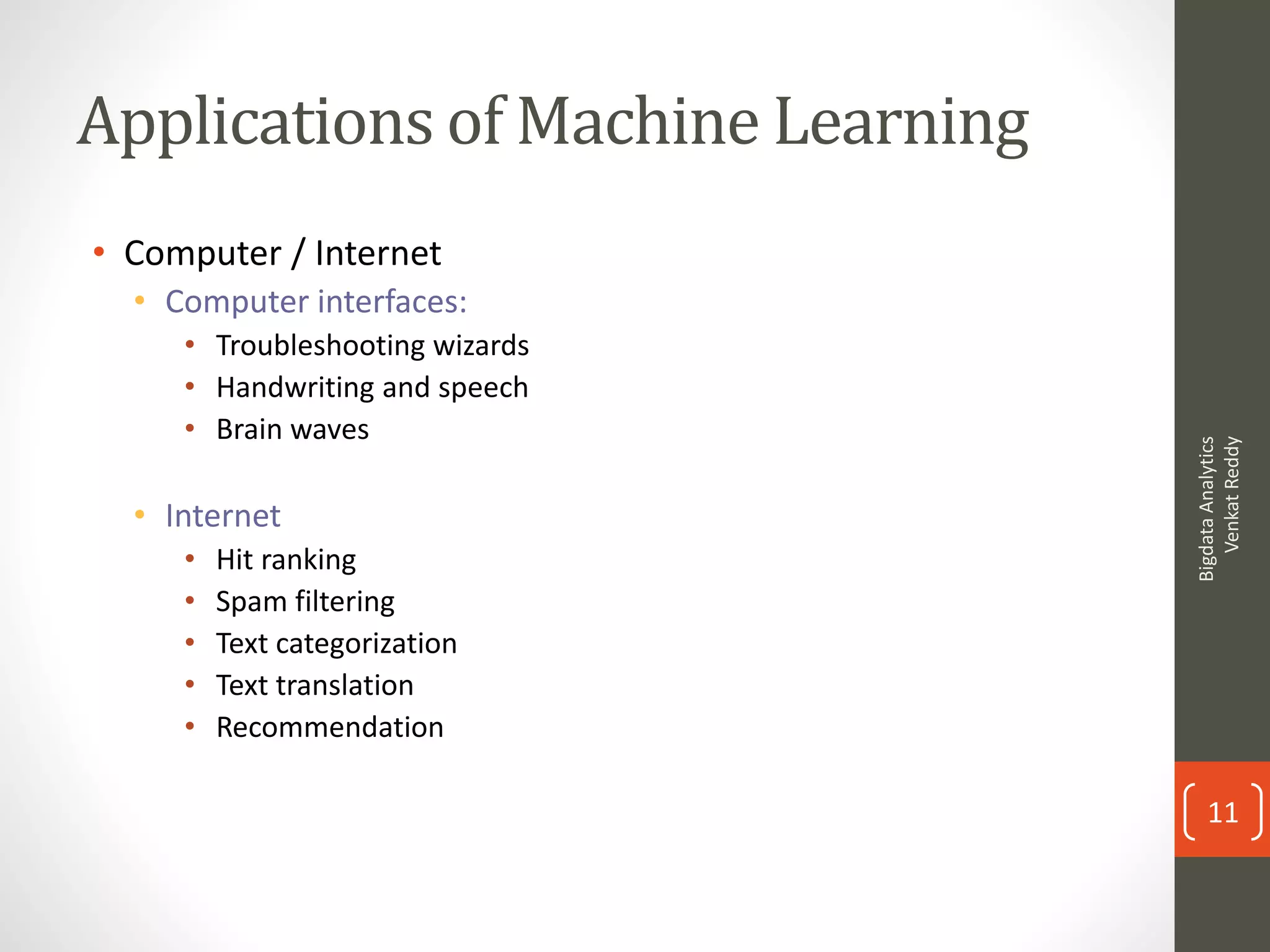
Applications of Machine Learning
• Computer / Internet
• Computer interfaces:
• Troubleshooting wizards
• Handwriting and speech
• Brain waves
• Internet
• Hit ranking
• Spam filtering
• Text categorization
• Text translation
• Recommendation
BigdataAnalytics
VenkatReddy
11
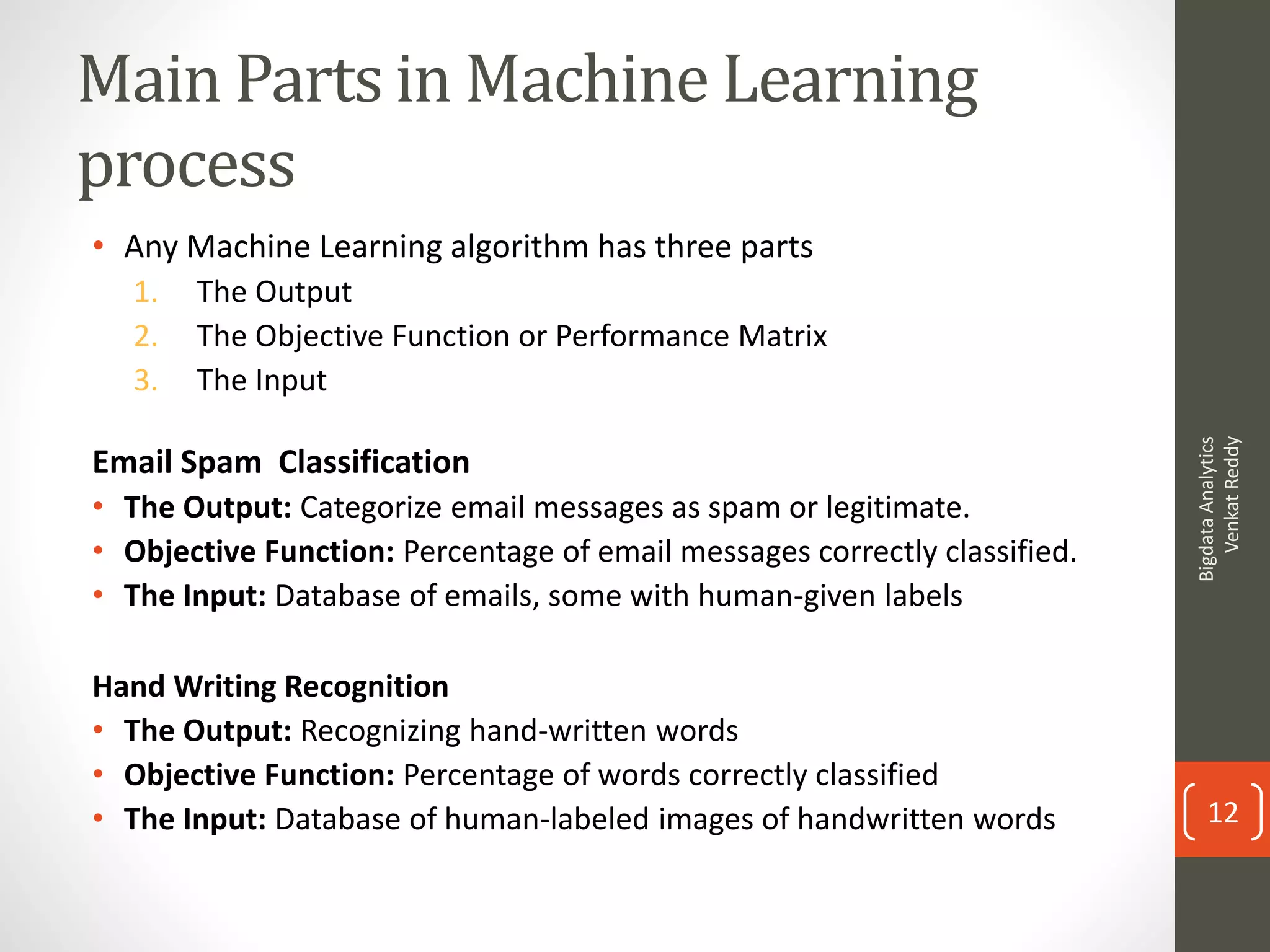
Main Parts in Machine Learning
process
• Any Machine Learning algorithm has three parts
1. The Output
2. The Objective Function or Performance Matrix
3. The Input
Email Spam Classification
• The Output: Categorize email messages as spam or legitimate.
• Objective Function: Percentage of email messages correctly classified.
• The Input: Database of emails, some with human-given labels
Hand Writing Recognition
• The Output: Recognizing hand-written words
• Objective Function: Percentage of words correctly classified
• The Input: Database of human-labeled images of handwritten words
BigdataAnalytics
VenkatReddy
12
Some Machine Learning
Methods
BigdataAnalytics
VenkatReddy
13
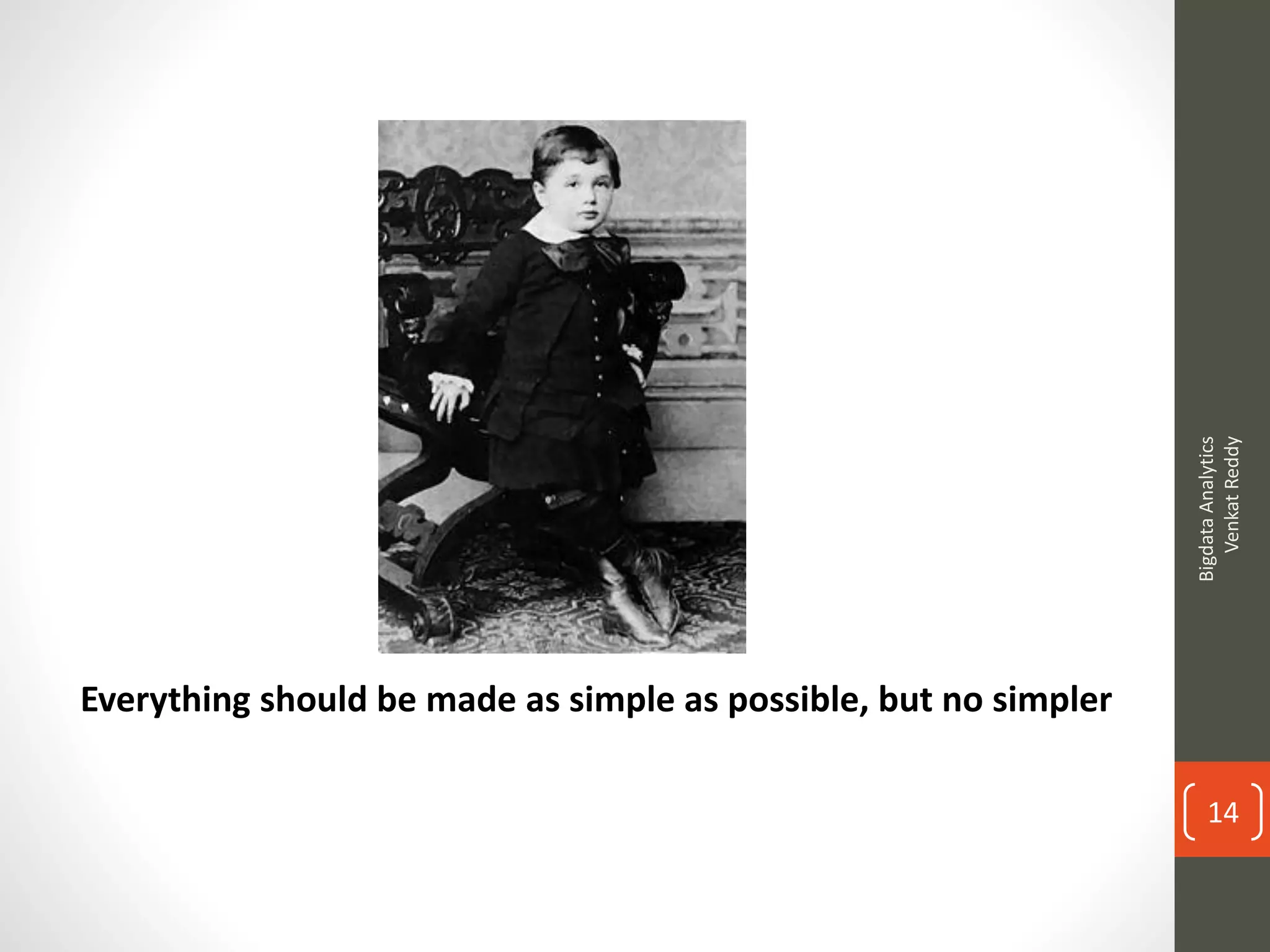
Everything should be made as simple as possible, but no simpler
BigdataAnalytics
VenkatReddy
14
Bayes Network
BigdataAnalytics
VenkatReddy
15
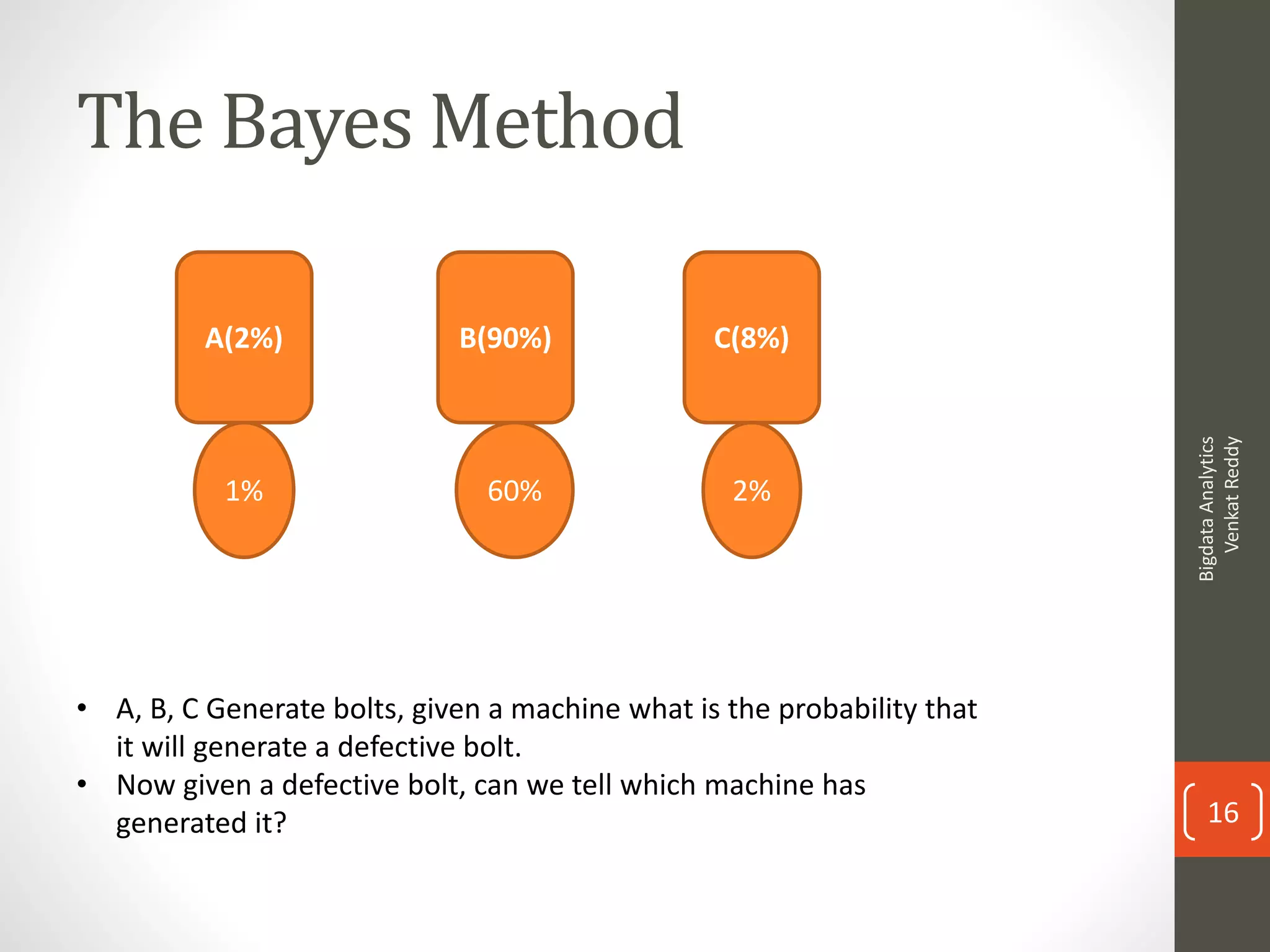
The Bayes Method
A(2%) B(90%) C(8%)
1% 60% 2%
• A, B, C Generate bolts, given a machine what is the probability that
it will generate a defective bolt.
• Now given a defective bolt, can we tell which machine has
generated it?
BigdataAnalytics
VenkatReddy
16
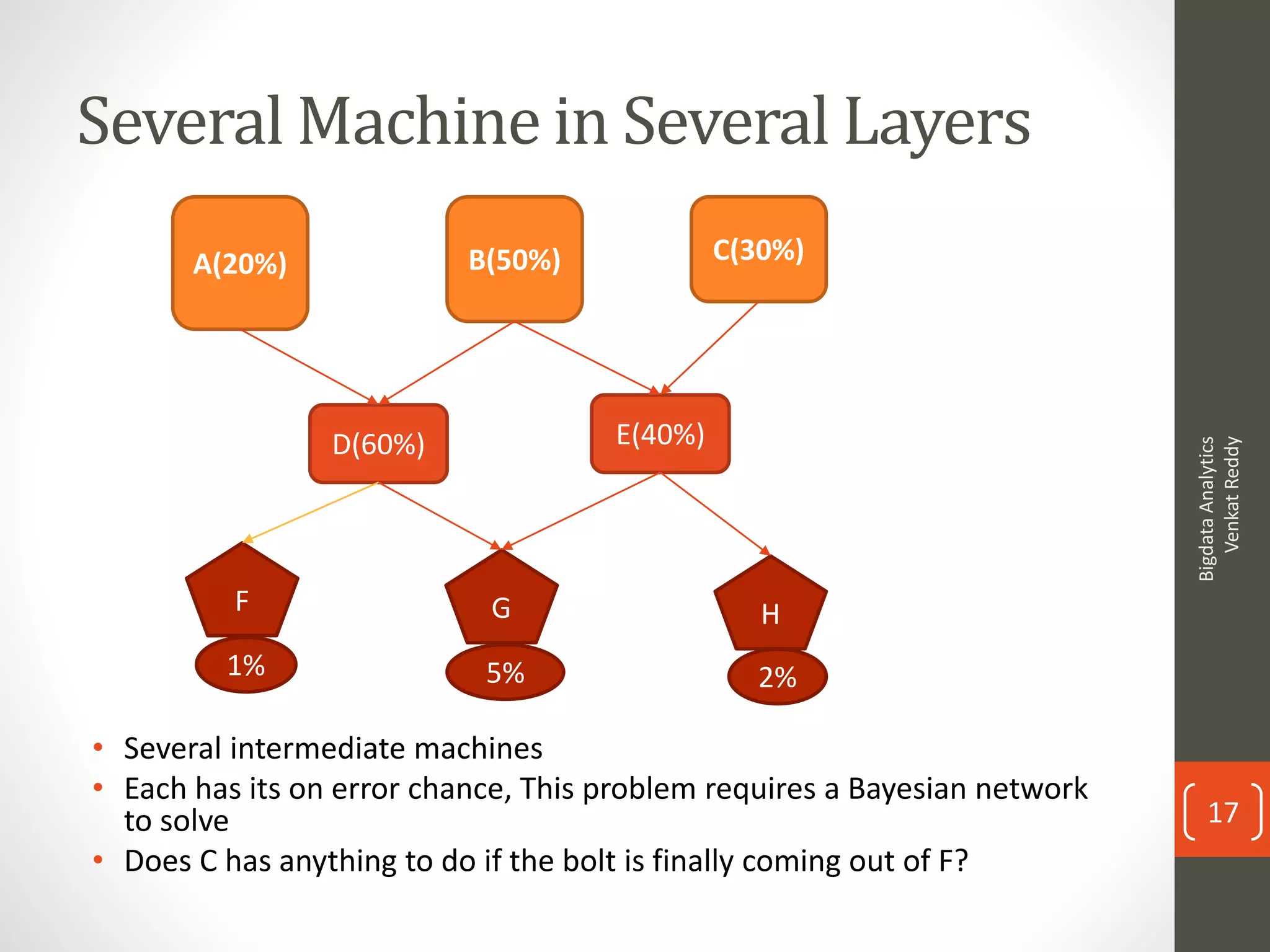
Several Machine in Several Layers
• Several intermediate machines
• Each has its on error chance, This problem requires a Bayesian network
to solve
• Does C has anything to do if the bolt is finally coming out of F?
A(20%) B(50%) C(30%)
1% 5% 2%
D(60%) E(40%)
F G H
BigdataAnalytics
VenkatReddy
17
Artificial Neural Networks
BigdataAnalytics
VenkatReddy
18
The Philosophy of Neural Network
• If we have to predict whether we win in a chess game
• Can we use logistic regression?
• Since there can be almost infinite number of intermediate steps
its almost impossible to predict the probability of winning
• If each move is considered as an input variable then there are
almost (countable)infinite moves. A coefficient for each of them
is always negligible.
Neural network uses a simple technique, instead of predicting the
final output they predict the intermediate output that lead to a win
previously, this will be an input for predicting the next move
BigdataAnalytics
VenkatReddy
19
Biological Motivation for NN
• Aartificial neural networks are built out of a densely
interconnected set of simple units, where each unit takes a
number of real-valued inputs (possibly the outputs of other
units) and produces a single real-valued output (which may
become the input to many other units).
• The human brain is estimated to contain a densely
interconnected network of approximately 1011 neurons, each
connected, on average, to 104 others.
• Neuron activity is typically inhibited through
connections to other neurons.
BigdataAnalytics
VenkatReddy
20
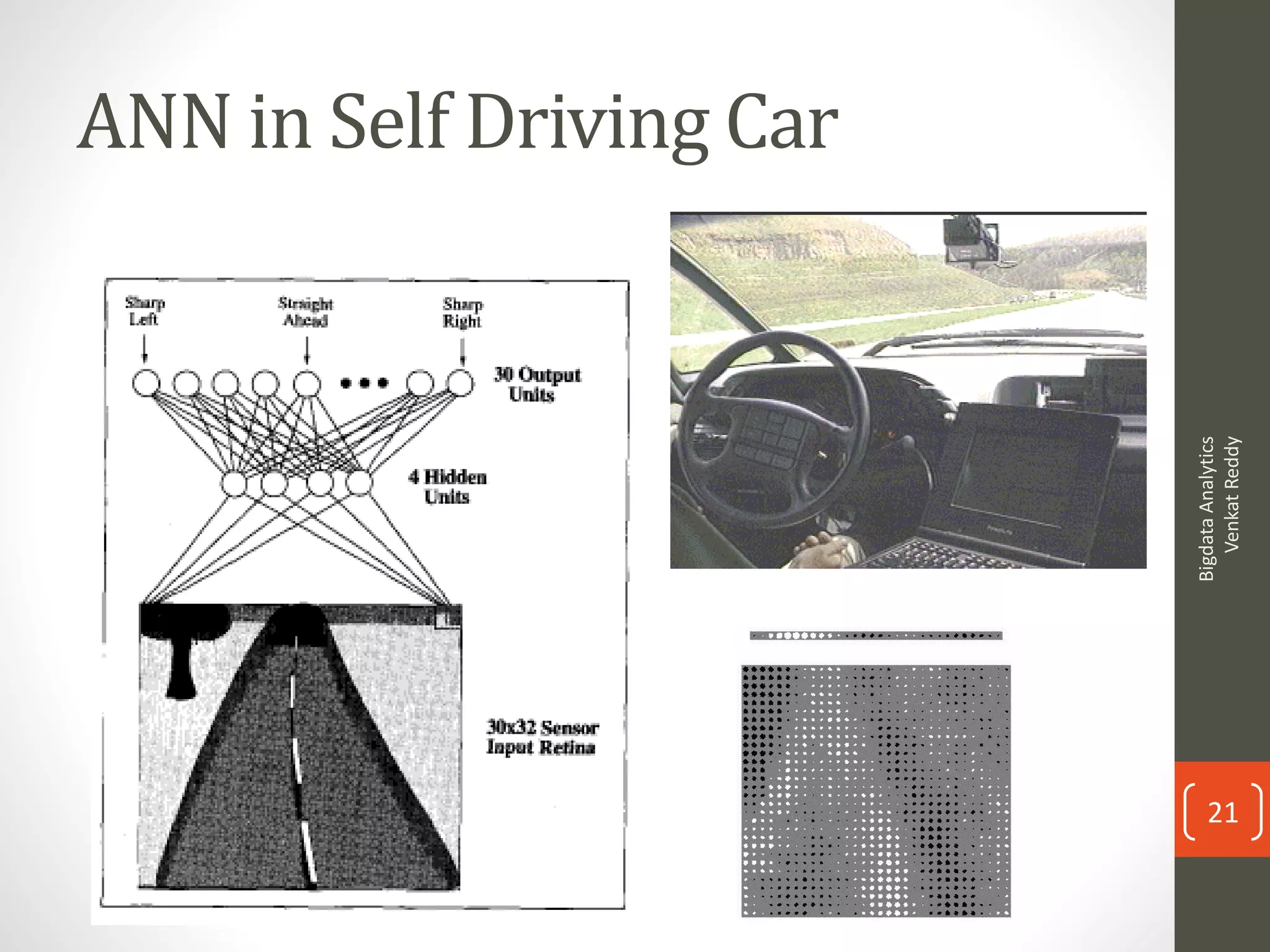
ANN in Self Driving Car
BigdataAnalytics
VenkatReddy
21
PCA and FA
BigdataAnalytics
VenkatReddy
22
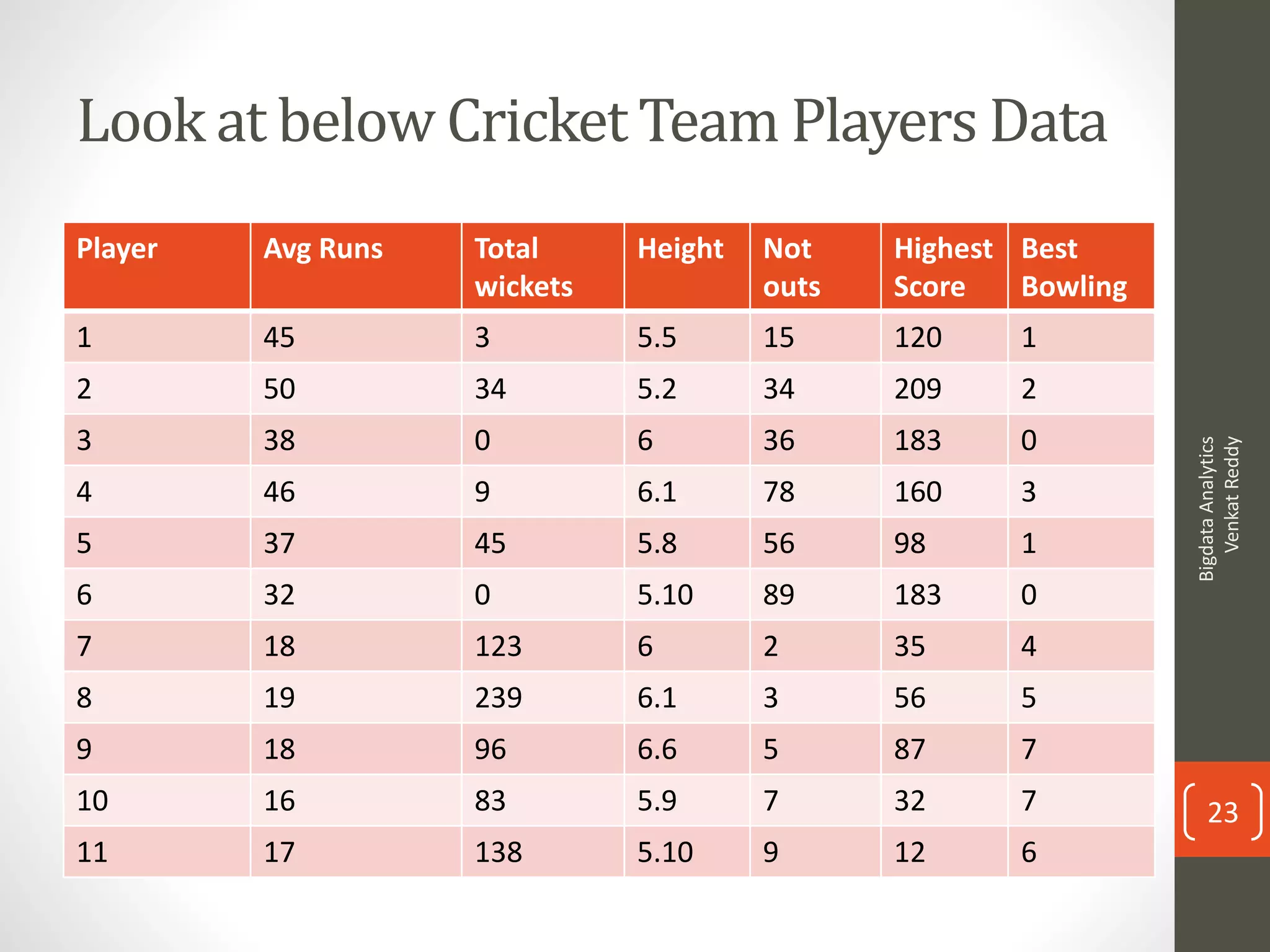
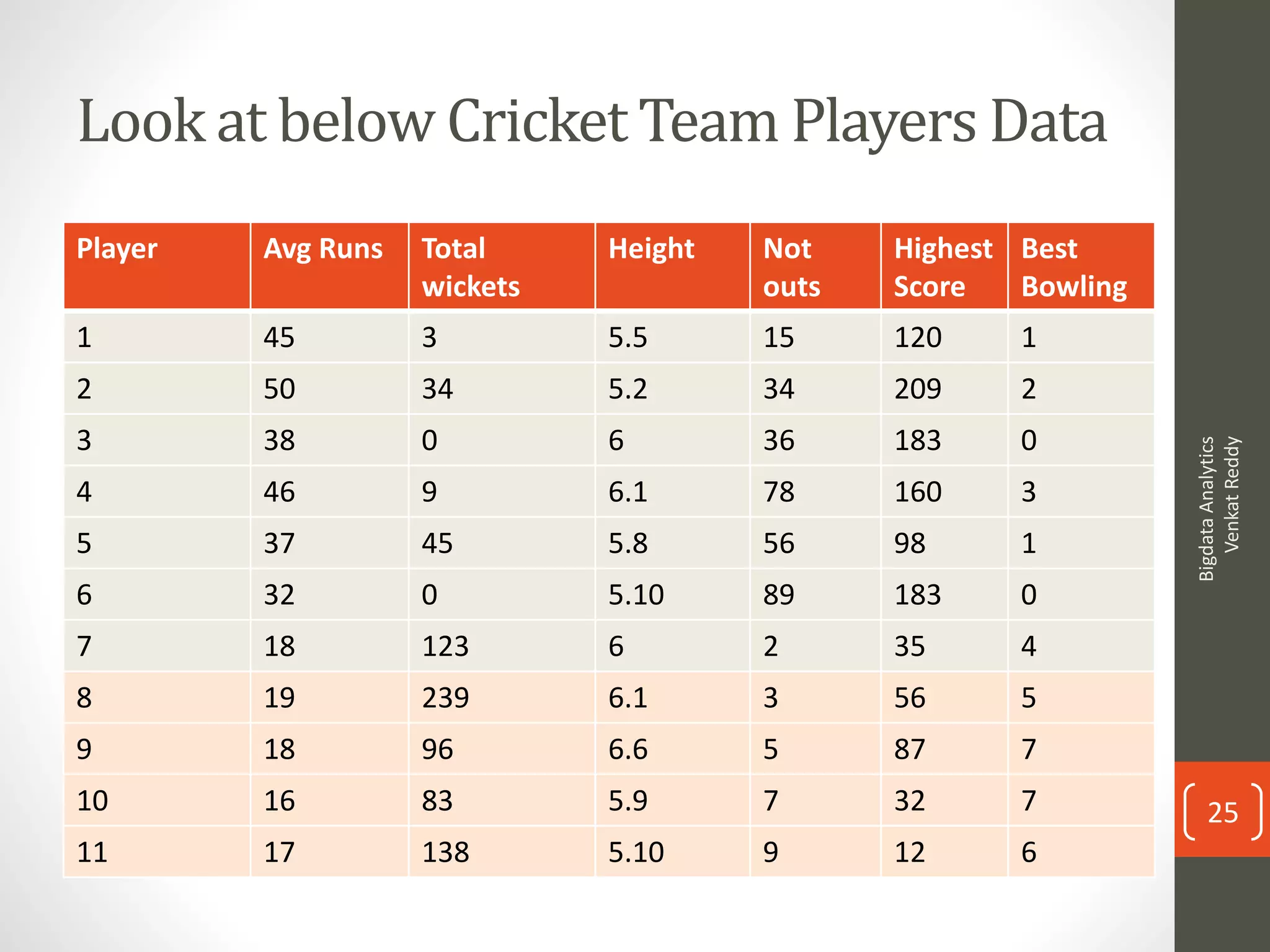
Look at below Cricket Team Players Data
Player Avg Runs Total
wickets
Height Not
outs
Highest
Score
Best
Bowling
1 45 3 5.5 15 120 1
2 50 34 5.2 34 209 2
3 38 0 6 36 183 0
4 46 9 6.1 78 160 3
5 37 45 5.8 56 98 1
6 32 0 5.10 89 183 0
7 18 123 6 2 35 4
8 19 239 6.1 3 56 5
9 18 96 6.6 5 87 7
10 16 83 5.9 7 32 7
11 17 138 5.10 9 12 6
BigdataAnalytics
VenkatReddy
23
Describe the players
• If we have to describe or segregate the players do we really
need Avg Runs, Total wickets, Height, Not outs, Highest Score,
Best bowling?
• Can we simply take
• Avg Runs+ Not outs+ Highest Score as one factor?
• Total wickets+ Height+ Best bowling as second factor?
Defining these imaginary variables or a linear combination of
variables to reduce the dimensions is called PCA or FA
BigdataAnalytics
VenkatReddy
24
Look at below Cricket Team Players Data
Player Avg Runs Total
wickets
Height Not
outs
Highest
Score
Best
Bowling
1 45 3 5.5 15 120 1
2 50 34 5.2 34 209 2
3 38 0 6 36 183 0
4 46 9 6.1 78 160 3
5 37 45 5.8 56 98 1
6 32 0 5.10 89 183 0
7 18 123 6 2 35 4
8 19 239 6.1 3 56 5
9 18 96 6.6 5 87 7
10 16 83 5.9 7 32 7
11 17 138 5.10 9 12 6
BigdataAnalytics
VenkatReddy
25
SVM Classification
BigdataAnalytics
VenkatReddy
26
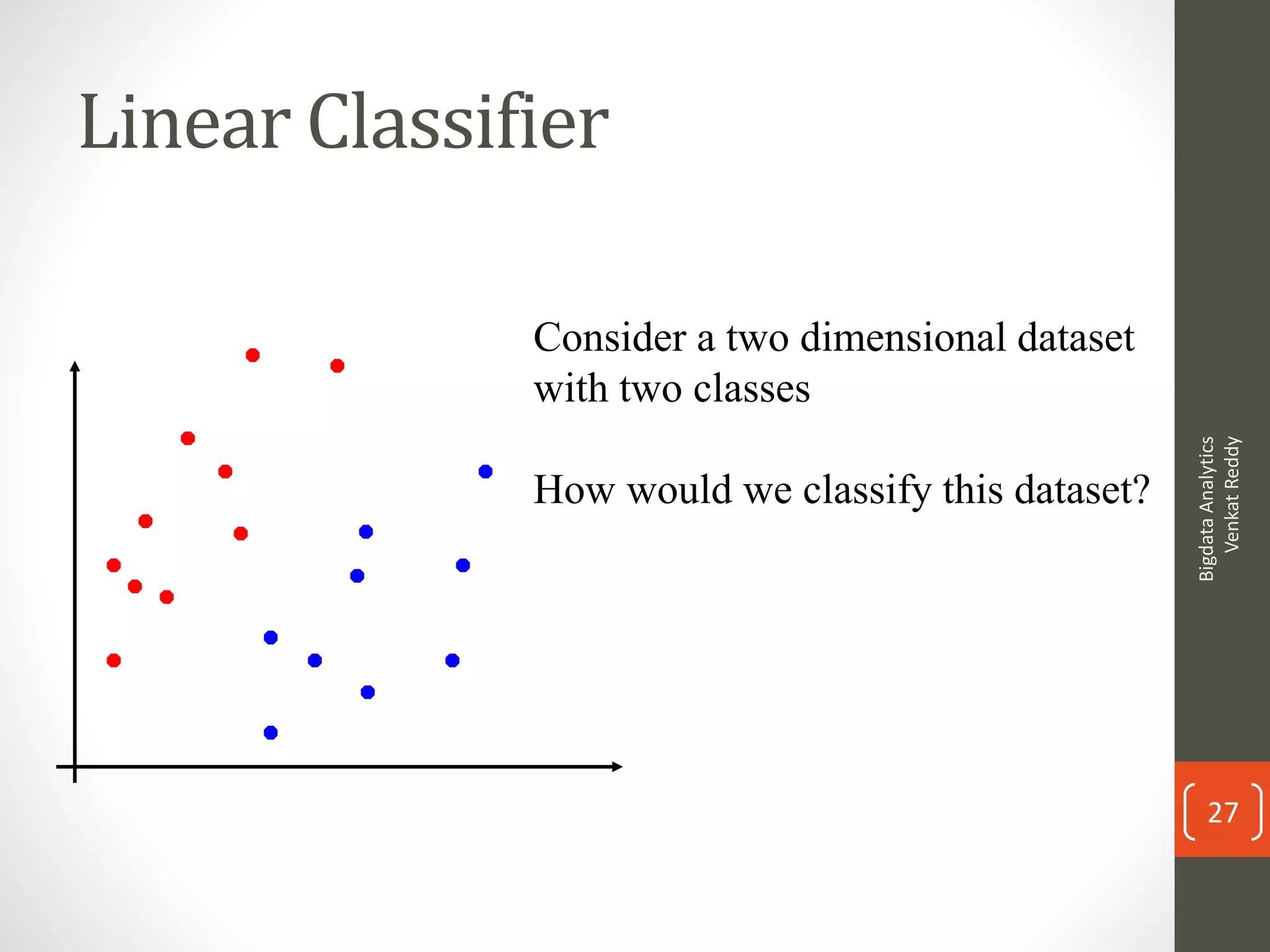
Linear Classifier
Consider a two dimensional dataset
with two classes
How would we classify this dataset?
BigdataAnalytics
VenkatReddy
27
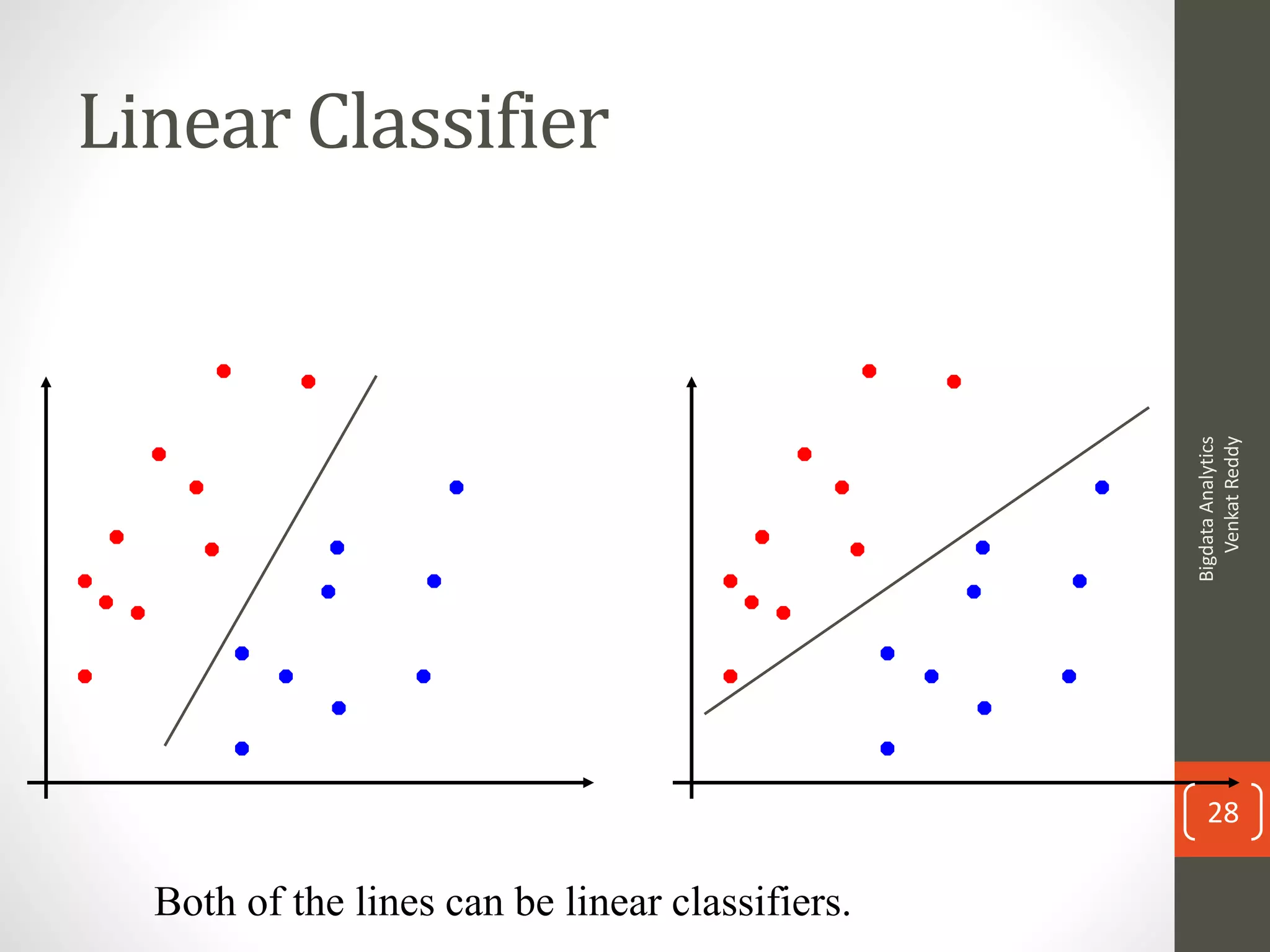
Linear Classifier
Both of the lines can be linear classifiers.
BigdataAnalytics
VenkatReddy
28
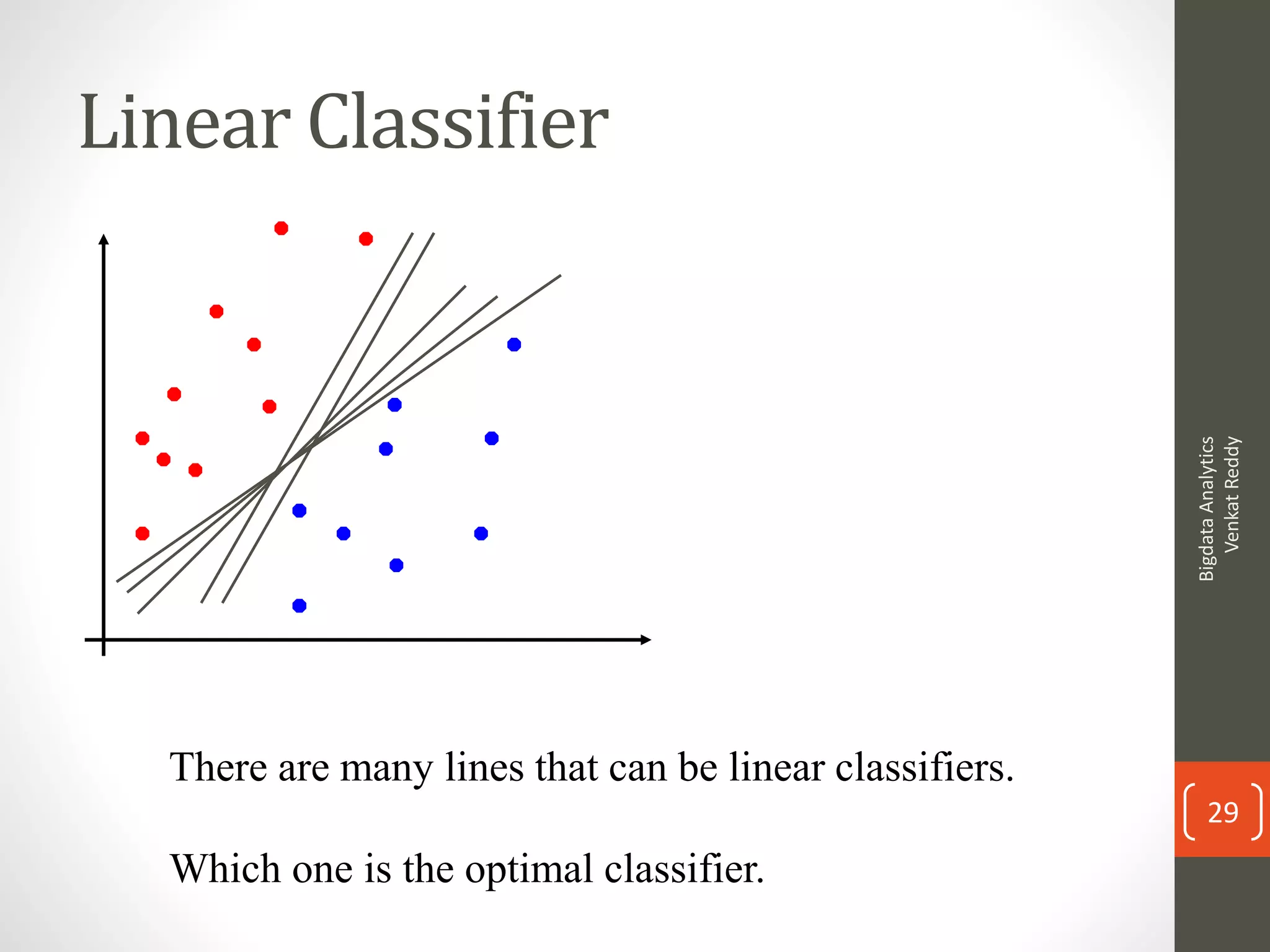
Linear Classifier
There are many lines that can be linear classifiers.
Which one is the optimal classifier.
BigdataAnalytics
VenkatReddy
29
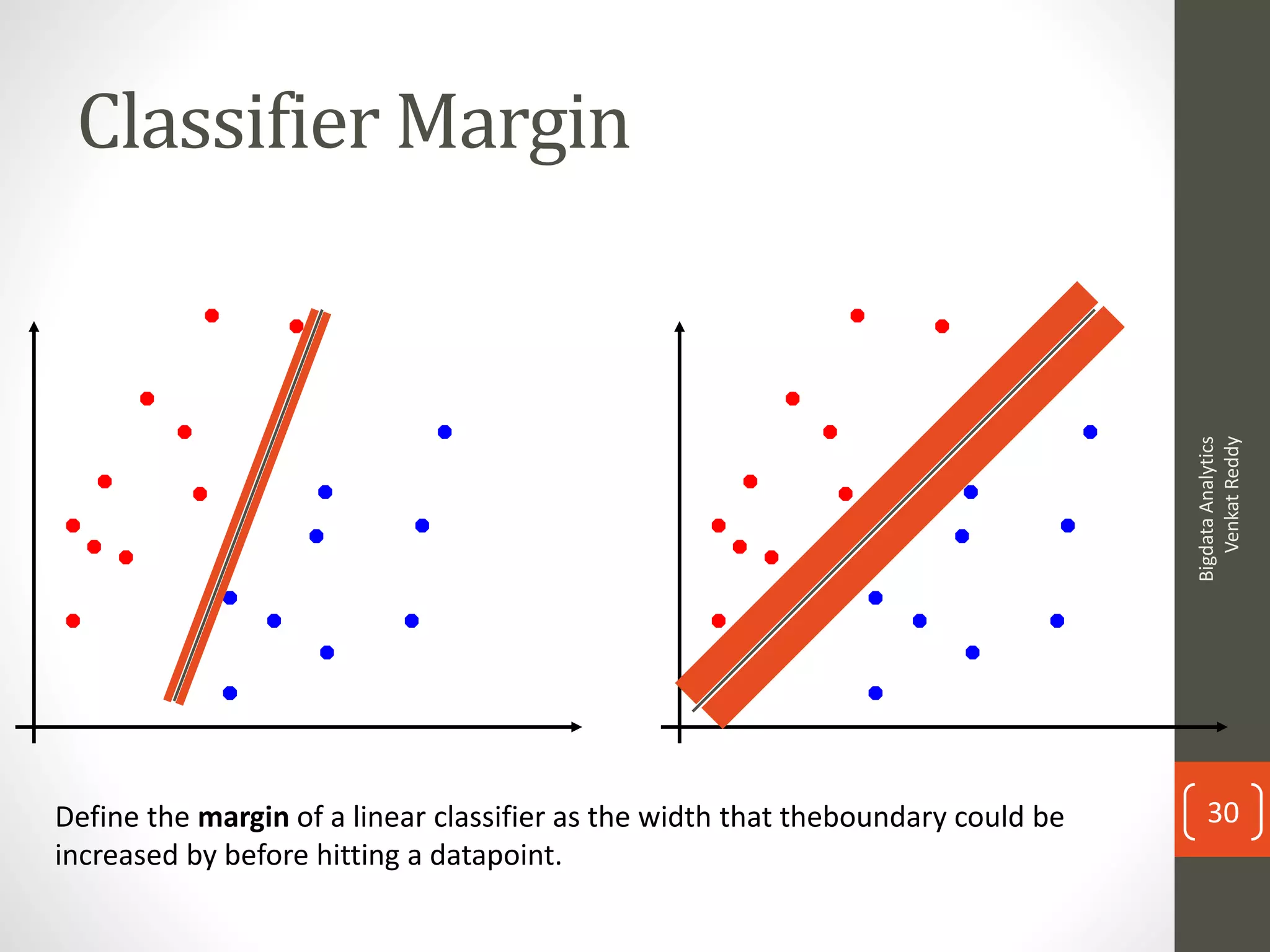
Classifier Margin
Define the margin of a linear classifier as the width that theboundary could be
increased by before hitting a datapoint.
BigdataAnalytics
VenkatReddy
30
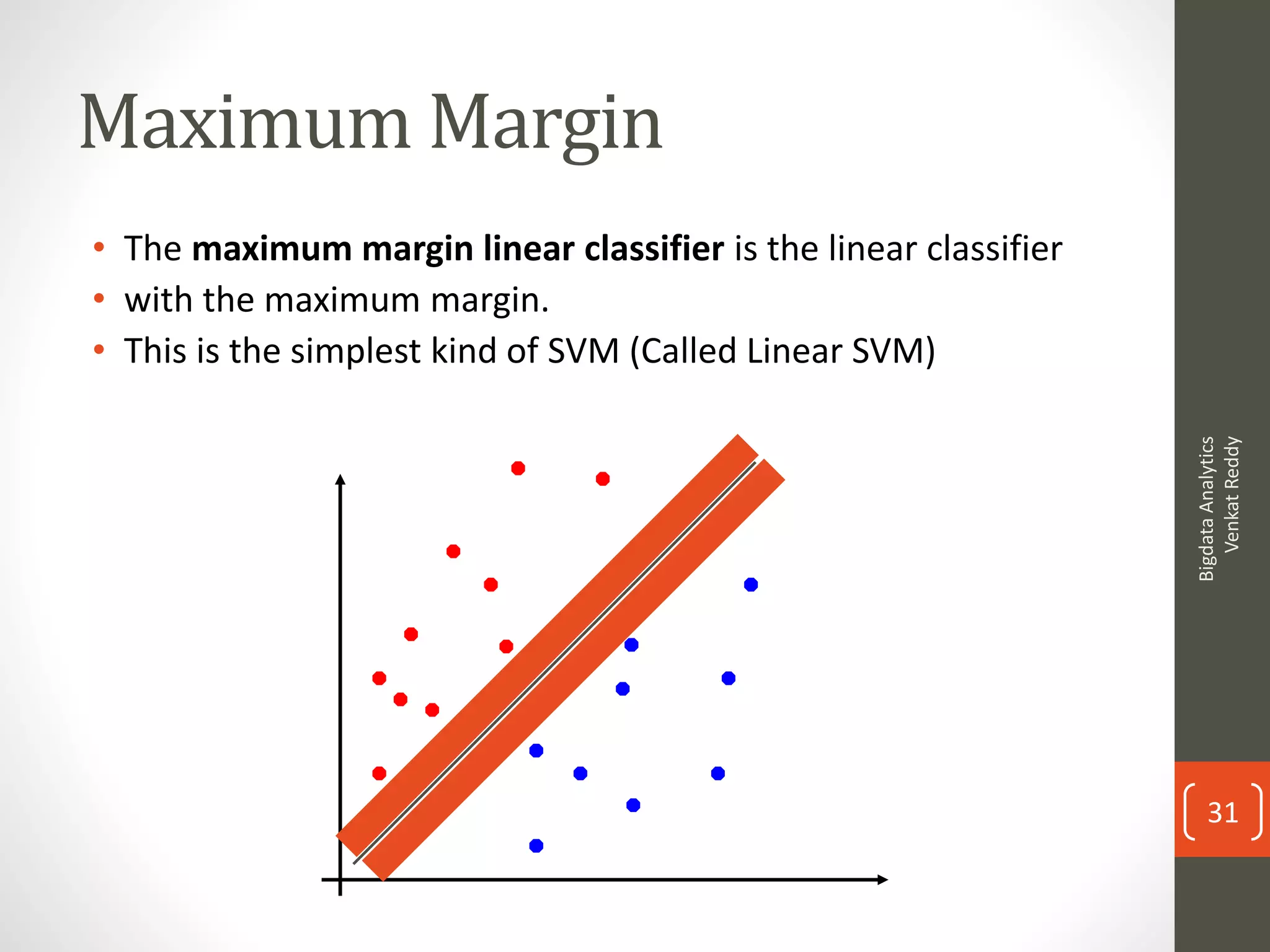
Maximum Margin
• The maximum margin linear classifier is the linear classifier
• with the maximum margin.
• This is the simplest kind of SVM (Called Linear SVM)
BigdataAnalytics
VenkatReddy
31
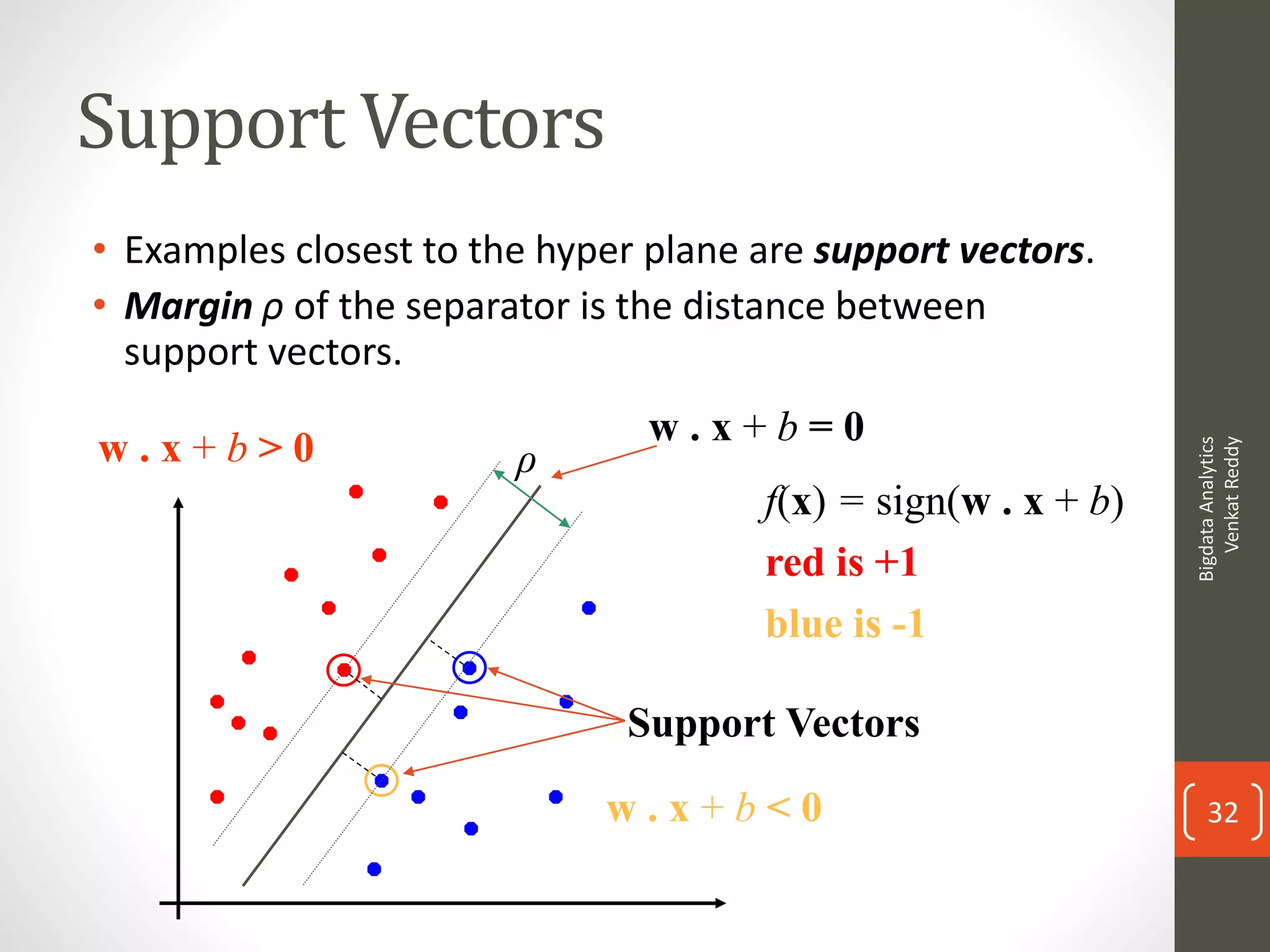
Support Vectors
• Examples closest to the hyper plane are support vectors.
• Margin ρ of the separator is the distance between
support vectors.
ρw . x + b > 0
w . x + b < 0
w . x + b = 0
Support Vectors
f(x) = sign(w . x + b)
red is +1
blue is -1
BigdataAnalytics
VenkatReddy
32
Difference Traditional Models &
Machine Learning
• ML is more heuristic
• Focused on improving performance of a learning agent
• Also looks at real-time self learning and robotics – areas
not part of data mining
• Some algorithms are too heuristic that there is no one
right or wrong answer
• Lets take K-Means example
BigdataAnalytics
VenkatReddy
33
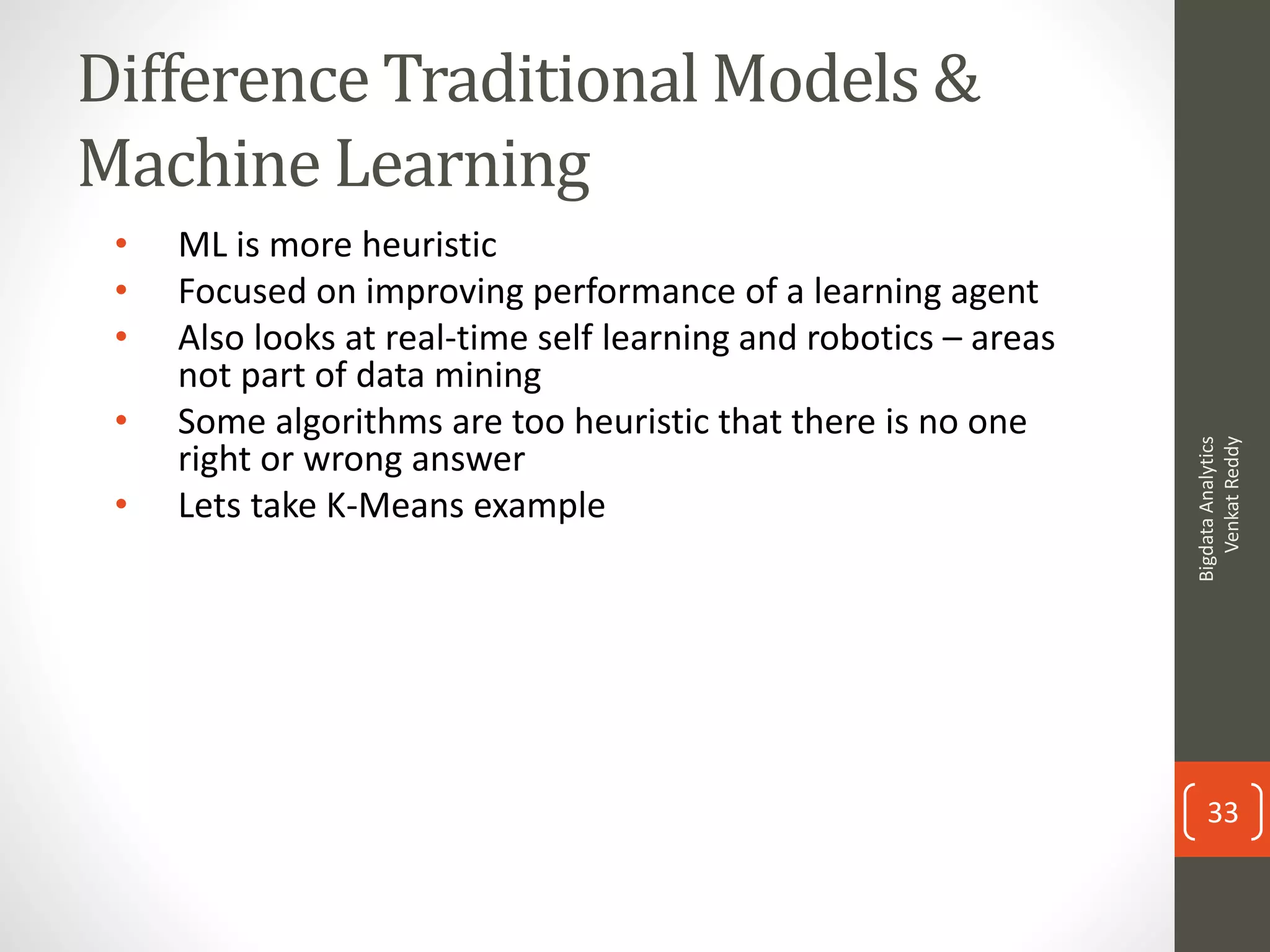
K-Means clustering
Overall population
BigdataAnalytics
VenkatReddy
34
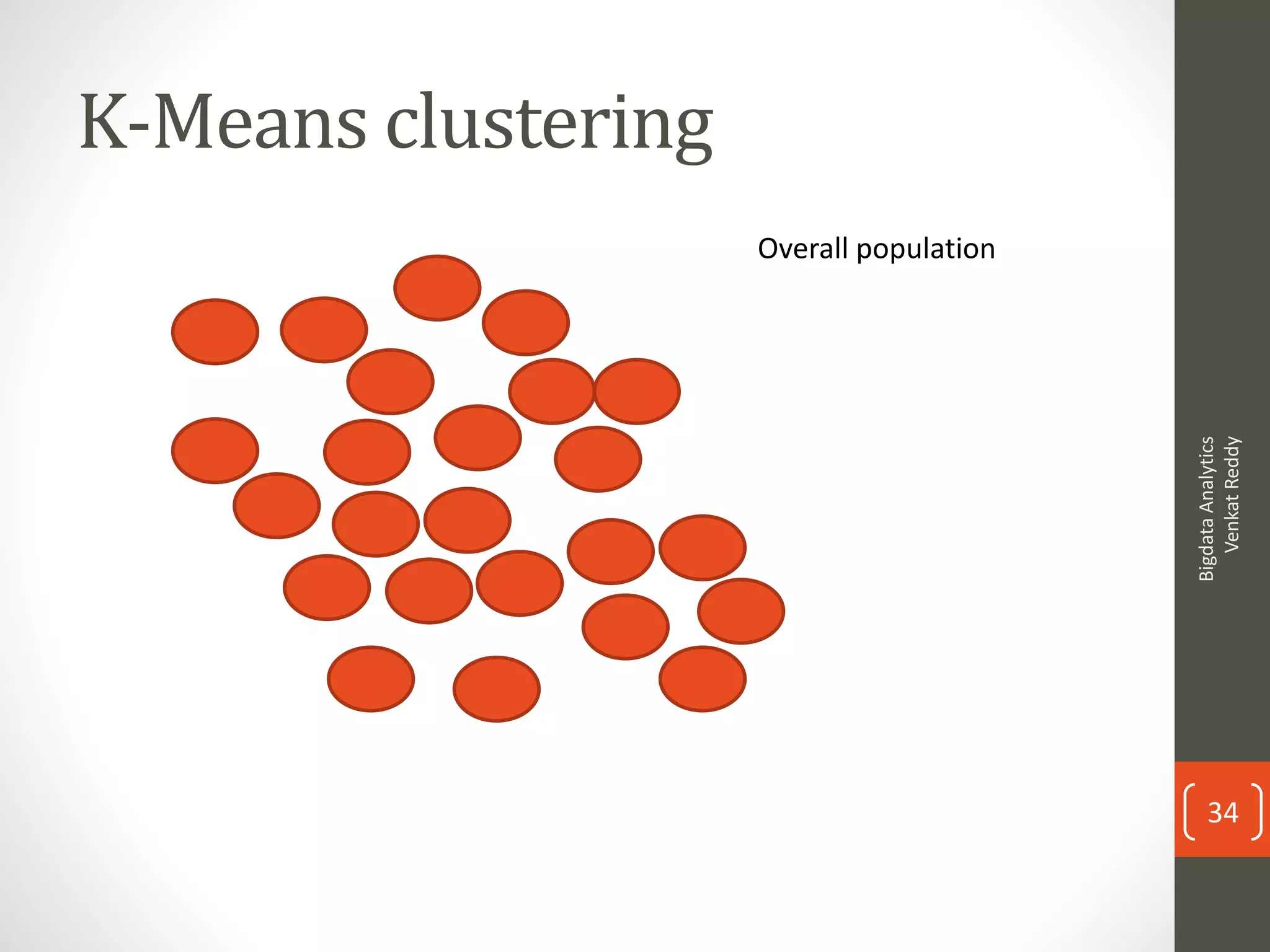
K-Means clustering
Fix the number of clusters
BigdataAnalytics
VenkatReddy
35
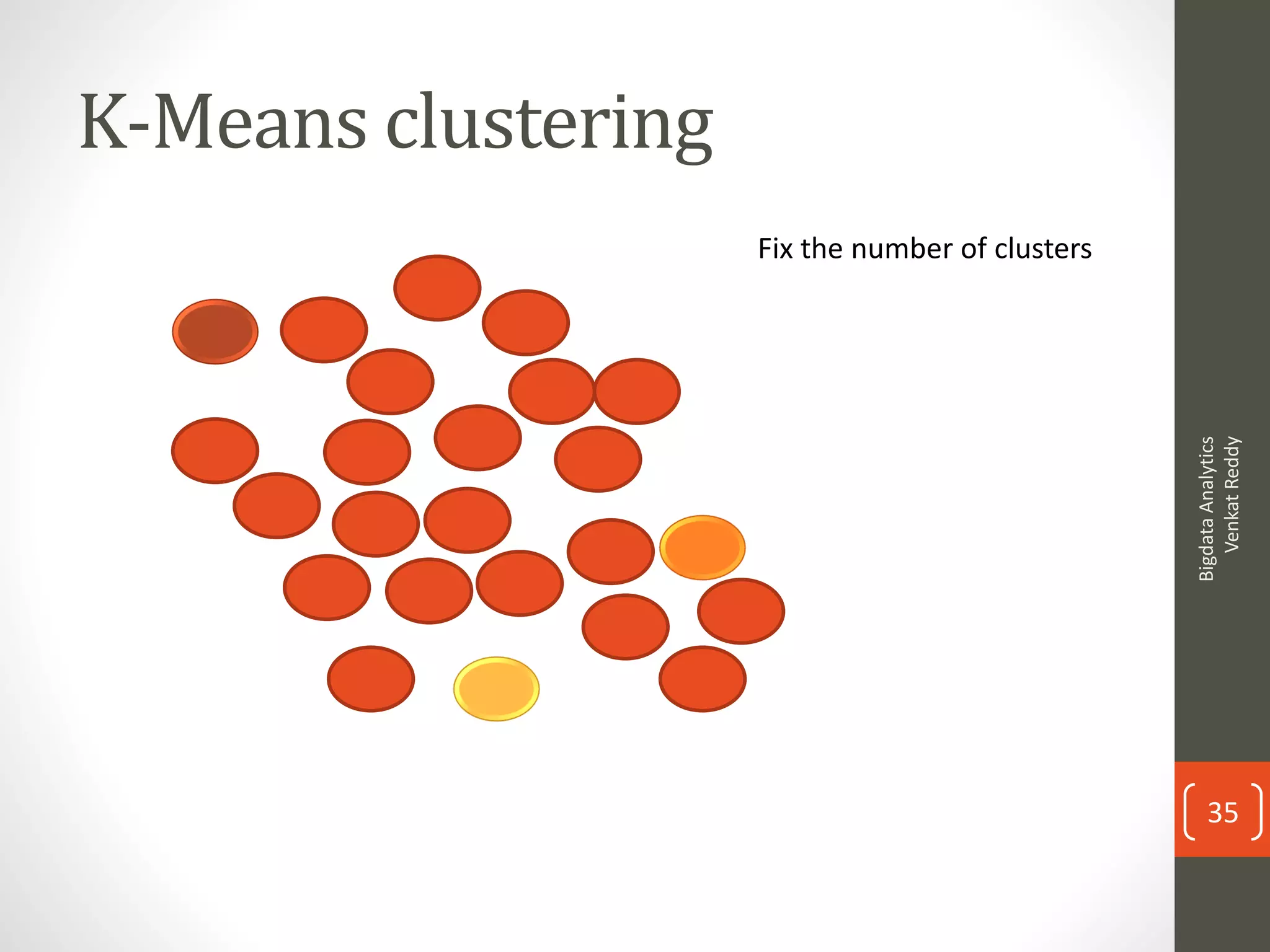
K-Means clustering
Calculate the distance of
each case from all clusters
BigdataAnalytics
VenkatReddy
36
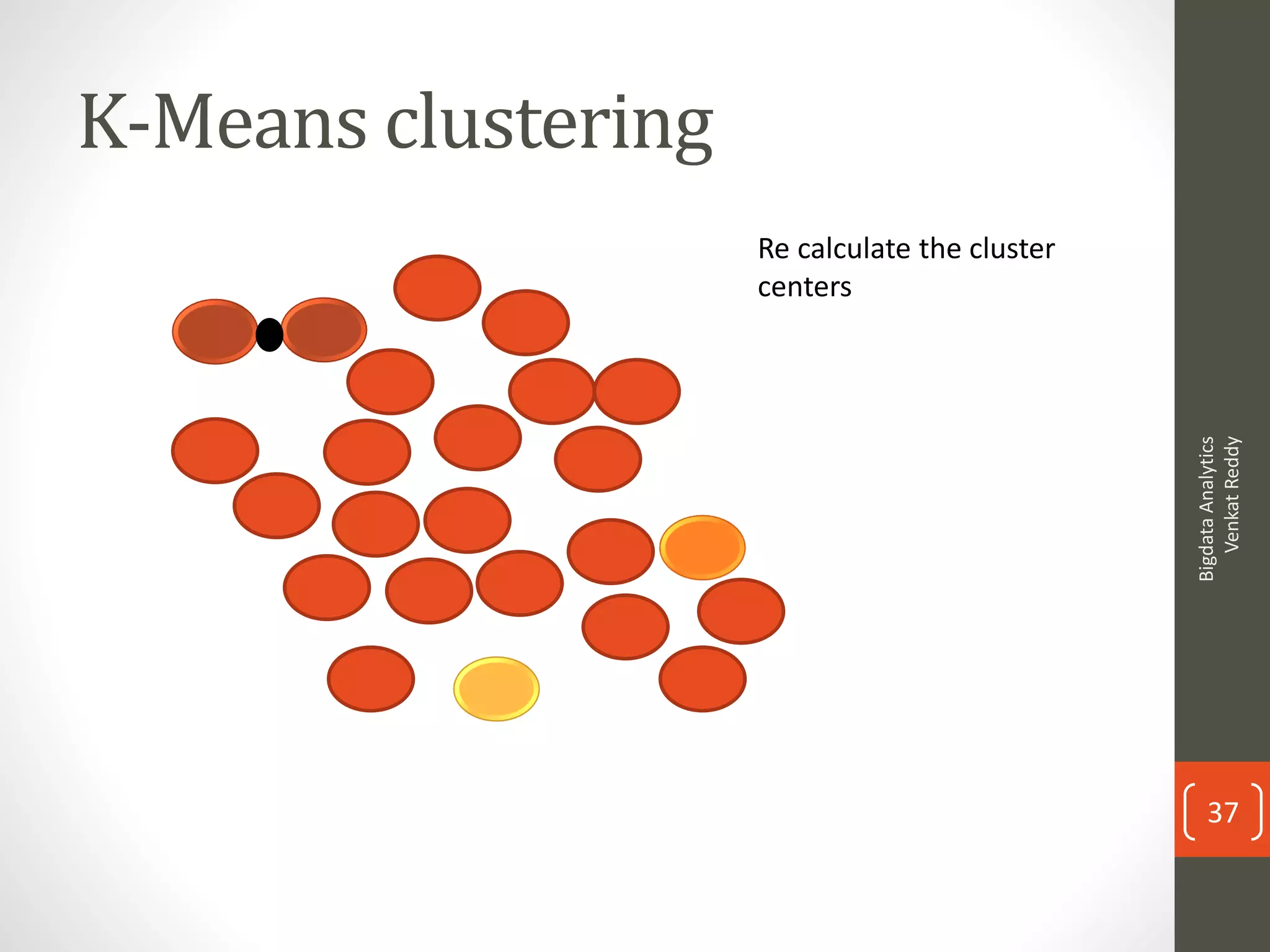
K-Means clustering
Re calculate the cluster
centers
BigdataAnalytics
VenkatReddy
37
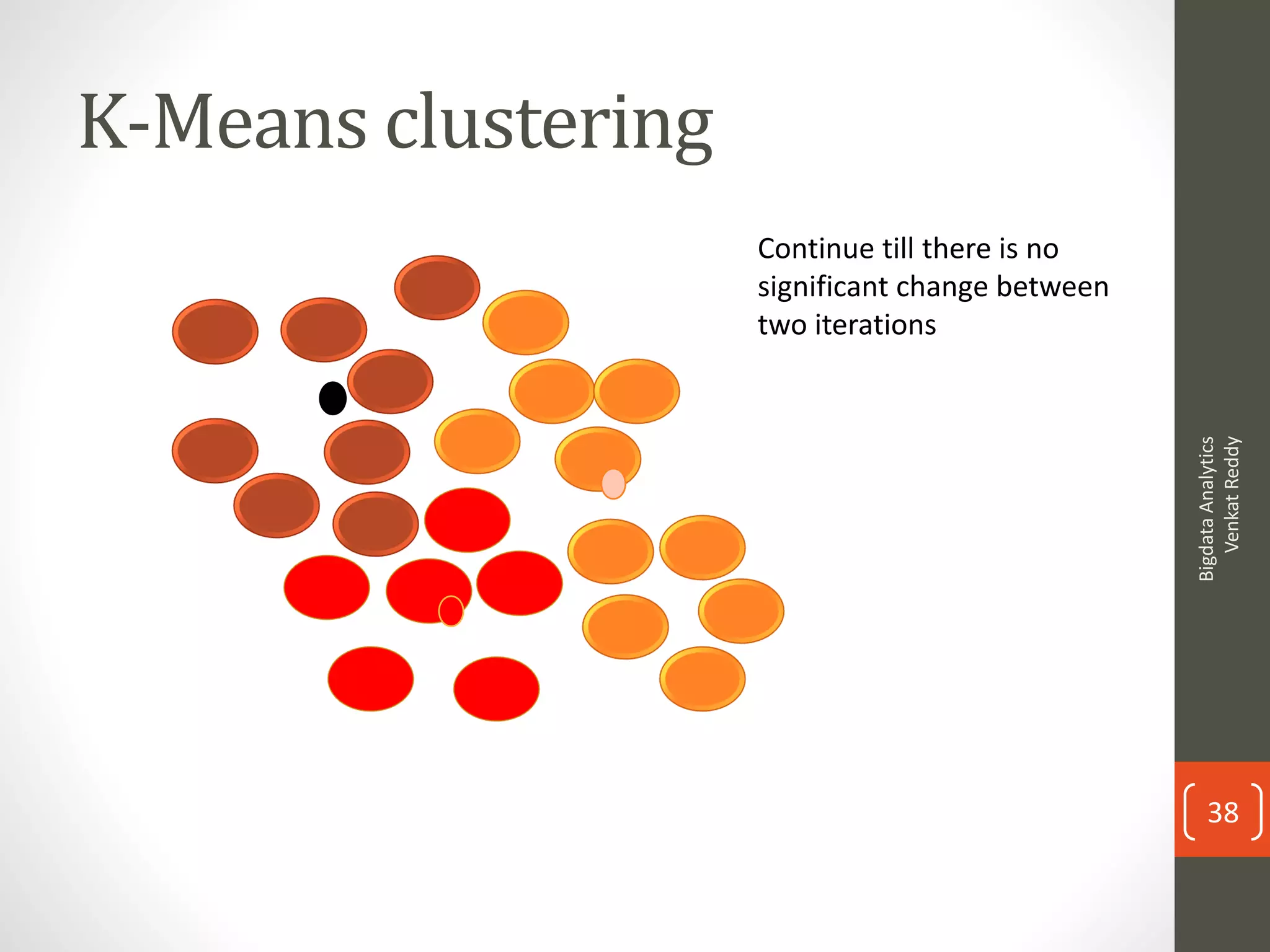
K-Means clustering
Continue till there is no
significant change between
two iterations
BigdataAnalytics
VenkatReddy
38
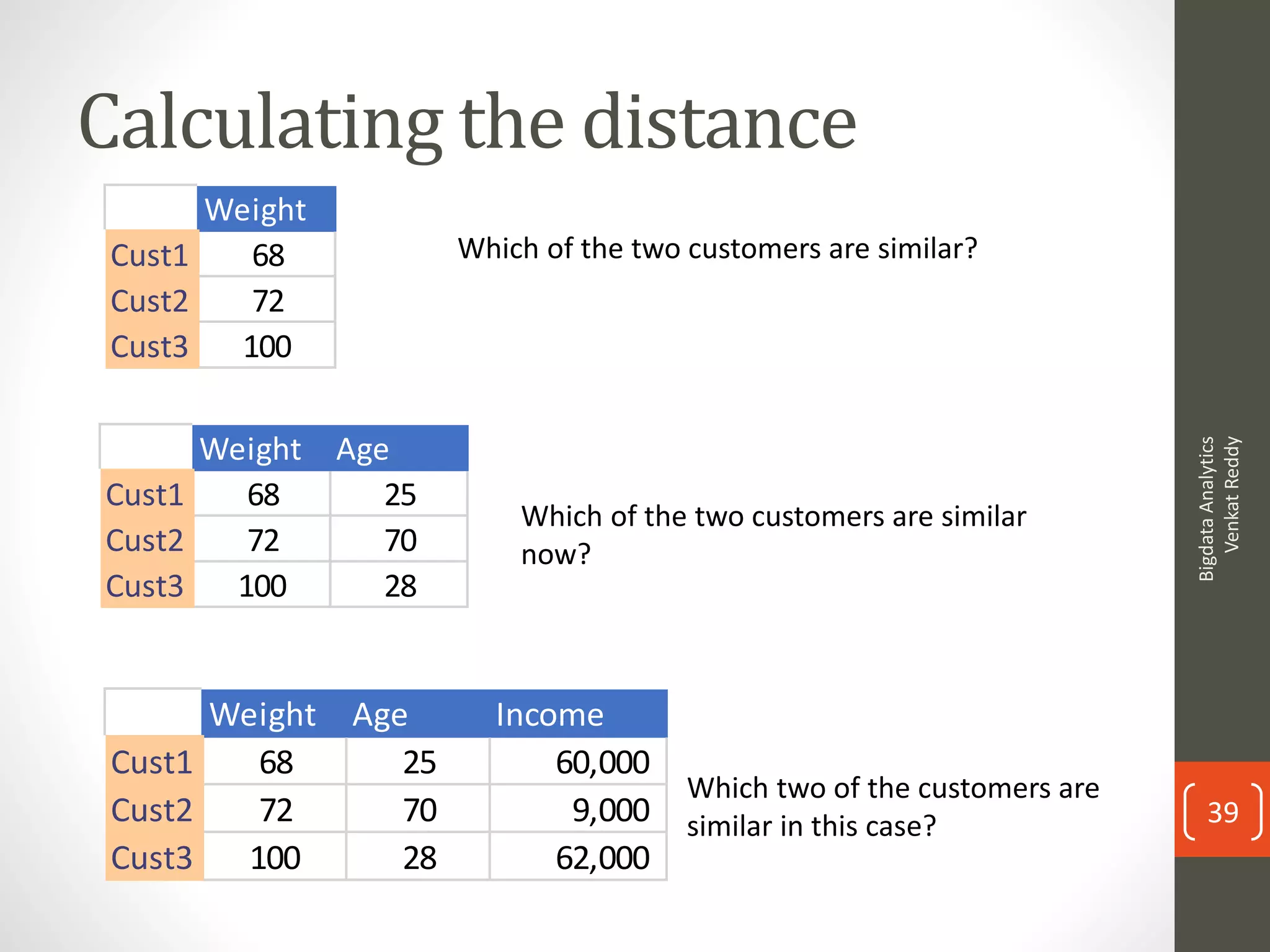
Calculating the distance
Weight
Cust1 68
Cust2 72
Cust3 100
Weight Age
Cust1 68 25
Cust2 72 70
Cust3 100 28
Weight Age Income
Cust1 68 25 60,000
Cust2 72 70 9,000
Cust3 100 28 62,000
Which of the two customers are similar?
Which of the two customers are similar
now?
Which two of the customers are
similar in this case?
BigdataAnalytics
VenkatReddy
39
Distance Measures
• Euclidean distance
• City-block (Manhattan) distance
• Chebychev similarity
• Minkowski distance
• Mahalanobis distance
• Maximum distance
• Cosine similarity
• Simple correlation between observations
• Minimum distance
• Weighted distance
• Venkat Reddy distance
• Not sure all these measures will result in same clusters in the
above example.
• So, same ML algorithms with different results. Generally this is not
the case with conventional methods
BigdataAnalytics
VenkatReddy
40
Thank you
BigdataAnalytics
VenkatReddy
41
More ..
BigdataAnalytics
VenkatReddy
42
http://www.slideshare.net/21_venkat/presentations
https://www.facebook.com/groups/SASanalysts/

Machine Learning for Dummies

  • 1.
  • 2.
  • 3.
    Machine Learning • Howdid our brain process the images? • How did the grouping happen? • Human brain processed the given images - learning • After learning the brain simply looked at the new image and compared with the groups classified the image to the closest group - Classification • If a machine has to perform the same operation we use Machine Learning • We write programs for learning and then classification, this is nothing but machine learning BigdataAnalytics VenkatReddy 3
  • 4.
  • 5.
    Example: Classification usingML • Image processing: • Machine learning can be used in classification Images & objects in an image • Ship • Water • Rock • Iron object • Fiber Object etc., • Does this really help? BigdataAnalytics VenkatReddy 5
  • 6.
  • 7.
  • 8.
    The main advantageof ML • Learning and writing an algorithm • Its easy for human brain but it is tough for a machine. It takes some time and good amount of training data for machine to accurately classify objects • Implementation and automation • This is easy for a machine. Once learnt a machine can process one million images without any fatigue where as human brain can’t • That’s why ML with bigdata is a deadly combination BigdataAnalytics VenkatReddy 8
  • 9.
    Applications of MachineLearning • Banking / Telecom / Retail • Identify: • Prospective customers • Dissatisfied customers • Good customers • Bad payers • Obtain: • More effective advertising • Less credit risk • Fewer fraud • Decreased churn rate BigdataAnalytics VenkatReddy 9
  • 10.
    Applications of MachineLearning • Biomedical / Biometrics • Medicine: • Screening • Diagnosis and prognosis • Drug discovery • Security: • Face recognition • Signature / fingerprint / iris verification • DNA fingerprinting BigdataAnalytics VenkatReddy 10
  • 11.
    Applications of MachineLearning • Computer / Internet • Computer interfaces: • Troubleshooting wizards • Handwriting and speech • Brain waves • Internet • Hit ranking • Spam filtering • Text categorization • Text translation • Recommendation BigdataAnalytics VenkatReddy 11
  • 12.
    Main Parts inMachine Learning process • Any Machine Learning algorithm has three parts 1. The Output 2. The Objective Function or Performance Matrix 3. The Input Email Spam Classification • The Output: Categorize email messages as spam or legitimate. • Objective Function: Percentage of email messages correctly classified. • The Input: Database of emails, some with human-given labels Hand Writing Recognition • The Output: Recognizing hand-written words • Objective Function: Percentage of words correctly classified • The Input: Database of human-labeled images of handwritten words BigdataAnalytics VenkatReddy 12
  • 13.
  • 14.
    Everything should bemade as simple as possible, but no simpler BigdataAnalytics VenkatReddy 14
  • 15.
  • 16.
    The Bayes Method A(2%)B(90%) C(8%) 1% 60% 2% • A, B, C Generate bolts, given a machine what is the probability that it will generate a defective bolt. • Now given a defective bolt, can we tell which machine has generated it? BigdataAnalytics VenkatReddy 16
  • 17.
    Several Machine inSeveral Layers • Several intermediate machines • Each has its on error chance, This problem requires a Bayesian network to solve • Does C has anything to do if the bolt is finally coming out of F? A(20%) B(50%) C(30%) 1% 5% 2% D(60%) E(40%) F G H BigdataAnalytics VenkatReddy 17
  • 18.
  • 19.
    The Philosophy ofNeural Network • If we have to predict whether we win in a chess game • Can we use logistic regression? • Since there can be almost infinite number of intermediate steps its almost impossible to predict the probability of winning • If each move is considered as an input variable then there are almost (countable)infinite moves. A coefficient for each of them is always negligible. Neural network uses a simple technique, instead of predicting the final output they predict the intermediate output that lead to a win previously, this will be an input for predicting the next move BigdataAnalytics VenkatReddy 19
  • 20.
    Biological Motivation forNN • Aartificial neural networks are built out of a densely interconnected set of simple units, where each unit takes a number of real-valued inputs (possibly the outputs of other units) and produces a single real-valued output (which may become the input to many other units). • The human brain is estimated to contain a densely interconnected network of approximately 1011 neurons, each connected, on average, to 104 others. • Neuron activity is typically inhibited through connections to other neurons. BigdataAnalytics VenkatReddy 20
  • 21.
    ANN in SelfDriving Car BigdataAnalytics VenkatReddy 21
  • 22.
  • 23.
    Look at belowCricket Team Players Data Player Avg Runs Total wickets Height Not outs Highest Score Best Bowling 1 45 3 5.5 15 120 1 2 50 34 5.2 34 209 2 3 38 0 6 36 183 0 4 46 9 6.1 78 160 3 5 37 45 5.8 56 98 1 6 32 0 5.10 89 183 0 7 18 123 6 2 35 4 8 19 239 6.1 3 56 5 9 18 96 6.6 5 87 7 10 16 83 5.9 7 32 7 11 17 138 5.10 9 12 6 BigdataAnalytics VenkatReddy 23
  • 24.
    Describe the players •If we have to describe or segregate the players do we really need Avg Runs, Total wickets, Height, Not outs, Highest Score, Best bowling? • Can we simply take • Avg Runs+ Not outs+ Highest Score as one factor? • Total wickets+ Height+ Best bowling as second factor? Defining these imaginary variables or a linear combination of variables to reduce the dimensions is called PCA or FA BigdataAnalytics VenkatReddy 24
  • 25.
    Look at belowCricket Team Players Data Player Avg Runs Total wickets Height Not outs Highest Score Best Bowling 1 45 3 5.5 15 120 1 2 50 34 5.2 34 209 2 3 38 0 6 36 183 0 4 46 9 6.1 78 160 3 5 37 45 5.8 56 98 1 6 32 0 5.10 89 183 0 7 18 123 6 2 35 4 8 19 239 6.1 3 56 5 9 18 96 6.6 5 87 7 10 16 83 5.9 7 32 7 11 17 138 5.10 9 12 6 BigdataAnalytics VenkatReddy 25
  • 26.
  • 27.
    Linear Classifier Consider atwo dimensional dataset with two classes How would we classify this dataset? BigdataAnalytics VenkatReddy 27
  • 28.
    Linear Classifier Both ofthe lines can be linear classifiers. BigdataAnalytics VenkatReddy 28
  • 29.
    Linear Classifier There aremany lines that can be linear classifiers. Which one is the optimal classifier. BigdataAnalytics VenkatReddy 29
  • 30.
    Classifier Margin Define themargin of a linear classifier as the width that theboundary could be increased by before hitting a datapoint. BigdataAnalytics VenkatReddy 30
  • 31.
    Maximum Margin • Themaximum margin linear classifier is the linear classifier • with the maximum margin. • This is the simplest kind of SVM (Called Linear SVM) BigdataAnalytics VenkatReddy 31
  • 32.
    Support Vectors • Examplesclosest to the hyper plane are support vectors. • Margin ρ of the separator is the distance between support vectors. ρw . x + b > 0 w . x + b < 0 w . x + b = 0 Support Vectors f(x) = sign(w . x + b) red is +1 blue is -1 BigdataAnalytics VenkatReddy 32
  • 33.
    Difference Traditional Models& Machine Learning • ML is more heuristic • Focused on improving performance of a learning agent • Also looks at real-time self learning and robotics – areas not part of data mining • Some algorithms are too heuristic that there is no one right or wrong answer • Lets take K-Means example BigdataAnalytics VenkatReddy 33
  • 34.
  • 35.
    K-Means clustering Fix thenumber of clusters BigdataAnalytics VenkatReddy 35
  • 36.
    K-Means clustering Calculate thedistance of each case from all clusters BigdataAnalytics VenkatReddy 36
  • 37.
    K-Means clustering Re calculatethe cluster centers BigdataAnalytics VenkatReddy 37
  • 38.
    K-Means clustering Continue tillthere is no significant change between two iterations BigdataAnalytics VenkatReddy 38
  • 39.
    Calculating the distance Weight Cust168 Cust2 72 Cust3 100 Weight Age Cust1 68 25 Cust2 72 70 Cust3 100 28 Weight Age Income Cust1 68 25 60,000 Cust2 72 70 9,000 Cust3 100 28 62,000 Which of the two customers are similar? Which of the two customers are similar now? Which two of the customers are similar in this case? BigdataAnalytics VenkatReddy 39
  • 40.
    Distance Measures • Euclideandistance • City-block (Manhattan) distance • Chebychev similarity • Minkowski distance • Mahalanobis distance • Maximum distance • Cosine similarity • Simple correlation between observations • Minimum distance • Weighted distance • Venkat Reddy distance • Not sure all these measures will result in same clusters in the above example. • So, same ML algorithms with different results. Generally this is not the case with conventional methods BigdataAnalytics VenkatReddy 40
  • 41.
  • 42.