Assessment of Peripheral and Central Auditory Function February 11, 2004 Steven T. Wright, M.D. Arun K. Gadre, M.D.
Auditory Function Complex auditory pathway Peripheral Auditory Assessment Basic armament of the otolaryngologist Central Auditory Assessment Relatively new interest Multidisciplinary
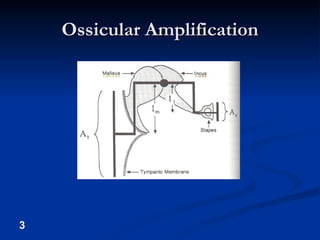
Ossicular Amplification
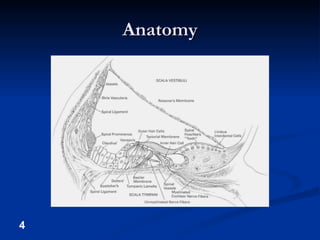
Anatomy
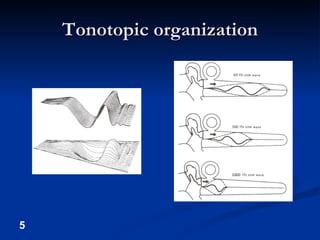
Tonotopic organization
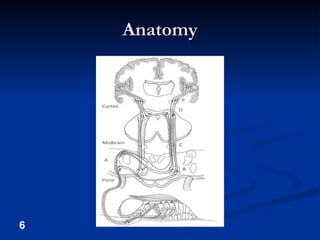
Anatomy
Peripheral Auditory Assessment Pure Tone Audiometry Speech Audiometry Acoustic Immittance Auditory Brainstem Responses Electrocochleography Otoacoustic Emissions
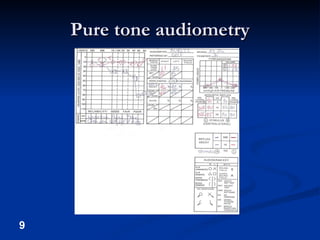
Pure Tone Audiometry Most common  Pure tones (sinusoids) are tonotopically maintained by the cochlea. Air conduction testing Octave frequencies Interoctave frequencies Bone conduction testing
Pure tone audiometry
Decibel Scale Audiologic units dB SPL: sound pressure level dB HL: hearing level dB SL: sensation level Audiometric 0 dB=  10 log 10
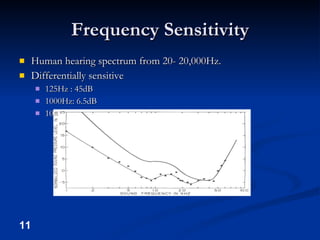
Frequency Sensitivity Human hearing spectrum from 20- 20,000Hz. Differentially sensitive 125Hz : 45dB 1000Hz: 6.5dB 10,000Hz: 20dB
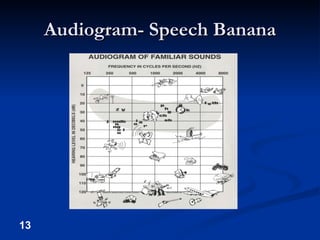
Audiogram Levels Normal 0 - 20dB  Mild 20 - 40dB Moderate 40 – 60dB Severe > 60 dB
Audiogram- Speech Banana
Crossover Audiometric results are only valid when the results are actually of the test ear. Interaural attenuation reflects crossover. Air conduction from 40-80dB Bone conduction even at 0dB
Masking The audiometric technique used to eliminate responses by the non-test ear. An appropriate noise is presented to the non-test ear while the test ear is being tested. Masking level must exceed the non-test ear threshold, but not create crossover.
Speech Audiometry Determines how well a person hears and understands speech. Spondee words SRT SRT should be in close correlation with PTA.
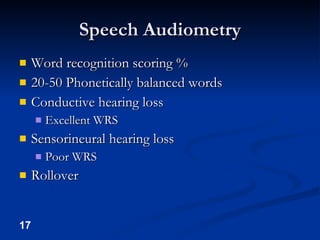
Speech Audiometry Word recognition scoring % 20-50 Phonetically balanced words Conductive hearing loss Excellent WRS Sensorineural hearing loss Poor WRS Rollover
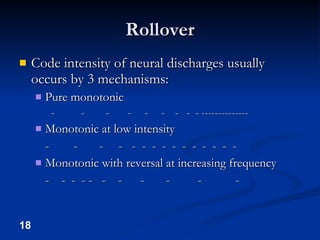
Rollover Code intensity of neural discharges usually occurs by 3 mechanisms: Pure monotonic -  -  -  -  -  -  -  -  - -------------- Monotonic at low intensity -  -  -  -  -  -  -  -  -  -  -  -  -  -  - Monotonic with reversal at increasing frequency -  -  -  - -  -  -  -  -  -  -
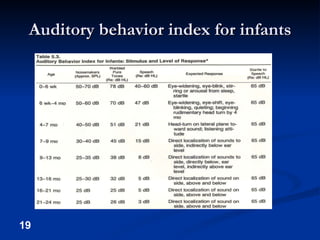
Auditory behavior index for infants
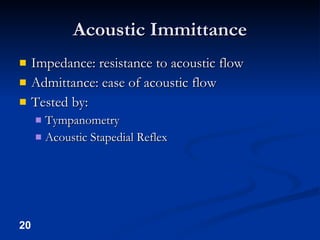
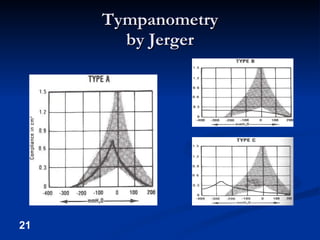
Acoustic Immittance Impedance: resistance to acoustic flow Admittance: ease of acoustic flow Tested by: Tympanometry Acoustic Stapedial Reflex
Tympanometry by Jerger
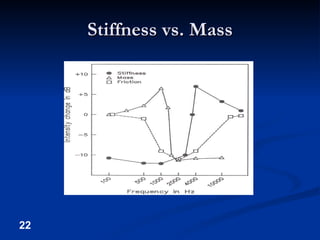
Stiffness vs. Mass
Acoustic Stapedial Reflex Lowest intensity required to elicit a stapedial muscle contraction. 3 primary acoustic reflex characteristics Presence or absence of the reflex Reflex threshold Reflex Decay
Acoustic Reflex Decay Measures the ability of the stapedius muscle to maintain sustained contraction. Lower frequency tone/noise for 10 seconds
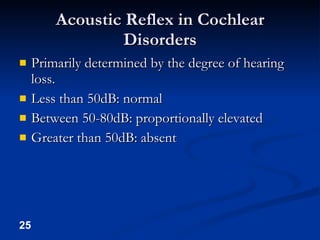
Acoustic Reflex in Cochlear Disorders Primarily determined by the degree of hearing loss. Less than 50dB: normal Between 50-80dB: proportionally elevated Greater than 50dB: absent
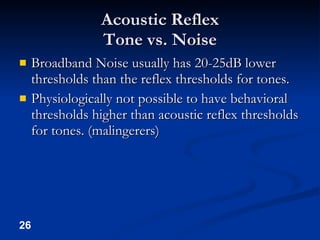
Acoustic Reflex Tone vs. Noise Broadband Noise usually has 20-25dB lower thresholds than the reflex thresholds for tones. Physiologically not possible to have behavioral thresholds higher than acoustic reflex thresholds for tones. (malingerers)
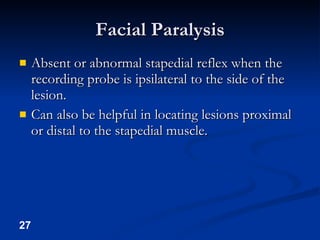
Facial Paralysis Absent or abnormal stapedial reflex when the recording probe is ipsilateral to the side of the lesion. Can also be helpful in locating lesions proximal or distal to the stapedial muscle.
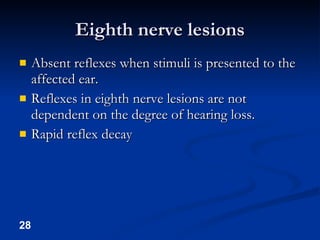
Eighth nerve lesions Absent reflexes when stimuli is presented to the affected ear. Reflexes in eighth nerve lesions are not dependent on the degree of hearing loss. Rapid reflex decay
Auditory Brainstem Responses Impulses that are generated by the auditory neural pathway that can be recorded on the scalp. Not a direct measure of hearing. Detected as early as 25wks gestation. Not affected by sleep, sedation, or attention.
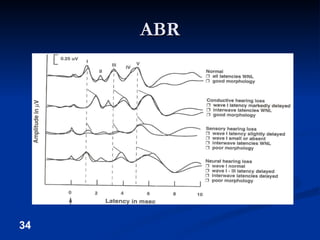
Click or Transient Evoked ABR Most widely used Moderate intensity levels with resultant firing of a wide range of neural frequency units. Repeatable Wave V to within 10dB of behavioral responses. Limited by frequency specificity
Tone Burst ABR More accurate results than click-evoked ABR Increased latency periods than click-evoked.
Bone Conduction ABR As reliable and repeatable as air conduction ABR. Particularly useful in structural abnormalities Canal Atresia or stenosis
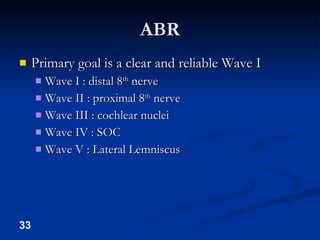
ABR Primary goal is a clear and reliable Wave I Wave I : distal 8 th  nerve Wave II : proximal 8 th  nerve Wave III : cochlear nuclei Wave IV : SOC Wave V : Lateral Lemniscus
ABR
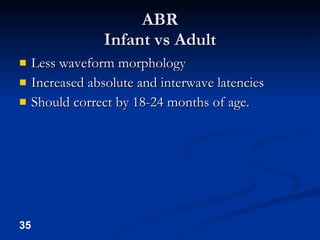
ABR Infant vs Adult Less waveform morphology Increased absolute and interwave latencies Should correct by 18-24 months of age.
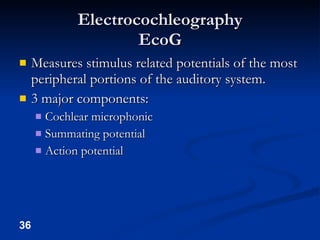
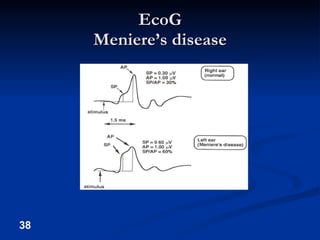
Electrocochleography EcoG Measures stimulus related potentials of the most peripheral portions of the auditory system. 3 major components: Cochlear microphonic Summating potential Action potential
EcoG Electrode placement Noninvasive Ear canal >50% Tympanic membrane >40% Invasive Transtympanic >30%
EcoG Meniere’s disease
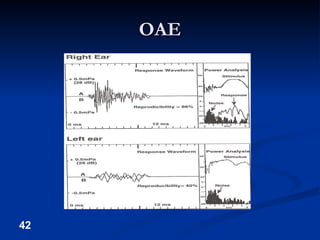
Otoacoustic Emissions Low energy sounds produced by the cochlear outer hair cells. Cochlear amplification. Spontaneous emissions Not present in greater than 25dB hearing loss. Evoked Emissions Transient evoked Distorted Product
TEOAE Transient stimuli, clicks, evoke emissions from a large portion of the cochlea. Generally present when hearing thresholds are below 35dB. Advantages Reliable separate normal from abnormal at 20-30dB Fast Disadvantages Poor at higher frequencies
DPOAE DP are additional tones that are created when two tones are presented.  f1 and f2 DP occurs at 2(f1-f2) by a nonlinear process. Generally present when hearing thresholds are below 50dB. Advantage is higher frequency (6000Hz)
OAE
OAE and middle ear pathology Transmission properties of the middle ear directly influence the OAE characteristics. Otitis media Newborns Tympanic membrane perforations
Central Auditory Processing No accepted definition of CAP. Task Force on CAP consensus and development Sound localization Auditory discrimination Auditory pattern recognition Temporal aspects of audition Auditory performance decrements with competing and degraded acoustic signals.
CAPD Categories Decoding Tolerance Fading Memory Integration Organization
Buffalo Model Takes into account the classification of CAPD as well as speech and language evaluation and academic characteristics. CAP battery Staggered Spondaic Word (SSW) test Phonemic Synthesis (PS) test Speech-in-Noise (SN) test Masking Level Difference (MLD) test
Decoding Category Most common (50%) Breakdown of auditory processing at the phonemic level. Difficulty reading and speaking & Articulation Errors “r” & “l” Posterior temporal lobe
Decoding category Management strategies center on improving phonemic and metaphonemical skills. Hooked on Phonics and Phonemic Synthesis Skills program Clear and concise instructions Outlining objectives Written instructions
Tolerance-fading memory category Second most common (20%) Poor auditory memory and difficulty understanding speech in adverse conditions. Deficits in expressive language and writing. Impulsive responders, short attention spans. Auditory continuous performance test can screen for ADHD. Linked to Broca’s area of the inferior frontal lobe.
Tolerance-fading memory Management focuses on improving the signal to noise ratio and strengthening short term memory skills. FM system is beneficial. Noise desensitization. Earplugs and quiet study areas.
Integration category Difficulty integrating auditory information with visual and nonverbal aspects of speech. Deficits of the corpus callosum and angular gyrus. Dyslexics and poor reader Management Improving signal to noise ratio Structured phonetically based reading exercises
Organizational category Least common category. Characterized by reversals and sequencing errors. Individuals are often disorganized at school and at home. Management Improving sequencing skills and organizational habits. Consistent routines, checklists, calendars.
CAPD Multidisciplinary approach Otologist Speech Pathologist Audiologist Schools
Conclusion Peripheral Assessment Measures of objective hearing Measures of physiologic hearing Central Assessment
Bibliography Ge X, Shea J.  Transtympanic electrocochleography: a 10 year experience.  Otology and Neurotology. 2002 Sept; 23(5): 799-805. Hall J, Antonelli P.  Assessment of the peripheral and central auditory function.  In:  Bailey BJ, et al, eds.  Head & Neck surgery- Otolaryngology.  Philadelphia: Lippincott, 2001; 1659-1672. Katz J, Stecker N, Henderson D, (Eds).  Central auditory processing: A transdiscliplinary view.  St. Louis: Mosby. 1992. Katz J, Masters M, Stecker N.  Central auditory processing disorders:  Mostly management.  Needham Heights: Allyn & Bacon. 1998. Rovinett M, Glattke T.  Otoacoustic emissions; Clinical Applications.  New York: Theime. 1997. Willeford J, Burleigh J.  Handbook of central auditory processing disorders in children. Orlando: Grune & Stratton. 1985. Wiley T, Fowler C.  Acoustic Immittance measures in clinical audiology.  San Diego: Singular Publishing Group.  1997.

Auditory function-slides-2004-0211 2

  • 1.
    Assessment of Peripheraland Central Auditory Function February 11, 2004 Steven T. Wright, M.D. Arun K. Gadre, M.D.
  • 2.
    Auditory Function Complexauditory pathway Peripheral Auditory Assessment Basic armament of the otolaryngologist Central Auditory Assessment Relatively new interest Multidisciplinary
  • 3.
  • 4.
  • 5.
  • 6.
  • 7.
    Peripheral Auditory AssessmentPure Tone Audiometry Speech Audiometry Acoustic Immittance Auditory Brainstem Responses Electrocochleography Otoacoustic Emissions
  • 8.
    Pure Tone AudiometryMost common Pure tones (sinusoids) are tonotopically maintained by the cochlea. Air conduction testing Octave frequencies Interoctave frequencies Bone conduction testing
  • 9.
  • 10.
    Decibel Scale Audiologicunits dB SPL: sound pressure level dB HL: hearing level dB SL: sensation level Audiometric 0 dB= 10 log 10
  • 11.
    Frequency Sensitivity Humanhearing spectrum from 20- 20,000Hz. Differentially sensitive 125Hz : 45dB 1000Hz: 6.5dB 10,000Hz: 20dB
  • 12.
    Audiogram Levels Normal0 - 20dB Mild 20 - 40dB Moderate 40 – 60dB Severe > 60 dB
  • 13.
  • 14.
    Crossover Audiometric resultsare only valid when the results are actually of the test ear. Interaural attenuation reflects crossover. Air conduction from 40-80dB Bone conduction even at 0dB
  • 15.
    Masking The audiometrictechnique used to eliminate responses by the non-test ear. An appropriate noise is presented to the non-test ear while the test ear is being tested. Masking level must exceed the non-test ear threshold, but not create crossover.
  • 16.
    Speech Audiometry Determineshow well a person hears and understands speech. Spondee words SRT SRT should be in close correlation with PTA.
  • 17.
    Speech Audiometry Wordrecognition scoring % 20-50 Phonetically balanced words Conductive hearing loss Excellent WRS Sensorineural hearing loss Poor WRS Rollover
  • 18.
    Rollover Code intensityof neural discharges usually occurs by 3 mechanisms: Pure monotonic - - - - - - - - - -------------- Monotonic at low intensity - - - - - - - - - - - - - - - Monotonic with reversal at increasing frequency - - - - - - - - - - -
  • 19.
  • 20.
    Acoustic Immittance Impedance:resistance to acoustic flow Admittance: ease of acoustic flow Tested by: Tympanometry Acoustic Stapedial Reflex
  • 21.
  • 22.
  • 23.
    Acoustic Stapedial ReflexLowest intensity required to elicit a stapedial muscle contraction. 3 primary acoustic reflex characteristics Presence or absence of the reflex Reflex threshold Reflex Decay
  • 24.
    Acoustic Reflex DecayMeasures the ability of the stapedius muscle to maintain sustained contraction. Lower frequency tone/noise for 10 seconds
  • 25.
    Acoustic Reflex inCochlear Disorders Primarily determined by the degree of hearing loss. Less than 50dB: normal Between 50-80dB: proportionally elevated Greater than 50dB: absent
  • 26.
    Acoustic Reflex Tonevs. Noise Broadband Noise usually has 20-25dB lower thresholds than the reflex thresholds for tones. Physiologically not possible to have behavioral thresholds higher than acoustic reflex thresholds for tones. (malingerers)
  • 27.
    Facial Paralysis Absentor abnormal stapedial reflex when the recording probe is ipsilateral to the side of the lesion. Can also be helpful in locating lesions proximal or distal to the stapedial muscle.
  • 28.
    Eighth nerve lesionsAbsent reflexes when stimuli is presented to the affected ear. Reflexes in eighth nerve lesions are not dependent on the degree of hearing loss. Rapid reflex decay
  • 29.
    Auditory Brainstem ResponsesImpulses that are generated by the auditory neural pathway that can be recorded on the scalp. Not a direct measure of hearing. Detected as early as 25wks gestation. Not affected by sleep, sedation, or attention.
  • 30.
    Click or TransientEvoked ABR Most widely used Moderate intensity levels with resultant firing of a wide range of neural frequency units. Repeatable Wave V to within 10dB of behavioral responses. Limited by frequency specificity
  • 31.
    Tone Burst ABRMore accurate results than click-evoked ABR Increased latency periods than click-evoked.
  • 32.
    Bone Conduction ABRAs reliable and repeatable as air conduction ABR. Particularly useful in structural abnormalities Canal Atresia or stenosis
  • 33.
    ABR Primary goalis a clear and reliable Wave I Wave I : distal 8 th nerve Wave II : proximal 8 th nerve Wave III : cochlear nuclei Wave IV : SOC Wave V : Lateral Lemniscus
  • 34.
  • 35.
    ABR Infant vsAdult Less waveform morphology Increased absolute and interwave latencies Should correct by 18-24 months of age.
  • 36.
    Electrocochleography EcoG Measuresstimulus related potentials of the most peripheral portions of the auditory system. 3 major components: Cochlear microphonic Summating potential Action potential
  • 37.
    EcoG Electrode placementNoninvasive Ear canal >50% Tympanic membrane >40% Invasive Transtympanic >30%
  • 38.
  • 39.
    Otoacoustic Emissions Lowenergy sounds produced by the cochlear outer hair cells. Cochlear amplification. Spontaneous emissions Not present in greater than 25dB hearing loss. Evoked Emissions Transient evoked Distorted Product
  • 40.
    TEOAE Transient stimuli,clicks, evoke emissions from a large portion of the cochlea. Generally present when hearing thresholds are below 35dB. Advantages Reliable separate normal from abnormal at 20-30dB Fast Disadvantages Poor at higher frequencies
  • 41.
    DPOAE DP areadditional tones that are created when two tones are presented. f1 and f2 DP occurs at 2(f1-f2) by a nonlinear process. Generally present when hearing thresholds are below 50dB. Advantage is higher frequency (6000Hz)
  • 42.
  • 43.
    OAE and middleear pathology Transmission properties of the middle ear directly influence the OAE characteristics. Otitis media Newborns Tympanic membrane perforations
  • 44.
    Central Auditory ProcessingNo accepted definition of CAP. Task Force on CAP consensus and development Sound localization Auditory discrimination Auditory pattern recognition Temporal aspects of audition Auditory performance decrements with competing and degraded acoustic signals.
  • 45.
    CAPD Categories DecodingTolerance Fading Memory Integration Organization
  • 46.
    Buffalo Model Takesinto account the classification of CAPD as well as speech and language evaluation and academic characteristics. CAP battery Staggered Spondaic Word (SSW) test Phonemic Synthesis (PS) test Speech-in-Noise (SN) test Masking Level Difference (MLD) test
  • 47.
    Decoding Category Mostcommon (50%) Breakdown of auditory processing at the phonemic level. Difficulty reading and speaking & Articulation Errors “r” & “l” Posterior temporal lobe
  • 48.
    Decoding category Managementstrategies center on improving phonemic and metaphonemical skills. Hooked on Phonics and Phonemic Synthesis Skills program Clear and concise instructions Outlining objectives Written instructions
  • 49.
    Tolerance-fading memory categorySecond most common (20%) Poor auditory memory and difficulty understanding speech in adverse conditions. Deficits in expressive language and writing. Impulsive responders, short attention spans. Auditory continuous performance test can screen for ADHD. Linked to Broca’s area of the inferior frontal lobe.
  • 50.
    Tolerance-fading memory Managementfocuses on improving the signal to noise ratio and strengthening short term memory skills. FM system is beneficial. Noise desensitization. Earplugs and quiet study areas.
  • 51.
    Integration category Difficultyintegrating auditory information with visual and nonverbal aspects of speech. Deficits of the corpus callosum and angular gyrus. Dyslexics and poor reader Management Improving signal to noise ratio Structured phonetically based reading exercises
  • 52.
    Organizational category Leastcommon category. Characterized by reversals and sequencing errors. Individuals are often disorganized at school and at home. Management Improving sequencing skills and organizational habits. Consistent routines, checklists, calendars.
  • 53.
    CAPD Multidisciplinary approachOtologist Speech Pathologist Audiologist Schools
  • 54.
    Conclusion Peripheral AssessmentMeasures of objective hearing Measures of physiologic hearing Central Assessment
  • 55.
    Bibliography Ge X,Shea J. Transtympanic electrocochleography: a 10 year experience. Otology and Neurotology. 2002 Sept; 23(5): 799-805. Hall J, Antonelli P. Assessment of the peripheral and central auditory function. In: Bailey BJ, et al, eds. Head & Neck surgery- Otolaryngology. Philadelphia: Lippincott, 2001; 1659-1672. Katz J, Stecker N, Henderson D, (Eds). Central auditory processing: A transdiscliplinary view. St. Louis: Mosby. 1992. Katz J, Masters M, Stecker N. Central auditory processing disorders: Mostly management. Needham Heights: Allyn & Bacon. 1998. Rovinett M, Glattke T. Otoacoustic emissions; Clinical Applications. New York: Theime. 1997. Willeford J, Burleigh J. Handbook of central auditory processing disorders in children. Orlando: Grune & Stratton. 1985. Wiley T, Fowler C. Acoustic Immittance measures in clinical audiology. San Diego: Singular Publishing Group. 1997.