APPROACH TO DEAFNESS
By
Ali Jaafer alkhafajy
OUTLINE
• Types of hearing loss
• Classification of hearing loss
• Diagnosing and managing different kinds of hearing loss; e.g congenital hearing loss
otosclerosis, presbyacusis, noise Induced Hearing Loss ,Meniers disease ,ototoxicity
• Performing and interpreting various subjective and objective hearing tests
• Tuning fork test
• Pure Tone Audiometry
• Impedance Audiometry
• Brain Stem Evoked Response Audiometry
HEARING IMPAIRMENT
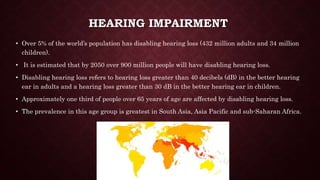
• Over 5% of the world’s population has disabling hearing loss (432 million adults and 34 million
children).
• It is estimated that by 2050 over 900 million people will have disabling hearing loss.
• Disabling hearing loss refers to hearing loss greater than 40 decibels (dB) in the better hearing
ear in adults and a hearing loss greater than 30 dB in the better hearing ear in children.
• Approximately one third of people over 65 years of age are affected by disabling hearing loss.
• The prevalence in this age group is greatest in South Asia, Asia Pacific and sub-Saharan Africa.
PHYSIOLOGY OF HEARING
TYPES OF HEARING LOSS
• Conductive deafness: due to defect in the conducting mechanism of the ear namely
external and middle ear.
• Sensori-neural deafness / Perceptive deafness: due to lesions in the labyrinth, 8th
nerve & central connections. It includes psychogenic deafness.
• Mixed deafness: both the above mentioned types are present.
• Central- Problem lies in the central nervous system
• External ear:
• Congenital atresia or stenosis
• Meatal obstruction: Foreign bodies, Wax, Infection, Keratosis obturans
• Neoplasms
• Middle ear:
• Congenital anomaly: Tympanic membrane, Ossicles, Oval/round windows
• Cholesteatoma
• Chronic Otitis media
• Otosclerosis
• Granulomatous disorders
• Trauma
• Neoplasia
CAUSES OF SENSORINEURAL HEARING LOSS
• Cochlea
• Congenital: Dysplasia, Perinatal hypoxia/infection, Syndromic
• Presbycusis
• Labyrinthitis / infection
• Vascular causes
• Trauma: direct ototoxicity
• Otosclerosis
• Ménière’s disease/endolymphatic hydrops
• Haematological disorders.
• Retrocochlea: Psychogenic, Meningitis
• Multiple sclerosis
• Neoplasia, e.g. acoustic neuroma
• Neurological disorders.
HISTORY
History of present illness
• Onset (sudden or gradual)
• Duration
• Unilateral/ bilateral
• Continuous / Intermittent
• Exposure- noise, drugs, viral illness
• History of ear or head trauma
• History of surgeries
• Associated symptoms- pain, discharge, tinnitus, vertigo
HISTORY
Past medical history
• Chronic illness: DM, HTN, Hypothyroidism
• Previous surgeries
• Rx: Ototoxic drugs
• Amino glycosides, diuretics, quinine, aspirin
• Social history:
• Occupation, Tobacco, Cocaine, Marijuana
PHYSICAL EXAMINATION
• General assessment
• Ear exam:
• Deformities of Pinna & EAC
• Pre & post-auricular region
• Otoscopy –
• external auditory canal
• Tympanic membrane
• Tuning Fork Test
• Rinne
• Weber test
• Cranial Nerves
INVESTIGATIONS
• Specific hearing tests
• Tuning Fork Tests
• Pure tone audiometry
• Impedance audiometry
• Brain stem evoked response audiometry
• Radiology
• CT & MRI of skull & temporal bones
• HEARING TESTS
• Subjective Tonic Fork test Pure tone audiometry (PTA)
• Objective Tympanometry (impedance audiometry) Electric response
audiometry (ERA).
• TUNING FORK TESTS
• Test: Weber Technique: Tuning Fork placed at midline forehead
• Normal: Sound radiates to both ears equally Abnormal: Sound lateralizes to one
ear Ipsilateral Conductive Hearing Loss OR Contralateral Sensorineural
Hearing Loss
• TUNING FORK TESTS
• Test: Rinne’s Technique First: Bone Conduction Vibrating Tuning Fork held
on Mastoid Patient covers opposite ear with hand Patient signals when sound
ceases
• Move the vibrating tuning fork over the ear canal Near, but not touching the ear
• Next: Air Conduction Patient indicates when the sound ceases
• TUNING FORK TESTS
• Test: Rinne’s Normal: Air Conduction is better than Bone Conduction Air
conduction usually persists twice as long as bone Referred to as "positive test"
• Abnormal: Bone conduction better than air conduction Suggests Conductive
Hearing Loss Referred to as "negative test"
• PURE TONE AUDIOMETRY (PTA
• PTA is the key hearing test used to identify hearing threshold level of an
individual, enabling determination of the degree, types and configuration of hearing
loss.
• Provides the basis for diagnosis and management. The symbols used on most
audiograms are: x - left, air conduction o - right, air conduction ] - left, bone
conduction [ - right, bone conduction
NORMAL AUDIOGRAM
CONDUCTIVE HEARING
LOSS
Conductive hearing
loss
Mixed hearing
loss
TYMPANOMETRY (IMPEDANCE
AUDIOMETRY)
• Assess the function of middle ear and Eustachian tube. Very useful when
screening for middle ear effusion.
• It is not a hearing test, but rather a measure of energy transmission through the
middle ear.
• It can also assess the integrity of stapedius reflux.
AUDITORY BRAINSTEM RESPONSE (ABR)
AUDIOMETRY
• An objective neurologic test of auditory brainstem function in response to auditory
(click) stimuli.
• Procedure: The stimulus either in the form of click or tone pip is transmitted to the
ear via a transducer placed in the insert ear phone or head phone. The wave froms
of impulses generated at the level of brain stem are recorded by the placement of
electrodes over the scalp.
AUDITORY BRAINSTEM RESPONSE (ABR)
AUDIOMETRY
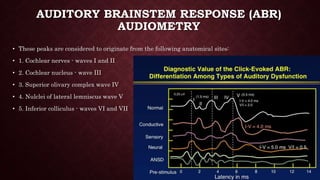
• These peaks are considered to originate from the following anatomical sites:
• 1. Cochlear nerves - waves I and II
• 2. Cochlear nucleus - wave III
• 3. Superior olivary complex wave IV
• 4. Nulclei of lateral lemniscus wave V
• 5. Inferior colliculus - waves VI and VII
→
MANGMENT
• Methods of rehabilitation
• I. Instrumental devices A. Hearing Aids - Conventional hearing aids - Bone
anchored hearing aids - Implantable hearing aids
• B. Implants - Cochlear implants - Auditory brainstem implants
• C. Assistive devices for the deaf
• II. Training A. Speech(lip) training B. Auditory training C. Speech conservation
CASE STUDY
Approach to deafness

Approach to deafness

  • 1.
  • 2.
    OUTLINE • Types ofhearing loss • Classification of hearing loss • Diagnosing and managing different kinds of hearing loss; e.g congenital hearing loss otosclerosis, presbyacusis, noise Induced Hearing Loss ,Meniers disease ,ototoxicity • Performing and interpreting various subjective and objective hearing tests • Tuning fork test • Pure Tone Audiometry • Impedance Audiometry • Brain Stem Evoked Response Audiometry
  • 3.
    HEARING IMPAIRMENT • Over5% of the world’s population has disabling hearing loss (432 million adults and 34 million children). • It is estimated that by 2050 over 900 million people will have disabling hearing loss. • Disabling hearing loss refers to hearing loss greater than 40 decibels (dB) in the better hearing ear in adults and a hearing loss greater than 30 dB in the better hearing ear in children. • Approximately one third of people over 65 years of age are affected by disabling hearing loss. • The prevalence in this age group is greatest in South Asia, Asia Pacific and sub-Saharan Africa.
  • 4.
  • 6.
    TYPES OF HEARINGLOSS • Conductive deafness: due to defect in the conducting mechanism of the ear namely external and middle ear. • Sensori-neural deafness / Perceptive deafness: due to lesions in the labyrinth, 8th nerve & central connections. It includes psychogenic deafness. • Mixed deafness: both the above mentioned types are present. • Central- Problem lies in the central nervous system
  • 8.
    • External ear: •Congenital atresia or stenosis • Meatal obstruction: Foreign bodies, Wax, Infection, Keratosis obturans • Neoplasms • Middle ear: • Congenital anomaly: Tympanic membrane, Ossicles, Oval/round windows • Cholesteatoma • Chronic Otitis media • Otosclerosis • Granulomatous disorders • Trauma • Neoplasia
  • 9.
    CAUSES OF SENSORINEURALHEARING LOSS • Cochlea • Congenital: Dysplasia, Perinatal hypoxia/infection, Syndromic • Presbycusis • Labyrinthitis / infection • Vascular causes • Trauma: direct ototoxicity • Otosclerosis • Ménière’s disease/endolymphatic hydrops • Haematological disorders. • Retrocochlea: Psychogenic, Meningitis • Multiple sclerosis • Neoplasia, e.g. acoustic neuroma • Neurological disorders.
  • 12.
    HISTORY History of presentillness • Onset (sudden or gradual) • Duration • Unilateral/ bilateral • Continuous / Intermittent • Exposure- noise, drugs, viral illness • History of ear or head trauma • History of surgeries • Associated symptoms- pain, discharge, tinnitus, vertigo
  • 13.
    HISTORY Past medical history •Chronic illness: DM, HTN, Hypothyroidism • Previous surgeries • Rx: Ototoxic drugs • Amino glycosides, diuretics, quinine, aspirin • Social history: • Occupation, Tobacco, Cocaine, Marijuana
  • 15.
    PHYSICAL EXAMINATION • Generalassessment • Ear exam: • Deformities of Pinna & EAC • Pre & post-auricular region • Otoscopy – • external auditory canal • Tympanic membrane • Tuning Fork Test • Rinne • Weber test • Cranial Nerves
  • 16.
    INVESTIGATIONS • Specific hearingtests • Tuning Fork Tests • Pure tone audiometry • Impedance audiometry • Brain stem evoked response audiometry • Radiology • CT & MRI of skull & temporal bones
  • 17.
    • HEARING TESTS •Subjective Tonic Fork test Pure tone audiometry (PTA) • Objective Tympanometry (impedance audiometry) Electric response audiometry (ERA).
  • 18.
    • TUNING FORKTESTS • Test: Weber Technique: Tuning Fork placed at midline forehead • Normal: Sound radiates to both ears equally Abnormal: Sound lateralizes to one ear Ipsilateral Conductive Hearing Loss OR Contralateral Sensorineural Hearing Loss
  • 19.
    • TUNING FORKTESTS • Test: Rinne’s Technique First: Bone Conduction Vibrating Tuning Fork held on Mastoid Patient covers opposite ear with hand Patient signals when sound ceases • Move the vibrating tuning fork over the ear canal Near, but not touching the ear • Next: Air Conduction Patient indicates when the sound ceases
  • 20.
    • TUNING FORKTESTS • Test: Rinne’s Normal: Air Conduction is better than Bone Conduction Air conduction usually persists twice as long as bone Referred to as "positive test" • Abnormal: Bone conduction better than air conduction Suggests Conductive Hearing Loss Referred to as "negative test"
  • 21.
    • PURE TONEAUDIOMETRY (PTA • PTA is the key hearing test used to identify hearing threshold level of an individual, enabling determination of the degree, types and configuration of hearing loss. • Provides the basis for diagnosis and management. The symbols used on most audiograms are: x - left, air conduction o - right, air conduction ] - left, bone conduction [ - right, bone conduction
  • 22.
  • 23.
  • 24.
  • 25.
  • 26.
    TYMPANOMETRY (IMPEDANCE AUDIOMETRY) • Assessthe function of middle ear and Eustachian tube. Very useful when screening for middle ear effusion. • It is not a hearing test, but rather a measure of energy transmission through the middle ear. • It can also assess the integrity of stapedius reflux.
  • 29.
    AUDITORY BRAINSTEM RESPONSE(ABR) AUDIOMETRY • An objective neurologic test of auditory brainstem function in response to auditory (click) stimuli. • Procedure: The stimulus either in the form of click or tone pip is transmitted to the ear via a transducer placed in the insert ear phone or head phone. The wave froms of impulses generated at the level of brain stem are recorded by the placement of electrodes over the scalp.
  • 30.
    AUDITORY BRAINSTEM RESPONSE(ABR) AUDIOMETRY • These peaks are considered to originate from the following anatomical sites: • 1. Cochlear nerves - waves I and II • 2. Cochlear nucleus - wave III • 3. Superior olivary complex wave IV • 4. Nulclei of lateral lemniscus wave V • 5. Inferior colliculus - waves VI and VII
  • 31.
  • 32.
    MANGMENT • Methods ofrehabilitation • I. Instrumental devices A. Hearing Aids - Conventional hearing aids - Bone anchored hearing aids - Implantable hearing aids • B. Implants - Cochlear implants - Auditory brainstem implants • C. Assistive devices for the deaf • II. Training A. Speech(lip) training B. Auditory training C. Speech conservation
  • 33.

Editor's Notes

  • #28 Operation[edit] A tone of 226 Hz is generated by the tympanometer into the ear canal, where the sound strikes the tympanic membrane, causing vibration of the middle ear, which in turn results in the conscious perception of hearing. Some of this sound is reflected back and picked up by the instrument. Most middle ear problems result in stiffening of the middle ear, which causes more of the sound to be reflected back. While 226 Hz is the most common probe tone, others can be used. In infants under 4 months of age, research has shown a 1000Hz tone yields more accurate results. Multi-frequency tympanometry is conducted at multiple frequencies between 250 and 2000 Hz and is used to help identify ossicular abnormalities. [2] Admittance is how energy is transmitted through the middle ear. The instrument measures the reflected sound and expresses it as an admittance or compliance, plotting the results on a chart known as a tympanogram. Normally, the air pressure in the ear canal is the same as ambient pressure. Also, under normal conditions, the air pressure in the middle ear is approximately the same as ambient pressure since the eustachian tube opens periodically to ventilate the middle ear and equalize pressure. In a healthy individual, the maximum sound is transmitted through the middle ear when the ambient air pressure in the ear canal is equal to the pressure in the middle ear.