NONBEHAVIORAL
ASSESSMENT MEASURES
IMMITANCE AUDIOMETRYIMMITANCE AUDIOMETRY
The Functions of
Immittance Audiometry
Detection of middle ear pathology
Differentiating cochlear from retrocochlear pathology
Estimate sensitivity of hearing loss
Cross referencable with pure tone results
The Role of Immittance Audiometry in
Detecting Middle Ear Disease
John T. Jacobson
Acoustic immitance
◦ Impedance:
◦ Resistance to the flow of acoustic energy
◦ Useful diagnostic tool to detect presence of
fluid in the middle ear, evaluate EU tube
function, help evaluate the facial nerve and
help predict audiometry
Admittance
◦ Ease of which acoustic energy flows
Immitance is a term derived from the terms for two inversely related
processes for assessing middle ear function
◦ Impedance
◦ Admittance
Compliance vs Impedance
Compliance
Ease with which
energy flows through a
system
Impedance
Resistance to energy
flow through a system
Advantages of Immittance
Audiometry
“Immittance is a physical characteristic of all mechanical vibratory
systems, of which the middle ear is one example”
Non-invasive
Non-behavioral
Instrumentation
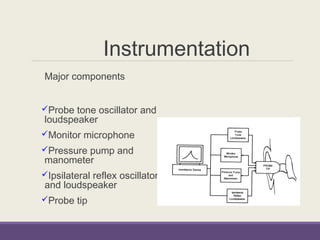
Major components
Probe tone oscillator and
loudspeaker
Monitor microphone
Pressure pump and
manometer
Ipsilateral reflex oscillator
and loudspeaker
Probe tip
Auditory Immittance
“ A way of assessing the manner in which energy flows through the
outer and middle ear into the cochlea”
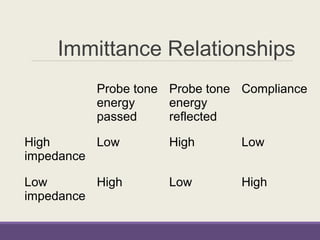
Immittance Relationships
Probe tone
energy
passed
Probe tone
energy
reflected
Compliance
High
impedance
Low High Low
Low
impedance
High Low High
Basic Immittance
Measures
Static compliance
Tympanometry
Acoustic Reflex Thresholds
Acoustic Reflex Threshold Decay
Static compliance
Measure of ear canal volume under two specific physical condition
200mH20 of positive air pressure is applied to ear canal and a volume is
read
Second volume reading occurs at a pressure value of maximum eardrum
compliance
Under normal mddle ear conditions, maximum eardrum compliance occurs
when atmospheric pressure is equal on both sides of TM (0mmH2O)
Two volumes are subrtracted from one another and remaining volume

represents the static compliance of the middle ear
Because wide variety of middle ear pathologies produce overlapping

compliance values, static compliance is least applicable measure of
immitance test battery.
Tympanometry
“A way of measuring how acoustic immittance of the middle ear
system changes as air pressure is varied in the external ear
canal”
Tympanometry
Yields information about
◦ Air pressure status of the middle ear
◦ Static acoustic immitance (establishing parameters of stiffness or flaccidity at
the ear drum)
◦ The integrity and mobility of the eardrum and ossicular chain
◦ Resonance point of the middle ear system
Tympanometry
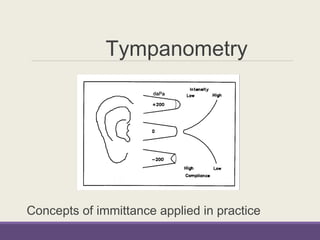
Concepts of immittance applied in practice
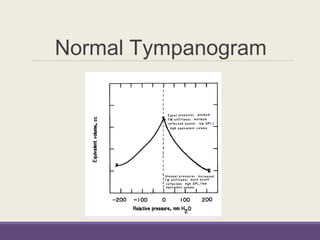
Normal Tympanogram
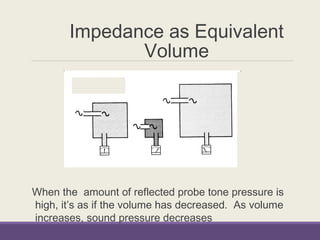
Impedance as Equivalent
Volume
When the amount of reflected probe tone pressure is
high, it’s as if the volume has decreased. As volume
increases, sound pressure decreases
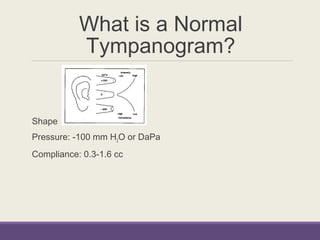
What is a Normal
Tympanogram?
Shape
Pressure: -100 mm H2O or DaPa
Compliance: 0.3-1.6 cc
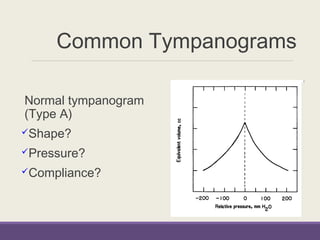
Common Tympanograms
Normal tympanogram
(Type A)
Shape?
Pressure?
Compliance?
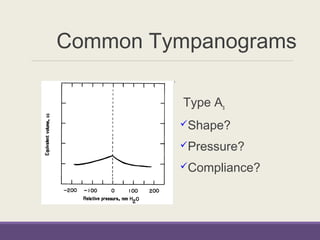
Common Tympanograms
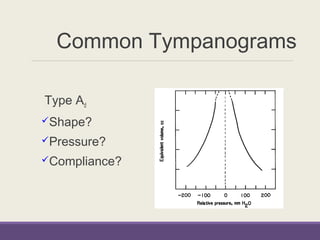
Type As
Shape?
Pressure?
Compliance?
Common Tympanograms
Type Ad
Shape?
Pressure?
Compliance?
Common Tympanograms
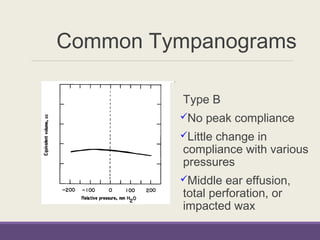
Type B
No peak compliance
Little change in
compliance with various
pressures
Middle ear effusion,
total perforation, or
impacted wax
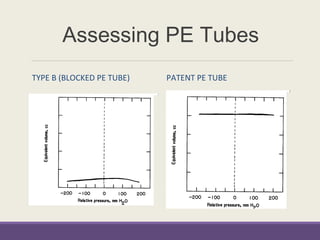
Assessing PE Tubes
TYPE B (BLOCKED PE TUBE) PATENT PE TUBE
Common Tympanograms
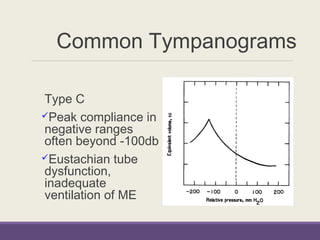
Type C
Peak compliance in
negative ranges
often beyond -100db
Eustachian tube
dysfunction,
inadequate
ventilation of ME
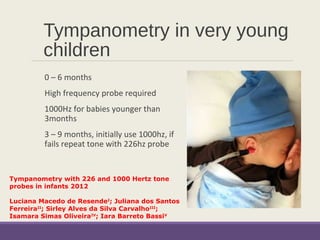
Tympanometry in very young
children
0 – 6 months
High frequency probe required
1000Hz for babies younger than
3months
3 – 9 months, initially use 1000hz, if
fails repeat tone with 226hz probe
Tympanometry with 226 and 1000 Hertz tone
probes in infants 2012
 
Luciana Macedo de ResendeI
; Juliana dos Santos
FerreiraII
; Sirley Alves da Silva CarvalhoIII
;
Isamara Simas OliveiraIV
; Iara Barreto BassiV
Basic Immittance
Measures
Tympanometry
Acoustic Reflex Thresholds
ASR
Defined as the lowest intensity required to elicit a stapedial muscle
contraction
Neural connection located in lower brainstem, with influences of higher
CNS structures on the reflex via the olivocochlear bundle
Afferent portion of the reflex is the ipsilateral eight nerve to cochlear
nuclei
Efferent limb is the facial nerve which innervates stapedial muscle
Contraction of the stapedial muscle tilts the anterior stapes away from
the oval window and stiffens the ossicular chain and results in
increased impedence, which is measured as small decrease in
compliance by the ear canal probe
ASR
3 primary acoustic reflexes characteristics commonly evaluated
◦ 1. presence or absence of the stapedial reflex
◦ 2.acoustic reflex threshold
◦ 3 acoustic reflex decay or adaptation
The time delay of acoustic reflex is thought to be 10ms
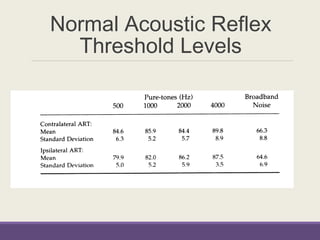
Acoustic reflex thresholds for tones in patients with normal hearing are usually
70 to 80 db above their tone thresholds and about 5db greater for the
contralateral threshold
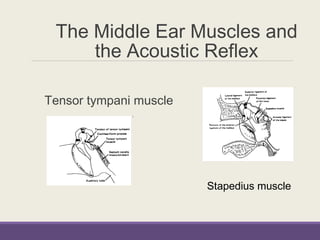
The Middle Ear Muscles and
the Acoustic Reflex
Tensor tympani muscle
Stapedius muscle
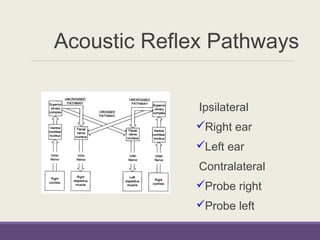
Acoustic Reflex Pathways
Ipsilateral
Right ear
Left ear
Contralateral
Probe right
Probe left
Acoustic Reflex Threshold
“the lowest intensity at which a middle ear immittance change can
be detected in response to sound”
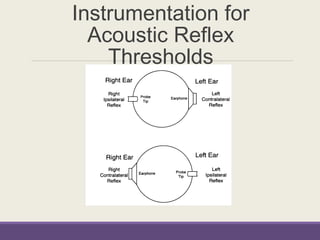
Instrumentation for
Acoustic Reflex
Thresholds
Normal Acoustic Reflex
Threshold Levels
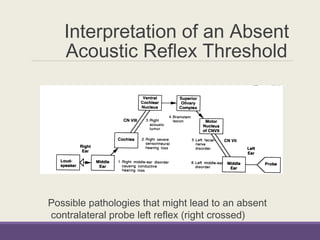
Interpretation of an Absent
Acoustic Reflex Threshold
Possible pathologies that might lead to an absent
contralateral probe left reflex (right crossed)
CN VIII lesions
Demonstrate absent acoustic reflex when stimuli presented to affected
ear
Acoustic reflexes differ from cnVIII lesion versus cochlear lesion
◦ cnVIII refles will be absent or abnormal regardless of degree of hearing loss
◦ Cochlear lesion usually dependent on degree of hearing loss
Abnormal reflexes also recorded when stapedial muscle function is altered by
myopathic disease such as Myasthenia Gravis and Eaton – Lambert
syndrome or hyperthyroidism
Basic Immittance
Measures
Tympanometry
Acoustic Reflex Thresholds
Acoustic Reflex Threshold Decay
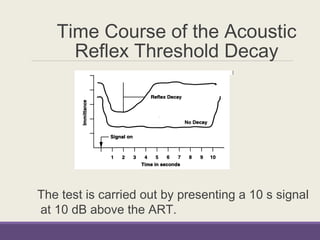
Time Course of the Acoustic
Reflex Threshold Decay
The test is carried out by presenting a 10 s signal
at 10 dB above the ART.
Thank you.
Immittance audiometry

Immittance audiometry

  • 1.
  • 2.
    The Functions of ImmittanceAudiometry Detection of middle ear pathology Differentiating cochlear from retrocochlear pathology Estimate sensitivity of hearing loss Cross referencable with pure tone results The Role of Immittance Audiometry in Detecting Middle Ear Disease John T. Jacobson
  • 3.
    Acoustic immitance ◦ Impedance: ◦Resistance to the flow of acoustic energy ◦ Useful diagnostic tool to detect presence of fluid in the middle ear, evaluate EU tube function, help evaluate the facial nerve and help predict audiometry Admittance ◦ Ease of which acoustic energy flows Immitance is a term derived from the terms for two inversely related processes for assessing middle ear function ◦ Impedance ◦ Admittance
  • 4.
    Compliance vs Impedance Compliance Easewith which energy flows through a system Impedance Resistance to energy flow through a system
  • 5.
    Advantages of Immittance Audiometry “Immittanceis a physical characteristic of all mechanical vibratory systems, of which the middle ear is one example” Non-invasive Non-behavioral
  • 6.
    Instrumentation Major components Probe toneoscillator and loudspeaker Monitor microphone Pressure pump and manometer Ipsilateral reflex oscillator and loudspeaker Probe tip
  • 7.
    Auditory Immittance “ Away of assessing the manner in which energy flows through the outer and middle ear into the cochlea”
  • 8.
    Immittance Relationships Probe tone energy passed Probetone energy reflected Compliance High impedance Low High Low Low impedance High Low High
  • 9.
    Basic Immittance Measures Static compliance Tympanometry AcousticReflex Thresholds Acoustic Reflex Threshold Decay
  • 10.
    Static compliance Measure ofear canal volume under two specific physical condition 200mH20 of positive air pressure is applied to ear canal and a volume is read Second volume reading occurs at a pressure value of maximum eardrum compliance Under normal mddle ear conditions, maximum eardrum compliance occurs when atmospheric pressure is equal on both sides of TM (0mmH2O) Two volumes are subrtracted from one another and remaining volume represents the static compliance of the middle ear Because wide variety of middle ear pathologies produce overlapping compliance values, static compliance is least applicable measure of immitance test battery.
  • 11.
    Tympanometry “A way ofmeasuring how acoustic immittance of the middle ear system changes as air pressure is varied in the external ear canal”
  • 12.
    Tympanometry Yields information about ◦Air pressure status of the middle ear ◦ Static acoustic immitance (establishing parameters of stiffness or flaccidity at the ear drum) ◦ The integrity and mobility of the eardrum and ossicular chain ◦ Resonance point of the middle ear system
  • 13.
  • 14.
  • 15.
    Impedance as Equivalent Volume Whenthe amount of reflected probe tone pressure is high, it’s as if the volume has decreased. As volume increases, sound pressure decreases
  • 16.
    What is aNormal Tympanogram? Shape Pressure: -100 mm H2O or DaPa Compliance: 0.3-1.6 cc
  • 17.
    Common Tympanograms Normal tympanogram (TypeA) Shape? Pressure? Compliance?
  • 18.
  • 19.
  • 20.
    Common Tympanograms Type B Nopeak compliance Little change in compliance with various pressures Middle ear effusion, total perforation, or impacted wax
  • 21.
    Assessing PE Tubes TYPEB (BLOCKED PE TUBE) PATENT PE TUBE
  • 22.
    Common Tympanograms Type C Peakcompliance in negative ranges often beyond -100db Eustachian tube dysfunction, inadequate ventilation of ME
  • 23.
    Tympanometry in veryyoung children 0 – 6 months High frequency probe required 1000Hz for babies younger than 3months 3 – 9 months, initially use 1000hz, if fails repeat tone with 226hz probe Tympanometry with 226 and 1000 Hertz tone probes in infants 2012   Luciana Macedo de ResendeI ; Juliana dos Santos FerreiraII ; Sirley Alves da Silva CarvalhoIII ; Isamara Simas OliveiraIV ; Iara Barreto BassiV
  • 24.
  • 25.
    ASR Defined as thelowest intensity required to elicit a stapedial muscle contraction Neural connection located in lower brainstem, with influences of higher CNS structures on the reflex via the olivocochlear bundle Afferent portion of the reflex is the ipsilateral eight nerve to cochlear nuclei Efferent limb is the facial nerve which innervates stapedial muscle Contraction of the stapedial muscle tilts the anterior stapes away from the oval window and stiffens the ossicular chain and results in increased impedence, which is measured as small decrease in compliance by the ear canal probe
  • 26.
    ASR 3 primary acousticreflexes characteristics commonly evaluated ◦ 1. presence or absence of the stapedial reflex ◦ 2.acoustic reflex threshold ◦ 3 acoustic reflex decay or adaptation The time delay of acoustic reflex is thought to be 10ms Acoustic reflex thresholds for tones in patients with normal hearing are usually 70 to 80 db above their tone thresholds and about 5db greater for the contralateral threshold
  • 27.
    The Middle EarMuscles and the Acoustic Reflex Tensor tympani muscle Stapedius muscle
  • 28.
    Acoustic Reflex Pathways Ipsilateral Rightear Left ear Contralateral Probe right Probe left
  • 29.
    Acoustic Reflex Threshold “thelowest intensity at which a middle ear immittance change can be detected in response to sound”
  • 30.
  • 31.
  • 32.
    Interpretation of anAbsent Acoustic Reflex Threshold Possible pathologies that might lead to an absent contralateral probe left reflex (right crossed)
  • 33.
    CN VIII lesions Demonstrateabsent acoustic reflex when stimuli presented to affected ear Acoustic reflexes differ from cnVIII lesion versus cochlear lesion ◦ cnVIII refles will be absent or abnormal regardless of degree of hearing loss ◦ Cochlear lesion usually dependent on degree of hearing loss Abnormal reflexes also recorded when stapedial muscle function is altered by myopathic disease such as Myasthenia Gravis and Eaton – Lambert syndrome or hyperthyroidism
  • 34.
    Basic Immittance Measures Tympanometry Acoustic ReflexThresholds Acoustic Reflex Threshold Decay
  • 35.
    Time Course ofthe Acoustic Reflex Threshold Decay The test is carried out by presenting a 10 s signal at 10 dB above the ART.
  • 36.

Editor's Notes

  • #4 Impedance properties of the middle ear are the result of complex interaction between the ossicular chain, the intra aural muscles and ligaments and atmospheric comdition within the middle ear space, all of which are reflected by the TM
  • #12 Dynamic in nature, measuring compliance while introducing air pressure change in the external ear canal Tympanometry reflects the mobility (compliance ) of tympanic membrane when air pressure is varied from 200 to -400dPa within the ear canal Tympanometry may be considered analogous to pneumatic otoscopy, but with far greater precision
  • #14 Tympanometry yields infor Volume of ear canal ranges from 0.5 to 1ml for children
  • #15 Type A. peak compliance between 0 and -100dpa, and within a normal range of compliance
  • #17 Volume of calan ranges from 0.5 to 1mls for children and 0.6 to 2.0 for adults Peak compliance between 0 and -100dpa, and within normal range of compliance
  • #18 Peaks that are located within the normal pressure range may be overly compliant Ad with atrophic tympanic membrane or As with ossicular chain fixation or tympanosclerosis
  • #19 As with ossicular chain fixation or tympanosclerosis
  • #20 Ad with atrophic tympanic membrane
  • #22 Volumes more than 1.0 for children and 2.0mls for adults may suggest tympanic membrane perforation or presence of patent ventilation tubes
  • #23 Type C is often a precursor to type B as development of negative pressure precedes the presence of effusion
  • #24  there may be a normal tympanometric curve when the 226 Hz probe is used, even in the presence of an air conduction component, which means that the tests carried out with this probe tone have a high rate of false-negative results.  Kiel et al, carvello et al,
  • #26 In a normal ear void of middle ear pathology the reflex occurs at approximately 80 -90 db HTL
  • #27 Even normal individuals may exhibit decay at higher frequencies, therefore lower frequency, 500 to 1000 Hz tones are used If response decreases to less than half within 5 seconds retrocochlear pathology may be suspected
  • #28 Acoustic reflex in ears with cochlear disorders is determined primarily by the degree of snhl. If auditory thresholds are below 50 – 55 db, reflex thresholds are normal If auditory threshold are between 55 – 80 db, the reflex thresholds are elevated in proportion to auditory thresholds If losses greater than 80 db acoustic reflexes absent
  • #30 Acoustic reflex in ears with cochlear disorders is determined primarily by the degree of snhl. If auditory thresholds are below 50 – 55 db, reflex thresholds are normal If auditory threshold are between 55 – 80 db, the reflex thresholds are elevated in proportion to auditory thresholds If losses greater than 80 db acoustic reflexes absent
  • #32 Normal acoustic reflex thresholds for broadband noise are approximately 20 – 25 db lower than reflex threshold for tones Clinically important in evaluation of malingerers because it is not physiologically possible for the paritentto truly have behavioural thresholds that are higher or worse than acoustic reflex thresholds for tones In patients with SNHL the difference between the broadband and tone thresholds is decreased inversely to that amount of hearing loss (degree of snhl in db increases, the diff in ac reflex thresholds for tones and noise decreases)
  • #33 Efferent limb of reflex is absent in ossicular chain disorders, such as otosclerosis and discontinuity and facial nerve pathology In vii paralysis, the acoustic reflex is absent or abn even when the probe is placed in ear ipsilateral to the lesion Asr can also be helpful in locating cnvii lesion either proximal to or distal to stapedeal muscle
  • #36 Acoustic reflex decay measures the ability of stapedial muscle to maintain sustained contraction, usually by presenting a signal 10db above the reflex threshold for 10s Rapid decay found in cnVIII lesions